
GE RG6 Coaxial Cable
4.7Editor score
Quad-shielded 50-foot cable
Gold-plated compression connectors
Flame-retardant in-wall construction
Compare the 10 best coaxial cable for antenna options, comparing shielding, length, connectors, weather resistance, signal range, and installation.
Choosing coaxial cable for an antenna involves more than matching a connector and estimating a cable length. Signal loss, shielding, conductor size, weather resistance, and installation method all influence how reliably an over-the-air television or radio antenna delivers a stable picture.
This guide compares ten coaxial cables using the specifications and construction details supplied for each product. It covers RG6 television cables, a longer shielded run, practical installation accessories, and one specialized RG8X option for 50-ohm radio systems.
Each review identifies the configuration that makes the cable most useful, from a convenient 10-foot indoor connection to a 100-foot outdoor run. Ratings and product details are included for quick comparison, while current prices and availability should be confirmed before purchase.
4.7Editor score

4.7Editor score

4.6Editor score
The comparison below highlights each cable's principal strength, from triple and quad shielding to weather-sealed connectors, conductor construction, supported applications, and installation flexibility.


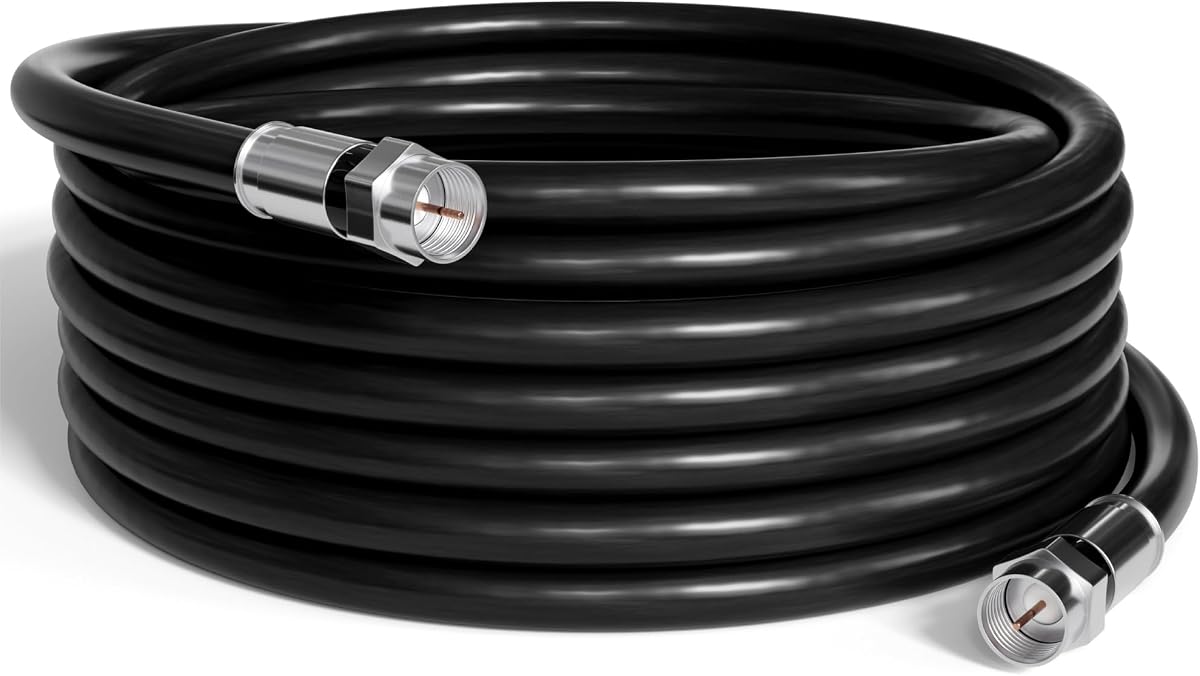

The G-PLUG 50FT RG6 Coaxial Cable Extender combines a 4.7 rating with construction designed for both television antenna work and conventional home connectivity. Its 75-ohm RG6 format, triple shielding, and pre-installed compression connectors make it a practical general-purpose cable for anyone extending an antenna farther from the receiver.
We may earn a commission when you buy through this link, at no additional cost to you.
Shielding is a central benefit because television antennas can operate near consumer electronics, Wi-Fi equipment, and other sources of electromagnetic or radio-frequency interference. This cable uses foil and braided shielding to preserve signal integrity, while the corrosion-resistant F-type connectors create firm connections without requiring separate termination work. The rubber-sealed connector design and durable PVC jacket also suit outdoor television, satellite, and internet connections.
The included F81 female-to-female coupler provides a way to join compatible RG6 cables when one 50-foot run is insufficient. That makes the package useful for a staged installation, although extending a signal through additional cable and coupling points can add loss. Buyers should still account for the total cable length, the number of connections, and the quality of the antenna and receiver rather than assuming the coupler is completely transparent.
This is a strong all-around recommendation for households connecting an outdoor HDTV antenna, a satellite service, or a cable internet device. It is especially appealing to installers who want weather protection, substantial shielding, and a supplied coupler in one package. For a shorter indoor connection, a more compact cable may be easier to manage, but for a full-length outdoor run this G-PLUG model combines the most useful features in the group.
Triple shielding helps reject interference that could appear as pixelation, freezing, or unstable reception. The 75-ohm RG6 design also provides a better foundation for broadband television signals than an unshielded or loosely constructed lead.
Pre-installed compression fittings simplify setup, while the F81 coupler allows compatible runs to be combined. Keep the total signal path as short and direct as practical to preserve signal quality.
We may earn a commission when you buy through this link, at no additional cost to you.
The energeaster 50FT RG6 Coaxial Cable earns a 4.7 rating and stands out for a clear combination of triple-layer shielding, modern signal support, and sealed fittings. It is presented for a broad range of antenna and home-entertainment applications, including caravan television, cable television, satellite reception, and broadband connections.
We may earn a commission when you buy through this link, at no additional cost to you.
The shielding system combines foil, braid, and another foil layer to reduce RFI and EMI interference. That layered approach is useful in homes where the antenna lead must pass near routers, televisions, power equipment, or other electronics. The 75-ohm cable is also described as supporting 4K HDR video, Dolby Digital audio, and high-speed internet connections, making it a versatile choice for a modern television setup.
Compression F-type connectors include rubber O-rings intended to block moisture, dust, and corrosion. The secure connector design and vibration-resistant fit also make the cable more appropriate for an installation that may be moved occasionally, such as a caravan setup. A pre-attached female-to-female coupler extends the range, although buyers should minimize added connector points when signal integrity is critical.
This cable is a strong choice for an outdoor or semi-outdoor television antenna that requires substantial interference protection. It is less convenient for a basic indoor connection where a 50-foot lead would be unnecessarily difficult to route. Within longer installations, however, its shielding, connector seals, and broad compatibility create a balanced and adaptable package.
Foil, braid, and foil shielding offer a broad defense against electromagnetic and radio-frequency noise. This makes the cable appropriate for installations where reception quality may be affected by nearby household electronics.
O-ring-equipped compression fittings help preserve a secure, moisture-resistant connection. Route the cable carefully and avoid pinching it to protect both the jacket and internal conductor.
We may earn a commission when you buy through this link, at no additional cost to you.
The Nixsto RG6 Coaxial Cable is the list's most flexible choice regarding available length, with options ranging from short 1.5-foot leads to 100 feet. Its 4.7 rating and stated compatibility with digital antennas, HDTVs, set-top boxes, modems, splitters, satellite receivers, and other coax equipment make it a practical option for a wide range of installations.
We may earn a commission when you buy through this link, at no additional cost to you.
The conductor is described as 75-ohm copper-plated wire, while the F-connectors are gold-plated and fitted with O-ring seals. The round black PVC jacket is described as water-resistant, and the overall construction is intended to resist tangling while being routed around furniture, entertainment centers, or wall-mounted equipment. The included brass female-to-female extender can help installers combine compatible leads.
Length selection is the feature that most distinguishes this product. A short lead can be cleaner behind a television, while the longer options suit outdoor antennas, basement arrangements, satellite dishes, and coastal installations. The trade-off is that buyers must select the right length at purchase, and every additional junction introduces another point where connectors can loosen, collect moisture, or add signal loss.
Nixsto is a strong recommendation for anyone who wants one cable family to cover several antenna projects. It offers a practical balance of shielding-related connector protection, flexible routing, and a wide selection of lengths. Buyers should measure the actual antenna-to-receiver path and allow a manageable amount of service slack without creating an unnecessarily long signal run.
The broad selection of lengths helps prevent excess cable from being bunched behind equipment. A precise length also makes outdoor routing and temporary antenna placement easier to manage.
Gold-plated contacts and built-in O-ring seals support stable connections in damp conditions. The water-resistant jacket is also suitable for antennas installed in basements, near exterior walls, or in other semi-exposed locations.
We may earn a commission when you buy through this link, at no additional cost to you.
The 50ft RG6 Coaxial Cable combines a 4.7 rating with an unusually complete set of installation accessories. Its package includes an F81 female coupler, a right-angle F adapter, cable clips, and cable ties, making it easier to organize a complete antenna run rather than source separate pieces.
We may earn a commission when you buy through this link, at no additional cost to you.
The cable is triple-shielded 18AWG RG6 with foil and braid shielding to reduce EMI and RFI interference. It is described as supporting signal transmission up to 3GHz and is compatible with television antennas, CATV, DirecTV, cable modems, broadband routers, satellite receivers, and cable boxes. That broad device support makes it useful for a household with several types of coax equipment.
Weather protection extends to the pre-installed waterproof boot connectors, internal waterproofing, corrosion-resistant threaded fittings, and a UV-resistant, wall-rated PVC jacket. These features are particularly relevant when an antenna lead travels along exterior walls, through a basement, or between an outdoor antenna and an indoor receiver. The included right-angle adapter can also simplify connections where space near a television is limited.
This is an excellent choice for installers who want the cable, basic extenders, and routing hardware in one package. Its main drawback is that the extra accessories may not be needed for every setup, and a shorter cable would be easier to conceal for a nearby indoor antenna. For a substantial outdoor or routed installation, however, the complete kit makes setup more convenient.
Cable clips and ties help secure a long run without leaving it loose, while the right-angle adapter offers a practical option in confined spaces. These additions can reduce clutter around the receiver and wall.
Waterproof boots, internal sealing, and a UV-resistant jacket support dependable use in exposed locations. Weather protection is especially important at connectors, where moisture can cause corrosion or intermittent contact.
We may earn a commission when you buy through this link, at no additional cost to you.
The 10FT RG6 Coaxial Cable is designed for a simpler and more compact antenna connection. It has a 4.7 rating, an 18AWG conductor, 75-ohm impedance, and a stated frequency range from 2.3MHz to 3.0GHz, covering many television, modem, air antenna, and satellite applications.
We may earn a commission when you buy through this link, at no additional cost to you.
Its shielding combines 60% braided aluminum with 100% aluminum foil to reduce electromagnetic and radio-frequency interference. The moisture-resistant outer layer is described as suitable for both indoor walls and outdoor antenna extensions, although the 10-foot length limits its usefulness for most permanent exterior runs. It is best suited to an indoor antenna positioned near a television or a short extension around a window or wall.
The jacket is also described as capable of withstanding sunlight and harsh conditions. That makes the cable more versatile than a lightweight indoor-only lead, although proper connector protection and careful routing remain important. Its compact length is a major practical advantage because it avoids a large coil of excess cable behind furniture or an entertainment center.
Buyers should choose this model for a nearby antenna, temporary placement, or short indoor run where preserving signal quality without an unwieldy cable matters most. It is not the best selection for reaching an elevated outdoor antenna, but for a ten-foot path it provides modern signal capacity, solid construction, and easier cable management in a compact package.
A ten-foot lead is easier to conceal and less likely to create an awkward loop. It is a sensible match for indoor antennas, media cabinets, and tabletop televisions.
The stated frequency range supports television sets, modems, air antennas, satellite dishes, and various data services. Matching the cable to the actual equipment and connector type remains the key requirement.
We may earn a commission when you buy through this link, at no additional cost to you.
The GE 33600 RG6 Coaxial Cable is a practical option for antenna users who value simplicity over a long list of specialized features. It carries a 4.6 rating and its most compelling advantages are immediate usability, 50 feet of cable, and screw-on F-type connectors that do not require tools.
We may earn a commission when you buy through this link, at no additional cost to you.
Because the connectors are already fitted, installation is largely a matter of routing the cable and attaching it to compatible antenna and television equipment. The ready-to-use format avoids the need to strip the cable, attach compression fittings, or purchase separate tools. This makes the product approachable for a first-time antenna setup, a repositioned indoor antenna, or a straightforward household extension.
The supplied information is less detailed about the internal shielding and conductor construction than it is for several competing products. As a result, buyers prioritizing a visibly specified triple- or quad-shield configuration may find another option more transparent for comparison. The fifty-foot length is generous for many antenna routes, but it can also create excess slack when the antenna and television are close together.
This cable is best for users who want a dependable-looking, uncomplicated coax lead without handling cable termination themselves. It is also useful as a general-purpose television and antenna cable rather than a specialized outdoor installation. Buyers should verify connector compatibility, avoid tightly bending the cable, and keep the signal path as direct as practical.
Pre-attached screw-on connectors make the cable approachable for beginners and quick replacements. A simple, secure attachment is often more valuable than extra installation hardware.
Fifty feet provides room for common indoor routes and many moderately sized outdoor installations. Coil excess cable loosely rather than bending it sharply at the television or wall.
We may earn a commission when you buy through this link, at no additional cost to you.
The GE RG6 Coaxial Cable is the premium choice in this group because it combines quad shielding, gold-plated compression connectors, and flame-retardant construction suitable for long-term in-wall installations. Its 4.7 rating and 50-foot length make it a high-performance option for a television antenna, cable modem, satellite connection, or other coax-equipped device.
We may earn a commission when you buy through this link, at no additional cost to you.
Quad shielding gives this cable the strongest specified shielding architecture in the comparison. A solid core conductor and maximum shielding are intended to protect against interference and support transfer speeds up to 3GHz. This can be particularly useful where the antenna cable passes close to electrical wiring, communications equipment, or other potential sources of noise.
The gold-plated compression connectors are designed to resist corrosion and provide a convenient screw-on connection without tools. The cable is also flame-retardant, making it suitable for in-wall video surveillance, security, internet, and home-theater installations. As a premium option, it may be overkill for a short cable path between an indoor antenna and a nearby television, where the simpler construction of a basic lead could be sufficient.
This is the recommendation for buyers who want maximum shielding, dependable connectors, and installation flexibility within a 50-foot cable. It is particularly compelling for an outdoor-to-indoor antenna run or a protected wall installation. Those who only need a temporary short connection can save complexity by choosing a shorter RG6 cable, but for a long or electrically busy route, the quad-shielded design is the stronger choice.
Multiple shielding layers provide a stronger barrier against interference than a single-layer cable. This is valuable when the antenna is distant from the television or the route passes through an area with nearby electronics.
The flame-retardant jacket and corrosion-resistant compression connectors suit protected in-wall routing. Ensure the path complies with local electrical and building requirements before installation.
We may earn a commission when you buy through this link, at no additional cost to you.
The RG8x Coaxial Cable is included because it represents a distinct antenna application: 50-ohm radio systems rather than 75-ohm television connections. It has a 4.6 rating, a 50-foot length, and PL259 male-to-male connectors, making it suitable for compatible CB, ham radio, antenna analyzers, tuners, dummy loads, SWR meters, and transceivers.
We may earn a commission when you buy through this link, at no additional cost to you.
The cable uses a 17AWG pure copper center conductor, which is thicker than the 18AWG conductor described for many of the television RG6 options. Double shielding is intended to prevent signal leakage and interference, while the nickel-plated brass PL259 connectors have gold-plated center pins. The stated supported frequency range is up to 300MHz, which aligns with its intended UHF radio use.
A strong and flexible PVC jacket supports indoor or outdoor routing, and the molded connectors are designed for repeated use in radio installations. The larger RG8X construction is also positioned as more durable and lower loss than RG58, making it appropriate for high-powered applications. It should not be selected for a standard television antenna without the appropriate connector and impedance adaptation.
This product is the right recommendation for a CB or ham radio operator, or for anyone connecting a 50-ohm antenna analyzer to compatible equipment. It is not a substitute for an F-type RG6 cable in a typical rooftop television installation. The key buying consideration is connector and system compatibility rather than simply choosing the longest or most heavily shielded cable available.
The 17AWG pure copper core and RG8X construction are designed to reduce loss in 50-ohm radio applications. The larger conductor distinguishes this cable from the thinner RG6 models used primarily for television.
PL259 fittings are suited to the listed radio equipment and will not directly fit standard RG6 F-type antenna connections. Confirm the antenna, radio, and accessory connector requirements before buying.
We may earn a commission when you buy through this link, at no additional cost to you.
The CIMPLE CO RG6 100 FT is the long-run television cable in this comparison. Its 4.7 rating, 100-foot length, and low-loss RG6 design make it relevant when the antenna is substantially farther from the television, receiver, or modem than a standard 50-foot lead can cover.
We may earn a commission when you buy through this link, at no additional cost to you.
The 75-ohm cable is described as swept to 3.0GHz and capable of handling frequencies down to 2.3MHz. A solid 18AWG center conductor supports high-speed digital and analog signals, while aluminum braiding and additional shielding are intended to reduce interference. Compatibility includes HD antennas, FTA and OTA antennas, televisions, cable modems, satellite receivers, radios, and CATV systems.
Double O-ring compression connectors and a PVC outer jacket allow the cable to be used indoors or outdoors. Precision-machined weathertight fittings help protect vulnerable connection points. The main concern with a 100-foot run is not its listed capability but installation quality: the cable should be routed without sharp bends, crushing, or unnecessary splits.
This is a strong recommendation for a long rooftop antenna run, a detached antenna location, or a connection that must cross an attic, basement, or exterior wall. It offers more reach than the 50-foot alternatives without moving into the specialized 50-ohm radio cable category. Buyers should measure the route carefully and use appropriate mounting or clips so the cable is supported along its full length.
One hundred feet reduces the need for inline couplers, which is beneficial because every added connection can contribute loss. It is a practical length for detached antennas and long exterior routes.
The weather-capable jacket and double O-ring fittings support indoor-to-outdoor routing. Seal appropriate entry points and avoid exposed moisture accumulation around connectors for dependable performance.
We may earn a commission when you buy through this link, at no additional cost to you.
The CIMPLE CO RG6 50 FT is built around dependable outdoor antenna connections. It has a 4.7 rating, a 50-foot length, a 75-ohm impedance, and connector protection that includes weather stabilization, UV coating, rubber boots, and double O-ring compression seals.
We may earn a commission when you buy through this link, at no additional cost to you.
Its 18AWG solid center conductor and layered aluminum shielding are designed to carry clear signals over long-distance runs. The cable is described as swept to 3.0GHz and compatible with digital and analog signals, as well as HD antennas, free-to-air antennas, off-air antennas, televisions, satellite receivers, radios, cable modems, and CATV systems.
The outdoor-focused connector treatment makes this model particularly attractive when the cable passes from an exterior antenna into an interior receiver. The PVC outer jacket and weather-booted ends help protect against environmental exposure, although a proper installation still needs secure routing and appropriate sealing at wall or roof entry points. As with any coax cable, sharply bending it near a connector or crushing it under roofing material can impair performance.
This is a well-balanced choice for a 50-foot outdoor television antenna run, especially for households connecting HD, FTA, or OTA equipment. It combines clear frequency support with a robust connector system and broad device compatibility. It is less suitable than the 100-foot model for unusually distant antennas, but it is easier to manage and often better suited to a common residential installation.
Weather-booted ends and double O-ring compression fittings help keep moisture away from the connection. These features are especially valuable where the antenna cable is exposed to rain, humidity, or temperature changes.
The cable supports HD, FTA, OTA, satellite, television, radio, CATV, and modem applications. Its stated 3.0GHz sweep supports modern high-frequency television signal requirements.
We may earn a commission when you buy through this link, at no additional cost to you.
The right antenna cable depends on the antenna type, signal frequency, route length, environment, and connector style. These factors help distinguish a basic indoor RG6 lead from a weather-sealed outdoor run or a specialized radio cable.
Most over-the-air television antennas use 75-ohm RG6 coax with F-type connectors. RG6 is also common for cable television, satellite, broadband modems, and routers. By contrast, the RG8X option reviewed here is a 50-ohm cable with PL259 connectors for CB and ham radio systems. Buying a television cable for a radio installation, or a radio cable for an F-type television antenna, can create connector and impedance incompatibility rather than simply producing a weaker signal.
Measure from the antenna feed point to the television, tuner, or receiver, and include the height and routing of the cable. A straight 50-foot run may need extra length for bends, service loops, wall routing, and attachment points. A 100-foot cable can remove the need for a coupler, but extra length is not free: longer runs and additional connections can increase attenuation. Choose a length that reaches comfortably without creating a large coil of slack.
Shielding helps reject electromagnetic and radio-frequency interference that can disrupt television or radio reception. Triple-shielded RG6 cables combine multiple foil and braid layers, while the quad-shielded GE model adds another layer of protection. The reviewed 10-foot and 100-foot models use dual shielding. In a clean indoor location, basic shielding may be sufficient, but cables running near power wiring, routers, motors, or heavy electronics benefit from stronger shielding.
F-type connectors are standard for television antenna installations, but the fitting style still matters. Compression connectors and screw-on fittings should attach firmly without damaging the connector or cable jacket. Corrosion-resistant contacts and weather-sealed boots add protection where moisture is present. Ensure the antenna and receiver accept F-type connectors, and avoid forcing a mismatched PL259 or other fitting into an incompatible port.
An outdoor cable needs a weather-resistant jacket, sealed connector ends, and careful protection at building entry points. Products with rubber O-rings, waterproof boots, UV coatings, or corrosion-resistant fittings are better suited to exposed runs. Weather protection does not eliminate the need to prevent water from collecting at a downward-facing connector or from entering through an unfinished wall opening.
An 18AWG solid conductor is specified in several reviewed RG6 products and is appropriate for high-frequency television and broadband signals. A cable swept to 3.0GHz is designed to cover modern digital television and high-speed data applications. The 75-ohm RG8x radio cable uses a thicker 17AWG pure copper conductor and a different impedance. Match the cable's frequency range and conductor construction to the equipment rather than judging it only by outside diameter.
The best cable is one that can be routed without sharp bends, crushing, or tension. Long runs should be supported with appropriate clips, ties, or other mounting hardware and kept away from power cables where practical. The 50ft RG6 package includes clips and ties, while other products include a coupler or right-angle adapter for routing. These accessories are useful, but they should complement sound planning rather than compensate for a needlessly long or poorly supported cable.
Female-to-female couplers can extend a run when a single cable is not long enough, but each connector introduces another interface that can loosen, corrode, or add loss. Where practical, use one correctly sized cable. When a coupler is necessary, make sure it matches the cable's impedance and connector type, tighten it securely, and protect it from moisture. Signal quality problems should be investigated at the antenna, connections, and receiver rather than assumed to result from the cable alone.
Begin by confirming that the antenna, television, tuner, or receiver uses compatible F-type connections, or select the correct connector and impedance for a radio system. Connect the cable to the antenna first, observing the manufacturer's orientation instructions, and then attach the other end to the receiver. Route the cable away from sharp edges, moving parts, heat sources, and direct contact with power wiring. Avoid twisting or sharply folding the coax at either connector.
For an outdoor installation, position the antenna where it can receive the clearest available signal and keep the cable supported along its route. Use weather-resistant clips, straps, or appropriate mounting hardware rather than leaving a long span hanging. Protect any entry point into the home with a suitable exterior sealant, and ensure connectors are not positioned where water can pool. Periodically inspect exposed sections for cracking, loose fittings, damaged jackets, or animal interference.
For indoor connections, leave a small amount of slack near the television so the connector does not carry the weight of the cable. Route excess length in a broad loop rather than a tight coil, and keep the cable away from heating vents and crowded power strips. If reception changes unexpectedly, check the antenna connections and television settings first, then inspect the coax run for damage, kinks, or a poorly tightened coupler.
A 75-ohm RG6 coax cable with F-type connectors is the standard choice for most over-the-air television antennas. Choose a length that reaches the receiver without excessive slack, and consider triple or quad shielding when the cable runs near electronics or power wiring. Outdoor runs should also have weather-sealed connectors and a moisture-resistant jacket.
Yes, provided the cable is designed for outdoor exposure. Look for features such as weatherproof or UV-resistant jackets, rubber O-rings, corrosion-resistant connectors, and sealed compression fittings. The cable should also be supported along its route and routed through wall entries in a way that prevents moisture from reaching the connectors.
No. A longer cable is useful only when it helps the antenna reach a better or more practical position. Longer runs and extra couplers can introduce more signal loss, and excess cable coiled tightly can create installation problems. Measure the route, use one suitable cable when possible, and choose a longer length for a genuinely distant antenna.
RG6 is generally a 75-ohm television cable with F-type connectors, while the reviewed RG8X is a 50-ohm radio cable with PL259 connectors and a larger conductor. RG6 is appropriate for most broadcast television antennas, whereas RG8X is intended for compatible CB, ham radio, antenna analyzer, and tuner systems. They should not be treated as interchangeable without checking impedance and connector requirements.
Quad shielding provides more protection against interference, but the additional shielding may not produce a visible benefit in a short, clean indoor installation. It is more relevant in electrically noisy locations, long outdoor routes, or professional installations. Cable quality, connector condition, antenna placement, and the number of connections also affect the final result.
Use a compatible female-to-female F-type coupler, commonly called an F81 coupler, and make sure both cable ends use male F connectors. Attach the coupler securely and weather-protect the connection if it is outdoors. Because additional connections can add loss and create failure points, using one correctly sized cable is preferable when practical.
A flame-retardant RG6 cable is suitable for many in-wall home theater, television, internet, and antenna installations, subject to local building and electrical requirements. It should not be confused with power or communications wiring, and installers should follow applicable codes and use suitable wall plates, strain relief, and exterior entry sealing. Check the cable manufacturer's installation guidance before routing it.
First inspect the antenna position, connections, cable damage, and television signal settings. Check that every F-type fitting is tight and that no cable is sharply bent, pinched, or exposed to moisture. If the setup uses a coupler, verify that it is correctly matched and secure. Persistent problems may require repositioning the antenna or checking the receiver rather than replacing the cable alone.
The G-PLUG 50FT RG6 Coaxial Cable Extender is the strongest all-around choice because it combines triple shielding, weather-sealed fittings, major provider compatibility, and an included F81 coupler. The GE RG6 Coaxial Cable is the premium option for buyers prioritizing quad shielding and long-term in-wall installation, while the GE 33600 RG6 Coaxial Cable offers the simplest tool-free approach.
For most television antenna installations, prioritize the correct 75-ohm RG6 type, F-type compatibility, a suitable length, and weather protection when the run is exposed. Shielding matters most in noisy or longer routes, while route length and connector quality deserve attention in every setup. The RG8X model serves a different 50-ohm radio market and should be selected only when its PL259 connectors match the equipment.
Ratings, specifications, prices, and availability can change, so confirm the current product details before purchasing. Compare the selected cable against the antenna location, receiver requirements, and planned route rather than choosing solely on length. A properly matched and well-supported cable gives an antenna installation the best chance of delivering a stable, interference-resistant signal.