
Kaiser 205411 Copy Stand RS 2-XA
4.6Editor score
Fine alignment grid
Adjustable camera arm
Rotatable aluminum column
Discover the best copy stands for film scanning and photo digitizing, with expert comparisons of stability, camera support, alignment, size, and versatility.
A copy stand gives cameras and smartphones a repeatable overhead position for scanning film, photographs, documents, artwork, and small objects. The best models combine a rigid base, adjustable support, accurate alignment aids, and a way to keep originals flat, making consistent results easier without relying on a flatbed scanner.
We compared the ten listed stands by examining their stated dimensions, weight, camera compatibility, support structures, adjustment ranges, alignment features, and intended uses. The list covers portable hobbyist stands, larger document-copy systems, dedicated film platforms, traditional professional copy stands, and a magnetic holder that can supplement another system.
Each review explains the practical strengths and limitations shown in the product information, helping you identify which option fits your source material, camera, workspace, and precision requirements. Ratings and availability can change over time, and current prices should always be checked before purchase.
4.6Editor score

4.8Editor score

5.0Editor score
The comparison below organizes every listed copy stand by its physical design, supported devices, alignment aids, and best-suited applications, making it easier to narrow the field before choosing a model.


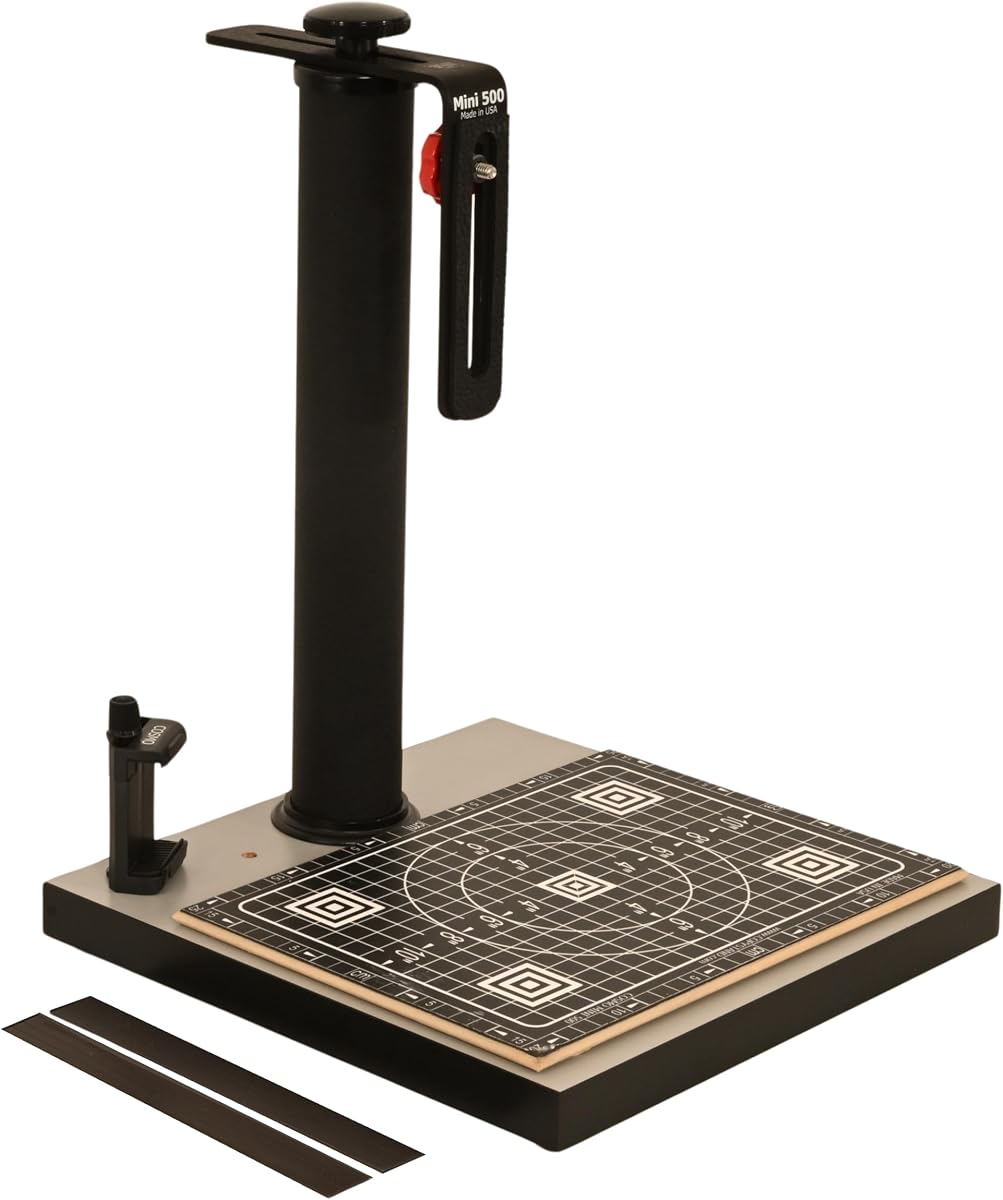
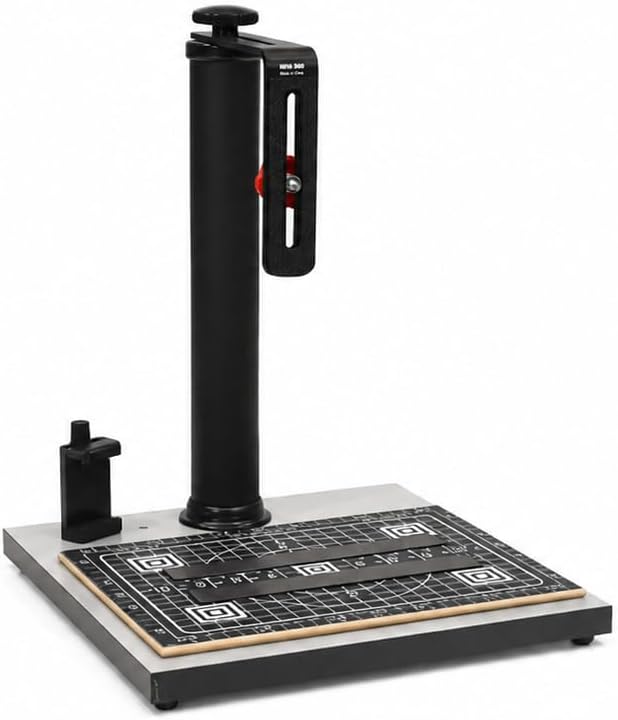
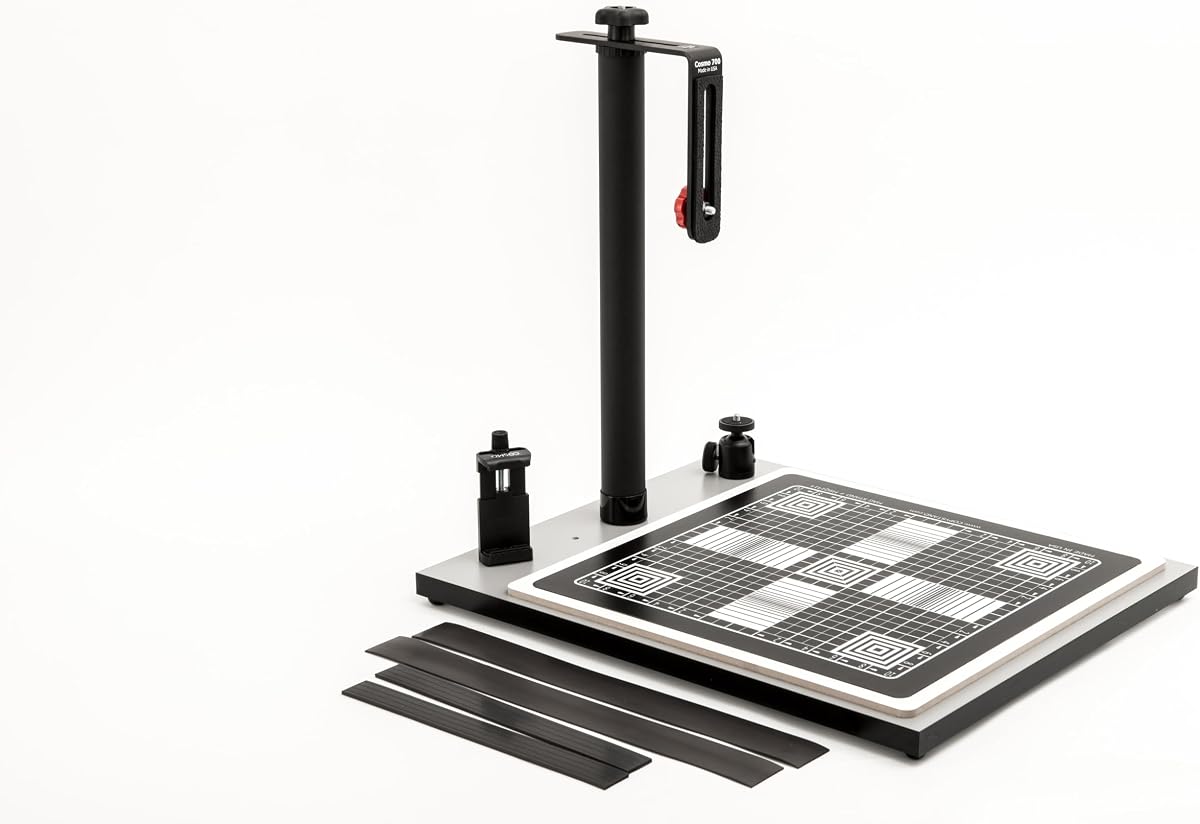

The Cosmo Mini 700 earns the leading position because it combines a generous 15.5-by-18.5-inch base with a 15-by-15-inch Floating Magnetic Board, a broad 14-by-14-inch working area, and adjustable overhead camera support. Its 4.8 rating reflects a particularly strong reception among buyers, while the feature set makes it useful for more than conventional photo digitization.
We may earn a commission when you buy through this link, at no additional cost to you.
The stand supports DSLR cameras under three pounds and most modern smartphones. A center mounting hole accommodates cameras, a side hole supports centered smartphone placement, and the included ball head allows more precise angle adjustment. Four magnetic strips secure originals against the laminated grid surface, helping reduce curling and maintain consistent framing for photographs, documents, food, collectibles, and dimensional subjects.
The main trade-off is scale. At 14 pounds and 17 inches tall, the Mini 700 is substantial compared with the smaller Cosmo models and less convenient for frequent transport. It is also explicitly described as a compact, hobby-oriented stand rather than a professional copy stand. Buyers with a permanent workspace and a need to handle large materials will find those limitations easier to accept than occasional users would.
Choose this model when a large, flat working area matters more than minimal storage. It is especially compelling for people digitizing family photographs, illustrating documents, photographing artwork, preparing online listings, or producing consistent overhead images of food and small objects. For broad device compatibility and flexible positioning in a stationary setup, the Mini 700 is the most complete option in this list.
The oversized magnetic board offers more room than most stands in the roundup, making it better suited to wide documents, larger photographs, scrapbook pages, and plated meals. The printed half-inch grid supports sizing and positioning before the camera is raised.
Two baseboard mounting options, an aluminum L-bracket, and the included ball head provide useful flexibility. The ball head is particularly helpful when a perfectly centered overhead view needs minor angle correction.
We may earn a commission when you buy through this link, at no additional cost to you.
The Kaiser 205411 Copy Stand RS 2-XA is a traditional, purpose-built copying platform for photographers who value measured alignment and a rigid overhead structure. Its 4.6 rating is among the strongest in the list, and the design resembles the controlled copy-stand systems used in dedicated photography workflows.
We may earn a commission when you buy through this link, at no additional cost to you.
A non-reflective matte-gray base includes a fine printed grid and inch and centimeter scales, while the matte-black anodized aluminum column carries similar measurement markings. The camera arm is height adjustable, the column rotates through 180 degrees, and approximately 2.7 inches of horizontal adjustment lets the operator position a supported camera more precisely. A standard one-quarter-inch mounting thread provides a familiar connection for suitable cameras.
Its maximum load is 3.3 pounds, which is sufficient for many smaller SLR bodies, digital cameras, and some CCD or CMOS camera systems but may not suit a heavier modern camera-and-lens combination. Optional lighting kits are available, though none is included. The relatively modest capacity and small horizontal reach distinguish it from heavier-duty professional systems.
This is a strong choice for users who already know their camera mounting requirements and want a measured, traditional copy stand rather than a magnetic hobby platform. It is particularly relevant for photographic reproduction, artwork, records, and controlled overhead work. Buyers needing substantial load capacity or a broad device ecosystem should consider the Kaiser RS1 instead.
Fine grids and dual-unit scales on both the base and column make it easier to repeat a setup or return the camera to a known position. The matte surfaces also help control reflections in overhead photography.
The height-adjustable arm and quarter-inch thread suit cameras with compatible mounting hardware. This makes the RS 2-XA more focused than phone-oriented copy stands that rely on a separate holder.
We may earn a commission when you buy through this link, at no additional cost to you.
The Photography Copy Holder Mag Stand is the most economical way to improve the consistency of overhead camera or phone work. It has a 5.0 rating and offers a 16-by-12-inch desktop platform with a laminated precision grid, two magnetic strips, and a layered construction designed to hold flat originals.
We may earn a commission when you buy through this link, at no additional cost to you.
The holder can sit directly on a desk or on the base of another copy stand, giving existing equipment a useful magnetic surface without requiring a complete replacement system. Squared corners, half-inch grid lines, and a laminated top assist with initial focusing, alignment, adjustment, sizing, and positioning. The platform may also move to frame a selected target during still photography or panning in video work.
This is not a full overhead stand. It does not include a column, camera arm, or phone holder, so a separate support system is required for repeatable vertical framing. That makes it less convenient for a complete beginner, but it can be an excellent add-on for anyone whose existing copy stand lacks a flat, aligned original surface.
Choose the Mag Stand when budget matters, the originals are flat, and you already have a way to position the camera or phone overhead. It is also useful for quick copying tasks where portability and simple setup matter more than integrated support. Despite its simplicity, the 5.0 rating makes it an appealing choice within this list.
The platform can rest on a desk for quick overhead capture with a separately supported camera or phone. Its broad surface is especially handy for documents and photographs that need to remain flat.
Placing the holder on a compatible copy-stand base adds magnetic retention and grid alignment without replacing the entire support structure. It can therefore serve as a practical accessory as well as a compact copying tool.
We may earn a commission when you buy through this link, at no additional cost to you.
The Cosmo Mini 100 is built for compact, portable digitization with a smartphone or very light camera. Its 4.3 rating reflects a practical middle ground between a basic desktop prop and a full copy stand, while the 10.5-by-8.5-inch base keeps its footprint manageable.
We may earn a commission when you buy through this link, at no additional cost to you.
A center hole supports compact cameras under one pound, and a side opening helps position a smartphone over the center of the board. The included 9-by-7-inch Floating Magnet Board uses two magnetic strips and half-inch grid lines to secure originals and assist with alignment, focusing, sizing, and positioning. The adjustable column extends from 11 to 16 inches, and the included phone holder accommodates devices 2.25 to 3.5 inches wide.
The product is explicitly aimed at students, hobbyists, and casual users rather than professional or large-format work. Its small board and light-duty camera allowance mean that larger prints, mounted artwork, and heavier camera systems are not its strongest use cases. The compact construction also offers less working area than the Mini 300, 500, or 700.
Choose the Mini 100 for phone-based photo capture, checks, compact prints, jewelry, coins, and other small objects when portability matters. It is also a sensible first copy stand for a home archive or occasional digitization project. Users handling larger originals or heavier cameras should step up to one of the more spacious Cosmo models.
The small base and short adjustable column make the system easy to carry, assemble, and store. Its side phone-alignment opening is especially convenient for users who do not need a mounted camera.
The included magnetic board adds useful half-inch markings to a small platform. Two strips help keep standard photographs and documents flat while the phone or light camera is positioned overhead.
We may earn a commission when you buy through this link, at no additional cost to you.
The Cosmo Mini 300 is a portable stand for users who want more camera support and adjustment than the Mini 100 while retaining a relatively manageable footprint. Its 4.2 rating and stated hobbyist orientation make it most appropriate for old-photo archiving and regular household digitization.
We may earn a commission when you buy through this link, at no additional cost to you.
The 12-by-9.5-inch melamine base contains a center camera hole and a side smartphone-alignment hole. The reversible anodized aluminum L-bracket adjusts vertically from 7 to 17 inches, with two horizontal mounting positions one inch apart. Cameras may weigh up to three pounds, while phones 2.25 to 3.5 inches wide can be held by the included holder. The 10-by-7.5-inch Floating Magnet Board adds half-inch grid markings and two magnetic strips.
Unlike models with a ball head or extended horizontal travel, the Mini 300 has relatively limited lateral positioning. It is designed for amateur and hobbyist use rather than professional production. The total weight of eight pounds and overall height of 14 inches make it easier to move than the larger Mini 500 and 700 systems, but less convenient than the Mini 100.
This model is well suited to people digitizing collections of standard photographs, documents, and small objects with either a compact camera or phone. It offers a useful middle ground in size, camera capacity, and adjustment range. Those needing a larger magnetic area or broader creative-project support should examine the Mini 500 or Mini 700.
The seven-to-17-inch range allows the operator to accommodate different source sizes and framing distances. Two horizontal bracket positions offer some additional flexibility without adding the complexity of a full ball head.
Supporting cameras up to three pounds gives the Mini 300 more capability than the lightest smartphone-oriented models. The same system can handle a broad range of modern phones through the included holder.
We may earn a commission when you buy through this link, at no additional cost to you.
The Copy Macro Stand is the most explicitly film-focused product in the list, with support for 135 and 120 negatives as its central feature. Although it does not have a listed customer rating, its full-metal frame, adjustable leveling feet, bubble level, and quick-release mounting plate are directly relevant to repeatable film digitization.
We may earn a commission when you buy through this link, at no additional cost to you.
The aluminum-alloy structure surrounds a sturdy 240-by-200-millimeter base. Vertical camera height can be adjusted through a quick-release plate, helping operators frame negatives and slides consistently. A built-in bubble level and locking knob support alignment, while adjustable feet help compensate for uneven work surfaces and reduce camera shake during exposure.
The mounting clip is designed to work with DSLRs, mirrorless cameras, and L-bracket arrangements, which broadens its use beyond one camera system. It can also support animation or macro work, but the stated film focus and relatively small base make it less natural for oversized prints or large documents.
Choose this model if negatives and slides are your primary subjects and you want a dedicated platform with clear leveling controls. It is less suitable for casual phone photography or a general-purpose overhead studio. Since no customer rating is provided, careful review of the dimensions, camera clearance, and available mounting space is especially important.
A rigid metal structure, adjustable feet, and a locking support mechanism help maintain a stable camera position. These features are particularly valuable during long film exposures or when using macro focusing.
The quick-release plate allows vertical repositioning without repeatedly rebuilding the mount. Compatibility with DSLRs, mirrorless cameras, and L-brackets makes camera transitions less cumbersome.
We may earn a commission when you buy through this link, at no additional cost to you.
The Cosmo Mini 500 offers a balanced mix of working area, adjustability, and portability for hobbyists who photograph more than basic phone snapshots. Its 4.2 rating reflects a generally positive reception, while the 12-by-12-inch base and nine-to-19-inch adjustment range make it a flexible home digitization platform.
We may earn a commission when you buy through this link, at no additional cost to you.
The stand supports cameras up to three pounds and smartphones 2.25 to 3.5 inches wide. Its reversible anodized aluminum L-bracket provides approximately four inches of horizontal travel and ten inches of vertical adjustment. The 8.5-by-11.5-inch Floating Magnet Board includes half-inch grid lines and two magnetic strips, helping position slides, negatives, photographs, artwork, calligraphy, sketches, tattoos, and restoration subjects.
The manufacturer explicitly states that it is not a professional copy stand. Some uses may also require an LED light box, which is not included, and transparent or difficult-to-light originals can therefore need separate equipment. At nine pounds, it is portable enough for occasional use but heavier than the Mini 100 and Mini 300.
Choose the Mini 500 when your projects extend beyond standard photographs into artwork, restoration work, presentations, video frames, and other creative assignments. It is a sensible all-around model for a home office or studio corner. Those who mainly work with large documents or need a truly professional-grade support system should look toward the larger Mini 700 or Kaiser models.
The product information identifies slides, negatives, artwork, sketches, tattoos, restorations, and presentations among suitable subjects. This makes the Mini 500 more than a simple family-photo copier for creative users.
Ten inches of vertical travel and roughly four inches of horizontal movement make framing easier across varied originals. Its nine-pound weight remains manageable for a semi-permanent home workspace.
We may earn a commission when you buy through this link, at no additional cost to you.
The revised Cosmo Mini 500 is a larger-base version of the popular Mini 500 formula, with a 13-by-12.5-inch melamine platform and the same nine-to-19-inch camera adjustment range. It has no listed customer rating, but its published specifications suggest a particularly stable option for standard photographs, documents, and small objects.
We may earn a commission when you buy through this link, at no additional cost to you.
Cameras up to three pounds and phones between 2.25 and 3.5 inches wide are supported. The reversible aluminum L-bracket provides approximately four inches of horizontal travel, while the two-inch steel column adds rigidity. An 8.5-by-11.5-inch Floating Magnet Board constructed from MDF, rubber steel, and laminated printed material includes a half-inch grid and two magnetic strips.
The wider base may offer a steadier platform than the original 12-by-12-inch model, but the product is still intended for hobby use rather than professional production. Its magnetic board, rather than the full base, determines the available working area for many originals. At nine pounds, it also needs a reasonably stable surface and deliberate storage space.
Choose this version when a slightly broader base appeals to you or when the standard Mini 500 footprint feels restrictive. It suits old-photo collections, school projects, documents, and small-object photography. The lack of a rating means the specifications should drive the decision, and buyers seeking a proven customer reception may favor the rated original Mini 500 instead.
The 13-by-12.5-inch platform provides additional space around the magnetic board and mounting points. That makes it easier to arrange support hardware while maintaining a tidy working area.
The included bracket, two-inch steel column, phone support, and magnetic board follow the established Mini 500 format. Users prioritizing the same working features can choose based on base footprint.
We may earn a commission when you buy through this link, at no additional cost to you.
The Cosmo Mini 700 Extended provides a large-format hobby platform for digitizing wide photographs, documents, plated food, collectibles, jewelry, coins, and three-dimensional objects. Although no customer rating is supplied, its 15.5-by-18.5-inch base and 15-by-15-inch magnetic board make it one of the most spacious options listed.
We may earn a commission when you buy through this link, at no additional cost to you.
The magnetic working area measures 14 by 14 inches and is held by four magnetic strips. A 15-inch Floating Magnetic Board uses layered MDF, rubber steel, and laminated printed film with half-inch grid lines. The one-and-a-half-inch powder-coated steel column supports an aluminum L-bracket with several vertical and horizontal positions, while the included ball head offers smooth angle changes.
Cameras under three pounds and most modern smartphones are supported, and the included phone holder fits devices 2.25 to 3.5 inches wide. The stand is not professional, however, and its 14-pound weight, 17-inch overall height, and broad base make it most appropriate for a fixed studio area rather than a crowded desk or frequent transport.
Choose this version if you regularly work with materials larger than standard letter-size sheets or need more lateral framing freedom than smaller models provide. It is especially suitable for food photographers, art students, online sellers, and photography enthusiasts producing polished overhead images. The similar Mini 700 with a listed rating may be more reassuring to risk-averse buyers.
A large flat area and broad magnetic working zone make the stand useful beyond photographs and paper. Jewelry, coins, food, collectibles, and plated dishes can all benefit from a stable overhead position.
The included ball head makes subtle camera-angle adjustments smoother than a fixed bracket alone. It can help users refine a composition while keeping the support column stable.
We may earn a commission when you buy through this link, at no additional cost to you.
The Kaiser RS1 with RA1 Camera Arm is the premium traditional system in the comparison, built around an extra-wide, vibration-resistant aluminum column. Its 4.2 rating indicates that it remains a well-regarded option, while features such as spring weight compensation and interchangeable threaded bushings distinguish it from lighter hobbyist stands.
We may earn a commission when you buy through this link, at no additional cost to you.
A non-reflective matte-gray base carries a fine printed grid to aid alignment. The column includes inch and centimeter scales, and the RA1 camera arm is height adjustable. Users can work with interchangeable one-quarter-inch and three-eighth-inch bushings plus a camera adjustment tool, allowing the system to accommodate different mounting arrangements.
The primary trade-off is financial and spatial commitment. This is a substantial professional copy-stand system rather than a compact phone accessory, and its features may be excessive for occasional family-photo capture. Buyers should also verify their camera hardware, mounting thread, available work surface, and desired support configuration before purchasing.
Choose the RS1 for controlled professional reproduction, heavier camera arrangements, or a dedicated workspace where stability and flexible mounting are priorities. It is the strongest choice here for users who prioritize traditional copy-stand engineering over a magnetic hobby platform. Casual users and mobile creators will generally receive more value from one of the Cosmo models.
The extra-wide column is designed to resist movement, which supports consistency during careful camera positioning. That stability is particularly relevant to photography where small changes in alignment affect framing or reproduction.
Interchangeable one-quarter-inch and three-eighth-inch bushings offer more mounting flexibility than a single-thread design. The roll-off spring mechanism also helps balance the camera arm.
We may earn a commission when you buy through this link, at no additional cost to you.
The right copy stand depends on the size of your originals, the imaging device you use, the precision required, and whether you need a portable setup or a permanent workstation. Review the following factors together rather than focusing on a single feature.
Choose based on the device you already own and the one you are most likely to use.
Measure your largest original and leave room for alignment and camera framing.
Prioritize a rigid, lockable structure whenever exposure length or close-up precision matters.
Favor measured grids and gentle magnetic retention for repeatable, damage-free positioning.
Choose enough vertical range for your subjects, then consider whether horizontal and angled positioning would improve the workflow.
Match the stand's footprint and weight to the space where it will be used and stored.
Budget for suitable lighting whenever scanning transparent film or reproducing reflective and fine-detail originals.
Match the construction level to the importance of repeatability rather than simply to the size of the originals.
Begin by assembling the stand on a level, clean surface, then tighten every locking point before installing the camera or phone. Position the magnetic board over the printed grid if alignment is important, and use the magnetic strips to flatten the original without forcing delicate media. Confirm that the camera is centered over the intended area before tightening the final adjustment controls.
Set the camera to manual or another fully controlled exposure mode, disable image stabilization when the support and tripod interface are already stable, and use a timer or remote release to avoid shake. Photograph the grid at the start of a session to check orientation and framing. For film, use a consistent scanning workflow and avoid changing the camera height or angle between related frames unless a new reference image is required.
After use, loosen adjustment controls before moving the column, disconnect the camera carefully, and store the stand in a dry area away from direct sunlight. Clean surfaces with a soft, dry cloth, and avoid liquid cleaners on laminated boards or printed grids. Remove batteries from unattended phones and inspect magnetic strips for debris that could scratch photographs. Always verify the latest manufacturer instructions before treating any component with moisture or solvents.
A copy stand can be an excellent alternative for flat originals because it captures them with a camera or phone while preserving control over perspective, lighting, and resolution. A flatbed scanner may offer automatic feeding and convenient multi-page handling. For fragile, mounted, or unusually sized photographs, a copy stand is often easier to position gently and may produce more flexible lighting.
Only if the stand offers a suitable phone holder or a stable way to mount a phone above the original. Several models include holders sized for common smartphones and base openings that help center the camera. A magnetic copy holder alone requires a separate overhead support, and compatibility also depends on whether your phone is physically narrow enough for the holder.
The original material itself may be small, but the platform must still provide enough room for lighting, alignment, and camera clearance. The Cosmo Mini 300, 500, and 700 include magnetic boards, while the dedicated Copy Macro Stand explicitly supports 135 and 120 negatives. A larger board can also be useful when scanning groups of slides or preparing multiple images in one session.
No. An evenly lit opaque photograph may be captured successfully with controlled ambient or directional lighting, but transparent slides and negatives often reveal glare and uneven illumination. Some product information states that an LED light box may be required for certain Mini 500 applications and is not included. Treat lighting as a separate part of the workflow and evaluate it for your specific media.
A customer rating can indicate overall satisfaction, but precision depends on mechanical features such as rigidity, locking, alignment marks, and the quality of your camera position. A highly rated compact model may still be less suitable than a lower-rated professional stand if your work requires heavier equipment, large sources, or extremely repeatable framing.
A magnetic holder provides the flat, aligned surface for originals, but it does not independently support the camera or smartphone above that surface. It can be used on a desk with a separate overhead arm or placed on a compatible copy-stand base. It is most useful as an affordable accessory that improves an existing setup.
Position the lighting so it is reflected away from the lens, and use diffused or polarized lighting when appropriate to the material. Avoid direct overhead light that reflects toward the camera. Taking a test image before processing the full collection allows you to identify glare and reposition the lights, camera, or original.
Among the listed systems, the Cosmo Mini 100 is the smallest and is explicitly described as portable, while the Mini 300 and 500 are also manageable stationary options. The Mini 700 and Kaiser RS1 require more space and are better suited to fixed workspaces. Portability should be balanced against the larger working areas and greater adjustment offered by the heavier systems.
The Cosmo Mini 700 stands out as the most versatile all-round choice because of its large magnetic surface, ball head, broad device support, and extensive adjustment. The Kaiser RS 2-XA offers traditional measured alignment, while the Photography Copy Holder provides an affordable magnetic surface for anyone who already owns an overhead support.
Prioritize the source material first, then match it to a suitable working area, device weight, and adjustment system. Small photographs and phones suit the Mini 100, broader creative work favors the Mini 500, dedicated film users may prefer the Copy Macro Stand, and demanding controlled workflows justify a traditional Kaiser system.
Before purchasing, verify the latest dimensions, included components, device compatibility, lighting requirements, and warranty details. Ratings, configurations, availability, and prices can change, so checking the current listing helps ensure that the selected copy stand still matches your specific digitization workflow.