
RVBOATPAT 150A Marine Distribution Pair
4.7Editor score
150A continuous capacity
Positive and ground pair
Includes copper lugs
Protective covers included
A bus bar power distribution block creates a organized central point for connecting battery cables and accessory circuits. A quality model should offer suitable current capacity, secure terminals, corrosion-resistant conductors, effective insulation, and enough mounting flexibility for the wires in your vehicle, boat, RV, or solar installation.
We compared these ten bus bars using the supplied specifications, focusing on rated capacity, voltage limits, stud dimensions, smaller terminal options, included hardware, conductor materials, protective covers, and intended applications. The guide covers compact 150A designs through heavy-duty 500A blocks, with installation details that matter for clean and reliable wiring.
Each review identifies the product's strongest use case and relevant trade-offs, helping you choose by circuit demand rather than appearance alone. Product configurations and availability can change, so confirm the current listing, measurements, included accessories, and electrical ratings before making a purchase.
4.7Editor score

4.8Editor score

4.8Editor score
As an Amazon Associate we earn from qualifying purchases.
The comparison below highlights the major differences in electrical capacity, stud size, terminal arrangement, materials, and installation access across all ten products.




This Joinfworld set provides one red positive block and one black negative block, giving installers the paired foundation needed for a tidy battery distribution system. Its 4.7 rating reflects a generally strong customer reception, while the listed 250A continuous rating, maximum operating voltage of 48V, and four 3/8-inch studs make it appropriate for substantial 12V circuits.
We may earn a commission when you buy through this link, at no additional cost to you.
The principal attraction is the combination of capacity and connection flexibility on each block. The larger studs can accept heavy cable lugs, while three #8 screw terminals provide convenient attachment points for smaller accessory wiring. A four-millimeter-thick copper bus bar plate is also specified, and the M10 nylon base posts are intended to secure the base without relying on the smaller terminal screws for structural support.
Each bar comes with a protective cover and nuts, helping limit accidental contact with exposed metal and reducing the likelihood of shorts during installation or service. The main compromise is that three screw terminals per block may be limiting if you need many small branches. It is also important to use ring lugs and cables sized for the 3/8-inch studs rather than forcing undersized connectors.
This is a strong all-around choice for boat, automotive, truck, solar, and other 12V installations where one or two major battery feeds and several accessory circuits need a central connection point. Buyers seeking a balanced combination of high current capacity, large studs, protective covers, and positive-ground pairing will find the feature set particularly persuasive.
The four 3/8-inch studs offer a large attachment point for substantial ring terminals. That makes the block practical when a circuit needs a main battery cable plus additional high-current distribution, while the smaller #8 positions handle lighter branches.
The included covers help shield exposed portions of the bars during installation and service. The red and black bases also make positive and ground identification straightforward, reducing assembly mistakes.
We may earn a commission when you buy through this link, at no additional cost to you.
This RVBOATPAT pair combines a 150A continuous rating with an unusually generous number of smaller connection points. Each block has a 1/4-inch stud and 12 stainless M4 terminal screws, making it a practical option when a boat, car, caravan, yacht, or solar system needs many accessory circuits rather than several heavy-gauge feeds.
We may earn a commission when you buy through this link, at no additional cost to you.
The inclusion of one positive bar, one ground bar, two covers, two 1/4-inch copper lugs, and 24 terminals provides a more complete starting package than many alternatives. A thick tinned copper plate is paired with a high-quality ABS base described as mechanically strong, insulated, heat resistant, and flame resistant, supporting use where wiring density and protection both matter.
Its main limitation is the lower 150A continuous capacity compared with the 250A, 300A, and 500A options in this list. The single large stud on each block also offers less flexibility for a panel with multiple battery-scale cables. For a lighter 12V system, however, that restraint may be an advantage because the product is designed around branch-circuit distribution rather than extremely heavy feeds.
Choose this set for a compact marine, automotive, caravan, or solar build with numerous smaller loads. It is especially compelling when the included lugs and terminals reduce the need to source additional connection hardware separately, provided the system remains within its stated electrical limits.
Twelve M4 screw terminals on each bar make it easier to consolidate lighting, pumps, controls, and other smaller circuits. The main 1/4-inch stud remains available for the primary cable.
Covers, copper lugs, and 24 terminals are supplied with the set. That broader accessory package supports a cleaner installation and reduces the need for extra compatible hardware.
We may earn a commission when you buy through this link, at no additional cost to you.
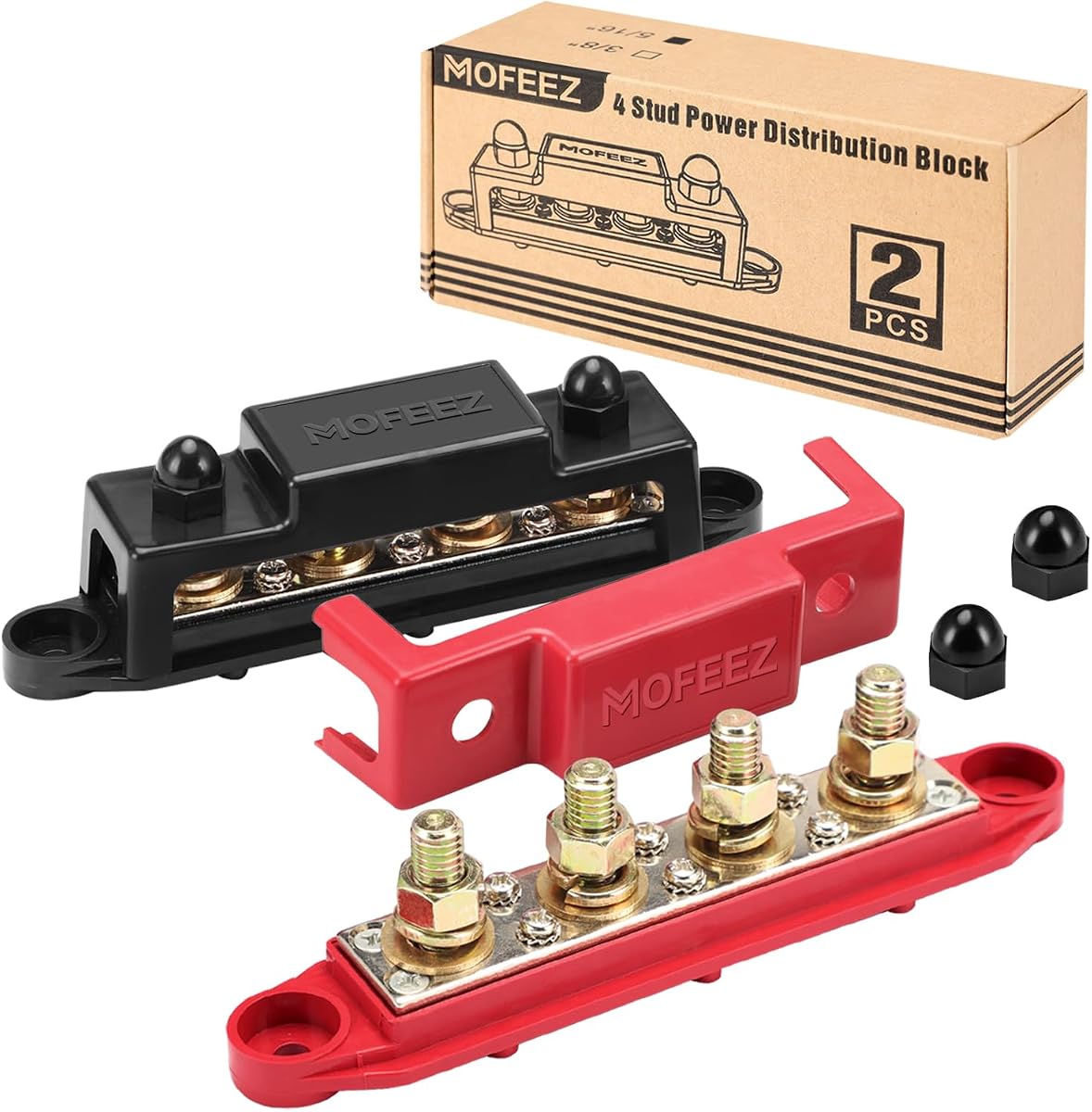
The MOFEEZ 250A pair stands out as the most balanced option in the group, combining four 5/16-inch studs with six #8 screw terminals on each block. Its 4.8 rating is the highest among the products that also have a numeric customer score, and the 250A continuous rating provides comfortable capacity for a broad range of 12V power systems.
We may earn a commission when you buy through this link, at no additional cost to you.
Nickel-plated brass bus bar plates are specified for low resistance, conductivity, and corrosion protection. Nylon nuts connect two external studs to help prevent accidental short circuits, while a removable nylon cover shields the metal components. The insulated nylon base is flame-retardant, adding a useful layer of protection in tightly packed electrical compartments.
The layout serves both heavy and light conductors. Larger cables can attach to the four main studs, while smaller accessory leads use the six #8 screw terminals, making the block useful for a dedicated ground, a battery feed, and multiple low-voltage circuits. A trade-off is that 5/16-inch studs require matching ring terminals; installers accustomed to 3/8-inch hardware must verify compatibility before ordering.
This is the editor's choice for a boat, car, RV, yacht, caravan, or ship power system where a clean, organized harness and a balanced number of connection points matter. It is especially attractive for users who want a 250A block with more distribution positions than simpler dual-stud designs.
Four 5/16-inch studs support primary and high-current leads, while six #8 screws organize smaller branches. The combination lets one pair handle several circuit sizes without crowding the main terminals.
Removable covers and nylon nuts help isolate exposed conductors during installation and service. The flame-retardant base also suits installations where heat and tightly grouped wiring require careful component selection.
We may earn a commission when you buy through this link, at no additional cost to you.
This RVMARINEPAT set emphasizes connection quantity, with six 5/16-inch M8 studs on each of the positive and negative bus bars. The 4.8 rating supports its reputation among buyers, while the stated 250A current and 48V DC limit make it suitable for demanding automotive, marine, and solar distribution applications.
We may earn a commission when you buy through this link, at no additional cost to you.
Its most useful distinction is the open area created by the cover design, which permits wire lug installation through up to 180 degrees. This can make wiring easier when cable direction is restricted or when several heavy terminals need to approach the bar from different angles. Copper conductor plates and stainless steel terminals support conductivity and resistance to harsh conditions.
Twelve copper ring lugs and twelve heat-shrink tubes are included, providing hardware for many of the listed studs. The round-corner base is designed to add stability and visual distinction. One point to examine is the listed 250A maximum current phrasing, which differs from continuous-current language used for some competing blocks; buyers with high-load systems should confirm the installation conditions in the current documentation.
Choose this pair when you need more large-conductor attachment points than conventional four-stud designs provide. It is a strong candidate for a crowded marine battery panel, vehicle auxiliary system, or solar installation where cable direction, lug organization, and corrosion-conscious materials are central concerns.
Each block provides six M8 stud positions, allowing several ring-lugged cables to be organized on one conductor. This is useful when a panel needs more branches than a four-stud bar can comfortably accommodate.
The open-sided cover supports lug installation from up to 180 degrees, offering more routing options around nearby equipment. The included lugs and heat-shrink tubes further support a neat termination.
We may earn a commission when you buy through this link, at no additional cost to you.
The DAIERTEK 150A mini pair is designed for installations where space is limited but a high-current central connection remains necessary. It has a 4.7 rating and combines four 5/16-inch M8 posts with a relatively compact layout. The stated operating limits are 300V AC and 48V DC, making the pair relevant to both DC distribution and applications involving AC-rated wiring.
We may earn a commission when you buy through this link, at no additional cost to you.
Tin-plated copper bars, stainless steel nuts and studs, a nylon base, and a polycarbonate cover form a practical materials package. The cover and spaced post arrangement improve access during installation. Side posts permit wire-lug installation from up to 180 degrees, which is valuable when the bar must sit close to a bulkhead, battery tray, or other fixed component.
The primary limitation is its 150A class, which is lower than several high-current alternatives. The listing also emphasizes the four main posts rather than a large collection of small screw terminals, so installers needing many low-current branch points may prefer a different layout. Its unusually broad voltage statement should be considered in the context of the exact circuit and applicable electrical requirements.
This mini pair is a sensible option for marine, automotive, and solar systems with moderate overall demand and limited mounting space. It works particularly well when the circuit requires several main cable connections, straightforward access from different directions, and a cover that helps protect exposed hardware.
The stated 150A capacity is delivered in a smaller format than conventional blocks of similar class. That makes the pair easier to fit into crowded battery compartments and compact equipment panels.
Tin-plated copper, stainless steel hardware, a nylon base, and a polycarbonate cover create a durable material combination. These choices suit automotive, marine, and solar environments where heat and moisture are concerns.
We may earn a commission when you buy through this link, at no additional cost to you.
This MOFEEZ version mirrors the strong layout of the editor's-choice block but increases each main stud from 5/16 inch to 3/8 inch. It offers a 4.7 rating, a 250A continuous rating, a maximum operating voltage of 48V, and four large studs plus six #8 screw terminals on each red and black block.
We may earn a commission when you buy through this link, at no additional cost to you.
Larger 3/8-inch studs are useful when the installer already uses compatible heavy ring terminals or needs a broad surface for substantial cable hardware. Nickel-plated brass bus bar plates are specified for low resistance, conductivity, and corrosion protection. Nylon nuts help prevent accidental short circuits, and the removable cover keeps metal components from contacting nearby objects.
Like the other MOFEEZ option, this is primarily a conventional heavy-and-light distribution arrangement. The larger main studs may be less convenient in a very tight compartment, and the three-quarter-inch hardware also requires appropriate cable and lug sizing. Compared with the 5/16-inch version, its main distinction is stud size rather than a different number of connection positions.
It is a good selection for a car, RV, boat, yacht, caravan, or ship harness that already uses 3/8-inch lugs. Buyers should favor this model over the closely related 5/16-inch model when their existing terminals match the larger posts and the extra connection surface offers a practical advantage.
Four 3/8-inch studs give the installer more attachment surface for appropriately rated main cables. This can make the pair attractive where the wiring plan already centers on 3/8-inch hardware.
Six #8 terminals complement the four large studs, allowing heavy feeds and smaller accessory circuits to remain organized. The insulated base and removable cover improve handling around the live connection area.
We may earn a commission when you buy through this link, at no additional cost to you.
The DaierTek 300A marine pair is a premium high-current option with six 3/8-inch M10 studs on each bar. It carries a 4.8 rating and a listed 300A continuous capacity at up to 300V AC or 48V DC. The package includes one positive red bus bar and one black ground bus bar, giving installers a matched distribution foundation.
We may earn a commission when you buy through this link, at no additional cost to you.
Six large studs on each block allow numerous heavy cable lugs to be secured in one location. The special cover leaves exposed areas on two sides, permitting wire-lug installation through up to 180 degrees and making it easier to route cables around obstructions. Its round-corner base is designed to improve stability and distinguish the enclosure from standard rectangular bus bars.
Capacity and physical size are the main considerations. While the 300A rating exceeds most alternatives, six M10 studs require enough space for the nuts, washers, ring terminals, and nearby wiring. The listing's 300V AC maximum is unusually broad for a product commonly associated with 12V marine systems, so installers should match the actual circuit to the relevant rating rather than assuming every configuration is interchangeable.
This premium pair is best suited to high-current automotive, car, and marine boat systems that need several substantial cable connections and a high-capacity central hub. It also makes sense for a professional-looking installation where cable access, a matched positive-ground set, and a high continuous rating justify the larger format.
The six large posts on each bar provide a generous number of heavy-cable positions. This supports battery, inverter, auxiliary, and accessory connections when several substantial circuits converge at one panel.
Open sides in the cover allow lugs to approach from up to 180 degrees. That flexibility can prevent tight bends and make a multi-cable installation easier to route and inspect.
We may earn a commission when you buy through this link, at no additional cost to you.
This two-pack offers a compact way to create positive and ground distribution points for a 12V system. Each block is rated for 150A and 48V, with a 4.6 customer rating. The stated dimensions of approximately 5.4 inches long with the cover, a 4.7-inch base, 0.9 inch wide, and 0.5 inch high make it particularly relevant where panel space is limited.
We may earn a commission when you buy through this link, at no additional cost to you.
Solid tinned copper is specified for low-resistance battery cable connections, while the rigid base supports stable mounting. Quarter-inch studs and 12 included terminals provide the main and smaller connection points. The snap-lock covers fit tightly to resist vibration and help reduce accidental contact or shorts during service and transport.
The set is presented as useful for inverters, chargers, DC accessories, solar systems, lighting, winches, audio, and other marine, RV, truck, UTV, and off-road installations. Its limitation is the modest 150A rating and quarter-inch studs, which are less appropriate when several heavy feeder cables or very high current demands are involved. The package also appears intended as a two-block set, so verify the quantity and contents in the current listing.
Choose it for a compact, neatly organized 12V installation with several accessory branches rather than exceptionally heavy feeds. It is a practical option for adding or reorganizing a distribution panel in a boat, RV, or vehicle where vibration resistance, covered terminals, and straightforward branch connections are the priorities.
The listed low-profile dimensions make the blocks easier to place in confined compartments. Measuring the available space and cable clearance before purchase is essential for a clean fit.
Snap-lock covers resist movement while helping isolate connection hardware. They also preserve the organized appearance of the panel when it is not being actively serviced.
We may earn a commission when you buy through this link, at no additional cost to you.
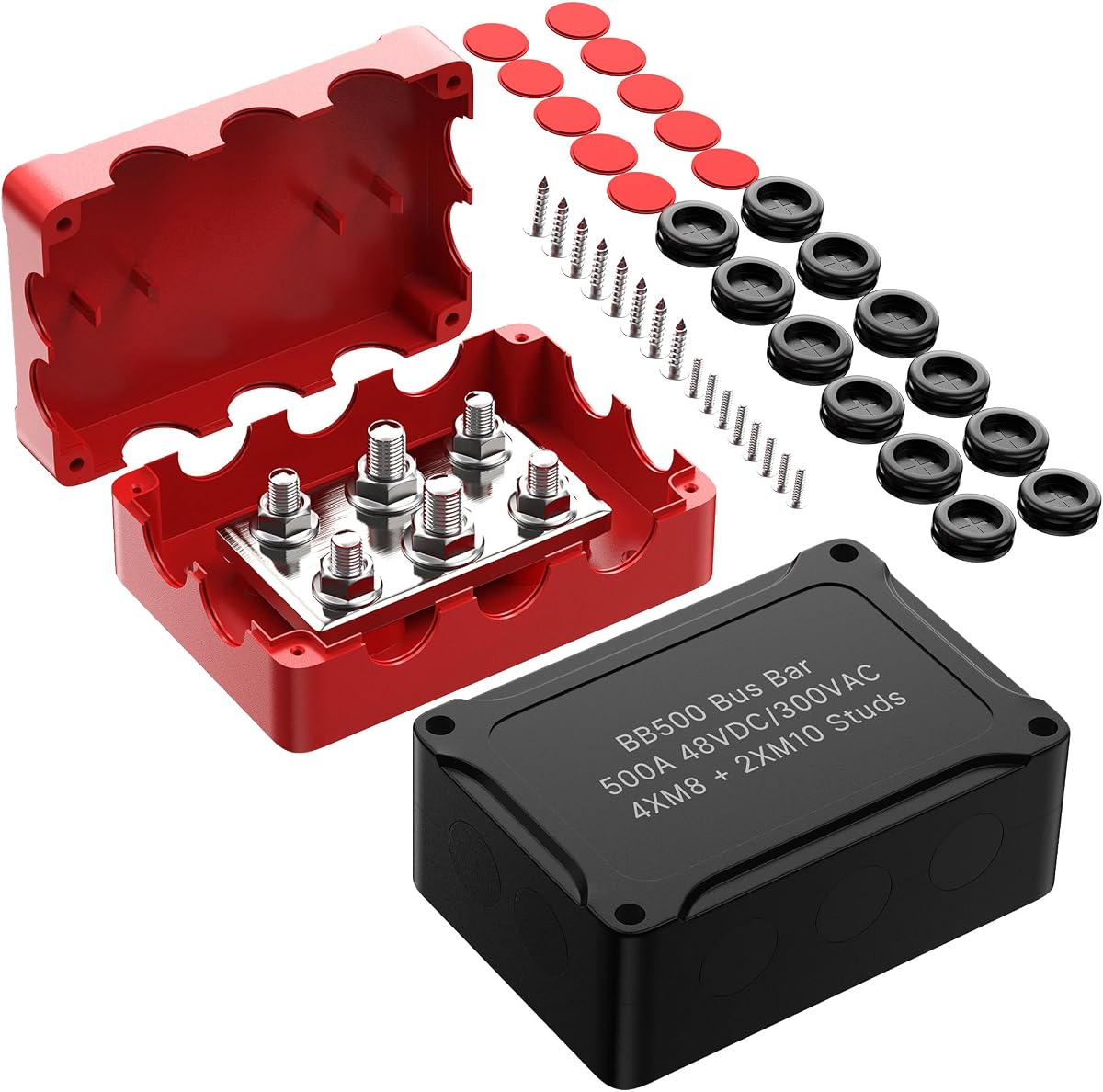
The Joinfworld 500A pair is the highest-capacity design in the guide, with a listed 500A rating, maximum 48V DC, and maximum 300V AC. Each of the two bus bars combines four 5/16-inch M8 studs with two 3/8-inch M10 studs, giving installers a choice of terminal sizes for 4/0-gauge wire and terminals.
We may earn a commission when you buy through this link, at no additional cost to you.
A thicker copper plate supports the high-current design, while the mixed stud arrangement allows more than one conductor size on the same bar. Waterproof rings are included to create a sealing function around connections, and removable plates allow wires and terminals to pass through more easily while helping prevent shorts during assembly.
The primary limitation is that there is no available numeric customer rating, so the guide cannot place it in the same rating-based comparison as the other nine products. As with any very high-current component, cable sizing, contact area, mounting security, and protection from the environment remain essential. The 500A figure is also a stated rating that should be treated as the upper limit rather than a target operating load.
This pair is intended for installers who genuinely need a high-capacity automotive, truck, marine, boat, RV, or solar distribution hub and have space for its larger hardware. The mixed studs, removable plates, and sealing rings are the key product-specific features for demanding cable configurations.
Four M8 studs and two M10 studs allow compatible cables of different sizes to share a bus bar. That flexibility is useful when a system includes both heavy feeder cables and substantial branch conductors.
Waterproof rings and removable access plates support cleaner cable entry and improved connection protection. They are particularly relevant to marine, automotive, and outdoor solar installations where contaminants may be present.
We may earn a commission when you buy through this link, at no additional cost to you.
This RVBOATPAT pair takes a streamlined approach, using two 3/8-inch M10 studs on each bar while maintaining a 250A continuous current rating and 48V DC maximum. Its 4.6 rating gives it solid user feedback, and the positive and ground configuration is well suited to a central battery distribution point in a boat, car, caravan, yacht, or solar system.
We may earn a commission when you buy through this link, at no additional cost to you.
The studs are made from 304 stainless steel to resist corrosion, while the protective covers use tough polycarbonate for strength and durability. Two 1/0 AWG copper lugs and four 6 AWG copper lugs are included, providing compatible connection hardware for both heavier and lighter cable sizes.
Compared with four- and six-stud alternatives, the two-stud design keeps the layout simple and may make each termination easier to inspect and tighten. That simplicity becomes a limitation if the system needs several accessory circuits, because the product does not list a collection of smaller screw terminals. Users requiring numerous branches should favor a bus bar with more distribution positions.
Choose this set when the goal is a compact, high-capacity connection point for a limited number of substantial cables rather than a multi-branch panel. It is particularly suitable for marine and automotive installations where corrosion-resistant studs, covered connections, and supplied copper lugs are the most important purchase criteria.
The limited number of main positions can reduce crowding around each lug. This helps when a battery panel needs a few heavy connections and a straightforward physical layout.
304 stainless steel studs are specified for corrosion protection. Combined with polycarbonate covers, the materials align well with demanding marine, automotive, and solar environments.
We may earn a commission when you buy through this link, at no additional cost to you.
The right bus bar depends on your largest expected current, cable sizes, available space, environmental exposure, and the number of circuits that must terminate in one place. Compare the listed ratings and hardware before choosing a model.
Choose a block whose current rating exceeds the maximum continuous load that will pass through it, with sensible margin for the system design. The options range from 150A models for lighter branch distribution to 250A, 300A, and 500A units intended for heavier demands. A higher capacity rating does not replace correct cable sizing, proper lug contact, sound mounting, and circuit protection, but it does help ensure the hardware is not being asked to exceed its stated limits.
Stud diameter determines which ring terminals and cables can be installed without modification. Options include 1/4-inch, 5/16-inch, and 3/8-inch posts, with the Joinfworld 500A model mixing 5/16-inch and 3/8-inch studs. Measure the cable lug opening and confirm the stud, washer, and nut clearance before purchase, because a larger stud is not useful if the installation area cannot accommodate its hardware or cable bend radius.
A bus bar with one or two main studs is best for a small number of substantial cables, while four- and six-stud models support heavier multi-branch panels. For numerous smaller accessories, compare products that also provide dedicated screw terminals, such as the RVBOATPAT 150A block with 12 M4 terminals or the MOFEEZ models with six #8 terminals. More connection positions increase flexibility but can also make the installation more crowded.
Most battery-based automotive, marine, RV, and solar installations operate on 12V DC, while larger house banks may use 24V or 48V DC. Most products in this guide specify a 48V maximum DC operating limit, and some also list 300V AC. Confirm that the voltage, current, and circuit type fall within the relevant product specifications rather than assuming a 12V label covers every possible installation.
Copper or brass bus plates provide the electrical connection, while plating can improve corrosion resistance and contact characteristics. Tinned copper appears in several products, and nickel-plated brass is used in the MOFEEZ designs. Stainless steel studs and terminal screws are useful in marine and outdoor systems. The material combination matters, but clean contact surfaces, proper torque, and compatible hardware are equally important to electrical performance.
A cover reduces accidental contact with live metal, shields exposed areas from debris, and helps prevent shorts during service. Removable covers, snap-lock lids, and open-sided designs trade complete shielding against easier cable access. Nylon and polycarbonate are common insulating choices in this group. Inspect the cover for secure fit and confirm that it can be reinstalled without pinching wires or obstructing required inspection points.
Marine, RV, automotive, and outdoor solar installations expose connections to moisture, vibration, heat, and corrosion. Marine-oriented products commonly emphasize stainless steel hardware, tinned or plated copper, sealed or locking covers, and sturdy insulated bases. These features support durability, but the bus bar should still be mounted away from standing water and protected from physical damage. Vibration resistance also depends on secure mounting and properly tightened connections.
The dimensions of the base, the space required for nuts and lugs, and the direction of incoming cables can be just as important as electrical ratings. The compact 150A two-pack is useful where enclosure space is tight, while six-stud and 500A designs need more room. Check the current product dimensions, included lugs, terminals, covers, and seals so the package matches your wiring plan without requiring unplanned extra hardware.
Begin by disconnecting the battery or otherwise de-energize the circuit according to the vehicle or vessel procedure. Plan the positive and ground locations, identify every load, and arrange the studs so heavy feeder cables reach the bar without sharp bends. Mount the base securely to a rigid, clean surface with enough clearance for nuts, washers, ring terminals, and the protective cover.
Use cables, ring terminals, fuses, and circuit protection appropriate to the load and the listed bus bar rating. Connect the correct cable to each terminal, remove unwanted paint or contamination where required, and tighten the hardware evenly to the manufacturer's guidance. Do not stack incompatible lugs, oversize the studs, or use the smaller screw terminals for circuits beyond their purpose. Install the covers after every conductor is secured.
During maintenance, disconnect power before changing a connection and inspect for looseness, heat discoloration, corrosion, damaged insulation, and cable movement. Keep the mounting points firm and the cover fully seated. Tighten or replace corroded hardware as needed, and confirm that the block remains protected from moisture and physical impact. Recommission the circuit carefully and check each load branch after work is complete.
A product labeled for 12V often supports a broader DC range, and most products in this guide list a maximum of 48V DC. The actual system voltage must remain within the manufacturer's stated limit. Do not infer compatibility from the product name alone, especially when the listing also mentions AC ratings or a separate intended application.
Most installations use a positive distribution block and a ground or negative block. The RVBOATPAT, MOFEEZ, RVMARINEPAT, DAIERTEK, and Joinfworld products in this guide include matched red and black pairs. Keeping positive and negative conductors separated reduces wiring confusion and provides a straightforward layout for battery and accessory circuits.
The stud size must match the opening in your ring terminals, not just the cable diameter. The guide includes 1/4-inch, 5/16-inch, and 3/8-inch studs. Confirm the terminal specification, cable gauge, lug length, and available clearance before installation, especially for very heavy cables that require large contact surfaces.
No. A bus bar is primarily a conductor and connection point, while a fuse block or circuit breaker protects individual circuits from overcurrent. A bus bar may feed a fuse block or serve as the common point upstream of protected branches, but each appropriately sized circuit still needs the required protection.
No. A higher rating only provides more capacity than the circuit may require. The more important considerations include correct cable sizing, compatible terminals, sufficient contact area, secure mounting, protection from the environment, and a connection layout that suits the actual number of cables.
Several models are explicitly designed for marine, boat, yacht, RV, automotive, or solar use. Their useful features include stainless steel hardware, plated copper, insulated bases, and protective covers. Even with those features, the block should be mounted securely and protected from standing water, salt spray, and physical damage.
The principal difference is the maximum continuous current the block is designed to carry under its specified conditions. A 150A model is intended for lighter distribution, while a 300A model accommodates heavier feeder connections. The correct choice also depends on cable and lug sizing, available mounting area, and the number of large conductors the system requires.
A cover reduces accidental contact and may reduce debris entry, but it should not automatically be treated as a waterproof enclosure. The Joinfworld 500A model specifically includes waterproof rings, while other products emphasize locking or removable covers. The complete installation, terminals, cable entries, and mounting environment determine the final level of protection.
The RVBOATPAT 150A pair is the practical budget-oriented choice for systems needing many smaller branch terminals, while the MOFEEZ 250A 5/16-inch pair offers the strongest overall balance of rating, connection positions, protective design, and customer feedback. The DaierTek 300A M10 pair represents the premium high-current choice, with six large studs per block and flexible cover access.
Your priority should be the required continuous load, compatible cable lugs, and the number of actual circuits—not simply the highest number printed on the package. Include wire size, protection, mounting stability, environmental exposure, and service access in the decision. A simpler block that correctly supports every conductor can be a better installation than an oversized model with unnecessary connection points.
Before purchasing, recheck the current listing for dimensions, stud sizes, included hardware, voltage limits, and package contents, since product configurations can change. Current pricing and availability also fluctuate, so compare the final offer with the installation requirements established in this guide.