
Siraya Tech Tenacious Flex Black
4.7Editor score
Soft rubber-like formulation
Fast elastic rebound
Excellent bending performance
Our Flexible Resin for 3D Printing guide compares ten resins for softness, rebound, impact resistance, detail, and printer compatibility.
Flexible resin for 3D printing is ideal when a project needs rubber-like movement, cushioning, shock absorption, or resistance to cracking. Unlike rigid photopolymer resin, these formulations can bend and stretch without snapping, making them useful for grips, gaskets, articulated models, protective components, wearables, and realistic prototypes.
This guide compares ten flexible and tough resin formulations based on their stated softness, elongation, rebound, impact resistance, surface quality, odor, curing requirements, and compatibility with LCD, DLP, SLA, and MSLA printers. The list includes soft elastomers, reinforced tough resins, and versatile blends intended to serve direct-printing or additive applications.
Each review explains the product's standout characteristics, practical trade-offs, and most suitable projects. The top selections represent the strongest balance of material performance and user feedback, while the comparison makes it easier to match a formulation with your printer, required flexibility, and preferred handling characteristics. Prices and availability can change, so check current listings before purchasing.
4.7Editor score
4.7Editor score

4.7Editor score
The table below compares all ten formulations by softness, elasticity, impact behavior, curing requirements, and printer support. Although several products share the Tough Resin 2.0 name, they differ in color, listed package size, and emphasized features, so each listing is reviewed separately.



Superflex 3D Printer Resin is a clear, 80A Shore flexible rubber formulation with a 4.4 rating. It is designed for users who want convincing rubber or TPU-like behavior without moving to a completely soft elastomer. Its principal attraction is the combination of cushioning, strength, and 100% elongation at break.
We may earn a commission when you buy through this link, at no additional cost to you.
The stated 50-micron layer speed of 1.7 seconds with monochrome LCD printers makes it appealing for high-volume production. A balanced 80A hardness also gives printed parts enough structure for grips, vibration isolators, protective pieces, and functional prototypes. Properly cleaned and fully post-cured prints are stated to pass ISO 10993-5 testing, adding relevance for biocompatibility-focused prototyping.
The main limitation is that 80A is firmer than 55A or 70A elastomers. If the goal is an extremely soft, slow-rebounding material, this formulation may not provide the same tactile experience. Clear color and a 500g container may also be less convenient than opaque or larger packages, depending on your preferred workflow.
Choose Superflex when you need a strong balance of bendability, detail, and production speed. It is particularly well suited to cushioning, damping, shock absorption, and hard flexible prototypes, and it is a practical starting point for makers moving from rigid resin into more resilient parts.
The listed curing speed makes this resin attractive for repeated production of flexible components. Verify the 50-micron timing on your own printer and settings, since exposure, geometry, and machine performance can affect actual results.
An 80A durometer balances compliance and structural integrity better than a very soft resin. That makes it useful for grips, vibration-control parts, and protective components that must flex repeatedly without losing their form.
We may earn a commission when you buy through this link, at no additional cost to you.
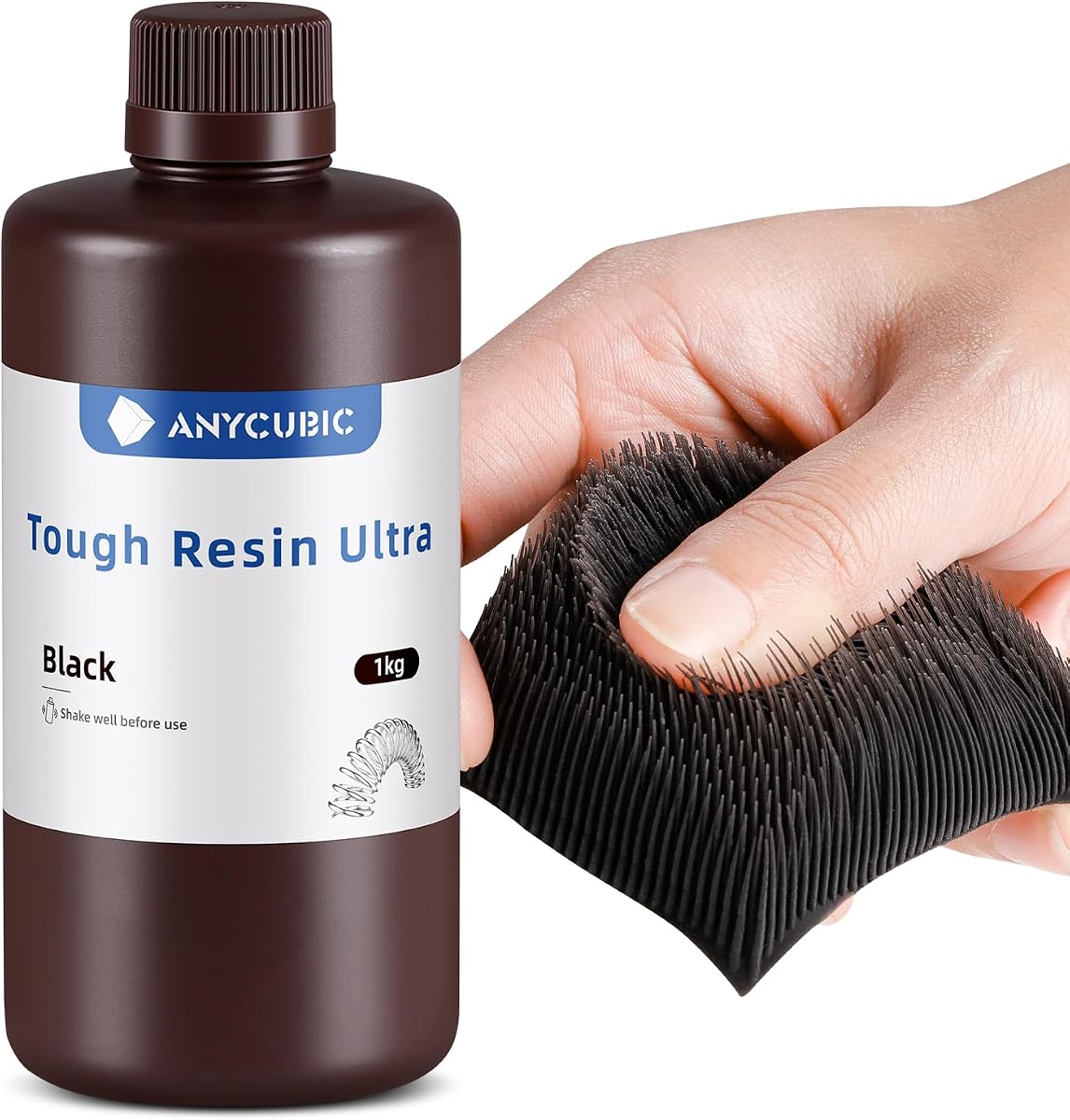
ANYCUBIC Ultra Tough Resin earns a 4.7 rating and stands out for an unusually complete set of toughness-focused properties. It combines strong impact resistance, flexibility, and resilience, allowing printed parts to recover their original shape after deformation instead of remaining permanently bent or cracking.
We may earn a commission when you buy through this link, at no additional cost to you.
Its material characteristics are especially relevant to articulated figures, action models, wearable pieces, and repeatedly handled parts. The formulation is also described as effective as a direct material or as an additive blended with other resins to improve toughness and durability. That versatility gives experienced users a way to tune performance rather than committing to a single formulation.
One important nuance is color mixing. The product can be blended with different colored resins, although the blend may affect the final color. A same-color combination is less likely to alter the intended appearance. For skin-contact-oriented wearables, thorough washing and curing are still important, and the comfortable surface claim should not be treated as a substitute for individual safety assessment.
This is our top overall recommendation because it balances genuine flexibility, resilience, impact resistance, and additive utility. It suits makers who want one versatile black resin for articulated models, functional prototypes, and reinforced mixes rather than a narrowly specialized formulation.
Fast recovery after bending or compression makes the material valuable for articulated models, grips, and components that undergo repeated handling. It helps preserve appearance and function after short-term impacts.
Using a small amount as an additive can increase toughness and flexibility in another resin. Begin with a controlled trial because color, viscosity, curing behavior, and final color may shift as the blend ratio changes.
We may earn a commission when you buy through this link, at no additional cost to you.
SUNLU Flexible Resin is a gray, 70A Shore formulation intended to combine softness with dependable strength. Its 3.5 rating is the lowest among the listed products, but the material still offers a useful set of characteristics, including 135% elongation, bendability, impact resistance, and compatibility with 365–405nm LCD, DLP, and SLA printers.
We may earn a commission when you buy through this link, at no additional cost to you.
The resin is positioned for soft and flexible items that should not become brittle under normal use. Its low-shrinkage behavior can help preserve dimensions, while the claimed smooth finish and dry, non-sticky post-cleaning surface are appealing for prototypes, grips, and cushioning pieces. A leak-proof bottle design helps reduce the chance of resin loss during transport.
The rating indicates some inconsistency in customer satisfaction, although the supplied information does not identify a specific defect. It is also worth noticing that the product title says 70A while one feature line refers to 66A; buyers should confirm the material specification with the manufacturer. Minimal odor is claimed, but ventilation and safe handling remain necessary.
SUNLU Flexible 70A is worth considering for soft, bendable prototypes that need a smooth finish and broad printer support. It may not be the strongest choice for highly demanding repeated-impact applications, but it offers a clearly defined 70A softness level for designers seeking a middle ground between rigid resin and very soft elastomer.
A 70A durometer is softer than the 80A and 90A options in this guide while remaining more structured than 55A resin. It is a practical middle point for tactile prototypes, flexible housings, and repeated-use parts.
Support for LCD, DLP, and SLA systems broadens the potential printer base. The bottle's leak-resistant packaging and the material's low-odor claim also simplify routine handling.
We may earn a commission when you buy through this link, at no additional cost to you.
Siraya Tech Tenacious Flex Black is a softer, more rubber-like update to the classic Tenacious resin and carries a 4.7 rating. It emphasizes rapid rebound, exceptional elasticity, and the ability to withstand extreme bending and compression while returning toward its original shape.
We may earn a commission when you buy through this link, at no additional cost to you.
That combination makes it particularly compelling for soft grips, gaskets, shock-absorbing components, and pliable prototypes. The claimed impact resistance is designed to reduce visible deformation and cracking after accidental drops. Because the material is more flexible than the original formulation, it should not automatically be treated as a drop-in replacement for every classic Tenacious project.
The trade-off is specialization. Projects that need high stiffness, very thin structural features, or the exact behavior of classic Tenacious resin may be better served by a toughened rigid formulation. Tenacious Flex Black can also be mixed with tough resins to improve impact resistance and flexibility, but this additive approach requires careful ratio testing because viscosity and color can change.
For users prioritizing rubber-like behavior and fast elastic response, this is the premium choice in the guide. It offers a clearer elastomer character than the general-purpose tough resins and is well aligned with wearables, vibration isolators, ergonomic pieces, and functional prototypes that must bend dynamically.
Quick shape recovery distinguishes this resin from formulations that remain flexed after unloading. It is a useful property for moving joints, compliant grips, and impact-absorbing prototypes.
A small amount added to another resin can improve flexibility and impact resistance. Test small batches first because a blend may alter cure time, surface finish, and dimensional accuracy.
We may earn a commission when you buy through this link, at no additional cost to you.
ANYCUBIC Tough Resin 2.0 in gray is a precision-focused tough resin with a 4.6 rating. The formulation has been upgraded for flexural strength, making it better suited to miniature components, thin models, shells, industrial spare parts, and other structures that would be vulnerable to cracking in conventional rigid resin.
We may earn a commission when you buy through this link, at no additional cost to you.
Its strong elongation and flexibility help it resist peeling, cracking, and stress marks caused by cyclic vibration. The low-odor, non-irritating formulation is intended to create a calmer printing environment, while low shrinkage supports dimensional accuracy and clean surface detail. It is optimized for 365–405nm exposure across most LCD, DLP, and SLA resin printers.
This is not a soft rubber replacement. Although it can flex, its practical strength comes from being a reinforced, high-performance polymer rather than a highly compliant elastomer. Users seeking deep cushioning or slow compression will find the 55A, 70A, 80A, and 90A products more appropriate. Its toughness makes it better for components that should bend somewhat but ultimately remain structurally sound.
Choose this gray Tough Resin 2.0 when detail, durability, and resistance to thin-part fractures matter more than a soft tactile finish. It is a strong general-purpose option for functional prototypes, miniature parts, maker projects, and applications exposed to vibration or incidental impacts.
Improved flexural strength helps delicate walls, miniature parts, and thin features survive handling better than standard brittle resin. This is valuable when small geometry also needs a clean surface finish.
A reduced shrinkage rate supports accurate dimensions and crisp visible detail. The result is especially useful for functional shells, fittings, models, and prototypes where visual quality and repeatability matter.
We may earn a commission when you buy through this link, at no additional cost to you.
SUNLU High Toughness Resin is a gray, 1kg formulation with a 4.7 rating and an emphasis on durability rather than extreme softness. It is described as having elongation five times higher than regular standard resin, improving bendability and reducing the likelihood that models will become brittle during everyday use.
We may earn a commission when you buy through this link, at no additional cost to you.
Low viscosity and high flowability are intended to shorten curing time and make model formation easier. The material also has reduced volume shrinkage, which helps limit distortion and cracking. A particular advantage is the claim that finished models are less prone to cracking after washing and curing, addressing a common failure point in tougher photopolymers.
The lower-odor 405nm formulation is designed for comfortable use and can be cleaned with alcohol or ethanol. It is suitable for most LCD, DLP, and SLA resin printers and for structural parts, solid models, and maker projects. The material remains a tough resin rather than a true soft elastomer, so users seeking a rubber-like tactile finish may prefer SUNLU Flexible 70A or Rebound 55A.
This is our budget recommendation because it combines a high user rating, broad compatibility, and practical toughness features in a large package. It is a sensible choice for everyday functional printing, thin components, and users who want fewer brittle failures without moving to a specialized soft formulation.
Low viscosity helps resin move through the print process and can support shorter curing times. Users should still tune exposure and layer settings for their particular machine and geometry.
A tough, lower-shrinkage formula may remain intact through washing and post-curing better than rigid resin. This improves success rates for thin walls, small parts, and shapes under mechanical stress.
We may earn a commission when you buy through this link, at no additional cost to you.
ELEGOO Tough Resin is a black, 1kg material with a 4.5 rating and a 84.7D Shore hardness. Its key distinction is a combination of flexibility, resilience, and practical strength: the cured material is easy to bend, resists cracking, and is intended to recover after external deformation.
We may earn a commission when you buy through this link, at no additional cost to you.
The material is marketed for structural parts, tools, hangers, jigs, fixtures, product casings, action figures, movable parts, and end-use products. Its cured finish can reportedly be drilled without cracking, making it a compelling option for functional components that need conventional post-processing. The high elasticity and impact resistance also help it tolerate mechanical workloads.
Weather resistance is another strength, with claimed resistance to brittleness, softening, and corrosion in humid conditions. Performance under extreme temperatures is also emphasized. As with other photopolymers, durability depends on complete curing and responsible use, and 84.7D is substantially firmer than the soft elastomers in this comparison.
ELEGOO Tough Resin fits makers who need a durable, moderately flexible material that can be drilled, handled, and used in functional assemblies. Choose it for tooling, fixtures, movable parts, and stressed housings rather than for soft cushions or realistic skin-like surfaces.
The ability to drill cured pieces without visible cracking gives this resin a practical advantage for jigs, fixtures, and assembled parts. Proper post-curing is essential before applying machining or mechanical loads.
The formulation is described as resisting brittleness, softening, and corrosion in damp environments. This makes it more broadly usable than formulations optimized only for appearance or indoor display pieces.
We may earn a commission when you buy through this link, at no additional cost to you.
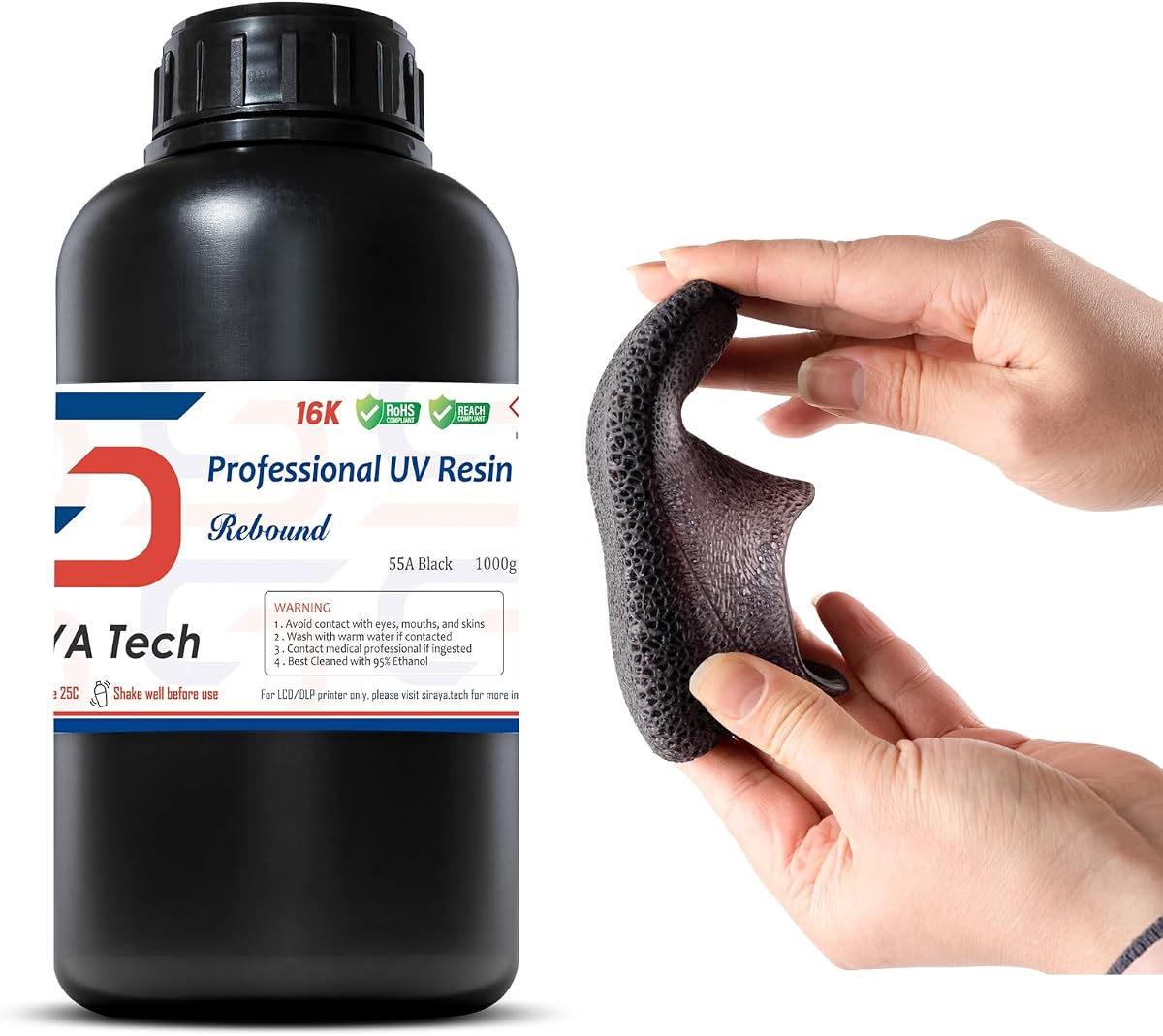
Siraya Tech Rebound 55A is the softest formulation in this guide, with a 4.2 rating and a 55A Shore durometer. It is designed around quick rebound, impact absorption, and a balance of compliance and structural integrity, making it more specialized than the general-purpose tough resins.
We may earn a commission when you buy through this link, at no additional cost to you.
Compared with standard elastic resins, the product is stated to rebound significantly faster after deformation. That behavior is attractive for shock-absorbing prototypes, gaskets, seals, personal protective equipment concepts, and consumer-product mockups. It prints on standard 405nm LCD and DLP resin printers and cleans with standard isopropyl alcohol methods, without A/B mixing or specialized processing.
The material is softer than Tenacious Flex, so it will accommodate more deformation but may be less suitable for rigid loads. The supplier also notes that initial compression testing is promising while long-term performance testing remains ongoing. This is important context for safety-critical or heavily service-loaded applications; a prototype should not be treated as a certified final product without appropriate engineering validation.
Choose Rebound 55A when fast recovery and a soft touch are central to the project. It is particularly attractive for wearable concepts, cushioning, seals, and articulated components, provided that the user recognizes the softer handling characteristics and the limited long-term data.
At 55A Shore hardness, this is the most compliant material in the guide. It is suitable for flexible prototypes that need to bend deeply, compress comfortably, or conform around another object.
Because the resin prints as a single material and uses standard cleaning methods, it avoids the complexity of A/B elastomers. Users still need normal exposure tuning, ventilation, washing, and complete post-curing.
We may earn a commission when you buy through this link, at no additional cost to you.
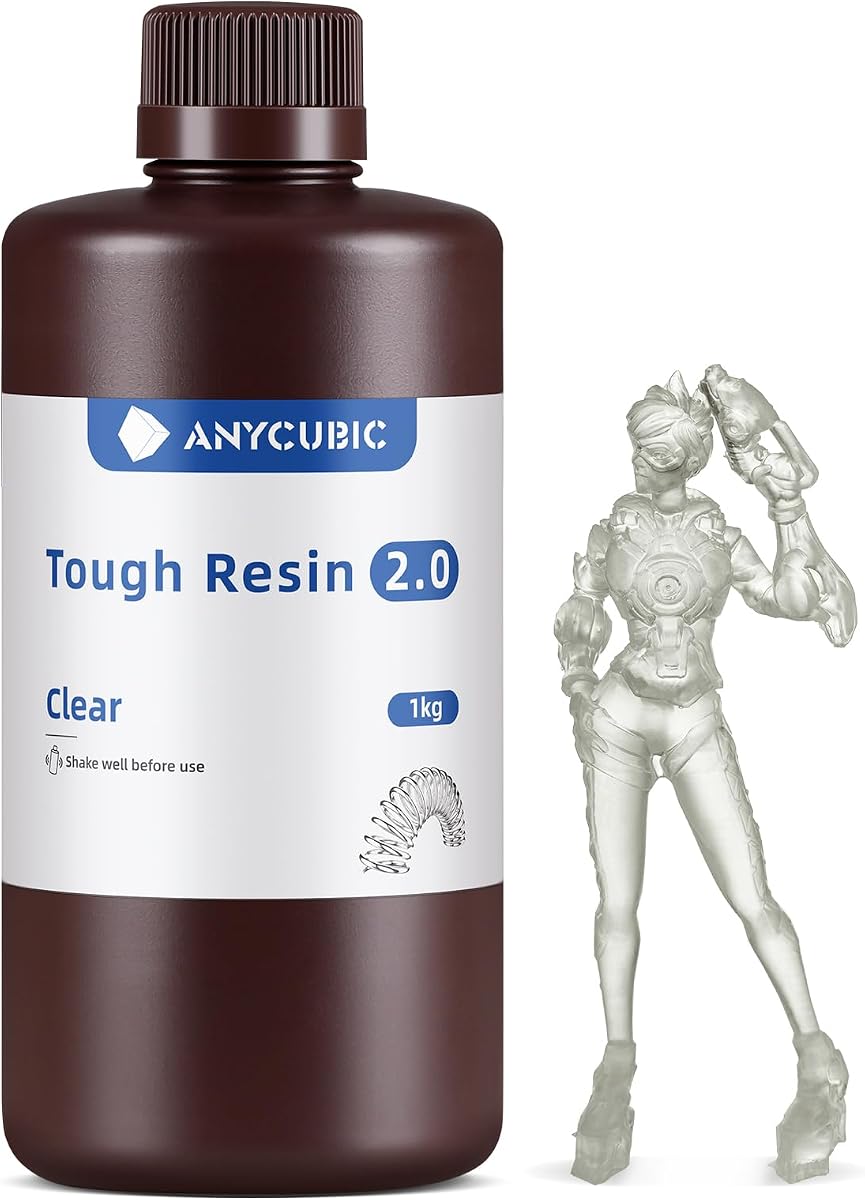
ANYCUBIC Tough Resin 2.0 in clear is a high-precision formulation with a 4.6 rating. Like the gray version, it emphasizes increased flexural strength, stretch capacity, and resistance to breakage, making it appropriate for thin components, delicate miniatures, and parts that may encounter drops or cyclic vibration.
We may earn a commission when you buy through this link, at no additional cost to you.
Its low-odor formulation is designed to reduce volatile compounds and create a calmer printing environment. Low shrinkage supports precise dimensions, while the clear finish can be useful for inspecting internal features, checking assembly fit, or creating prototypes that benefit from visible construction lines. It is listed for 4, 8, 12, and 16K LCD, DLP, and SLA resin printers.
The material is tough rather than truly soft. It can flex and resist cracks, but it will not match the cushioning behavior of a 55A or 70A elastomer. Clear photopolymers can also discolor over time or under prolonged UV exposure, although that does not affect the structural claims. Complete washing and post-curing remain important for achieving the intended properties.
This listing is a good choice for makers who want the toughness of the 2.0 formulation in a transparent color. It is especially useful for fit checks, mechanism prototypes, thin-walled parts, and display models that require detail and dimensional accuracy without appearing completely opaque.
The clear formulation makes internal fit, layers, and assembly relationships easier to inspect. Combined with low shrinkage, it is useful when visual inspection and accurate joining are central to prototype development.
Improved flexural strength reduces the risk of thin walls snapping during removal or handling. The material's stretch and vibration resistance support repeated-use prototypes without making it excessively soft.
We may earn a commission when you buy through this link, at no additional cost to you.
FUNCECOL 90A Resin is a black, 1kg formulation with a 4.4 rating. Its 90A Shore hardness places it at the firm end of this flexible-resin selection, combining a rubber or TPU-like feel with enough structure for protective cases, toy tires, shoe-sole concepts, grips, gaskets, and other frequently handled parts.
We may earn a commission when you buy through this link, at no additional cost to you.
The claimed high elongation, tear resistance, and bending performance allow repeated folding without normal cracking. Strong tear resistance is particularly important for thin, complex geometries because flexibility without tear strength can still result in short-lived parts. The material also emphasizes high precision, low odor, and support for MSLA, DLP, and LCD printers operating at 405nm.
Compared with 55A, 70A, or 80A resin, 90A will feel considerably firmer and offer less cushioning or deformation. It is better suited to durable grips and realistic functional parts than to deep compression, protective cushions, or wearable objects intended to drape around the body. Good ventilation remains essential even though odor is reduced.
Choose FUNCECOL 90A when you want visible flexibility but need the part to withstand repeated bending, pulling, and everyday wear. It rounds out the guide as a firm flexible option for engineering mock-ups, functional prototypes, cosplay components, and robust ergonomic parts.
At 90A, the resin offers a durable rubber-like feel rather than a plush cushion. That firmness helps it resist tearing and permanent deformation in frequently handled prototypes.
The low-odor formula is described as high precision, allowing flexible parts to retain crisp details. It is a useful bridge between rigid tough resin and genuinely soft elastomer behavior.
We may earn a commission when you buy through this link, at no additional cost to you.
The right flexible resin depends on how much the finished part must bend, how quickly it must recover, what loads it will withstand, and how your printer handles the formulation. These factors narrow the choice more effectively than the word flexible alone.
Shore hardness is the clearest starting point because it indicates how soft or firm the cured material feels. Rebound 55A is the softest option here and offers deep deformation, while SUNLU Flexible 70A occupies the middle. Superflex at 80A and FUNCECOL at 90A are progressively firmer, and ELEGOO Tough Resin uses a 84.7D rating for a stronger, less rubber-like result. The ANYCUBIC and SUNLU tough formulations are reinforced polymers that can flex but should not be judged like soft elastomers.
In short, choose a lower Shore value for cushioning and compression, and a higher value for structural strength, grip, and wear resistance.
Elongation at break describes how far a cured sample can stretch before failing. Superflex states 100% elongation, while SUNLU Flexible 70A lists 135%. Several other products emphasize strong elongation or repeated stretching without providing a single numerical value. High elongation is useful for rubber-like objects, but it does not reveal the force required to stretch the material or how quickly it returns.
In short, treat numerical elongation as a comparative signal and prioritize demonstrated rebound or recovery when your design depends on repeated motion.
If a part will be dropped, squeezed, attached to a mechanism, or used as a grip, impact resistance matters more than softness alone. ANYCUBIC Ultra Tough emphasizes recovery after external force, Siraya Tenacious Flex focuses on extreme bending and cracking resistance, and SUNLU High Toughness focuses on long-lasting toughness and elongation. FUNCECOL adds an explicit tear-resistance claim for frequently handled parts.
In short, flexible does not automatically mean durable, so match impact, tear, and compression claims to the way the part will actually be used.
Rebound describes how quickly a material returns toward its original shape after being compressed or bent. Fast recovery is valuable for articulated models, protective components, repeated gripping, and shock absorption. Siraya Rebound 55A is specifically positioned around faster rebound, while Tenacious Flex and ANYCUBIC Ultra Tough also emphasize rapid recovery. A tough reinforced resin may return to shape differently and feel more structure-oriented than a soft elastomer.
In short, prioritize rebound when the model must move repeatedly or return to a consistent shape after a brief deformation.
Most products in this guide support common LCD, DLP, SLA, or MSLA resin printers. SUNLU Flexible and ANYCUBIC Tough Resin 2.0 explicitly cover 365–405nm wavelengths, while FUNCECOL specifies 405nm curing. Rebound 55A is listed for standard 405nm LCD and DLP systems. Compatibility can also depend on printer size, vat type, build volume, power supply, and software settings, so check the printer's own material requirements before ordering.
In short, confirm both wavelength and printer format, then verify that your machine supports the chosen resin's viscosity and curing profile.
ANYCUBIC Ultra Tough and Siraya Tenacious Flex can be used directly or blended with other resins to increase toughness or flexibility. Blending allows you to tune an existing formulation, but it may change viscosity, curing time, surface finish, and color. Different colored resins can shift the appearance of the final blend, while a matching color is less likely to create an obvious change. Direct use is more predictable for first-time users.
In short, begin with the manufacturer-designed resin and treat additives as an experimental tool until you have tested a small batch.
Flexible parts can show fine details, but low shrinkage, smooth surfaces, and reliable curing are especially valuable when the result must fit with other components. ANYCUBIC Tough Resin 2.0 emphasizes low shrinkage and precision, SUNLU Flexible 70A claims a smooth, non-sticky finish after cleaning, and FUNCECOL highlights high precision. Very soft materials may present more support, removal, or dimensional challenges than reinforced tough resins.
In short, prioritize smooth surfaces and low distortion for precision parts, and validate thin walls or complex geometry with a test print.
All photopolymer resins require washing and post-curing to reach their intended properties. Rebound 55A is notable for using standard isopropyl alcohol cleaning without A/B mixing or special processing, while most other products follow familiar resin workflows. Complete curing is particularly important when flexibility, skin contact, impact resistance, or long-term performance is expected. Follow the resin supplier's exposure, washing, and curing instructions for the chosen formulation.
In short, do not judge flexibility from an uncured or partially cured sample; wash and fully post-cure the print before evaluating its finish or performance.
Begin with a small test model and a clean, compatible resin vat. Stir the bottle according to the manufacturer's instructions, taking care not to introduce bubbles, and pour carefully. Resin that has settled or changed consistency should be brought back to the condition required by the supplier. Before loading a material with a new viscosity, resin color, or softness level, confirm that your printer supports it and run a simple calibration print.
Expose the first layers using the supplier's recommended settings, then adjust exposure carefully for your printer, power supply, ambient temperature, and model geometry. Soft resins can sometimes require different exposure and layer behavior than rigid materials. Inspect the test print for undercutting, warped corners, trapped air, weak layer adhesion, and excessive cure shrinkage. Support the model appropriately, but avoid supports that leave difficult marks on flexible surfaces.
After printing, remove the part carefully and wash it using the required cleaning method before completing the post-curing process. Let it cool between washing and curing, then inspect it for a dry, non-sticky surface, cracks, and uncured areas. Store the bottle tightly sealed and away from heat, direct sunlight, and sources of contamination. For extended storage, follow the supplier's guidance on temperature, container condition, and possible remixing, and always verify the material before reusing it.
Siraya Tech Rebound 55A is the softest option listed, with a 55A Shore durometer. It is intended for deep compression, quick rebound, and soft prototypes rather than rigid functional parts. SUNLU Flexible 70A is the next softer choice, while 80A and 90A products provide progressively firmer rubber-like behavior.
It can be used for functional prototypes and selected parts when the formulation matches the load, temperature, wear, and environment. Tough and impact-resistant products are better for structural work, while softer elastomers suit cushions, seals, and grips. Any safety-critical or load-bearing application should undergo appropriate engineering and material validation.
No. Tough resin is reinforced to resist cracking and fracture while still allowing some flex, whereas a dedicated elastomer is optimized for softness, stretch, and compression. Products such as ANYCUBIC Tough Resin 2.0 and SUNLU High Toughness are versatile functional polymers, not substitutes for a soft 55A or 70A material.
Most products support common LCD, DLP, SLA, or MSLA photopolymer printers. Check the specified wavelength, which is commonly 405nm or 365–405nm, and confirm compatibility with your printer's resin specifications. A printer may still require exposure and profile adjustments when moving from rigid to flexible resin.
They still require thorough washing and complete post-curing, but most use familiar resin procedures rather than A/B mixing. Rebound 55A specifically notes standard isopropyl alcohol cleaning and no special cleaning process. Always follow the individual product instructions because viscosity, formulation, and recommended exposure can vary.
ANYCUBIC Ultra Tough and Siraya Tenacious Flex can be used as additives to improve the flexibility or impact resistance of other resins. Blending may affect viscosity, curing behavior, dimensions, and color, so test a small batch first and record the ratio used for consistent future results.
ANYCUBIC Ultra Tough is especially focused on articulation, clear hair-like textures, and recovery after deformation. Siraya Tenacious Flex and Rebound 55A also suit moving parts, with Tenacious offering greater structural strength and Rebound greater softness. The best choice depends on the required joint travel and the amount of wear the model will experience.
Use a smaller layer height, verify adequate exposure, avoid moving the part before curing, and complete both washing and post-curing correctly. Low-shrinkage formulations and stronger layer adhesion can also help. If cracks continue to appear, test a simpler geometry and make small exposure or profile adjustments rather than changing several settings at once.
ANYCUBIC Ultra Tough is the strongest all-around selection because it combines impact resistance, flexibility, rapid shape recovery, and useful additive versatility. Siraya Tenacious Flex Black stands out for softer rubber-like behavior and elastic rebound, while SUNLU High Toughness Resin delivers durable, precise results with broad printer compatibility and a 4.7 rating.
For genuinely soft applications, choose Rebound 55A when rapid recovery is essential or SUNLU Flexible 70A when a softer middle ground is preferred. Superflex 80A offers a structured rubber-like balance, FUNCECOL 90A prioritizes tear resistance and wear, and the tough formulations are better suited to thin, functional, or repeatedly handled parts that need strength more than cushioning.
Before buying, verify wavelength, printer type, intended hardness, curing workflow, and the part's real-world load. Review the current listing and product documentation, as availability, formulations, and prices can change. A small calibrated test print is the most reliable way to confirm that the chosen resin works well with your machine and design.