
2026 Ultrasonic Pest Squirrels Rodent Repellent for Car Engines Under Hood
4.8Editor score
Variable-frequency ultrasonic output
Combined flashing light action
Three flexible power options
Vehicle vibration sensing
Compare 10 Strobe Light for Squirrels in Attic options, including ultrasonic repellers, LED strobes, power options, coverage, and installation needs indoors.
A squirrel in an attic can create noise, damage stored belongings, and leave trails that are difficult to ignore. A suitable deterrent should combine an appropriate warning effect with reliable placement, safe power options, and enough coverage to discourage activity around the areas rodents are most likely to use.
This guide compares ten ultrasonic rodent repellers, LED strobe lights, and combination devices based on their documented features, intended environments, power methods, installation requirements, and suitability for attics. The list includes dedicated indoor units, basic party lights adapted for warning use, and vehicle-oriented products that also work in covered storage spaces.
Each review explains the strongest benefit and the most important trade-off so buyers can distinguish a purpose-built attic solution from a general-purpose light or vehicle deterrent. Ratings reflect the supplied customer feedback, while practical suitability depends on access, wiring, exposure, and squirrel behavior. Product availability and pricing can change.
4.8Editor score

5.0Editor score

4.2Editor score
The comparison below highlights the deterrent method, power, coverage, and best-use environment of each option so shoppers can find a device suited to an attic, garage, covered area, or vehicle without overlooking installation constraints.




This plug-in pest repeller combines an ultrasonic system, an LED strobe, and a visible display in one indoor unit. Its 4.0 rating reflects generally favorable customer feedback, while the most attractive attic feature is the unusually broad listed coverage of up to 3,900 square feet. The display also helps owners distinguish the active ultrasonic, scene, and strobe settings.
We may earn a commission when you buy through this link, at no additional cost to you.
Eight speakers, including four pulsed metal speakers, provide the device with several directions from which to project ultrasonic sound. The product information describes sonic frequency conversion, multiple sonic modes, three scene modes, and three strobe modes, all intended to keep the environment from becoming predictable. For a large attic, garage, basement, or workshop, that combination offers more control than a simple flashing lamp.
The main limitation is dependence on a nearby outlet and the fact that this is a general indoor pest repeller rather than a squirrel-specific model. Its description mentions squirrels, rodents, bats, and other small animals, but the listed 3,900-square-foot coverage should still be treated as a manufacturer claim rather than a guaranteed exclusion zone. Large open attics may also require careful placement so sound is not obstructed.
This is a sensible choice for homeowners with a powered attic who want a dedicated repellent with several adjustment options and a larger speaker array. Place it near the squirrel's likely route, keep the output unobstructed, and allow time for the animal to learn that the area is uncomfortable. Buyers seeking a vehicle-only installation should consider one of the under-hood models instead.
The listed 3,900-square-foot range and eight-speaker arrangement make this model more relevant to a broad attic than a compact mini light. Test the unit in the space and reposition it if rafters, stored furniture, or insulation appear to block the ultrasonic output.
Separate sonic, scene, and strobe modes provide several ways to vary the deterrent. Rotating these settings can make the environment less predictable without requiring chemical bait or traps.
We may earn a commission when you buy through this link, at no additional cost to you.
The LeafZap package includes two compact rodent deterrent units and earns a 4.4 rating. Each device combines 25–55kHz ultrasonic output with six white LED strobes, combining two kinds of changing sensory stimulation in a housing originally designed for vehicle engine compartments. That background makes it most convincing when a squirrel is entering through a garage, parking area, or connected covered space.
We may earn a commission when you buy through this link, at no additional cost to you.
Installation is flexible because each unit can operate from four AA batteries, a DC connection, or a USB adapter. The supplied description claims a combined 3,600 square feet for the pair and notes eight included zip ties. A vibration sensor is also used to place the device in standby while a vehicle is running and reactivate it after the vehicle has been parked, which may be useful for owners protecting both an engine bay and a nearby storage area.
The main caveat is that the product was engineered around under-hood heat and vibration rather than a conventional attic. It should be kept in a dry, covered location away from direct rain or snow. The listed frequencies are described as inaudible to humans, dogs, and cats, and the device uses no odors or residues, but users should still consider their own household and local safety requirements.
This two-pack works best for buyers who want to protect an attic-adjacent garage, workshop, stored vehicle, or other covered area with flexible power sources. It is less compelling for a fully enclosed attic with no usable outlet unless battery operation is acceptable. Its dual-mode output and automatic sensing make it a practical alternative to a basic strobe-only fixture.
One unit can protect a vehicle or storage bay while the second covers an entry route or nearby covered area. Separate placement may be more useful than expecting one device to cover an entire property.
AA, USB, and DC options allow the owner to match the installation to available infrastructure. Vehicle sensing adds convenience in automotive spaces but should not be relied upon as the only control in a walk-in attic.
We may earn a commission when you buy through this link, at no additional cost to you.
This PUBAMALL unit is designed around common indoor rodent-control needs and explicitly identifies attics among its intended spaces. Its 4.2 rating and feature set make it one of the most direct matches for the search: nine LED strobe lights work with ultrasonic waves rather than relying on flashing light alone. The visual warning is designed to disturb a rodent's perception in a dark space while the sound targets its sensitive hearing.
We may earn a commission when you buy through this link, at no additional cost to you.
Four modes expand the owner's options. Test Mode simulates the sounds rodents hear so the user can check operation, while Fixed Mode uses a 25kHz central ultrasonic sensor. Sweep Mode employs two side speakers across a 22–32kHz range, and Double Mode combines the fixed and sweep functions. This menu makes it easier to vary the environment than with a light that offers only a flash-rate control.
The product description is admirably direct about the timeline: this is a longer-term deterrent, and rodents may initially become more active while irritated. It may take three or four weeks to produce obvious results. That expectation matters because a squirrel's response cannot be predicted precisely, and increased movement during the first days should not automatically be interpreted as success.
This is the most straightforward option for an attic with an outlet and a need for numerous visible warning lights. Its ultrasonic-and-light combination gives it more purpose than a general party strobe, while the relatively compact feature list keeps operation understandable. Place it along the animal's entry path, keep the surrounding area clear, and rotate modes as part of a consistent routine.
The distributed LED array provides a more conspicuous warning effect than a single compact bulb. Position the unit where squirrels can see it in a dark attic and avoid blocking the lights with stored objects.
Test, fixed, sweep, and double modes let owners check the unit and vary ultrasonic output. Alternating modes may be useful when a persistent squirrel has remained comfortable with one consistent pattern.
We may earn a commission when you buy through this link, at no additional cost to you.
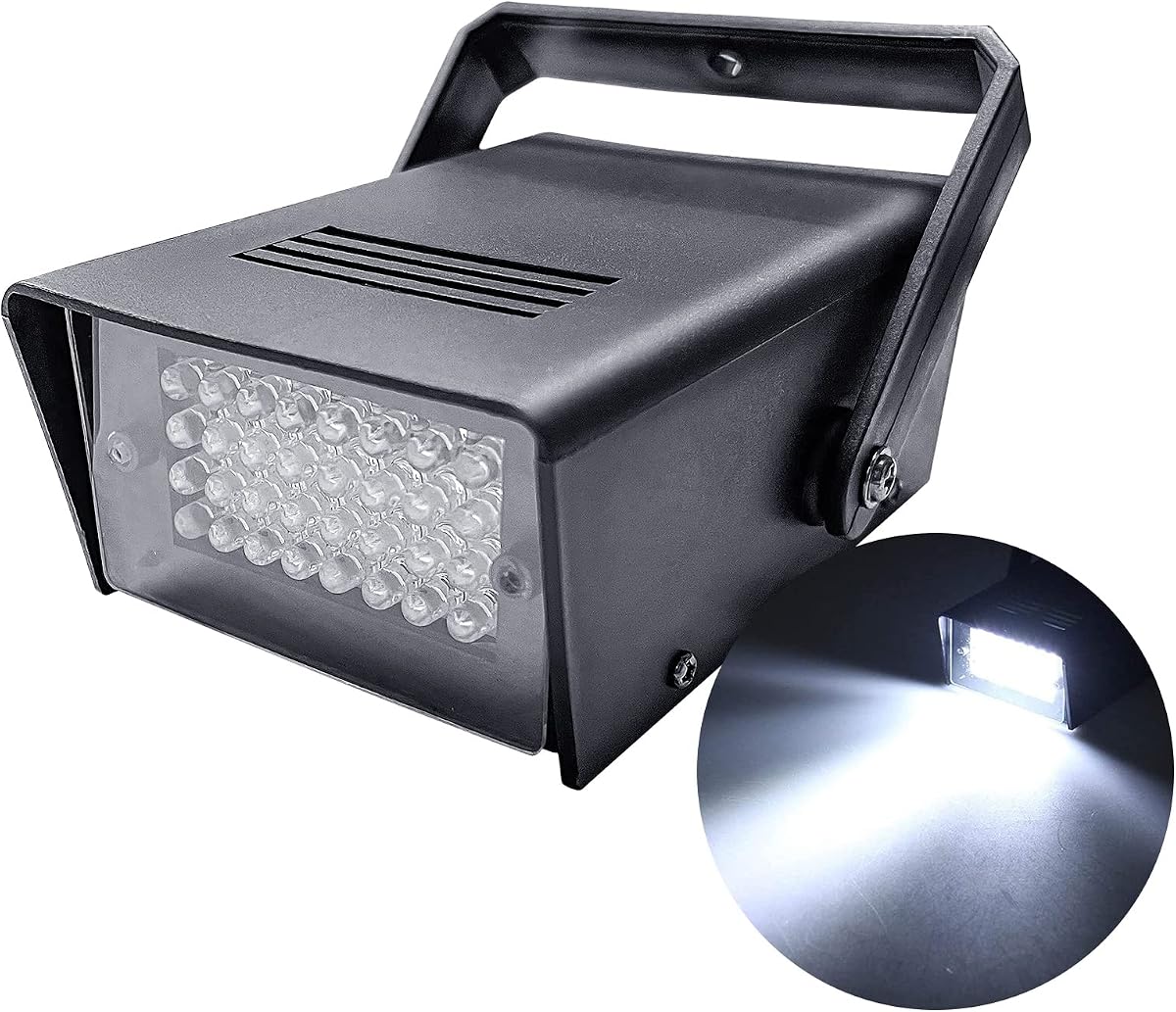
The Disco 32-LED strobe is a general-purpose flashing light with a 4.2 rating, and its product information specifically mentions placing a unit in an attic or garage to deter mice, squirrels, bats, and spiders. It is small enough to sit in one hand, uses 32 five-millimeter white LEDs, and includes a plastic mounting bracket for positioning the light where squirrels can see it.
We may earn a commission when you buy through this link, at no additional cost to you.
Its main strength is simplicity. A rotary control on the rear adjusts the strobe speed, so the owner can choose a slower flash or a more intense effect without navigating a complicated control panel. The five-watt output is designed for continuous operation, and the listed LED lifespan is 100,000 hours. These characteristics make it easy to add visual deterrence to an attic access point.
Unlike dedicated ultrasonic repellers, this unit has no documented ultrasonic output, occupancy sensor, or variable sound component. It is therefore best viewed as a supplemental visual warning device rather than a complete multi-sensory pest-control system. The plastic housing also requires care around moisture, and exposed outdoor placement may not be appropriate unless the unit is protected from rain and condensation.
Buy this model when the goal is inexpensive visual disruption with minimal setup. It can be especially useful near a known entry hole, in a dark crawl space, or inside a garage where several bright flashes may interrupt nighttime movement. For stronger deterrence, pair its conspicuous warning effect with exclusion work and consider a dedicated ultrasonic unit in the same area.
The rear speed control lets the user tune the light to the space. Starting with a moderate setting and adjusting it after observing the squirrel's behavior is sensible, especially in a confined attic where rapid flashing is visually intense.
The included bracket makes it practical to mount the light near a gap, beam, or access route. Keep the plug and connections protected from moisture and ensure the unit is stable rather than resting where it could be knocked loose.
We may earn a commission when you buy through this link, at no additional cost to you.
This two-pack supplies two small strobe units, each with 32 white LEDs and an adjustable flash rate. The listed applications include barns, lofts, and garages, which makes the lights relevant to an attic warning setup. Its 4.2 rating is comparable with other highly rated options, but the important distinction is that these are party-style lights used for a visual deterrent rather than combined ultrasonic repellers.
We may earn a commission when you buy through this link, at no additional cost to you.
The pair provides more placement flexibility than a single fixture. One light can face an entry point while the other illuminates a second route, or each can be installed at opposite ends of a long attic. Both units have simple controls, plastic cases, and mounting brackets, while the stated five-watt consumption and lack of heat buildup support continuous operation.
The product information cautions that the lights work indoors and should be kept from moisture if used outside. It also states that they are strobe lights and cannot function as continuous lighting fixtures. Neither limitation is unusual for this type of unit, but both matter in an attic where condensation, temperature changes, and limited electrical access are common.
This two-pack is best for owners who want a simple visual deterrent at two locations without dealing with sound settings or power adapters. Its strengths are convenience, brightness, and adjustable flashing. It should not be viewed as a substitute for sealing access points, and buyers who need ultrasonic coverage should consider a combination device instead of relying on light alone.
A pair is more useful when an attic has multiple likely routes. Place each unit where the squirrel is likely to cross a dark or exposed area, while keeping cords and fixtures out of its reach.
The stated low power draw and LED longevity make continuous operation practical. Still, check the plug, connections, and surrounding materials regularly, especially in an attic subject to heat or damp conditions.
We may earn a commission when you buy through this link, at no additional cost to you.
This 2026 ultrasonic squirrel and rodent repellent has a 4.8 rating and pairs 18–36kHz variable-frequency output with flashing light. It was developed for engine compartments, but its stated uses extend to garages, stored vehicles, covered carports, and indoor parking areas. Those features make it a strong option for an attic only when the installation can remain dry and reasonably sheltered.
We may earn a commission when you buy through this link, at no additional cost to you.
Its standout feature is the combination of changing ultrasonic output and visual warning. The variable range is intended to prevent the environment from becoming static, while the light adds another source of disruption. A built-in vibration sensor moves the unit into standby while the vehicle is operating and resumes protection after the vehicle is parked, which is useful in automotive applications.
Power can come from four AA batteries, a 5–12V USB supply, or a direct 12-volt vehicle battery connection. That flexibility is a major advantage over a simple plug-in party light, especially in a garage or storage building without a conventional outlet. The batteries are not included, and the owner must provide a suitable USB adapter when choosing that route.
This is our premium pick for buyers who want more than a basic flashing lamp and whose squirrel problem intersects with a garage, covered parking space, or stored vehicle. It is less ideal as a bare-bones attic solution because it lacks the high listed coverage of purpose-designed indoor repellers. Keep it away from direct rain and snow, position it near travel routes, and leave the output unobstructed.
Variable-frequency sound paired with flashing light creates two simultaneous signals. This makes the device more substantial than a visual-only fixture and allows the owner to vary the ultrasonic environment over time.
AA batteries provide cordless placement, while USB and direct vehicle connections support longer-term installations. Select the power method that matches the space and can be protected from attic temperature extremes.
We may earn a commission when you buy through this link, at no additional cost to you.
The ENUOLI unit is a compact white LED strobe with 24 lamps, variable speed control, and a portable rectangular design. Its 4.2 rating places it among the well-reviewed products in this group, but the documented feature set focuses on parties, clubs, Halloween, and general events. It can supply visible warning in an attic, yet it lacks the multi-sensory features of the dedicated repellers.
We may earn a commission when you buy through this link, at no additional cost to you.
Adjustable speed is the most relevant feature for squirrel deterrence. The owner can select a less intense pattern in a smaller room or use faster flashes to create a stronger visual interruption. The compact shape is convenient for testing at several entry points, and LED construction supports efficient, long-lasting illumination without the heat associated with older incandescent flash units.
Because the product is principally a party light, there is no documented ultrasonic frequency, occupancy detection, vibration sensing, or dedicated squirrel-control coverage. It should not be marketed as equivalent to a purpose-built repeller. It also lacks attic-specific environmental information, so care is needed with dust, temperature, insects, and moisture around the fixture.
This model is a reasonable supplemental choice for a homeowner who wants a compact strobe near a known entry route. Its portability makes it useful for checking where a squirrel is most active before installing a more comprehensive system. For a primary deterrent, select a device with ultrasonic output, multiple warning modes, and a clearer indoor specification.
The small body can be moved between access points without complex setup. This makes it easier to identify the location where a visual interruption is most visible from the squirrel's route.
Variable speed provides more control than a fixed flashing pattern. Start at a moderate setting and confirm that the light is visible from likely approach angles before leaving it in place.
We may earn a commission when you buy through this link, at no additional cost to you.
The IYZ repeller has a 5.0 customer rating, the highest numeric score in this group, and its product information explicitly names attics, garages, basements, storage rooms, and workshops among suitable areas. Four integrated LED strobes work alongside sweeping ultrasonic waves, giving this unit a clearer multi-sensory proposition than a standalone party light.
We may earn a commission when you buy through this link, at no additional cost to you.
Three power configurations make it adaptable to an attic and connected spaces. The owner can use four AA batteries, connect a USB-to-Type-C cable to a power bank or adapter, or use the vehicle power cable. A sensitivity sensor detects vehicle movement, pauses the device while a vehicle is being driven, and reactivates it 90 seconds after the vehicle stops.
The product claims that the unit can operate for at least three months after battery replacement when used normally in a vehicle, but that statement should not be transferred automatically to every attic environment. Battery life can vary with temperature, activity, and operating mode. The unit also requires periodic checking, especially where dust, pests, or exposed wiring could interfere with installation.
This is our editor's choice because it balances attic relevance, three power methods, visible strobe effects, and ultrasonic output in a single package. It is especially attractive for a garage workshop or storage area where conventional power may be inconvenient. Use the vibration mode around vehicles, select continuous power where appropriate, and position the unit along the squirrel's likely travel line.
Unlike models marketed almost entirely for engine compartments, this unit explicitly lists attics and storage rooms. That broader intended use makes the documentation more directly relevant to a typical squirrel problem.
Battery, USB-to-Type-C, and vehicle connections allow cordless or sustained operation. Continuous power is often easier to maintain in a fixed attic location, while batteries can help during testing or where wiring is inconvenient.
We may earn a commission when you buy through this link, at no additional cost to you.
This two-pack uses variable-frequency ultrasound and flashing white light to discourage rodents in vehicles, garages, warehouses, and other covered locations. Its 3.9 rating is lower than those of the leading repellers, but the package still offers a useful combination of two units, three power methods, and installation features aimed at practical covered spaces.
We may earn a commission when you buy through this link, at no additional cost to you.
Power can be supplied through four AA batteries, a DC-to-USB cable, or a vehicle power cable. A self-check function and vibration detection are included, with the unit switching off when motion is sensed to help conserve power. The flashing light is intended to disturb a rodent's visual perception, while the changing ultrasonic output supplies a separate deterrent effect.
The device is designed for 12-volt vehicles, which is an important constraint. Although the listing names attics, barns, sheds, basements, and farms as additional environments, the installation guidance is vehicle-centered. Buyers should not assume it has the same long-distance coverage as a dedicated indoor unit with multiple directional speakers.
The two-pack is most useful when a garage or storage building needs coverage in more than one location, or when one unit can protect a vehicle and another an exposed entry route. Its 3.9 rating suggests somewhat mixed experiences, so careful positioning and realistic expectations are important. Pair it with physical exclusion measures rather than treating it as a guaranteed solution.
The included pair can be divided between a vehicle and a nearby covered area, or placed at separate squirrel routes. This broadens coverage without requiring a single unit to reach every part of a large property.
Vibration detection turns the unit off during vehicle movement and uses a safety switch to avoid unnecessary battery drain. This is especially useful in engine compartments, though the feature adds less value in a stationary attic installation.
We may earn a commission when you buy through this link, at no additional cost to you.
This four-pack combines variable-frequency ultrasonic output with flashing white light and is marketed for 12-volt cars, trucks, RVs, engine bays, warehouses, and attics. Its 3.9 rating matches the two-pack version, so it should be considered alongside that model rather than automatically viewed as a more powerful unit. Its main advantage is the number of devices included.
We may earn a commission when you buy through this link, at no additional cost to you.
Each unit supports four AA batteries, a DC-to-USB cable, or a vehicle power connection. A power-on self check and vibration detection are included to reduce unnecessary operation when a vehicle is moving. The variable ultrasonic output and changing light are designed to interfere with a rodent's normal sensory environment and discourage it from entering or settling nearby.
Four units can cover an attic, garage, vehicle, and separate storage area, but the listing does not state a broad indoor coverage figure. The device should be kept in dry or covered settings, and its 12-volt vehicle orientation makes the instructions less directly relevant to a conventional residential attic. Managing cables and power sources across four locations also requires planning.
This product makes the most sense for buyers with several connected areas, multiple vehicles, or a large farm, workshop, or storage complex. It is less attractive for a single small attic where one well-positioned unit would be sufficient. Because its customer rating is among the lower results here, owners should monitor placement, avoid moisture, and reinforce entry points physically.
The four-pack can place a deterrent in each of several connected spaces. Concentrating two units near an active route may be more effective than scattering them thinly, but the correct arrangement depends on the building layout.
Every unit uses the same combination of variable ultrasound and flashing light. Standardized equipment makes maintenance and placement easier when the devices serve different areas of a garage, warehouse, or property.
We may earn a commission when you buy through this link, at no additional cost to you.
The most useful choice depends on whether the attic is powered, whether the device must operate in damp conditions, the squirrel's route, and whether visual warning alone is sufficient. These factors help narrow a large category of lights and repellers to an appropriate installation.
A dedicated rodent repeller that combines ultrasonic output with LED strobe lighting offers more deterrent mechanisms than a standard flashing lamp. Ultrasonic waves target the sensitive hearing of small rodents, while a bright and changing light can interrupt activity in a dark attic. Models with variable frequencies and several operating modes are especially useful because a constant environment may become less effective over time. A visual-only light can still make one route feel unsafe, but it offers no documented sound component.
Prioritize a combined ultrasonic-and-strobe device when the goal is a dedicated deterrent. Choose a simple party strobe only when the light will supplement physical exclusion or another control method.
Coverage should be judged against the actual attic dimensions, access routes, and obstructions. A unit claiming broad coverage and using several speakers may be more practical in an open or expansive space than a single compact light. However, manufacturer coverage figures are best treated as comparative guidance rather than guaranteed exclusion zones. Rafters, insulation, stored furniture, and partitions can interrupt the path of ultrasonic output, making strategic placement more important than the headline figure.
Look for a multi-speaker design with directional or 360-degree output when the squirrel can move through a large area. For a small attic with one obvious entry point, a smaller unit placed directly in the animal's path may be sufficient.
Power requirements should match the attic's infrastructure and the owner's willingness to maintain the device. Plug-in operation is simple and consistent but requires access to a suitable outlet. Battery power supports cordless placement and testing but requires periodic replacement, particularly in temperature extremes. USB and direct 12-volt connections offer other options for garages, workshops, and covered spaces. Always follow the manufacturer's instructions regarding batteries, adapters, and power consumption.
Choose continuous power for a permanent, fixed installation when a protected outlet is available. Use rechargeable or replaceable batteries for temporary testing and locations where running a cable is inconvenient.
Attics can become extremely hot, cold, dusty, and damp, so environmental suitability matters. Some vehicle repellers use heat-resistant construction and are useful in covered areas, while ordinary party lights are typically described for indoor use and should be protected from moisture. A device that works well under a vehicle hood is not automatically suitable for an exposed roof cavity. Check whether the product documentation limits use to dry locations and whether a nearby outlet is exposed to condensation or temperature swings.
For an unfinished attic, favor equipment with a clearly stated indoor or covered-area application. Protect connections, keep fixtures away from water entry, and choose stable mounting locations that will not be disturbed by stored items or wildlife.
Automatic sensing can make a deterrent easier to operate, although different sensors serve different purposes. Vehicle vibration sensors pause operation while a vehicle is moving and reactivate it after parking. Mode controls can vary ultrasonic frequency, light pattern, or the combination of both. Some repellers also include a test function that helps the user verify whether the ultrasonic output is operating as expected. These automated features do not replace occasional inspection, especially in dusty or temperature-exposed spaces.
Select variable modes when a squirrel has already encountered a fixed pattern. In a vehicle or garage, an automatic vehicle sensor is a meaningful convenience that can reduce unnecessary operation.
Installation time can range from plugging in a display-equipped unit to positioning several vehicle-powered devices and routing their cables. Compact lights often include a bracket, while repellers designed for vehicles may include reusable zip ties. A fixed attic installation should keep the unit stable, visible where appropriate, and away from obstructions. A battery-powered unit can be moved during testing to determine which routes the squirrel uses, but it should not be left where a vibrating animal could knock it down.
Favor a device with a mounting bracket or simple reusable ties if it must remain elevated. Before permanent placement, observe the attic for travel patterns and choose a position that can be checked without repeatedly disturbing stored belongings.
A single device can be sufficient when the squirrel has one clear route through a small attic. Multiple units become more useful when the building has separate entries, adjacent rooms, a garage, and an upper storage space. Two- and four-packs can provide broader placement options, but more devices do not automatically guarantee better results. Concentrating a unit in an active corridor and physically securing other openings may be more useful than placing several lights where they are rarely triggered.
Count separate zones before choosing a multipack. Two units often provide a practical balance for a garage and attic, while four are better justified by multiple vehicles, outbuildings, or widely separated access points.
Electronic repellents work best as part of a complete wildlife-control plan. Strobe and ultrasonic devices discourage activity but do not physically close an opening, remove nesting material, or resolve every access route. Metal or other durable screening may be needed to cover gaps, and damaged insulation or wiring should be repaired. A squirrel already inside the attic may require a different removal strategy. Buyers should also follow local wildlife rules and avoid placing devices where they could endanger non-target animals.
Use the deterrent to support—not replace—sealing entry points and removing attractants. If activity continues, consult a wildlife professional or a properly licensed pest-control service.
Begin by identifying where squirrels enter, travel, and nest. Inspect gaps around vents, roof penetrations, soffits, and transitions into the attic without placing yourself in immediate danger. Clean away food sources, secure loose materials, and repair obvious damage. Position the deterrent where the animal will encounter it, preferably along a recurring route rather than in an isolated corner where it cannot be seen or heard.
Install the unit according to its instructions, using a stable bracket, included ties, or another secure method. Connect the specified power source and select the appropriate ultrasonic, scene, and strobe modes. Where a test function is provided, use it to confirm operation. Leave the area undisturbed and allow the documented acclimation period; some rodents may initially move more because they are irritated by the changed environment.
Check the device periodically for dust, damage, loose wiring, and signs that squirrels have moved to a different route. Clean the housing according to the manufacturer's guidance without pushing moisture into openings. Rotate modes or relocate the unit if activity continues, and reinforce the physical entry points at the same time. If nesting, damaged wiring, or persistent human contact is involved, seek professional wildlife assistance.
A strobe light can make a dark route feel unsafe and may discourage repeated movement, but it does not physically remove an animal already inside. Results vary with squirrel behavior, placement, and the severity of the infestation. A unit combining LED strobes with variable ultrasonic output generally offers more deterrent features, while physical exclusion remains essential.
The listed ultrasonic repellers are marketed as inaudible to humans, dogs, and cats, and several descriptions emphasize a non-toxic, odor-free approach. Buyers should still follow the included instructions and avoid placing the unit where people or pets are likely to remain directly beside the output. Children and animals should not be allowed to handle wiring or the power connections.
There is no fixed timetable because squirrels differ in habituation and the amount of ultrasonic coverage varies. PUBAMALL specifically states that obvious results may take three or four weeks and that rodents can initially be more active while irritated. A persistent squirrel may also be responding to an unsealed route rather than merely ignoring the device.
A plug-in model is convenient for continuous operation when a suitable protected outlet is available. Battery power makes temporary testing and cordless placement easier, but batteries need periodic replacement and may lose performance in temperature extremes. USB and vehicle power options can provide alternatives in garages, workshops, and covered storage areas.
A party strobe can provide a bright, changing visual warning and may discourage activity around a specific entry route. It does not provide the ultrasonic component found in dedicated rodent repellers, so it is better treated as a supplemental or testing device. A dedicated combination unit is generally more appropriate for a primary deterrent.
Place it near a known entry point or along a repeatedly traveled route, ideally where the squirrel can see or encounter the warning effect. Keep ultrasonic output unobstructed by insulation, stored furniture, or partitions. Testing several locations with a portable unit can help identify the most active path before final installation.
Attic conditions vary, and not every model is designed for exposed or damp locations. The vehicle-oriented repellers generally specify dry or covered use, while the mini party lights are described as indoor products that should be kept away from water. Follow the product-specific guidance, protect connections, and avoid direct rain, snow, and condensation.
Yes. Closing gaps is important because a deterrent cannot prevent an animal from entering through an open route. Use appropriate screening or other durable exclusion material, repair damaged areas, and keep food and nesting materials inaccessible. If a squirrel is already nesting inside, a licensed wildlife professional can help determine the safest removal plan.
The variable-frequency vehicle repellent stands out for premium dual-action operation, the IYZ Four-Light Repellent offers the most attractive attic-focused feature set, and the PUBAMALL Nine-Light Repellent is a clear purpose-built choice with several modes. For simpler visual warnings, the Disco 32-LED and ENUOLI lights can be affordable supplemental tools, but they do not match the deterrent capabilities of ultrasonic combination devices.
Prioritize an approach suited to the actual space. A large attic with reliable power favors an indoor multi-speaker unit, while an attached garage or covered storage area may benefit from a vehicle-rated model with USB, battery, and direct-power options. In every case, place the device on a confirmed squirrel route, vary modes when appropriate, and seal access points so the animal cannot simply return.
Before purchasing, confirm the installation area, power access, environmental restrictions, and the product's full title and rating. Product designs, customer feedback, availability, and pricing can change, so check the current listing and manufacturer instructions at the time of purchase. The most effective setup is a well-positioned deterrent combined with practical exclusion and, when necessary, professional wildlife help.