
Klein Tools ET450 Advanced Circuit Breaker Finder and Wire Tracer Kit
4.7Editor score
Traces energized or non-energized wires
Adjustable receiver sensitivity
Supports multiple voltage levels
Our Circuit Breaker Finders guide compares ten tools for accurate circuit tracing, GFCI and outlet testing, voltage detection, accessories, and ease of use.
Circuit breaker finders make electrical troubleshooting faster by connecting a transmitter to a known outlet or fixture and using a receiver to identify the matching breaker. The best models add clear signals, dependable detection, outlet and GFCI testing, useful adapters, and features that make dark panels easier to inspect.
We compared all ten products by their stated circuit-tracing methods, supported voltage ranges, receiver alerts, diagnostic displays, safety functions, included accessories, ratings, and intended applications. The list covers practical options for homeowners, electricians, maintenance teams, residential wiring, and commercial electrical systems.
Each pick highlights the features that distinguish it from the alternatives, while the comparison table shows where the tools differ. Product ratings and availability can change over time, and current prices should be checked on the linked product pages before making a purchasing decision.
4.7Editor score

4.7Editor score

4.5Editor score
The comparison below organizes each finder by its core tracing capability, display or alert system, diagnostic functions, and included accessories, helping readers identify the most suitable tool for routine panel work or advanced wire tracing.




The Klein Tools ET310KIT AC Circuit Breaker Finder Kit earns a 4.7 rating and stands out as a balanced, practical choice for everyday electrical troubleshooting. It combines a transmitter, receiver, GFCI testing capability, and several connection adapters without turning the core task into a complicated diagnostic process. Its strongest appeal is the combination of accurate identification and practical accessories in one kit.
We may earn a commission when you buy through this link, at no additional cost to you.
The transmitter connects to an outlet or fixture, while the receiver scans the breaker panel. Users receive both visual and audible cues when the correct breaker is located, which is particularly useful in crowded panels where a weak light or subtle signal could otherwise slow the process. The built-in GFCI outlet tester adds another layer of usefulness, allowing the same equipment to inspect wiring conditions and test GFCI devices.
Its light socket adapter makes it possible to identify a lighting circuit rather than relying only on receptacles. The included three-prong-to-two-prong grounding adapter improves compatibility with older or unusual outlet arrangements, and the alligator clip adapter supports testing on bare wires. These accessories broaden the range of jobs the kit can handle, although it remains focused on standard 90–120V AC residential-style circuits.
This kit is a strong choice for homeowners who want a dedicated breaker finder and for electricians or maintenance personnel who regularly need a compact multi-diagnostic tool. It is less suited to tracing de-energized conductors or identifying multiple voltage systems, but for its intended category it offers a convincing mix of convenience, useful alerts, and included accessories. It is the most well-rounded recommendation in this guide.
Matching audible and visual feedback reduces the need to repeatedly look away from the panel or rely on a single weak cue. That makes the receiver practical for identifying a breaker quickly in both bright and dim workspaces.
The integrated GFCI tester and connection adapters extend the kit beyond finding a breaker, making it useful for wiring checks, lighting fixtures, and bare-wire connection points on supported circuits.
We may earn a commission when you buy through this link, at no additional cost to you.
The Klein Tools ET310 AC Circuit Breaker Finder carries a 4.7 rating and offers a direct way to identify the breaker serving a standard outlet or fixture. Its two-part design is easy to understand: the transmitter stays at the circuit being tested, and the receiver scans the panel. Visual and audible indications provide confirmation without requiring interpretation of a complex display.
We may earn a commission when you buy through this link, at no additional cost to you.
A notable convenience is the transmitter's ability to dock in the receiver for compact storage. That matters for technicians moving between jobs or homeowners who want the tool in one place rather than loose in a toolbox. The unit also includes a GFCI outlet tester, so it can check more than the panel location and provide additional information about supported wiring conditions.
The main limitation is its narrower accessory selection compared with several competitors in the guide. The standard three-pin plug is designed for North American grounded outlets, and the listed compatibility centers on 90–120V AC circuits. It does not offer the wider voltage displays, non-contact voltage detection, bare-wire accessories, or signal-strength screens found on more elaborate models.
For someone who wants an uncomplicated breaker finder with a proven brand name and no need for extensive accessories, the ET310 remains a persuasive option. It is especially suitable for routine household troubleshooting, such as identifying which breaker powers an outlet, a room, or a connected fixture. Users seeking advanced tracing capabilities should look farther down the list.
The nesting design keeps the transmitter and receiver together, reducing missing pieces and making the tool simpler to carry from a panel to a work area.
The plug-in transmitter and panel-scanning receiver reduce procedural complexity, which can be helpful for first-time users carrying out basic household diagnosis.
We may earn a commission when you buy through this link, at no additional cost to you.
The KAIWEETS KT301P earns a 4.5 rating and delivers one of the broadest feature sets among the value-oriented tools in this roundup. It combines breaker tracing, outlet testing, GFCI testing, non-contact voltage detection, a flashlight, and a backlit LCD. The display provides real-time voltage, wiring status, and signal strength, giving users more information than a simple beep-and-light finder.
We may earn a commission when you buy through this link, at no additional cost to you.
Its GFCI tester includes an automatic trip function, red and green indicators, and detection of seven common wiring faults. The auto-hold behavior retains the latest outlet results and voltage reading after the transmitter is unplugged, which is convenient when working in a confined area. The receiver's non-contact voltage function can identify nearby voltage sources without direct contact to a conductor.
The included three-prong-to-two-prong adapter, light socket adapter, alligator clip adapter, and carrying case create a generous package. These additions support older outlets, lighting circuits, and bare-wire testing. The tradeoff is that the feature set can feel more complex than a basic receiver, and its broad display does not mean it is appropriate for every electrical system or operating condition.
This is a compelling pick for DIYers and maintenance staff who want more diagnostic information without moving to an advanced wire-tracing kit. It is also a good choice for users who value a backlit screen in dark panels. Among the products offering an LCD, GFCI tools, NCV detection, and a complete accessory set, the KT301P is especially well balanced.
Real-time voltage and signal-strength information can make it easier to understand why the receiver is responding, while the backlight improves visibility in poorly illuminated panels.
The combined GFCI, outlet, and non-contact voltage functions reduce the need to carry several separate instruments for common diagnostic tasks.
We may earn a commission when you buy through this link, at no additional cost to you.
This Circuit Breaker Finder and GFCI Outlet Tester earns a 4.5 rating by combining digital circuit tracing with detailed outlet diagnostics. Its dual-function LCD shows real-time voltage and signal strength, giving users a more precise way to distinguish the target circuit from nearby breakers. It operates on 90–135V AC circuits, covering a useful range of standard North American installations.
We may earn a commission when you buy through this link, at no additional cost to you.
The transmitter's GFCI tester includes automatic trip testing, and the screen shows the time required for the trip. Red and green LEDs supplement the display, while the system can diagnose six common wiring faults, including open circuit and reverse polarity. The receiver has an anti-slip design intended to make one-handed panel work more manageable.
At 0.9 pounds, the product is described as lightweight and portable, with an impact-resistant ABS housing for routine work-site demands. Batteries, a screwdriver, a manual, and a carrying case are included. It does not list a non-contact voltage function, so users seeking that capability should favor the KT301P or KT303P instead.
The tool is best suited to electricians and DIYers who want visible measurements rather than relying entirely on audible and visual signals. Its broad voltage window, digital guidance, and GFCI timing information make it a good middle ground between basic finders and more specialized wire tracers. It is a particularly practical option for users who prioritize diagnostics over maximum tracing range.
Numeric voltage, signal strength, wiring conditions, and GFCI trip timing provide more context than a simple indicator light, helping users distinguish a strong match from a weak signal.
The lightweight housing and anti-slip receiver are sensible features for crowded workspaces where balancing a full-size tool or reading a small panel is difficult.
We may earn a commission when you buy through this link, at no additional cost to you.
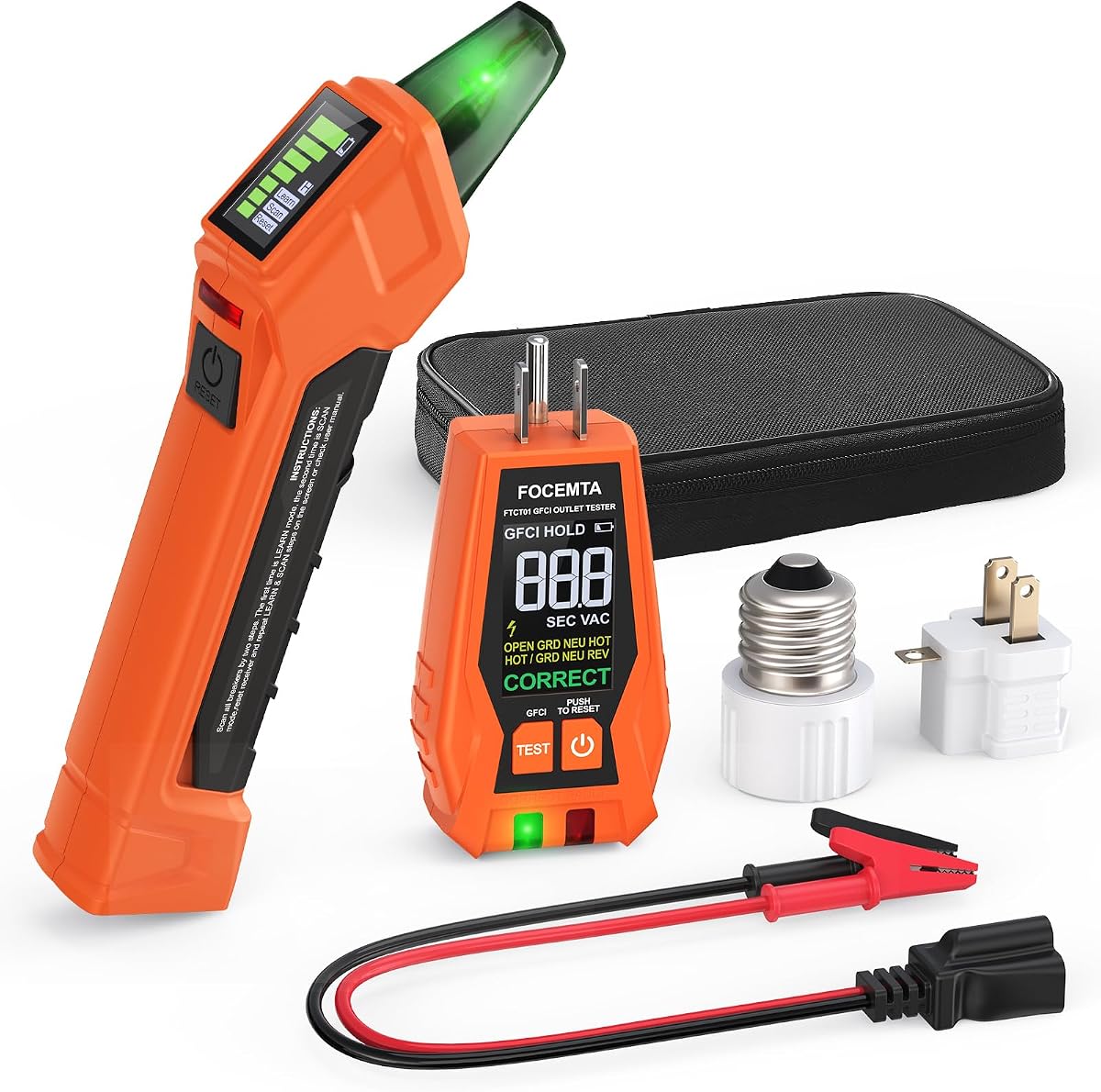
The KAIWEETS KT302P Circuit Breaker Finder Tool Kit has a 4.5 rating and emphasizes intuitive operation. Its learn-then-locate process asks users to connect the transmitter to the circuit, establish the reference signal, and then scan the panel. This removes the need for manual sensitivity adjustments and makes the tool approachable for homeowners, maintenance staff, and electricians handling routine identification.
We may earn a commission when you buy through this link, at no additional cost to you.
The receiver uses bright LEDs, a distinct audible signal, and a built-in flashlight to help locate the correct breaker. The flashlight is particularly useful in dark panels or confined work areas. A dual-sided GFCI outlet tester places six LED indicators on both the front and back of the transmitter, so wiring conditions remain visible regardless of how the receptacle is oriented.
Three-prong-to-two-prong, light socket, and alligator clip adapters make the kit flexible for different connection points. The carrying case keeps those accessories together and protects them during transport. What it does not offer is an LCD, numerical voltage display, or stated non-contact voltage mode, so its appeal rests on clear indications rather than detailed measurements.
The KT302P is a good selection for users who prefer straightforward signals and a simple workflow. It also suits anyone who regularly needs to test supported outlets and GFCI devices while tracing a breaker. It is not the strongest option for advanced cable tracing, but for everyday circuit identification and fault checking, it provides a focused and approachable toolset.
The learn-then-locate sequence is designed to establish a stable reference before scanning, reducing user input and making repeated checks more consistent.
Dual-sided LED patterns make wiring status easy to see even when a receptacle is mounted in a position that would hide the usual indicator face.
We may earn a commission when you buy through this link, at no additional cost to you.
This Circuit Breaker Finder Kit has a 4.4 rating and offers a detailed digital approach to identifying circuits. Its dual-function LCD presents real-time voltage from 90–135V and signal strength, while audio and visual alerts provide quicker confirmation. It combines breaker finding, outlet testing, and GFCI diagnostics in a portable package designed for residential and commercial work.
We may earn a commission when you buy through this link, at no additional cost to you.
A particularly useful feature is the ability to lock test data on the display for ten seconds if power is lost. That preserves critical readings during an unexpected interruption instead of forcing the user to repeat the test. The GFCI section also shows testing duration, uses red and green indicators for immediate feedback, and identifies six common wiring faults.
The product includes a transmitter, receiver, batteries, screwdriver, manual, carrying case, light socket adapter, three-prong-to-two-prong grounding adapter, and alligator clip lead. The clip adapter uses a combined metal-and-plastic design intended to improve contact security and reduce slippage. The stated CAT II 135V rating and screw-sealed battery compartment add visible details about its intended electrical environment.
This kit is a strong fit for electricians or technically inclined DIY users who want numbers, retained results, and a broad accessory selection. It may feel unnecessarily elaborate for a quick breaker-identification task, but the added diagnostics are valuable when checking wiring or GFCI operation in the same workflow. It stands out among mid-range finders for its power-loss data hold.
Retaining the last voltage and fault information for ten seconds can prevent a useful result from disappearing during a brief interruption or while the user changes position.
The one-piece metal-plastic clip construction is designed to maintain electrical contact and reduce movement, making the adapter more dependable during testing.
We may earn a commission when you buy through this link, at no additional cost to you.
The Fluke BK120 SmartTrace Breaker Finder and Socket Tester has a 4.6 rating and delivers a focused four-in-one design. It functions as a breaker finder, non-contact voltage detector, socket tester, and LED flashlight. That combination gives it broad everyday utility without the larger accessory package or elaborate display seen on some competing models.
We may earn a commission when you buy through this link, at no additional cost to you.
Audible and visual alerts help users locate the correct breaker, while the transmitter's built-in socket tester uses easy-to-see LEDs to verify wiring in both standard and GFCI outlets. Its distinctive dual-sensitivity non-contact voltage mode can be useful around terminal strips and supply cords, where switching sensitivity may help separate nearby live sources.
The built-in flashlight adds practical value in poorly lit electrical panels. However, the listed feature set does not mention a numerical voltage display, a broad collection of adapters, or the ability to trace de-energized wiring. Users who need those functions may prefer one of the digital LCD kits or the advanced Klein ET450.
The BK120 is especially compelling for professionals and homeowners who value focused diagnostics in a recognizable, professional-oriented format. It is particularly useful for routine outlet checks, panel identification, and checking for nearby voltage without direct contact. It is not the most comprehensive kit, but it may be the most convenient for users who want a single compact instrument rather than a large collection of components.
The dual-sensitivity NCV mode gives users more control when checking terminal strips, power cords, or other locations where multiple conductors may be close together.
Combining tracing, socket testing, voltage detection, and illumination reduces the number of separate tools needed for common electrical checks.
We may earn a commission when you buy through this link, at no additional cost to you.
The AstroAI Circuit Breaker Finder Tool has a 4.4 rating and offers a streamlined way to locate standard household breakers. The digital receiver is designed to filter interference and reduce the repeated trial-and-error associated with manually switching breakers. The operating method is conventional: connect the transmitter to an outlet or light socket, then scan the panel with the receiver.
We may earn a commission when you buy through this link, at no additional cost to you.
A red flashing light and audible beep confirm the correct breaker, while an integrated LED illuminates the panel. The transmitter also works as a GFCI and outlet tester, allowing users to check wiring conditions and confirm GFCI functionality. Its stated compatibility is 90–120V AC at 50 and 60Hz, covering common North American household systems.
Auto-shutdown and low-battery alerts are useful practical additions that can prevent an unexpected loss of power during a task. The product does not list a digital voltage readout, non-contact voltage mode, or an extensive accessory package. That limits its appeal for users who want more advanced measurements or multiple connection methods.
The AstroAI is a practical choice for a homeowner who mainly needs to identify which breaker controls an outlet or light. It also works for maintenance staff who want a straightforward finder with outlet diagnostics. Its restrained feature set is easy to understand, and the added low-battery protection helps support dependable use during a single troubleshooting session.
The digital receiver is intended to separate the target circuit from nearby signals, helping users avoid unnecessary manual breaker testing.
Automatic shutdown and low-battery warnings help conserve power and provide warning before the tool stops during an active task.
We may earn a commission when you buy through this link, at no additional cost to you.
The KAIWEETS KT303P has a 4.3 rating and combines breaker tracing, GFCI testing, outlet diagnostics, non-contact voltage detection, and panel illumination. Its receiver uses a large dual-color backlit display to show signal strength and scan modes, supplemented by LEDs and audible alerts. The 90–130V AC range covers common standard circuits in residential and commercial settings.
We may earn a commission when you buy through this link, at no additional cost to you.
The transmitter detects seven common wiring faults, including open ground, open neutral, and reverse polarity. Its GFCI test function verifies whether protection devices are operating correctly. The receiver's NCV mode can identify live voltage without direct contact, while the flashlight helps in dark panels. These functions make the tool useful for preliminary safety checks as well as breaker identification.
A three-prong-to-two-prong adapter, light socket adapter, alligator clip adapter, two AAA batteries, manual, and circuit breaker labels are included. The labels are a small but thoughtful addition for maintaining an organized panel after tracing. The transmitter and receiver nest together, reducing the chance of leaving parts behind, although the compact arrangement may take practice when the receiver is being used independently.
This kit suits users who want organized storage, detailed outlet diagnostics, and a full accessory set without moving to a premium advanced tracer. Its lower listed rating reflects some variation in user experience, so buyers should consider the complete feature requirements rather than relying on rating alone. For routine residential work and supported commercial circuits, it remains a well-equipped option.
The included circuit labels help users document identified circuits after tracing, supporting a clearer and more usable panel over time.
The receiver's NCV detection offers an additional way to identify nearby live voltage before direct contact, although it does not replace required safety procedures.
We may earn a commission when you buy through this link, at no additional cost to you.
The Klein Tools ET450 Advanced Circuit Breaker Finder and Wire Tracer Kit earns a 4.7 rating and is the most specialized product in this guide. Unlike basic tools intended mainly to map receptacles to breakers, it can trace energized or non-energized breakers, fuses, wires, conduit, pipes, and individual conductors within a bundle. That scope makes it appropriate for complex diagnostics and professional tracing work.
We may earn a commission when you buy through this link, at no additional cost to you.
Adjustable receiver sensitivity allows users to tune the detection level. According to the stated instructions, this can help detect through materials such as drywall, cement block, shielded cable, and underground, with specific manuals required for shielded and underground tracing. Audible beeps and visual indicators provide signal-strength feedback so users can move closer to the likely conductor as the response strengthens.
The receiver includes a flashlight and non-contact voltage function. The transmitter's external indicators show 12V, 48V, 120V, 240V, and 480V levels, making the kit more versatile than tools restricted to standard household circuits. The package also includes blade and ground prongs, alligator clips, three-foot and 20-foot lead adapters, AC plug leads, batteries, instructions, and a carrying case.
This is the right choice for electricians, advanced maintenance personnel, and serious users who need control over sensitivity and must trace beyond a standard receptacle-to-breaker relationship. It is less appropriate for someone who only wants the simplest way to identify a household breaker, and its extensive feature set demands careful use. For demanding wire tracing, it is the most capable selection here.
Adjustable sensitivity helps users tune the receiver for different obstacles and conductor conditions, making it more adaptable than fixed-signal basic finders.
The ability to trace individual wires, conduit, pipes, and de-energized conductors extends the tool into installation and fault-isolation work where a standard panel finder is insufficient.
We may earn a commission when you buy through this link, at no additional cost to you.
The right circuit breaker finder depends on the wiring environment, diagnostic demands, and the level of guidance you want. The following factors help separate basic household tools from versatile digital kits and advanced wire tracers.
Voltage compatibility should match the circuits you intend to trace. Most residential-style tools in this guide operate around 90–120V AC or 90–135V AC, while the KAIWEETS KT301P displays measurements from 30–150V. The Klein ET450 is the exception in a broader sense because its transmitter displays several external voltage levels and can trace energized or non-energized conductors. Choosing outside the supported range can produce unreliable results or create an unsafe testing situation.
Choose a tool whose range matches the outlets, lighting circuits, and equipment you service. Confirm the current specification on the listing before use.
Receiver feedback determines how quickly and confidently you can identify the correct breaker. Most products use audible and visual alerts, while the KAIWEETS KT301P, KT303P, and the two digital LCD competitors also show signal strength on an LCD. Numeric signal strength can be useful in panels with several similarly labeled or closely spaced circuits, while a strong beep and light are often sufficient for routine household use.
Prioritize a clear display if you work in dim spaces or need more precise feedback. For occasional identification, simple audible and visual alerts are usually easier to operate.
A built-in GFCI tester can reveal whether an outlet's protection is operating and provide information about common wiring conditions. The KAIWEETS KT301P and KT303P list seven common fault types, while the Digital Circuit Tracer Kit and Digital LCD Circuit Tracer list six. GFCI timing is displayed on the two digital LCD tools and the Digital Circuit Tracer Kit, which can make repeated testing easier to interpret.
Look for a tester with clear red and green indicators and a readable fault display. Remember that a GFCI test result is separate from confirming a specific breaker even when both functions share one device.
Non-contact voltage detection can help identify a live source without touching a conductor, which adds awareness during preliminary inspection. It is included in the KAIWEETS KT301P, KT303P, and Fluke BK120, while the Klein ET450 combines NCV functionality with a much broader wire-tracing system. This feature should be treated as an additional diagnostic aid rather than a guarantee that every conductor in an area is de-energized.
Choose an NCV-equipped model for routine safety checks, but continue to follow electrical safety procedures and verify conditions properly before handling wiring.
Adapters determine whether a breaker finder can work with the fixtures in a building. The Klein ET310KIT, KAIWEETS KT301P, KT302P, and KT303P, and the Digital Circuit Tracer Kit include light socket adapters for identifying lighting circuits. Three-prong-to-two-prong adapters support older outlet arrangements, while alligator clips allow connection to bare wires where appropriate.
Match the included adapters to your actual outlet and fixture types. A light socket adapter is more useful than a collection of plug adapters when the goal involves lamps or lighting circuits.
Basic breaker finders trace a live circuit from an outlet to a panel. Advanced tracers can identify individual wires, conduit, pipes, or conductors within bundles, and may trace energized or non-energized systems. The Klein ET450 offers adjustable sensitivity and detailed signal-strength feedback, making it the strongest selection for complex installations or non-energized conductor work.
If your work remains limited to standard household outlets and lighting, the added complexity may not be necessary. Choose advanced tracing when you routinely need to follow conductors through walls or distinguish wires in complex bundles.
A backlit LCD can be highly useful in dark breaker panels, but a built-in flashlight may serve the same purpose with less complexity. The Fluke BK120, AstroAI Circuit Finder, KAIWEETS KT302P, and Klein ET450 include illumination. Digital models add numerical voltage, scan mode, fault, or signal-strength information, making them useful for users who want visible data rather than only confirmation alerts.
Consider both the panel lighting and the interface. A large backlit display is useful for detailed diagnostics, while a focused flashlight and strong LED indicator may be better for straightforward breaker matching.
Carrying cases, nesting components, and labeled accessories make a kit easier to manage between jobs. The Klein ET310 stores its transmitter in the receiver, while the KAIWEETS KT303P uses a similar nesting arrangement. Most of the larger kits include a dedicated case, and the KT303P adds circuit labels for panel organization. The Digital LCD Circuit Tracer is explicitly described as lightweight at 0.9 pounds, which may matter for users who carry equipment throughout a workday.
Favor a storage system that matches how you work. Compact nesting suits quick household jobs, while a full case with batteries, leads, adapters, and manuals is better for regular professional use.
Begin by inspecting the finder, batteries, leads, adapters, and power leads for visible damage. Confirm that the tool's voltage rating and operating range are appropriate for the circuit. For a standard breaker finder, connect the transmitter to the energized outlet, lamp socket, or other supported connection point while the receiver is kept away from the panel. Read the transmitter's outlet or GFCI results before beginning the scan.
At the breaker panel, stand back initially and scan the breakers one at a time with the receiver. Look for the strongest audible and visual response, using the display or signal-strength readings as a guide where available. Once a likely breaker is identified, switch off that breaker and verify that the intended outlet or fixture no longer operates. Do not rely on a trace result as the sole safety verification.
After use, switch off the equipment, remove batteries if the manufacturer recommends long-term storage, and coil any leads without sharp bends. Keep the transmitter, receiver, and accessories clean and dry, and store them in the supplied case. If readings become inconsistent, replace the batteries before troubleshooting further, and consult the product manual for compatibility, underground tracing, shielded cable guidance, and replacement parts.
A typical circuit breaker finder uses two connected parts. The transmitter is plugged into an outlet or attached to a fixture on the target circuit, while the receiver scans the breaker panel to detect the corresponding signal. Audible and visual alerts indicate the strongest match, and some models also display voltage, signal strength, or wiring status. Always confirm the result by switching off the identified breaker and checking the affected load.
Most standard outlet-based breaker finders are designed to trace energized circuits, so they may not work when the target receptacle or light is completely without power. Some advanced tracers can detect conductors in non-energized systems. The Klein ET450 is specifically described as capable of tracing energized or non-energized breakers, fuses, and wires. Check the product's manual and supported methods before using any finder on a de-energized circuit.
A breaker finder links a transmitter to a known circuit and then helps identify the corresponding panel breaker. A voltage detector indicates whether voltage is present, often without direct conductor contact, but usually does not tell you which breaker controls a particular outlet. Combining both functions, as available on the KAIWEETS KT301P, KT303P, Fluke BK120, and Klein ET450, allows preliminary voltage awareness alongside circuit tracing.
A light socket adapter is helpful when you need to trace a lighting circuit rather than a receptacle circuit. Plugging the transmitter into the target lamp can establish the correct reference signal, allowing the receiver to identify the corresponding breaker. Several kits in this guide include one. If your work regularly involves finding breakers for fixtures, choosing a model with the adapter will be more convenient.
They can perform basic GFCI and wiring checks on supported circuits, including automatic trip testing and detection of common faults such as open ground, open neutral, and reverse polarity. Different models advertise different fault counts, so check the specifications carefully. A successful tester result does not establish that every part of an installation is safe, and serious wiring problems should be handled by a qualified electrician.
The best choice depends on whether you prioritize detailed information or simple confirmation. Digital models with signal-strength displays can make it easier to compare nearby circuits, while products with strong audible alerts and flashlights are convenient in dark panels. The Fluke BK120 is especially compact, and the KAIWEETS KT301P provides a backlit display, voltage information, and a flashlight. Labeling identified circuits afterward can also prevent future confusion.
Most North American household branch circuits are supported by tools operating in the 90–135V AC range, although the exact product specification should always guide your choice. Some models advertise narrower 90–120V or 90–130V limits. Do not assume a tool can test every circuit in a mixed installation, particularly when dealing with different systems, unusual equipment, or advanced wire tracing.
Keep the unit and its accessories dry, clean, and protected from impact. Store the transmitter and receiver together so components are not misplaced, and coil flexible leads without sharply creasing them. Replace weak batteries promptly and remove them during extended storage if the manufacturer recommends doing so. Recalibrate or return the tool for service if readings become erratic, damaged, or inconsistent with the manual.
The Klein Tools ET310KIT is the most well-rounded choice for standard residential tracing because it combines accurate visual and audible confirmation with a GFCI tester and useful adapters. The KAIWEETS KT301P offers the richest value package for users who value an LCD, non-contact voltage detection, and organized accessories, while the Klein ET450 is the clear premium option for advanced conductor tracing and adjustable sensitivity.
Prioritize the type of work you will actually perform. A simple two-part finder is enough for identifying standard household breakers, a digital model helps when signal strength and fault details matter, and an advanced tracer is appropriate when following individual wires through materials or working with energized and non-energized conductors. Confirm the voltage range, included connection methods, and safety ratings before purchasing.
Ratings, included components, and current prices can change, so check the linked listing for the latest product information before buying. With the right tool for the circuit type and diagnostic depth, identifying a breaker can become a much faster and more organized part of electrical troubleshooting.