
AA AUDIO ACCESSORY AP16 XLR Patchbay
4.6Editor score
Four modular four-channel blocks
Gold-plated XLR pins
Reversible steel rack ears
A studio patchbay creates a central, organized routing point between consoles, preamps, monitors, recorders, and outboard equipment. The right model can reduce cable clutter, make signal changes faster, and simplify maintenance without compromising balanced audio or essential switching modes.
We compared ten studio patchbays across connector format, channel count, rack design, switching options, construction, and practical routing capabilities. The selection covers XLR, TRS, TT, and DB-25 configurations, from compact eight-point units to expansive 48- and 96-point systems.
Each recommendation identifies the product's strongest use case, its notable specifications, and the trade-offs worth considering. Product listings and ratings can change over time, while prices and availability fluctuate, so readers should verify current details before making a purchase.
4.6Editor score

4.8Editor score

4.8Editor score
As an Amazon Associate we earn from qualifying purchases.
The comparison below covers ten studio-focused patchbays with different channel capacities, connector formats, switching systems, and mounting arrangements. These details help reveal which model fits a compact studio, a large control room, or a rack built around multipoint routing.



The AA AUDIO ACCESSORY AP16 XLR Patchbay is a 16-channel balanced XLR panel built around four independent four-channel modules. Its 4.6 rating reflects a practical balance of useful construction, modular serviceability, and clean studio integration. The factory-assembled blocks distinguish it from designs that require cutting and modifying circuit boards.
We may earn a commission when you buy through this link, at no additional cost to you.
Its most significant advantage is the modular organization. Each four-channel block can be assigned to a separate studio zone, and individual modules can be removed or replaced without reworking the entire PCB. Gold-plated XLR pins, a dual-layer coated circuit board, and the full-steel chassis all support dependable use in a rack filled with audio equipment.
The tradeoff is that this is primarily a routing panel rather than a mode-switching patchbay. It does not list normalled, half-normalled, parallel, or thru controls comparable to the Samson, Behringer, or ART TPatch. Users who need to interrupt and reconnect signal paths with switches will need to consider one of those alternatives instead.
This AP16 is best for studios that want a tidy central XLR hub with serviceable, zone-based construction. It is particularly attractive when future changes may involve moving or replacing a four-channel section. For those priorities, it offers more thoughtful modularity than many conventional alternatives.
Because the unit arrives as four independent four-channel blocks, it avoids the risky PCB-cutting process associated with some traditional patchbays. Studios can organize front-of-house, monitoring, recording, and outboard zones independently, then service a single block without rebuilding the full panel.
The full-steel chassis helps suppress resonance and external vibration, while the gold-plated pins support stable connections. A dual-layer PCB with high insulation resistance is also designed to reduce leakage and interference across the studio's balanced audio paths.
We may earn a commission when you buy through this link, at no additional cost to you.
The ART P16 XLR Balanced Patchbay combines a 4.8 rating with a straightforward 16-point layout that suits many professional studios. It provides 32 XLR connectors, with 16 female connectors at the front and 16 male connectors at the rear, giving users direct access to balanced routing from the rack position.
We may earn a commission when you buy through this link, at no additional cost to you.
Its construction is focused on reliable everyday operation. All connections use PCB wiring, while the fully shielded black all-steel enclosure helps protect the internal assembly. The 19-inch, one-rack-unit height preserves valuable vertical space, and reversible rack ears accommodate different front or rear mounting arrangements.
The P16 does not advertise configurable normalled, half-normalled, or thru modes. That makes it a routing panel rather than a switching centerpiece, and studios that require per-channel mode selection may prefer the Samson S-Patch Plus or Behringer ULTRAPATCH PRO. Its simpler design also means fewer controls and a more straightforward signal path.
For most studios seeking an XLR hub with a strong rating, compact footprint, and established feature set, the ART P16 is an excellent general-purpose recommendation. It is especially well suited to permanent signal organization where cables are patched into place and changed occasionally rather than constantly.
Sixteen front and rear XLR connections make this a practical central point for microphones, preamps, monitor paths, and studio equipment. The balanced arrangement supports clean signal routing while keeping a substantial amount of patching in a single rack unit.
The fully shielded steel enclosure and PCB wiring emphasize dependable construction rather than decorative features. Reversible rack ears provide installation flexibility, and the included three-year warranty adds manufacturer support to an otherwise straightforward studio utility.
We may earn a commission when you buy through this link, at no additional cost to you.
The Samson S-Patch Plus Balanced 48-Point 1/4" Patch Bay is a high-capacity routing center with a 4.8 rating. It supports 48 balanced channels through 48 front and 48 rear 1/4-inch phone connections, making it a strong fit for studios that rely on TRS wiring and need many patch points.
We may earn a commission when you buy through this link, at no additional cost to you.
Its defining feature is per-channel switching. High-quality miniature toggle switches allow each channel to operate in normalled, half-normalled, or thru mode. In thru mode, the rear upper input feeds the front upper output while the lower connections provide the corresponding reverse path, making the panel useful for flexible signal routing and bypass workflows.
The major compromise is connector format. TRS patchbays are highly useful for line-level and balanced studio paths, but they cannot accept the XLR cables commonly used for microphones and speaker connections without suitable adapters. A 48-point unit also occupies more space and requires more cable planning than a smaller panel.
This Samson is best for a studio that values switching flexibility and centralized access over XLR convenience. It is a particularly compelling option for education facilities, production rooms, and large control environments where a clean front-panel workflow can replace repeated access to equipment behind the rack.
Normalled, half-normalled, and thru settings let users change how a channel behaves without moving to the rear of the rack. The mini toggle switches make each mode accessible directly from the front, supporting faster signal-path changes in active production environments.
Forty-eight channels give a large studio room to organize routing across multiple subsystems. Front access eliminates the need to constantly reach behind a mixer or equipment rack, while the balanced design supports clean line-level distribution.
We may earn a commission when you buy through this link, at no additional cost to you.
The Behringer ULTRAPATCH PRO PX3000 is a multifunctional 48-point balanced patchbay rated 4.6 by customers. It is designed to organize studio connections while giving each channel several possible operating behaviors, including parallel, half-normalled, normalled, and open functions.
We may earn a commission when you buy through this link, at no additional cost to you.
That range of modes distinguishes it from a basic routing panel. Parallel operation can support distribution, normalled operation provides a direct connected path, half-normalled operation offers interrupted routing, and open mode removes the internal connection. The exact application will depend on the user's equipment and the desired signal behavior.
Its main disadvantage is complexity. A basic patch panel can be understood immediately, while four operating modes demand careful signal-flow planning and a clear labeling scheme. The supplied information also emphasizes through modes and balanced routing without identifying the physical connector format in the same detail as several other picks.
The PX3000 is a strong recommendation for a studio that needs flexible per-channel switching across numerous balanced paths. It is best suited to users who understand patchbay modes and value routing versatility over a simple fixed connection panel.
Four operating choices give each of the 48 points a different potential role. This flexibility is useful when one studio must support direct monitoring, distribution, interruption, or bypass behavior without relying on separate routing boxes.
Rugged construction and high-quality components are intended to support long-term use in an active studio. The panel's main purpose is practical cable organization, giving users a central place to make and understand signal connections.
We may earn a commission when you buy through this link, at no additional cost to you.
The Black Lion Audio PBR XLR Patchbay is a 16-point rack panel with 32 gold-plated XLR connectors. Its 4.4 rating places it among the more highly reviewed choices in this group, while its focused XLR format gives it a clear purpose as a dedicated microphone and balanced-audio routing panel.
We may earn a commission when you buy through this link, at no additional cost to you.
The defining benefit is straightforward connectivity. Sixteen points with front and rear XLR access allow a studio to consolidate common balanced routes into one location. Gold-plated contacts can be beneficial in a frequently connected environment where the patchbay serves as an active routing centerpiece rather than a rarely touched cable termination point.
The available product information is limited, and it does not list configurable normalled, half-normalled, thru, or parallel modes. Buyers who require those controls should treat this as a simpler routing panel. Its published feature set is also less detailed than that of the ART, AA AUDIO ACCESSORY, and DIYTECH models.
The PBR XLR is best for a studio that already uses XLR cables and wants a clean, dedicated 16-point panel without unnecessary controls. It is a focused alternative for users who value connector simplicity and contact plating rather than extensive switching options.
With 32 XLR connectors across 16 points, the panel provides the front-and-rear access expected from a practical studio patchbay. It suits mic inputs, preamp outputs, balanced distribution, and other XLR-based signal paths.
Gold-plated XLR contacts provide a durable surface for repeated mating cycles. That makes the panel relevant to studios where signal routes are changed frequently and connection consistency matters.
We may earn a commission when you buy through this link, at no additional cost to you.
The Black Lion Audio PBR TRS Patchbay is a 48-point TRS patch panel with 96 gold-plated connectors. It provides considerably more routing capacity than the 16-point PBR XLR model and is aimed at studios that organize balanced line-level paths with quarter-inch TRS cables.
We may earn a commission when you buy through this link, at no additional cost to you.
Its capacity is the main attraction. Forty-eight points can accommodate a dense collection of inputs, outputs, inserts, and auxiliary routes in a single panel. Front and rear connector access allows signal paths to be patched without repeatedly reaching behind a mixer, and the gold-plated contacts suit an actively used routing hub.
Its 4.1 rating is lower than the ratings attached to most products in this comparison, and the supplied listing provides only a brief description. No specific mode-switching or chassis details are stated, so buyers should examine the full current listing and confirm physical compatibility with their rack and signal requirements.
This patchbay is best for a large, TRS-centric studio that needs more routing points than a compact panel can provide. It is less compelling for a small setup or for users specifically searching for selectable normalled and thru behavior.
A 48-point layout can consolidate a large amount of line-level routing without forcing users across several unrelated panels. This is useful in facilities where console, recorder, monitor, and outboard connections must remain accessible from the front.
All 96 connectors are described as gold-plated, providing a consistent connection surface across the panel. The format works particularly well for balanced line-level connections already using quarter-inch TRS cable.
We may earn a commission when you buy through this link, at no additional cost to you.
The DIYTECH 16 Port XLR Patchbay is a rackmount balanced-audio panel with reversible XLR connectors and a 4.3 customer rating. It is designed for studios, live-sound rigs, theaters, worship spaces, and broadcast carts that need a central XLR distribution point.
We may earn a commission when you buy through this link, at no additional cost to you.
Reversibility is its most interesting feature. Fully reversible male and female ports allow the panel to accommodate different I/O arrangements and panel swaps without rewiring the entire installation. The heavy-duty steel chassis has a black powder coat intended to resist scratches, drops, and touring wear, while included mounting screws simplify standard 19-inch rack installation.
Its balanced three-pin wiring is designed to minimize noise and interference, including in high-gain sources and longer cable runs. However, the product information does not identify selectable normalled, half-normalled, or thru modes, so it should be treated as a clean routing and distribution panel rather than a full switching matrix.
The DIYTECH is best for installers and studios that prioritize a durable XLR hub, flexible connector orientation, and straightforward installation. It is particularly useful where standard XLR cables and a broad range of preamps, mixers, recorders, and snake boxes already form the core of the signal workflow.
Male and female port orientation can be configured to suit the desired input and output layout. This makes the panel more adaptable during system planning, particularly when the studio is being assembled in stages or reused with different equipment combinations.
The steel chassis and included mounting hardware support a direct standard 19-inch rack setup. Its powder-coated finish is intended to withstand the knocks and handling expected in mobile and working studio environments.
We may earn a commission when you buy through this link, at no additional cost to you.
The Black Lion Audio PBR TT LIT is a 96-point patchbay combining 96 TT connectors with 12 DB-25 ports. It is a specialized, high-capacity model intended for studio systems that need dense routing, visible status information, and a different connector approach from conventional XLR or TRS panels.
We may earn a commission when you buy through this link, at no additional cost to you.
Its most distinctive features are gold-plated construction and customizable LED displays for macOS and Windows. The 96-point layout offers considerable room for routing numerous individual circuits, while the DB-25 connections provide an efficient way to organize grouped connections alongside the TT points.
No customer rating is currently supplied for this product, so it does not offer the same feedback signal as the rated alternatives. Its specialized format may also require more careful planning than a straightforward XLR panel. Users should confirm that their computer, software environment, and cable inventory are compatible with the included display system.
The PBR TT LIT is best for a large installation with sophisticated routing needs, particularly one designed around TT, DB-25, and computer-visible status displays. For a modest home or project studio, the channel count and specialized controls may be far more than required.
The exceptional point count supports large-scale routing networks where individual signal paths need regular access. Twelve DB-25 ports add a useful grouped-connection option for systems that need to organize many circuits in a controlled rack footprint.
Customizable LED displays provide visual feedback that can make a complex patch field easier to navigate. Software support for both major desktop operating systems makes the status system relevant to contemporary computer-based studio workflows.
We may earn a commission when you buy through this link, at no additional cost to you.
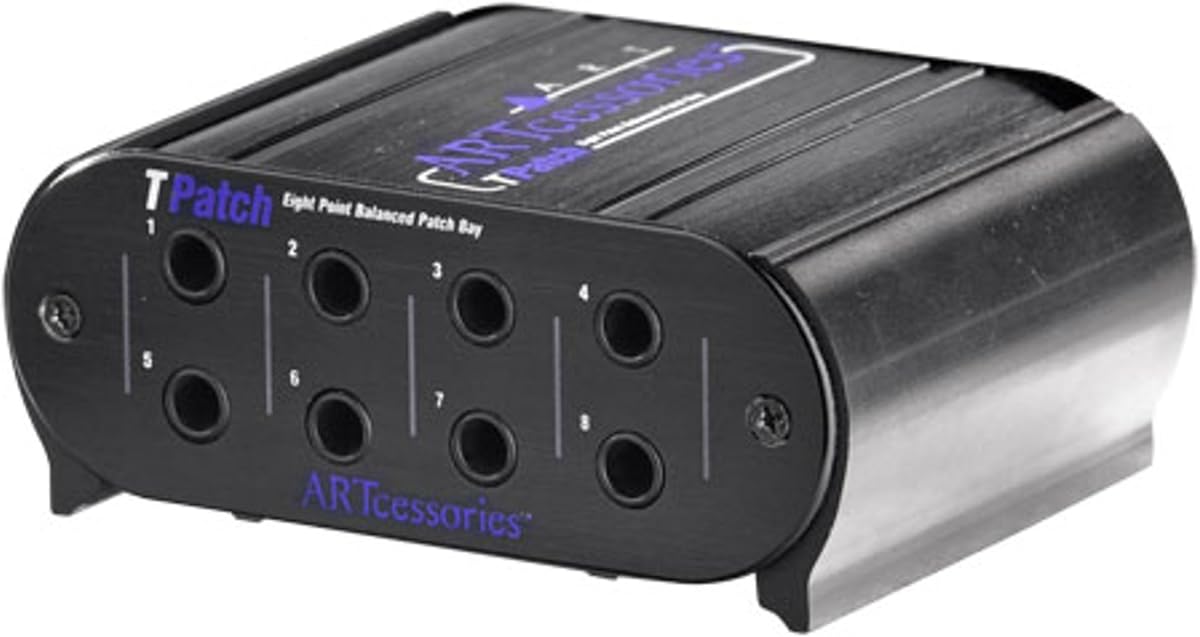
The Art Pro Audio TPatch is an eight-point balanced patch bay with a 4.6 rating. It is one of the most compact options in this guide, offering four linked input and output pairs in a rugged extruded aluminum case for studios that need focused, manageable routing.
We may earn a commission when you buy through this link, at no additional cost to you.
Its switching capabilities include half-normal and normal modes, along with through-type connections. These controls give users more flexibility than a fixed panel while keeping the signal layout understandable. The linked pairs make it easier to organize channel-related input and output paths in a smaller system.
Eight points is the primary limitation. A control room with many consoles, preamps, monitors, and recorders can quickly exceed that capacity, making a larger 16- or 48-point panel more practical. The quarter-inch TRS connectors also require appropriate cable choices and do not directly accept standard XLR microphone cable.
The TPatch is best for a small studio, project room, or focused signal zone where compact construction and real switching modes matter more than maximum channel count. It is a sensible choice for users who find a 48-point system unnecessarily large but still want more control than a basic routing panel.
Normal, half-normal, and through-style operation brings useful flexibility to an eight-point panel. The compact design is appropriate for studios that want the convenience of switchable routing without the complexity and footprint of a large multipoint system.
The extruded aluminum case provides a durable enclosure around the four linked routing pairs. It suits studio use where a patchbay must tolerate regular handling while remaining clearly organized in the rack.
We may earn a commission when you buy through this link, at no additional cost to you.
The Hosa PDR-369 12-Point XLR Balanced Patchbay is a compact balanced-routing panel with a 4.4 rating. Its 12-point capacity sits neatly between the eight-point ART TPatch and the larger 16-point XLR options, making it a possible fit for studios with a moderate number of balanced routes.
We may earn a commission when you buy through this link, at no additional cost to you.
The defining feature is its reversible 12-point XLR arrangement. That flexibility can help users configure the panel to suit different input and output patterns, reducing the need to modify cabling assumptions during setup. Its native XLR format also matches many microphone, preamp, and balanced studio signal paths.
The compact product information provides little detail beyond the reversible XLR design, and no per-channel switching modes are listed. Buyers should therefore treat it as a patch panel for organized routing rather than assume normalled, half-normalled, or thru functionality. Its 12-point capacity may also be restrictive for larger rooms.
This Hosa is best for a studio that wants an uncomplicated, reversible XLR hub without moving to a 16- or 48-point system. It works particularly well when the required route count is known in advance and straightforward front-to-back XLR distribution is the main requirement.
The reversible 12-point arrangement gives the installer options for how signals enter and leave the panel. That makes it useful when designing a balanced studio hub around existing cable directions and equipment layouts.
Twelve points provide enough room for a moderate collection of studio routes without the footprint demands of a 48-point system. It offers a middle ground for small rooms and specialized signal zones.
We may earn a commission when you buy through this link, at no additional cost to you.
Choosing a studio patchbay starts with the signal paths you need to organize, followed by the connector format, channel count, switching method, rack space, and construction that suit your working environment.
Connector format should be the first practical filter because it determines which existing cables and equipment can connect without adapters. XLR is common for microphones, preamp stages, speaker feeds, and many balanced studio paths. TRS is well suited to balanced line-level routing and compact console connections, while TT is frequently used for dense, high-point-count professional systems. DB-25 appears in specialized grouped-routing applications, and the Black Lion Audio PBR TT LIT combines that format with TT points.
Match the patchbay to the connectors already used in the studio whenever possible. A technically capable panel can still be inconvenient if every cable requires an adapter. An XLR-focused studio should generally favor an XLR panel, while a TRS-centric room may gain more flexibility from a large switched TRS model.
Channel count should reflect present needs with enough attention to future growth. An eight-point panel is appropriate for a focused signal zone, 12 or 16 points suit moderate studios, and 48 points can consolidate a control room filled with console, recorder, monitor, and outboard routes. A 96-point model is intended for large or specialized systems rather than ordinary project rooms. Overbuying adds cost, rack weight, cable density, and configuration complexity without automatically improving performance.
Count the actual connections before choosing. Include direct and interrupt-style paths if you need mode switching, then leave a little room for future equipment. The best capacity is the smallest one that comfortably supports the routing system.
A fixed routing panel simply provides a connected path, while a switchable patchbay can support normalled, half-normalled, thru, parallel, or open behavior. Normalled operation maintains a default connection that can be interrupted. Half-normalled designs preserve one side of the path when a plug is inserted. Thru mode routes the signal in an alternate direction, while parallel mode supports distribution. These behaviors must align with the user's signal flow rather than merely sound technically impressive.
Choose switching modes only when the studio actually needs them. For permanent cable management, a straightforward XLR panel may be easier to maintain. For active routing, bypass, or insert workflows, a model such as the Samson S-Patch Plus, Behringer ULTRAPATCH PRO, or Art Pro Audio TPatch offers more direct control.
Rack height, mounting depth, and connector accessibility determine how comfortably a patchbay fits into a working studio. The ART P16 occupies a single rack unit and emphasizes efficient use of vertical space, while 48- and 96-point models may require more room and careful cable management. Reversible rack ears are useful when the front or rear orientation of the enclosure needs to change. A patchbay should also be placed where operators can reach its front connections without moving other equipment.
Sketch the rack layout before ordering, including cable bend space and access to neighboring controls. Confirm the unit's mounting dimensions and connector orientation. A patchbay that is difficult to reach can add more time to a session than the cable clutter it was meant to eliminate.
A studio patchbay should withstand repeated plugging, rack movement, and years of normal operation. Steel and aluminum enclosures are common choices because they resist deformation and help control vibration. The AA AUDIO ACCESSORY AP16 uses a full-steel chassis, the DIYTECH panel has a powder-coated steel body, and the Art Pro Audio TPatch uses extruded aluminum. Gold-plated contacts on the AA AUDIO ACCESSORY, Black Lion Audio, and related models can provide a durable mating surface, particularly in frequently changed routing systems.
Prioritize construction that suits the environment. A fixed installation may not need touring-level toughness, while a mobile rig should tolerate more handling. Balanced wiring, shielding, and insulation quality also matter because they influence noise and signal stability across the panel.
A simple signal path is easier to troubleshoot than a complex one. Modular blocks, labeled sections, and clearly separated input and output rows make it easier to identify a failed route. Fixed panels reduce the number of controls that a user must understand, while switched panels provide more control at the cost of a steeper learning curve. The AA AUDIO ACCESSORY AP16's zone-based modules and the Samson S-Patch Plus's front access illustrate two different approaches to the same organizational goal.
Choose the level of complexity that matches the operator's habits and the studio's maintenance routine. A clear, well-labeled system is more valuable than advanced features that users avoid because they are difficult to configure.
Installation support can make a significant difference in a rack-based environment. Included mounting screws simplify setup, as offered by the DIYTECH 16 Port XLR Patchbay. Manufacturer warranties provide added confidence, with the ART P16 listing a three-year warranty. The AA AUDIO ACCESSORY product also states that technical support is available for installation, compatibility, and setup through Amazon messaging, with a response expected within 24 hours.
Check what hardware, documentation, and support are included before ordering. Confirm rack compatibility, connector orientation, and any required adapters. A product with a clear installation process and accessible support is usually easier to integrate into a working studio.
Begin by documenting every intended route before connecting equipment. Label the front and rear connections according to the signal's function rather than only its number, and make a diagram showing the devices at each end. This prevents accidental feedback loops, duplicated outputs, and confusion when a channel is later moved or replaced.
Install the patchbay in a position with comfortable access to its front connectors. Use the specified mounting hardware, verify that the enclosure sits securely, and avoid leaving cables under tension. Connect the rear equipment first, confirm signal flow with low monitoring levels, and then add or remove front jumpers according to the panel's normalled, half-normalled, thru, parallel, or open behavior.
Inspect connectors regularly and avoid forcing plugs into a socket. Dust, bent pins, and accumulated debris can cause intermittent noise or unreliable contact. Keep the panel's documentation nearby, particularly when multiple operating modes are available, and periodically test each route to catch degradation before it disrupts a session. Never change critical connections during an active recording without a clear recovery plan.
A studio patchbay provides a central location for connecting and changing signal paths. It can link mixers, preamps, recorders, monitors, and outboard equipment without repeatedly reaching behind a rack. Depending on its design, it may simply provide fixed routing or offer switches for normalled, half-normalled, thru, parallel, and open operation.
Choose XLR when your existing equipment and cables predominantly use three-pin XLR connections for microphones, preamps, balanced feeds, or monitor routes. Choose TRS for balanced line-level systems that already use quarter-inch cables. The best format is the one that matches the studio's real cable inventory and avoids unnecessary adapters.
A normalled channel maintains a direct default signal path until a plug interrupts the connection. A half-normalled channel preserves one side of the path when interrupted, which can be useful when maintaining a send or return. The exact behavior should be confirmed in the product documentation before using a mode for a critical signal.
A small studio may be well served by eight to 16 points, depending on how many consoles, preamps, recorders, monitors, and outboard devices it operates. Larger facilities can require 48 or more points. Count the signal paths that need regular access rather than selecting solely by rack space or overall equipment count.
No. The product's connector format and signal specifications determine compatibility with microphone-level sources. An XLR panel can be appropriate for microphone and other balanced connections, while a TRS or TT panel may be intended mainly for line-level routing. Always verify the unit's specifications and signal-path requirements before connecting microphones.
Gold-plated contacts can provide a durable, corrosion-resistant mating surface and are especially relevant when connections are changed frequently. They are not the only factor determining signal quality, however. Balanced wiring, shielding, construction, and correct signal flow remain important as well.
A patchbay is best for hands-on routing, jumpers, bypasses, and accessible connections rather than automated matrix control. A dedicated digital or software router may be more appropriate when recallable presets, computer control, or complex routing matrices are required. Some studios use a patchbay and a separate control system together.
Group routes by function, such as console inputs, monitor feeds, recording sends, returns, and outboard inserts. Use consistent labels on the front, rear, and equipment ends, and keep a current diagram nearby. For very large panels, software-controlled displays or clear color coding can help users identify active routes without tracing every cable.
The ART P16 XLR Balanced Patchbay stands out as the strongest general-purpose recommendation, combining a high rating with a compact one-rack-unit body and 32 XLR connectors. The AA AUDIO ACCESSORY AP16 is especially appealing for modular organization, while the Samson S-Patch Plus serves large TRS-based studios that need three selectable operating modes.
Prioritize the connector format, required channel count, and operating behavior before comparing appearance or construction. A fixed 12- or 16-point XLR panel may be ideal for a modest studio, while a controlled room may justify a switched 48-point system. The Behringer ULTRAPATCH PRO, Art Pro Audio TPatch, and specialized 96-point TT model are worth considering when routing flexibility is the priority.
Finally, verify the current listing, dimensions, connector orientation, included hardware, and warranty before purchasing. Product ratings and specifications can evolve, and prices and availability change frequently. Checking those details at the time of purchase helps ensure that the selected patchbay integrates cleanly with the studio's existing equipment and workflow.