
SVBONY SV550 AP0 80mm
4.5Editor score
Air-spaced S-FPL51 triplet optics
Magnesium alloy dual-speed focuser
Internal light-control measures
Our Apochromatic Refractors guide compares ten triplets and quadruplets for astrophotography and visual astronomy, highlighting optics, apertures, focusers
Apochromatic refractors use carefully arranged low-dispersion glass elements to control chromatic aberration and produce sharp, high-contrast views. The strongest examples pair refined optics with stable focusers, practical mounting hardware, and enough portability for field use, making them well suited to lunar, planetary, visual, and deep-sky observation.
The products in this guide were compared using the supplied specifications, including optical design, aperture, focal length, coatings, focuser travel, collimation provisions, weight, included accessories, and suitability for imaging. The list covers standalone optical tube assemblies, portable triplets, a quadruplet, and complete kits for guiding or astrophotography.
Each review shows how a particular model fits into the category and which buyers it is most likely to serve. Ratings reflect the information supplied for each listing, while unrated products remain in the comparison because their specifications and included equipment are still informative. Product availability and pricing can change.
4.5Editor score

4.9Editor score

5.0Editor score
This side-by-side comparison covers ten 80mm, 102mm, and 122mm apochromatic refractors, ranging from lightweight imaging OTAs to larger kits with flatteners, reducers, guide scopes, cameras, and carrying hardware. It emphasizes the factors that most directly affect image quality, field coverage, setup convenience, and portability.




The SVBONY SV550 80mm is a compact f/6 triplet apochromatic refractor built around one S-FPL51 low-dispersion element and two correction elements. Its supplied rating is 4.5, and the main appeal lies in the balance between refined optical design, a manageable aperture, and practical focuser construction. As an OTA, it is aimed at observers and astrophotographers who want a capable refractor without a full mount-and-accessory package.
We may earn a commission when you buy through this link, at no additional cost to you.
The air-spaced triplet arrangement is intended to virtually eliminate chromatic aberration, particularly the blue-edge fringing that can remain in simpler single-ED designs. Internal light barriers in the focuser and lens barrel are designed to suppress stray light and improve contrast. The magnesium alloy 2.5-inch dual-speed focuser has a 1:10 ratio, while its relatively light construction can reduce the load placed on a support platform.
The principal trade-off is that this is an optical tube rather than a complete imaging system. A field flattener, camera, filter, mount, and other accessories will be needed for serious astrophotography, and buyers should account for those requirements before purchase. Even so, the standard focal length and compact 80mm aperture make this an adaptable platform for visual observing, lunar and planetary work, and smaller imaging sensors.
This is a strong general recommendation for buyers who prioritize a true triplet design and a refined focuser without opting for the largest aperture in the category. It is particularly appealing for portable visual setups and for photographers who already own the rest of their imaging equipment. The separate SV550 80mm bundle shown later may be more convenient for new imaging users.
The combination of S-FPL51 ED glass and two correction lenses is the defining feature of this triplet. This arrangement is designed to deliver more consistent color than a single-element ED doublet, particularly around bright stars and high-contrast planetary details.
The magnesium alloy focuser reduces weight compared with a comparable aluminum component, while the dual-speed 1:10 mechanism supports fine adjustment. These traits suit quick visual sessions and imaging rigs where every gram on the mount matters.
We may earn a commission when you buy through this link, at no additional cost to you.
The Explore Scientific ED80 Essential Series is an 80mm, f/6 air-spaced triplet built with genuine FCD1 HOYA extra-low-dispersion glass. Its supplied rating is 4.2, and the product stands out for its clearly specified optical materials, enhanced multilayer coatings, and front-cell push-pull collimation system. It is designed for observers and photographers who appreciate an 80mm refractor with a traditional long focal length.
We may earn a commission when you buy through this link, at no additional cost to you.
The 480mm focal length gives the scope a natural, low-distortion imaging scale that can suit Lunar, planetary, and moderately sized deep-sky targets. Air-spaced triplet construction is intended to virtually eliminate chromatic aberration, while coatings on all optical surfaces are designed to improve contrast and transmission. The retractable dew shield and compact proportions support spontaneous observing and relatively easy transport.
One limitation is that the listing does not include a focal reducer or field flattener, so users pursuing a very wide field or a large sensor must plan additional purchases. The stated 4.2 rating is also lower than those assigned to several alternatives in this list, although it does not negate the objective design advantages. The dedicated collimation adjustments are nevertheless a meaningful refinement for an air-spaced triplet.
The ED80 is best for buyers who value named premium glass, optical coatings, and a straightforward f/6 imaging configuration. It can also serve as a compact guide or imaging scope when mounted alongside a larger instrument, as the supplied information specifically notes. Those seeking the most self-contained package may prefer one of the SV550 bundles instead.
Using genuine FCD1 HOYA ED glass distinguishes the ED80 from scopes that describe only a general low-dispersion objective. The air-spaced triplet arrangement then provides the platform for strong control of axial chromatic aberration.
Push-pull front-cell adjustments give owners a direct way to manage alignment of the separated optical elements. This is especially useful for air-spaced designs because their optical surfaces require more deliberate maintenance than a cemented doublet.
We may earn a commission when you buy through this link, at no additional cost to you.
The SVBONY SV550 80mm Bundle combines an 80mm f/6 triplet with the SV209 1.0X field flattener. Its supplied rating is 5.0, and the chief advantage is integration: the corrective component is specified for this optical tube, reducing the need to guess whether a generic flattener will produce satisfactory edge performance. It is a compelling option for astrophotographers who want a coordinated optical train.
We may earn a commission when you buy through this link, at no additional cost to you.
The flattener package includes an M63 extension tube and an M48 adapter ring. These components are intended to establish a conventional 55mm back focal length for the flat-field mirror, while the effective field of view is listed as supporting both half-frame and full-frame cameras. The OTA retains a S-FPL51 triplet objective and a magnesium alloy focuser designed to reduce support-platform weight.
The 180mm hollow dovetail plate offers a practical mounting foundation and is designed for straightforward setup. Internal light barriers remain part of the focuser and lens-barrel design, helping control stray light. The trade-off is that the bundle does not supply a camera or mount, and the flattener adds another optical surface that must be carefully spaced and collimated for best results.
This bundle is an excellent recommendation for new astrophotographers who want a field flattener matched to an established refractor rather than a collection of unrelated components. It is also attractive to owners of full-frame cameras who value a corrected field without changing the native 1:1 optical ratio. The standard 80mm OTA remains the simpler option when every gram and accessory matters.
The SV209 is described as a field flattener for the SV550 80mm f/6 optical tube. Using the intended pairing can make spacing requirements more predictable and gives imaging users a clearer path to sharp stars across the frame.
The listed 45mm effective target-surface field is intended to cover full-frame cameras as well as smaller formats. That support is particularly relevant for wide-field nebula imaging, where off-axis color and field curvature can otherwise become distracting.
We may earn a commission when you buy through this link, at no additional cost to you.
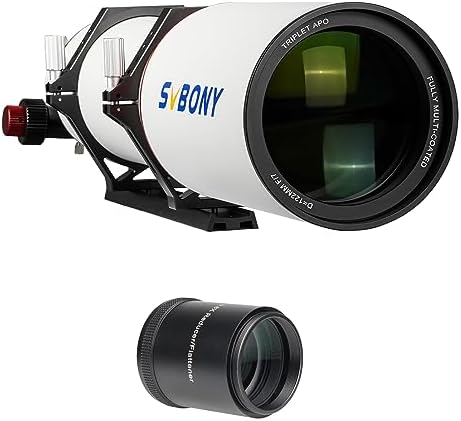
The SVBONY SV550 122mm Base package pairs a large-aperture triplet with the 203mm SV211 dovetail base. It has no supplied rating, so its appeal must be assessed through its specifications rather than a customer score. With a 122mm aperture, 854mm focal length, and f/7 design, it targets observers and photographers who want more light gathering and resolution than an 80mm refractor offers.
We may earn a commission when you buy through this link, at no additional cost to you.
The optical tube uses an FPL-51 triplet apochromatic structure containing one ED element. According to the supplied information, this design improves aberration correction, reduces chromatic aberration, and supports clearer, sharper images. The 122mm aperture can reveal fainter deep-sky objects and gather more light, while the OTA weight is listed at 6.44kg, or 14.18 pounds.
The SV211 base adds a portable handle and a finder-scope mounting bracket. Two M6 mounting screws, four M4 set screws, and an M5 wrench are included for installation, making the base more useful than a simple mounting plate. The trade-off is weight: although described as portable, this combination is substantially heavier than the 71mm Askar or 80mm triplets and benefits from a stable support system.
This product makes the most sense for buyers who regularly observe or image under a reasonably dark sky and need the additional aperture. Its larger glass can expose faint galaxies and nebulae while improving detail potential, but those benefits require careful handling and a capable mount. It is less suitable for hikers seeking an ultralight instrument.
The 122mm aperture is substantially larger than the other options here, increasing the scope's potential to reveal fainter deep-sky objects. This advantage is most meaningful under transparent skies and with well-matched eyepieces or cameras.
The included SV211 base gives the tube a carrying solution and a defined place for a guide scope. Its supplied hardware and straightforward screw-based assembly make the package more practical than a bare OTA for mobile imaging.
We may earn a commission when you buy through this link, at no additional cost to you.
The Askar 71F is a 71mm, f/6.9 air-spaced quadruplet designed to provide a self-flattening field in a compact package. Its supplied rating is 4.9, making it one of the strongest-rated products in this comparison. The 490mm focal length, ED glass, and flat-field design make it well suited to deep-sky astrophotography as well as visual observing.
We may earn a commission when you buy through this link, at no additional cost to you.
At 2.5kg for the optical tube and 3kg including the hoop and dovetail plate, it is notably lighter than the 122mm SV550 configurations. CNC machining supports a refined exterior, while matte paint on the barrel interior helps reduce stray-light reflections. A focus rotation of 360 degrees allows the camera position to be adjusted without rotating the entire optical tube.
The trade-off is aperture. A 71mm objective gathers less light than 80mm, 102mm, or 122mm alternatives, so it may require longer integration for faint targets and offer less resolution for demanding planetary work. Its 230mm Vixen-style dovetail is practical, though buyers must confirm compatibility with their mount. The four-element design also introduces more surfaces to collimate than a cemented doublet.
The Askar is the standout recommendation for portability without abandoning apochromatic image quality. It is especially attractive to astrophotographers seeking a compact, self-flattened OTA that can travel easily between dark-sky locations. Visual users will also appreciate a manageable instrument with a native focal length suited to a range of targets.
The quadruplet configuration is designed to correct field curvature while retaining an apochromatic level of color control. That combination can simplify imaging by reducing the need for separate corrective optics in compatible setups.
The low tube weight and modest dimensions make the 71F comfortable to carry and position. A rotary focuser further improves camera framing without twisting the OTA, a practical benefit for repeatable field setup.
We may earn a commission when you buy through this link, at no additional cost to you.
The SVBONY SV503 102mm combines a 102mm aperture with a 714mm focal length at f/7. Its supplied rating is 4.8, and its strongest selling point is the generous focus system: a 360-degree field rotator, a 1:10 dual-speed focuser, and 90mm of focus travel. Those features are unusually practical for a refractor intended for both visual observation and astrophotography.
We may earn a commission when you buy through this link, at no additional cost to you.
S-FPL51 ED glass is used to reduce chromatic aberration and color fringing, while FMC coatings are intended to improve transmission and limit internal reflections. The 133mm retractable hood blocks stray light, helps prevent dew formation, and protects the objective. Because of its 102mm aperture, the scope can also function as a more capable guide or small imaging instrument alongside another telescope.
The product data confirms ED glass but does not explicitly identify the objective as a triplet apochromatic design, so buyers focused on that specific optical architecture should examine the listing carefully. Another limitation is the absence of an included field flattener or focal reducer. Those accessories may be needed for wide-field sensors or large formats, and they affect both image scale and optical spacing.
The SV503 is a strong middle ground between compact 71mm and 80mm scopes and the much heavier 122mm SV550. It suits buyers who need more aperture than the smaller options but do not want the largest system in the list. The generous travel and rotating focuser also make it a particularly logical choice for filter wheels, field flatteners, and visual accessories.
Ninety millimeters of focus travel gives considerable room for spacers, filter wheels, field flatteners, and camera sensors. This is important because a short-focusing image train can otherwise limit the accessories and positions available to a photographer.
The integrated 360-degree rotator changes the camera's angle without requiring the entire tube to rotate. This makes framing a target more consistent and can simplify repeated imaging sessions.
We may earn a commission when you buy through this link, at no additional cost to you.
The SVBONY SV550 122mm Reducer package includes a 122mm f/7 triplet apochromatic refractor and the SV209 0.8X focal reducer field flattener. Its supplied rating is 5.0, and it stands apart from other 122mm listings because the imaging correction is built into the package. The combination is aimed at astrophotographers who want both substantial light gathering and a wider corrected field.
We may earn a commission when you buy through this link, at no additional cost to you.
The OTA's FPL-51 triplet structure uses one ED element with two correction elements to improve aberration control and reduce chromatic aberration. Its 122mm aperture can reveal fainter deep-sky objects, while the listed 6.44kg weight makes portability a relative rather than absolute strength. The 854mm native focal length becomes more compact when used with the specified 0.8X reducer.
The SV209 is designed specifically for prime-focus imaging with this 122mm f/7 refractor. It corrects field curvature and is intended to improve edge-of-field image quality and shooting efficiency. The trade-off is that the additional optic requires exact spacing and careful collimation, while the resulting image scale and vignetting must be evaluated with the chosen camera and sensor.
A 0.8X focal reducer increases the effective field of view compared with native prime-focus imaging. This helps large emission nebulae fit more comfortably within the frame while retaining the advantages of the 122mm aperture.
The flattener is designed specifically for the SV550 122mm f/7 optical tube, which is preferable to a generic reducer whose back-focus requirements may differ. The integrated package reduces compatibility guesswork for imaging users.
We may earn a commission when you buy through this link, at no additional cost to you.
The SVBONY SV550 122mm Kit combines the 122mm triplet OTA, SV209 0.8X focal reducer field flattener, and portable SV211 dovetail base. It has no supplied rating, but it is one of the most complete configurations in the comparison. The package is designed for observers and photographers who want a large corrected refractor with dedicated carrying hardware.
We may earn a commission when you buy through this link, at no additional cost to you.
The optical system has a 122mm aperture, 854mm focal length, and f/7 native ratio. Its FPL-51 triplet design is intended to reduce chromatic aberration, while the larger aperture offers a higher limiting potential than the smaller scopes. The 0.8X reducer flattener addresses field curvature and creates a wider imaging field, making the setup especially relevant for large nebulae and broad star-field compositions.
The major drawback is weight. The OTA alone is listed at 6.44kg, and adding the reducer, camera, dovetail base, cables, and mount hardware makes this more of a destination observing or imaging system than a casual backpack telescope. The kit also leaves out the mount and imaging camera, so it is complete in optical accessories rather than a fully operational photography rig.
This kit is a good choice for buyers who value a coordinated 122mm system and already own a capable mount and camera. The integrated base, carrying handle, and matched flattener make the package easier to deploy than assembling those pieces separately. Those seeking a smaller, lighter setup should look to the Askar 71F or one of the 80mm triplets.
The same bundle concept combines a serious aperture with the accessories needed to correct and support the optical system. That makes it easier to plan a complete imaging configuration around one listed package.
The 0.8X reducer gives the large telescope a much broader imaging role, while the base improves handling. These conveniences come at the cost of a 6.44kg optical tube, making transport and mounting stability important considerations.
We may earn a commission when you buy through this link, at no additional cost to you.
The SVBONY SV550 80mm Kit adds the SV209 field flattener and a carrying handle to the 80mm f/6 triplet optical tube. It has no supplied rating, so prospective buyers should focus on the stated optical features and included equipment. The package is aimed at users who want a corrected apochromatic OTA with added portability.
We may earn a commission when you buy through this link, at no additional cost to you.
The objective uses one S-FPL51 low-dispersion ED element and two correction elements, specifically addressing blue-edge chromatic aberration associated with simpler single-ED structures. The fully multilayer-coated lens and additional achromatic glass are described as controlling reflections and supporting bright, clear images. The SV209 is designed for the SV550 80mm f/6 and is intended to improve edge-field curvature.
The adjustable carrying handle can be repositioned to improve safety during installation and is compatible with several listed SV503 and SV550 configurations. Visually, the image is inverted when the scope is used with an eyepiece, which the listing identifies as normal. The kit still omits a camera, mount, filters, and other imaging essentials, so it should be treated as an optical bundle rather than an all-in-one imaging system.
This kit is well suited to buyers who want the 80mm triplet's compact proportions without giving up a matched flattener. It may be especially useful for imaging the Moon, planets, and smaller deep-sky targets with a range of camera formats. Those needing the smallest travel system may prefer the Askar 71F, while larger-sensor photographers should scrutinize the flattener's stated coverage.
The SV209 is intended specifically for the SV550 80mm f/6 OTA, giving photographers a defined optical pairing. It targets the edge-field curvature issue identified in the supplied product information.
A repositionable handle offers a more secure way to install or remove the telescope from a mount. Its compatibility with multiple supported SVBONY optical tubes also increases the usefulness of the accessory within a broader equipment system.
We may earn a commission when you buy through this link, at no additional cost to you.
The SVBONY SV550 Guiding Kit combines the 122mm f/7 triplet OTA with the SV165 mini guide scope and SV905C telescope camera. It has no supplied rating, but its primary distinction is obvious: it includes the two components used to capture guiding data. This turns a large optical tube into a more complete package for astrophotography.
We may earn a commission when you buy through this link, at no additional cost to you.
The SV905C has a 1.23-megapixel color sensor with a resolution of 1280 by 960 pixels and 3.75-micron pixels. The supplied specifications cite peak quantum efficiency of 80% and low read noise, with the camera positioned for autoguiding or planetary imaging. Its 1.25-inch and M42 interfaces are compatible with mainstream autoguiding cameras, including the listed SV305 Pro, Orion ZWO, and QHY options.
Although the supplied camera is capable, its 1.23-megapixel resolution is modest by current astrophotography standards and is more relevant to guiding than to finished deep-sky images. Some camera combinations may require extra focusing accessories, and the guide scope still needs a suitable mounting arrangement. The 122mm OTA also weighs 6.44kg, so the complete setup demands a stable mount.
This kit is best for buyers who want a guided imaging configuration without sourcing a separate guide scope and camera. It may be useful for short focal-ratio imaging, planetary capture, or a complete setup for a specific supported camera. Photographers with an established guiding train may prefer the standard optical tube or another SV550 bundle instead.
The included SV165 guide scope and SV905C camera address a key imaging requirement: monitoring star movement during long exposures. Their inclusion reduces the need to assemble a separate guiding train.
The 3.75-micron pixel size is suitable for fine guiding when paired with a compatible guide scope and suitable imaging scale. The high stated peak quantum efficiency supports sensitivity in faint star fields.
We may earn a commission when you buy through this link, at no additional cost to you.
Choosing an apochromatic refractor means balancing optical correction, aperture, focal length, weight, mounting needs, and the accessories required to reach a complete imaging system. The most important starting point is deciding whether the instrument will primarily support visual observing, guided deep-sky imaging, planetary photography, or a flexible combination of all three.
A true apochromatic refractor is designed to control chromatic aberration across a broad range of wavelengths rather than merely reducing it around a single focus point. The products here use different architectures: the SV550 80mm and Explore Scientific ED80 use air-spaced triplets, the Askar 71F uses an air-spaced quadruplet, and the SVBONY SV503 is described as using ED glass without an explicit triplet designation. These distinctions affect color control, collimation demands, weight, and cost in practical use.
Aperture determines how much light the objective can collect and influences potential resolution. The Askar 71F uses 71mm, the 80mm options are noticeably more capable under faint conditions, the SV503 offers 102mm, and the 122mm SV550 provides the greatest light-gathering potential in this list. The larger SV550 models can reveal fainter deep-sky targets, but their weight and mounting requirements increase substantially.
A short focal length creates a wider field and makes large nebulae easier to frame, while a longer focal length provides a more magnified view and can be advantageous for smaller targets. The 71mm Askar and 80mm models sit around 480 to 490mm, the 102mm SV503 reaches 714mm, and the 122mm SV550 is listed at 854mm. If you need more width, the 0.8X reducer bundle can change the effective framing of the 122mm scope.
A refractor may produce sharp stars near the center of an image while showing softness or curvature at the edge. A field flattener corrects that behavior, and a focal reducer widens the frame. The SV550 80mm bundles include a specified SV209 flattener, while the 122mm options pair with a 0.8X SV209 unit. Because back-focus distance is critical, the flattener should be matched to the optical tube and camera rather than treated as a universal accessory.
Fine focusing becomes more difficult when cameras, filters, spacers, and field flatteners consume back-focus distance. The SV503 provides 90mm of travel, a notable advantage for accessory-heavy imaging trains. Dual-speed focusers appear across several SVBONY options, while the 360-degree rotator on the SV503 allows camera-angle changes without rotating the whole tube. These features are valuable but should be considered alongside minimum focus distance and load limits.
Portability depends on more than the stated optical-tube weight. The Askar 71F weighs 2.5kg before its hoop and dovetail, the 80mm triplets are comparatively manageable, and the 122mm SV550 tube weighs 6.44kg. Included carrying handles, finder brackets, and dovetail bases improve handling, but a complete rig also includes the camera, guide scope, mount head, counterweights, and cables.
Many of these refractors can serve both roles. Long focal lengths are pleasant for visual observing and planetary work, while 71mm and 80mm models are easier to carry to dark-sky sites. Imaging adds considerations such as sensor coverage, focal reduction, guiding, and precise focus. The Explore Scientific ED80 can even be mounted above a larger telescope to separate guiding and imaging duties, illustrating the category's modular strength.
Multilayer coatings improve transmission and can reduce internal reflections, while matte barrel interiors and internal light barriers help suppress stray light. The Askar 71F uses a matte-painted interior, the SV550 80mm has several internal light barriers, and the SV503 uses FMC coatings. These details are especially useful for high-contrast lunar and planetary viewing, though they do not replace careful collimation and a clean optical surface.
Begin with a stable setup. Attach the dovetail or base to a compatible mount, balance the optical tube with all intended accessories installed, and tighten the retaining hardware gradually. For imaging, verify that the camera, filter, field flattener, or focal reducer has enough focus travel and that the resulting image circle covers the sensor corners.
Bring the instrument to ambient outdoor temperature before opening or exposing the objective. Check the lens for condensation, clean it only with an approved lens-safe method, and avoid touching the exposed glass. If dew forms, allow it to clear or use a controlled lens-heating solution. After use, cap the tube, keep it dry, and store it in a padded case away from temperature extremes.
Air-spaced triplets and quadruplets need periodic collimation, and adding a flattener introduces another adjustment-sensitive component. Use a suitable collimation tool and follow the manufacturer's sequence rather than adjusting screws by intuition. Check focus frequently as temperature changes, and avoid forcing a focuser against a camera or filter. For guided imaging, take test exposures early, confirm that guiding is stable, and check for vignetting before committing to a long session.
A triplet uses three main optical elements, while a quadruplet uses four. Both designs can provide strong apochromatic correction, but a quadruplet may be designed to flatten the field as well, potentially reducing the need for a separate flattener. It also introduces more optical surfaces that require careful collimation.
It depends on the refractor and sensor. Some apochromatic models, including the self-flattening Askar 71F, are designed to control field curvature without one. Other 80mm and 122mm SV550 bundles include or specify the SV209 flattener. Matching the flattener to the optical tube and verifying back-focus spacing is essential.
An 80mm apochromatic refractor is a very capable imaging platform, particularly for larger deep-sky objects. Its native f/6 focal length gives a relatively natural image scale, while a matched flattener can improve edge performance. A camera, mount, guiding setup, filters, and correct spacing are still required.
A reducer is useful when the desired field of view is wider than the scope provides at native focal length. The included 0.8X SV209 in the relevant bundle is designed specifically for the 122mm f/7 SV550. It both widens the field and corrects field curvature, so it should be configured according to the supplied spacing instructions.
Aperture influences light gathering, resolution, and how much detail can be revealed under good conditions. The 122mm SV550 can show fainter objects than the smaller 71mm and 80mm scopes, but it is also heavier. For imaging, aperture can be traded against exposure time, field coverage, and the difficulty of managing a larger, more demanding setup.
A basic imaging train needs a camera, suitable imaging adapter, focuser or adapter, and a mount. Guided imaging also requires a guide scope, guide camera, guide cables, and software that can control the mount. Filters and a field flattener may also be needed, depending on the optical tube and target.
Collimation should be checked before an important imaging session and after the scope has been moved, subjected to significant impact, or disassembled. Temperature changes can also affect alignment. A triplet or quadruplet should be adjusted using a suitable procedure and checked at the intended observing temperature when possible.
Lighter models can be easier for beginners to carry, mount, and balance. The Askar 71F and 80mm triplets offer portable apochromatic designs, while the 102mm and 122mm options provide more aperture at the cost of weight. The best beginner choice still depends on whether the primary goal is visual observing, planetary imaging, or deep-sky photography.
The SVBONY SV550 80mm stands out as the best general-purpose value in the group, combining S-FPL51 triplet optics, a light magnesium focuser, and a compact f/6 format. The Askar 71F earns the Editor's Choice distinction for its self-flattening quadruplet design and exceptional portability, while the SV550 80mm Bundle is the strongest premium option for photographers who want a matched flattener and full-frame support.
Prioritize the optical system that matches your targets, then account for the complete system rather than the OTA alone. A smaller scope is easier to carry, a larger aperture reveals fainter objects, and a dedicated flattener can be decisive for edge-to-edge sharpness. If visual use matters, consider a long focal length; if imaging matters, check sensor coverage, back-focus requirements, accessory weight, and guiding needs.
Before purchasing, confirm the current specifications and included components on the retailer listing. Product configurations can change, and pricing or availability may vary over time. The comparison here is designed to narrow the field, but the best apochromatic refractor is ultimately the one whose optical performance, physical demands, and included accessories fit the way you plan to use it.