
Newentor Wireless Indoor Outdoor Thermometer
4.3Editor score
Large color LCD display
Three-channel sensor support
Atomic clock and dual alarms
Adjustable backlight
Our Large Screen Weather Station guide compares ten readable, feature-rich stations for forecasts, sensors, smart-home support, alerts, and easy monitoring.
A large screen weather station turns complex environmental readings into information that is comfortable to check at a glance. The most useful models combine an easy-to-read display with dependable indoor and outdoor sensors, useful forecasts, adjustable lighting, and alerts suited to home, garden, or workshop use.
We compared these ten stations using their stated display sizes, measurement capabilities, wireless coverage, forecast features, clock functions, connectivity, installation requirements, and power options. The list covers simple temperature and humidity displays as well as advanced systems measuring wind, rainfall, pressure, UV exposure, and smart-home conditions.
Each pick reveals what distinguishes it from the alternatives, including the strongest feature, the compromises, and the type of home most likely to benefit. Product ratings and availability can change over time, and prices also fluctuate, so check the current listing before making a final purchasing decision.
4.3Editor score

4.4Editor score

4.1Editor score
The comparison below covers display design, sensing capability, connectivity, and practical extras such as forecasts, clock functions, alerts, and outdoor mounting. It highlights how the simplest indoor-outdoor thermometers differ from full smart weather stations.


The AcuRite Iris combines a large color LCD with one of the broadest information sets in this guide, earning a 4.4 rating. It monitors indoor and outdoor temperature, humidity, wind speed and direction, barometric pressure, and rainfall, while also presenting heat index, dew point, feels-like temperature, historical information, and pressure trends.
We may earn a commission when you buy through this link, at no additional cost to you.
Its most impressive strength is depth without making the display seem cluttered. The included outdoor sensor can be mounted on a pole or post with the supplied bracket, while the console combines conditions with the current time and date. An adjustable dimmer improves comfort at night, and the personalized forecast uses elevation and barometric pressure information to estimate conditions over the next 12 hours.
The trade-off is that Iris is more involved than a basic wireless thermometer, particularly for users who only need temperature and humidity. It also lacks the Wi-Fi and app automation found in the Ambient Weather and La Crosse smart models. Nevertheless, it delivers broad measurement capability, flexible viewing, and straightforward setup without requiring a network connection.
This is the strongest all-around choice for a household that wants visible wind, rain, pressure, and comfort data in one place. It suits patios, gardens, garages, and living areas where a readable console is the primary interface. Choose it when comprehensive local information and a large display matter more than remote notifications or smart-home control.
The Iris offers more than 55 data points, including historical records, heat index, dew point, feels-like temperature, and pressure trends. That makes it easier to investigate changing conditions rather than simply watch a single current reading.
Elevation and barometric pressure data support a personalized 12-hour forecast, while the included mounting bracket simplifies outdoor installation. It is a capable disconnected display for users who prefer physical controls over app-based monitoring.
We may earn a commission when you buy through this link, at no additional cost to you.
The Newentor Wireless Indoor Outdoor Thermometer is a value-focused display with a 4.3 rating. Its large color LCD presents indoor and outdoor temperature, humidity, daily high and low records, customizable alerts, time, date, forecasts, moon phase, and barometric pressure, giving it many of the conveniences associated with more elaborate stations.
We may earn a commission when you buy through this link, at no additional cost to you.
Three-channel support is the standout feature. The package includes one remote sensor, but the display can monitor up to three remote locations, making it practical for a main floor, garage, nursery, or outdoor patio. It also calculates a forecast for the next 12 to 24 hours and uses a stated seven-to-ten-day calibration period for local accuracy.
Power is flexible. The included DC adapter supports continuous operation, while battery-only use automatically invokes an energy-saving backlight that illuminates for approximately 15 seconds before dimming. The product does not measure wind or rainfall, and users should allow time for barometric calibration before judging forecast consistency.
This is the best choice for readers seeking a large, informative screen without investing in a complete outdoor sensor array. It works particularly well as an upgraded indoor clock and temperature display, but households that need wind, rain, UV, or remote smart-home data should consider a more advanced alternative.
Up to three remote sensor channels let users watch temperature and humidity in separate rooms or at an outdoor location. Although only one sensor is included, the platform supports expansion without changing the basic display format.
Wall power keeps the color screen continuously visible, while battery operation dims the backlight after a short illumination period. This flexibility suits both permanent installations and more flexible placements.
We may earn a commission when you buy through this link, at no additional cost to you.
The La Crosse Technology C85845-INT delivers a 4.4 rating and focuses on comfortable, at-a-glance environmental monitoring. Its large color display includes dynamic forecast icons, trend arrows, indoor and wireless outdoor temperature, humidity, records, dew point, heat index, and customizable high and low alerts.
We may earn a commission when you buy through this link, at no additional cost to you.
Comfort is a central focus. Colorful bars communicate humidity levels for both indoor and outdoor locations across a stated range of 10 to 99 percent relative humidity. The atomic self-setting clock offers 12- or 24-hour formats, a crescendo alarm, snooze, daylight-saving control, several time-zone settings, and a complete calendar date.
Its main limitation is sensor scope. It does not provide the wind, rainfall, UV, or smart-home functions found in higher-end stations. Forecast icons also need seven to ten days of barometric calibration, so early readings may not represent the station's settled performance.
This model is well suited to households that want customized comfort thresholds, detailed humidity feedback, and a dependable clock beside a large display. It works especially well in a living room, bedroom, nursery, or home office, provided outdoor wind and precipitation measurements are not priorities.
Separate high and low alerts can be set for indoor and outdoor temperature and humidity. Color comfort bars and dew point and heat index views add context that a plain thermometer cannot provide.
The atomic clock, dual-format time display, crescendo alarm, and snooze make the console useful beyond weather monitoring. An included power cord provides a constant adjustable backlight, with optional battery backup.
We may earn a commission when you buy through this link, at no additional cost to you.
The Ambient Weather WS-5000 is a premium smart station with a 4.1 rating. Its package combines an ultrasonic sensor array, rain cup, indoor and outdoor thermo-hygrometer-barometer, and a full-color TFT LCD console, allowing it to monitor a broad range of backyard conditions in one integrated system.
We may earn a commission when you buy through this link, at no additional cost to you.
The all-in-one array uses no moving parts and provides real-time condition updates every five seconds. Enhanced Wi-Fi supports remote data access, customizable alerts, and programming of compatible smart-home actions through services such as IFTTT, Google Home, and Alexa. Users can also transmit data to the Ambient Weather Network and customize a personal dashboard.
This capability comes with added complexity. Setting up Wi-Fi features, accounts, and automations takes more effort than using a standalone wireless display. It is also substantially more specialized than basic thermometers, so buyers should be confident they need wind, rain, and connected environmental information.
The WS-5000 is best for enthusiasts who want a capable local dashboard and remote automation from a readable indoor console. It can also serve as a central data source for irrigation, climate, or household systems, making its extended feature set more useful than decorative.
The ultrasonic array reports real-time conditions every five seconds, useful when short-term changes matter. A single integrated array also reduces the number of separate outdoor components that need separate mounting and upkeep.
Wi-Fi access supports remote viewing, alerts, and IFTTT, Google Home, and Alexa integrations. This turns the station from a passive display into a source for automatically adjusting lights, irrigation, and other connected equipment.
We may earn a commission when you buy through this link, at no additional cost to you.
The Ambient Weather WS-2000 earns a 4.4 rating and gives users a capable TFT color display backed by a comprehensive integrated outdoor array. The array measures wind speed and direction, temperature, humidity, rainfall, UV index, and solar radiation, making it suitable for monitoring gardens, patios, and larger properties.
We may earn a commission when you buy through this link, at no additional cost to you.
The console supports imperial and metric units, with calibration available when fine adjustment is wanted. Enhanced Wi-Fi connectivity is also available, allowing the station to send data wirelessly to a personal weather network. The included 5V DC adapter powers the console, while the outdoor array requires three AAA batteries that are not included.
Compared with the WS-5000, this model offers less emphasis on a completely moving-part-free design and does not highlight the same five-second update interval. The optional nature of its network connection also means buyers should not assume every feature requires Wi-Fi, even if they ultimately choose to connect it.
The WS-2000 is a strong middle ground between a simple connected thermometer and a highly integrated premium station. It is well matched to users who want wind, rain, UV, and solar readings but do not need every automation feature offered by the more advanced model.
Combining wind, rain, temperature, humidity, UV, and solar radiation in one outdoor array makes the station efficient for whole-property awareness. It provides useful context for deciding when to water plants or assess outdoor conditions.
Users can select imperial or metric measurements and calibrate readings as needed. This flexibility is useful for international households or anyone who wants to fine-tune the relationship between the display and the outdoor array.
We may earn a commission when you buy through this link, at no additional cost to you.
The La Crosse Technology Advanced Weather Station has a 4.4 rating and provides a full-color LCD with dynamic forecast icons, tendency indicators, indoor and outdoor temperatures, humidity, minimum and maximum records, and customizable alerts. It occupies an appealing middle ground between a clock-sized thermometer and a full backyard station.
We may earn a commission when you buy through this link, at no additional cost to you.
The included weather-resistant sensor supports a stated 330-foot transmission range when unobstructed. The console also includes an atomic self-setting clock and calendar, daylight-saving reset, 12- or 24-hour display, a ten-minute snooze alarm, and three backlight levels with an off setting.
It does not include wind, rain, UV, or Wi-Fi functions, so it cannot substitute for a full environmental array. When operated on battery power alone, the backlight is temporary to conserve energy, whereas the optional 5V adapter enables the full display. Optional battery backup requires three AAA batteries.
This station is ideal for users who want a colorful forecast, accurate clock, and dependable temperature and humidity monitoring in a single conventional console. It is particularly suitable for bedrooms and living rooms where useful clock features and adjustable lighting are more important than advanced sensor breadth.
Dynamic color icons and tendency indicators make changing conditions easier to interpret, while min-max records preserve recent extremes. Custom alerts add a practical warning layer for temperature and humidity.
High, low, and off settings accommodate different viewing environments. Battery-only operation illuminates temporarily, preserving the screen while reducing unnecessary power consumption.
We may earn a commission when you buy through this link, at no additional cost to you.
The Tempest Weather Station has a 4.2 rating and combines a broad set of observations in a single outdoor device. It monitors temperature, humidity, barometric pressure, wind speed and direction, dew point, solar radiation, UV index, lightning strikes, rainfall, and other conditions.
We may earn a commission when you buy through this link, at no additional cost to you.
Its solar-powered sensor transmits wirelessly up to a stated 1,000-plus feet and sends real-time updates every three seconds. The device uses no moving parts, reducing the number of components that can wear, jam, or require frequent maintenance. App-based access, Amazon Alexa, Rachio, IFTTT, and other smart-home platforms support remote monitoring and automation.
The main compromise is the user experience. Compared with the other large-display options, Tempest emphasizes the app and connected ecosystem rather than a feature-filled indoor console. Users primarily interested in reading every measurement from a large screen may find this approach less direct.
Tempest is a strong option for homeowners who want remote access, quick updates, and automated actions based on hyperlocal weather. It is especially useful for irrigation management, monitoring outdoor conditions, or linking backyard data to a broader smart-home system.
The integrated sensor measures wind, rain, radiation, lightning, and other environmental data in one solar-powered unit. Its lack of moving parts supports long-term operation with minimal maintenance.
Three-second updates and a transmission range exceeding 1,000 feet make the system useful across larger properties. Smart-home integration allows that live data to influence irrigation, lighting, and temperature controls.
We may earn a commission when you buy through this link, at no additional cost to you.
The La Crosse S84107 combines a 4.4 rating with an especially decorative color display. It provides indoor and outdoor temperature, humidity, minimum and maximum records, customizable alerts, barometric pressure, a 24-hour historical graph, dynamic forecast icons, and a forecast tendency indicator.
We may earn a commission when you buy through this link, at no additional cost to you.
Seasonal foliage backgrounds change every three months, giving the console a distinctive look compared with conventional instrument panels. Its pressure history helps users interpret short-term weather movement, while the forecast display and temperature records provide useful context for daily planning.
The station is focused rather than exhaustive. It does not measure wind, rainfall, UV, or solar radiation, and the supplied information points users to the manual for setup and troubleshooting. The stated indoor temperature range is 32 to 99 degrees Fahrenheit, or 0 to 37 degrees Celsius, which should be considered in unheated or unusually warm spaces.
This is a good choice for someone who values presentation and a readable forecast display as much as measurement breadth. It is particularly effective as an attractive living-room or kitchen station that supplies temperature, humidity, pressure trends, and an atomic clock-style display without app complexity.
A 24-hour pressure graph helps show whether conditions are rising or falling. This adds useful context to the forecast tendency indicator and current indoor and outdoor readings.
The foliage scene changes every three months, giving the large color screen a more decorative appearance. It suits users who want a weather station that blends naturally into a frequently viewed room.
We may earn a commission when you buy through this link, at no additional cost to you.
The La Crosse Technology V42-PRO-INT has a 4.2 rating and stands out for offering substantial functionality both as a standalone station and as a connected device. Its large color display includes dynamic forecast icons, seasonal scenes, indoor and outdoor temperature, humidity, custom alerts, high and low records, and an indoor comfort meter.
We may earn a commission when you buy through this link, at no additional cost to you.
The outdoor equipment includes separate temperature and humidity and wind and rain sensors. Readings cover current and peak wind speed, direction and compass rose, rain graphs, and scrolling history. A stated transmission range of up to 400 feet gives the system flexibility across yards, patios, and outbuildings.
With Wi-Fi connected, the station can show a seven-day forecast, the next 12 hours, and enhanced data such as UV index, sunrise and sunset times, thunderstorms, air quality, and AccuWeather streaming options. The free La Crosse View app adds remote monitoring, customizable alerts, and notifications, although remote access requires Wi-Fi setup.
This model is well suited to users who want a readable console, local backyard measurements, and modern app access. The outdoor sensors and their battery requirements increase installation effort, so buyers should be comfortable mounting a wind and rain assembly as well as the temperature and humidity probe.
Current and peak wind data, direction, a compass rose, rain graphs, and historical records make this one of the strongest choices for outdoor monitoring. Stamped high and low records help preserve important readings over time.
Wi-Fi unlocks seven-day forecasts, hourly views, UV data, sunrise and sunset, thunderstorm information, and air quality. The app extends those features through remote access and customizable notifications.
We may earn a commission when you buy through this link, at no additional cost to you.
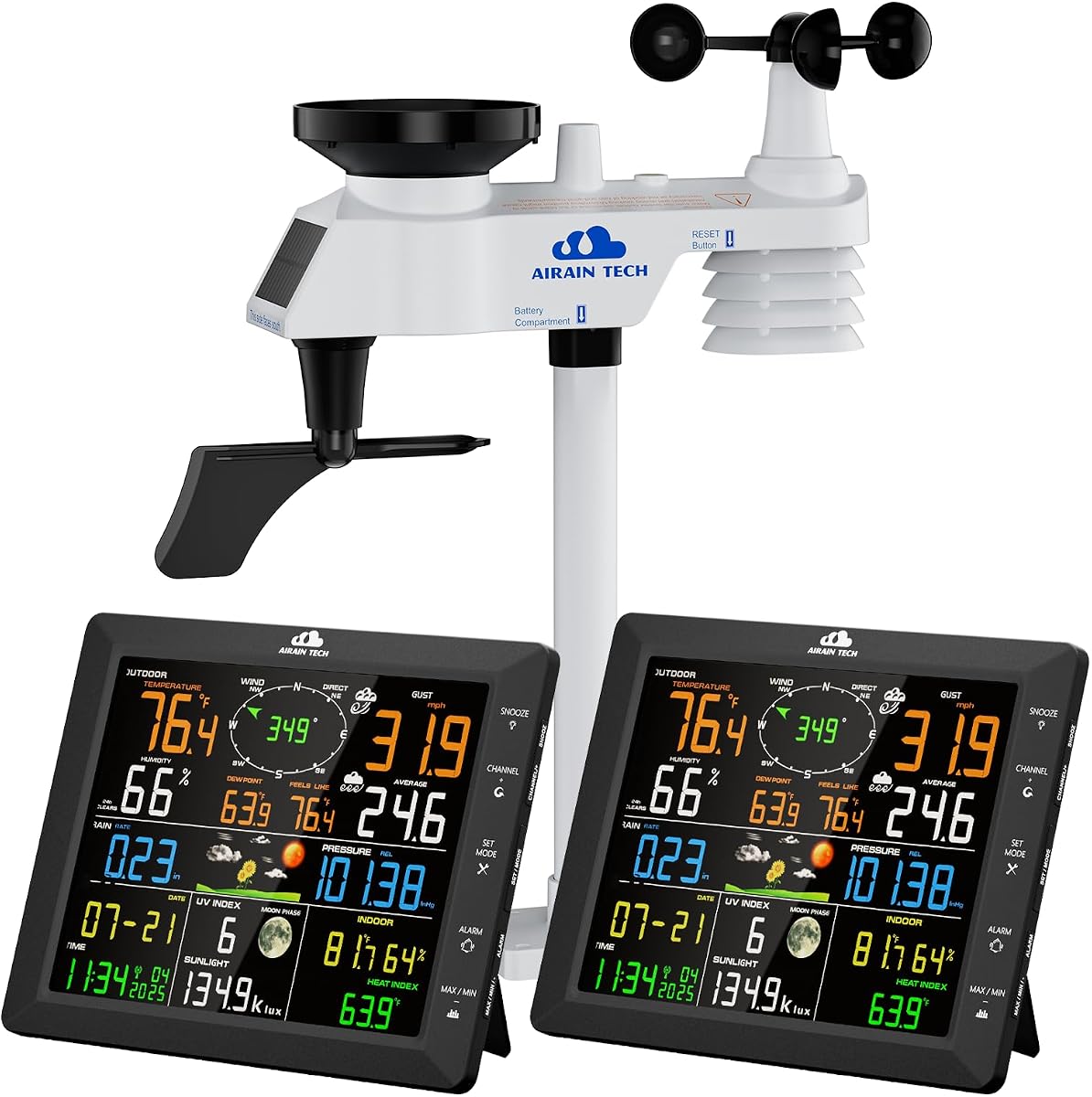
The Wireless Weather Station with Dual Displays has a 4.4 rating and offers the largest explicitly stated screen in the guide at 8.5 inches. Its color LCD uses adjustable brightness and brings wind speed and direction, future trends, indoor and outdoor temperature and humidity, and barometric pressure changes together on one screen.
We may earn a commission when you buy through this link, at no additional cost to you.
Its outdoor assembly includes a rain gauge, anemometer, and temperature and humidity sensors. The host console receives rainfall, wind, UV index, wind chill, dew point, moon phase, and pressure readings, with a stated wireless range of 328 feet. The package includes two main display units, an outdoor sensor, a power adapter, mounting hardware, and a pole.
There is no Wi-Fi, app, or cloud connection, so this is a local display system rather than a remotely monitored station. The stated temperature range extends from minus 40 to 140 degrees Fahrenheit, humidity from 10 to 99 percent, and the console includes a stated two-year warranty and Florida-based support.
The station is a compelling choice for users who prioritize a very large screen and comprehensive local readings. It suits a workshop, garage, garden room, or busy household wall where one readable overview can be seen from a distance, provided the outdoor assembly can be mounted securely.
At 8.5 inches, the color LCD is designed to present many measurements at once. Adjustable brightness helps balance readability with comfort in different rooms and times of day.
Rain, wind, radiation, temperature, humidity, and pressure data arrive through a wireless outdoor assembly. Automatic pairing and an adjustable bracket simplify setup, while a second display unit adds placement flexibility.
We may earn a commission when you buy through this link, at no additional cost to you.
The right station depends on which measurements matter, how the display will be used, and whether remote access matters more than a simple local installation. Evaluate screen readability, sensor coverage, wireless range, power, connectivity, and mounting requirements together.
A large display is most valuable when it can be understood quickly from a normal viewing distance. Consider the stated screen size, color presentation, forecast icons, adjustable dimming, and how many data fields appear at once. A bigger screen can show more information, but dense layouts may still require close reading. The Dual Display model offers an explicitly stated 8.5-inch panel, while most other choices emphasize large color LCDs with varying layouts.
Choose a large screen with a simple hierarchy, distinct icons, and brightness controls. It should be readable from across a kitchen, bedroom, office, or workshop without looking like a permanent industrial control panel.
Temperature and humidity form the foundation of most home stations, but outdoor conditions may also require wind, rainfall, barometric pressure, UV index, and solar radiation. The AcuRite Iris, Ambient Weather models, Tempest, La Crosse V42-PRO-INT, and Dual Display Station provide broader measurements. Newentor and several La Crosse options concentrate on temperature, humidity, forecasts, and comfort data.
Match the sensor package to the decisions you expect to make. Garden irrigation may justify rain and wind readings, while indoor comfort monitoring is best served by humidity alerts, dew point, and heat index.
A forecast display should be evaluated as a trend aid rather than an infallible prediction. Several products use barometric pressure, elevation information, or connected forecast data, and many need a calibration period before local accuracy settles. The AcuRite Iris provides a personalized 12-hour forecast, while connected systems can present longer-range and hourly information.
Look for a tendency indicator, forecast icons, and access to pressure history. A longer calibration period is a temporary setup consideration, not necessarily a defect, but it should influence when the system is first evaluated.
Wireless range determines whether the outdoor sensor can be placed where it will measure useful conditions. Stated ranges range from 330 feet for the La Crosse Advanced Station to 328 feet for the Dual Display model, 400 feet for the V42-PRO-INT, and more than 1,000 feet for Tempest. Walls, buildings, obstructions, and installation height can affect actual results.
For apartments or small homes, range is rarely the deciding factor. For larger properties, prioritize unobstructed placement and verify that the stated range fits the intended distance. Newentor's three-channel support offers a different benefit by allowing multiple local sensor locations.
Wi-Fi transforms a weather station into a connected data source. The Ambient Weather WS-5000 and WS-2000 support network transmission, Tempest supports remote app access and smart-home integrations, and the La Crosse V42-PRO-INT adds mobile alerts and extended online information. Standalone models offer fewer configuration demands and continue working without a network.
Choose Wi-Fi if remote monitoring, automation, historical dashboards, or notifications are important. Choose a standalone unit if reliable local readings, simpler ownership, and fewer account requirements matter more.
Power requirements affect installation, brightness, and backup behavior. Some consoles use an included adapter for continuous illumination, while battery-only mode dims the display after a short interval to conserve energy. The Newentor and La Crosse Advanced Station both use temporary battery backlighting, whereas the C85845-INT offers a constant adjustable backlight when connected to AC power.
Check which adapters and backup batteries are included. Plan the nearest outlet or provide suitable batteries, and use brightness controls to reduce glare in a bedroom or other dark space.
Several stations double as household clocks, with atomic time, calendar displays, alarms, and snooze. Custom high and low alerts for temperature and humidity can be valuable for protecting plants, pets, or elderly family members. Forecast tendency arrows and records add context when checking conditions later in the day.
Prioritize the alert controls you will actually use. A console with several useful thresholds can be more valuable than one with many decorative features, while a precise clock may matter most in a bedroom or kitchen.
Outdoor sensors need a secure, representative mounting location. Some products provide simple wall brackets, while complete stations include poles, bolts, and adjustable-angle hardware. Placement can affect wind, rain, sunlight, and humidity readings, so avoid sheltered corners that make measurements unrepresentative of actual yard conditions.
Review the package contents and mounting process before ordering. Confirm that the outdoor location is reachable during setup, the included hardware fits the mounting surface, and the display will receive power in its intended room.
Begin by unpacking the console, sensors, power adapter, mounting hardware, and instructions. Identify each component, install the required batteries, and place the console near its power source. Position the remote sensor outdoors in an open, secure location that represents the conditions you want to monitor, away from direct heat sources and obstructions.
Power on the console and remote unit, then allow them to pair and transmit. Set the date, time, units, alerts, and display brightness. Forecast systems may need several days of barometric calibration, so avoid judging predictive accuracy from the first hours. For connected models, complete the app and network setup before configuring remote notifications or automations.
Clean the outdoor sensor periodically and inspect the mount, batteries, and connections. Remove accumulated debris from rain gauges and keep ventilation paths unobstructed. Replace batteries on a schedule, particularly before extended periods of cold or inactivity. Recalibrate after moving a sensor, and verify the latest manual for model-specific maintenance guidance.
The most important feature depends on how you plan to use the station. Temperature and humidity are essential for indoor comfort, while rainfall, wind, pressure, and UV data help with gardening and outdoor planning. Readability, alerts, and reliable transmission are equally important because a sophisticated measurement is less useful when it is difficult to see or interpret.
Wireless stations are generally suitable for home monitoring when the sensors are correctly positioned and paired. Accuracy varies by sensor type, placement, calibration, and environmental conditions. Give barometric forecast systems time to calibrate, compare the display with a nearby trusted source, and keep outdoor units away from heat vents, direct sunlight, and other distorting conditions.
No. Standalone stations display measurements, forecasts, history, and alerts locally without an internet connection. Wi-Fi becomes useful when you want phone access, remote notifications, online dashboards, extended forecasts, or automated smart-home actions. It also introduces account setup and network dependence, so consider how much remote functionality you actually need.
Choose a secure outdoor location with open exposure and a clear wireless path to the display. The sensor should be high enough to avoid splash or ground moisture but not surrounded by structures that block wind or sunlight. Follow the model instructions, and remember that walls and obstructions can reduce the practical range of a wireless connection.
Several products in this guide require approximately seven to ten days of barometric calibration before their forecasts stabilize. During that period, keep the station powered and avoid frequent clock or pressure resets. Local pressure trends, elevation, and the quality of the sensor all influence how closely the forecast matches actual conditions.
It depends on the model. The Newentor supports up to three remote sensor channels, allowing temperature and humidity monitoring in multiple rooms or areas. Most other stations in this guide focus on one primary outdoor sensor package while adding different measurements such as wind, rain, UV, or solar radiation.
A weather station includes additional sensing and forecasting functions beyond indoor and outdoor temperature. Depending on the model, these may include humidity, barometric pressure, wind, rainfall, UV index, solar radiation, heat index, dew point, records, and alerts. A basic thermometer is simpler and may be more appropriate when only temperature readings are needed.
Inspect the mounting point and batteries regularly, especially after severe weather. Keep the sensor and rain gauge clear of dirt, leaves, ice, and other obstructions, while following the manual for safe cleaning methods. If readings change unexpectedly, check placement and sensor connection before assuming the display or forecast has failed.
The AcuRite Iris is the most balanced overall selection because it combines a large dimmable color display with more than 55 data points, wind and rain readings, and a personalized forecast. The Newentor Wireless Thermometer is the strongest budget-oriented option for temperature, humidity, forecasts, multi-channel monitoring, and clock functions, while the Ambient Weather WS-5000 leads the premium group with fast updates, an integrated array, and broad smart-home integration.
Prioritize the measurements you will use, the size and layout of the display, and whether local-only operation or remote access is more valuable. A basic temperature-and-humidity station is easier to own, but adding wind, rain, pressure, UV, and connectivity creates a much more useful backyard and smart-home platform. Installation requirements should be considered just as carefully as the feature list.
Finally, check the current product listing, included accessories, battery requirements, and price before ordering. Ratings, availability, and promotional terms can change, and outdoor mounting options can materially affect the usefulness of the entire system. Choose the model that best matches your measurements and daily routine rather than simply selecting the largest number of features.