
PreSonus StudioLive Classic 16.0.2
4.0Editor score
Sixteen-channel digital console
Class A XMAX preamplifiers
Multitrack USB recording
Scene recall and MIDI control
Discover the best sound board for church, comparing inputs, EQ, phantom power, recording, monitoring, and connectivity for worship teams in live audio setups.
A church sound board is the central control point for microphones, instruments, playback devices, and other program audio. A useful model balances enough input capacity with clear gain control, dependable monitoring, and features that help volunteer operators manage predictable, worship-ready mixes.
The mixers in this guide were compared by channel count, input flexibility, EQ options, phantom power, effects, headphone monitoring, recording capabilities, Bluetooth and USB support, and construction. The list ranges from compact consoles for small services to a digital console designed for more demanding live-production workflows.
Each review explains where the mixer is strongest, where compromises may appear, and which teams should give it serious consideration. Ratings and specifications reflect the supplied product information, while availability and prices can change, so confirm current details before purchasing.
4.0Editor score

4.5Editor score

4.4Editor score
The comparison covers ten mixers with different levels of channel capacity, recording functionality, and operator control, from compact five- and six-channel models to a full digital console.




This eight-channel recording sound board carries a 4.3 rating and offers one of the more balanced feature sets for a compact church mixer. Its eight XLR and 1/4-inch inputs accommodate several vocal microphones, instruments, playback sources, and other line-level devices without moving beyond a manageable channel count.
We may earn a commission when you buy through this link, at no additional cost to you.
Every channel has independent gain, effects, and volume controls, along with high, mid, and low EQ. Built-in delay and reverb can add depth to worship vocals, while 48V phantom power supports condenser microphones. PFL monitoring and a headphone output give operators a way to check individual channels before including them in the room mix.
Bluetooth 5.0 playback and USB audio support make it practical for backing tracks, computer playback, and recording workflows. One important limitation is that Bluetooth is for receiving streamed audio rather than sending the mixed program to a speaker. The 1.57-inch chassis is portable, and sealed controls are intended to resist dust during regular use.
This is a strong candidate for small worship teams that need more than a basic four-channel mixer but do not require the input count of a larger console. It is especially helpful for operators who want channel EQ, effects, and direct monitoring in a relatively compact board. For churches using condenser microphones and recording services, its connectivity and phantom-power support add practical value.
Independent channel gain, EQ, effects, and volume controls make it easier for a less-experienced operator to isolate problems. PFL also helps identify feedback or unwanted noise without changing the main audience mix.
Bluetooth and USB give worship teams convenient ways to bring in tracks, accompaniment, or computer audio. The USB function supports both playback and recording according to the supplied description.
We may earn a commission when you buy through this link, at no additional cost to you.
The W IN-MIX DX16 earns a 4.5 rating and is one of the strongest all-around choices in this roundup. Its 16-channel layout provides substantially more room than compact eight-channel models, making it suitable for services with multiple speakers, musicians, guest microphones, playback, and a dedicated effects return.
We may earn a commission when you buy through this link, at no additional cost to you.
Individual three-band EQ and gain controls let operators balance vocals, guitars, and backing tracks. A seven-band master equalizer provides room-level tone shaping, while 99 DSP effects include reverb, delay, chorus, and dynamics. Phantom power is available on every channel, and illuminated mute buttons help prevent accidental cutoffs during a service.
The board includes 14 XLR and 6.35 mm combo inputs plus two stereo channels. Bluetooth handles backing-track streaming, while USB recording captures performances to a computer. Its metal construction and intuitive layout are intended for live stages, studios, karaoke, touring musicians, and church sound teams that need flexible input and output options.
This mixer is a particularly good fit for growing churches and worship bands that routinely connect several microphones and instruments. It offers more onboard processing and connectivity than a basic analog board, while remaining less digitally complex than the PreSonus. Volunteer operators should still create labeled gain structures and scene-like channel notes because the number of options can become difficult to manage without preparation.
Fourteen combo inputs make it easier to support vocalists, instruments, guest speakers, and stereo sources at the same time. Two additional stereo channels extend the available routing options.
Ninety-nine effects and the master EQ can handle common polish tasks without relying on a rack of outboard processors. Per-channel phantom power simplifies condenser-microphone deployment.
We may earn a commission when you buy through this link, at no additional cost to you.
The PreSonus StudioLive Classic 16.0.2 is the premium and most production-oriented mixer in this guide. Its 4.0 rating reflects a capable digital console with 16 channel inputs, professional signal processing, and a built-in 18-input, 16-output USB audio interface for computer recording.
We may earn a commission when you buy through this link, at no additional cost to you.
Twelve Class A XMAX solid-state microphone preamplifiers provide a clear technical foundation for vocal and instrument capture. Fat Channel processing gives every channel and bus three-band semi-parametric EQ, compression, downward expansion, and limiting. Four auxiliary buses, two internal effects buses, a 31-band main-bus graphic EQ, and scene recall support repeatable, sophisticated mixes.
The included software library covers Studio One Artist, Capture live recording, UC Surface control, and QMix-UC wireless auxiliary control for supported mobile devices. MIDI I/O can manage output levels, recall effects presets and scenes, or serve as a MIDI interface. This combination makes the console appropriate for churches that record services, rehearsal mixes, or original worship music.
It is best suited to a church with a dedicated audio volunteer, a volunteer group trained in digital workflows, or a production team that values repeatable scenes and multitrack capture. The advanced feature set is less convenient for a simple occasional-use board, but it offers the deepest integrated recording and recall capabilities among the ten products.
Stored scenes let an operator recall channel, bus, and effect settings for recurring service configurations. This can reduce setup time and make changes easier to repeat week after week.
The integrated USB interface records all channels and the main stereo mix, making the console a central hub for multitrack worship recording. Compatible computer software completes the production workflow.
We may earn a commission when you buy through this link, at no additional cost to you.
The XTUGA CT120 has a 4.3 rating and combines a 12-channel frame with a slim 1.4-inch profile. That combination makes it appealing for small churches, mobile worship teams, and operators who need to move a sound board between rooms without giving up balanced microphone connections.
We may earn a commission when you buy through this link, at no additional cost to you.
Gold-plated XLR ports and 48V phantom power support clean microphone input, while balanced XLR connections with insert points suit recording, podcasting, live streaming, and karaoke. The mixer supports multiple channel configurations, including 6, 8, 12, and 16-channel input arrangements as described in the supplied information.
Bluetooth works with iOS and Android devices, tablets, and MP3 players, while direct MP3 or USB flash-drive playback adds another source option. The USB audio interface can record, edit, and export audio to a computer. A built-in MP3 player and recorder supports common formats including MP3, WAV, and WMA.
Churches that need moderate channel capacity and several playback methods should give the CT120 serious consideration. It is less appropriate for operators seeking extensive scene recall or advanced multitrack workflows, but its portable construction, low-noise-oriented connections, and media flexibility make it a practical choice for regular services and mobile ministry setups.
The low-profile chassis is easier to transport and store than a full console. Sealed rotary knobs add resistance to dust while maintaining smooth operation.
Bluetooth, flash-drive playback, MP3-player support, and a USB interface cover common worship-track sources. That range is useful when a team wants redundancy without a complex playback system.
We may earn a commission when you buy through this link, at no additional cost to you.
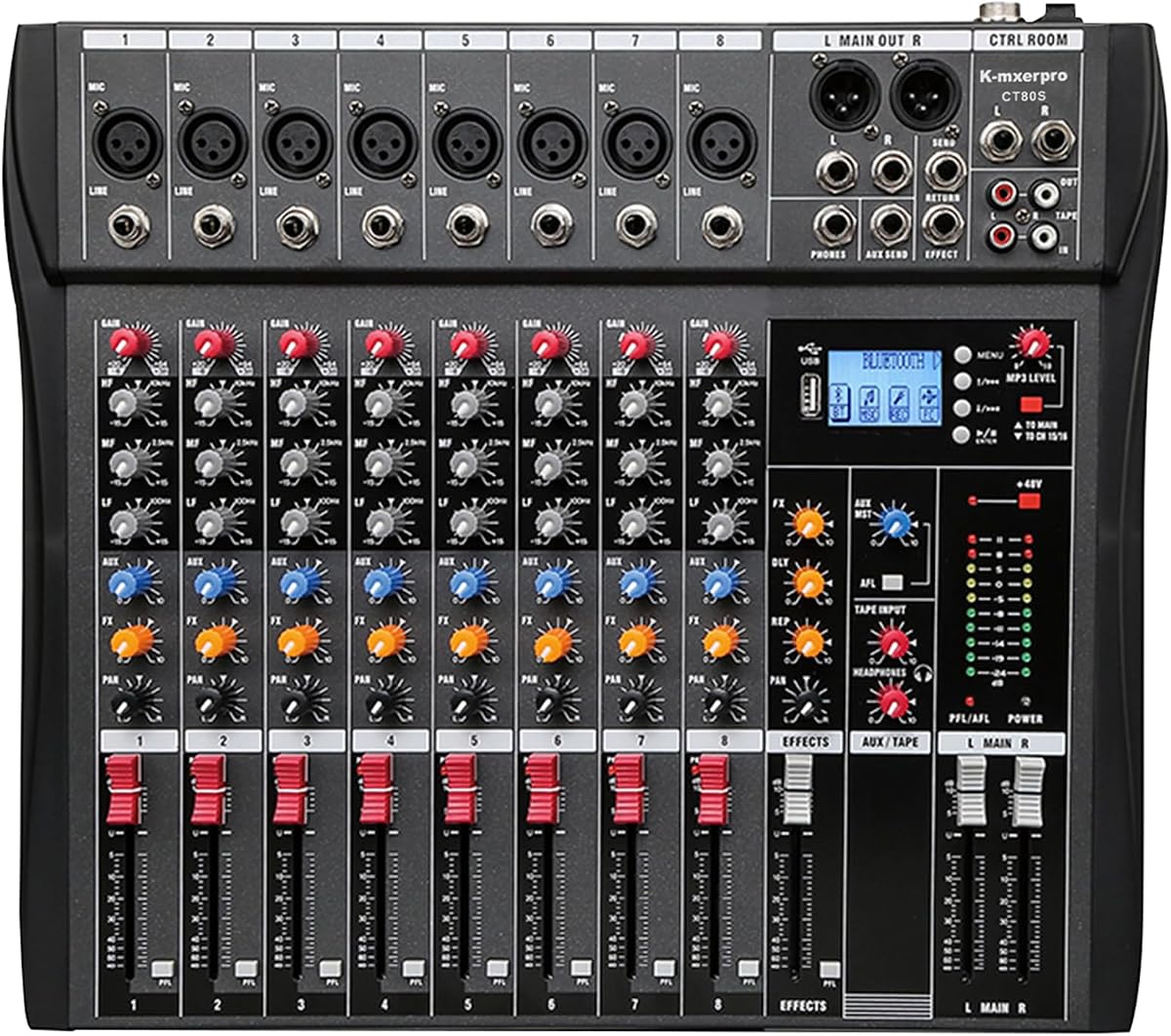
The FULUODE CT-80S carries a 4.4 rating and stands out as the best budget-oriented option in this list. Its eight-channel board gives small churches enough capacity for several vocal microphones, instruments, and a playback source without the larger footprint of a 12- or 16-channel mixer.
We may earn a commission when you buy through this link, at no additional cost to you.
The console includes 48V phantom power for condenser microphones, three-segment control per channel, Bluetooth 5.0 wireless connectivity, and MP3 or USB input. A large LED display presents song information and operating status, while support for an external digital effector expands the available processing options.
Its 1.57-inch design is portable and appropriate for family karaoke, small bands, campus events, conferences, and church services. The stated 110V power configuration and American plug are important to verify for international users. The supplied information also notes that the display arrives with a protective film.
This mixer is a sensible choice for a church that needs a straightforward board for a few microphones, occasional instruments, and Bluetooth accompaniment. It does not offer the digital scene recall or sophisticated multitrack features of higher-end models, but it covers the essential live-mixing functions at a focused, budget-friendly level.
The large LED display shows track information and mixer status, helping an operator confirm the selected source. This is useful when a service relies on prepared playback files.
Built-in 48V phantom power allows compatible condenser microphones to operate without a separate supply. That simplifies setups for worship leaders and guest speakers.
We may earn a commission when you buy through this link, at no additional cost to you.
This eight-channel professional sound board has a 4.0 rating and focuses on detailed analog control. All eight channels accept both XLR and unbalanced 6.35 mm plugs, while dedicated record and tape inputs and outputs expand the available source connections.
We may earn a commission when you buy through this link, at no additional cost to you.
Each channel provides gain, effects, PFL, a fader, a peak indicator, and high, mid, and low EQ. Delay and reverb can shape vocals and instruments without external processors. The PFL or AFL button sends a selected channel through the monitor headphones, helping operators locate hum, distortion, or balance problems.
The mixer can receive audio from a computer, flash drive, phone, tablet, or other USB device. Bluetooth playback supports accompaniment from compatible devices, and ongoing audio can be recorded to a USB flash drive. Built-in transport controls allow play, pause, track switching, and mode changes.
Churches that value direct, understandable channel control will find this mixer useful for small bands, weddings, streaming, podcasting, and worship services. It offers less input capacity than the 12- and 16-channel options, but every one of its eight channels includes a substantial set of controls. It is a good middle ground for operators who want more visibility than a basic compact board.
PFL and AFL selection gives the operator a private way to inspect a channel. The corresponding peak indicators provide an additional visual reference when setting levels.
Independent three-band EQ on every channel allows vocals and instruments to be balanced separately. Reverb and delay add polish for spoken ministry and music.
We may earn a commission when you buy through this link, at no additional cost to you.
The 12-channel DSP mixer holds a 4.1 rating and differentiates itself with an unusually extensive library of 320 selectable 24-bit DSP effects. It also includes a seven-band graphic EQ on the master output, giving operators substantial tonal control for a church or event room.
We may earn a commission when you buy through this link, at no additional cost to you.
Every channel has 48V phantom power, a -26 dB pad, and an 80 Hz high-pass filter. These features help accommodate different microphones and reduce low-frequency noise or overload. Additional controls include gain, three-band EQ, dual auxiliary sends, pan, and a dedicated PFL button for private source monitoring.
Bluetooth playback, USB input, and direct U-disk recording and playback provide several ways to handle tracks and capture program audio. A 6.35 mm headphone output supports real-time monitoring. Phone-based live streaming and recording through USB requires an OTG adapter, which is not included, so that workflow needs an extra accessory.
This board is well matched to churches that want many channel options and several built-in effects without moving to a digital console. The broad effects library can be valuable for worship, testimony, karaoke, and event programming. Volunteers should keep a short list of useful effects rather than exploring all 320 presets during a service.
The 80 Hz high-pass filters and pad controls help manage rumble and excessive signal levels. These options are particularly useful when different microphones are used from one week to the next.
Dual auxiliary sends allow selected channels to feed separate monitor or processing paths. PFL monitoring supports troubleshooting before a source reaches the main mix.
We may earn a commission when you buy through this link, at no additional cost to you.
The GP160 has a 5.0 rating, the highest listed score in the group, and combines a 16-channel layout with a heavy-duty metal chassis. Its construction and input capacity make it a natural candidate for permanent church installations, medium-size worship teams, and other live settings.
We may earn a commission when you buy through this link, at no additional cost to you.
A 24-bit DSP processor and three-band EQ on every channel provide the main tone controls, with separate delay and reverb knobs for adding depth to vocals and instruments. Independent phantom power, PFL monitoring, auxiliary sends, and separate headphone and monitor volume controls support a more structured live mix.
Bluetooth and USB playback are included, along with a dedicated recording output and a full-size MP3 fader. USB audio can be routed to physical channels, allowing playback to receive the same EQ treatment as other sources. The described copper jacks and anti-oxidation construction are intended to support dependable connections.
The mixer is listed as suitable for live stages, churches, studios, and karaoke. Its strongest appeal is the combination of channel capacity, monitoring features, and robust construction. The 5.0 rating is encouraging, but buyers should also verify the exact jack layout, software needs, and output requirements against their existing PA system before installation.
PFL lets an operator check a source privately, while independent AUX and monitor controls support separate listening paths. These are useful features for troubleshooting a service before the room fills.
Routing USB audio to physical channels lets operators apply EQ and level control to tracks. That can produce a more consistent result than leaving accompaniment outside the main mix.
We may earn a commission when you buy through this link, at no additional cost to you.
This six-channel audio interface mixer has a 4.3 rating and is a compact option for churches with a simple service format. Four XLR inputs handle balanced microphones, while the fifth and sixth channels accept stereo 6.35 mm connections for instruments, wireless receivers, or other line sources.
We may earn a commission when you buy through this link, at no additional cost to you.
The four XLR channels support phantom power for compatible condenser microphones. Independent 48V switches allow operators to power only the channels that require it. Three-band EQ and gain controls are provided, along with faders, a master output, and an effects control. Sixteen DSP presets include delay and reverb options.
Bluetooth accepts streamed audio from a phone or tablet, and the USB interface can work with a flash drive or Bluetooth device for playback and recording. Built-in controls provide play, pause, track skipping, and mode changes. The package includes a power supply and manual according to the supplied information.
This mixer is best for a small church with a worship leader, one or two additional speakers, and a single instrumental source. It is less suited to a full band because only four XLR mic inputs are available. Careful input selection and a clear labeling plan will help prevent confusion during services.
The XLR inputs support the common church combination of pastor, worship leader, and guest microphones. Stereo channels extend the board to instruments and other line-level sources.
Bluetooth and flash-drive options make it easy to prepare accompaniment from a phone or stored media. Physical transport controls reduce dependence on a phone screen.
We may earn a commission when you buy through this link, at no additional cost to you.
The five-channel streaming mixer has a 3.7 rating and is the most focused option in the guide. Three XLR and 6.35 mm combo inputs support microphones or instruments, while separate left and right 6.35 mm and RCA stereo inputs accommodate CD players, keyboards, computers, and other sources.
We may earn a commission when you buy through this link, at no additional cost to you.
The first three channels offer three-band EQ, a compressor, independent 48V phantom power, and a high-pass filter. Compression helps reduce sudden vocal level changes, while the high-pass filter can reduce low-frequency rumble. Ninety-nine categorized DSP effects include reverb, delay, chorus, and flanger.
Bluetooth, USB computer connection, and flash-drive playback are supported without additional drivers. USB recording is a stereo mix at 16-bit and 48 kHz, so a separate audio interface is necessary for true multitrack recording. A 6.35 mm headphone output provides direct hardware monitoring without computer delay, and an AUX output can feed speakers or stage monitors.
The board is intended for home recording, personal projects, podcasting, karaoke, and small events rather than a demanding fixed church system. It can work for a small worship stream with disciplined gain staging, but the five-channel capacity and stereo-only recording limit complex production. Its focused feature set is the trade-off for a compact and approachable setup.
Direct hardware monitoring avoids computer delay during a performance. The separate AUX output can provide another feed for speakers, monitors, or a second listener.
The USB recorder captures a stereo mix at 16-bit and 48 kHz. Churches that need to isolate and edit individual instruments should plan on using a dedicated multitrack interface.
We may earn a commission when you buy through this link, at no additional cost to you.
The right church mixer depends on the number of regular sources, the skill level of its operators, the room's monitoring needs, and whether the service requires recording or multitrack capture.
Choose enough inputs for normal operation, with modest room for growth. A mixer with too few channels creates rushed re-patching, while an overly complex board can be intimidating for volunteers.
Match the board to the existing cables and PA system rather than assuming all connectors perform the same function. Input count alone does not confirm complete compatibility.
Prioritize clear channel-level control and basic tone shaping. Large effects libraries are useful, but dependable EQ, gain staging, and monitoring matter more on a regular basis.
Per-channel phantom-power switches offer the most flexibility. Ensure the power is off for incompatible microphones and avoid sending phantom power along unintended routing paths.
Look for a monitoring workflow that volunteers can understand quickly. Private source selection and clear level control should be priorities over elaborate routing that will not be used.
Choose a stereo recorder for straightforward service archives, but use a dedicated multitrack interface when editing individual musicians. Confirm the file format, sample rate, and software compatibility before recording.
Favor a layout that can be explained in a short training session. Create a written gain, channel, and playback plan so knowledge does not depend on one experienced volunteer.
Decide where the mixer will live before choosing its size. Portability, durability, and room storage should complement the input and processing requirements.
Begin by connecting microphones and instruments with powered speakers muted, then identify every input on the console and in your written setup sheet. Confirm which microphones need 48V phantom power, keep that power disabled for incompatible devices, and check that each source is connected to the intended channel. Balanced XLR connections should be favored for microphones and other long cable runs.
Set gain before EQ and effects. With the vocalist or reference source at a normal performance level, bring the channel fader to a controlled position, adjust preamp gain, and watch the meter for clipping. Apply high, mid, and low EQ gradually, add only the reverb or delay needed, and use PFL or headphone monitoring to locate hum, distortion, or unintended feedback.
After each service, mute channels before changing cables, reduce the master output, and disconnect equipment in a controlled order. Keep the mixer covered and away from moisture, excessive heat, and dust. Update the setup sheet whenever a source, gain, effect, or routing assignment changes, and back up any saved digital scenes or computer recording projects.
A small church serving one or two vocalists with limited instruments may be able to use five or six usable channels. Count each microphone, stereo instrument feed, wireless receiver output, and playback source, then leave some flexibility for occasional guests or additional instruments. An eight-channel board is a practical middle ground for many small teams.
No. Most condenser microphones require 48V phantom power, while most dynamic microphones do not. A ribbon microphone may also be incompatible with phantom power. Check the microphone documentation and use a mixer that provides clearly controlled phantom power only on the required channels.
Bluetooth is convenient but can be affected by wireless interference, device notifications, or an unstable connection. For critical services, maintain a local backup such as a flash drive, wired computer output, or another playback source. The mixers with USB and flash-drive support offer useful redundancy.
Stereo recording captures one blended left and right program, which is convenient for archives and quick edits. Multitrack recording captures individual channels so vocals, instruments, and effects can be adjusted independently after the service. A mixer with a multitrack USB interface is better for serious music production.
They allow an operator to listen to a selected channel privately through headphones before or during a service. This makes it easier to identify feedback, noise, clipping, or an incorrect source. It is especially useful when a problem is difficult to locate through the main speakers alone.
An analog mixer is often simpler for a small team that needs dependable live control, while a digital console can provide extensive processing, scene recall, and multitrack recording. Digital options reward careful setup and training. Choose the complexity that the church's audio volunteers will actually operate confidently.
Basic reverb and delay can be useful for vocals and spoken ministry, but onboard effects are not essential if the church already has quality external processors. A broad effects library is most valuable when the board is the main processing center. Reliable gain control, EQ, and monitoring should remain the priority.
The plan should list every source, input assignment, gain setting, phantom-power requirement, EQ starting point, effect, output route, and playback backup. A simple diagram and notes for each service type prevent a volunteer from guessing during a rehearsal or worship gathering.
The W IN-MIX DX16 is the most versatile live choice in this guide, with 16 channels, 99 effects, extensive inputs, and Bluetooth and USB recording. The PreSonus StudioLive Classic 16.0.2 takes the premium route with digital processing, scene recall, professional preamplifiers, and multitrack capture, while the FULUODE CT-80S provides a focused eight-channel foundation for smaller budgets.
For most churches, the right decision begins with an honest count of weekly sources and the number of volunteers who will operate the board. Choose balanced XLR connections, dependable gain and EQ controls, appropriate phantom power, and a monitoring method the team understands. Add sophisticated processing or recording only when there is a clear ministry use for it.
Before buying, confirm the current specifications, connector requirements, software compatibility, and accessories needed for the intended setup. Product ratings, availability, and prices can change, so checking the latest listing can prevent an incompatible purchase and help ensure the selected mixer supports the church's present and future services.