
Fluke Networks D914S
4.7Editor score
Automatic spring handle
EverSharp 66/110 blade
Integrated hook and spudger
Lifetime warranty
Our Ethernet Punch Down Tool guide compares 10 leading options for 66 and 110 blocks, keystone jacks, cable compatibility, durability, handling, and ease of
An Ethernet punch down tool seats and trims twisted-pair wires inside 66 and 110 blocks, patch panels, and compatible keystone jacks. A useful model combines the correct termination blade, controlled impact, secure blade retention, and a grip that remains comfortable during repetitive cabling work.
The products in this guide were compared using the supplied specifications, including supported wiring systems, cable categories, blade configurations, impact controls, storage features, and stated durability. The list covers general-purpose tools, multi-tool kits, and specialized systems for particular 90-degree keystone jacks.
Each review identifies the tool most likely to suit a particular installation style, from a straightforward 66/110 option to a high-end impact tool or a specialized speed-terminating jack tool. Product details and availability can change, so readers should verify compatibility and current pricing before purchasing.
4.7Editor score

4.8Editor score

4.7Editor score
This side-by-side comparison highlights blade standards, supported cable and equipment, impact control, and specialized features so installers can quickly identify the most appropriate termination tool.


The Klein Tools VDV427-300 is an impact-style punch down tool built for installers who want one tool to cover widely used 66 and 110 termination points. Its 4.8 rating reflects a particularly strong combination of useful features, clear application support, and a conventional design that should appeal to both experienced technicians and attentive DIY users. The included pick and spudger also make it more practical than a bare punch down tool with only a blade.
We may earn a commission when you buy through this link, at no additional cost to you.
The tool terminates and cuts CAT3, CAT5e, CAT6, and CAT6A cable in a single step. A metal injection-molded blade is included, while the spring-loaded mechanism is designed to seat wires efficiently. Most importantly, the Hi/Low impact-force lever lets the operator tailor the action to the cable type and termination task, which is useful when moving among punch blocks, patch panels, and keystone jacks.
The cushioned traditional handle and nonslip grip are practical advantages during large jobs. Repeated terminations can fatigue the hand, so comfort and control are not superficial features in a cable tool. The trade-off is that this is a more substantial manual-impact design than a lightweight plastic punch tool, and it does not include a Krone blade. Buyers whose installations rely on Krone-style blocks will need a different or additional termination system.
This is the strongest general recommendation for a broad range of structured-cabling work. It combines dual blade standards, selectable impact, and good handling without restricting itself to a narrow family of jacks. Choose it when you regularly work with 66 or 110 systems, need a dependable everyday impact tool, or want one purchase to cover common data and voice termination tasks.
The selectable impact setting is one of the VDV427-300's most valuable details. A lower setting can suit lighter conductors, while the higher setting provides the force needed for more substantial terminations. Matching the setting to the wire and hardware helps operators achieve consistent seating without relying on a single fixed force for every job.
The combination of 66 and 110 blades makes this tool adaptable to common blocks, panels, and compatible jacks. The supplied pick and spudger support common installation tasks involving cable routing and positioning, reducing the need to keep separate small tools close at hand.
We may earn a commission when you buy through this link, at no additional cost to you.
The Fluke Networks D914S is a premium impact punch down tool aimed at technicians who value established professional features, service-oriented design, and a lifetime warranty. Its 4.7 rating places it among the strongest products in this guide. The tool combines a soft-touch ergonomic handle with an automatic spring handle and includes the accessories and storage features commonly sought by installers working directly in panels and wiring blocks.
We may earn a commission when you buy through this link, at no additional cost to you.
The automatic spring handle offers low impact for 24- and 26-gauge wire and high impact for 22-gauge wire. That explicit wire-gauge selection is especially useful because it connects the force setting to the conductor being terminated. The supplied EverSharp 66/110 cut blade is intended for 66 and 110 wiring blocks, allowing the tool to perform both seating and trimming in a familiar professional configuration.
Fluke integrates the hook and spudger into the handle and provides blade storage in the same area. That keeps essential accessories from becoming loose pieces in a tool bag. The soft-touch rubber grip and special ergonomic design are intended to improve control and reduce hand fatigue, both of which matter during a full day of repetitive terminations. The main limitation is its premium position, which may not be justified for a single occasional outlet.
The D914S is the right choice for a working technician, facilities team, or installer who makes punch-down terminations part of a regular workload. Its warranty, ergonomics, and integrated accessories justify the premium positioning when uptime and convenience matter. For occasional basic work, a lower-cost 66/110 tool may be more sensible, but the Fluke is designed to remain a dependable part of a professional toolkit.
The D914S centers usability on the grip and impact mechanism. A rubber handle gives the installer more purchase than a bare plastic frame, while the spring handle returns the tool to a ready position after each strike. The design is centered on making repeated terminations more controlled and less tiring.
Built-in hook and spudger storage reduces the likelihood of losing the small tools used to separate and position conductors. The stated blade-storage feature provides a dedicated place for replacement blades, making the tool more convenient to carry between jobs or store in a technician's case.
We may earn a commission when you buy through this link, at no additional cost to you.
The TRENDnet TC-PDT stands out as a value-oriented punch down tool for users who need both 110 and Krone termination formats. Its 4.7 rating indicates strong customer reception, and the twist-and-lock holder, reversible blades, and spare-blade storage make it especially well suited to installations that involve mixed wiring standards or frequent blade changes.
We may earn a commission when you buy through this link, at no additional cost to you.
The tool inserts and cuts terminations in one operation for Cat5, Cat5e, Cat6, and Cat6A network cables. It can be used with telephone sockets, Cat5e faceplates, and patch panels, giving it useful flexibility across common residential and commercial wiring tasks. The 110 and Krone blades are interchangeable and reversible, so a single tool body can cover two distinct standards.
Blade retention deserves particular attention because loose blades can be dangerous or can fail to remain aligned. TRENDnet's twist-and-lock holder is designed for fast changes while helping prevent blade pullout, and the holder can also store a spare blade. The comfort grip improves handling, although the absence of selectable impact force means operators cannot tune the action to different wire gauges. It also lacks a 66 blade, which separates it from some competing tools.
The TC-PDT is a compelling choice when 110 and Krone compatibility matter more than having several impact settings. It is especially attractive for installers maintaining mixed legacy and modern networks, or for users who want reversible blades and secure storage without moving to a premium price tier. For North American residential work focused only on 66 and 110 hardware, the Klein VDV427-300 offers broader blade coverage.
The reversible 110 and Krone blades allow users to move between two termination styles without carrying a separate tool for each. This is particularly useful in environments where telephone-style Krone blocks coexist with standard 110 hardware.
Twist-and-lock retention supports quick changes while resisting pullout. The same holder provides storage for a spare blade, helping prevent a frequently used replacement from being misplaced in a tool bag.
We may earn a commission when you buy through this link, at no additional cost to you.
The Cable Matters Punch Down Tool with 110 and 66 blades is a versatile choice for modern twisted-pair cabling, with stated compatibility from Cat5 through Cat8. Its 4.4 rating reflects a balanced feature set, particularly the combination of two standard blades, adjustable impact, and internal blade storage. It is a practical option for installers who work across several cable categories and common IDC terminal formats.
We may earn a commission when you buy through this link, at no additional cost to you.
Its spring-action design seats and terminates wires with low effort, while the reversible cut/punch blade handles trimming as part of the termination process. The Lo/Hi force setting provides useful control when working with different cable and hardware combinations. Removable blades use twist-and-lock sockets and can be stored inside the tool body during transport, improving organization and reducing the chance of an exposed blade rattling loose.
The 110 and 66 configuration makes the tool appropriate for compatible patch panels and keystone jacks, including Cat5, Cat5e, Cat6, Cat6A, Cat7, and Cat8 network or voice cables. Its limitation is that it does not add Krone support, and any product marketed as compatible still requires the connector's IDC layout to match the relevant blade. This is a general 66/110 tool, not a specialized all-jack solution.
Choose this model when broad compatibility and easy force adjustment matter more than premium branding or a specialized 90-degree jack mechanism. It is especially appealing to technicians who want one impact tool for common blocks, panels, and keystone jacks. Its internal blade storage also makes it appealing to anyone who values a tidy, protected carry arrangement.
Stated support extends through Cat6A, Cat7, and Cat8, making this a useful option for installers handling modern high-category twisted-pair runs. Compatibility is tied to the hardware's IDC layout, so buyers should still confirm that the jack or block uses the expected 66 or 110 termination position.
Keeping the removable blade inside the body during transport is a practical detail for field work. It reduces exposure and helps organize the tool, particularly when several punch-down tools and spare blades share the same bag or case.
We may earn a commission when you buy through this link, at no additional cost to you.
The VCELINK Punch Down Impact Tool with 110 and 66 blades offers a multi-function approach to data-cable termination. Its 4.3 rating reflects a useful combination of adjustable impact, reversible blades, and several built-in cable-management features. The tool is designed for network keystone jacks and patch panels, making it relevant to installers who want more than basic blade support.
We may earn a commission when you buy through this link, at no additional cost to you.
The double cutter head allows excess cable to be cut while the wires are punched, reducing the need to switch between a punch tool and separate cutter. Its blades are interchangeable and reversible between 110 and 66 standards, and Lo/Hi impact settings adapt the force to different termination requirements. A storage hole at the bottom can hold an extra blade, helping prevent loss of a frequently needed replacement.
Its most distinctive feature is the set of built-in utilities. Side-mounted wire pullers and a flat-blade puller are intended to remove extra cable and clean up terminated wiring. A mini wire stripper is also included in the package, and the manufacturer provides dedicated customer assistance for 18 months. The drawback is that these additions make the tool less minimalist, and there is no Krone blade for users who need that standard.
This VCELINK model is a good match for installers who value consolidation of several small termination tasks into one tool. It makes particular sense when repeatedly working with 110 or 66 keystone jacks and patch panels and wanting a cutter, pullers, and blade storage close at hand. Users who need maximum simplicity or Krone support should consider a more specialized alternative.
The side-mounted pullers are designed to remove excess conductors and help tidy a completed termination. Incorporating those functions into the body can save time when a technician is processing many identical jack locations and wants to avoid reaching for separate cleanup tools.
A dedicated bottom storage hole provides a place for an extra blade. That arrangement is helpful for high-volume work because a worn or damaged blade can be replaced without allowing the spare to disappear among unrelated tools and connectors.
We may earn a commission when you buy through this link, at no additional cost to you.
The VCELINK Speed Punch Down Tool is a specialized instrument rather than a general 66/110 punch down tool. It is designed exclusively for VCE's C265 series 90-degree keystone jacks, including the company's CAT6A, CAT6, and CAT5E models. Its 4.6 rating indicates a strong reception among users who need this precise, high-volume workflow.
We may earn a commission when you buy through this link, at no additional cost to you.
The central advantage is simultaneous operation. Its sharp blade head punches down and cuts eight wires in one smooth action, which the manufacturer describes as substantially faster than seating wires individually with a conventional punch-down tool. Because the tool operates directly on a mounted jack, it does not require a separate flat platform, allowing termination on patch panels and wall plates with one hand.
The replaceable blade head is made from SK5 steel and is intended to resist rust. Users can replace the small working component rather than discarding the entire tool after repeated wear. The specialized format also allows the jack to remain held in position while conductors are seated, which can be useful in confined work areas. The central trade-off is strict compatibility: it will not serve as a universal Ethernet punch down tool or work with competing 90-degree jacks.
Buy this tool if all of your relevant terminations use compatible VCE C265 keystone jacks and you regularly perform installations where speed matters. It is especially suitable for fitting slim jacks side by side in multiport wall plates or patch panels. For mixed brands, general 66/110 blocks, or uncertain jack types, a conventional multi-standard tool is a safer investment.
Simultaneously seating and cutting eight wires can substantially reduce the number of tool movements required for a jack. The design is built around the fixed conductor layout of the C265 series, allowing the blade head to align with all eight positions in one pass.
The tool can engage a mounted jack directly, so the installer does not have to place the keystone on a separate surface and punch it one conductor at a time. That design supports one-handed work at a patch panel, wall plate, or other already installed location.
We may earn a commission when you buy through this link, at no additional cost to you.
The Rapink Speed Keystone Jack Tool is a specialized termination tool for Rapink CAT6 90-degree speed-termination keystone jacks, specifically the model identified in the product information. Its 4.2 rating reflects a focused tool that solves a particular jack-termination problem well. It is not a general 66/110 punch down tool, and that distinction should guide every purchase decision.
We may earn a commission when you buy through this link, at no additional cost to you.
Its built-in housing holds the compatible jack in position while the tool punches and trims the conductors together. The manufacturer states that this approach can reduce installation time dramatically compared with a regular punch-down tool while avoiding the repetitive crimping motion that can contribute to finger and hand fatigue. The housing also makes it possible to terminate a jack in the air where conventional tools may be awkward to operate.
Adjustable trimming depth is another important feature. If cutting is incomplete, the setting can be changed; if the blade cuts too deeply and risks damaging the keystone, it can be adjusted in the other direction. The body is described as carbon steel with an alloy steel termination head, and the manufacturer states that the head can withstand more than 10,000 presses. The limitation is absolute brand and model compatibility.
This is an excellent choice for a technician whose workflow consistently uses the specified Rapink 90-degree keystone. It reduces repeated crimping, protects the jack during the operation, and allows controlled trimming in a compact housing. Do not select it for another manufacturer's jack or for general wiring blocks. If compatibility is uncertain, verify the exact jack model before buying.
The built-in housing supports the jack while the conductors are punched and trimmed. This helps reduce finger exposure to the force of the tool and can lower the repetitive hand motion involved in conventional one-wire-at-a-time crimping.
The central adjustment controls how much excess wire is removed. Fine-tuning it for the compatible jack helps avoid leaving an untidy projection or cutting the terminal too deeply, while the housing keeps the jack stable during the operation.
We may earn a commission when you buy through this link, at no additional cost to you.
The Klein Tools VDV026-212 is the most complete kit in this guide because it combines a punch down tool with cable stripping, cutting, crimping, modular plugs, and a carrying pouch. Its 4.8 rating is especially notable for a multi-tool package. Rather than serving as a single-purpose impact punch, it gives new or occasional installers several tools needed to prepare and terminate modular cable.
We may earn a commission when you buy through this link, at no additional cost to you.
The kit includes a 110-type punch down tool with Klein's DuraBlade precision cutting edge, a ratcheting modular crimper and stripper, a radial stripper with a durable high-carbon steel blade, a cable cutter, and six RJ45 Cat5e modular data plugs. The radial stripper automatically adjusts to different cable diameters, while the ratcheting tool handles cutting, stripping, and crimping. Everything fits inside a polyester zippered bag for organized storage and transport.
Its strongest benefit is consolidation. A technician or DIY user can prepare a cable, terminate a plug, and punch a compatible jack without assembling a broad collection of separate tools. The trade-off is that the kit does not center on 66/110 versatility in the same way as dedicated punch tools, and the included plug and punchdown specifications may not cover every connector in a given installation. Some users may also find the larger assortment unnecessary for occasional work.
The VDV026-212 is best for installers building a compact toolkit, assembling a small number of data connections, or wanting a ready-to-carry cable-termination set. Its 4.8 rating and comprehensive organization make it a strong all-in-one option. It is less appropriate when a technician already owns quality stripping and crimping tools and only needs to replace a punch down blade.
The kit covers several stages of modular cable work: stripping the jacket, cutting and crimping a plug, and punching wires into compatible hardware. The zippered pouch keeps those tools together, which is especially helpful for field technicians who need a complete ready-to-use setup.
The radial stripper adjusts automatically to different cable diameters, and the ratcheting crimper and stripper combines several operations in one tool. These additions complement the 110-type punchdown tool and make the package more useful than a punch tool with a generic storage pouch.
We may earn a commission when you buy through this link, at no additional cost to you.
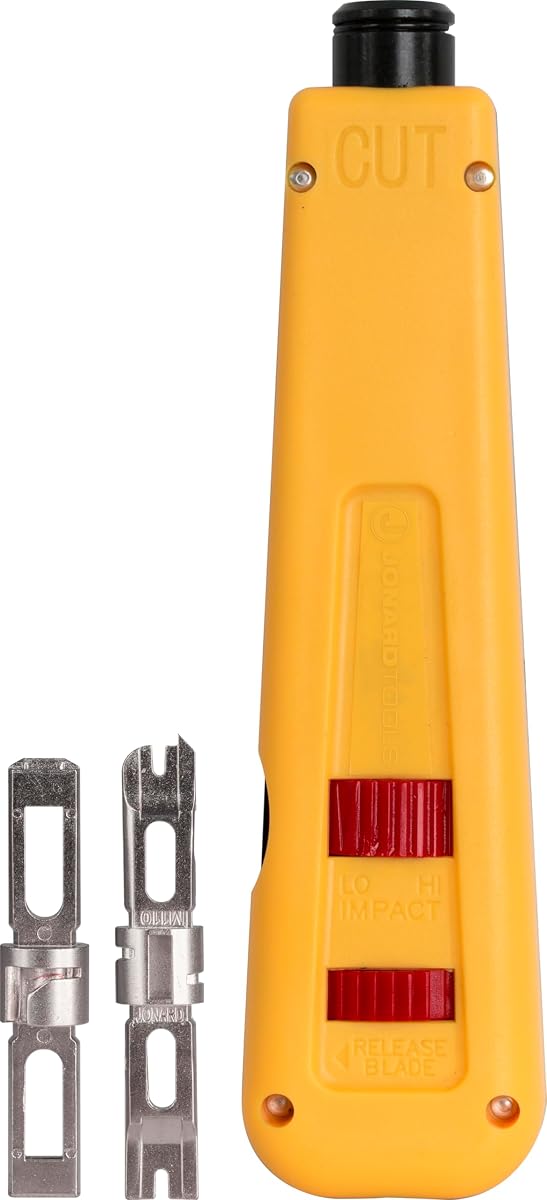
The Jonard Tools EPD-91461 is a manual punch down tool designed around durability, clear impact selection, and practical storage. Its 4.5 rating reflects a strong balance of features for technicians who need both 66 and 110 blades. The color-coded body and straightforward construction make it easy to identify and use in the field.
We may earn a commission when you buy through this link, at no additional cost to you.
High and low impact settings let users select an appropriate force for different termination requirements. The included blades are made from hardened alloy steel with nickel plating, and the product information states that the tool was tested to 100,000 cycles at the high impact setting. That durability claim makes the EPD-91461 appealing for shops and installers who use a punch down tool intensively.
A combination hook and spudger is stored in the chassis, and the enlarged compartment provides room for blades and small accessories. The tool also works with EPB-series blades and similar blades from other brands, which are sold separately. This ecosystem can be convenient for users who already own compatible components. The limitation is that it does not provide a specialized solution for 90-degree keystone jacks or a different termination standard such as Krone.
Choose the EPD-91461 when long service life, selectable impact, and broad blade compatibility are priorities. It is a strong general option for structured cabling technicians who appreciate a simple manual design and already understand the Jonard blade system. Those who need dual 66/110 blades but not the brand ecosystem will still find the included components sufficient for standard work.
The stated 100,000-cycle testing and hardened, nickel-plated alloy steel components support the EPD-91461's reputation as a durable manual tool. For a technician who terminates many cables each week, resistance to wear is a more meaningful advantage than a small reduction in tool weight.
The combination hook and spudger remains available in the body, while the enlarged storage compartment provides room for blades. This keeps frequently used parts together and reduces the chance of leaving a required tool at the workstation.
We may earn a commission when you buy through this link, at no additional cost to you.
The Klein Tools VDV427-300 rounds out the comparison as another highly rated general-purpose punch down tool. It is particularly attractive alongside the Cable Matters option because it shares a strong set of foundational qualities: common 66/110 blade support, selectable impact, spring-loaded operation, and a handle intended to remain secure and comfortable during repetitive work.
We may earn a commission when you buy through this link, at no additional cost to you.
The tool handles CAT3, CAT5e, CAT6, and CAT6A cable and can terminate and cut wires in a single step. It works with 66 and 110 panels and blocks, and the included pick and spudger assist with common positioning tasks. The Hi/Low impact lever allows the operator to tailor the action to the cable and application, while the cushioned, nonslip handle supports control and comfort.
Its limitations mirror those of many general-purpose impact tools. It does not include a Krone blade, and its 66/110 configuration does not make it suitable for every specialized 90-degree keystone system. Users with a mixed fleet of proprietary jacks may need one of the dedicated speed tools. For conventional blocks, panels, and compatible jacks, however, this is a straightforward and capable solution with a 4.8 rating.
This Klein model is a strong choice for a technician who wants a proven general tool with both common blade standards and adjustable force. It works especially well alongside a broader tool bag because the pick and spudger fill common gaps. Confirm the connector's IDC format before ordering, and choose a specialized speed punch tool if your work centers on one brand of 90-degree keystone.
A spring-loaded impact mechanism and a dedicated force lever make the tool intuitive to use for standard 66/110 terminations. This familiar configuration benefits technicians moving between patch panels, wiring blocks, and compatible keystone jacks without relearning a specialized operating method.
The combination of a nonslip grip, cushioned handle, and selectable impact provides a practical balance for repetitive work. It helps the operator maintain consistent control while reducing the fatigue associated with using a hard, narrow handle.
We may earn a commission when you buy through this link, at no additional cost to you.
The right Ethernet punch down tool depends on the termination hardware, cable types, workflow, and level of repetitive use. Blade standards, impact behavior, portability, and specialized jack compatibility should be evaluated before making a choice.
A punch down tool must match the physical position and cutting geometry of the connector's insulation displacement contacts. The two most common choices in this guide are 66 and 110, while some installations use Krone equipment. A tool that includes the wrong blade cannot create a reliable termination, regardless of its impact force or ergonomic design. Buyers should inspect existing patch panels, blocks, and keystone jacks before ordering.
General tools can often terminate common Cat5e, Cat6, and Cat6A cable, while some products list support through Cat7 and Cat8. Specialized speed tools are much narrower and may support only a named manufacturer and model of 90-degree jack. Review both sides of the compatibility claim: whether the cable category is acceptable and whether the connector's blade layout is physically supported.
Impact-style tools use controlled force to seat and trim wires. A Lo/Hi switch or explicit wire-gauge selection can make results more consistent across different conductors, though the correct setting also depends on the termination hardware. Manual tools without a selectable setting can still be effective, but operators have less built-in guidance. New users should practice on spare connectors before working on visible or final installations.
A cushioned or rubberized nonslip handle can reduce fatigue and improve control during large jobs. Weight, balance, grip texture, and the force required to operate the spring mechanism are equally important. The premium ergonomic features of a higher-end model make the most sense for full-time technicians, while occasional users may prioritize compactness and simplicity instead.
Twist-and-lock systems help keep a blade from pulling out during use, while internal storage protects the cutting edge and keeps the tool organized in a bag. Some models include spare-blade storage, hooks, or spudgers in the handle. These details do not change the core termination process, but they can reduce lost parts and make daily work more convenient.
Tools designed for specific 90-degree keystone jacks can punch and cut multiple conductors in one action. That may be valuable for consistent high-volume work, but it trades versatility for speed. A proprietary tool is most useful when the installer knows every compatible jack is from the specified brand. It should complement, rather than automatically replace, a general 66/110 punch down tool.
A single punch down tool handles only part of the cable-termination process. Stripping, cutting, opening conductors, seating jacks, and cleaning excess wire may require additional accessories. Kits that include a crimper, stripper, cable cutter, modular plugs, and a carrying pouch can be economical for new users. Experienced technicians may already own those accessories and should compare the punch tool itself.
Blade material, housing construction, stated cycle testing, warranties, and replacement-part availability can influence long-term value. A replaceable blade head is useful for a specialist tool because it avoids replacing the whole body when the working edge wears. Warranty coverage and manufacturer support are also useful considerations for professional users who depend on a tool for regular work.
Begin by identifying the connector type, arranging the conductors in the required color sequence, and ensuring the cable jacket is supported according to the connector's instructions. Place the correct blade into the tool and confirm that it locks securely. Before striking the first live connector, practice on a spare jack or block so the blade alignment, impact setting, and seating depth become familiar.
Hold the tool square to the termination point and use a controlled, deliberate action. Let the tool perform the seating and cutting operation rather than striking it repeatedly or applying uneven force. If a wire does not remain in the correct position, reset it and make another attempt on a fresh connector. A specialized speed tool should engage only the exact compatible jack model specified by its manufacturer.
After use, remove loose wire fragments and keep the blade clean of adhesive, insulation, and debris. Store the cutting edge in its protected position, lock or cover it where applicable, and retain any integrated pick, spudger, or replacement blade. If cuts become rough or wires are not being trimmed cleanly, replace a worn blade rather than forcing the tool harder.
An Ethernet punch down tool seats twisted-pair conductors into the insulation displacement contacts of compatible keystone jacks, patch panels, and wiring blocks. It also trims excess wire, usually during the same operation. The correct blade and connector layout are essential because the contacts must align with each conductor's position.
Neither blade is inherently better; the right choice depends on the hardware being terminated. A 66 blade is required for 66-style blocks, while a 110 blade fits 110-style blocks and compatible keystone jacks. Some tools include reversible blades or separate heads so both standards can be handled with one body.
Many general tools are rated for both Cat6 and Cat6A when the connector has the appropriate 66 or 110 IDC layout. Always follow the connector manufacturer's instructions because cable category and termination position must align. Specialized 90-degree jack tools are much less universal and may support only a particular brand and model.
An impact punch down tool uses a spring-driven action to seat and cut several conductors quickly. A manual tool may require the installer to position and press each wire individually. Impact tools are efficient for repetitive work, but users still need to learn the correct force setting and blade alignment.
A wall plate that contains a keystone jack generally needs a punch down tool if the jack uses IDC terminals. A plate fitted with a pre-terminated modular plug or integrated connector may not. Confirm the hardware design before purchasing, especially when a 90-degree keystone requires a particular proprietary termination tool.
A worn blade may cut unevenly, leave excess wire, nick conductors, or fail to seat terminals consistently. Replacement is generally preferable to compensating with excessive force because that can damage the tool or connector. Use a compatible blade and follow the tool manufacturer's replacement instructions.
They can be worthwhile when every jack in a repetitive workflow matches the exact supported model. Their ability to punch and cut multiple wires together may reduce time and hand fatigue. They are less useful for mixed-brand installations, and a general 66/110 tool is usually more adaptable for varied work.
It can be used when the cable conductors and connector use a supported termination standard. Products with a Krone blade are intended for Krone-style telephone blocks, while 110 and 66 tools suit compatible data or voice hardware. Verify the blade geometry and wire gauge before use to avoid damaging the connector.
The Klein Tools VDV427-300 stands out as the most versatile general recommendation, combining 66 and 110 blades, adjustable impact, useful accessories, and a strong 4.8 rating. The Fluke Networks D914S is the premium option for professionals who value ergonomics, integrated storage, and lifetime warranty coverage, while the TRENDnet TC-PDT delivers strong value when both 110 and Krone standards are needed.
The right decision starts with the hardware you actually use. Choose a conventional multi-blade tool for blocks and standard compatible jacks, or a specialized speed punch for a confirmed manufacturer and model of 90-degree keystone. Also consider how frequently you will terminate cable, whether adjustable impact matters, and which accessories you already own before deciding on comfort or complete-kit features.
Product specifications, availability, and pricing can change, so check the current listing before purchasing. Confirm blade compatibility, included components, warranty terms, and the precise jack model to ensure the selected Ethernet punch down tool fits your installation system and workflow.