
MEYULMOL 12V 300Ah LiFePO4 Battery
4.4Editor score
3840Wh nominal capacity
200A intelligent BMS
4S4P expansion support
App-based status monitoring
Low-temperature charging cutoff
This guide compares the best 12V 300Ah LiFePO4 Battery options for capacity, cycle life, BMS protection, expandability, monitoring, and applications.
A 12V 300Ah LiFePO4 battery is a substantial deep-cycle power source for RVs, boats, solar systems, off-grid projects, and home backup installations. The best model balances usable energy, dependable protection, manageable weight, accurate monitoring, and the flexibility to expand as demand changes.
We compared ten batteries using the specifications and feature details supplied for each product, including capacity, energy output, BMS ratings, cycle claims, temperature protection, expansion limits, charging options, and monitoring functions. The list covers batteries designed primarily for energy storage as well as dual-purpose models.
Each review explains the battery's strongest attributes and practical trade-offs so buyers can match a model to their installation. Ratings and specifications may change over time, while seller pricing and promotions also fluctuate, so confirm the current listing and compatibility before purchasing.
4.4Editor score

4.9Editor score

4.8Editor score
The comparison below highlights each battery's rated capacity, protection hardware, expansion capability, and primary distinguishing feature to help identify the most suitable option for RV, marine, solar, and backup-power use.




The MEYULMOL 12V 300Ah LiFePO4 battery combines 3840Wh of nominal energy, a 200A intelligent BMS, mobile-app monitoring, and flexible 4S4P expansion. Its 4.4 rating reflects a well-equipped option that serves RV, solar, camping, off-grid, and backup-power applications without requiring a cluster of smaller batteries.
We may earn a commission when you buy through this link, at no additional cost to you.
A major strength is its monitoring module. The app can report real-time capacity, voltage, current, and operating temperature for Android and iOS devices, giving installers a useful view of battery behavior without extra monitoring hardware. Protection includes overcharge, over-discharge, overcurrent, and short-circuit handling, while the charging cutoff at 0°C helps prevent lithium plating in freezing conditions.
The battery can also scale to four series and four parallel connections, reaching a stated 48V and 1200Ah system configuration. That makes it attractive for buyers who expect power demands to increase. One consideration is that the headline 15,000-plus cycle claim is strongly tied to operating depth and conditions, so real-world longevity should be evaluated using the manufacturer's more conservative guidance.
This is a strong choice for RV owners, solar builders, and off-grid users who want app visibility, substantial capacity, and expansion without moving to a more specialized system. It is our Best Budget pick because it combines the most broadly useful 300Ah features at a comparatively accessible point in the list, although buyers who need engine starting should verify compatibility.
Real-time visibility of voltage, current, temperature, and state information can make troubleshooting much easier. Confirm that the app supports your phone and that Bluetooth or wireless connectivity reaches the battery before relying on remote monitoring.
The 4S4P configuration supports larger systems without committing to a one-time final capacity. Use identical batteries, follow the manufacturer's balancing and wiring guidance, and confirm that the inverter, charge controller, and other equipment support the intended system voltage.
We may earn a commission when you buy through this link, at no additional cost to you.
This 12V 300Ah Lithium LiFePO4 battery stands out through its dual-mode BMS, strong customer rating of 4.9, and unusually broad feature set. It can operate as a deep-cycle storage battery or enter a high-current starting mode, giving RV, marine, and off-grid users more flexibility than an energy-only design.
We may earn a commission when you buy through this link, at no additional cost to you.
The startup mode is advertised to deliver 1,500A of instantaneous current, while the normal storage mode supports more than 5,000 cycles. The 200A BMS includes protection against overcharging, over-discharging, overcurrent, short circuits, and temperature extremes. Its stated operating range is -4°F to 140°F, with charging and discharging cutoffs at unsuitable temperatures.
Expansion is another major strength. Up to 16 identical batteries in a 4P4S arrangement can provide 61.44kWh and a stated 40.96kW maximum output. The app monitors voltage, current, power, state of charge, and cycle count, while solar, generator, and 14.6V 70A LiFePO4 charger compatibility provides multiple charging paths.
This is our Editor's Choice because it offers the most complete combination of deep-cycle capacity, starting capability, monitoring, and large-scale expansion. It is especially compelling for mobile installations, but owners should read the manual, correctly select operating modes, and observe hot-surface warnings before use.
The intelligent dual-mode control allows the battery to serve as long-duration energy storage or a high-current starting source. This can simplify installations, although correct mode configuration and the manufacturer's instructions remain essential.
The stated 4P4S configuration is valuable for larger solar, backup, and mobile power systems. Proper battery matching, communication setup, cable sizing, and equipment compatibility determine whether the expanded system performs as intended.
We may earn a commission when you buy through this link, at no additional cost to you.
The SUPER EMPOWER 12V 300Ah LiFePO4 battery offers a balanced mix of capacity, protection, and warranty coverage. Its 4.7 rating, 3840Wh output, and five-year warranty make it an appealing option for RVs, camper vans, boats, trolling motor setups, solar storage, emergency backup, and off-grid systems.
We may earn a commission when you buy through this link, at no additional cost to you.
Grade A LiFePO4 cells and an integrated 200A BMS form the core of the design. The BMS monitors voltage, current, and temperature while guarding against overcharge, over-discharge, overcurrent, short circuits, and temperature-related conditions. That protection is particularly useful in installations where the battery operates near demanding appliances or changing weather.
Its cold-weather charging function automatically pauses charging below 0°C, and discharge stops at -20°C, with operation resuming above 5°C. The battery weighs 58.4 pounds and measures 15.35 by 7.59 by 9.84 inches. Those dimensions are useful for planning, but buyers should check the battery compartment and cable-clearance requirements before ordering.
The main omission is app-based remote monitoring, which several competing models provide. Even so, this battery is a strong fit for buyers who prioritize a clear capacity rating, well-described temperature management, a five-year warranty, and straightforward use across RV, marine, solar, and backup installations.
Automatic charging cutoff below 0°C helps reduce the risk of charging a lithium battery under unsafe freezing conditions. The separate discharge limit and restart temperature add another layer of control for seasonal installations.
At 58.4 pounds, the battery is lighter than many lead-acid alternatives of similar rated capacity. Its listed dimensions still deserve comparison with your enclosure because terminals, ventilation, wiring bends, and clearance also consume space.
We may earn a commission when you buy through this link, at no additional cost to you.
The PUPVWMHB 12V 300Ah LiFePO4 battery combines 3840Wh of capacity with Bluetooth app monitoring and broad expansion support. Its 4.5 rating and five-year warranty position it as a practical choice for RV, marine, camping, solar, and home energy-storage installations that may grow over time.
We may earn a commission when you buy through this link, at no additional cost to you.
The app reports current, voltage, temperature, and cycle information, helping owners understand how the battery is performing. A 200A BMS supplies overcharge, over-discharge, overcurrent, short-circuit, and temperature protection. The cell also carries a UL test certificate, while the stable LiFePO4 chemistry is presented as less prone to combustion or explosion under severe conditions than conventional lead-acid chemistry.
Its most notable feature is the expansion ceiling. The battery can be connected in series and parallel to reach 1200Ah, 51.2V, 61.44kWh, and a stated 40.96kW maximum load. That scale is appropriate for serious off-grid or home-storage work, but it also requires an inverter, charge controller, communications wiring, and protection equipment designed for the full load.
For buyers seeking a monitoring-enabled battery with substantial room for expansion, this is a persuasive option. Its stated capacity remains above 80% after 2,000 cycles according to the supplied details, making the five-year warranty and technical support particularly relevant. Use only matched batteries and follow the prescribed series and parallel procedure.
The stated 61.44kWh ceiling makes the battery attractive for large solar and home-storage projects. Before building a multi-battery system, verify the inverter's voltage window, charge-controller limits, conductor size, and required communication connections.
Direct Bluetooth monitoring gives users convenient access to current, voltage, temperature, and cycle data. It can be especially helpful during initial commissioning because charging behavior and state information are easier to observe.
We may earn a commission when you buy through this link, at no additional cost to you.
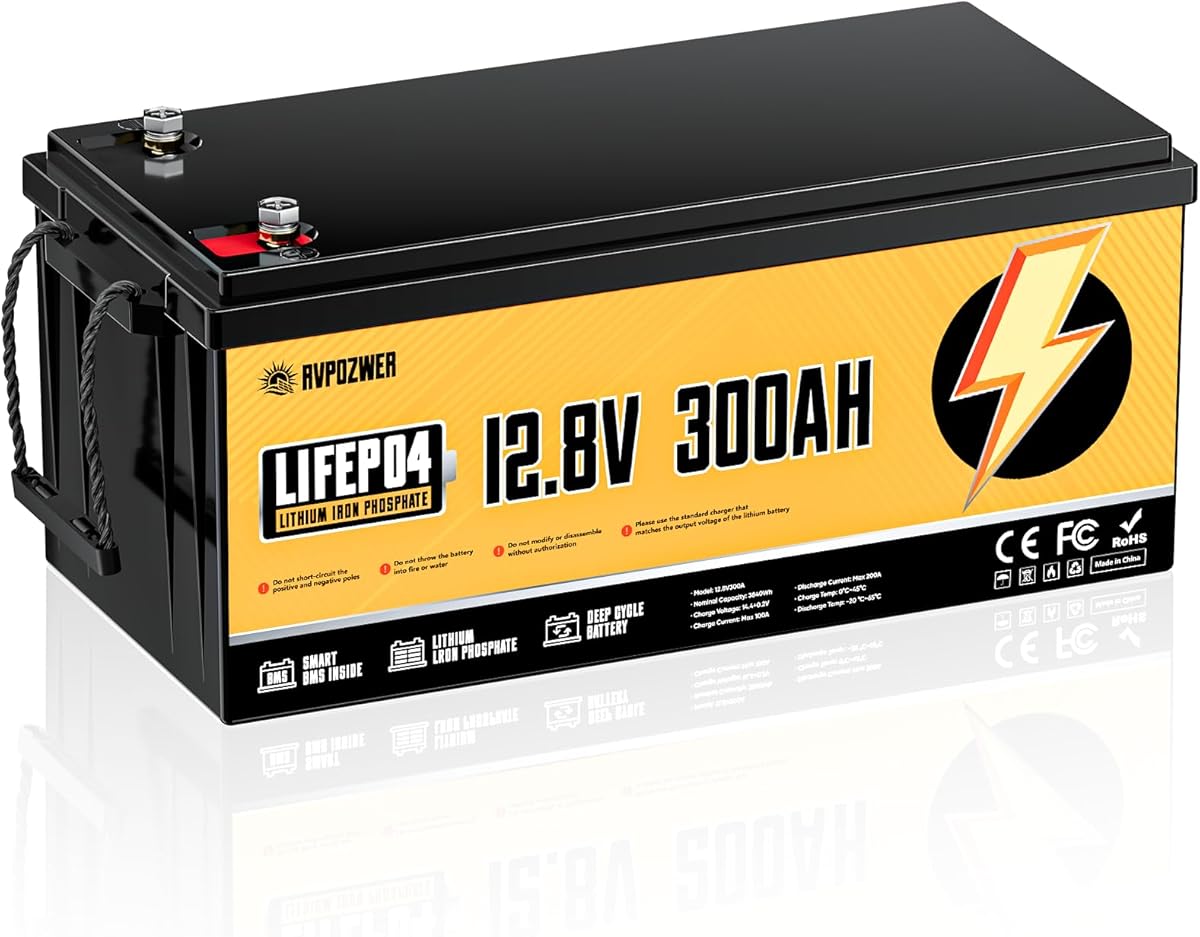
The Rvpozwer 12.8V 300Ah LiFePO4 battery is differentiated by detailed cycle claims tied to depth of discharge and a broad 4S4P expansion range. Its 4.0 rating is the lowest among the listed products, but the underlying specifications still make it a capable option for RV, marine, solar, trolling motor, and off-grid uses.
We may earn a commission when you buy through this link, at no additional cost to you.
The manufacturer states 4,000 cycles at 100% depth of discharge, 6,000 cycles at 80%, and up to 15,000 cycles at 60%. These figures help buyers understand that expected longevity depends heavily on how deeply the battery is discharged. The Grade A cells, 200A smart BMS, and protections against overcharge, over-discharge, overcurrent, overvoltage, and short circuits form a solid technical foundation.
The battery can be connected with up to three other matching units in series or parallel, supporting 51.2V or 1200Ah configurations. It is designed around Group 31 dimensions, which can simplify comparison with common RV and marine battery compartments, although installers should check the exact case and terminal measurements. Its stated operating range extends from -20°C to 65°C.
This battery is best for buyers who prioritize usable cycle-life options and familiar physical dimensions. Its lower aggregate rating suggests some buyer experiences may be less consistent, so reviews, warranty terms, and support should be examined carefully. For an installation requiring remote telemetry, a monitoring-equipped alternative may fit better.
The stated cycle figures are unusually useful because they connect longevity to operating conditions. Keeping the battery within a moderate discharge range may extend service life, while deeper daily cycling calls for a more conservative replacement horizon.
Group 31 design can make physical planning more convenient for RV and marine users. It is not a guarantee of compatibility, so compare exact measurements, terminal orientation, cable clearance, and the battery box's ventilation requirements.
We may earn a commission when you buy through this link, at no additional cost to you.
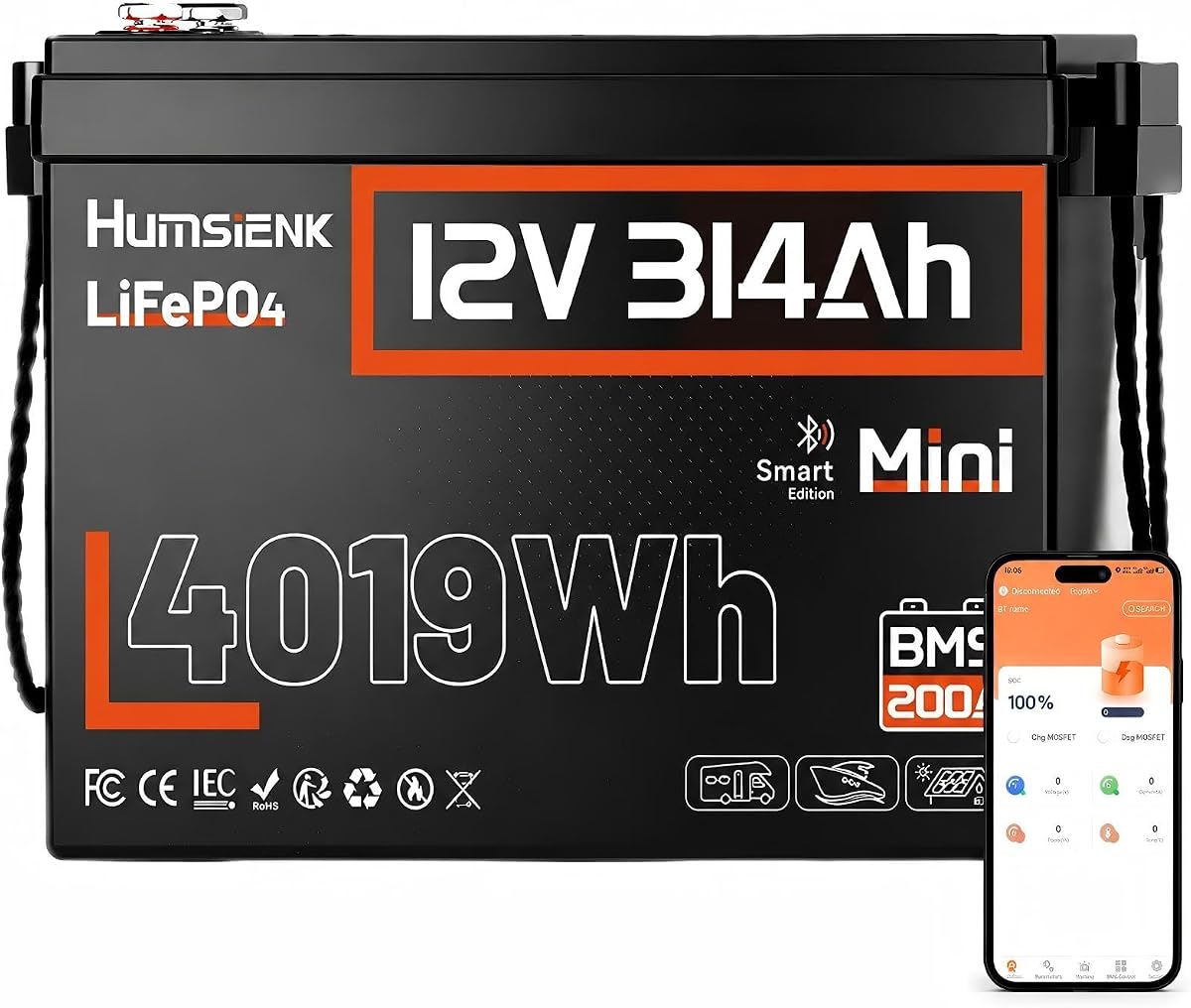
The HumsiENK 12V 300Ah listing describes a 314Ah battery with 4019Wh of energy, giving buyers slightly more rated capacity than the nominal 300Ah category. Its 4.4 rating, compact dimensions, 200A BMS, and app monitoring make it a well-rounded option for RV, marine, solar, and home-backup installations.
We may earn a commission when you buy through this link, at no additional cost to you.
The internal aluminum frame is intended to resist swelling and absorb shock, while the ABS case provides the external enclosure. Low-temperature charging cutoff protects against charging below freezing, and a high-temperature cutoff activates above 158°F. The battery can support devices over 2,000W and is backed by a 200A BMS for electrical protection.
At 59.5 pounds and 15.1 by 9.7 by 7.6 inches, it is designed to occupy less space than a comparable lead-acid installation. It can be connected with up to three other matching batteries in series and three in parallel, reaching a stated 51.2V, 1256Ah, and 64.3kWh. The app provides voltage, current, capacity, and temperature information through a 15-meter Bluetooth connection.
The short Bluetooth range means monitoring is most convenient near the battery rather than from across a home or large RV. Nevertheless, the higher capacity, robust internal frame, and five-year coverage make this a strong fit for space-conscious buyers who want more than the standard 300Ah rating.
The 314Ah rating and 4019Wh claim distinguish this model from standard 300Ah listings. Its relatively low weight and reduced footprint can help RV and boat owners conserve space, but available area should still be measured before installation.
An aluminum internal frame, ABS enclosure, low-temperature charging cutoff, and high-temperature cutoff provide multiple layers of protection. These features are especially relevant where vibration, movement, and changing ambient temperatures are common.
We may earn a commission when you buy through this link, at no additional cost to you.
The Vatrer Power 12V 300Ah LiFePO4 battery combines deep-cycle energy storage with starting-battery functionality. Its 4.6 rating, 200A BMS, temperature cutoffs, and 5,000-plus cycle claim make it a versatile option for RV, boat, camper, travel-trailer, and off-grid solar installations.
We may earn a commission when you buy through this link, at no additional cost to you.
Automotive-grade LiFePO4 cells are used to provide high energy density and rapid charge and discharge performance. The BMS protects against overcharge, over-discharge, overcurrent, and short circuits, while the stated charging cutoff above 167°F and low-temperature cutoff guard against environmental extremes. Expansion supports up to four series and four parallel connections.
One of the model's most practical advantages is its all-in-one starting and storage design. Instead of maintaining separate batteries for engine cranking and house loads, a compatible installation may use one unit for both roles. Because the battery contains no acid, the supplied details also indicate that it can be mounted in different orientations, although installation instructions and equipment guidance still apply.
The stated 5,000-plus cycle life and roughly one-third the weight of comparable lead-acid batteries also improve long-term portability. This is a strong option for mobile users who value installation flexibility, but it lacks listed app monitoring. Buyers should confirm wiring, alternator compatibility, and starting-current requirements before integrating it into a vehicle electrical system.
Combining storage and starting functions can reduce installation complexity and conserve space. Compatibility with the alternator, starter, charger, and load requirements should be verified to avoid conflicts with the battery management system.
A stated 5,000-plus cycle claim positions the battery for repeated deep-cycle use in demanding mobile applications. Actual life depends on temperature, charge discipline, depth of discharge, and the number of high-current starts.
We may earn a commission when you buy through this link, at no additional cost to you.
This 12V 314Ah LiFePO4 battery emphasizes rugged outdoor use, including marine, fishing, RV, solar-storage, ice-fishing, and off-grid applications. Its 4.6 rating and IP65 water-resistance claim distinguish it from models focused primarily on indoor energy storage, while the enhanced 200A BMS provides comprehensive protection.
We may earn a commission when you buy through this link, at no additional cost to you.
The battery is described as exceeding 6,000 cycles at 80% depth of discharge and carrying a 15,000-plus cycle headline. It weighs only one-third as much as a same-capacity lead-acid battery according to the supplied information, helping with handling and installation. The 314Ah capacity offers a modest increase over the standard 300Ah configuration.
Its enhanced BMS includes protection against overcharging, over-discharging, low-temperature charging, overcurrent, and short circuits. When voltage exceeds 14.1V, automatic balancing is activated to help maintain consistent state of charge across connected cells. The product information also advises charging or discharging the battery once every six months when it is not being used.
This model is clearly specified for energy storage and is not suitable for starting gasoline engines, golf carts, or jacks. That limitation makes it less versatile than dual-purpose models, but its rugged enclosure and higher capacity are compelling for marine and outdoor systems. Confirm enclosure placement and charging practices before deployment.
The stated IP65 rating offers added confidence in humid or exposed environments. It does not make the battery immune to every condition, so a protected location, sound mounting, and secure terminals remain best practices.
Automatic balancing above 14.1V can help keep cells aligned within a multi-battery setup. Wiring quality, matched units, and periodic monitoring are still necessary to maintain a healthy system.
We may earn a commission when you buy through this link, at no additional cost to you.
The TEMGO 12V 300Ah LiFePO4 battery combines a 4.8 customer rating with Bluetooth app monitoring, a 200A BMS, and a relatively light 54.67-pound design. It is a particularly refined option for marine, RV, camper, travel-trailer, and off-grid users who value remote visibility and convenient handling.
We may earn a commission when you buy through this link, at no additional cost to you.
The built-in Bluetooth function lets users review battery information through the app, while low-temperature cutoff protection helps guard trolling-motor applications in cold conditions. The BMS protects against overcharge, over-discharge, overcurrent, overheating, and short circuits. Its case is described as made entirely from recycled post-consumer ABS and contains no heavy or rare metals.
Despite its 300Ah rating, the battery is the lightest of the ten products at 54.67 pounds, according to the supplied data. That makes it easier to position in an RV, boat, or off-grid enclosure. Expansion supports up to four batteries in parallel and four in series, allowing 24V, 36V, and 48V system arrangements.
The one-year service life is shorter than the five-year warranties offered by several alternatives, which is the main reason this model is not first overall despite its high rating. It is our Best Premium pick for its cohesive combination of light weight, monitoring, recycled enclosure material, and polished app-based operation. Use only batteries of the same brand and model when expanding.
Built-in Bluetooth keeps the battery's operating information accessible through a phone app. This is useful for checking condition near the installation and can simplify setup when balancing and configuring a new system.
The listed 54.67-pound weight reduces installation strain and can be meaningful in an RV, boat, or camper. Terminal security, vibration resistance, and balanced weight distribution still deserve attention during mounting.
We may earn a commission when you buy through this link, at no additional cost to you.
The Paoweric 12V 300Ah/330Ah LiFePO4 battery is notable for supporting up to six series and six parallel connections, the broadest expansion arrangement listed in this guide. Its 4.4 rating, 200A BMS, and more than 10,000 cycle claim make it relevant for serious RV, solar, marine, backup, and off-grid power planning.
We may earn a commission when you buy through this link, at no additional cost to you.
Automotive-grade LiFePO4 cells are used for energy density and stability, while a 200A BMS provides protection from overcharge, overvoltage, over-discharge, overcurrent, and short circuits. The listing indicates that properly charged and stored batteries may last more than 10 years. It also describes the unit as roughly one-third the size of a same-capacity lead-acid battery, improving portability and space efficiency.
The 6S6P capability offers more flexibility than the common four-series, four-parallel arrangement, but large banks demand careful engineering. High voltage, accumulated current, cable resistance, and BMS communications can create safety and performance issues if the system is assembled without compatible equipment and detailed planning.
This battery is best for experienced installers who may eventually need a larger 48V-class bank and value expansion headroom more than app monitoring. Buyers should confirm whether the supplied unit is rated at 300Ah or 330Ah, use matching batteries from the same production run, and follow the stated recommendation against mixing brands in series or parallel.
The 6S6P arrangement is the broadest specified in this comparison and can serve larger solar or backup systems. Every connected component must be rated for the intended voltage, current, and charging method.
The more-than-10-year service potential depends on correct charging, storage, and operating practices. Maintain the recommended state of charge during long inactivity and follow the manufacturer's storage recommendations.
We may earn a commission when you buy through this link, at no additional cost to you.
The right 300Ah lithium battery depends on more than nominal capacity. Battery chemistry, usable energy, current handling, temperature limits, physical fit, monitoring, expansion plans, and the precise role of the battery in your electrical system should all influence the decision.
A battery labeled 300Ah at 12.8V has a nominal energy content of approximately 3,840Wh, although usable energy depends on cutoff voltage, inverter draw, temperature, aging, and discharge rate. Some listings advertise slightly higher ratings of 314Ah or 330Ah, while others state 4019Wh in the title. Compare nominal and usable figures rather than relying only on the headline capacity.
Choose enough capacity for several hours of expected load and allow appropriate headroom for inverter surge, charger output, and future additions. A larger nominal battery is not automatically better if the enclosure, charger, or wiring cannot support it.
The battery management system regulates charging and discharging while protecting against overcharge, over-discharge, overcurrent, overvoltage, and short circuits. A 200A BMS is common among these products, but the rating alone does not prove compatibility with your inverter. Check startup surge, continuous output, and the equipment manufacturer's current limits.
Prioritize a BMS with temperature protection, especially for outdoor, marine, RV, or cold-weather use. Also determine whether the system supports communication and whether balancing occurs automatically when multiple batteries are connected.
Cycle claims are often quoted at different depth-of-discharge levels. A 15,000-cycle claim at 60% depth of discharge does not mean the same number of cycles at 100%, and elevated temperature, high current, poor charging habits, and chronic undercharging can shorten service life. Compare products using the same depth-of-discharge assumptions where possible.
Look for a realistic warranty and understandable operating guidance. A long headline number is less valuable than a documented test condition, transparent specifications, responsive support, and a practical maintenance plan.
Cold weather affects lithium batteries differently from lead-acid chemistry. A low-temperature charging cutoff can prevent harmful charging below freezing, while separate discharge limits define the colder operating range. High-temperature cutoffs provide another layer of protection in hot compartments, engine spaces, and sun-exposed installations.
Choose cutoffs appropriate for the environment rather than a single universal specification. Determine whether the battery is installed where freezing occurs, how it is heated or insulated, and whether the attached charger or solar controller has its own low-temperature charging logic.
Most options support four series and four parallel batteries, allowing larger capacity and 24V, 36V, or 48V arrangements. The Paoweric model lists 6S6P support, while the dual-mode product supports up to 16 batteries in a 4P4S configuration. Expansion potential is useful only when the inverter, charge controller, cables, breakers, and communication system are designed for it.
Use batteries of the same brand, model, capacity, age, and ideally production batch. Confirm maximum charge voltage, equalization requirements, and whether series operation requires a communication bus or a manufacturer-specified balancer.
Weights range from approximately 54.67 pounds for the TEMGO model to 58.4 pounds for SUPER EMPOWER and 59.5 pounds for HumsiENK, while dimensions vary substantially. Measure the battery compartment, terminals, cable bend radius, ventilation clearance, and access space rather than relying on broad battery-group labels.
Secure the battery against movement, protect terminals as directed, and maintain the manufacturer's recommended orientation and ventilation. A lighter battery can still become difficult or unsafe to handle if it cannot be positioned safely or if its weight is concentrated in a poorly supported enclosure.
App and Bluetooth monitoring can expose voltage, current, temperature, capacity, state of charge, power, and cycle count. This information is valuable for balancing, fault diagnosis, and tracking battery aging. However, a monitoring app does not replace proper fusing, torque checks, or a correctly sized charger.
Confirm the required app, phone compatibility, connection range, and whether multiple batteries must be registered individually. Some products in this comparison omit app monitoring, which may be acceptable for a simple stationary installation but less convenient for mobile or remotely managed systems.
Most 300Ah LiFePO4 batteries are designed as deep-cycle energy-storage units. Several listings also advertise combined starting capability, while one explicitly prohibits engine starting, golf-cart use, and jack operation. This distinction matters because a starting battery and a storage battery experience different current profiles and charge demands.
Use a LiFePO4-compatible charger set to the appropriate charging voltage and current. Check whether solar, generator, grid, or alternator charging is supported, and ensure the charge controller has the correct battery profile. Do not assume ordinary lead-acid chargers are automatically suitable.
Before installation, identify every load, calculate approximate energy requirements, and confirm the inverter, charger, solar controller, and wiring are designed for lithium chemistry and the intended battery bank. Match every battery in a series or parallel group and follow the manufacturer's terminal-torque, polarity, ventilation, and clearance instructions.
Charge the battery using an approved LiFePO4 charging profile before connecting sensitive loads. During operation, monitor voltage, current, and temperature through the app or a suitable meter. Do not operate the battery outside its stated temperature range, and never bypass the BMS or defeat thermal cutoffs.
For long-term storage, follow the manufacturer guidance, maintain the recommended state of charge, and recharge periodically. Inspect terminals, cables, mounting points, and enclosure seals, clean only as directed, and investigate unusual heating, swelling, odor, voltage imbalance, or repeated BMS disconnects promptly.
At a nominal 12.8V, a 300Ah battery stores approximately 3,840Wh, or 3.84kWh. Actual usable energy is lower because the BMS, inverter, wiring losses, temperature, and battery cutoff remove some of the nominal capacity. Appliances should be sized against realistic continuous and surge requirements rather than the headline energy value alone.
Yes, when the inverter, charger, and installation are designed for the battery's voltage and current. One battery is appropriate for moderate loads, while several matching units can be combined in series or parallel to build a larger system. Confirm expansion limits and ensure all connected equipment supports the resulting voltage and communication requirements.
Most models support both configurations, commonly up to four series and four parallel. The Paoweric model lists 6S6P support, while the dual-mode battery supports a 4P4S arrangement totaling up to 16 units. Use identical batteries, follow the required wiring order, and verify the inverter and charge controller can handle the final system voltage.
No. Charging a lithium iron phosphate battery below its specified low-temperature threshold can cause lithium plating and lasting damage. Batteries in this comparison include low-temperature charging cutoffs, but you should also use a charger or solar controller that respects the same restriction. Warm the battery or wait for a safe temperature before charging.
It depends on the model. The dual-mode and Vatrer Power options advertise combined energy-storage and starting functions, while the 12V 314Ah waterproof model explicitly states that it is not suitable for engine starting. Verify the battery's startup-current specification, BMS mode, alternator compatibility, and the vehicle or marine charging system before using it for cranking.
It is not essential for basic operation, but it makes state-of-charge estimates, charging checks, fault diagnosis, and long-term battery monitoring more convenient. Models with app support can report voltage, current, temperature, power, capacity, or cycle information. If remote telemetry is not important, a non-connected model may still meet your needs.
The supplied guidance for one product recommends charging or discharging it once every six months to prevent damage from disuse. Other manufacturers may recommend a different maintenance interval, so follow the instructions for the exact model. Keep the battery at the recommended storage state of charge and avoid exposing it to extreme temperatures.
Only if the charger is specifically compatible with LiFePO4 chemistry or can be programmed to the battery's required charging profile. An inappropriate lead-acid charging profile may overcharge the battery or fail to bring it fully into the usable lithium operating range. Follow the charger's setup instructions and the battery manufacturer's voltage guidance.
The MEYULMOL model offers the strongest value-oriented combination of 3840Wh capacity, app monitoring, a 200A BMS, and 4S4P expansion. The dual-mode battery is the most feature-rich option, adding starting capability and unusually broad system scaling, while the TEMGO model is a polished premium choice with high ratings, light weight, and convenient Bluetooth monitoring.
Before choosing, prioritize the battery's intended role, the load and surge requirements, the installation temperature, physical space, and the expansion plan. Verify charger compatibility, connection limits, warranty terms, and whether remote monitoring adds meaningful convenience for the way you will operate the system.
Specifications, ratings, seller offers, and promotions can change, so review the current product listing and manufacturer instructions before ordering. A current listing confirmation is especially important for capacity wording, app availability, included accessories, warranty terms, and the exact battery model included in the sale.