
UGREEN 3.5mm to RCA Cable
4.7Editor score
Gold-plated stereo connectors
Tangle-free flexible jacket
Broad device compatibility
A 3.5mm to RCA cable bridges modern headphone or AUX outputs and traditional stereo equipment with red and white RCA inputs. The right cable should provide a secure connection, preserve the left and right channels, resist interference, and reach without creating excess strain or clutter.
We compared ten options based on their supplied specifications, including cable length, conductor and shielding construction, connector design, channel splitting, equipment compatibility, bend resistance, and physical routing features. The list includes everyday 4-foot and 6.6-foot cables, extended 10-foot and 15-foot models, angled connectors, braided jackets, and premium audiophile constructions.
Each pick highlights a different practical advantage, from flexible everyday connections to reduced interference and more refined materials. Ratings reflect the supplied customer feedback, while technical details come from the product information; current prices and availability can change, so check the listing before purchasing.
4.7Editor score

4.7Editor score
4.5Editor score
As an Amazon Associate we earn from qualifying purchases.
The comparison covers cable length, signal construction, shielding, connector style, channel identification, and intended use so you can quickly identify the cable that best fits your devices and setup.




The UGREEN 3.5mm to RCA Cable is a versatile 6.6-foot stereo adapter with a supplied rating of 4.7. It combines a 3.5mm male plug with two RCA male plugs, making it suitable for connecting a phone, tablet, laptop, or other equipped device to an amplifier, receiver, speaker system, or other RCA-enabled component. Its strongest appeal is the balance of useful construction details and broad everyday usability.
We may earn a commission when you buy through this link, at no additional cost to you.
Gold-plated connectors and copper conductors are intended to support conductivity, durability, and dependable stereo transmission. The product information also states that the design reduces radio-frequency and electromagnetic interference, while the flexible PVC jacket is rated for more than 10,000 bends. A slim connector profile is particularly helpful when the source device is in a case, and the red and white RCA markings make it easier to identify the correct channel.
The main limitation is that it is a fixed-length cable without a right-angle option. A 6.6-foot run may be longer than necessary for a desktop setup, yet short of the reach offered by the 10-foot and 15-foot options. It also remains a conventional stereo Y cable rather than a more elaborate directional or audiophile-focused design, so buyers seeking advanced filtering or a precisely engineered internal split may prefer another model.
Despite those trade-offs, this is an excellent general recommendation for anyone who wants one cable to cover many common devices. It avoids unnecessary complexity, supplies useful color identification, and offers a practical length for connecting portable sources to nearby or moderately distant stereo equipment. It is our strongest all-purpose pick for typical home and office audio setups.
The slim 3.5mm plug is designed to fit connected devices more easily when a protective case remains in place. That makes the UGREEN practical for phones and tablets used around a desk, entertainment center, or kitchen audio system.
Red and white markings on the RCA plugs reduce confusion when connecting to a receiver. This straightforward visual cue is useful in setups where the cable must be moved or reconnected regularly.
We may earn a commission when you buy through this link, at no additional cost to you.
The JSAUX RCA to 3.5mm Cable pairs a 6.6-foot length with a double-braided nylon exterior and a supplied rating of 4.7. Its 3.5mm male plug and dual RCA male ends are configured for stereo audio, with red and white markings that clarify the right and left connections. It works with common phones, tablets, MP3 players, TVs, cars, speakers, amplifiers, and stereo receivers.
We may earn a commission when you buy through this link, at no additional cost to you.
Its strongest feature is the combination of dual shielding, an oxygen copper wire core, and gold-plated connectors. According to the supplied product information, those elements help reduce outside interference and support stable stereo transmission. The double-braided jacket is also rated for more than 10,000 bends, while the easy-grip RCA housings should make repeated connections more convenient.
Like most adapters in this category, it provides only one fixed cable length and no right-angle source connector. The 6.6-foot design may therefore be less tidy for a compact desk or too short for a source located far from the stereo equipment. The product is also described as bi-directional, but users still need to connect one side as an output and the other as an input rather than treating it as two independent output paths.
This cable is a strong recommendation for people who want dependable construction without moving to a specialized premium model. It handles the common need to link a 3.5mm source with a stereo receiver or powered speakers, while its braided jacket should remain attractive and manageable in frequently used entertainment setups. Among the general-purpose options, its material specification and balanced design make it an especially well-rounded choice.
Dual shielding and an oxygen copper core are central to the JSAUX design. Together, these features are intended to preserve a clean stereo signal while reducing susceptibility to common sources of EMI and RFI.
The double-braided exterior resists repeated bending and helps reduce tangling. It is a useful choice when the cable will be moved between a phone, laptop, receiver, and speakers rather than left permanently installed.
We may earn a commission when you buy through this link, at no additional cost to you.
The FosPower 3.5mm to RCA Cable is a 10-foot stereo adapter with a supplied rating of 4.7. It uses one mini-stereo male connector and two RCA male connectors, allowing a 3.5mm source to feed left and right inputs on a receiver, amplifier, speaker, or other compatible stereo system. Its extra length is the defining feature for users who need more distance than a short desktop cable provides.
We may earn a commission when you buy through this link, at no additional cost to you.
A beveled, step-down plug is designed to seat properly even when the connected phone or other source device still has a case on. The cable combines copper braid and aluminum foil shielding to reduce EMI and RFI, while a polyethylene foam dielectric is intended to minimize signal loss. Its 24K gold-plated connectors resist corrosion and tarnish according to the product information.
The obvious trade-off is that 10 feet can create unnecessary slack in a compact setup. Without a right-angle connector, the source plug may also protrude more than desired when the device is positioned close to a wall or cabinet. The construction emphasizes shielding and internal signal characteristics, but the jacket is not described as braided, so it may not offer the same visual finish or abrasion characteristics as some alternatives.
This is a practical recommendation for home theaters, workshop audio systems, secondary rooms, and other installations where the source and stereo equipment are separated by several feet. It combines useful reach, a case-friendly connector, and layered shielding without introducing complicated directional requirements. For that category of use, the extra length makes it a particularly sensible option.
The 10-foot run provides practical flexibility when a phone, laptop, or portable player must remain some distance from a receiver or speaker system. It is especially useful when a short cable would force the source device into an awkward position.
Copper braid and aluminum foil work together to limit unwanted interference. The dielectric insulation is also designed to support signal stability, making this a sensible option for longer runs through active entertainment areas.
We may earn a commission when you buy through this link, at no additional cost to you.
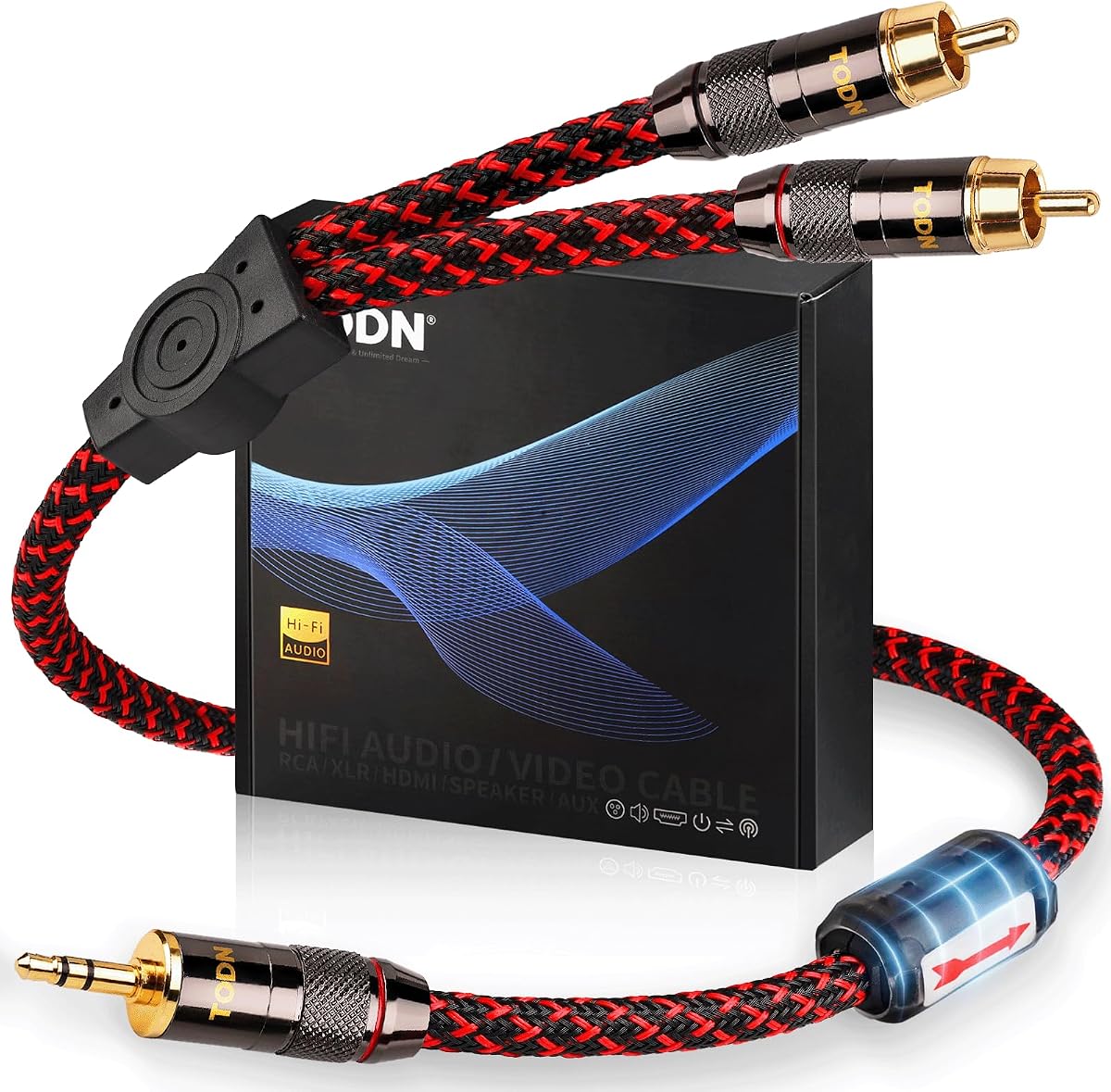
The TODN 3ft RCA to 3.5mm Cable is a compact audiophile-oriented adapter with a supplied rating of 4.5. It connects a 3.5mm stereo output to dual RCA inputs and uses a four-core oxygen-free copper conductor described as 99.99% pure. The increased conductor surface area is intended to improve high-frequency performance and reduce resistance compared with a simpler two-core arrangement.
We may earn a commission when you buy through this link, at no additional cost to you.
A ferrite bead positioned about 15 centimeters from the 3.5mm end provides a specific filtering point, while tinned copper braid shielding is designed to reduce EMI, RFI, and crosstalk. At the RCA end, a built-in PCB handles the left-right split, and both sections are described as having a 7mm diameter to minimize crosstalk. A 24K gold-plated pure copper plug adds corrosion resistance and secure connectivity.
This is not a completely interchangeable cable in every installation. The ferrite bead includes an arrow indicating the intended signal direction, and the product information warns that reverse installation may create a signal-level mismatch or equipment damage. Its 3-foot length is also short, so it works best near a receiver, speaker, or connected source rather than across a large room.
The TODN is best for listeners who want a more deliberate signal path and have equipment that benefits from careful interconnect design. It is a premium pick rather than the simplest solution, but its four-core conductors, shielding system, PCB splitter, and directional marker offer a compelling set of features for a compact, high-quality stereo connection.
The internal PCB separates the 3.5mm stereo signal into dedicated left and right RCA paths. Combined with the 7mm cable profile, this design is intended to reduce crosstalk and maintain clearer channel separation.
The ferrite bead can suppress high-frequency noise when the cable is installed in the indicated direction. Following that guidance helps the filtering and shielding design work as intended while reducing installation risk.
We may earn a commission when you buy through this link, at no additional cost to you.
The Amazon Basics 3.5mm Stereo Aux to 2 RCA Audio Cable Adapter is a straightforward four-foot solution with a supplied rating of 4.7. The package includes one 3.5mm male connector and two male RCA connectors, allowing a smartphone, tablet, or MP3 player to connect to a speaker, stereo receiver, amplifier, or another RCA-enabled device.
We may earn a commission when you buy through this link, at no additional cost to you.
Its construction focuses on the essentials rather than elaborate audiophile features. Dual shielding, polished metal connectors, and a corrosion-resistant gold-plated 3.5mm plug are designed to provide clear audio with minimal signal loss. The four-foot length is also one of the most compact options here, which can make routing easier when source and receiver are positioned close together.
Buyers with a large room or a source several feet away may find four feet insufficient. The cable does not include the more specialized features found in premium models, such as a ferrite bead, an internal PCB splitter, or a multi-layer shielding arrangement. It also does not advertise a right-angle 3.5mm connector, so clearance near walls or tightly positioned equipment may be less than ideal.
For a desktop, bedside, or compact entertainment setup, this adapter offers a sensible balance of simplicity and construction. It is easy to understand, appropriately sized for close-range use, and supported by a strong customer rating. It is a particularly good choice for buyers who want a familiar basic cable without paying for specialized signal-engineering features they may not need.
The four-foot run is long enough to position source equipment comfortably but short enough to avoid excess cable around a desk. It works especially well for a phone or tablet placed near a compact stereo system.
Dual shielding and a gold-plated source connector cover the most important everyday requirements. The design avoids specialized directional parts, so installation is simply a matter of matching the stereo input and output.
We may earn a commission when you buy through this link, at no additional cost to you.
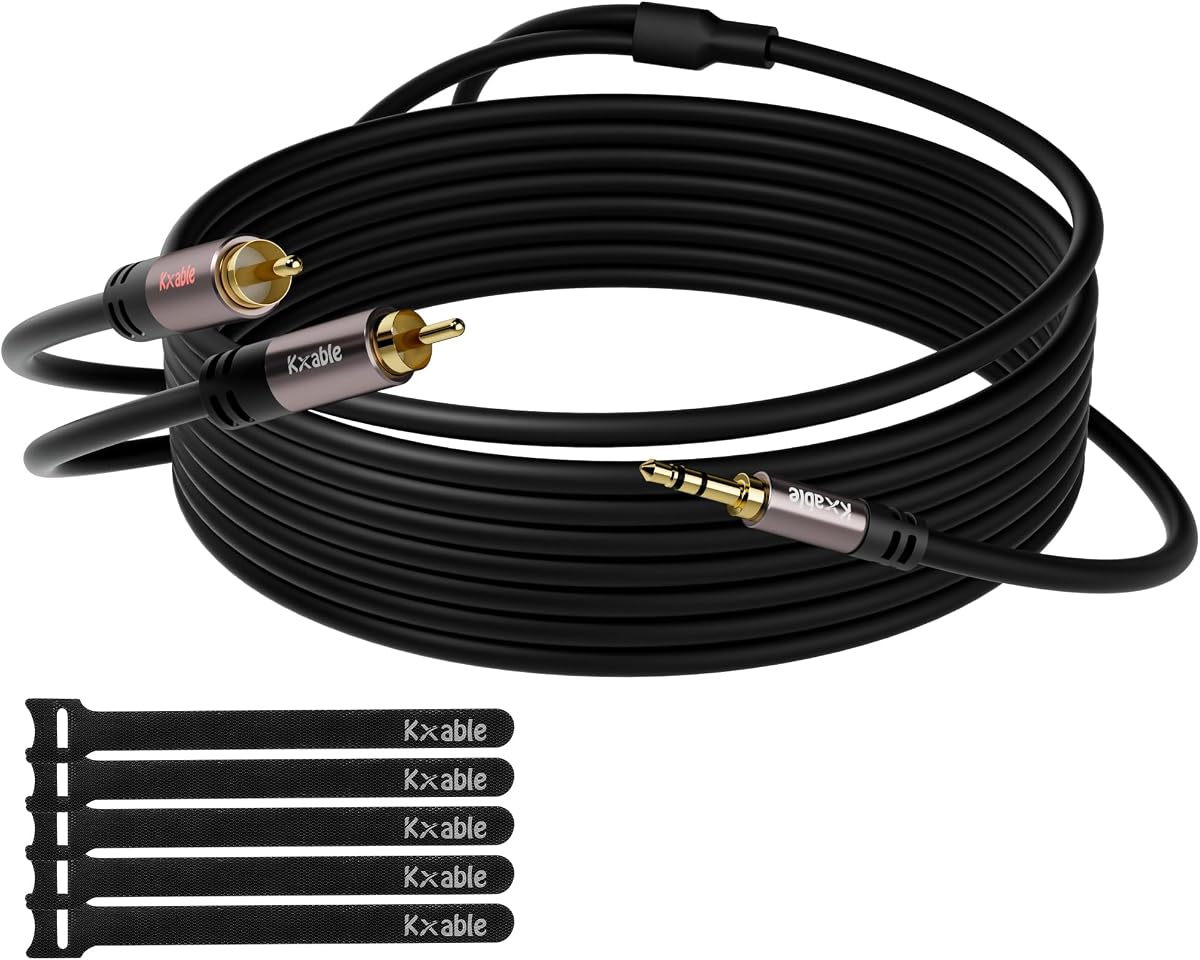
The 3.5mm to RCA Cable 15FT is the longest option in this guide, with a supplied rating of 4.7. It connects a 3.5mm headset or auxiliary output to two RCA inputs on amplifiers, receivers, speakers, HDTVs, cars, and other compatible systems. The extra reach makes it useful when the portable source cannot sit close to the stereo equipment.
We may earn a commission when you buy through this link, at no additional cost to you.
The cable uses an oxygen-free copper core and double shielding to support signal transmission and reduce interference. Its high-elasticity PVC jacket is described as having been tested for more than 10,000 bends without a change in performance. The connectors use 24K gold plating and aluminum shells to resist oxidation and corrosion, while the package includes five cable ties for managing the long run.
Fifteen feet is not automatically better, however. In a compact room, the cable may create a large loop or become difficult to hide. The standard straight 3.5mm plug can also protrude awkwardly if the source is placed against a wall. This is a general-purpose Y cable rather than a directional audiophile model, so it does not offer specialized ferrite filtering or an engineered PCB split.
The best reason to choose this cable is distance. It is a strong recommendation for larger rooms, event spaces, workshop setups, or installations where the phone or media player needs to remain far from a fixed receiver. If long reach is not important, one of the shorter options will usually create a neater and more portable installation.
The 15-foot length gives users considerable freedom to move a phone, tablet, or media player while keeping it connected to a distant stereo system. It is useful where extension leads or additional adapters would otherwise be needed.
The included cable ties can help gather excess slack and keep the run neater. A suitable route also reduces the chance of creating sharp bends close to either connector.
We may earn a commission when you buy through this link, at no additional cost to you.
The CableCreation 3.5mm to RCA Cable is a 10-foot stereo Y cable with a supplied rating of 4.7. Its defining physical feature is the right-angle 3.5mm connector, which helps a phone, player, or other source sit closer to a wall, cabinet, or road case without the plug projecting straight outward.
We may earn a commission when you buy through this link, at no additional cost to you.
The 90-degree configuration also helps reduce stress at the source connection. Inside, the product description highlights gold-plated connectors and oxygen-free copper for conductivity and stereo transmission. A soft cotton braided exterior adds flexibility and should help the cable resist tangles while maintaining a neat appearance over time.
The cable is described as bi-directional, but one side must act as an input and the other as an output. It cannot be used as two simultaneous unidirectional paths, so a user connecting two output-only source devices to the same RCA input should look elsewhere. Its 10-foot length can also be longer than necessary, and the right-angle source plug will not fit every case or recessed socket.
This is the most compelling choice when clearance is the main problem. It is particularly appropriate for a phone mounted beside a wall, a laptop placed close to furniture, or portable audio equipment positioned near the back of a case. For more open desk arrangements, its angled design remains useful but may not be essential.
The low-profile source connector is the key reason to choose this model. It fits where a straight plug would stick out, allowing the attached device to rest more naturally against furniture or inside a compact installation.
The angled geometry changes the direction of the cable immediately after the plug. That reduces leverage on the connection and can be helpful in setups where the source device may be moved or bumped.
We may earn a commission when you buy through this link, at no additional cost to you.
The Audiophile HiFi RCA to 3.5mm Audio Cable is a compact 3.28-foot adapter with a supplied rating of 4.5. It is designed to connect a 3.5mm source to dual RCA inputs while using 4N oxygen-free copper conductors intended to support balanced bass, midrange, and high-frequency response.
We may earn a commission when you buy through this link, at no additional cost to you.
Its defining technical feature is a multi-shielding arrangement. High-density tinned copper braid and double-layer PVC shielding work with ferrite cores to reduce EMI, RFI, signal loss, and distortion. The 3.5mm connector uses 24K gold plating described as five microns thick, while the pure copper core is intended to support smooth insertion and reliable contact after repeated use.
The cable also has a heavy-duty nylon braid designed to resist pulling, abrasion, and repeated bending. Its stated tangle-free design helps with storage, although a 3.28-foot lead is primarily intended for close-range equipment. As with other premium interconnects, many of the detailed performance claims depend on the rest of the audio chain, and a better cable cannot compensate for weak source or amplification hardware.
This is a good recommendation for compact, carefully arranged stereo systems in which interference control, connector durability, and a low-profile cable run matter. It is less suitable for a phone that must remain far from a receiver. For listeners seeking refined construction and extensive shielding at close range, it delivers a specialized set of benefits without directional installation requirements.
Tinned copper braid, double-layer PVC shielding, and ferrite cores provide several forms of protection. The combination is designed to limit external noise and crosstalk in audio systems that may sit near computers or other electrical equipment.
The 24K gold-plated 3.5mm plug is described as having a thicker plating layer for corrosion resistance. Combined with a pure copper core, it is intended to maintain smooth, dependable connections through repeated insertion cycles.
We may earn a commission when you buy through this link, at no additional cost to you.
The SKW Audiophile 3.5mm to Dual RCA Y Cable is a 3.2-foot, one-meter stereo adapter with a supplied rating of 4.6. It uses a 1/8-inch TRS male plug to two RCA male plugs and is compatible with subwoofers, DJ equipment, MP3 and CD players, laptops, tablets, amplifiers, and receivers with red and white RCA inputs.
We may earn a commission when you buy through this link, at no additional cost to you.
The cable is built around a relatively substantial 22AWG copper core, dual-layer shielding, and a 7mm outer diameter. Its high-gloss copper connector housings and corrosion-resistant 24K gold-plated contacts are intended to support long-term use and dependable audio transmission. The nylon-braided jacket adds mechanical protection around a conductor size that feels more substantial than that of many compact adapters.
Its short length is the most obvious limitation. A 3.2-foot cable is convenient beside a receiver or stereo system but may not reach from across a room or even from a desk positioned several feet away. It also lacks the specialized ferrite bead, PCB split, or four-core architecture offered by some premium alternatives, although its shielding remains more elaborate than that of basic models.
The SKW is a strong choice for close-range, high-use installations where a robust short lead is preferable to a long cable. It works particularly well for DJ equipment, desktop systems, and receivers positioned directly beside a source. For users prioritizing material thickness, a braided exterior, and straightforward compatibility, it offers a well-engineered alternative.
The 22AWG copper core provides a meaningful physical foundation for signal transmission. Its larger specified gauge is particularly appealing for a short, permanently positioned home or professional audio connection.
Dual-layer shielding limits interference, while the nylon braid protects against everyday flexing and abrasion. The 7mm profile also makes the cable easier to handle than a very thin lead.
We may earn a commission when you buy through this link, at no additional cost to you.
The Premium AUX to 2RCA Audio Cable is a one-meter stereo cable with a supplied rating of 4.7. It connects a 3.5mm output to dual RCA inputs and is marketed for amplifiers, speakers, smartphones, turntables, MP3 players, laptops, tablets, and other compatible source devices.
We may earn a commission when you buy through this link, at no additional cost to you.
Its most notable specification is the stated 75-ohm constant impedance. In conjunction with high-purity copper conductors and double-layer shielding, this is designed to support consistent signal transmission and reduce interference. The connectors use 24K gold plating and reinforced copper shells to withstand frequent plugging and unplugging.
The cotton braided cover is rated in the product information to pass more than 15,000 bends, and it is intended to resist wear while maintaining a classic appearance. The fixed 3.2-foot length is well suited to close-range systems but not to long-distance placement. There is also no right-angle connector, so users should confirm that a straight plug provides enough clearance.
This cable is a compelling option for buyers who want a short, refined connection with a clearly specified impedance target. It is compatible with a broad range of modern sources and traditional stereo equipment, while the braided jacket and reinforced connectors suit frequent use. It may be especially attractive for neatly arranged desktop or home audio installations where both signal consistency and appearance matter.
The stated 75-ohm constant impedance gives the cable a defined signal characteristic. That can be useful in organized stereo installations where predictable transmission and reduced interference are priorities.
A cotton braided exterior, reinforced copper shells, and gold-plated contacts all contribute to the cable's resistance to regular wear. The stated bend-test figure indicates attention to the flexing that occurs in everyday use.
We may earn a commission when you buy through this link, at no additional cost to you.
The best 3.5mm to RCA cable depends on equipment layout, desired construction, and how much interference the installation may encounter. Compare length, signal direction, connector fit, channel separation, shielding, and durability before making a selection.
Choose the shortest practical length that still allows comfortable routing. For a fixed setup, measure from the source port to the destination inputs before selecting a cable.
Confirm that your source has a working audio output and that the destination offers left and right RCA inputs. Follow any directional markings supplied with the cable.
For nearby home audio equipment, basic shielding is usually sufficient. For computers, crowded entertainment centers, or more demanding stereo systems, favor multiple shielding layers and well-specified internal construction.
Test or confirm the source-jack depth, case opening, and available space around the device. A snug, fully seated connection is preferable to forcing a plug into a recessed port.
Look for clear red and white channel identifiers. If you listen for extended periods or operate a high-fidelity setup, a more carefully engineered split may be worthwhile.
Pay for the features that match your environment. Prioritize reliable connectors, appropriate length, and effective shielding before selecting a model based on premium terminology alone.
Choose a jacket and bend rating appropriate to how mobile the connection will be. Use gentle curves, avoid tight folding, and keep connectors away from areas where they may be stepped on.
Verify both source and destination connections before ordering. Check the manufacturer information when dealing with a turntable, powered speaker, TV, or older stereo component.
Begin by identifying the source output and the destination's left and right RCA inputs. Disconnect power from an amplifier or receiver if its manual recommends it. Connect the red RCA plug to the right channel and the white plug to the left channel, then attach the 3.5mm male plug fully to the source device's headphone or auxiliary output. If the cable includes a directional ferrite arrow, place that end toward the source as indicated.
After checking every connection, lower the volume on the source and stereo equipment before powering on. Select the appropriate RCA input and increase the volume gradually. If there is no sound, verify that the source is actually outputting audio, confirm the left and right plugs are seated correctly, and check that the destination is not muted or set to another input. A right-angle plug may require a little more care when attaching it to a device in a tight space.
To preserve the cable, unplug it by holding the connector housing rather than pulling on the wire. Keep the jacket away from sharp edges, pet claws, heat, and strong sunlight, and avoid tightly coiling it under heavy objects. When storing it, loosely loop the cable or use a tie, but do not create a sharp bend at the split or connectors. Periodically inspect the plug and jacket for exposed copper, cracks, or damaged shielding, and replace the cable if physical damage appears.
It connects a device with a 3.5mm headphone or auxiliary output to equipment with left and right RCA stereo inputs. Common sources include phones, tablets, laptops, MP3 players, CD players, and portable gaming devices. Typical destinations include amplifiers, stereo receivers, powered speakers, televisions, and compatible car audio systems.
Yes, as long as the phone has a working 3.5mm audio output and the receiver has left and right RCA inputs. Connect red to right and white to left. If the phone lacks a headphone jack, you may need a compatible USB-C or Lightning audio adapter before using the 3.5mm cable.
A standard 3.5mm to dual-RCA cable in this category carries analog stereo audio, not video. The red and white plugs represent the right and left audio channels. Video requires an appropriate separate video connection or a different adapter designed for the source and display in question.
Gold plating can improve corrosion resistance and provide a stable contact surface, but it does not by itself determine audio quality. Cable construction, shielding, connector fit, source quality, and the rest of the audio system also matter. For ordinary use, a well-made cable with secure connectors may be more important than plating alone.
In most product descriptions, the terms refer to the same physical Y-shaped adapter viewed from opposite ends. One end is a 3.5mm male plug, while the other splits into two RCA male plugs. The important thing is the actual connector layout and signal direction, not the order used in the product name.
Many of these cables can carry stereo audio in either direction because the 3.5mm end combines the left and right channels and the RCA end separates them. However, one end must connect to an output and the other to an input. Cables with directional ferrite beads or arrows must be installed in the specified direction.
First, keep both connections fully seated and confirm the correct left and right inputs are selected. A shielded cable can also help when it runs near computers, power transformers, or poorly isolated audio equipment. Avoid sharply bending the cable, keep it away from high-interference power cables, and lower the source volume before testing another input.
Buy a longer cable only when the measured distance between your source and stereo equipment requires it. A 10-foot or 15-foot lead provides more placement freedom, but excess slack can create clutter and accidental pulls. For equipment positioned beside a receiver, a 3.2-foot, four-foot, or 6.6-foot model is usually easier to manage.
The UGREEN 3.5mm to RCA Cable is the strongest general-value choice because it combines a useful 6.6-foot length, slim connector, color-coded RCA plugs, and durable flexible construction. The JSAUX is also highly versatile, with dual shielding, an oxygen copper core, and a double-braided jacket. For buyers seeking a more specialized premium signal design, the TODN offers four-core conductors, a ferrite bead, layered shielding, and a PCB-based channel splitter.
Prioritize the requirements of your actual setup. Choose a short cable for nearby equipment, a longer run when distance requires it, a right-angle connector for confined spaces, and stronger shielding when noise is a concern. Verify that your source has a working 3.5mm output, the destination offers left and right RCA inputs, and any direction markers are followed correctly.
Prices, ratings, and availability can change, so review the current product listing before buying. Comparing the latest connector fit, construction details, and customer feedback against the priorities in this guide will help you select the most practical 3.5mm to RCA cable for your equipment and listening environment.