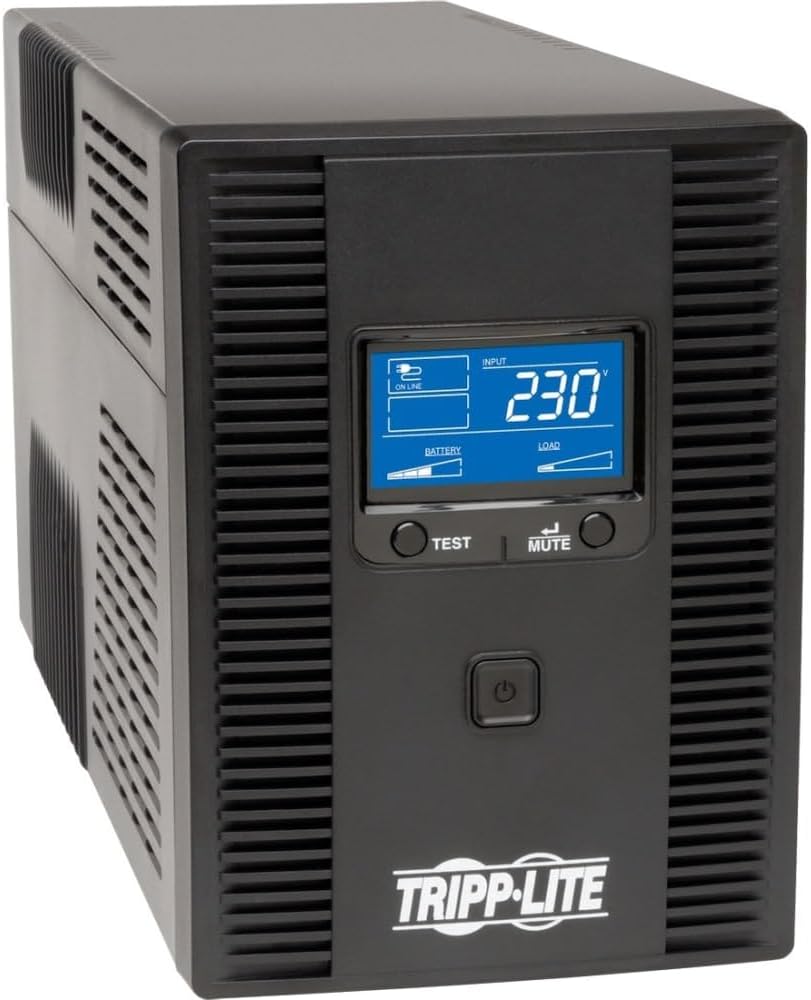
Eaton Tripp Lite SMX1500LCDT
3.6Editor score
1500VA and 900W capacity
Eight C13 outlets
AVR and LCD monitoring
PowerAlert software support
Explore the best 240V UPS systems, comparing capacity, topology, voltage support, outlet types, runtime, and protection for workstations, servers, and racks.
A 240V UPS system provides battery backup, voltage regulation, surge protection, and a controlled response to utility power problems. The right model depends on load size, equipment type, outlet format, installation space, and how much runtime you need during an outage.
The products in this guide range from compact 1500VA systems for workstations and home entertainment to rack-mounted and double-conversion models for servers, networking equipment, and other mission-critical loads. We compared capacity, topology, supported voltages, outlets, monitoring, and physical design.
Each review explains where a system fits best, along with the compromises that deserve attention before purchase. Product details and availability can change, so confirm the current electrical ratings, connector standards, and compatibility with your equipment before ordering.
3.6Editor score

4.0Editor score

The table below compares all ten systems by their most important purchasing variables: usable capacity, power-conversion topology, supported output voltages, and connection options. These distinctions matter because a high-capacity UPS may still be unsuitable if its input, plugs, or outlets do not match the installation.


The Eaton Tripp Lite SMX1500LCDT combines 1500VA of capacity with a 900W continuous-power rating, making it a practical option for home and office equipment that uses IEC-style connections. Its most useful qualities include automatic voltage regulation, an LCD status display, PowerAlert compatibility, and protection against blackouts, brownouts, surges, and line noise.
We may earn a commission when you buy through this link, at no additional cost to you.
The model accepts a nominal 230V input and corrects under- and overvoltage conditions from 170V to 280V. That broad correction window is valuable where utility power fluctuates. All eight output receptacles are IEC 60320 C13, although only two provide the stated 455-joule surge protection; the remaining outlets are intended primarily for UPS-backed connections.
The main compromise is connector compatibility. C13 outlets generally suit computers, monitors, and network equipment, but they are not universal household sockets. Buyers should inventory their equipment and obtain suitable cords or adapters. A second consideration is that the 1500VA/900W rating should be treated as a maximum combined load rather than a target for a fully loaded system.
This is a sensible choice for a compact workstation, media center, or home entertainment setup where eight IEC C13 positions and broad AVR correction matter more than advanced double-conversion behavior. It is best suited to users who want straightforward monitoring and surge protection without moving to a larger rack-oriented design.
The stated 170V to 280V correction range allows the UPS to bring moderate low-voltage and high-voltage conditions back toward an acceptable level. That can reduce unnecessary battery transfers and help maintain steadier power for sensitive electronics.
Eight C13 outlets make the system attractive for a desk or media rack with several standard IEC power leads. Check each device's wattage and confirm that it accepts C13 connections before choosing this model.
We may earn a commission when you buy through this link, at no additional cost to you.
The Tripp Lite OMNIVSX1500 is a 1500VA tower UPS designed around line-interactive AVR operation. It supports 220V, 230V, and 240V AC output, giving it broader international relevance than a unit built solely around North American 120V receptacles. Eight C13 outlets provide a practical connection count for computer and network equipment.
We may earn a commission when you buy through this link, at no additional cost to you.
Its stand-by transfer time is listed at one minute, which means battery power is not intended as the normal operating mode or as a solution for every millisecond-scale interruption. Instead, the unit provides sustained backup during outages while AVR handles smaller voltage variations. The stated eight-hour recharge period gives a clear reference for planning around full recovery after a discharge.
The design is less elaborate than a double-conversion system, so buyers should not equate it with continuous online protection for highly sensitive loads. It also lacks a documented network interface in the supplied specifications. Its strongest appeal is the balance of capacity, outlet count, international output support, and straightforward tower packaging.
Choose the OMNIVSX1500 for offices, telecom equipment, networking gear, or home technical systems already using IEC C13 leads. It is a strong all-around recommendation when you want a 1500VA UPS that can deliver 220–240V output and offers AVR without the bulk and complexity of a large online system.
Support for 220V, 230V, and 240V output makes the tower easier to align with international equipment. Verify that the input cord, local power service, and every connected device are compatible with the selected voltage arrangement.
The vertical format can sit beside or beneath a workstation, network cabinet, or media-center shelf. Its stated package dimensions should be checked against the intended location, particularly in a confined equipment area.
We may earn a commission when you buy through this link, at no additional cost to you.
The OPTI-UPS 3000VA Online is a 3000VA, 2700W double-conversion UPS built around pure sine wave output. It is designed for data centers, computers, instruments, and automation systems that benefit from a continuously regulated supply. Zero transfer time further distinguishes it from units that briefly switch between utility and battery power.
We may earn a commission when you buy through this link, at no additional cost to you.
Its output can be selected for 220V, 230V, or 240V at either 50Hz or 60Hz. The unit includes four IEC 10A outlets and one IEC 16A outlet, along with a cold-start function, emergency power-off control, LCD display, ECO mode, and monitoring software. Active power factor correction and generator compatibility broaden its appeal for equipment rooms and controlled installations.
Compatibility is the decisive issue. The product is explicitly a European model with IEC outlets, and the supplied information states that it will not work with standard US voltage. It should not be purchased by North American users merely because its output range includes 240V; the input and plug configuration must also match the site.
For a properly equipped European installation, this is a strong choice when continuous conversion, clean sine wave output, and zero transfer time outweigh the need for North American receptacles. Verify the rear-panel configuration, selected voltage, frequency, and every device connection before ordering.
Online double conversion keeps the load supplied through the UPS conversion stage rather than relying on a conventional transfer event. That behavior is valuable for automation, instruments, and other systems sensitive to abrupt supply changes.
The IEC 10A and IEC 16A outputs are appropriate for compatible European equipment. Users in other regions should not assume that a listed voltage range makes the entire product suitable for their local wiring and plugs.
We may earn a commission when you buy through this link, at no additional cost to you.
The APC Smart-UPS SRT 5kVA is a high-capacity tower system configured for 208V operation and equipped with a transformer that steps 208V or 240V down to 120V. Its outlet selection includes eight 5-20R, four L6-20R, two L6-30R, and one L6-30R connection, giving it flexibility for servers, network equipment, and other higher-load devices.
We may earn a commission when you buy through this link, at no additional cost to you.
A notable part of the package is the inclusion of both 208V and 240V capabilities on the input side while making 120V power available through the transformer-equipped output. This arrangement can suit installations with a mix of common NEMA devices, although the exact input arrangement and required installation should be verified with the product documentation and electrical professional.
The supplied information does not detail backup runtime, battery replacement procedure, efficiency, or the included conversion kit, and no customer rating is provided. Those omissions make it especially important for buyers to review the technical documentation rather than infer performance from capacity alone. A 5000VA unit also needs appropriate floor space, ventilation, and circuit sizing.
This APC model is most appropriate for a commercial or technically equipped space that specifically needs 120V output from a 208V or 240V source. It is a better fit than a compact desktop UPS for organizations supporting several connected systems, but buyers should confirm transformer details, plug types, and installation requirements.
The included transformer addresses a common infrastructure mismatch by making 120V output available from a higher-voltage system. Verify whether it is integrated, how the output is corded, and whether the chosen receptacle types fit the intended equipment.
Five-20R, L6-20R, and L6-30R outlets support different plug and current requirements. Inventory the equipment in advance so each device receives the appropriate connection without an improvised adapter.
We may earn a commission when you buy through this link, at no additional cost to you.
The CyberPower PR2200ELCDRTXL2U combines 2200VA of capacity with a 1650W power rating and pure sine wave output. It is designed to support active power factor correction and conventional computer power supplies, making it a versatile option for servers, telecom installations, VoIP systems, and professional network equipment.
We may earn a commission when you buy through this link, at no additional cost to you.
The output section contains nine IEC 320 C13 receptacles and one IEC 320 C19 receptacle, while the input uses an IEC 320 C20 plug with a 10-foot cord. A rotatable multifunction LCD presents estimated runtime, battery capacity, and load capacity. The unit can stand as a tower or be rack mounted, and input voltage can be selected at 220V, 230V, or 240V.
AVR corrects minor fluctuations without needlessly invoking the battery, which can help preserve battery life. Smart management software is included, while optional SNMP or HTTP remote monitoring requires the separately sold RMCARD205. The IEC input also means the UPS needs a suitable upstream C20 outlet or cord arrangement rather than a common wall plug.
This is a strong option for a small server room or network cabinet where sine wave quality, high-voltage input flexibility, and numerous C13 outputs matter. Its three-year warranty includes the batteries, adding meaningful support for an installation expected to remain in service for years.
The pure sine wave output is well suited to modern active-PFC power supplies and other electronics that benefit from a cleaner waveform. It can also be preferable where stepped or simulated waveforms are less desirable.
Runtime, load, and battery information on the rotatable LCD gives operators a quick way to evaluate operating conditions. The panel can remain readable whether the system is rack mounted or positioned vertically.
We may earn a commission when you buy through this link, at no additional cost to you.
The Tripp Lite SmartPro SMX1500XLRT2UN is a 1500VA UPS that can be installed in a two-unit rack space or used vertically with the appropriate orientation. Its 230V AC input and selectable 220V, 230V, or 240V output make it relevant to a broad range of international equipment configurations.
We may earn a commission when you buy through this link, at no additional cost to you.
AVR is included to stabilize minor voltage variations, while overload protection adds a basic safeguard for the UPS and connected equipment. The output panel has eight IEC 60320 C13 receptacles, making it suitable for a standard network or server cabinet populated by equipment with matching C13 leads.
The stated recharge time is 4.5 hours and stand-by transfer time is 4.9 minutes. The latter is too long for equipment that cannot tolerate even a brief interruption, so it should not be interpreted as online double-conversion performance. No customer rating or additional runtime figures are supplied, making technical review and realistic load calculations important.
Choose this model for a compact rack cabinet where a low-profile two-unit footprint and tower flexibility are both valuable. It works well for standard server, telecom, and network loads, but the C13-only output and relatively long transfer specification should be checked against critical equipment requirements.
The two-unit rack format helps conserve space in equipment cabinets, while tower support offers an alternative for work areas without a rack. Confirm the included hardware and orientation instructions before installation.
The 220V, 230V, and 240V output options are useful when supporting international-standard devices. Every connected load must be rated for the selected output, and the input cord must match the site.
We may earn a commission when you buy through this link, at no additional cost to you.
The Eaton 9SX3000G is a 3000VA, 2700W UPS positioned for commercial and technical installations. Its nominal configuration is 208V, while the listed AC input range covers 200V, 208V, 220V, 230V, and 240V. That range gives an installer some flexibility when working with different high-voltage utility arrangements.
We may earn a commission when you buy through this link, at no additional cost to you.
The output connectors consist of eight C13 receptacles and one C19 receptacle, supporting a mix of standard and higher-current IEC equipment. RS-232 and USB connectivity provide options for local or software-based monitoring, although the supplied information does not list network-card support. A perpendicular L6-20P input plug indicates that the installation must provide a compatible dedicated circuit.
The product data does not state runtime, recharge time, waveform, or whether the listed 9SX family configuration is line-interactive or online for this exact model. Buyers should therefore avoid inferring those characteristics and should review current manufacturer documentation. A dedicated 208V installation also requires attention to breaker capacity, cord routing, and local electrical practices.
This Eaton model fits a small server room, telecom installation, or network cabinet with 208V service and mixed IEC loads. It is more appropriate than a desktop model when 3000VA capacity and managed high-voltage input are priorities, provided the plug, circuit, and load requirements align.
Input support extending from 200V to 240V can simplify equipment planning across several 208V, 220V, 230V, and 240V environments. The actual permitted configuration should still be confirmed for the exact unit and circuit.
Eight C13 outlets accommodate common network and server devices, while the C19 outlet supports equipment with a larger IEC connection. Match cable ratings and connector types to each load.
We may earn a commission when you buy through this link, at no additional cost to you.
The Eaton Tripp Lite SU6000RTMB is a 6000VA, 5400W double-conversion UPS designed for installations where power quality and operational continuity justify a substantial system. It supports 200V to 240V input and provides four premium outlets: two L6-20R and two L6-30R. Both line and battery-mode output benefit from automatic voltage regulation.
We may earn a commission when you buy through this link, at no additional cost to you.
Its most distinctive feature is the preinstalled maintenance bypass switch. During service, the bypass can route utility power to the load while the UPS is removed, reducing interruption to connected equipment. The unit also provides outlet-group power management and includes a network interface card for remote configuration, which is useful in a small server room or equipment cabinet.
The chassis occupies three rack units and can alternatively stand vertically using the included supports. It includes a four-post rail kit, a 10-foot L6-30P cord, and provision for a hardwired input through the cable gland. Runtime can be extended with as many as four BP180RT battery modules. These are installation-level features, so adequate capacity, ventilation, and electrical support are essential.
This is the premium recommendation for server rooms, telecommunications equipment, and other high-consequence loads that benefit from continuous double-conversion architecture. Its 5400W output provides room to consolidate multiple devices, while the bypass and remote controls simplify maintenance. Verify the selected input method and available space before installation.
The integrated maintenance bypass allows the UPS to be serviced while keeping essential equipment supplied through utility power. It requires careful operation by a qualified technician and should be tested according to the manufacturer's procedure.
Compatibility with up to four BP180RT extended battery modules allows runtime to be tailored to the installation. Expansion changes space, weight, ventilation, and maintenance requirements, so the complete battery arrangement must be planned.
We may earn a commission when you buy through this link, at no additional cost to you.
The Eaton International 5S1500G is a 1500VA UPS from Eaton's International 5S series and is specified for 220V. Its relatively modest capacity makes it a candidate for small office equipment groups, network accessories, control systems, or home installations that need protection from common utility disturbances.
We may earn a commission when you buy through this link, at no additional cost to you.
The supplied product information is brief, providing only the series and model identification. As a result, details such as wattage, topology, output receptacles, backup runtime, recharge time, waveform, network monitoring, and battery replacement provisions cannot be confirmed from the provided data. Those points should be verified in the current product documentation.
The primary purchasing risk is connector and regional compatibility. A 220V rating alone does not guarantee that the plug, receptacles, input cord, and frequency arrangement will fit a particular site. Users should also consider whether line-interactive behavior is sufficient or whether critical equipment requires an online topology with a near-zero transfer time.
The 5S1500G is best treated as a compact international option for users who can confirm its detailed specifications. It may suit a smaller installation that does not need the outlet count, runtime, or management capabilities of the larger models in this guide, but those benefits must be validated before purchase.
At 1500VA, the model is aimed more at focused equipment groups than broad server consolidation. Calculate the connected load and leave operating headroom for startup surges and future additions.
Because the supplied listing is brief, outlet configuration, runtime, and management options require confirmation. Review the manual and label before choosing cables or arranging the installation.
We may earn a commission when you buy through this link, at no additional cost to you.
The Eaton Tripp Lite SUINT1500LCD2U is a 1500VA, 1350W double-conversion UPS designed for 208V or 230V environments. It occupies two rack units and includes eight NEMA C13 outlets. The line-interactive description in the supplied information appears inconsistent with the stated double-conversion title, so buyers should confirm the exact architecture in the current documentation.
We may earn a commission when you buy through this link, at no additional cost to you.
Four outlets are divided into two individually controllable banks, allowing selected components to be rebooted or shed remotely to preserve runtime for critical equipment. The front LCD displays power, settings, and alarms. A separately sold WEBCARDLXE can add IP-based remote configuration, management, load shedding, safe shutdowns, and automatic probing for lost connectivity.
Internal batteries are user-replaceable using the specified Eaton 744-A3297 model, and BP48RT battery packs can extend runtime. The system filters EMI and RFI interference and is backed by a two-year limited warranty along with connected-equipment insurance. The network card and any additional battery modules are separate purchases.
This model is a good fit for a rack containing network, telecom, or computing equipment that benefits from double-conversion protection and grouped outlet control. Its 1350W output is more limited than the larger premium systems, so it works best when loads are moderate and energy management is more important than maximum capacity.
Two independently controllable outlet banks let operators prioritize essential equipment. A remote interface or appropriate local control method can shed or restart selected components when battery capacity becomes constrained.
The optional WEBCARDLXE adds IP-based management, safe shutdown capability, and automatic connectivity probing. It is valuable for distributed installations where direct console access is inconvenient.
We may earn a commission when you buy through this link, at no additional cost to you.
A suitable 240V UPS must fit the electrical service, connector standards, load, runtime, and operating environment. Comparing those requirements before focusing on capacity prevents an expensive mismatch and makes expansion easier later.
Start with the combined running wattage of every device that will remain on during an outage, then include any equipment that starts at the same time. Compare that total with the UPS's continuous wattage rating rather than relying only on its VA figure. A UPS should not be operated as though every available watt is available to the load.
Leave operating headroom because power supplies, storage systems, and network equipment can draw additional power during startup or under heavy activity. Larger installations should also consider whether a future device will be added. Capacity is a ceiling, not a target to fill completely.
A unit marketed for 240V may still be designed around a different input arrangement. Check the nominal input, supported input range, output voltage, frequency, plug, and cord. Products that mention 220V, 230V, or 240V may support several voltage arrangements, but they are not automatically interchangeable across regions.
For North American installations, a 208V or 240V commercial UPS may require a step-down transformer to power 120V equipment. Conversely, a European IEC model may be unsafe or incompatible with local wiring. The complete power path should be verified before adding any adapter.
Line-interactive designs use AVR to correct moderate voltage swings and switch to battery power for longer outages. They are generally simpler and appropriate for offices, network gear, and home systems. Online double-conversion models continuously pass power through conversion stages, providing a more stable output and near-instant transfer for demanding loads.
Double conversion is worth considering for servers, instruments, industrial controls, and other equipment sensitive to voltage quality. The extra circuitry, size, and thermal demands reflect the stronger protection. If a system cannot tolerate a multi-second transition, verify the published transfer time rather than assuming battery mode begins immediately.
Outlet quantity alone does not guarantee a suitable installation. IEC C13, C19, NEMA 5-20R, L6-20R, and L6-30R connections serve different equipment and current requirements. A device with an unsuitable plug may require a dedicated cable, and a high-current outlet still needs a correctly rated upstream circuit and UPS load.
List each device, its input plug, voltage, and peak demand before selecting the model. Also identify any outlet-group controls or special bypass outlets that must remain on during battery operation. This inventory makes it easier to balance connector compatibility across workstations, network cabinets, and rack-mounted systems.
Runtime depends on connected load, battery condition, inverter efficiency, and the age of the installation. A useful estimate begins with the actual load rather than the UPS capacity. Heavy power consumption can reduce runtime sharply, while light loads may not fully exercise the battery during ordinary operation.
Models with external battery modules can be valuable when the required outage duration exceeds what the internal battery provides. Check module compatibility, available rack space, additional weight, and charging requirements. For long runtime, prioritize energy efficiency and load control rather than assuming a larger battery can solve every issue.
A front LCD can show load, battery capacity, estimated runtime, alarms, and operating mode. Software adds historical visibility and may support controlled shutdowns, automatic notifications, and remote diagnostics. These features are particularly useful in server rooms and network cabinets where operators cannot visit the equipment frequently.
Remote network cards are sometimes optional and sold separately. Confirm compatibility and whether the card provides web management, SNMP, email alerts, or load-shedding controls. Do not assume that USB or RS-232 support means the UPS can be monitored over a network without additional hardware.
Tower systems suit floors, shelves, and home-office installations, while rack models save cabinet space and make cabling easier. Some chassis support both orientations. Include ventilation, service-clearance, cable bend radius, and weight in the plan, especially for large units with extended battery modules.
Double-conversion systems may require a bypass arrangement for maintenance. A maintenance bypass can keep essential loads running while the UPS is serviced, but it should be operated only by someone who understands the procedure. Review battery-replacement intervals, replacement-part availability, and warranty coverage before installation.
Place the UPS on a stable, dry surface or in a properly ventilated rack, keeping the intake and exhaust paths clear. Confirm the input configuration, connect the UPS using the specified cord, and then connect protected equipment. For networked models, complete the monitoring setup before adding critical loads. A startup test with the main loads disconnected can help verify that each outlet behaves as expected.
Use the LCD and management software to check input status, load percentage, battery capacity, estimated runtime, and active alarms. Test the battery backup periodically by transferring the unit to battery operation under a controlled procedure. Do not repeatedly force battery tests if doing so shortens the useful battery life. After an extended outage, allow the batteries to recharge before relying on the system again.
Keep batteries connected when the UPS is operating on utility power, and follow the manufacturer's guidance for replacement, testing, and disposal. Clean vents and remove dust without opening the battery compartment. Keep the unit away from moisture, direct heat, and combustible materials, and arrange professional service for installation work involving high-current locking outlets, hardwired inputs, transformers, or rack power distribution.
Only if the UPS provides a correctly rated 120V output, usually through an appropriate step-down transformer. A 240V output itself will not power a 120V device safely. Confirm the input, transformer rating, plugs, outlets, and combined load before connecting equipment.
A 240V UPS is designed around a higher-voltage power environment and may use commercial-style or IEC connections. A 120V UPS is intended for common North American household-style equipment. The distinction includes input voltage, output voltage, plug types, and outlet formats, so the label alone does not determine compatibility.
Some models accept a range of high-voltage inputs or provide selectable 220V, 230V, and 240V output. Others are fixed to one nominal configuration. Check the exact model, selected settings, frequency, and every attached device's requirements before operation.
It is usually optional for ordinary computers, monitors, and networking equipment when a reliable line-interactive UPS is used. It becomes more valuable for servers, instruments, automation controls, and other equipment that cannot tolerate output fluctuations or a noticeable transfer delay.
Add the normal running wattage of the equipment that must remain online and leave room for startup demand. Compare that figure with the UPS's continuous wattage rating, not just its VA value. A higher-capacity model also offers more room for future equipment and longer runtime in some configurations.
No. One model may use eight C13 receptacles, while another may provide NEMA 5-20R, L6-20R, L6-30R, C19, or transformer-equipped connections. Inventory the plugs on your equipment and verify both connector type and current rating before buying.
It provides a controlled path that can keep the connected load supplied while the UPS is removed or serviced. It is intended for qualified operators following the manufacturer's procedure. It does not provide battery protection during bypass, so critical systems should remain aware that utility-quality power is then reaching the load.
Testing frequency should follow the manufacturer and the criticality of the connected equipment. Periodic controlled tests can reveal battery degradation, while visual monitoring and management software can provide more frequent status updates. Replace batteries when capacity falls below the manufacturer's service threshold.
The Tripp Lite OMNIVSX1500 stands out as the most versatile general-purpose pick, combining 1500VA capacity, AVR, eight C13 outlets, and 220–240V output in a practical tower. The Eaton SMX1500LCDT is the budget-oriented alternative for compatible IEC equipment, while the SU6000RTMB is the premium option for high-consequence loads needing double conversion, bypass control, and expansion.
Prioritize compatibility before capacity. Match the site's input, selected output voltage, plugs, receptacles, rack space, and monitoring requirements. From there, calculate the load, leave headroom, and decide how much runtime the installation truly needs. For sensitive or business-critical equipment, transfer behavior and protection topology deserve more attention than outlet count alone.
Product specifications and availability can change, so check the current listing, manufacturer documentation, and your equipment's power requirements before ordering. In particular, verify regional plug compatibility, transformer needs, battery expansion options, and warranty coverage. Those final checks can make the difference between a well-matched UPS and an expensive installation mismatch.