
YESWELDER LYG-M800H
4.4Editor score
Wide 3.93-inch viewing area
Four responsive arc sensors
True-color 1/1/1/1 optics
An auto darkening welding helmet protects the welder from arc radiation while giving a clearer view of the workpiece than a fixed-shade mask. The right model combines fast sensor response, an appropriate viewing area, useful shade controls, reliable power, and a headgear system that remains comfortable through long sessions.
This guide compares ten current auto darkening welding helmets using the specifications supplied for each model. It examines viewing area, sensor count, response speed, shade range, true color performance, power options, controls, comfort features, process compatibility, and any stated safety standards or included accessories.
The selections represent different priorities, including budget-friendly protection, established professional features, wide viewing, advanced electronics, and premium construction. Each review highlights the strongest reasons to consider that helmet, along with trade-offs that may matter to a particular welder. Prices and availability change, so check current listings before buying.
4.4Editor score

4.7Editor score

4.7Editor score
As an Amazon Associate we earn from qualifying purchases.
The table below compares the ten helmets by their viewing area, arc detection, shade range, and power system, making it easier to identify the model that best fits your welding tasks and working conditions.


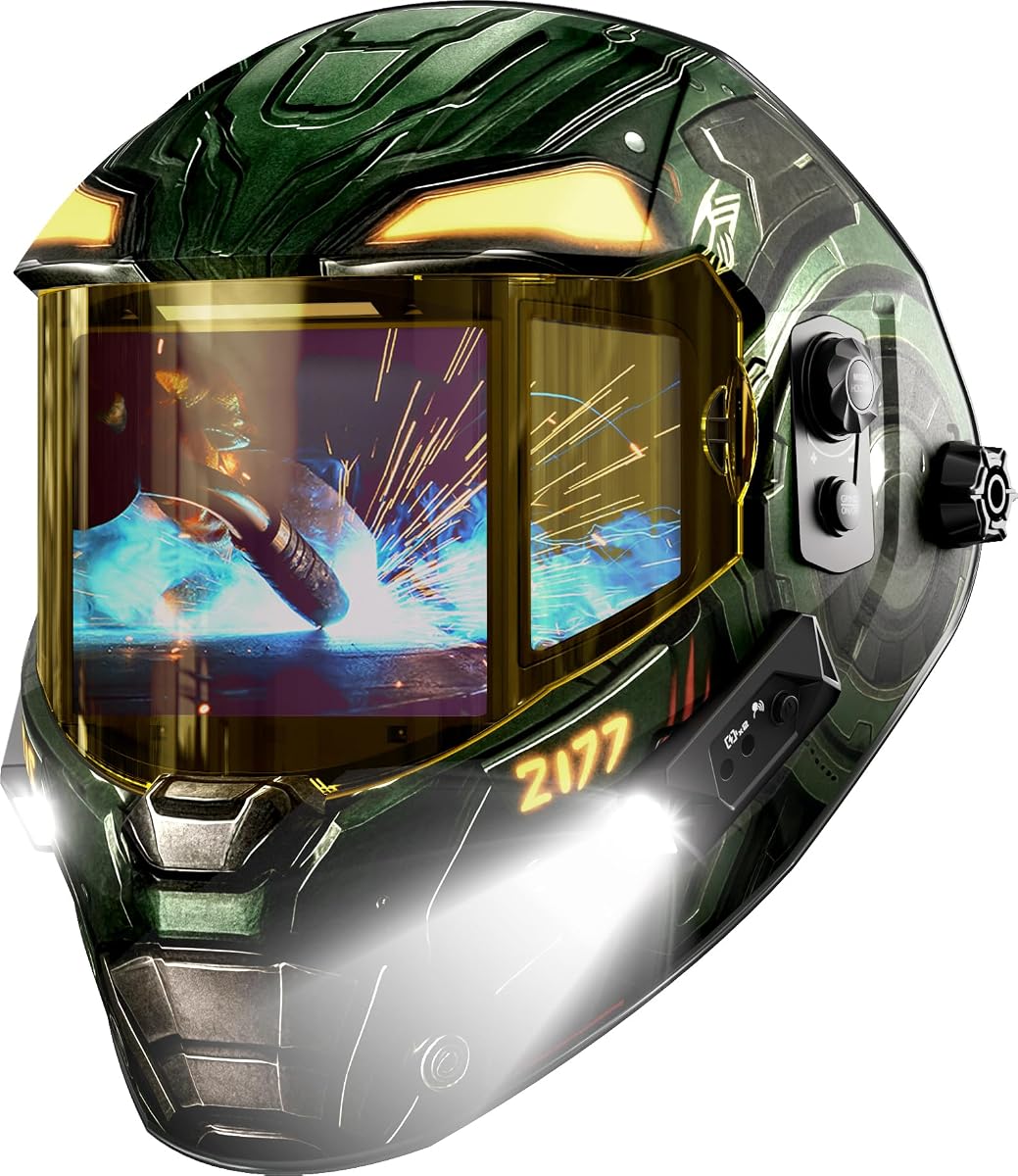


The YESWELDER LYG-M800H is a practical all-rounder for home garages, repair shops, and general fabrication work. Its 4.4 rating reflects a strong combination of large viewing area, true color optics, fast auto-darkening, and a manageable weight. The helmet supports TIG, MIG, Stick, CUT, and grinding applications, making it more versatile than a model built for only one process.
We may earn a commission when you buy through this link, at no additional cost to you.
Its 3.93-by-3.66-inch viewing area gives users a broad look at the weld puddle, joint edges, and work position. The stated 1/1/1/1 true-color optical clarity is intended to provide a more natural image than a traditional green-tinted lens. Four arc sensors and a 1/30,000-second switching speed help the filter darken quickly, while adjustable DIN 3/5-9 and 9-13 ranges cover multiple welding conditions and lower-amperage work.
Comfort is another strength. At approximately 1.32 pounds, the helmet is designed to remain light during longer sessions, while adjustable headgear, a reinforced hinge, and strengthened connection points support a secure fit. It also accepts magnifying cheater lenses and uses an accessible replaceable CR2450 lithium battery. These are practical features for welders who want flexibility without a complicated setup.
The principal compromise is that four sensors, while capable, do not provide the redundancy of the seven-sensor ANDELI model. It also lacks the stored presets and advanced digital interface found on higher-end electronic helmets. Even so, the LYG-M800H covers the essentials with a generous field of view, rapid response, and broad process compatibility. It is a strong choice for value-conscious welders who need a capable everyday helmet.
The 3.93-by-3.66-inch viewing area gives the LYG-M800H an open, practical view of the joint and surrounding workpiece. That extra width can be useful when positioning, reading bead shape, and checking edges without repeatedly moving the helmet.
Four independent arc sensors, a 1/30,000-second response, and broad shade controls make the filter adaptable to TIG, MIG, Stick, cutting, and grinding. A welder who regularly changes processes can keep one helmet in service rather than switching between separate masks.
We may earn a commission when you buy through this link, at no additional cost to you.
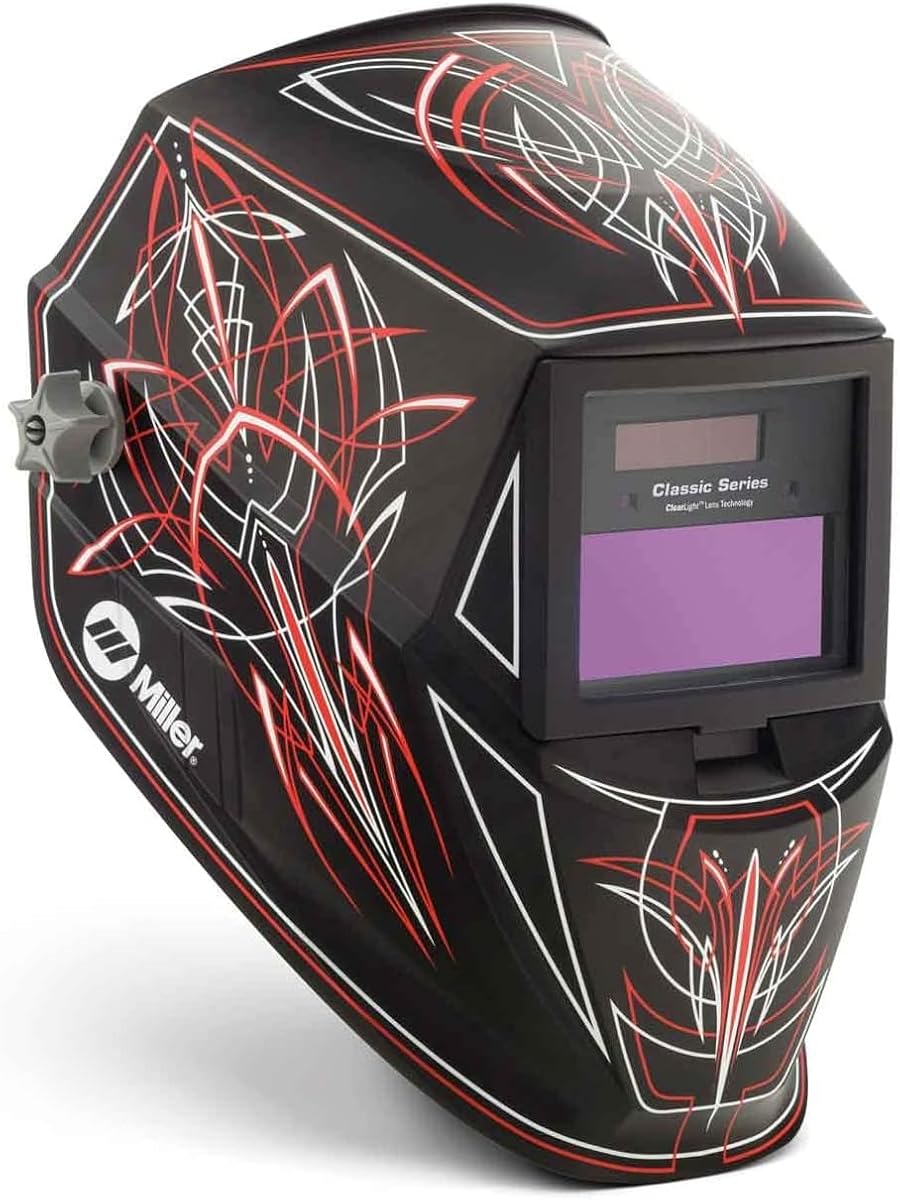
The Miller Classic Series in black offers a refined, straightforward approach to auto darkening. It carries a 4.7 rating and pairs ClearLight lens technology with a six-square-inch viewing area, digital controls, and a ratchet headgear. The product is positioned for precision welding and extended work sessions, especially for users who value straightforward operation over a crowded feature set.
We may earn a commission when you buy through this link, at no additional cost to you.
The helmet provides weld shades 8-13, cut shades 5-8, and grind shade 3. Two arc sensors support a stated 1/23,000-second switching time, while digital controls allow adjustment of shade, delay, and sensitivity. Auto-on operation activates the lens at the strike of an arc, and a 3.0 light state allows the welder to keep the hood down between welds, preserving visibility while changing positions.
Safety is another major selling point. The supplied information states that the helmet meets ANSI Z87.1+, CSA, and CE standards. The ratchet headgear is designed to distribute the helmet securely, while the digital interface makes it easier to establish repeatable settings. A three-year warranty also adds confidence for regular users who depend on one helmet for shop work.
The main limitation is the two-sensor arrangement, which is less extensive than the four- and seven-sensor systems in this comparison. The six-square-inch viewing area is also smaller than the very broad screens offered by the Hobart and ANDELI. Nevertheless, the Miller balances optical clarity, process-specific shade choices, safety claims, and simple controls. It is the most complete pick for a welder who wants established professional features without an elaborate electronic interface.
Separate weld, cut, and grind shades let the filter move between fabrication tasks without treating every operation as if it were the same. The grind mode is especially useful because the lens stays clear for surface work while remaining ready for subsequent welding.
Digital controls for shade, delay, and sensitivity make the helmet easy to configure. Auto-on activation removes the need for a manual power switch at the moment the arc strikes, which supports an efficient and consistent workflow.
We may earn a commission when you buy through this link, at no additional cost to you.
The MIGVAN True Color Helmet combines a large viewing screen, four arc sensors, true-color optics, and dual power in one package. It carries a 4.4 rating and is aimed at users who move between TIG, MIG, Stick, cutting, and grinding. Its emphasis is a broad feature set and practical ownership rather than the compact simplicity of a basic analog model.
We may earn a commission when you buy through this link, at no additional cost to you.
The filter uses a golden lens with optical-class technology that is designed to reduce distortion and color saturation. Four sensors activate the auto-darkening function in 1/10,000 seconds, moving from a DIN 4 light state to DIN 5-9 and 9-13 dark states. An outer yellow filter adds UV and IR protection, while sensitivity and shade controls allow tuning for different tasks.
Power comes from solar energy and a replaceable CR2450 battery, offering flexibility in low-light conditions and for extended work sessions. Adjustable pivoting headgear and breathable padding are designed to improve comfort and reduce strain. The package also includes two inner lenses, two outer lenses, setup guides, a manual, and a heavy-duty storage bag, making it particularly useful for transporting a complete setup.
There are some trade-offs to consider. The long product name and extensive feature list may make the options feel more complicated than necessary for a new welder. The replaceable lenses also require more maintenance than a sealed design. Even so, the supplied lens spares, bag, solar and battery power, and multi-process range make this a generous package for a garage, course, or mobile repair business.
Two inner lenses, two outer lenses, setup documentation, and a rugged storage bag are included. Those spare components are useful because a scratched or damaged cover lens can affect both visibility and protection.
Solar power and a replaceable CR2450 battery offer two ways to keep the filter operating. That flexibility is useful when work occurs in poorly lit shops, outdoor repair sites, or locations where maintaining access to fresh batteries is difficult.
We may earn a commission when you buy through this link, at no additional cost to you.
The Hobart 770890 stands out for its stated 9.3-inch widescreen viewing area, one of the broadest fields of view in this guide. Its 4.7 rating reflects a combination of PureColor lens technology, four independent arc sensors, and uncomplicated analog operation. This makes it appealing to welders who want to see more of the workpiece and the area surrounding the joint.
We may earn a commission when you buy through this link, at no additional cost to you.
PureColor technology is intended to provide an accurate, clear image of the weld and work environment. The four independent sensors support dependable detection and prompt darkening, while an auto-on and auto-off power function is triggered at the strike of an arc. The helmet also switches from weld to grind mode, allowing a clear view during surface preparation without removing the entire mask.
Analog knobs are used for shade, sensitivity, and delay. While digital controls and memory functions are more elaborate, the straightforward approach can be easier to understand and adjust. It also reduces the number of steps needed to make a setting change, a useful benefit in repair work where the user may switch between processes or materials frequently.
The important trade-off is that analog controls do not provide the nine stored settings or detailed digital readout found on the ESAB Sentinel A60. Exact physical dimensions are also not supplied, so buyers should examine the fit and headgear directly. Overall, the 770890 is a compelling choice for users who prioritize a wide view, natural color, and uncomplicated controls over advanced automation.
The 9.3-inch widescreen is the defining feature of this model. A broader view can improve awareness of the joint, surrounding metal, and tool position, particularly when the workpiece is large or the welding position makes direct visualization difficult.
Shade, sensitivity, and delay are adjusted with knobs rather than a digital interface. This straightforward control layout can reduce setup time for users who already understand how these settings affect the welding arc.
We may earn a commission when you buy through this link, at no additional cost to you.
The ESAB Sentinel A60 is the premium pick in this comparison because it combines refined optics, fine shade adjustment, internal controls, and programmable settings. Its 4.7 rating reflects a helmet designed for users who repeatedly perform different tasks and want to return to proven configurations without rebuilding every adjustment.
We may earn a commission when you buy through this link, at no additional cost to you.
The viewing area measures 4.65 by 2.80 inches and uses ESAB OpTCS True Color Lens Technology. Four arc sensors support a listed switching time of 0.08 milliseconds, while the shade range covers DIN 3/5-13 in 0.5 increments. Internal controls for sensitivity and delay reduce the need to reach around the helmet, and a shade lock adds another layer of control during setup or inspection.
On-board memory can store up to nine settings. That is particularly valuable for a fabrication shop or serious hobbyist who alternates among welding, cutting, grinding, and different materials. LED indicators for low battery, grind mode, and shade lock provide clear status cues, reducing uncertainty about which mode is active. The replaceable CR2450 battery keeps the power system serviceable.
A premium feature set does bring trade-offs. Nine memories may be unnecessary for someone who performs only one type of work, and the internal control system may take more time to learn than simple analog knobs. The replaceable battery also requires occasional awareness of its condition. Even so, the A60 offers the most focused combination of premium optical technology and repeatable professional settings.
Nine onboard memories allow users to save and recall preferred configurations. This is useful when switching between tasks with different shade, delay, or sensitivity requirements, especially in shops that repeat the same jobs across multiple work orders.
The DIN 3/5-13 range adjusts in 0.5 increments, offering finer control than broad-step interfaces. A dedicated shade lock can also hold the filter at a chosen level when the welder needs stable visibility outside an active arc.
We may earn a commission when you buy through this link, at no additional cost to you.
The Sunstac Auto-Darkening Welding Helmet is designed for welders who need dependable protection and improved visibility in low-light working conditions. It carries a 4.5 rating and combines a 3.94-by-3.27-inch viewing screen, four arc sensors, dual power, true-color optics, and a rechargeable auxiliary work light.
We may earn a commission when you buy through this link, at no additional cost to you.
The filter supports Stick, TIG, MIG, CUT, MMA, and plasma applications, with grinding features and a shade range of DIN 4/5-9/9-13. Four sensors and a stated 1/30,000-second switching speed support rapid adaptation, while the 1/1/1/1 true-color view aims to provide a clearer, more natural image than a green-tinted lens.
The work light is the most distinctive addition. It is rechargeable, offers concentrated and broad-area lighting modes, and can swivel to illuminate the joint precisely. This is helpful for inspecting a weld in a dark shop or setting up a workpiece before striking an arc. The helmet can run from a lithium battery or solar power, and cheater-lens compatibility supports users who require magnification.
The auxiliary light and cheater lens require separate purchases if the buyer does not already own them, so the complete setup may not be as immediately self-contained as some alternatives. The stated environmental commitment and overall feature set are otherwise appealing. This Sunstac model is especially attractive for night-shift fabrication, field repair, and home-shop work where lighting around the workpiece is limited.
The rechargeable light provides two brightness patterns and an adjustable swivel angle. Directing the illumination at the joint can make it easier to examine bead placement, surface preparation, and material condition before welding begins.
Multiple headgear adjustments and internal padding are designed to create a more even fit. Cheater-lens compatibility also gives vision-corrected users a way to install appropriate magnification without replacing the entire helmet.
We may earn a commission when you buy through this link, at no additional cost to you.
The Miller Classic Series Rise shares the core optical and electronic strengths of the black Classic Series while using the rise-style configuration. Its 4.7 rating, six-square-inch viewing area, ClearLight lens technology, and digital controls make it a strong choice for welders who prefer a proven feature set and a convenient way to reposition the helmet.
We may earn a commission when you buy through this link, at no additional cost to you.
As with the related model, the filter provides weld shades 8-13, cut shades 5-8, and grind shade 3. Two sensors support a stated 1/23,000-second response, and digital controls manage shade, delay, and sensitivity. Auto-on power activation begins when the arc strikes, while the 3.0 light state supports visibility between welds. The ratchet headgear is intended to secure a comfortable fit during extended sessions.
Safety and warranty details provide additional confidence. The supplied information lists ANSI Z87.1+, CSA, and CE compliance, along with a three-year warranty. These are meaningful considerations for professional users who wear the helmet regularly and need reliable protection, consistent controls, and a clear path to product support.
The two-sensor arrangement remains the central technical limitation, and the six-square-inch viewing area is modest next to wide-screen designs. Nevertheless, the Rise variant's appeal lies in its established core features rather than an extensive electronic suite. It is most suitable for users who value established ClearLight performance, digital adjustment, and straightforward rise-style positioning.
The 3.0 light state keeps the filter relatively clear between welds, allowing a welder to check the setup without raising the helmet. Auto-on activation then returns the mask to its protective role as soon as an arc is detected.
Digital shade, delay, and sensitivity adjustments make it easier to reproduce a suitable setup. This is helpful for repeat work where maintaining a consistent view reduces the need to make small corrections throughout the day.
We may earn a commission when you buy through this link, at no additional cost to you.
The ANDELI Smart Helmet is the most electronically advanced model in this guide. It receives a 4.4 rating and offers automatic adjustment, a panoramic three-sided viewing arrangement, seven arc sensors, nine custom presets, digital controls, and two intelligent work lights. It is built for users who want the filter to handle changing arc conditions with minimal manual intervention.
We may earn a commission when you buy through this link, at no additional cost to you.
The viewing system combines a 4.6-by-3.2-inch main lens with two 1.3-by-2.5-inch side lenses, and all three darken automatically. The stated 1/1/1/1 true-color view and integrated optical filter are designed to reduce visual distortion while providing broad directional protection. Seven sensors and a 1/30,000-second switching speed support reliable, rapid detection.
Shade, delay, and sensitivity can be adjusted automatically within plus or minus nine levels, individually or together. Gradient control supports smoother transitions, and the user can save nine presets. A fully digital internal screen provides direct control. The helmet also includes Weld, Grind, Cut, and Lock modes, making it easy to adapt to different stages of fabrication.
The lights add another layer of utility. A motion sensor turns them on or off, and two brightness levels accommodate different conditions. The main system uses a 1,500mAh rechargeable battery with solar assistance, while a separate 1,000mAh battery powers the LEDs. A screen-based battery indicator helps monitor remaining power. The trade-off is complexity: users who want fully manual, uncomplicated operation may prefer a simpler analog model.
The intelligent system can adjust shade, delay, and sensitivity according to conditions. Fine-tuning remains available, but automatic operation can reduce repeated manual changes when arc brightness or task conditions vary.
Auto-darkening side lenses extend the protected viewing arrangement beyond the main display. The panoramic 7.2-by-3.2-inch total viewing area is especially useful when the head is tilted and the work lies outside a conventional forward-facing view.
We may earn a commission when you buy through this link, at no additional cost to you.
The MIGVAN Welding Helmet with Light holds the highest listed rating in this guide at 4.8. Its combination of true-color optics, four sensors, a 1/10,000-second response, dual power, and an integrated adjustable LED makes it a particularly complete choice for a wide range of welding and finishing tasks.
We may earn a commission when you buy through this link, at no additional cost to you.
The viewing area measures 3.94 by 3.23 inches. An amber lens with optical-class technology is designed to eliminate distortion and color saturation, producing a more lifelike view of the weld pool and workpiece. The shade range spans DIN 4, DIN 5-9, and DIN 9-13, supporting TIG, MIG, Stick, cutting, and grinding. Four arc sensors manage the darkening response.
A USB-powered LED on top provides two brightness settings for low-light work. It must be installed when the helmet arrives, which is a minor setup task, but allows the user to direct additional light toward the bead. Dual front-facing solar panels and a replaceable CR2450 battery provide a hybrid power system, while the stated minimum current is five amps.
Comfort is supported by flexible polypropylene construction, adjustable ergonomic headgear, and breathable padding. The outer and inner lenses are replaceable, and the filter includes permanent DIN 16 UV and IR protection along with stated ANSI and CE compliance. The main caution is the need to install the LED and maintain both solar and battery components. Overall, the high rating and balanced feature set make this a strong general-purpose recommendation.
The top-mounted USB light offers two brightness levels, allowing the user to choose stronger illumination or a less distracting output. This is useful for low-light work and for examining the joint before the arc begins.
Replaceable inner and outer lenses make it easier to maintain visibility when a component is scratched or damaged. Permanent DIN 16 UV and IR protection remains part of the filter specification, supporting use across the listed welding processes.
We may earn a commission when you buy through this link, at no additional cost to you.
The SHINE Leather Helmet offers a distinctive full-leather, flip-up design for welders who prefer a traditional exterior over a molded plastic shell. It has a 4.5 rating, weighs 17 ounces, and uses a 1/1/1/2 true-color lens with a variable DIN 4/9-13 shade range.
We may earn a commission when you buy through this link, at no additional cost to you.
Genuine cowhide is used across the helmet, with the stated intention of protecting against sparks, splashes, and high temperatures. The flip-up lens allows a welder to raise the viewing section without removing the entire helmet, making it convenient to check a drawing, handle material, reposition work, or perform a task that does not require eye protection.
The replaceable lens format accepts fixed #9, #10, or #11 lenses, as well as variable #4/9-13 options. That range gives the owner some flexibility in how the helmet is configured. The stated 17-ounce weight and ergonomic shape are designed to support long wearing periods, making comfort one of the model's main selling points.
The trade-off is optical specification and viewing area. A 1/1/1/2 rating is slightly less uniform than the 1/1/1/1 ratings advertised by several competitors, and the two-by-4.25-inch lens is more compact than the broad viewing areas offered elsewhere in the guide. Natural wrinkles and color variation in genuine cowhide are normal. Even so, this is a compelling model for buyers who value leather construction, a light weight, and the flexibility of a flip-up lens.
The full cowhide exterior is intended to shield against sparks, splashes, and heat, while the flip-up design allows quick access to the face. This combination is useful in mixed fabrication work where the helmet remains on during short non-welding tasks.
At 17 ounces, the helmet is designed to reduce fatigue during extended wear. Its ergonomic shape and relatively low weight may be especially appealing to users who spend long periods welding, grinding, and positioning workpieces in the same session.
We may earn a commission when you buy through this link, at no additional cost to you.
The best auto darkening welding helmet is determined less by any single specification than by the match between its lens, sensors, controls, power system, and fit. Review the factors below in the context of your own processes, environment, and comfort requirements.
A larger viewing area makes it easier to see the weld puddle, joint edges, workpiece, and nearby tools. The models here range from a compact two-by-4.25-inch lens to wide formats that include side lenses or a stated 9.3-inch widescreen. True-color specifications such as 1/1/1/1 or 1/1/1/2 indicate an effort to reproduce a more natural image than older green-tinted filters, but the actual perceived clarity will also depend on the lens condition and ambient light.
Prioritize a viewing area that feels open without making the helmet unnecessarily large. For close, detailed work, center visibility may matter more than overall dimensions. For fabrication involving large parts or frequent head movement, a panoramic arrangement can be valuable. Inspect the lens for distortion, scratches, and consistent color before committing to frequent use.
Arc sensors determine when the filter darkens. More sensors can improve confidence because the helmet has multiple points from which it can detect the arc, which is useful in TIG work, low-amperage welding, awkward positions, and situations where the arc may appear only briefly. Sensor counts in this guide range from two to seven, while stated response speeds range from 0.08 milliseconds to 1/30,000 second.
Do not focus on response speed alone. A fast filter still depends on stable detection, appropriate sensitivity, and correct placement. For low-current TIG or work with a narrow or obstructed arc, prioritize sensor coverage and sensitivity adjustment. For conventional MIG, Stick, and cutting tasks, a two- or four-sensor model can provide adequate performance when correctly configured.
A broad shade range helps one helmet handle different tasks. The YESWELDER, Sunstac, ANDELI, MIGVAN, and SHINE models provide a variable dark-state range reaching shade 13, while the Miller models divide the range into weld, cut, and grind settings. ESAB adds a shade lock and 0.5-step adjustments. Dedicated grind or cut modes keep the lens usable for tasks that do not require welding protection.
Match the shade range to the processes you actually perform. Frequent multi-process work benefits from clearly separated welding, cutting, and grinding settings. A specialist who performs one type of weld may find a narrower range sufficient. Consider whether a lock function helps during setup, and whether stored settings would save time when moving between different jobs.
True color lenses are intended to make the workpiece and puddle easier to interpret without the heavy green cast associated with many conventional filters. The models here use different ratings and technologies, including 1/1/1/1 true color, 1/1/1/2 true color, ClearLight, PureColor, and OpTCS True Color. These names indicate different approaches rather than a directly interchangeable measurement.
For detailed work, assess the light state as well as the dark state. A filter that remains sufficiently clear between welds can speed up alignment and inspection. The Miller models specify a 3.0 light state, while some competitors use a DIN 4 light state. Bright, clean lenses also help preserve clarity, so maintenance should be part of the purchase decision.
Analog knobs offer direct physical adjustment, while digital controls can show exact values and support finer changes. Fully automatic systems may adjust shade, delay, and sensitivity based on changing conditions, which is convenient but can require a learning period. Stored presets are valuable when the same helmet is used for several recurring tasks, while a simple interface is often better for beginners or occasional users.
Choose the control style that matches your workflow. Frequent process changes favor memory and quick recall, while a single consistent task may need only a shade adjustment. Make sure the controls are understandable, the indicators are visible through the mask, and lock modes do not interfere with welding. Complex features are valuable only when they simplify the work in practice.
Auto-darkening filters may use solar panels, replaceable lithium batteries, rechargeable batteries, or a combination of these approaches. Solar power is convenient for extended operation, while a replaceable CR2450 cell makes the system straightforward to service. The ANDELI uses rechargeable batteries and solar assistance, and the Sunstac includes an auxiliary rechargeable light. Power availability should be considered alongside work location, lighting, and access to charging equipment.
Check the battery type before committing, because replacement logistics differ. Lithium cells may need regular checks, rechargeable systems require charging, and solar-assisted models still benefit from a dependable battery. Low-battery indicators are useful but cannot prevent a shutdown. Choose a system with a power reserve suited to your longest typical workday and keep a spare compatible battery where appropriate.
A protective lens is only useful if it stays correctly positioned. Look for adjustable headgear, balanced suspension, padded contact areas, and enough range to accommodate head size, clothing, and preferred positioning. Weight also matters: the YESWELDER is listed at approximately 1.32 pounds, while the SHINE leather model is listed at 17 ounces. Lightweight construction can reduce neck fatigue, although fit quality is equally important.
Try the helmet if possible and check the view through the installed lens. The mask should not shift when you look down, and the controls should remain reachable. Ratchet systems, pivoting headgear, and multi-point contact can improve stability. For users who wear prescription glasses, confirm that the helmet accommodates the frames and consider cheater-lens compatibility.
Look for a stated safety standard, UV and IR protection, and replaceable optical components. Some models in this guide list ANSI Z87.1+, CSA, or CE compliance, while others state ANSI and CE standards. These claims should still be verified against the current manufacturer documentation and the exact model. Construction also affects daily care: plastic shells resist heat differently from full leather, and serviceable lenses make long-term maintenance easier.
Check whether a storage bag, spare inner lenses, outer lenses, user guide, or work light is included. A complete package can be useful for mobile work, but replacement parts should also be readily available. Inspect the helmet for loose screws, cracked surfaces, damaged headgear, and scratched lenses before use. No auto-darkening filter should be used if its protective components are compromised.
Before the first weld, read the instructions for the exact model and install the battery or solar component as directed. Adjust the headband and rear fit knob so the helmet sits securely without pressure points, then confirm that the viewing area is centered on the work. Set the appropriate welding shade, sensitivity, and delay, and verify that the filter darkens when an arc is struck. Do not look directly at an arc without a functioning protective filter.
Select a shade and operating mode suited to the process, current, material, and position. TIG, MIG, Stick, cutting, and grinding can require different settings, so recheck the controls when changing tasks. Some filters include grind, cut, or lock modes that should be used according to the manual. A work light may improve visibility before welding, but it does not replace the helmet's UV and IR protection during an arc.
Clean the viewing lens with an appropriate, nonabrasive method and avoid solvents or rough materials that can damage the coating. Remove dirt from sensors so detection remains reliable, replace damaged inner and outer lenses, and inspect the headgear, battery compartment, and power contacts. Store the helmet in a clean, dry place with the viewing lens protected. For a flip-up design, check the hinge and locking mechanism regularly, and service replaceable batteries according to the manufacturer’s instructions.
Yes, but they must detect the TIG arc reliably and be set to an appropriate sensitivity and delay. TIG can use a narrow, low-current arc that some filters detect less consistently than a bright MIG or Stick arc. A helmet with multiple sensors, wide sensitivity adjustment, and a fast response is generally better suited to varied TIG work. Confirm that the model explicitly supports TIG and test the settings before beginning a project.
The numbers describe different optical performance characteristics rather than shade settings. A 1/1/1/1 lens is advertised as providing a more uniform true-color view than a 1/1/1/2 rating, which has a lower value in the final category. Actual clarity can vary with illumination, lens condition, and the viewing environment. The most useful comparison also considers viewing area, distortion, and how the filter performs in both light and dark states.
Two sensors can work well for many conventional applications, while four or more provide more opportunities for arc detection. Sensor count is particularly relevant for TIG, low-amperage work, obstructed arcs, and positions where the arc briefly appears at the edge of the viewing field. More sensors do not eliminate the need for proper sensitivity, clean detector surfaces, and correct helmet positioning.
Many models in this guide include a grind mode, and several offer a light state or separate grinding shade. These settings keep the lens sufficiently clear for surface work while allowing the same helmet to be used for welding later. Always follow the manufacturer’s instructions, because a setting intended for grinding should not be used while an arc is active.
Solar power can extend operation when the filter receives sufficient light, while a replaceable or rechargeable battery provides a dependable backup. The two systems are especially useful in dim workshops and outdoor repair locations where light exposure varies. A dual-power design still requires occasional battery checks, and solar panels should not be mistaken for a guarantee of unlimited runtime in dark conditions.
They can be useful for setting up material, checking a joint, and working in low-light spaces before or after welding. Models with adjustable brightness or a swivel head can direct light toward the work area. A work light does not increase the filter’s UV or IR rating and should not be treated as a substitute for a properly functioning auto-darkening lens.
Use the cleaning method approved by the manufacturer and a soft, lint-free cloth. Avoid abrasive pads, harsh solvents, and excessive pressure, which can scratch the lens or damage special coatings. Keep the control sensors free of dust and replace damaged cover or inner lenses. Regular gentle cleaning is preferable to trying to repair a badly scratched filter with general-purpose products.
Many helmets can accommodate ordinary glasses, but fit depends on the headgear and the space available around the cheeks and temples. Some models support separately sold cheater lenses, including the YESWELDER and Sunstac options listed here. Users who need strong magnification should confirm that the replacement lens matches the helmet’s viewing system and can be securely installed.
The YESWELDER LYG-M800H is the strongest all-around value, combining a large view, true color, four sensors, fast response, and low weight. The Miller Classic Series stands out for its balanced professional feature set, ClearLight optics, digital controls, safety standards, and warranty, while the ESAB Sentinel A60 takes the premium lead with fine shade adjustment and nine stored settings.
The right choice depends on the work. Select a wide or panoramic screen when awareness of the surrounding area matters, prioritize multiple sensors for TIG or difficult arcs, and choose programmable settings for repeated multi-process work. Solar or rechargeable power can improve flexibility, while a built-in light and cheater-lens compatibility may matter in dim shops or for vision-corrected users. Fit and comfort deserve the same attention as electronics.
Finally, verify the current product details, included accessories, availability, and price directly from the listing before purchasing. Specifications and configurations can change, and current cost is an important part of any buying decision. Compare the final choice against your most common processes, longest working sessions, and lighting conditions rather than selecting only by the largest feature list.