BoatSense by BilgeBuddy Smart Boat Monitoring System
4.7Editor score
Remote bilge pump control
High-water and voltage alerts
Integrated GPS tracking
Bilge health testing
Multi-channel notifications
Discover the best alarm system for boats in 2026 by comparing theft deterrence, remote monitoring, high-water alerts, GPS tracking, and installation options.
A boat alarm system can provide more than an audible theft warning. The right equipment may monitor unauthorized entry, track a vessel remotely, detect rising bilge water, protect critical equipment, and report a low battery before damage becomes serious. Because boats face different risks depending on size, layout, storage location, and power system, a useful alarm should match the vessel rather than rely on one generic feature.
This guide compares ten alarm, annunciation, and boat-monitoring products using the supplied specifications, ratings, and intended applications. The list covers remotely connected hubs, GPS and bilge monitoring systems, audible anti-theft alarms, motion sensors, physical security bars, and marine annunciators, allowing readers to distinguish theft deterrence from broader vessel-safety monitoring.
Each numbered review explains the product's strongest benefits, practical limitations, and ideal buyer. The top picks highlight the most compelling combinations of coverage, convenience, and marine-oriented functionality. Ratings and product details reflect the supplied information, while prices can change over time, so readers should confirm current availability and cost before making a final decision.
4.7Editor score

4.8Editor score
5.0Editor score
The table below compares all ten products by their core purpose, connectivity, primary sensing capabilities, and physical installation approach. It includes connected monitoring systems, self-contained alarms, an add-on motion sensor, a physical security bar, and two marine annunciators.




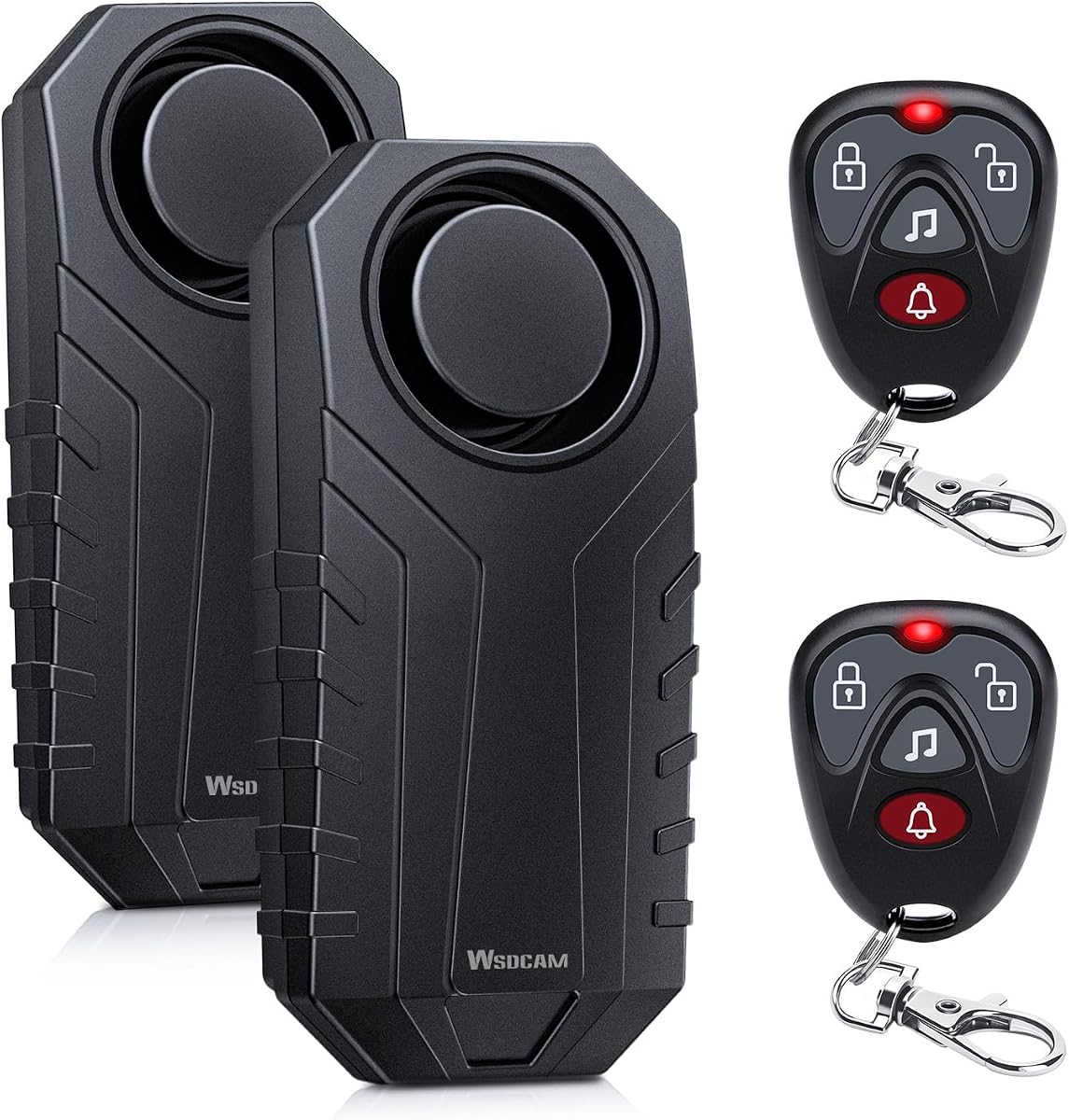
The WSDCAM vibration sensor alarm is a compact, budget-oriented deterrent for anyone who needs a loud alert when a protected object is moved, touched, or struck. Its supplied rating is 4.6, and its defining feature is an alarm that can reach 113 dB. The two-pack format also allows the owner to protect two separate areas, which is useful on a boat with multiple exterior access points.
We may earn a commission when you buy through this link, at no additional cost to you.
The alarm supports remote operation across a stated wireless range of up to 328 feet. Its three volume settings let the owner balance neighborhood deterrence with a less obtrusive setting, while seven sensitivity levels accommodate gentle contact through stronger pushing or impact. A vehicle-search or remote noise function adds another way to locate a boat in a crowded marina, and the IP65 rating makes the units suitable for outdoor exposure.
This is not a full vessel-monitoring platform, so buyers should not expect GPS tracking, remote bilge-pump control, cellular notifications, or a detailed record of boat health. Its vibration trigger may also respond differently aboard a boat than it does around a motorcycle or trailer, especially when waves, wind, or dock movement create variable forces. Careful placement and sensitivity adjustment are therefore important.
The WSDCAM is a sensible choice for owners seeking a straightforward audible deterrent without a complex installation. It is especially attractive for smaller boats, inexpensive electronics, or gear that can be protected with a local alarm. For owners who primarily want off-site awareness, one of the connected monitoring systems in this guide will be more suitable.
The 113 dB output and adjustable remote volume make this system easy to use as an immediate deterrence. Wireless pairing allows the owner to test the alarm and activate its locating noise without running cables through the vessel.
The included two-pack can cover separate hatches, compartments, or stored items. Double-sided adhesive and a strap provide straightforward mounting options, although the owner must select locations that balance sensitivity with false triggers.
We may earn a commission when you buy through this link, at no additional cost to you.
The LocMarine Global LTE Boat Monitoring & Security Hub is the most complete connected system in this comparison. It carries a supplied rating of 4.8 and combines GPS tracking, speed information, entry alerts, geofencing, battery monitoring, shore-power oversight, and bilge or high-water detection in one marine-oriented package. All sensors are included, reducing the need to assemble a custom monitoring setup.
We may earn a commission when you buy through this link, at no additional cost to you.
Connectivity through 4G and 5G LTE allows the hub to report information remotely rather than depending entirely on an audible alarm at the dock. The user-friendly LocMarine app serves as the central interface, while geofencing can help flag movement outside a selected area. A shore-power alert is particularly useful for detecting when a connected vessel unexpectedly loses its connection to dock power.
The hub cannot overcome the limits of cellular coverage, and its capabilities require compatible sensors, a suitable installation, and ongoing monitoring service. Buyers should consider antenna placement, signal strength at their usual marina or storage site, and whether the included service terms meet their long-term needs. Insurance-ready status may also depend on the insurer's particular requirements rather than applying universally.
This is the strongest all-around choice for owners who want to know the vessel's location and condition from a distance. It suits boats left unattended for extended periods, equipped with important electronics, or vulnerable to theft and water intrusion. Owners seeking only a loud local deterrent can find a simpler option, but few products cover this much remote intelligence in one package.
The combination of bilge, high-water, shore-power, and battery information is more useful than location alone. It allows an owner to identify a developing flood or loss of dock power before the problem becomes a major damage event.
The included sensor package and rugged, U.S.-made construction distinguish this system from a general-purpose tracker. It is a better fit for owners who want one platform to watch security and vessel health together.
We may earn a commission when you buy through this link, at no additional cost to you.
The Skyhawk Oversea Cellular Hub is a wireless gateway for boat owners who want remote monitoring without running new wiring throughout the vessel. Its supplied rating is 4.5, and its self-powered design is a major advantage. The hub operates on replaceable AA batteries, helping it avoid draining the boat's own battery while it links compatible sensors to the Oversea app.
We may earn a commission when you buy through this link, at no additional cost to you.
The gateway provides location-on-demand service and connects wirelessly with a broad Oversea sensor suite that includes bilge pump, battery, power, entry, high-water, sound, and motion sensors. That flexibility lets owners expand coverage as needs change. Cellular IoT connectivity supports remote status information, while long-range radio communication between the hub and sensors removes the need for a Wi-Fi network.
The specification lists AA battery endurance in two ways: up to three years for sensor monitoring and one to two years when functioning as a location-on-demand gateway and hub. Actual runtime depends on use, signal conditions, and battery quality. The product also relies on an Oversea subscription for full remote alerting, so owners should evaluate service availability and cost before installation.
This hub is especially attractive to owners of older boats without accessible wiring or a convenient place to mount a permanently powered system. It is a strong choice for modular monitoring across entry points, the engine area, battery bank, and bilge. Buyers seeking a complete turnkey package may prefer LocMarine, while Skyhawk serves owners who prefer a flexible sensor ecosystem.
The battery-powered gateway can be installed in minutes and does not need to be connected to the vessel's electrical system. Wireless sensor links make it especially practical for older boats or installations where cable routing would be disruptive.
The hub is designed to work with entry, high-water, sound, motion, power, battery, and bilge-pump sensors. Owners can start with the most important protection and add sensors as their monitoring priorities evolve.
We may earn a commission when you buy through this link, at no additional cost to you.
The Murphy by Enovation Controls ST10AS-LM is a ten-point remote alarm annunciator designed for marine pilot houses and other control environments. Its supplied rating is 4.1, and its role is different from that of a consumer security alarm. Rather than sounding a stand-alone siren at the point of intrusion, it presents remote alarm and annunciation functions where crew can quickly recognize developing engine, gear, bilge, or auxiliary-power problems.
We may earn a commission when you buy through this link, at no additional cost to you.
The Selectronic remote system allows the annunciator to serve as a centralized status panel. A ten-point format gives operators visibility across multiple monitored functions, which is useful on a larger or more complex vessel. The less-mount version is intended for installations where the panel will be fitted into a suitable console or mounting arrangement.
This product does not include a flange or gimbal mounting bracket, and it is not presented as a self-contained theft alarm. Installation may require appropriate control wiring, panel space, and integration with the boat's existing alarm network. The listed rating is lower than those of the leading connected systems, so buyers should also consider the availability of replacement parts and support for their specific control architecture.
The ST10AS-LM is a better choice for a boat owner, captain, or refit technician who needs a marine annunciation panel. It is particularly relevant where engine-room and electrical faults require visual confirmation. It should not be chosen as the only protection against theft, but it can complement a separate alarm and vessel-monitoring setup.
An annunciator reduces the need to inspect several individual instruments when something goes wrong. Its remote points provide a consolidated way to identify engine, gear, bilge, or auxiliary-power alarms.
The less-mount format is useful where an installer wants to position the unit directly in a custom console. The missing bracket means the owner must confirm that the planned mounting method is available before installation.
We may earn a commission when you buy through this link, at no additional cost to you.
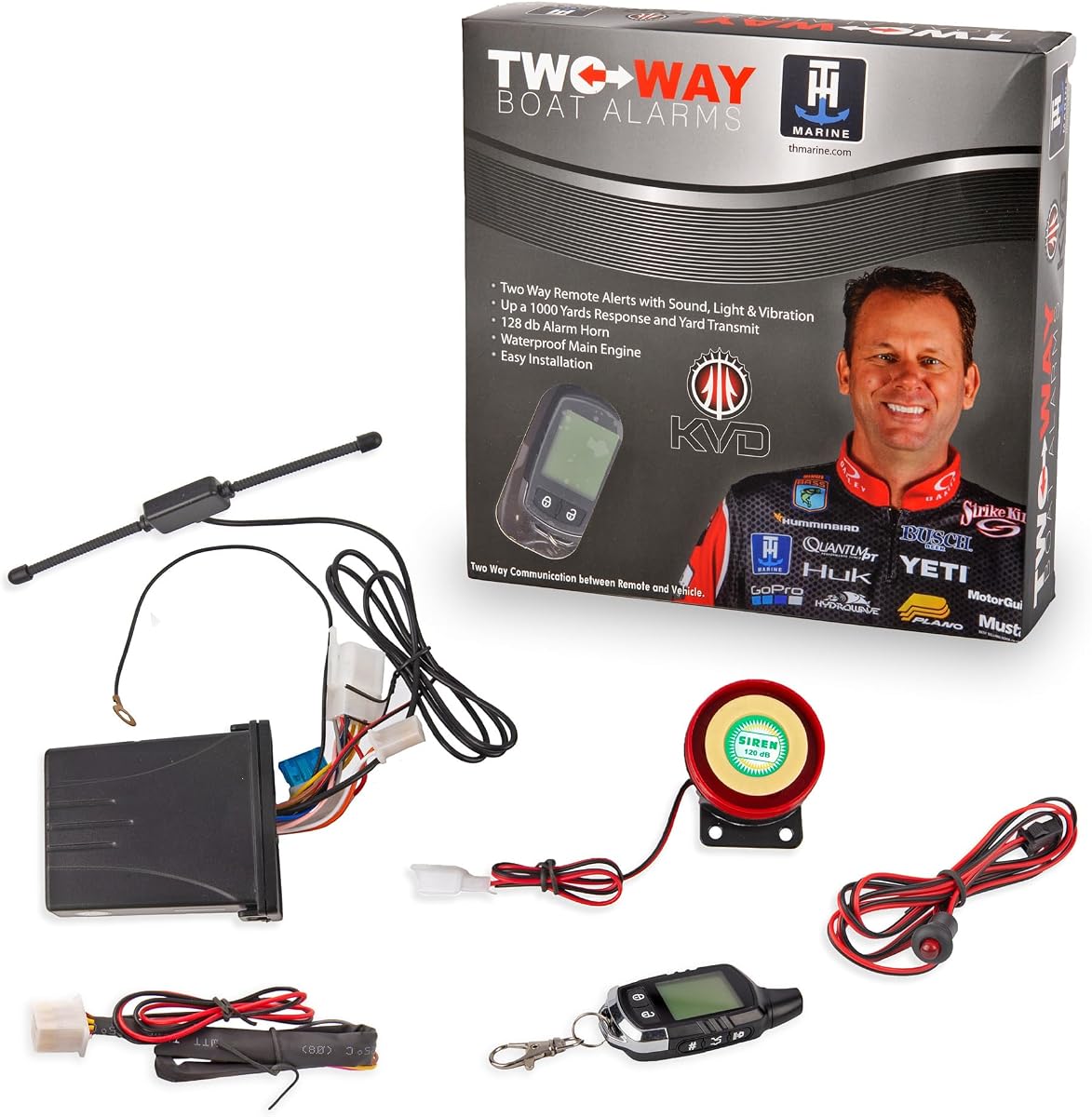
The T-H Marine 2-Way Boat Alarm System is built around a shock sensor, a powerful horn, and a two-way remote. Its supplied rating is 2.9, the lowest among the listed products, so prospective buyers should weigh that feedback carefully. Even with that lower rating, the stated feature set is clearly aimed at owners who want an immediate local alarm and confirmation on a handheld remote.
We may earn a commission when you buy through this link, at no additional cost to you.
The horn is rated at 128 dB, making it loud enough to serve as a meaningful audible deterrent. The remote can vibrate, flash, and beep when the alarm triggers, while the stated communication range extends to 3000 yards. That long range is useful when the boat is docked or stored away from the owner's immediate location, though actual performance depends on the environment and installation.
The shock sensor has adjustable sensitivity, which is important because a boat can experience different levels of natural movement depending on water conditions, dock activity, and weather. The engine module is described as sealed for marine use. However, the product does not provide the remote telemetry, GPS position, or battery-health information available from cellular monitoring systems.
This alarm makes the most sense for a boat owner who prioritizes a loud deterrent and a two-way remote over cloud-based vessel monitoring. Because the supplied rating is relatively low, careful review of current customer feedback, warranty terms, and compatibility is advisable. Buyers who require remote status data should consider a connected hub instead.
The 128 dB horn is the system's defining feature. It provides a powerful response to detected impact or motion, helping alert nearby people and discourage an intruder from continuing.
The two-way remote gives the owner tactile, visual, and audible feedback when a trigger occurs. Its stated 3000-yard range offers more separation than a typical short-range key fob, although obstructions and local conditions can affect results.
We may earn a commission when you buy through this link, at no additional cost to you.
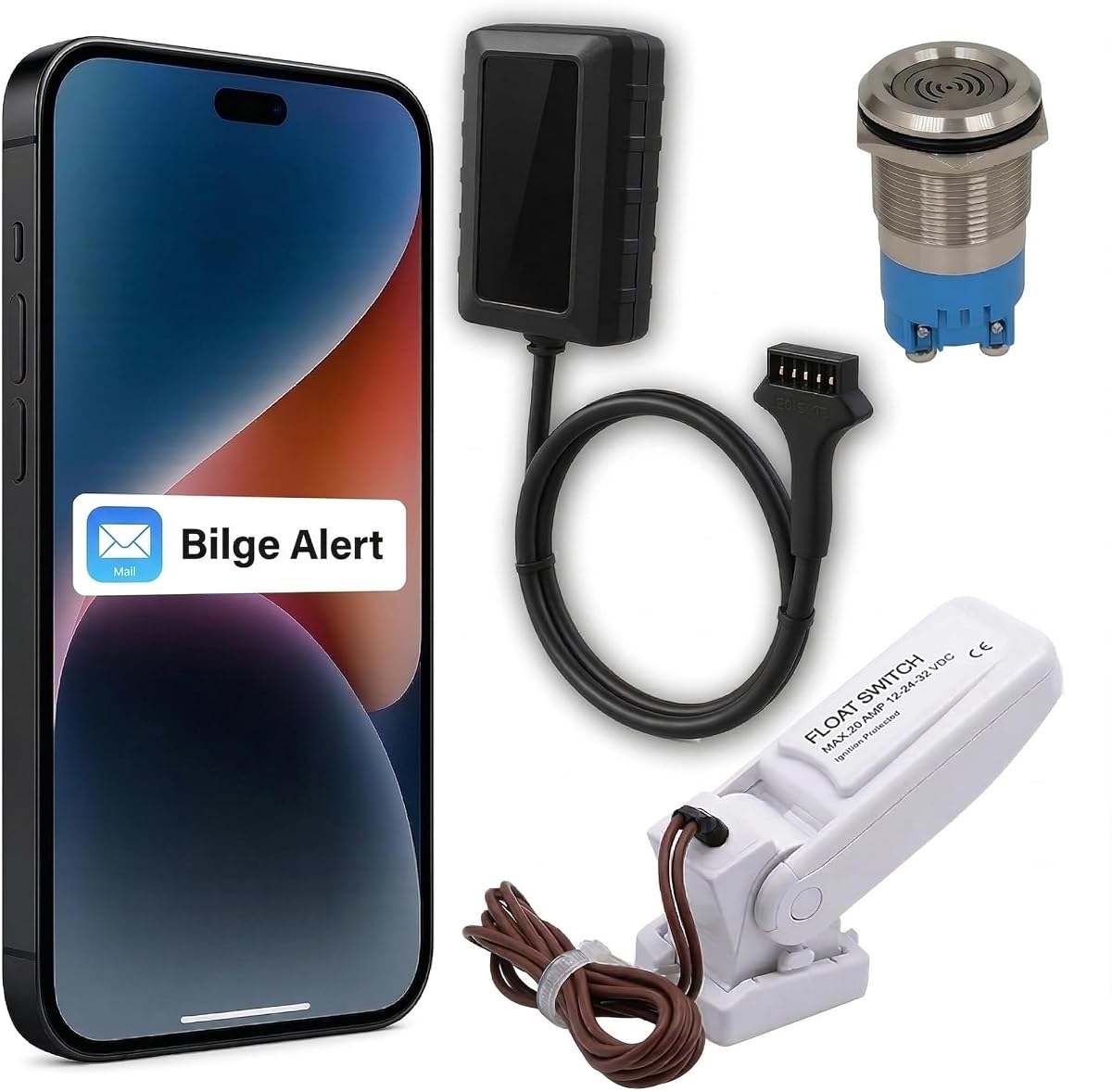
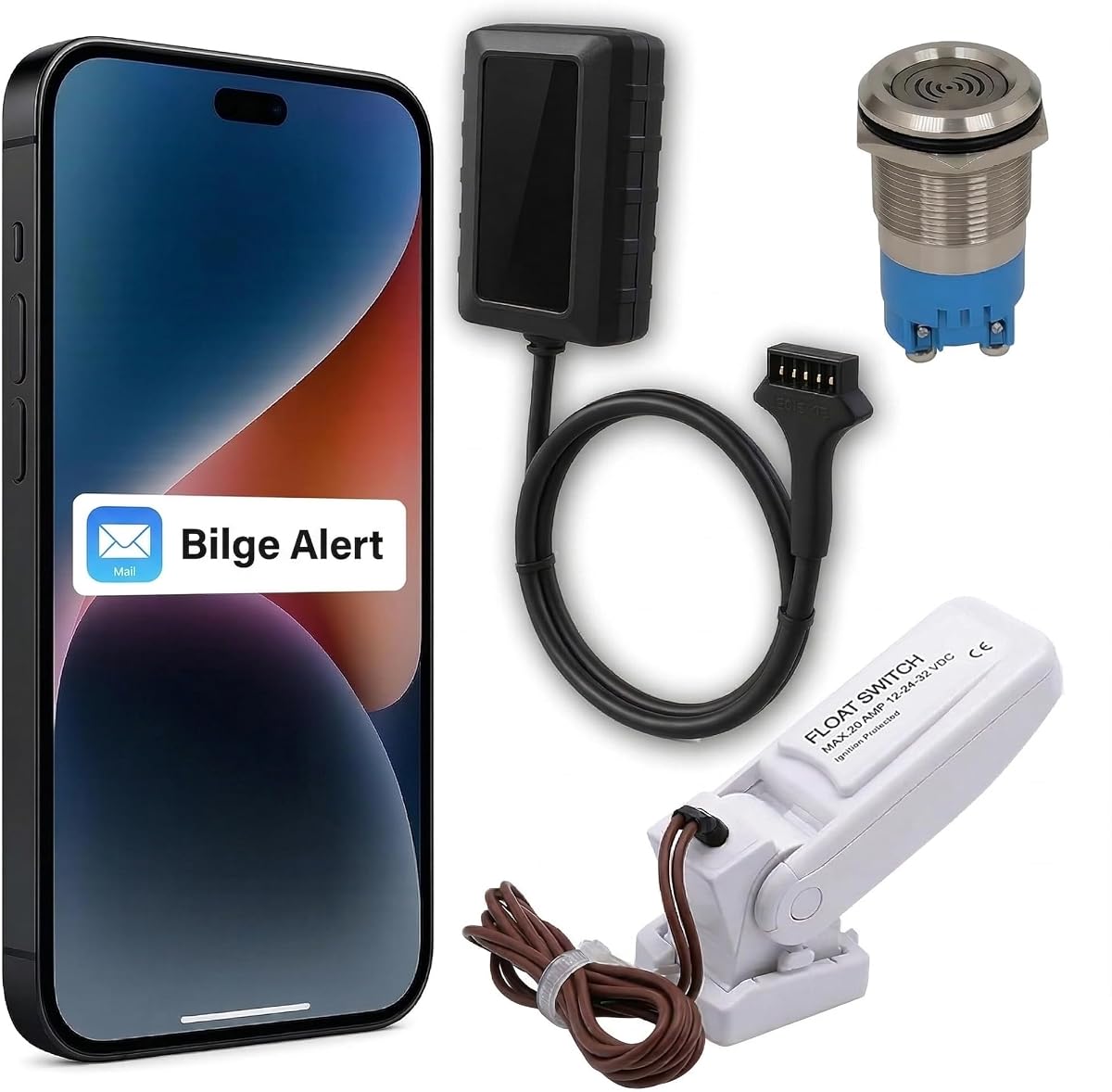
BoatSense by BilgeBuddy combines a smart monitoring platform with practical control of a boat's bilge pump. Its supplied rating is 4.7, and the product is especially distinctive because it does more than report high water: the owner can operate the bilge pump remotely from a smartphone. That capability can help manage a developing flood even when no one is aboard.
We may earn a commission when you buy through this link, at no additional cost to you.
The system monitors high water, low battery voltage, current, position, GPS, impact, temperature, and system malfunctions. Push notifications, SMS, and email alerts allow the owner to select the most useful communication method. Regular bilge-pump and float-switch health tests add a preventive dimension, while the backup auto-float switch offers another way to activate the pump when needed.
The stated electrical limit is all 12-volt systems rated at 15 amperes or less. Installation should still be planned carefully around wiring, water exposure, sensor placement, and the existing bilge arrangement. Remote pump operation is not a substitute for maintaining a sound float switch, adequate battery capacity, and sound wiring, and the system's usefulness depends on reliable cellular reception for remote commands.
BoatSense is a compelling option for owners who want a single system to watch bilge health, battery condition, and location. It is particularly valuable for boats left unattended overnight or for longer periods. It also goes beyond conventional anti-theft alarms by making remote flood response possible, which is why it stands out as one of the strongest premium picks in this guide.
The smartphone-based bilge-pump control is the standout feature. It gives the owner a way to respond to rising water rather than merely receive notice of a potentially serious problem.
Regular pump and float-switch tests can reveal degradation before a critical failure. Combined with the backup auto-float switch, this creates a more resilient approach to unattended water management.
We may earn a commission when you buy through this link, at no additional cost to you.
The T-H Marine Loc-R-Bar Complete Alarm System provides physical security rather than cellular monitoring. Its supplied rating is 4.3, and its central idea is straightforward: a robust stainless-steel bar spans the boat's deck and ties several hatches or compartments together, making it harder for someone to open one locker and remove valuable equipment.
We may earn a commission when you buy through this link, at no additional cost to you.
The adjustable bar works with included solid-aluminum mounting brackets and is designed for front deck compartments and rod lockers. An integrated, motion-activated alarm padlock adds an audible deterrent without external sensors or wiring. This self-contained approach is particularly useful for anglers who leave tackle and electronics at hotels, ramps, marinas, or other exposed storage locations.
Installation depends on the boat's dimensions, locker arrangement, and available mounting points. The bar is physical deterrence, so it does not provide GPS tracking, mobile notifications, water-level sensing, or remote health information. Its alarm also depends on the padlock's ability to detect movement in a real installation, making secure bracket placement important.
The Loc-R-Bar is best for owners focused on preventing opportunistic access to gear rather than tracking a vessel's condition. It can serve as a useful second layer beside an electronics tracker or bilge monitor. Buyers should measure their deck and verify bracket clearance before purchase, particularly on boats with unusual locker geometry.
Tying several compartments together addresses a common weakness in individual boat hatches. An intruder cannot simply open one isolated locker when a single secured bar connects multiple access points.
The motion-activated padlock adds a deterrent while keeping the installation self-contained. This simplifies use for owners who do not want to route sensor wires through deck compartments.
We may earn a commission when you buy through this link, at no additional cost to you.
The Wireless Boat Motion Sensor adds passive infrared detection to an Oversea monitoring setup. No numeric customer rating was supplied, so this review does not assign one. The sensor detects people or animals moving in cabins, salons, outdoor walkways, and other onboard areas, then reports the activity through the compatible Oversea Hub.
We may earn a commission when you buy through this link, at no additional cost to you.
Its stated detection range reaches up to 16 feet, making it useful for covering a meaningful section of a deck or interior. Long-range RF communication is used instead of Bluetooth or Wi-Fi, which allows the sensor to link wirelessly to the hub even when the boat has no local network. The hub then provides cellular connectivity and, with an appropriate subscription, remote phone alerts.
The sensor requires AA batteries and is described as operating for up to five years without connecting to the boat's battery or shore power. Its marine-oriented, waterproof construction and U.S. manufacture make it suitable for year-round use. However, pet movement, passengers, and changing temperatures may influence PIR behavior, so placement and sensitivity need to suit the vessel.
This is a strong add-on for owners who already use the Oversea ecosystem or are considering the Skyhawk Oversea hub. It is not a standalone alarm, and the requirement for a hub and subscription increases the total system complexity. For coverage of decks and cabins without full vessel monitoring, a dedicated security alarm may offer a more direct solution.
PIR sensing is particularly useful in enclosed cabins and salons where an open hatch may not reveal an intruder. It can also provide awareness of activity on exterior walkways where a pressure or entry sensor would be less suitable.
AA power and long-range RF remove both wiring and the need for a local Wi-Fi network. The stated five-year battery life makes this sensor appealing for hard-to-reach locations, subject to actual use and environmental conditions.
We may earn a commission when you buy through this link, at no additional cost to you.
The Murphy by Enovation Controls ST10AS-F is a ten-point remote alarm annunciator with a supplied rating of 5.0. It is designed for marine pilot houses and other locations where crew need a central indication of problems involving the engine, gear, bilge system, or auxiliary power. Its Selectronic remote capability allows it to work as part of a broader control and alarm architecture.
We may earn a commission when you buy through this link, at no additional cost to you.
The flange-mount version includes a flange with the annunciator, making it more convenient for owners who have not separately selected a mounting bracket. This is the main practical distinction from the ST10AS-LM less-mount model reviewed earlier. Both provide the same core ten-point annunciation function, but their installation packages suit different console arrangements.
Although the supplied rating is excellent, the rating should not be interpreted as direct evidence that the product prevents theft. It is an annunciator rather than a consumer alarm, GPS tracker, or motion detector. Appropriate wiring, sensor integration, labeling, and a clear understanding of each alarm point are necessary for effective operation.
The ST10AS-F is a strong choice for boat owners undertaking a monitored-panel installation or working with a marine electrical technician. It is especially attractive when the desired mounting method requires a flange. For primary theft deterrence, it should be paired with a suitable alarm or monitoring system rather than used as the only layer of protection.
The included flange simplifies planning for a conventional panel installation. Buyers can compare the unit directly with less-mount alternatives and choose the package that matches their console design.
A 5.0 supplied rating is a strong signal of customer satisfaction, but product fit remains the decisive factor. The unit best serves owners who need centralized fault indication in a properly integrated marine system.
We may earn a commission when you buy through this link, at no additional cost to you.
The SPY SPOT GV57 combines GPS location tracking with a bilge-water alarm in one marine safety bundle. Its supplied rating is 5.0, and the package includes the GPS tracker, a float switch, and a dashboard-mounted buzzer. This gives the owner both remote vessel-position information and an immediate onboard warning when rising bilge water is detected.
We may earn a commission when you buy through this link, at no additional cost to you.
Movement alerts and geo-fence notifications help track a boat stored at a marina, dock, or boatyard. Low-battery and system-status notifications add another layer of awareness, while the IP67 housing is designed for exposure to saltwater, rain, humidity, and other demanding marine conditions. The system is compatible with standard 12-volt marine electrical systems and common bilge-pump arrangements.
Professional marine installation is specifically required, which is an important consideration. A qualified technician can verify waterproof sealing, correct wiring, sensor placement, and reliable integration with the vessel's systems. The system also does not provide the extensive sensor suite or remote bilge-pump control offered by more advanced connected platforms.
The GV57 is a compelling choice for owners seeking a straightforward combination of tracking and flood detection without a larger multi-sensor platform. It is well suited to fishing boats, cruisers, yachts, and fleet vessels equipped with a bilge system. Its supplied rating, complete bundle, and focused feature set make it an attractive value-oriented option, provided the owner can arrange professional installation.
The package addresses two distinct unattended-boat risks. GPS and geo-fence features support location awareness, while the float switch and dashboard buzzer provide a local warning for rising bilge water.
Ultra-low standby consumption is particularly useful during seasonal storage or long-term parking. The system can remain ready for monitoring without draining the boat's electrical system as aggressively as a conventional continuously powered alarm.
We may earn a commission when you buy through this link, at no additional cost to you.
The right boat alarm depends on the threats you want to detect, the vessel's electrical layout, your storage conditions, and how much attention you can give to alerts. Compare coverage and installation requirements before choosing a device based only on alarm volume or a headline feature.
Boat security can include theft of the entire vessel, opening of a hatch, removal of tackle or electronics, or intrusion into a cabin. It can also involve water accumulation, loss of shore power, low battery voltage, and bilge-pump failure. Connected monitoring systems are strongest when the goal is to receive condition reports remotely, while a local siren is better suited to creating immediate noise and deterring someone nearby.
Choose based on the risk that would hurt you most. If the boat remains at a remote ramp or travels unattended overnight, GPS, geofencing, and high-water alerts may be more valuable than a loud horn. If valuable gear is exposed in a marina, a physical security bar may deserve priority.
Local radio alarms, cellular hubs, and remotely accessible cloud alerts serve different purposes. A short-range remote can inform someone within a limited area, while a cellular hub may provide updates from much farther away. Connected systems depend on cellular coverage at the vessel's usual location, and owners should consider signal quality in marinas, boatyards, and covered storage areas.
For a smart monitoring system, verify that the hub has an appropriate cellular network plan and that its antenna can be positioned effectively. For a local alarm, confirm the stated range is useful at the location where the boat is kept. Remote coverage is not automatically reliable everywhere, so test the product in the actual environment.
Alarm hardware may be battery-powered, self-powered, or designed to connect to a vessel's 12-volt system. The BoatSense system is specified for 12-volt systems rated at 15 amperes or less, while the SPY SPOT GV57 is designed for standard 12-volt marine electrical systems. Battery-only products can be attractive on older boats, but they still require regular battery checks and thoughtful placement.
Match the product to the boat's wiring, battery condition, and available mounting space. Owners should not assume that a hull, deck, or compartment location is suitable without checking ingress protection and the manufacturer's placement guidance. Professional installation is especially valuable for wired systems.
Marine environments demand attention to water resistance, condensation, corrosion, and sensor placement. IP ratings provide useful guidance, but they do not replace correct installation. A sensor installed in a location that collects standing water may fail earlier than its rating suggests, and a high-water float switch must be positioned at the intended activation level.
Look for a combination of automatic bilge detection, high-water alerts, and pump health checks if flooding is a concern. Remote pump control can add valuable response capability, while a backup auto-float switch provides local protection if communications fail. Confirm that any planned bilge equipment remains compatible with the boat's pump and float-switch arrangement.
Alarm volume matters when the goal is to startle or deter an intruder. The WSDCAM reaches up to 113 dB, while the T-H Marine system uses a 128 dB horn. These figures describe maximum output rather than guaranteed coverage, and actual audible performance depends on mounting, wind, background noise, and how the alarm is heard in the surrounding area.
Consider whether the alarm is local or accompanied by remote notification. A loud siren may work well near an occupied dock, while a silent sensor and phone alert may be preferable in a residential area. Some products, such as the Loc-R-Bar, combine physical deterrence with an integrated motion alarm.
Some systems are designed for quick drop-in installation, while others require wiring, panel configuration, and integration with existing sensors. The Skyhawk Oversea hub uses replaceable AA batteries and wireless sensor links, reducing installation demands. The SPY SPOT GV57 explicitly calls for professional marine installation to protect wiring integrity and long-term reliability.
Owners should assess their own experience honestly. A battery-powered or adhesive-mounted alarm can be straightforward, but improperly routed wiring or poorly sealed penetrations can create leaks and false confidence. For a custom vessel, an experienced marine installer can recommend a safer layout and document the installation for future service.
Connected products may require a subscription for remote notifications, cellular service, or access to cloud features. Oversea equipment depends on a hub and subscription for full remote alerting, while LocMarine includes six months of monitoring service. Before buying, review what happens when the included term ends and whether the service supports the alerts the owner actually needs.
Battery-powered hubs and sensors reduce vessel power drain but add maintenance. Published battery life is often an ideal estimate rather than a guarantee. Temperature, signal quality, transmission frequency, battery type, and installation can all influence runtime, so periodic checks remain important.
A sensitive alarm is not automatically a better alarm. Boat movement from wind, wakes, loose halyards, pets, and changing water levels can activate sensors that were not adjusted for the environment. The WSDCAM and T-H Marine systems both provide sensitivity controls, allowing owners to tune the response to the installation.
Choose alerts that you can realistically monitor and verify. A remote system should prompt a safe response plan: check camera or location information, contact a marina or trusted person, and avoid rushing to the boat alone when a theft or intrusion may be in progress. Local alarms should be positioned so that a sound is likely to be noticed.
Begin by mapping the boat's access points, electrical systems, likely movement patterns, and the locations where water, heat, salt, and direct sun accumulate. Decide which hazards the system must cover, then position each sensor where it can detect its assigned condition without being repeatedly triggered by normal boating activity. Read the included installation instructions before cutting power, drilling holes, or connecting any component.
After installation, test the complete system rather than only checking that it powers on. Trigger the alarm manually, verify phone notifications when applicable, confirm GPS position accuracy, and test high-water or float-switch operation according to the manufacturer's guidance. Calibrate shock and vibration sensitivity with the boat in its normal moored condition, then reassess after rough weather or significant changes to equipment placement.
For ongoing care, inspect sealed housings, cables, brackets, adhesive mounts, and battery compartments regularly. Replace batteries according to the manufacturer's schedule, especially in cold weather or when devices transmit frequently. Clean salt and dirt from exposed surfaces with fresh water and a soft cloth, and have a qualified marine technician inspect any wired installation after a collision, impact, or evidence of moisture intrusion.
A connected monitoring hub is usually the most useful option for an unattended boat because it can report position, entry, battery, bilge, and high-water conditions remotely. A local siren remains valuable as a deterrent, so the strongest setup may combine both. The best choice depends on cellular coverage at the storage site and the types of equipment being protected.
It depends on the system. Battery-powered or self-powered devices continue operating without shore power, while wired systems need a healthy onboard battery or another suitable power source. Low-power designs can be especially useful for seasonal storage, but the owner should test them periodically and replace batteries according to the stated service interval.
Yes, some connected products combine security and vessel-health functions. The SPY SPOT GV57 includes GPS tracking, movement alerts, a bilge float switch, and a dashboard buzzer, while the LocMarine hub adds several environmental and security sensors. The BoatSense system goes further by offering remote bilge-pump control and health tests.
A loud alarm can deter opportunistic intruders, especially in a populated marina, but it does not track the vessel or report problems when no one is nearby. Physical security, GPS tracking, cellular alerts, and water monitoring add important layers. The best protection is usually a combination of deterrence, detection, and remote awareness.
Start with a lower sensitivity setting and install the sensor where normal waves, wind, pets, and passengers will not dominate the detection area. Test the system while the boat is moored in typical conditions, then adjust after different weather states. If a sensor repeatedly triggers without a real concern, its placement may be better than its sensitivity level.
It depends on the product and the complexity of the installation. Battery-powered or self-contained units may be straightforward to mount, while wired GPS, bilge, and panel systems benefit from professional installation. The SPY SPOT GV57 specifically states that professional marine installation is required, and a qualified installer can protect wiring seals and system reliability.
High water, loss of shore power, low battery voltage, entry, and unexpected movement are among the most useful conditions to monitor. Theft tracking is important for expensive vessels, while bilge-pump condition is critical for boats stored unattended. Prioritize alerts that address the most likely and most damaging events on your particular boat.
Test it before leaving the boat unattended and at regular intervals thereafter, following the manufacturer's schedule. A practical routine includes confirming the app connection, checking sensor status, reviewing battery condition, and manually testing local audible alerts. Tests that could activate a bilge pump or affect electrical systems should be performed according to the product instructions.
The LocMarine Global LTE hub is the leading overall choice for owners who want broad, remote visibility into boat security and health. BoatSense stands out for smartphone control of the bilge pump, automatic health tests, and detailed condition alerts, while the SPY SPOT GV57 offers a focused combination of GPS tracking and bilge detection in a more compact package.
Prioritize the risks that matter to your vessel rather than treating alarm volume as the only measure of quality. A comprehensive owner may need a local deterrent, physical protection for gear, a GPS tracker, and bilge monitoring, while a boat on a trailer or in secure indoor storage may require something simpler. Confirm electrical compatibility, cellular coverage, mounting conditions, and service requirements before buying.
Finally, check current prices, package contents, ratings, warranty terms, and availability at the time of purchase. Product features and service plans can change, and professional installation may add an important cost for wired systems. Comparing the current configuration against your vessel's real security and flooding risks will lead to the most useful alarm system for the boat.