
First Alert Hardwire Smoke Alarm
4.5Editor score
Precision Detection sensing
Battery backup during outages
Quick Connect Plug included
Interconnect-compatible alarm system
Compare the best hardwired smoke detectors for home safety, backup power, interconnection, alarm features, installation, and long-term coverage.
Hardwired smoke detectors connect to a home’s electrical system, providing dependable primary power while battery backup protects against outages. A strong unit combines responsive sensing, clear alerts, reliable interconnection, straightforward installation, and a maintenance plan that prevents the entire system from becoming an afterthought.
We compared all 10 listed products by examining power configuration, backup type, detection features, warning indicators, interconnectability, installation requirements, ratings, and intended use. The list includes dedicated hardwired alarms, combination smoke and carbon monoxide units, multipacks for larger homes, and two standalone X-Sense models included for broader comparison.
Each review shows why a product belongs on the list, along with limitations that matter during selection. The top picks highlight a convenient interconnected multipack, a budget-conscious installation, and a feature-rich combination alarm. As with all safety equipment, availability, codes, and prices can change, so verify local requirements before purchasing.
4.5Editor score

4.7Editor score

4.4Editor score
This side-by-side comparison highlights each alarm’s power arrangement, detection scope, warning features, and installation considerations so buyers can distinguish true hardwired options from battery-powered alternatives.




The First Alert BRK SMI100-AC is a strong all-around hardwired option because it combines dependable AC power, outage protection, broad interconnection support, and a six-unit configuration. Its 4.6 rating reflects a favorable balance of features, and the pack is especially practical for homeowners or contractors covering several rooms at once.
We may earn a commission when you buy through this link, at no additional cost to you.
Its standout strength is the open mounting design, which supports easier installation and faster work on job sites. A side-loading 9-volt battery compartment makes routine battery replacement more convenient, while the included backup battery keeps the alarm operating when household power fails. Tamper-resistant locking pins add another layer of protection against accidental disabling.
The main limitation is that the backup battery is replaceable rather than sealed for a decade. The unit also requires a compatible hardwired installation, which can be more involved than plugging in a standalone battery alarm. However, the stated interconnection capacity of up to 18 units—comprising 12 smoke and 6 CO, heat, or relay devices—makes the multipack unusually versatile.
Choose this package when you need a coordinated alarm network, want multiple rooms covered, or prefer an installer-friendly model with straightforward battery access. It is our top overall pick because it covers the core needs of a hardwired system without sacrificing essential warning features or expanding to multiple alarm types.
Six units provide a practical starting point for whole-home coverage, while the broad interconnection limit leaves room for compatible smoke, CO, heat, and relay alarms. That makes this pack more versatile than a small smoke-only bundle.
The open mounting design and side-loading battery compartment reflect a clear focus on setup and maintenance. These details can simplify installation planning and reduce the inconvenience of routine backup-battery service.
We may earn a commission when you buy through this link, at no additional cost to you.
This First Alert hardwire smoke alarm earns the Best Budget designation by concentrating on the essentials without burdening buyers with an unnecessarily elaborate package. It has a 4.5 rating and includes Precision Detection sensing, backup power, interconnection, and a Quick Connect Plug intended to simplify installation.
We may earn a commission when you buy through this link, at no additional cost to you.
The included plug is particularly useful in retrofit projects because the product description indicates that installation may be possible without rewiring. Precision Detection technology is designed to comply with newer industry standards, reduce cooking-related nuisance alarms, and provide earlier warning of a fire. When connected to compatible alarms, one unit sounding causes the others to sound as well.
A visual alarm indicator helps identify the unit that initiated the warning, which is valuable in a larger home where several alarms sound together. Battery backup provides continued operation during outages, although the supplied information does not state the backup battery’s exact type or service life. Buyers should therefore verify those details and the electrical compatibility before installation.
This is a sensible pick for a first hardwired unit, a replacement alarm, or a homeowner who wants a streamlined setup. It may require a larger multipack for comprehensive coverage, but as a focused, accessible choice, it balances useful technology with installation convenience.
The Quick Connect Plug is intended to reduce installation complexity, particularly when replacing an existing compatible unit. It does not replace checking wiring, voltage, interconnection requirements, or local safety-code rules.
Precision Detection focuses on reducing cooking-related nuisance alarms while maintaining early warning. This balance is valuable in kitchens and in homes where smoke detectors are tested regularly.
We may earn a commission when you buy through this link, at no additional cost to you.
The Kidde 20SA10 3-Pack combines hardwired primary power with a built-in ten-year battery, making it appealing to buyers who want to minimize maintenance. Its 3.9 rating is the lowest among the listed products, but the underlying feature set is substantial, including faster stated smoke detection, interconnection, and a ten-year limited warranty.
We may earn a commission when you buy through this link, at no additional cost to you.
The built-in battery removes the routine replacement cycle associated with a removable AA or 9-volt backup. The product data also states that the sensing technology detects smoke over 25 percent faster and is designed to distinguish real smoke from everyday cooking or steam. An 85-decibel alarm and red LED provide both audible and visual warning information.
The trade-off is that the 3.9 rating suggests more mixed customer feedback than the other options. The unit detects smoke only, so it cannot fulfill carbon monoxide monitoring needs. Installation still requires a compatible 120-volt AC hardwired system, and interconnection depends on compatibility with other Kidde alarms.
This multipack is best for homeowners who prioritize long battery life, reduced maintenance, and a three-unit starting point. It is a strong alternative to models with replaceable backup batteries, especially where dependable outage protection and whole-home interconnection are priorities.
The integrated ten-year battery removes much of the recurring maintenance associated with replaceable backup cells. It is a particularly attractive feature for landlords, property managers, and homeowners who operate hardwired systems across multiple units.
The alarm combines an 85-decibel sound with a red visual indicator and advanced sensing intended to reduce cooking and steam nuisance alarms. UL 217 10th Edition and FCC testing are also noted in the supplied information.
We may earn a commission when you buy through this link, at no additional cost to you.
The First Alert Hardwire Smoke Alarm shares a focused feature set with the brand’s other hardwired model and carries the same 4.5 rating. It is particularly attractive for retrofit installations because the included Quick Connect Plug is designed to enable installation without a full rewiring job when the existing setup is compatible.
We may earn a commission when you buy through this link, at no additional cost to you.
Precision Detection advanced sensing is intended to comply with updated industry standards, reduce cooking-related nuisance alarms, and improve early warning. The alarm can join a compatible interconnected system, ensuring that activation of one unit produces warnings throughout the home. A visual indicator shows which unit initiated the event.
Its limitations are not fully defined in the supplied information. The exact backup-battery format and service life are not stated, and the listing title does not indicate a multipack. That makes it important to confirm the included components and compare them with the closely related B0CJMN3443 model before ordering.
Buy this model when an existing compatible hardwired location makes the Quick Connect Plug valuable, particularly for replacing an older unit. It is a solid choice for households building toward a connected network, though buyers planning comprehensive coverage may want to purchase several matching alarms.
A plug-based connection can streamline replacement when the existing electrical box and wiring meet the unit’s requirements. Compatibility should still be confirmed before removing an existing alarm.
The visual source indicator makes it easier to find the initiating alarm after multiple interconnected units sound. This is particularly helpful during an emergency when occupants need actionable information quickly.
We may earn a commission when you buy through this link, at no additional cost to you.
The Kidde 20SAR is a conventional hardwired smoke detector with a replaceable AA battery backup. It carries a 4.2 rating and provides the core protection expected from a mains-powered alarm: advanced sensing, an 85-decibel warning, a red visual indicator, interconnection, and a ten-year limited warranty.
We may earn a commission when you buy through this link, at no additional cost to you.
Its most approachable feature is the use of two AA batteries for backup. Familiar cells can simplify maintenance, although they must be replaced periodically and can be vulnerable to removal or discharge. The product is designed for homes and can connect with other Kidde alarms, allowing multiple units to warn occupants together.
The trade-off is maintenance compared with a ten-year sealed backup battery. It is also sold as a single unit, so covering several rooms requires multiple purchases. The stated smoke detection performance is designed to be over 25 percent faster, and the sensing technology aims to reduce false alerts caused by cooking or steam.
The 20SAR suits a homeowner replacing one existing hardwired smoke alarm or building a system gradually. It is a sensible conventional option for anyone comfortable checking and replacing AA batteries, though a sealed-backup model may be easier to maintain over the long term.
Two AA cells are widely understood and easy to source. They make outage backup practical for the average homeowner, provided the batteries are checked and replaced on schedule.
Interconnect capability allows the detector to work with other compatible Kidde alarms. This makes it useful for phased installation, provided every linked model supports the intended connection method.
We may earn a commission when you buy through this link, at no additional cost to you.
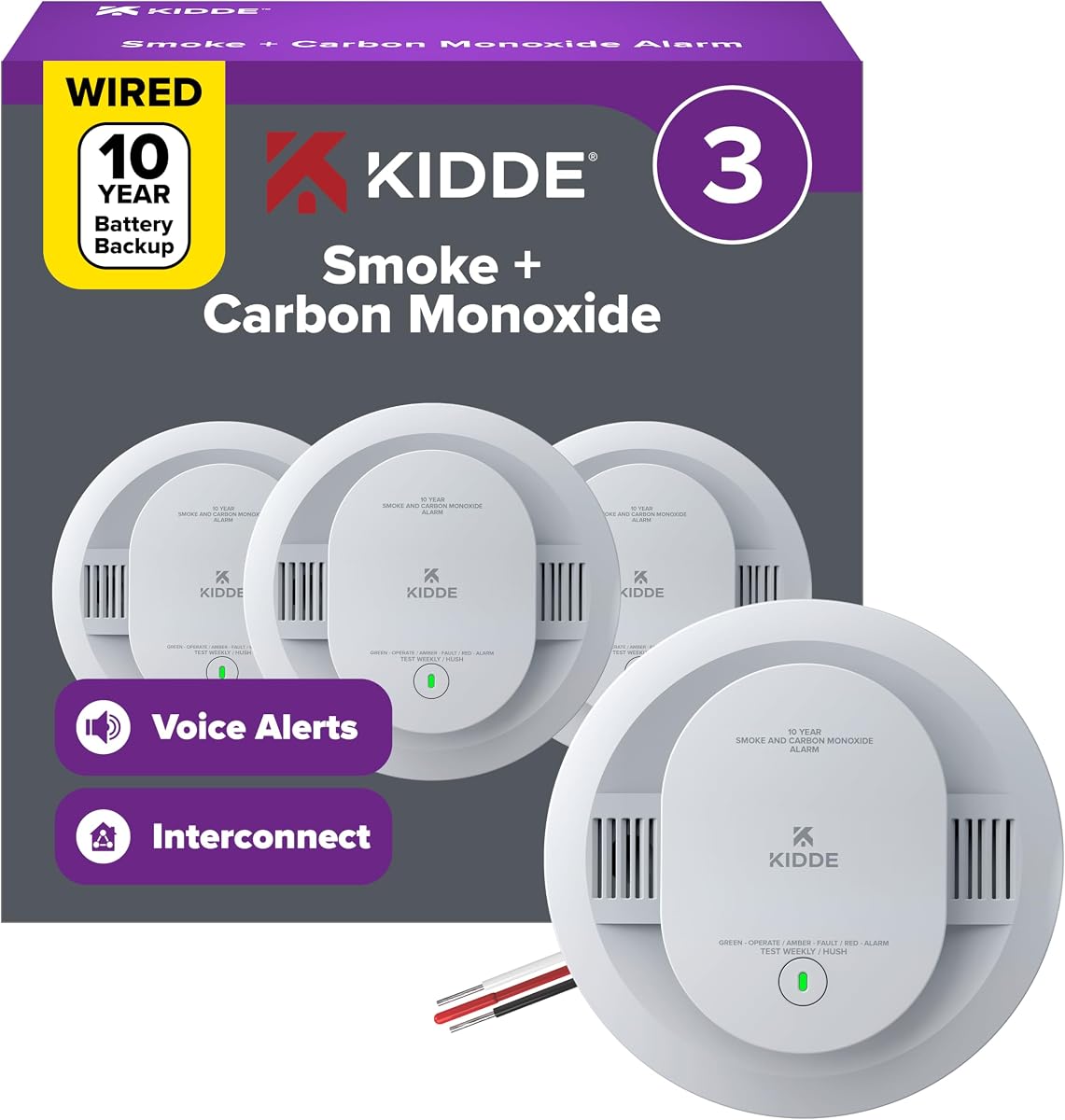
The Kidde 30CUA10-V 3-Pack is a strong choice for homes that want smoke and carbon monoxide monitoring in the same hardwired devices. Its 4.2 rating is supported by a long-life battery, spoken hazard alerts, interconnection, and compliance-focused testing for both smoke and CO performance.
We may earn a commission when you buy through this link, at no additional cost to you.
The voice system distinguishes the hazard by announcing “Fire” when smoke is detected and “Warning, Carbon Monoxide” when CO is present. That specificity can help occupants begin the appropriate response without interpreting a generic warning. The alarm also uses an 85-decibel sound and red LED for immediate visual and audible notification.
The built-in ten-year battery minimizes maintenance, while the three-unit package supports broader placement. Interconnection allows compatible alarms to sound together. Buyers should consider that combination units must be positioned according to local requirements, and CO alarms have placement rules that differ from those for smoke detection.
This multipack is ideal for households seeking combined protection, clear spoken warnings, and fewer battery replacements. It is especially compelling when a three-location plan is already known, although local code and the intended locations of the units should be evaluated before installation.
Spoken hazard messages remove much of the guesswork from a generic alarm. Identifying smoke or CO first can help occupants begin evacuation or ventilation procedures more quickly.
Each alarm combines hardwired power with a ten-year built-in battery, extending protection during outages without the recurring battery changes required by removable-cell designs.
We may earn a commission when you buy through this link, at no additional cost to you.
The X-Sense SC07 is included to broaden the comparison because it is a strong smoke and CO combination alarm, but it is not a hardwired model. It uses a sealed ten-year lithium battery, has a 4.5 rating, and is explicitly described as a basic standalone unit without wireless interconnection, Wi-Fi, or base-station support.
We may earn a commission when you buy through this link, at no additional cost to you.
Its photoelectric smoke sensor is designed to respond to slow-smoldering fires and help reduce cooking-related false alarms. An electrochemical CO sensor adds protection against dangerous carbon monoxide. The unit can be mounted on a wall or ceiling using the included bracket, screws, and anchor plugs, with no rewiring required.
The decisive drawback is category mismatch. Buyers searching specifically for hardwired detectors need an electrical connection and a design intended to join a wired network. The SC07 does not provide that, and it also cannot be expanded through the wireless options offered by other X-Sense models.
Choose the SC07 when a standalone, low-maintenance combination alarm is more important than hardwiring. It is a good renter-friendly or retrofit option, but it should not be selected as a substitute for a true hardwired alarm in a home that requires a connected system.
The sealed lithium battery and no-rewiring installation make the SC07 appealing where electrical work is undesirable. Its standalone design is straightforward, though it cannot provide the same network-wide warning as interconnected hardwired units.
Photoelectric smoke sensing and electrochemical CO detection cover two distinct hazards in one device. UL 217 and UL 2034 certification are noted in the supplied product information.
We may earn a commission when you buy through this link, at no additional cost to you.
The X-Sense XP0H-SN is a feature-rich standalone combination alarm with a 4.6 rating. Although it is not hardwired, it deserves consideration for renters and homeowners seeking simple installation because it combines smoke and CO sensors, a ten-year sealed lithium battery, an automatic self-test, and an easy-to-read LCD.
We may earn a commission when you buy through this link, at no additional cost to you.
The display shows real-time CO levels and battery status while remaining dark during normal standby. It lights during an alarm or test, which helps preserve the uncluttered appearance of a wall or ceiling. The built-in self-test checks the sensors, electronics, and battery every 60 seconds, offering continuous internal reassurance.
Its extra-large 5.7-inch mounting bracket can conceal old screw holes and ceiling marks left by earlier alarms. Buyers should check whether their existing device fits within the bracket dimensions. As with the SC07, this model does not support wireless interconnection, Wi-Fi, or a base station, and it does not meet the hardwired requirement of this guide.
The XP0H-SN is best for a standalone location where visible CO and battery information are priorities. It is not the correct choice for a required hardwired network, but it offers a polished and informative alternative for flexible installation.
The LCD remains off during standby and illuminates when information matters. This creates a useful balance between accessible CO and battery readings and an unobtrusive daily appearance.
The large mounting bracket can cover the marks left by many previous alarms. It is a thoughtful option for replacing an older unit without immediately patching the wall or ceiling.
We may earn a commission when you buy through this link, at no additional cost to you.
The First Alert Hardwire Combination Smoke & Carbon Monoxide Alarm is a polished option for buyers who want both hazard types in a hardwired unit. It has a 4.4 rating, Precision Detection sensing, battery backup, and compatibility with most First Alert and BRK alarms for interconnected early warning.
We may earn a commission when you buy through this link, at no additional cost to you.
Its mounting system deserves attention. The perfect-mount bracket secures the alarm while allowing a wide rotation range, making alignment easier during installation. A latching visual indicator identifies the initiating unit or a low-battery warning, providing useful diagnostic information after an event.
The exact backup-battery type and service life are not specified in the supplied data, so buyers should confirm both before installation. It is also important to follow separate placement guidance for smoke and CO alarms. A combination unit is convenient, but it does not automatically satisfy every location requirement in every jurisdiction.
This model is a strong premium-style choice for a compatible First Alert or BRK household, particularly when a secure bracket and visible source identification are priorities. It is well suited to interconnected installation, but it should be selected only after confirming wiring, battery, and placement requirements.
The wide rotation range helps installers align the alarm correctly while the bracket holds it securely. This makes the unit useful in both new installations and replacement projects.
Interconnection with most compatible First Alert and BRK alarms creates a broader warning network. The combination sensors add CO coverage, although placement and code requirements still apply.
We may earn a commission when you buy through this link, at no additional cost to you.
The First Alert SMI105-AC 6-Pack ranks highest in the supplied ratings, earning a 4.7 and making it a leading choice for connected homes. It combines hardwired power with a ten-year battery backup, a six-unit pack, compatible-alarm interconnection, and an end-of-life warning.
We may earn a commission when you buy through this link, at no additional cost to you.
The long-life backup is the defining advantage. Unlike designs using replaceable AA or 9-volt cells, this model provides outage protection for ten years, reducing maintenance across all six units. When one connected alarm detects danger, compatible alarms sound together, while a visual indicator identifies the source unit.
Interconnection compatibility must be confirmed before installation, and the model is less appropriate for renters or locations without suitable wiring. The exact installation method and regional requirements should be checked. Even so, the package delivers a clear combination of long-term reliability, network-wide warning, and convenient whole-home scale.
This is an excellent pick for a new hardwired system, a major upgrade, or a property manager replacing several units at once. The end-of-life warning adds a useful layer of maintenance awareness, making the 10-year service period easier to manage responsibly.
The integrated ten-year battery keeps each unit operating during a power interruption without the regular replacement schedule required by removable-cell backups.
Six units provide a substantial starting point for whole-home protection. Compatible interconnection ensures that a detected hazard produces warnings beyond the room where it originated.
We may earn a commission when you buy through this link, at no additional cost to you.
The right hardwired smoke detector depends on the electrical system, battery-backup design, network compatibility, hazard coverage, and placement plan. Buyers should assess these factors together rather than focusing on a single headline specification.
A true hardwired alarm connects to a 120-volt AC household system and is intended to remain powered there during normal operation. Before choosing a model, confirm that the installation box has suitable wiring, that the circuit is correctly configured, and that the replacement or new unit matches the existing system. Some listings labeled as hardwire products include a battery solely for outage backup, while the X-Sense models in this comparison are entirely battery powered.
Choose a model only when the wiring method, voltage requirements, alarm box, and local electrical code all align. Do not assume a quick-connect plug eliminates the need for code-compliant electrical work or permits installation in an incompatible location.
Backup power determines what happens during an outage and how much maintenance the alarm requires. The listed hardwired options use replaceable 9-volt or AA batteries, built-in ten-year batteries, or a battery configuration whose exact format is not specified. Long-life integrated batteries reduce replacement work, while common removable cells may be easier for some owners to service.
Prioritize outage reliability and a maintenance schedule you can realistically follow. Check the battery type, replacement interval, test procedure, and end-of-life information before installation, and never assume all backup batteries provide the same service life.
A dedicated smoke alarm may suit a system whose primary goal is fire detection, while a combination smoke and CO unit adds carbon monoxide monitoring in one housing. Combination alarms are particularly useful in homes with fuel-burning appliances, attached garages, or other CO risk areas, but their placement requirements may differ from those for smoke-only devices.
Map the hazards present in the home and review local code before choosing. Do not substitute a combination unit for a required smoke alarm unless its listing, certification, and installation location satisfy the applicable rules. Separate CO and smoke devices may be required in some jurisdictions.
Interconnected alarms are designed to sound together when one unit detects a hazard, extending warning throughout the home. The First Alert and Kidde options in the list provide interconnection features, but compatibility is model-specific. The SMI100-AC supports a stated network of up to 18 units, while other products describe compatibility with a broader or brand-specific group of alarms.
Check every existing and planned alarm against the manufacturer’s compatibility instructions. Mixed brands or mixed generations may not interconnect even when each product uses similar wiring. A connected system is only as useful as its compatibility, installation quality, and regular testing.
Sensing technology affects warning speed and the likelihood of unwanted cooking or steam alerts. First Alert Precision Detection and the Kidde models are described as reducing nuisance alarms while maintaining rapid smoke response. The X-Sense XP0H-SN adds an LCD for CO and battery information, while the Kidde 30CUA10-V announces the detected hazard through voice prompts.
Choose features that support the installation environment and household needs. A display can be helpful in occupied rooms, and voice alerts may reduce ambiguity, but the fundamental priorities remain reliable detection, a sufficiently loud alarm, visible warning, and straightforward maintenance.
Some products include features that make installation easier, such as the First Alert Quick Connect Plug, open mounting design, and rotating bracket. These are useful for straightforward replacements, but they do not remove the need to verify wiring, power, mounting position, and code requirements. A plan should identify every intended location before ordering a multipack.
Follow the manufacturer’s placement instructions and local rules for smoke and CO alarms. Avoid placing a unit in an unsuitable location, and never assume that one alarm satisfies an entire floor or home. Hardwired work may require a qualified electrician depending on the property and local regulations.
A smoke detector’s useful life depends on testing, cleaning, battery attention, and replacement at the appropriate time. The SMI105-AC includes an end-of-life warning, while other models emphasize longer warranties or standard maintenance practices. Review the entire instructions and warranty because the supplied listing may not describe every service detail.
Choose an alarm you can maintain consistently. Record installation dates, test on a schedule, keep replacement batteries available when applicable, and replace the entire unit when its service life ends. Reliability comes from the complete system, not only the model selected.
Before installation, read the complete manufacturer’s manual, identify the unit’s power source and backup configuration, and confirm that existing wiring and alarm boxes are compatible. If the installation is not straightforward, use a qualified electrician. Interconnected alarms should be configured according to the instructions for every unit involved rather than linked one at a time by guesswork.
Test the alarms regularly using the manufacturer’s test or silence control, and involve occupants so they recognize the warning pattern. Test every interconnected unit, not just the alarm nearest you. Replace removable backup batteries as directed, clean vents gently, and avoid blocking any part of the detector with decorations, dust, paint, or stored items.
After an alarm sounds, treat the event seriously even if the cause appears to be cooking. Silence the network only after the danger has been investigated and the air is clear. Replace a unit when it reaches its end-of-life date, becomes damaged, or produces a malfunction or low-battery signal. Keep the model number and installation date for future replacements.
Hardwired detectors can provide dependable primary power and are often well suited to interconnected systems, while battery-powered models are easier to install in some locations. The better choice depends on the existing wiring, maintenance preferences, local code, and whether the system must communicate across multiple alarms. No single type is ideal for every home.
Yes, many hardwired smoke alarms use a backup battery so they can continue warning occupants during a power interruption. The listed products use several backup approaches, including replaceable 9-volt, replaceable AA, and built-in ten-year batteries. Check the exact model instructions because backup type and replacement requirements differ.
Some replacements are straightforward for homeowners with electrical experience, particularly when the new unit is compatible with existing wiring and uses an approved quick-connect arrangement. Other installations require opening boxes, handling wiring, troubleshooting circuits, or meeting local electrical and fire-code requirements. When in doubt, hire a qualified electrician.
Not necessarily. Interconnection depends on manufacturer compatibility, wiring method, signaling requirements, and the specific model involved. Products that mention compatibility with other alarms may still be limited to certain brands or series. Verify the official compatibility list before combining units or replacing part of an existing network.
The required number depends on the home’s layout, floor levels, sleeping areas, basements, hazards, and local fire code. A multipack may be convenient, but the unit count should follow a placement plan rather than a package size. Check current local requirements and the manufacturer’s instructions for each alarm location.
Not always. A combination unit performs both functions, but placement rules can differ between smoke and carbon monoxide detection. Some locations may require a dedicated smoke alarm, a separate CO alarm, or both. Review local code and the product’s installation instructions before substituting a combination device.
Test units regularly and follow the manufacturer’s recommended schedule and procedure. Interconnected systems should be tested through the network so occupants can hear the warning from multiple locations. Testing confirms that the alarm, interconnection, and power arrangement function, but it does not replace cleaning, battery service, or eventual replacement.
An alarm may briefly sound when primary AC power returns or when the system detects an interruption or restart condition. Persistent or repeated chirping can indicate a low backup battery, an incompatible unit, an interconnection issue, or another fault. Check the instructions and source indicator, and consult a qualified electrician if the cause is unclear.
The First Alert SMI105-AC 6-Pack stands out for its 4.7 rating, ten-year backup, six-unit package, compatible interconnection, and end-of-life warning. The B0CJMN3443 is a focused budget pick for a single location or straightforward compatible installation, while the First Alert hardwire smoke and CO combination alarm provides a polished two-hazard option with a secure mounting bracket.
Prioritize electrical compatibility, backup-power design, interconnect support, and the correct sensor type for each location. A longer battery service life can reduce maintenance, but it does not eliminate testing, cleaning, code compliance, or eventual replacement. Avoid selecting solely on package size when a carefully mapped layout would serve the household better.
Check current product availability, manufacturer instructions, local fire and electrical codes, and current prices before ordering. Prices and promotions can change, and installation complexity varies by property. The right hardwired smoke detector is the one that fits the electrical system, covers the required hazards, and can be maintained safely for years.