
B006 15W Wireless Voice System
4.4Editor score
98-foot wireless transmission
15W high-output speaker
One-touch microphone mute
Our microphones for teachers guide compares ten portable and wireless systems for classroom power, wireless range, battery life, comfort, and audio features.
A classroom microphone can transform a lesson by making a teacher's voice easier to hear without forcing anyone to speak louder than is comfortable. The right system should provide clear amplification, dependable wireless performance, comfortable placement, enough battery life for a full day, and controls that remain simple during a busy lesson.
This guide compares ten microphones for teachers using the specifications and customer ratings provided for each product. It covers portable wired amplifiers, wireless headset systems, clip-on lavalier microphones, and compact speaker units, with particular attention to output, range, runtime, sizing, connectivity, and classroom practicality.
Each selection reveals which environments and teaching styles it best suits, along with meaningful trade-offs to consider before buying. Product details and ratings can change over time, and current availability, included accessories, manufacturer updates, and retailer terms should be verified before making a final purchasing decision.
4.4Editor score

4.4Editor score

4.3Editor score
The table below compares all ten systems by their core design, output, wireless capability, battery configuration, and intended teaching environment.




The ZOWEETEK Voice Amplifier for Teachers Original Portable Wired Microphone combines a compact 10-watt speaker with a wired microphone and a 4.4 customer rating. Its most useful qualities are straightforward operation, a compact 4.1 by 1.4 by 3.4-inch body, and the freedom to wear the unit on a belt, pocket, waist, or neck. For a teacher who wants reliable voice projection without dealing with wireless pairing, that combination remains compelling.
We may earn a commission when you buy through this link, at no additional cost to you.
The supplied information states that the amplifier can cover about 10,000 square feet and operate for up to 12 hours when used for voice amplification. It also supports TF card playback, USB flash-drive playback, and a 3.5mm AUX input. The adjustable microphone distance allows the user to control how closely the mic is held, while the ABS construction is described as durable and wear-resistant.
Its main compromise is the wired microphone. There is no wireless range to manage, but the cable can limit movement around desks, student tables, or a gym. The stated room coverage also describes the maximum potential of the system rather than a guarantee of equally clear sound in every acoustic environment, so teachers should judge the output against their own room size and noise level.
This amplifier is well suited to conventional classrooms, small offices, training sessions, presentations, and situations where predictable wired operation matters more than cable-free movement. It offers an unusually balanced set of output, runtime, playback features, and portability for a compact teacher-focused device.
The back clip, waistbelt, and neck-carrying options let teachers position the amplifier according to clothing and lesson requirements. That flexibility is useful when switching between lecturing, circulating, and presenting at the front of a room.
TF card, USB flash-drive, and 3.5mm AUX support make the unit more than a voice-only tool. Teachers can use compatible stored audio or connected media sources, subject to the product's operating controls and available connections.
We may earn a commission when you buy through this link, at no additional cost to you.
The ZOWEETEK Portable Rechargeable Mini Voice Amplifier for Teachers shares the appeal of compact construction and substantial voice output with the original ZOWEETEK model, but its wired headworn microphone is better suited to teachers who prefer a headset-style presentation. It holds a 4.4 rating and is described as producing clear, crisp sound without the noise or distortion cited in less capable portable systems.
We may earn a commission when you buy through this link, at no additional cost to you.
Its 10-watt maximum output is stated to cover approximately 10,000 square feet, while the 1800mAh battery provides up to 12 hours of continuous voice amplification. Charging takes approximately three to five hours. The microphone boom is adjustable, allowing the user to alter its distance from the mouth, and the body can be clipped to a belt or pocket or carried with the supplied waistbelt or neck arrangement.
The wired connection is the main limitation. It removes concerns about pairing, radio interference, and wireless dropouts, but it also means the teacher must account for the cable when moving around the room. The advertised coverage is also a maximum-use description, and real intelligibility depends on room acoustics, student noise, and the position of the speaker.
This is a sensible option for regular classroom instruction, seminars, coaching, tours, and presentations where a comfortable headset and compact amplifier matter. It offers much of the convenience of a wireless system without adding radio setup, but users who routinely roam should give greater consideration to one of the wireless lavalier alternatives.
The adjustable headworn microphone lets the user control mouth distance, an important detail for clarity and natural delivery. Its lightweight amplifier can then remain clipped to clothing or carried around the neck or waist.
With up to 12 hours of stated voice runtime and a relatively short full-charge period, the system is designed for repeated classroom use. Actual runtime may vary with output level, media use, and operating conditions.
We may earn a commission when you buy through this link, at no additional cost to you.
The WinBridge Wireless Voice Amplifier with Clip-On Lapel Mic for Teachers is the strongest all-around choice in this roundup because it combines genuine wireless movement with a discreet microphone, straightforward controls, and a 4.4 customer rating. The 15-watt speaker is aimed at small and medium classrooms, while the 0.64-ounce lavalier avoids the weight and pressure associated with many headset microphones.
We may earn a commission when you buy through this link, at no additional cost to you.
The system is designed for teachers who write at a whiteboard, move between student groups, or teach gym and other active lessons. The microphone may be clipped to a collar, held in hand, or used with the included strap. Automatic pairing reduces setup time, and both the amplifier and microphone feature mute buttons. A 2600mAh speaker battery is rated for 12 to 15 hours of voice amplification, while the 3000mAh microphone battery is rated for more than 10 hours.
Bluetooth playback adds flexibility for background music and other compatible audio, and the auto power-down feature helps conserve energy when the system is not in use. As with any radio-based setup, performance can be affected by interference, obstacles, and distance, although the product is intended for close-to-medium classroom use. Teachers should also maintain sensible microphone-to-speaker separation to reduce feedback.
This is an excellent recommendation for teachers seeking a balance of clear output, unrestricted movement, simple operation, and all-day practicality. The separate speaker and mic batteries require planning, but the overall design directly addresses the common frustrations of classroom amplification.
The lavalier design is particularly useful for active lessons because it does not press on the ear or interfere with glasses. Teachers can write, gesture, and walk around while maintaining a consistent speaking position.
Automatic pairing and one-touch mute controls reduce the learning curve. The speaker's auto power-down feature also helps preserve charge between classes, making the system easier to manage in a daily teaching routine.
We may earn a commission when you buy through this link, at no additional cost to you.
The B006 15W Voice Amplifier with Bluetooth and Wireless Lavalier Microphone is the premium choice for educators who need more wireless freedom than a standard classroom microphone provides. Its 4.4 rating is supported by a high-output 15-watt speaker, a sensitive wireless lavalier, and a stated 2.4GHz transmission range of at least 98 feet in open areas.
We may earn a commission when you buy through this link, at no additional cost to you.
The clip-on microphone keeps both hands available and avoids the pressure of a headset. Its one-touch mute button lets a teacher silence voice amplification without walking back to the speaker, which is useful during side conversations or brief interruptions. The speaker can also play Bluetooth audio at the same time as the amplified voice, supporting classroom sound and media workflows.
Battery life differs between the two components. The wireless microphone is listed at up to 15 hours, while the speaker is listed at up to 7 hours under specific testing conditions. That difference is worth considering for full-day schedules, especially if music playback, high volume, or extended use drains the speaker more quickly. The 98-foot range is an open-area specification, so walls and other obstructions may reduce practical distance.
The B006 is best for large classrooms, campuses, training facilities, tours, meetings, and outdoor instruction where range and mobility are priorities. Teachers seeking a premium wireless system with strong output, convenient muting, and simultaneous media playback will find this a well-rounded option.
The stated 98-foot range gives teachers more freedom to move through a classroom, training room, or outdoor lesson area. Open environments offer the best conditions, so users should test coverage in their usual teaching location.
The lavalier's integrated mute control can immediately pause amplified speech from the speaking position. That saves a walk to the speaker and makes the system more convenient for interruptions and private exchanges.
We may earn a commission when you buy through this link, at no additional cost to you.
The 2200mAh Portable Voice Amplifier for Teachers delivers a useful combination of long battery life, compact sizing, and an adjustable wired headset. Its 4.3 rating reflects a generally positive customer reception, while the stated ability to cover a room of approximately 25 to 50 people makes it relevant for small classes, training groups, offices, and presentations.
We may earn a commission when you buy through this link, at no additional cost to you.
The amplifier provides up to 8 watts of output, supports TF card and USB flash-drive playback, and includes a 3.5mm connection. Its 2200mAh battery is rated for up to 20 hours of voice amplification and 13 hours of music playback after a stated four-to-six-hour charge. The microphone uses an adjustable gooseneck and band, while the main unit includes a rear clip for a belt or waistband.
Compared with the 15-watt wireless options, this system offers less maximum output and no radio-based movement. Its advantage is the combination of long stated runtime, flexible media support, and a low-profile form factor. The manufacturer also recommends charging before first use and maintaining distance between the speaker and microphone to reduce unwanted noise.
This is the best budget-oriented pick for teachers who want dependable voice support without a complex wireless arrangement. It is particularly well suited to small classrooms and lessons in which the teacher remains near the front of the room or carries the lightweight unit in a pocket or at the waist.
The stated 20-hour voice runtime is among the longer figures in the comparison. Teachers can use it across multiple classes, although actual performance will depend on volume, media playback, and battery condition.
With up to 8 watts of output and a stated capacity of roughly 25 to 50 people, this model is most appropriate for smaller teaching groups. It can also serve outdoor instruction and training sessions when the environment is not excessively noisy.
We may earn a commission when you buy through this link, at no additional cost to you.
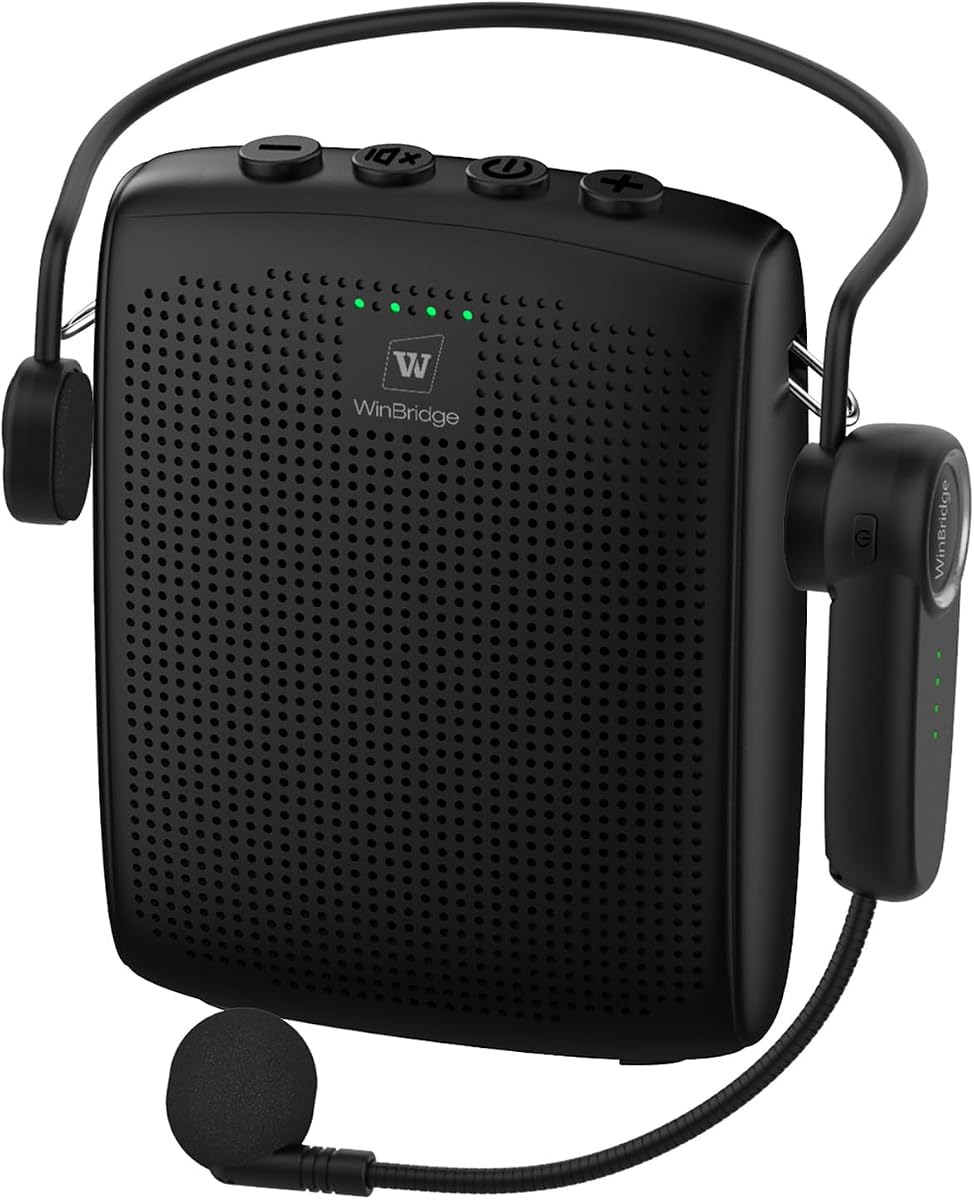
The WinBridge WB002 Bluetooth Voice Amplifier stands out because its wireless headset can be used in multiple ways. It can function as a headset, be held as a handheld microphone, clip to the belt, or hang from the supplied neck strap. That versatility makes it appealing to teachers, presenters, coaches, and anyone who moves between formal instruction and informal speaking roles.
We may earn a commission when you buy through this link, at no additional cost to you.
The speaker has a 15-watt output and is stated to cover approximately 10,000 square feet indoors. Automatic pairing is intended to make setup straightforward. A 2600mAh speaker battery provides up to 12 to 15 hours of use, while the headset microphone is listed at 8 to 10 hours. Both components use the included Type-C charging cable for convenient charging.
The 8-to-10-hour microphone runtime is shorter than the battery figures available on several lavalier systems. Teachers with uninterrupted multi-period schedules may need to recharge the microphone during a planning break. Bluetooth also adds a connection method that some users find less direct than a dedicated radio link, although the product description emphasizes automatic headset pairing.
The WB002 is a good fit for classrooms, training sessions, presentations, and mobile speaking jobs where a headset is preferred. It offers a strong combination of output, multiple wearing methods, automatic setup, and after-sales support, making it a practical alternative to lavalier-only systems.
The detachable headset can be worn securely or handled as a handheld microphone. This makes the same system adaptable to lectures, demonstrations, group activities, and presentations where the speaking position changes frequently.
Turning on the two components initiates automatic pairing according to the product description. That reduces setup friction for teachers who may need to move the system between classrooms without technical support.
We may earn a commission when you buy through this link, at no additional cost to you.
The A006 Voice Amplifier with Wireless Lapel Microphone combines a 15-watt speaker with an exceptionally light 0.6-ounce lavalier and a 4.4 rating. The amplifier weighs 7.05 ounces and measures small enough for pocket or bag storage, making this a discreet option for teachers who want clear projection without a visible headset.
We may earn a commission when you buy through this link, at no additional cost to you.
The stated wireless range is up to 15 meters, or 49 feet, giving users practical freedom to move around a standard classroom. Automatic connection is designed to happen within seconds after both units are switched on. The lapel microphone includes a one-touch mute function, while the speaker provides straightforward volume and setting controls.
The amplifier is rated for 12 to 15 hours of use, and the microphone can run for up to 15 hours, with runtime varying by volume. A dual charging cable allows both units to be charged together. Bluetooth 5.0 and USB playback provide additional audio functions, and the supplied description says voice amplification and Bluetooth playback can operate simultaneously.
This model is a strong recommendation for teachers seeking a light, professional-looking lavalier and a full-size amplification output without a long-range requirement. It suits classrooms, studios, yoga instruction, tours, and public speaking where 49 feet of movement is sufficient.
The lavalier's low weight and compact form make it less noticeable than a headset. The amplifier can be clipped to a belt or carried with a strap, preserving a professional appearance during lessons and presentations.
Bluetooth 5.0 and USB playback allow the speaker to handle more than live voice amplification. Simultaneous voice and Bluetooth operation is particularly useful for teachers who want to accompany lessons with compatible background media.
We may earn a commission when you buy through this link, at no additional cost to you.
The Skin Tone Wireless Lavalier Voice Amplifier offers a compact 10-watt system with a discreet 20-gram microphone and a 3.7 customer rating. That rating is the lowest among the products in this guide, so it deserves careful consideration, but the system's core specifications make it relevant for teachers who prioritize small size and a visually unobtrusive microphone.
We may earn a commission when you buy through this link, at no additional cost to you.
The speaker and lavalier connect automatically after both are powered on, avoiding manual Bluetooth pairing steps for the microphone link. Its 10-watt output is intended for lectures, presentations, and gatherings, while the stated 15-meter wireless range allows the speaker to remain on a desk as the teacher moves around the room.
The main limitation is endurance. The microphone's 120mAh rechargeable battery is listed at more than seven hours of continuous use, and the 1800mAh speaker is rated for 8 to 12 hours. These figures can cover a substantial portion of a teaching day, but a teacher with a tightly packed schedule may need a top-up during the day. The lower rating also warrants checking recent customer feedback and warranty terms before purchase.
This system is best for small classrooms, meetings, presentations, and settings where appearance and compactness matter. It may be less attractive for teachers who need all-day microphone endurance, exceptionally broad room coverage, or the strongest wireless range.
At 20 grams, the lavalier is designed to disappear under a collar or tie. That makes the system suitable for teachers who prefer a professional appearance and do not want to wear a headset throughout the day.
The stated 49-foot wireless range allows the compact speaker to remain on a desk while the teacher circulates. Keeping the microphone and speaker well apart can also help reduce feedback and sharp reflected sound.
We may earn a commission when you buy through this link, at no additional cost to you.
The SHIDU 35W Voice Amplifier for Teachers is the clear high-output option in this comparison, with a 4.0 customer rating and a maximum speaker output of 35 watts. The supplied information says it can cover approximately 22,604 square feet and suit a gathering of as many as 320 people, making it relevant to large instructional venues.
We may earn a commission when you buy through this link, at no additional cost to you.
Its 2.4GHz wireless microphone is stated to maintain a connection over 40 meters, or 131 feet, while the speaker supports Bluetooth 5.3 music playback. The lightweight lavalier can be clipped to a collar or held by hand, avoiding the discomfort associated with a headset. A 3100mAh battery is rated for up to 16.5 hours of use after a stated two-to-four-hour charge.
More power is not automatically better in every room. Teachers should adjust the volume to suit the space and avoid pointing the microphone directly at the speaker. The manufacturer warns that a microphone placed too close to the speaker can create sharp, strange sounds caused by acoustic feedback. Walls, crowds, and room dimensions can also affect practical coverage.
The SHIDU is best for large lecture halls, auditoriums, gymnasiums, conferences, outdoor assemblies, and other high-noise environments where the other systems may be challenged. It is less compelling for a small office or quiet classroom where a lower-output device would be more appropriate.
The 35-watt output is the key differentiator, offering substantial headroom for large rooms and noisy audiences. Teachers should still begin with a moderate level and increase it according to feedback and room acoustics.
A stated 131-foot range and 16.5-hour runtime support larger venues and extended sessions. The 3100mAh battery and included Type-C charging method simplify routine power management.
We may earn a commission when you buy through this link, at no additional cost to you.
The Tearstone Voice Amplifier for Teachers with Bluetooth and Dual Magnetic Mics has a 4.1 customer rating and a useful integrated storage design. The microphone attaches magnetically to the back of the amplifier, which also serves as its charging dock. This makes the two components easier to keep together between lessons and reduces the chance of leaving the mic behind.
We may earn a commission when you buy through this link, at no additional cost to you.
Its 2600mAh battery provides a stated total runtime of up to 15 hours. The product includes a two-in-one power and volume wheel, automatic pairing, Bluetooth and USB modes, and a clear battery-level display. The speaker can be clipped to a belt, worn crossbody, or tied around the waist with the adjustable strap.
Audio features include a 270-degree omnidirectional microphone, a 76mm horn, and a DSP noise-reduction chip intended to reduce distortion, feedback, and whistling. The stated effective transmission covers 10,000 square feet. Teachers should still keep the microphone away from the speaker and avoid aiming it directly at the amplifier, since feedback can still occur at high levels.
The Tearstone is best for teachers who travel between classrooms or teaching locations and want a compact system that stores and charges as one unit. It combines wireless freedom, media connectivity, and a practical battery indicator, though users should follow the included magnetic attachment instructions carefully.
The magnetic back attachment keeps the microphone close to the amplifier and charges it in place. Teachers can detach the microphone for speaking and return it to the unit when finished, making transport between classes more organized.
A clear battery-level display helps teachers judge whether the system is ready for another class. The stated charging periods are three to five hours for the speaker and two to four hours for the microphone.
We may earn a commission when you buy through this link, at no additional cost to you.
The most useful classroom microphone balances adequate output with the coverage, wearing style, battery life, and controls that fit a teacher's daily routine. The following factors help narrow the field before choosing a wired, wireless, or headset-based system.
Start with the size of the teaching space, the number of students, and the amount of ambient noise. The products in this guide range from 8 watts to 35 watts, with stated capacities ranging from small groups of roughly 25 to 50 people to much larger gatherings. Higher output can provide useful headroom in noisy rooms, gymnasiums, auditoriums, and outdoor lessons, but excessive power in a small room can create echo, feedback, or an unpleasant sense of excessive volume. A teacher with 20 to 30 students in a conventional classroom may not need the highest-output model, while a coach instructing a full gymnasium may benefit from it.
Choose output that comfortably fills your usual environment without being forced to operate at maximum level. Also consider whether the speaker will sit on a desk, be worn on a belt, or be placed farther from the audience.
Wired microphones are dependable, easy to connect, and free of radio pairing concerns, but the cable can restrict movement and become caught on desks or classroom equipment. Wireless systems remove that restriction and are usually better for active teachers who write on whiteboards, walk between groups, or teach moving exercises. They require charging both components, managing a radio connection, and understanding that walls, large crowds, and competing radio signals may affect range. A teacher who remains at a lectern may find a wired system more than adequate, while a facilitator who circulates throughout a room will probably appreciate a wireless lavalier.
Prioritize wireless freedom if movement is central to your job. Choose wired simplicity if dependable cable operation and lower component complexity matter more.
Headset microphones keep the microphone near the mouth and can be convenient for demonstrations, but some users find headbands, earpieces, and boom arms uncomfortable over long periods. Lavalier microphones clip to a collar or tie, look more professional, and leave the ears completely free. Their placement may vary if a teacher moves a lot, so testing the clip and considering the 270-degree pickup of the Tearstone model can be useful. Adjustable gooseneck microphones provide more precise mouth positioning than a fixed clip. The best choice is the style you can wear consistently and adjust quickly without distracting students.
Try the included wearing options if possible. A comfortable microphone is more likely to be used properly and kept in the correct speaking position.
Range is the maximum distance over which the microphone and speaker can remain connected, but the useful range depends on the transmission technology, room layout, obstacles, and interference. The listed systems range from about 49 feet to 131 feet, with some specifying open-area performance. Standard classrooms usually require less distance than a teacher may think because the speaker can remain near the front while the microphone moves among the students. Larger gyms, outdoor fields, multi-room training programs, and campuses benefit from longer stated range. Treat maximum range as an upper limit rather than a guarantee and test the setup in the actual teaching environment.
Match stated range to your normal movement pattern, then leave some margin. Avoid positioning the speaker and microphone in ways that create feedback.
Battery life should cover a full teaching schedule without forcing a mid-day recharge. Stated voice runtimes range from more than seven hours to approximately 20 hours, although the speaker and microphone often have different endurance in wireless systems. A long speaker runtime is less useful if the microphone cannot complete the same period. Some units charge through a dual cable, while the Tearstone stores and charges its magnetic microphone on the speaker. Teachers should also examine the stated full-charge time and whether a spare charging setup is available at school or home.
Prioritize sufficient runtime for your longest day, then choose a charging method that is easy to remember. Lower output and limited media use may extend actual performance beyond conservative estimates.
A portable speaker should be easy to carry, store, and position where sound can reach the audience. The listed systems range from pocket-sized 7.05-ounce units to compact 10-watt and 15-watt models. Wearing options include belt clips, neck straps, waistbands, and crossbody straps. A desktop placement may be sufficient for a teacher who stays near the front, while belt or neck carry provides more consistent coverage while walking. Teachers should also consider the room's available surfaces, cable reach when using a wired model, and whether the speaker could obstruct student activities.
Choose a carrying method that suits your lesson style. A stable, elevated position can improve coverage, but mobility should not be sacrificed unnecessarily.
Many teachers use amplification alongside recorded audio, music, language exercises, or presentations from a phone or computer. TF card and USB flash-drive support appears in several wired systems, while newer wireless models commonly add Bluetooth. The WinBridge clip-on system, B006, A006, Skin Tone model, SHIDU, and Tearstone support Bluetooth playback according to their descriptions, with several allowing voice and media playback simultaneously. Check the required Bluetooth mode, device compatibility, and whether the microphone connection is separate from audio streaming. These features add value, but they are secondary to reliable voice amplification.
Prioritize simultaneous playback only if your lessons need it. Confirm that the connected device and media source are compatible before class.
Simple controls matter because a teacher should not need to navigate complex menus between periods. Automatic pairing, one-touch mute, dedicated volume controls, auto power-down, and visible battery indicators are all useful features in this comparison. Headset systems may be easier to position quickly, while lavalier microphones often include a mute control that prevents a teacher from interrupting amplification. Accessories such as clips, straps, charging cables, and storage docks should support the intended use rather than add clutter. Warranty coverage and after-sales support can also provide confidence, particularly for equipment used daily during an academic year.
Favor controls that work quickly with one hand. Confirm that replacement microphones, straps, and charging cables are available when needed.
Begin by fully charging the amplifier and microphone before the first lesson, then check the controls in a quiet room. Test voice clarity at a normal speaking volume and walk to the locations where you commonly teach. Wireless systems should be paired according to the supplied instructions, while wired models need their cables fully seated. Position the microphone consistently near the collar or mouth, and place the speaker on a stable surface or use its intended clip or strap.
Maintain sensible separation between the microphone and speaker. Positioning the mic too close to the amplifier or pointing it directly into the horn can produce feedback, whistling, or sharp reflected sounds. Increase the volume only as much as needed for the room, and use the microphone mute control for brief side conversations. When using Bluetooth or stored media, start with a low media level, connect the source before class, and test whether voice and playback can operate together.
Care for the system by cleaning the microphone head and speaker grille gently with a dry, soft material, avoiding moisture and harsh chemicals. Store wireless components together, and use the Tearstone system's magnetic dock as intended after removing any clothing clip. Charge batteries periodically rather than leaving them depleted for long periods, keep charging ports free of debris, and follow the manufacturer's guidance for storage, cleaning, and replacement parts.
A wireless lavalier system is often the most convenient for an active teacher because it provides clear amplification without a headset or trailing cable. A wired headset may be better for a stationary instructor who values dependable operation. The right choice depends on classroom size, noise, movement, and personal comfort.
They can be, but performance depends on the system, room layout, and interference environment. The listed products provide different stated ranges, from about 49 feet to 131 feet. Test the microphone in the actual room, keep the speaker away from the mic, and avoid placing radio equipment directly beside each other.
The right power depends on room size, student count, acoustics, and background noise. A smaller classroom may be served well by the listed 8-watt and 10-watt systems, while a gymnasium or auditorium may benefit from 15 watts or more. Choose enough headroom for intelligibility without running the speaker at an excessive level.
Many models support Bluetooth, USB flash drives, TF cards, or a 3.5mm AUX connection. Some wireless systems allow voice amplification and Bluetooth playback at the same time. Check the specific product's compatibility, controls, and supported file or connection methods before relying on media playback in a lesson.
Comfort depends on the wearer and the design. Some teachers dislike the pressure of a headband or boom, while others prefer a headset because it stays near the mouth. A lightweight lavalier can look more professional and leave the ears free, but it must be clipped securely and positioned consistently.
Keep the microphone and speaker separated, never point the microphone directly at the speaker, and reduce the volume if squealing begins. Proper positioning and a moderate level are more important than maximum output. Each system should also be tested before class in the exact arrangement used during teaching.
Ideally, the microphone and speaker should both last through the longest scheduled day without an unplanned recharge. The products in this guide state microphone runtimes ranging from more than seven to 15 hours and speaker runtimes of approximately 7 to 20 hours. Real endurance can vary with volume, Bluetooth use, and media playback.
Yes, as long as the device is portable, rechargeable, and appropriate for each room. Wireless systems are convenient for moving between spaces, while wired models require a reachable connection point. Carry the complete microphone and speaker together, and check the battery and wireless connection before the next class.
The WinBridge Wireless Clip-On System is the most balanced recommendation because it combines 15-watt output, a lightweight wireless lavalier, automatic pairing, mute controls, and long stated runtimes. The B006 15W Wireless System stands out for greater wireless reach, while the 2200mAh Portable Teacher Amplifier provides an efficient wired option for smaller rooms.
Prioritize the features that match your teaching environment rather than choosing solely by output. Active instructors benefit from a wireless lavalier, stationary teachers may prefer a wired headset, and large venues may need the SHIDU system's high output and extended range. Comfort, battery endurance, feedback control, and simple operation are just as important as raw speaker power.
Before making a final decision, verify the current product details, included accessories, battery claims, compatibility information, warranty terms, and retailer availability. Product features and ratings can change, so the latest listing and manufacturer guidance should guide the final purchase.