
MAXKOSKO 6ft Self Regulating Heat Tape
4.5Editor score
Compact six-foot heating cable
Five watts per foot output
CSA-certified electrical design
Supports three installation methods
Compare the best heat tape for water lines, including self-regulating cables, freeze protection, lengths, installation methods, and outdoor durability.
Heat tape for water lines helps protect exposed plumbing from freezing by adding controlled warmth along metal or plastic pipes. A useful cable should combine reliable cold-weather performance with safe electrical construction, suitable length, and a jacket capable of enduring outdoor conditions. The right installation also matters greatly.
This guide compares ten heating cables using the supplied specifications, customer ratings, available lengths, temperature claims, electrical features, pipe compatibility, and installation methods. It covers pre-assembled products for homeowners as well as a cut-to-length roll for professionals, without suggesting that every product is appropriate for every plumbing situation.
The selections show why short cables suit localized repairs, longer runs cover entire water lines, and cut-to-length systems offer greater routing flexibility. Ratings reflect the listed customer feedback, while product details and availability can change. Compare current listings and installation requirements before purchasing.
4.5Editor score

4.8Editor score

4.6Editor score
The comparison below highlights cable length, heating capacity, cold-weather claims, pipe compatibility, and installation considerations for all ten options.



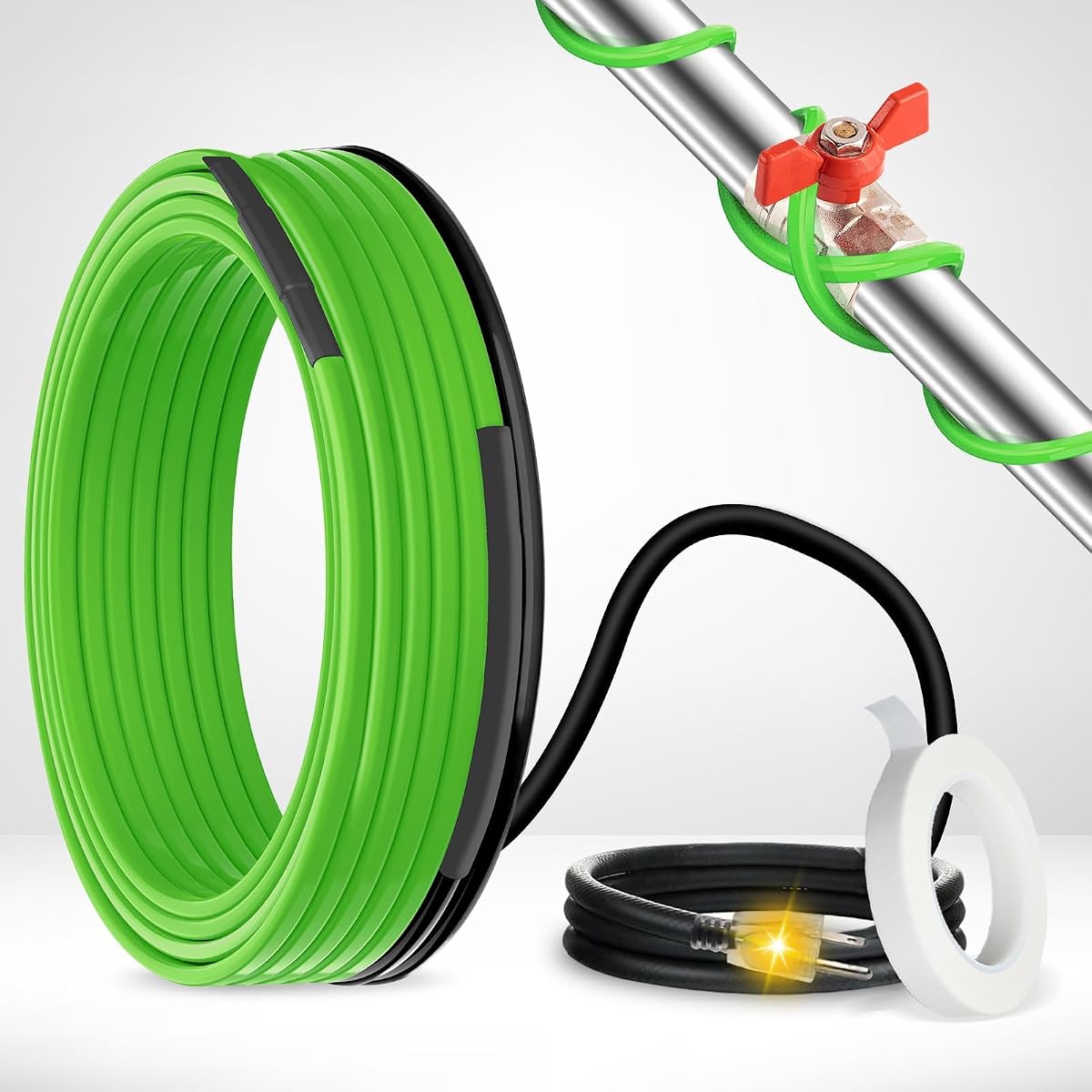
This 50-foot pipe heating cable is the most versatile option in the roundup, offering a balance of substantial coverage, outdoor-oriented construction, and several installation approaches. Its customer rating is 4.6, and the listed design includes a pure copper core, aluminum alloy shielding, and a weather-resistant TPE jacket.
We may earn a commission when you buy through this link, at no additional cost to you.
The cable produces 5 watts per foot and is described as maintaining water-filled pipes 10 to 15 degrees above ambient in severe cold. Its IP67 jacket and 70-percent aluminum shield coverage are meaningful advantages for exposed plumbing, particularly where moisture, UV exposure, and physical impact may be concerns. Compatible copper, PVC, PEX, and stainless steel pipes broaden its possible uses.
The main trade-off is that this is a permanently installed electrical heating system, not a temporary patch. It also carries explicit warnings against use on fuel lines and gutters because those applications lack the water load needed to control heat. Buyers should match the selected length to the actual pipe route and follow the manufacturer's instructions carefully.
This is a strong recommendation for homeowners or installers covering a meaningful outdoor run with copper or plastic water lines. Its range of lengths and robust construction make it especially useful when the installation must tolerate harsh weather while maintaining water flow.
The oxygen-free copper core supports even heat distribution, while the aluminum winding and TPE outer jacket add mechanical and environmental protection. These features are particularly relevant to exterior lines exposed to rain, sunlight, and winter temperature swings.
Straight tracing, spiral wrapping, and overlapping installation provide ways to follow pipe runs efficiently. Spiral placement can add surface contact, while overlap may improve coverage in especially vulnerable areas, provided the product instructions permit it.
We may earn a commission when you buy through this link, at no additional cost to you.
The Frost King HC6A is a compact automatic electric heat kit designed to keep water moving through pipes in temperatures down to -40 degrees Fahrenheit. It earns a 4.6 rating and offers a straightforward alternative for protecting a short vulnerable section rather than covering a long exterior line.
We may earn a commission when you buy through this link, at no additional cost to you.
Its six-foot heating cable operates at 120 volts and produces 7 watts per foot. The product is listed for both metal and plastic water pipes, giving it useful flexibility across common household plumbing materials. The automatic heating function is designed to reduce the need for constant manual adjustment when cold conditions threaten a line.
The obvious limitation is its six-foot length. That makes the HC6A most appropriate for a hose bib, short outdoor section, or isolated pipe area. It will not serve an extended run without multiple installations, and a higher output per foot should not be interpreted as a reason to place it on unsuitable applications.
Homeowners seeking a simple, compact kit for a limited section should consider the HC6A. Verify pipe length, electrical access, and local conditions before installation, and follow the enclosed guidance for safe operation.
The listed 7-watt-per-foot output gives this compact cable meaningful heating capacity for its size. That makes it a practical candidate for a short water-hose connection or another concentrated cold-weather risk.
Support for metal and plastic pipes means the same kit can suit different household plumbing arrangements. The still-needed task of measuring the vulnerable area remains essential.
We may earn a commission when you buy through this link, at no additional cost to you.
This 79.5-foot heat tape is built for extended water-pipe protection and carries a 4.6 customer rating. It combines a five-watt-per-foot output with a pure copper core, PVC inner sleeve, aluminum winding, and temperature-resistant TPE outer jacket for a layered cable construction.
We may earn a commission when you buy through this link, at no additional cost to you.
The product is described as capable of operating in weather down to -40 degrees Fahrenheit and maintaining pipes 10 to 15 degrees above ambient. A grounded five-foot plug with an indicator light provides useful feedback that the cable is powered. Compatibility extends to copper, PVC, and stainless steel pipes, while straight, spiral, and overlap placement accommodate different routes.
As with other fixed electric heating cables, installation quality determines how useful its capacity will be. The warnings against fuel lines and gutters are significant because improper applications can create overheating conditions. Buyers should also confirm that the chosen length includes the heating section rather than assuming the entire lead is heated.
This cable is a compelling option for a long exterior plumbing route that needs robust, weather-conscious construction. It combines useful power, broad material compatibility, and a generous range of length choices for residential, agricultural, or industrial-scale water lines.
The copper, PVC, aluminum, and TPE sequence creates several levels of protection around the heating element. The weather-resistant exterior is especially relevant to outdoor lines where sunlight and moisture are unavoidable.
The grounded plug and indicator light make it easier to confirm that the circuit is live. This is useful during installation checks, although it does not replace proper testing of the entire installation.
We may earn a commission when you buy through this link, at no additional cost to you.
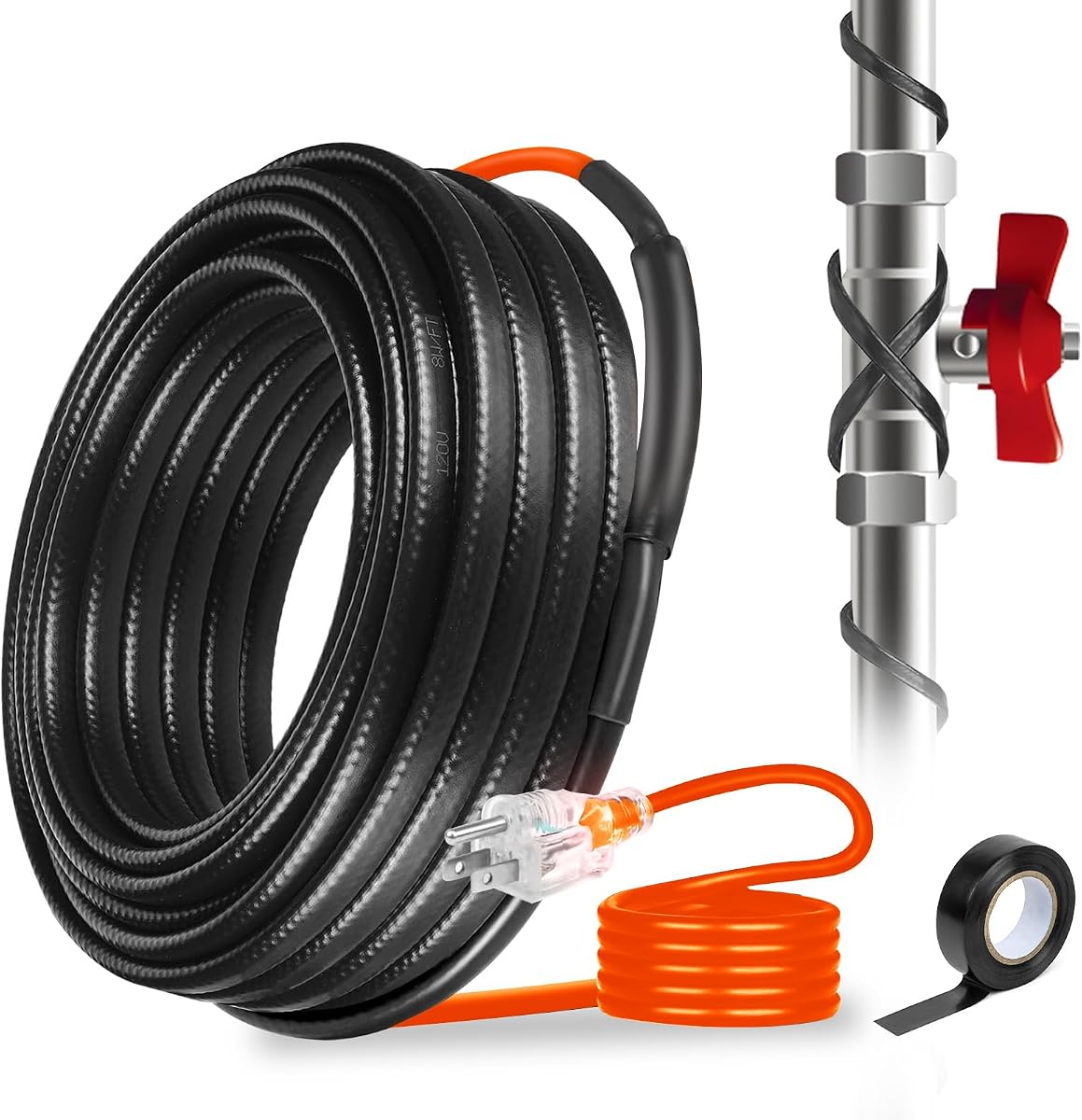
The 40-foot heat tape combines an 8-watt-per-foot heating output with an integrated temperature sensor. It has a 4.6 rating and is described as a pre-assembled solution for protecting water pipes, hoses, drain lines, downspouts, and storage tanks from freezing.
We may earn a commission when you buy through this link, at no additional cost to you.
Its controller activates the cable below approximately 41 degrees Fahrenheit and switches it off once the cable temperature rises above approximately 59 degrees. This automatic cycling is designed to increase warmth in colder conditions while reducing power after the cable reaches the stated operating temperature. The IP65 waterproof construction adds outdoor suitability.
The higher listed wattage requires attention to the size and thermal behavior of the pipe being protected. Buyers should not interpret the specifications as permission to use the cable on every drain application or on a fuel line. The product's listed uses are broad, but the manufacturer instructions and application limits should guide the final decision.
This option is well suited to a 40-foot run where automatic control and strong localized heat are priorities. It is particularly attractive for users who want a ready-to-install system with a sensor, rather than a manually managed heating arrangement.
The built-in sensor changes the operating state as temperatures move across the stated thresholds. This gives the cable a more automated character than a continuously energized design.
Pre-assembly makes the product approachable for DIY users, while the included three-foot power cord offers a defined connection point. Pipe measurement and safe routing remain important prerequisites.
We may earn a commission when you buy through this link, at no additional cost to you.
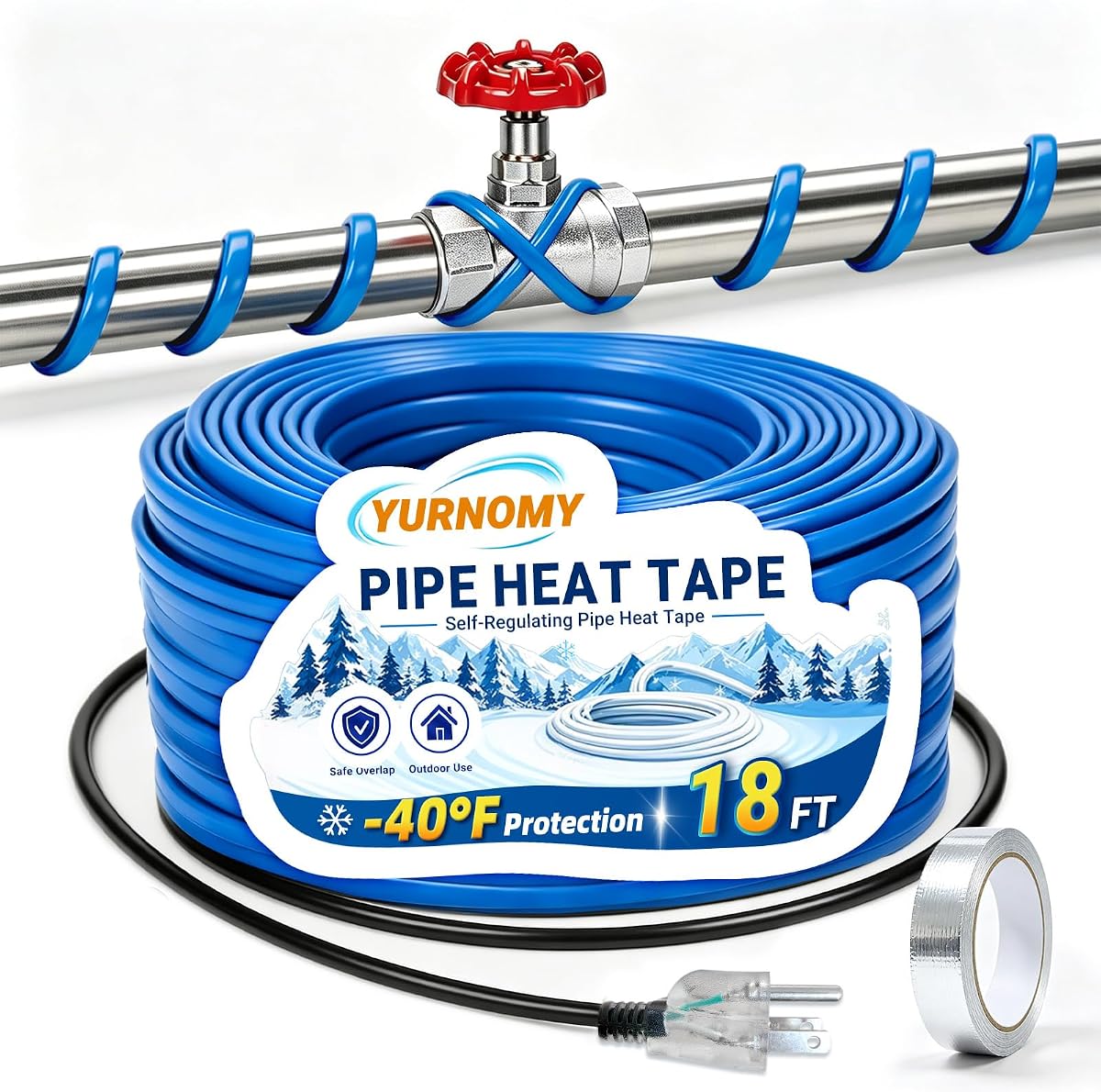
The YURNOMY 18-foot cable is a self-regulating option for water lines that must remain protected through changing outdoor temperatures. It has a 4.6 rating and uses a temperature-responsive core to adjust heat output rather than relying solely on a fixed on-or-off control.
We may earn a commission when you buy through this link, at no additional cost to you.
The stated cold-weather capability extends to -40 degrees Fahrenheit. Its UV-resistant TPE jacket is designed to withstand sunlight, moisture, and outdoor exposure, while compatibility with PVC, PEX, and metal pipes expands the range of suitable installations. Straight, spiral, and overlap methods offer practical routing choices.
The main limitation is its moderate 18-foot length, which may not cover a complete exterior run. Although the listing references several environments, including roof drainage and other piping applications, the core purpose remains freeze protection for water-carrying lines. Overlap is explicitly supported, but installation should still follow the supplied directions.
Choose this cable for a medium-length plumbing section that benefits from automatic heat adjustment. It is a particularly useful option where UV resistance and flexible installation are priorities, such as a well-exposed RV, cabin, barn, or outdoor residential connection.
The self-regulating core responds to surrounding temperature, which can reduce unnecessary power in warmer conditions while maintaining cold-weather protection. That behavior makes it attractive for seasonal plumbing exposed to changing ambient temperatures.
The TPE outer jacket provides resistance to UV exposure and moisture, while the flexible cable can bend around fittings and follow uneven layouts. The eighteen-foot span should be measured against the actual vulnerable section.
We may earn a commission when you buy through this link, at no additional cost to you.
This 30-foot self-regulating heat tape offers a balanced combination of useful length, moderate power, and outdoor durability. Its 4.7 rating is the second-highest listed in the roundup, making it a reassuring choice for buyers focused on customer feedback as well as clear electrical specifications.
We may earn a commission when you buy through this link, at no additional cost to you.
At 120 volts and five watts per foot, the cable provides a standard residential heating rate while adjusting its output to ambient conditions. The UV-resistant TPE jacket is intended for sunlight, moisture, and outdoor exposure. PVC, PEX, and metal pipes are supported, and the flexible construction accepts straight, spiral, or overlap placement.
Because the length is fixed, users must determine whether a continuous 30-foot cable can cover the intended section without a hazardous or ineffective extension. Self-regulating behavior should not be confused with a thermostat that guarantees one exact pipe temperature. Actual results depend on pipe size, insulation, wind exposure, ambient temperature, and installation quality.
This is an excellent middle-ground choice for a medium residential run, RV line, cabin, farm, or barn connection. Buyers who want a manageable fixed length, a strong customer rating, and a weather-resistant self-regulating design should give it particular consideration.
The cable responds to changing environmental conditions rather than maintaining a single fixed output level. This feature is particularly useful for pipes that experience variable daytime and nighttime temperatures.
A 30-foot section is long enough for many individual plumbing runs while remaining easier to plan than a bulk roll. Measuring the route and accounting for bends is essential before installation.
We may earn a commission when you buy through this link, at no additional cost to you.
The 100-foot cut-to-length heat tape is the leading choice for installers who need one product to cover several pipes or a route that does not fit a standard length. Its 4.8 customer rating is the highest in the group, and the roll format provides a high degree of routing flexibility.
We may earn a commission when you buy through this link, at no additional cost to you.
The self-regulating cable supports metal, PEX, PVC, and plastic pipes up to two inches in diameter. It is listed for freeze protection down to -40 degrees Fahrenheit and can serve RV hoses, outdoor pipes, drain lines, palm trees, animal troughs, and garden pipes. The kit includes a 120V grounded plug with an indicator, a wire splitter, and an end seal cap.
Cutting and sealing the cable introduces a more involved installation than simply mounting a preassembled unit. Correct measurement, cutting, and termination are critical, and the included end seal must be used as directed. The listing calls for only a utility knife for the basic setup, but buyers should still follow all instructions and use an appropriate electrical connection.
Despite that modest learning curve, this is the most versatile product here. Plumbers, skilled homeowners, and property managers can size the cable precisely, reduce unused material, and install separate runs without ordering multiple fixed-length cables.
Cutting the cable to the required length can make a bulk roll economical for scattered vulnerable points. It is especially useful when straight, pre-cut kits do not match the available pipe length.
The included grounded plug, splitter, and end seal support the basic installation workflow. Using every component as specified is essential to preserve the cable's construction and intended operation.
We may earn a commission when you buy through this link, at no additional cost to you.
The MAXKOSKO six-foot cable is a compact, budget-oriented solution for a specific cold-weather plumbing risk. It has a 4.5 rating and is notable for the stated CSA certification, which the manufacturer says applies to applicable United States and Canadian safety requirements.
We may earn a commission when you buy through this link, at no additional cost to you.
The heating cable produces five watts per foot and uses self-regulating technology to adjust its output. Its built-in thermostat is described as activating at 38 degrees Fahrenheit, and the product can be installed straight, spiraled, or overlapped. It supports residential and commercial plastic or metal water supply pipes up to two inches in diameter.
Its principal limitation is size. Six feet of heating cable plus a three-foot power cord is appropriate for a short riser, hose section, or compact vulnerable point, but not a lengthy property line. The listed protection claim extends to -40 degrees Fahrenheit, although the actual outcome still depends on the pipe, insulation, exposure, and installation.
This is a sensible choice for a homeowner who needs a small, certified, self-regulating section rather than a large installation. Measure the area carefully, use the four-step instructions, and avoid extending the cable beyond its intended configuration.
The stated CSA certification is an important purchasing consideration for a permanently energized product. The listing notes that packaging may temporarily lag behind the certification update, although the design and specifications remain unchanged.
The thermostat's stated 38-degree activation point allows the cable to begin heating before temperatures reach the pipe-freezing range. The self-regulating core then adjusts output as conditions change.
We may earn a commission when you buy through this link, at no additional cost to you.
The 50-foot heating cable provides adjustable heat output for metal and plastic home pipes, earning a 4.6 customer rating. It is designed for 120-volt power, produces five watts per foot, and includes an IP67-rated jacket and a five-foot plug wire.
We may earn a commission when you buy through this link, at no additional cost to you.
The stated maximum temperature of 167 degrees Fahrenheit shows that its output can rise above ambient conditions, while the listed -40-degree operating capability addresses severe cold. Its pure copper core, PVC inner sleeve, aluminum winding, and high- and low-temperature-resistant TPE jacket form a layered construction designed for outdoor plumbing and other DIY heating applications.
The listing also discusses preventing ice on roofs, gutters, and downspouts. Because other products in this roundup explicitly warn against gutter use, buyers should follow the complete instructions for this particular cable and verify whether a given application is approved. Its installation method involves securing the cable with installation buttons at the intended position.
This is a solid option for a medium-length exterior water line where adaptable heating and durable outer construction are priorities. It also provides a straightforward way to think about application selection, but users should not infer that every ice-control use on the listing is interchangeable with a pipe-freeze installation.
The cable is described as adjusting its heating temperature in response to ambient conditions. That responsive behavior can improve efficiency when the pipe is already warm and conditions do not require full output.
The IP67-rated outer jacket and multilayer internal construction are useful for exterior lines. A five-foot plug lead provides additional separation between the cable's heating section and the power connection.
We may earn a commission when you buy through this link, at no additional cost to you.
The MAXKOSKO seven-foot heat tape is a convenient, preassembled option for short water-pipe applications. Its 4.6 rating reflects generally positive customer feedback, while the product specification provides a clear five-watt-per-foot output at 120 volts.
We may earn a commission when you buy through this link, at no additional cost to you.
The cable uses self-regulating technology, supports straight, spiral, and overlapped installation, and is listed for pipes up to two inches in diameter. It can be used for residential and commercial water supply lines, including RV connections, inlet pipes, drain pipes, sewer lines, and palm-tree frost protection according to the listing.
The seven-foot heating section is accompanied by a six-foot power cord, and fiberglass cloth tape is included to secure the cable to the pipe. That package simplifies installation, but the total lead length and location of the power connection must be considered. As with other products here, claimed cold-weather performance is not independent of pipe size, insulation, wind, and installation quality.
This is a good fit for a compact exposed line or a point where freezing repeatedly causes trouble. Buyers who want more coverage should look toward a longer cable or a cut-to-length roll, while those who need only a small section can appreciate the simple preassembled format.
The included fiberglass cloth helps keep the cable positioned against the pipe. Consistent contact and secure placement can influence how effectively heat reaches the protected line.
A five-watt-per-foot self-regulating output provides a balanced approach for a short run. The preassembled design also reduces the number of termination tasks compared with a bulk roll.
We may earn a commission when you buy through this link, at no additional cost to you.
The right heat tape depends on pipe length, material, exposure, electrical access, and how closely the cable must follow the plumbing route. These factors help narrow the field before installation begins.
Begin by identifying every section of pipe that lacks reliable protection from winter cold. Measure the actual centerline length, including bends, unions, valves, and any straight sections that should remain accessible. Add a modest allowance when a listing describes a selectable length range, but avoid creating unnecessary slack that complicates mounting. For larger or more complex systems, compare the route with the bulk-roll option rather than assuming one cable can cover it.
All ten products claim compatibility with common metal or plastic pipes, although not every listing uses the same scope. Confirm that the pipe is copper, PVC, PEX, stainless steel, or another material expressly covered by the chosen manufacturer. Several products specify support for pipes up to two inches in diameter. Diameter matters because the heat required to protect a larger pipe can exceed what a small cable can deliver effectively.
The listed outputs range from five to eight watts per foot, while some cables self-regulate and others use a temperature sensor. More watts can produce stronger localized heat, but the correct choice depends on pipe size, insulation, wind exposure, and safe operating limits. Self-regulating cables adjust to ambient conditions, while sensor-controlled cables switch according to stated temperature thresholds. Neither feature replaces sound installation practices.
For exterior plumbing, inspect the jacket material and listed ingress rating. IP65 and IP67 options provide a stronger case for moisture exposure than an unspecified outer covering. UV resistance is equally important because sunlight can degrade materials over time. Look for copper cores, protective sleeves, and shielding where the cable will be exposed to impact, condensation, salt-laden air, or repeated handling during installation.
Straight tracing conserves cable and works well along simple runs. Spiral wrapping can increase contact with the pipe, and overlap may help concentrate warmth around a particularly vulnerable point. These methods are not universally interchangeable, so confirm that the chosen product explicitly supports the technique you need. The 100-foot cut-to-length product offers the most sizing flexibility, while preassembled cables are simpler for short, predictable routes.
Look for a grounded plug, visible power indicator, complete cable certification, and clear end insulation. One product specifically states CSA certification, while others describe full-cable certification, shielding, and grounding. These details help distinguish a carefully engineered heating cable from a basic power lead. Always follow the product instructions, keep connections dry, and use suitable electrical protection. Never splice or extend a heating cable unless the manufacturer expressly permits it.
Pipe-freeze cables and roof-gutter deicing cables may have different thermal demands. A pipe containing water can absorb and distribute heat, while an empty gutter may concentrate it and create a hazard. Several listings explicitly prohibit gutter or fuel-line use, while one lists broader ice-control uses. Always follow the instructions for the exact product rather than assuming the names are interchangeable. Fuel lines and other non-water applications should never use a cable approved only for water lines.
Good contact between cable and pipe improves the transfer of warmth, while proper supports reduce movement and abrasion. Some kits include fiberglass cloth, while others expect the installer to provide suitable fasteners or buttons. Insulation may help retain heat around a pipe, but it must be installed so it does not trap moisture or obstruct inspection. Plan the installation so the cable, plug, and any sensor remain accessible for seasonal checks.
Before installation, identify the water pipe that needs protection, measure its route, inspect the pipe for existing damage, and confirm the cable length, voltage, output, and approved installation style. Read all manufacturer instructions and compare them with local electrical requirements. Keep the heating cable away from fuel lines, sharp edges, moving parts, and applications not expressly covered by the product listing.
Clean and dry the pipe surface, then position the heating cable in a straight, spiral, or overlapping pattern as permitted. Secure it at regular intervals with compatible fasteners or the supplied fiberglass tape, taking care not to pinch the jacket. Install any required end seal on a cut-to-length cable, connect the grounded plug to a suitable outlet, and confirm power at the indicator before leaving the system unattended.
Inspect the installation before freezing weather and periodically thereafter. Look for loose sections, damaged insulation, water intrusion, discoloration, or damage caused by sunlight, animals, construction, and moving pipes. Keep the cable clean and dry, and do not use sharp tools to remove ice that presses against it. At seasonal end-of-use, disconnect power according to the instructions, then leave the cable in place if the manufacturer permits or remove it carefully if temporary use is intended.
A self-regulating pipe-heating cable with a UV-resistant and moisture-resistant outer jacket is generally well suited to outdoor water lines. The pipe's material, diameter, length, and exposure should also be checked. For exposed runs, verify the stated cold-weather rating, ingress protection, and the manufacturer's installation instructions before choosing a product.
Many products in this roundup are listed for metal, copper, PVC, PEX, and stainless steel pipes. Even so, compatibility should be confirmed in the listing for the exact model. Pipe diameter, insulation, fluid flow, and ambient exposure influence the amount of heat required for reliable freeze protection.
Spiral installation can improve cable-to-pipe contact and distribute heat more evenly than a simple straight run. It uses more cable than a straight layout, however, and some products specify different installation rules. Follow the selected cable's instructions and avoid excessively tight spacing or unsupported overlap.
A properly selected and installed cable can greatly reduce freezing risk, but no performance claim is independent of pipe size, insulation, wind, snow cover, and electrical conditions. Products here include claims down to -40 degrees Fahrenheit, but the listed temperature is a product specification rather than a guarantee for every installation. Protective measures should be layered when risk is especially high.
Self-regulating cable responds internally to temperature and changes its heat output along the run. Temperature-controlled cable uses a sensor and a stated switching threshold to energize or de-energize the system. Both approaches can be useful, but the sensor location, pipe temperature, and local conditions can affect when the controller responds.
Only cut a heat tape if the manufacturer specifically says it is a cut-to-length product and provides proper termination instructions. The 100-foot roll in this guide includes an end seal for this purpose. A preassembled cable should not be cut, spliced, or extended without explicit authorization because doing so can compromise the heating element and insulation.
No. Several listings explicitly warn against using water-pipe heat tape on fuel lines because a different fluid and operating condition can lead to overheating. Use only equipment specifically certified and approved for the intended fuel application. Electrical and fire-safety guidance should always come from the cable manufacturer and applicable local requirements.
Insulation can help retain heat and improve energy efficiency on suitable water lines, but it must be installed according to the heating cable instructions. Improper coverings can trap moisture, conceal damage, or interfere with temperature sensing. Keep the cable itself and any sensor accessible when the manufacturer recommends inspection.
The 100-foot cut-to-length roll stands out for flexible sizing, a self-regulating design, and the highest listed customer rating. The MAXKOSKO six-foot model is a practical budget choice for a compact, certified application, while the 50FT Pipe Heating Cable offers a strong premium combination of layered construction, broad length choices, and outdoor protection.
Prioritize the pipe's material and diameter, the actual route length, the climate exposure, and the manufacturer's approved installation method. Higher output is not automatically better, and a long cable is unnecessary for a short isolated risk. Confirm certification, grounding, weather resistance, and application restrictions before installing any system.
Product listings, ratings, and prices can change over time, so review the current details before making a final purchase. Comparing the latest specifications with the specific plumbing problem will produce a more useful decision than relying on the ranking alone.