
WD-40 Specialist Contact Cleaner Spray, 11 oz.
4.8Editor score
Removes oil, dirt, and flux
Quick-drying and residue-free
Safe on metals and most plastics
Our electronic contact cleaner guide compares ten top-rated sprays for residue-free cleaning, flux removal, precision access, and safe electronics care at home.
Electronic contact cleaners remove dust, oil, grease, flux residue, and condensation from switches, connectors, circuit boards, and other sensitive electrical components. A worthwhile formula evaporates quickly, leaves no residue, and reaches confined areas without unnecessarily wetting nearby parts.
We compared ten contact cleaners using the information supplied for each product, focusing on cleaning purpose, residue control, material compatibility, application precision, container format, and suitability for common electronics tasks. The list includes single cans, multipacks, a compact option, and both general-purpose and focused cleaning solutions.
Each review explains what distinguishes the selected product, where it is most useful, and which trade-offs deserve consideration. The top picks reflect the balance of ratings and documented features, while all ten products are included for direct comparison. Product availability and prices can change, so confirm current details before buying.
4.8Editor score

4.8Editor score

4.7Editor score
The comparison below places all ten cleaners side by side, highlighting their stated formulas, sizes, primary cleaning applications, precision features, and compatibility considerations to help buyers match a product to a specific electronics-maintenance task.




CRC 05103 QD Electronic Cleaner earns a 4.8 rating and stands out as the most balanced option in this guide. Its documented formula combines petroleum distillate and alcohol, delivering fast evaporation without leaving residue. That combination makes it particularly relevant for routine maintenance of electrical contacts that must remain clean and functional after servicing.
We may earn a commission when you buy through this link, at no additional cost to you.
The product information emphasizes plastic-safe cleaning for sensitive electronics, a valuable characteristic when working around housings, connector surrounds, switches, and mixed-material assemblies. Its application list is also impressively broad, covering computer components, circuit breakers, contacts, sockets, plugs, relay switches, PVC, nylon, lighting, coin mechanisms, and flux removal. This versatility makes one can useful across several types of equipment.
The main trade-off is its standard eleven-ounce aerosol presentation. Aerosol application requires attention to spray placement, especially near keyboards, displays, adhesives, and components that should not be wetted. The supplied data does not mention a precision straw, so users may need to control the nozzle carefully rather than directing a long straw into enclosed areas.
This is a strong recommendation for computer technicians, electronics hobbyists, and homeowners who want one dependable contact cleaner for many tasks. Its high rating, residue-free behavior, and plastic-safe positioning make it the most versatile pick for everyday electronics care, provided users follow the product label and avoid spraying sensitive surfaces indiscriminately.
Fast evaporation is especially useful when reconnecting switches, sockets, and circuit components soon after cleaning. The absence of a lingering residue reduces the chance of introducing a new film after maintenance.
The wide documented application range makes this can practical for computers, relay switches, plugs, circuit breakers, lighting, and other electrical equipment instead of limiting it to a single repair category.
We may earn a commission when you buy through this link, at no additional cost to you.
WD-40 Specialist Contact Cleaner Spray, 11 oz. receives a 4.8 rating and is a straightforward choice for routine contact maintenance. It is designed to remove oil, dirt, flux residue, and condensation from sensitive electrical equipment, covering the common contaminants most likely to interfere with electrical connections.
We may earn a commission when you buy through this link, at no additional cost to you.
Its quick-drying, residue-free formula is a major practical benefit. Because the cleaner evaporates without leaving a film, it suits printed circuit boards, controls, switches, precision instruments, and electric panels where residue could complicate subsequent assembly or operation. The product data also identifies most rubbers and metals as suitable surfaces.
Compatibility still requires care. The manufacturer advises testing on plastic before use and avoiding adhesives, device screens, and keyboards. Those limitations make this less convenient for blind spraying around a densely packed device, even though its underlying cleaning performance is well suited to carefully targeted applications.
For budget-conscious buyers seeking a well-rated, widely applicable contact cleaner, this product is a compelling recommendation. It handles multiple contaminant types, dries quickly, and is presented as suitable for professional and enthusiast maintenance. The best results will come from disconnecting equipment, protecting nearby materials, and applying the cleaner only where it is needed.
Oil, dirt, flux residue, and condensation represent different cleaning challenges, but the stated formula is designed to address all four. This makes the spray useful after soldering, servicing switches, or cleaning aging electrical equipment.
A quick-drying formula helps keep maintenance moving because components can be reassembled sooner. Its residue-free behavior is also valuable for contacts that need to remain electrically clean after cleaning.
We may earn a commission when you buy through this link, at no additional cost to you.
Hosa CAIG Laboratories D5S-6 CAIG DeoxIT Contact Cleaner has a 4.7 rating and occupies the premium slot because it is presented specifically as a contact cleaner rather than a general-purpose aerosol. Its compact five-ounce format and five-percent spray specification make it a focused maintenance product for users who want a dedicated option close to their workbench.
We may earn a commission when you buy through this link, at no additional cost to you.
Specialization is the main appeal. A product formulated for contact cleaning can be attractive to electronics enthusiasts, audio-equipment users, and technicians who recognize the DeoxIT name and want a cleaner tailored to electrical interfaces. The smaller can may also be easier to organize in a toolbox or keep near a repair station than a larger multipurpose aerosol.
The supplied information is less extensive than for some other products. It does not explicitly list plastic compatibility, evaporation rate, residue behavior, or precision accessories. Those omissions do not negate the product's 4.7 rating or specialized purpose, but they make label-based compatibility verification especially important before applying it to unfamiliar plastics, adhesives, displays, or keyboards.
This is the top premium recommendation for buyers who prioritize a specialist contact-cleaning product and recognize the CAIG DeoxIT format. It is less compelling as a do-everything aerosol and requires more careful comparison of the manufacturer instructions. For targeted work involving electrical contacts, however, the focused positioning justifies inclusion near the top.
A dedicated contact cleaner offers a more focused proposition than a broad maintenance aerosol. Buyers already familiar with this product line may value the specialized format and compact size.
The five-ounce can is practical for technicians who maintain equipment in several locations. It can be kept near a compact repair setup without taking up as much space as a larger multipack.
We may earn a commission when you buy through this link, at no additional cost to you.
BW-100 Non-Flammable Electronic Contact Cleaner earns a 4.6 rating and distinguishes itself with an attached extension straw. That delivery feature is valuable for reaching narrow gaps around contacts, sockets, and densely arranged circuit-board components where a normal spray pattern may be too broad.
We may earn a commission when you buy through this link, at no additional cost to you.
The documented formula is non-flammable, quick-evaporating, and produces zero residue. It is described as improving conductivity by removing dust from sensitive electrical equipment, while also addressing dirt and other contaminants. The can is compatible with rubber, metal, and most plastics, although testing a small area first remains advisable.
The main caution is that no contact cleaner should be sprayed indiscriminately. The listing specifically says to avoid keyboards, screens, and adhesives. Even with a precision straw, overspray can occur if the can is tilted aggressively or the nozzle is inserted too deeply. Power isolation and controlled application remain essential.
This is a strong option for PC builders, console accessory repairers, and anyone who regularly works inside crowded electronic devices. The combination of extension access, non-flammable cleaning, and zero residue makes it especially useful when broad overspray is undesirable and a dedicated contact cleaner is needed.
The included straw helps direct cleaner into confined areas, reducing the need to flood a nearby surface. It is especially helpful around Joycons, computers, circuit boards, and tightly packed connector assemblies.
Removing dust and contaminants while leaving no residue supports continued conductivity. The quick-evaporating characteristic also helps the product clear the treated area promptly.
We may earn a commission when you buy through this link, at no additional cost to you.
The WD-40 Specialist Contact Cleaner Spray with Smart Straw, Twin Pack has a 4.7 rating and combines a proven cleaning format with a useful two-can package. Each can contains 11 ounces, making the set suitable for maintaining separate work areas, keeping a spare, or sharing supplies between technicians and household projects.
We may earn a commission when you buy through this link, at no additional cost to you.
The Smart Straw is a notable addition. It allows more controlled delivery than an unrestricted spray, which can be useful on controls, switches, precision instruments, electric panels, and printed circuit boards. The formula quickly removes oil, dirt, flux residue, and condensation, then dries without leaving residue.
The same caution applies as with the single-can WD-40 Specialist product: test plastic first and avoid adhesives, device screens, and keyboards. The two-pack does not reduce compatibility concerns, and users must still avoid spraying exposed screens or delicate surfaces. Its benefit comes from packaging and application control rather than a different cleaning specification.
This package is a good recommendation for frequent maintenance users who want a spare can or work in more than one location. The 4.7 rating supports its reputation as a dependable general contact cleaner, while the Smart Straw adds a practical layer of precision for dense electronic assemblies.
The delivery tube makes it easier to place cleaner near a specific contact without spraying the entire surrounding area. This is useful when working on controls, switches, and circuit boards.
Two eleven-ounce cans offer practical redundancy for technicians, repair shops, or dedicated electronics workspaces. Keeping a second can available can reduce downtime when one is in use or stored elsewhere.
We may earn a commission when you buy through this link, at no additional cost to you.
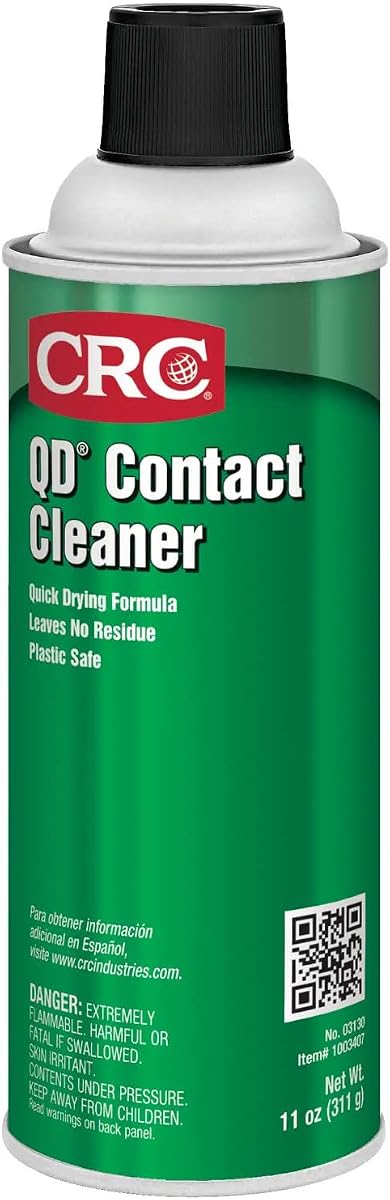
CRC QD Contact Cleaner has a 4.8 rating and offers a compelling combination of quick drying, plastic safety, and broad application support. The manufacturer describes it as safe on all plastics and says it evaporates quickly without leaving residue, which makes it useful for cleaning sensitive equipment assembled with mixed materials.
We may earn a commission when you buy through this link, at no additional cost to you.
Its cleaning targets include dust, light oil, grease, and dirt. The listed applications cover telephones, personal computers, relays, edge connectors, tape heads, busbars, circuits, contacts, printed circuit boards, switches, and breakers. This range makes the product attractive for general repair inventories rather than a single category of electronics.
One formulation qualification is that it should be used where lower-flashpoint cleaners are acceptable. That is important for users with strict safety protocols or facilities that require a particular solvent profile. The product data also does not mention a straw, so precision will depend on careful aerosol technique.
This is an excellent choice for general users who want a highly rated contact cleaner explicitly approved for plastics. Its broad application list, fast evaporation, and residue-free result set it apart from products with more narrowly stated uses. Verify the lower-flashpoint condition and follow all label precautions before application.
Being safe on all plastics according to the manufacturer makes this a reassuring option for devices with plastic housings and delicate internal components. It avoids the need to limit use solely because of a plastic component near the contact.
From telephone and computer contacts to relays, busbars, switches, breakers, and circuit boards, the application range supports multipurpose maintenance. It is also registered under NSF K2 for applicable uses.
We may earn a commission when you buy through this link, at no additional cost to you.
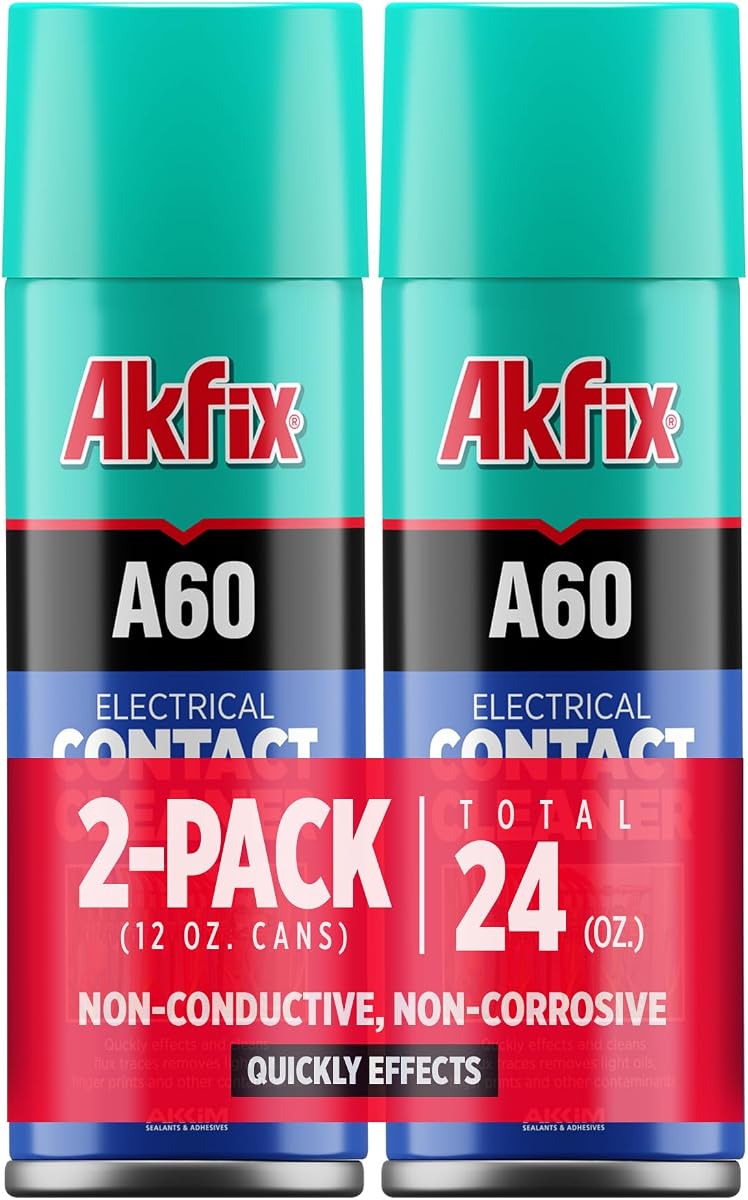
Akfix A60 Electrical Contact Cleaner Spray has a 4.6 rating and stands out for its broad contaminant removal, fast evaporation, and two-can package. Each can contains 12 ounces, giving the set substantial capacity for regular cleaning of computers, batteries, keyboards, digital equipment, and metal connectors.
We may earn a commission when you buy through this link, at no additional cost to you.
The formula is described as removing dirt, light oil, grease, flux, and dust. It is also promoted as non-corrosive and capable of leaving no residue after evaporating quickly. Those qualities are well matched to contact maintenance, where residue or corrosion could undermine the performance of the cleaned connection.
Compatibility is not unconditional. The product information recommends testing sensitive plastics, adhesive-mounted parts, and stressed components before use. The reference to keyboards in the general application list should therefore be read alongside that caution, since key mechanisms may contain plastics, membranes, adhesives, or spring-loaded parts that should be evaluated first.
This two-pack is a good option for repairers who frequently encounter mixed contamination or want stock available in more than one location. Its fast-evaporating, non-corrosive approach is attractive, but careful testing remains important. For users who clean many metal connectors and circuit-board contacts, it provides a convenient balance of capacity and focused purpose.
The quick-evaporating formula is intended to leave no residue after treatment. That is valuable when contacts must remain clean and components must be reassembled without an intervening oily or dusty film.
The non-corrosive formula is suitable for metal connectors and electronic equipment when used as directed. It targets dirt, oil, grease, flux, and dust in one maintenance product.
We may earn a commission when you buy through this link, at no additional cost to you.
CRC 05103-Case 5103 Quick Dry Electronic Cleaner, 11 oz, 12 Pack carries a 4.8 rating and is built for users with unusually high consumption. The case contains twelve 11-ounce cans, making it a practical bulk option for repair professionals, electronics facilities, maintenance departments, or anyone who prefers to keep a substantial supply on hand.
We may earn a commission when you buy through this link, at no additional cost to you.
The underlying product is a quick-drying electronic cleaner, so the case format does not require choosing between bulk quantity and a recognized cleaning product. Repeated availability can improve workflow consistency because technicians do not need to reorder after every service session. The listed fit type is universal, and the supplied package information gives the case a clearly defined physical format.
The drawback is obvious but important: twelve aerosol cans occupy considerably more space than a single can, and occasional users may end up with products they rarely need. Aerosol storage also requires attention to heat and other label precautions. Buyers should estimate realistic consumption and confirm that their workspace can safely store the full case.
For a busy workshop, this is the best bulk-oriented option in the list. Its strong rating and quick-drying format support regular maintenance, while the multipack format simplifies inventory management. It is less compelling for a household that might clean a switch or connector only once or twice each year.
Twelve cans are intended for organizations that use electronic cleaner routinely. Keeping a full case on hand reduces repeated purchasing and helps standardize the cleaner used across service tasks.
The multipack requires enough shelf space for twelve aerosol cans and a real need for ongoing use. Occasional buyers should compare the quantity with their likely maintenance frequency before committing.
We may earn a commission when you buy through this link, at no additional cost to you.
CRC QD Electronic Cleaner 05101 has a 4.7 rating and offers the same broadly applicable cleaning concept in a smaller 4.5-ounce aerosol can. That compact format is attractive for a small repair kit, a household toolbox, or a technician who wants to carry only a modest amount of cleaner.
We may earn a commission when you buy through this link, at no additional cost to you.
Its formula is made from petroleum distillate and alcohol and is described as fast evaporating, residue-free, and plastic-safe. The applications include computer components, circuit breakers, circuits, coin mechanisms, contacts, flux removal, sockets, lighting, plastics, nylon, plugs, relay switches, and PVC, giving it a genuinely broad maintenance remit.
The smaller container is the central trade-off. Users who clean many devices or perform frequent maintenance may exhaust it more quickly than they would an eleven-ounce can. The product information does not mention a precision straw, so accurate placement depends on careful handling of the standard aerosol nozzle.
For occasional users, repair hobbyists, or professionals who prefer portable equipment, this is a highly practical recommendation. It preserves the attractive residue-free, fast-drying, plastic-safe characteristics associated with CRC's electronic cleaner line while reducing storage bulk. The main question is simply whether the smaller volume suits your maintenance schedule.
The 4.5-ounce format is easy to include in a compact toolbox or carry between work locations. It is particularly useful for occasional contact cleaning rather than high-volume service.
The documented plastic-safe, residue-free formula is intended for sensitive electronic contacts. It combines quick evaporation with a broad list of suitable applications.
We may earn a commission when you buy through this link, at no additional cost to you.
The 250ML Electronic Contact Cleaner receives a 4.0 rating and offers a different application style from the aerosol products that dominate this list. Its 250-milliliter format is designed to be applied directly to an oily area, wiped repeatedly, and allowed to dry, which can give the user greater control over where the liquid goes.
We may earn a commission when you buy through this link, at no additional cost to you.
The product information highlights rapid-evaporation technology, claiming that the cleaner dries within seconds and prevents liquid residue from building up on circuit boards and connectors. It is described as suitable for computer motherboards, mobile-phone repairs, and industrial control boards, giving it a clearly electronics-oriented position.
Its 4.0 rating is the lowest among the compared products, and the supplied details do not explicitly address plastic compatibility, flame characteristics, or specific surface exclusions. Users should therefore give extra attention to the full manufacturer instructions. A direct-wipe method can also require more care around mounted components than a narrow aerosol application.
This is a worthwhile option for repairers who prefer controlled, direct application and work frequently on circuit boards or mobile devices. Its rapid drying and PCB focus are useful, but it trails the leaders on rating strength and documented compatibility. Verify the label and test cautiously before using it on unfamiliar materials.
The stated rapid evaporation helps minimize the time that moisture remains near components. This is useful when cleaning exposed board contacts that need to be dry before reassembly.
Applying the cleaner to a selected oily area and wiping it repeatedly can offer more localized control than a broad spray. The method suits mobile-phone, motherboard, and industrial-control-board maintenance.
We may earn a commission when you buy through this link, at no additional cost to you.
The right electronic contact cleaner depends on the contaminants, components, surfaces, and working conditions involved. Review residue behavior, material compatibility, application control, evaporation, and container format before choosing a product.
A contact cleaner should remove contaminants without leaving an oily film, crystalline deposit, or tacky coating that could interfere with conductivity. Several products in this guide explicitly advertise residue-free or zero-residue performance, while fast evaporation is commonly paired with that benefit. This matters most when contacts will be reconnected immediately or when residue could collect dust and create a recurring cleaning problem.
The relevant feature is not simply a fast-drying claim. Buyers should look for language connecting evaporation with no residue and confirm whether the claim applies to the specific formula and intended use. Direct-wipe products should also be allowed to dry fully before power is restored or components are reassembled.
Contacts are often surrounded by plastic housings, printed markings, adhesives, rubber seals, screens, and delicate membranes. A product described as plastic-safe is more convenient for mixed assemblies, but the strongest guidance comes from the manufacturer. Some listings require testing on sensitive plastics, and most warn against spraying keyboards, screens, or adhesives. A cleaner that is excellent on a PCB contact may still be inappropriate for a keyboard membrane.
Before purchasing, identify the materials near the contact and review the complete label. Test on a small, inconspicuous area when compatibility is uncertain. If the device contains coated components, display assemblies, or adhesive-mounted parts, plan to shield them or use a controlled application method.
Dust and light dirt require different cleaning action than oil, grease, flux residue, or condensation. Products such as CRC 05103 and WD-40 Specialist are described as removing several of these contaminants, while BW-100 focuses heavily on dust and general contaminants. The broad wording can be useful, but a product specifically stating the contaminants it targets is easier to match to a repair job.
Consider whether the source is mechanical wear, soldering residue, moisture, or a combination. Post-soldering work generally calls for effective flux removal, while a dusty switch may need only a careful blast. Avoid assuming that every cleaner is equally effective against every substance; use the product information as a guide and confirm that it matches the contamination present.
Precision is essential in crowded circuit boards, game controllers, control panels, compact appliances, and other devices where a wide spray can affect nearby components. An extension straw or smart straw improves directional control and helps the user place cleaner near a contact without soaking the surrounding area. Direct-wipe applicators can also provide localized treatment, although they require careful handling.
Aerosol cans without a stated precision attachment should be used with extra restraint. Apply the shortest effective burst, keep the can upright unless the label permits otherwise, and maintain enough distance to avoid flooding the target. The best applicator is one you can control accurately while the device is open and safely accessible.
Contact cleaner is consumed at different rates depending on the size of the job, the number of devices maintained, and how frequently cleaning is performed. A 4.5-ounce or 5-ounce can is convenient for occasional work and portable kits. Eleven- or twelve-ounce cans suit more frequent use, while twelve-can cases are intended for workshops, facilities, and service teams with dependable demand.
Choose the format around actual consumption rather than simply the largest available. A bulk case offers convenience and consistency but requires storage space and a commitment to routine use. For a household that occasionally services a switch or connector, a standard single can may provide a better balance than a multipack.
The ideal product often depends on the device category. CRC products list computer components, relays, switches, breakers, sockets, and other broad electrical tasks. BW-100 specifically highlights Joycons, computers, and printed circuit boards. Akfix A60 targets computers, batteries, keyboards, digital equipment, and metal connectors, while the 250ML option focuses on motherboards, phone repairs, and industrial control boards.
Look for a product whose documented applications overlap with your own work. A dedicated PCB cleaner may be more reassuring for densely populated boards, while a general contact cleaner with a long application list can be more versatile for mixed equipment. The use case should drive the choice more than the product's overall reputation.
Aerosol format provides fast access and can reach confined areas, but ventilation, ignition-source control, and other label precautions may be important. Some products explicitly advertise non-flammable or other formulation attributes, while others do not provide that detail. Buyers working in confined areas or regulated facilities should review the full safety data before use.
A direct-wipe format may offer more localized control but can take additional time and applicator materials. Aerosols may be more convenient for numerous small components. Neither format removes the need to disconnect power, protect nearby surfaces, and allow the product to dry before equipment is energized.
Begin by disconnecting the device from power, removing batteries where applicable, and allowing the equipment to cool. Identify the contacts and nearby materials, then consult the cleaner instructions for compatibility and exclusions. Move or shield screens, keyboards, adhesives, labels, membranes, and other surfaces that could be damaged by liquid or overspray.
Apply the cleaner with the least amount needed to reach the contaminated area. Use a precision straw or controlled spray for crowded assemblies, or apply a small quantity directly and wipe as directed for a contact-cleaning product intended for that method. Keep the product away from ignition sources, use appropriate ventilation, and follow all warnings printed on the can.
Allow the treated contacts and surrounding surfaces to dry fully before reconnecting the device or restoring power. Reinspect the area for residue, moisture, or unintended wetting. If the problem persists, determine whether the cause is contamination or a damaged, corroded, loose, or worn contact; a cleaner cannot repair defective hardware. Store the container upright, away from heat or flame, and keep its nozzle protected from accidental spraying.
Yes, when the product is specifically documented for circuit-board or PCB cleaning and is applied according to its instructions. Several options in this guide list printed circuit boards or electronic components among their intended uses. Disconnect power, protect nearby sensitive materials, apply only enough cleaner to reach the contact, and allow it to dry fully before reassembly.
Contact cleaner is formulated for cleaning electrical interfaces, where residues, oil, dust, and flux can interfere with conductivity. A general electronics spray may be designed for broader lubrication, static control, or component cleaning. Choose contact cleaner when the objective is to clean connectors, switches, relays, or similar electrical interfaces without introducing an unwanted film.
Residue-free behavior and plastic safety are separate claims. A product may leave no residue but still affect certain plastics, while another may be explicitly approved for plastics. Check the manufacturer's material guidance, test an inconspicuous area, and avoid displays, adhesives, keyboards, and membranes unless the instructions expressly permit them.
Cleaning can help when poor conductivity is caused by dust, oil, grease, flux residue, or condensation on a contact. It will not repair burned connectors, loose terminals, damaged insulation, corroded components, or a failed circuit. If cleaning does not resolve the issue, inspect the hardware and seek appropriate technical or repair assistance.
Follow the instructions for the specific product. Some cleaners are designed for targeted aerosol application, while the 250ML option is described as being applied directly and wiped repeatedly. Never improvise a method that floods components, and avoid spraying screens, keyboards, or adhesives where the labeling says not to do so.
Clean contacts when dust, corrosion-related residue, oil, flux, condensation, or symptom-related contamination is present, rather than following a rigid schedule for every device. Higher-use and exposed equipment may need more frequent inspection, while protected industrial contacts may require less. Always disconnect power before cleaning and investigate underlying causes of recurring contamination.
Non-flammability can be an important workplace and storage consideration, but it is not the only measure of cleaning performance. Buyers should also assess residue, evaporation, contaminant removal, material compatibility, precision, and the product's documented uses. BW-100 is identified as non-flammable in its supplied information, while the other products require separate label review for that attribute.
No. Wait until the cleaner has fully evaporated and the area is dry, with no visible residue or moisture. Powering a device while liquid remains can cause short circuits, unexpected behavior, or damage. If the product requires a specific drying interval, follow that instruction even when the surface appears dry.
CRC 05103 QD Electronic Cleaner is the strongest all-around choice because it combines a 4.8 rating with fast evaporation, residue-free cleaning, plastic-safe positioning, and a wide range of applications. WD-40 Specialist Contact Cleaner is a practical budget alternative for oil, dirt, flux, and condensation, while CAIG DeoxIT D5S-6 offers a specialized premium option for buyers who prefer a dedicated contact-cleaning formula.
Prioritize the formula that matches the actual task. Look for clear residue and compatibility statements, especially if the device contains plastics, adhesives, screens, membranes, or coated parts. A precision straw, direct-wipe method, compact size, or multipack can add convenience, but controlled application and proper safety practices matter more than any packaging feature.
Finally, confirm the current product details and price before purchasing, because availability and pricing can change. Match the cleaner to the contaminants and materials involved, follow the label precisely, disconnect power, and let the treated contacts dry completely before returning the equipment to service.