
meross Presence Sensor MS600
3.8Editor score
Radar, PIR, and light sensing
Matter local control support
Wide adjustable detection area
Matter Compatible Motion Sensor guide comparing detection range, connectivity, power options, light sensing, privacy, installation, and smart home compatibility
A Matter compatible motion sensor connects wireless occupancy and movement data to a broader smart home ecosystem, but the best choice depends on detection technology, power requirements, and hub support. Radar-based presence sensors can recognize stationary people, while simpler PIR models focus on movement and often include a convenient ambient light sensor.
This guide compares ten real options using their supplied specifications, focusing on Matter or Thread support, detection range, field of view, local control, power source, installation flexibility, environmental resistance, and multi-sensor capabilities. It also identifies several popular Zigbee and proprietary alternatives whose compatibility must be checked carefully.
Each review shows which rooms and automations a sensor can serve, along with the ecosystem equipment it needs. The top three recommendations balance Matter integration, presence detection, useful mounting options, and overall value, while product ratings, features, and availability can change and current prices should always be confirmed before purchase.
3.8Editor score

3.5Editor score

3.7Editor score
The comparison below organizes every product by sensing method, connectivity, power, detection capability, and practical setup requirements, making it easier to identify the right sensor for a particular smart home.




The meross Presence Sensor MS600 combines millimeter-wave radar, PIR sensing, and a built-in light sensor in one wired unit. Its 3.8 rating reflects room for improvement, but the core technology is unusually flexible: it can react to both movement and continued human presence, helping prevent lights from switching off while someone is sitting still.
We may earn a commission when you buy through this link, at no additional cost to you.
Matter over Wi-Fi makes this sensor appealing for users who want one device to work with Meross, HomeKit, Alexa, Home Assistant, and Google Home. The adjustable base pivots through 180 degrees and rotates through 360 degrees, while the specified detection reaches 12 meters for motion and 6 meters for effective presence detection. Cable management keeps the included 1.5-meter cord relatively tidy.
The main compromise is that the MS600 needs continuous power. It also requires a hub for Matter compatibility even though no hub is needed for the listed direct integrations. A permanently installed position may be inconvenient renters, but it is a reasonable trade-off for users who want strong presence sensing without frequent battery maintenance.
This is a strong pick for living rooms, offices, bedrooms, and other areas where a conventional PIR sensor might extinguish lights too soon. It is especially suitable when stationary detection and a pet-trigger shield matter more than battery convenience.
Radar sensing allows the MS600 to distinguish continued occupancy from an empty room, while PIR adds conventional motion responsiveness. The combination is useful for desk work, reading, and other situations where a person may remain almost perfectly still.
The pivoting, rotating base supports wall or corner positioning, and the included shield can reduce accidental triggers from pets or a robot vacuum. This makes the unit more adaptable to complicated household movement patterns.
We may earn a commission when you buy through this link, at no additional cost to you.
The Aqara Motion and Light Sensor P2 is a compact native Matter over Thread device with a 3.5 rating. It combines a PIR detector with a separate ambient light sensor, allowing motion and brightness to participate in different automations rather than forcing both readings to trigger the same action.
We may earn a commission when you buy through this link, at no additional cost to you.
Its laboratory-tested detection reaches up to 7 meters across a horizontal angle of up to 170 degrees, with vertical coverage of 45 degrees. The adjustable stand supports wall, ceiling, and zone placement, while the app offers multiple sensitivity levels. Two CR2450 batteries are rated for up to two years, which is convenient for locations where wiring is inconvenient.
Matter and Thread provide broad platform potential, including Apple Home and Amazon Alexa, but a compatible 2-in-1 Matter Controller and Thread Border Router is required and sold separately. Amazon Frustration-Free Setup works with listed Echo devices, and the light sensor operates independently, although Alexa does not support that light-sensor function.
For users seeking an uncomplicated Matter sensor rather than a full radar presence system, the P2 is highly versatile. It is a good fit for hallways, kitchens, bedrooms, and living spaces where a standard motion detector, a daylight-aware controller, or both are needed.
The separate light sensor can run as its own condition, making it possible to trigger curtains or dimmers by brightness while reserving motion for occupancy controls. This separation adds flexibility without requiring multiple physical sensors.
Aqara states that supported automations execute without cloud service, preserving operation when internet access is unavailable. That local approach is valuable for lighting, energy-saving routines, and other recurring home controls.
We may earn a commission when you buy through this link, at no additional cost to you.
The meross Presence Sensor MS605 is built around AI-assisted presence detection, radar, PIR, and light sensing. Its 3.1 rating is the lowest among the products reviewed, so buyers should assess compatibility and feature requirements carefully. Even so, it offers an unusual combination of battery operation, Matter over Thread, and IP67 protection.
We may earn a commission when you buy through this link, at no additional cost to you.
The included CR123A battery is rated for three years, and the folding, rotating stand supports ceilings, walls, and corners. The app can divide detection into three independently configurable zones, each appearing as a separate sensor on supported third-party platforms. This is especially useful in rooms where a broad zone can be divided into near, middle, and far occupancy areas.
Its rating suggests that some users may encounter limitations in setup, app behavior, or platform compatibility. The product description also refers to a Wi-Fi version in one location despite describing the MS605 as a Matter over Thread model, and Alexa direct control is said to require a firmware update. Those details warrant checking before installation.
Despite the caveats, the MS605 is compelling for users who need weather-resistant presence sensing without a power cable. It is especially appropriate for patios, utility spaces, basements, and other locations where a traditional indoor PIR sensor would be less practical.
Separate near, middle, and far zones let a bathroom, hallway, or living room trigger different actions based on where a person is detected. This creates more useful controls than a single all-or-nothing presence boundary.
The IP67 rating and included battery make the MS605 suitable for damp or exposed areas that would be difficult to wire. Rotation and folding mounts help compensate for the different angles required outdoors.
We may earn a commission when you buy through this link, at no additional cost to you.
The Eve Motion Matter 3-Pack includes three wireless motion and light sensors, making it a convenient way to cover several rooms or entrances. Its 3.5 rating is moderate, but the package is aimed at users who prioritize broad platform support, straightforward PIR behavior, and privacy-focused local communication.
We may earn a commission when you buy through this link, at no additional cost to you.
Each sensor offers a 120-degree field of view and a detection range up to 9 meters. IPX3 water resistance extends placement options beyond completely dry interiors, while the Eve app can refine automations using brightness information for iOS users. Notifications are available on selected platforms, adding security value beyond basic lighting control.
A Thread Border Router is required, although the product works with examples from Apple, Samsung SmartThings, Amazon Alexa, and Google Home. The listing explicitly states that there is no Eve cloud, no registration, and no tracking, which is a meaningful advantage for privacy-conscious users who want local control.
This bundle is a sensible choice for a new Matter installation with several monitored spaces. Its limitation is that it detects movement rather than true stationary occupancy, so someone sitting completely still may not continue satisfying a presence-based automation as a radar sensor would.
The three-pack reduces the need to buy and install each room separately. It is particularly useful for hallways, bedrooms, kitchens, and other areas where consistent motion coverage is more important than stationary presence detection.
Eve emphasizes local communication without cloud dependency, along with no account registration or tracking. Users still need a platform hub, but their automations can remain within the local smart home network.
We may earn a commission when you buy through this link, at no additional cost to you.
The TP-Link Tapo T100 is not a native Matter product, so it does not meet the central connectivity requirement of this roundup. It nevertheless earns inclusion because it is a capable, highly rated motion sensor that can serve as a practical budget alternative for shoppers already invested in the Tapo ecosystem.
We may earn a commission when you buy through this link, at no additional cost to you.
With a 4.5 rating, it leads this group. The sensor uses a 120-degree detection angle, reaches up to 7 meters, and offers selectable ranges of 3, 5, and 7 meters. A single included CR2450 battery is rated for up to two years when motion is detected fewer than 100 times per day.
Its dedicated Tapo H100 hub communicates over the Sub-1G low-power wireless protocol rather than Matter or Thread. The hub can support up to 64 sensors and enables Smart Actions even if the network is disconnected. A 90-decibel ringer with 19 tones can also turn the hub into an alert system.
This is the strongest budget choice for a Tapo household, but it is not appropriate for a buyer whose primary requirement is Matter. The adhesive or magnetic base, adjustable body, real-time notifications, and long battery life make it attractive within its own ecosystem.
Choosing a 3-meter, 5-meter, or 7-meter range reduces unnecessary triggers and makes one sensor usable in both small and larger rooms. The adjustable body adds another layer of placement control.
The Tapo hub can sound a 90-decibel alarm, send app notifications during custom schedules, and run Smart Actions when the network is down. These functions extend the sensor beyond ordinary lighting control.
We may earn a commission when you buy through this link, at no additional cost to you.
The Aqara Presence Sensor FP300 is the most functionally expansive product in the roundup, combining 60 GHz mmWave radar, PIR, light, temperature, and humidity sensing in one wireless device. Its 3.7 rating is solid, while the hardware design supports both Matter over Thread and Zigbee.
We may earn a commission when you buy through this link, at no additional cost to you.
AI-assisted sensing is intended to keep lights on when a person is stationary and reduce false triggers as the device learns. The 120-degree field of view reaches up to 6 meters, and the multi-axis mount supports walls, ceilings, and corners. Two replaceable CR2450 batteries provide up to three years in Zigbee mode or two years in Thread mode.
This dual-protocol support is a major advantage. Matter users can connect through Apple Home, Home Assistant, Alexa, Google Home, SmartThings, or Homey, while Aqara users can work with suitable Zigbee 3.0 or Matter hubs. Third-party Matter ecosystems still require a Thread Border Router and Matter Controller.
The FP300 is ideal for a homeowner seeking a single device to inform lighting, climate, and security automations without running multiple separate sensors. Its premium feature set justifies deeper research into hub compatibility, especially for people with an existing Aqara installation.
Presence, movement, brightness, temperature, and humidity data can inform different automations from the same unit. That consolidation reduces installation effort and visual clutter compared with deploying several dedicated sensors.
Supporting both Matter over Thread and Zigbee gives the FP300 unusual migration flexibility. It can fit newer cross-platform setups or an Aqara-centric Zigbee system, subject to the correct hub and current firmware.
We may earn a commission when you buy through this link, at no additional cost to you.
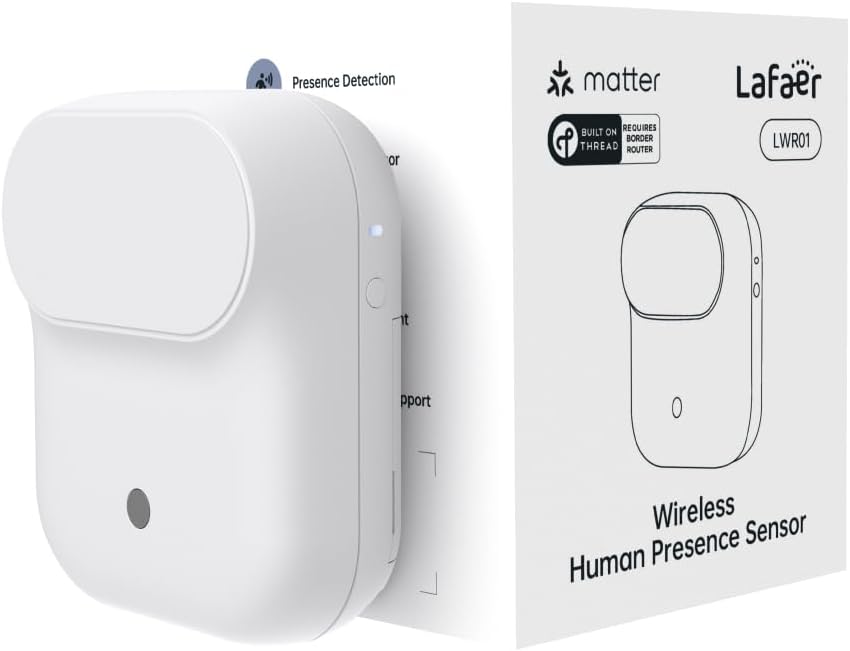
The Wireless Human Presence Sensor LWR01 uses mmWave radar to detect subtle movement and stationary occupancy, with a 3.3 rating. It operates over Matter via Thread and includes an ambient light sensor, bringing together two commonly needed conditions for intelligent lighting in a compact wireless unit.
We may earn a commission when you buy through this link, at no additional cost to you.
The stated ranges are up to 6 meters for movement and 3.5 meters for a motionless person. IPX3 water resistance makes it suitable for bathrooms and other moisture-prone spaces, while battery power offers cable-free installation. A Type-C DC connection is also supported for continuous high-performance use.
The listing says no new hub is needed in one portion but separately requires a compatible hub or router. The detailed compatibility list clarifies that a Matter Controller and Thread Border Router are needed for Apple Home, Alexa, Google Home, Homey, and SmartThings. Buyers should therefore plan around a Thread-capable platform device.
The LWR01 is a good option for someone who wants true presence behavior and the freedom to install without wiring. It works particularly well in bathrooms, reading areas, offices, and rooms where a light sensor can prevent unnecessary lamp activation during daylight.
Unlike a basic PIR unit, the radar sensor can continue registering a person who is sitting still. That makes it better suited to desks, sofas, baths, and other stationary-use environments.
Battery operation simplifies installation in finished rooms, while Type-C power can support continuous use. The choice allows users to prioritize placement flexibility or steady performance.
We may earn a commission when you buy through this link, at no additional cost to you.
The Aqara Motion Sensor P1 is a proven Zigbee 3.0 model with a 4.2 rating, strong battery life, and broad compatibility through supported Aqara hubs. Although it does not provide native Matter support, it can be relevant to shoppers building a mixed smart home that still uses HomeKit, Alexa, IFTTT, or Home Assistant.
We may earn a commission when you buy through this link, at no additional cost to you.
Its primary PIR detection provides a 170-degree field of view up to 4 meters or a 150-degree field up to 7 meters. Users can choose high, medium, or low sensitivity and configure a timeout from 1 to 200 seconds. The flexible 360-degree stand helps position the sensor to reduce unwanted triggers.
A supported Aqara Zigbee 3.0 hub is required, along with the appropriate Wi-Fi network and current hub firmware. Aqara notes that the product is not officially supported by Zigbee2MQTT or comparable third-party USB dongles, so generic Zigbee claims should not be interpreted as universal compatibility.
The P1 is a strong alternative for a large Aqara installation because the five-year battery life reduces maintenance. Users who require the open cross-platform path provided by Matter should choose a native Matter model instead, while existing Aqara users can benefit from the P1's established feature set.
A timeout adjustable from 1 to 200 seconds gives control over how long motion continues to count as active. Combined with three sensitivity levels, this helps balance fast responses against false alarms.
The stated five-year battery life is among the strongest in this group. It makes the P1 attractive for numerous hard-to-reach sensors where frequent battery changes would be inconvenient.
We may earn a commission when you buy through this link, at no additional cost to you.
The SwitchBot Smart mmWave Radar Motion Sensor combines radar, PIR, and light sensing to detect both movement and subtle changes associated with a stationary person. Its 3.6 rating is competitive, and the product is designed for bathrooms, offices, reading areas, and other places where conventional motion detection can be too shallow.
We may earn a commission when you buy through this link, at no additional cost to you.
Detection reaches up to 8 meters for moving humans and 5 meters for stationary humans across a 120-degree area. AI self-learning is designed to filter interference from fans and air conditioners, while the magnetic base can be placed flat, wall-mounted, or rotated to improve the detection zone.
Matter access depends on the SwitchBot Matter Hub Mini included in the product bundle. The sensor also supports Apple Home through that hub, Home Assistant, Alexa, Google Home, and other platforms. Its battery design is rated for up to two years on a single charge, although the exact charging and power workflow should be confirmed before installation.
This is a practical choice for users who want radar-level presence behavior without committing to a fully wired unit. It also suits people who want the SwitchBot hub to serve as a central bridge for several compatible devices.
Radar can pick up subtle chest movement even when someone is reading or working without obvious motion. This helps keep lighting active during activities that a simple PIR sensor may interpret as an empty room.
Self-learning is intended to reduce false triggers caused by fans, air conditioners, and other recurring environmental effects. The rotating magnetic mount gives users another way to keep the detection field away from those sources.
We may earn a commission when you buy through this link, at no additional cost to you.
The SONOFF SNZB-03P is a compact Zigbee 3.0 motion sensor with a 4.2 rating. It is not natively Matter compatible, but its fast response, three-year battery life, and local-scene support make it a useful budget choice for homes already equipped with a compatible Zigbee gateway.
We may earn a commission when you buy through this link, at no additional cost to you.
The sensor can detect motion on a five-second scale, allowing lights to respond quickly when someone passes by. Its CR2477 battery is rated for more than three years, and supported hubs include SONOFF NSPanel Pro, iHost, ZB Bridge Pro, ZBDongle-E, and Echo Plus 2nd generation.
Local Zigbee scenes can still activate if the Wi-Fi connection fails, provided the participating Zigbee devices remain powered. For security use, the sensor can trigger a camera to record, sound an alarm through a gateway, and send app notifications. It therefore does more than activate lighting.
The SNZB-03P is a strong value for a SONOFF or compatible Zigbee setup, but it does not satisfy a strict Matter requirement. Those committed to Matter should select one of the native Matter options and budget for the required Thread or Matter infrastructure.
A five-second detection interval helps lights activate promptly when a person enters. It is useful in hallways, closets, kitchens, and other areas where delayed movement recognition would be frustrating.
The sensor can initiate camera recording, activate a gateway alarm, and issue app alerts. Local scene support also preserves selected automations when the wider network is unavailable.
We may earn a commission when you buy through this link, at no additional cost to you.
The right Matter motion sensor depends on whether you need basic movement detection or continuous presence awareness, as well as on your hub, power source, room conditions, and desired automations. These factors determine compatibility, maintenance, and overall usefulness more than appearance alone.
In summary, verify native Matter support, required hub models, and whether Thread infrastructure is already available before buying.
In summary, choose radar for stationary occupancy and conventional motion control; choose PIR for simpler movement-triggered automations.
In summary, compare maintenance requirements with placement needs, and choose continuous power only where a permanent installation is acceptable.
In summary, evaluate the whole detection cone rather than range alone, and prefer adjustable sensitivity when a room contains pets, fans, or passing traffic.
In summary, prefer light sensing for daylight-aware lighting and a suitable water-resistance rating for bathrooms, patios, or exposed areas.
In summary, confirm the exact hub, current firmware, and feature-level platform support instead of relying only on a broad Matter label.
In summary, choose an adjustable mount so the detection cone can be refined after observing normal household movement.
In summary, prioritize local execution and clear privacy policies when occupancy data is used for security, climate, or lighting routines.
Begin by identifying the platform hub, confirming that it supports Matter and, for Thread models, functioning as a Matter Controller and Thread Border Router. Install the manufacturer's app, update the hub and sensor firmware, and follow the pairing instructions in the order specified by the manufacturer. Position the sensor before tightening brackets or attaching adhesive, since the viewing angle can affect both movement and stationary-presence behavior.
Create automations gradually rather than enabling every available trigger at once. Start with lighting in the intended room, then test motion, absence timeouts, light thresholds, notification schedules, and multi-zone conditions. Walk through the full coverage area and remain still where appropriate to confirm that the sensor behaves as expected. A short test period can reveal interference from fans, curtains, pets, vehicles, or rapidly changing daylight.
For care, keep the sensing area clean and unobstructed, and avoid placing the unit directly beside strong infrared-emitting equipment. Replace batteries according to the stated estimate, then test the sensor immediately afterward. Update hub and sensor software regularly, check that the device remains connected, and remove or reset the sensor carefully if it is relocated. For outdoor or damp installations, confirm that its water-resistance rating and mounting method are appropriate.
Not necessarily. Native Matter support improves cross-platform compatibility, but each model may still require a compatible hub, controller, or Thread Border Router. Feature support can also vary, as shown by the Aqara P2's lack of light-sensor support in Alexa. Check the sensor's approved hub list and confirm that the specific functions appear in the target ecosystem before purchase.
A PIR sensor mainly detects movement, while radar can identify continued human presence even when someone is sitting still. PIR is usually simpler and less concerned with stationary occupancy, whereas radar is better for living rooms, offices, bathrooms, and reading areas. Hybrid sensors combine both approaches to balance responsiveness and energy efficiency.
Most Thread-based Matter sensors need both a Matter Controller and a Thread Border Router, which may be provided by a compatible Apple, Samsung, Amazon, or Google device. The meross MS600 uses Matter over Wi-Fi but its product information states that a hub is still required for Matter compatibility. Always verify the specific infrastructure listed for the model you are considering.
Only if it uses true presence-sensing technology rather than PIR alone. The meross MS600 and MS605, Aqara FP300, LWR01, and SwitchBot sensor use radar with adaptive or AI-assisted detection, allowing them to recognize stationary occupancy. The Aqara P2, Eve Motion, Aqara P1, Tapo T100, and SONOFF SNZB-03P primarily respond to movement.
It can be very useful. A separate light reading allows a lamp to remain off when daylight is sufficient or to trigger blinds and dimmers based on brightness. The Aqara P2 can even use its light sensor independently, though Alexa does not support that function. It can also make a night light more effective by activating only after darkness is detected.
They may work through a compatible bridge, but they are not natively Matter products. The Aqara P1 and SONOFF SNZB-03P require supported Zigbee hubs, while the Tapo T100 uses Tapo's Sub-1G protocol and requires the Tapo H100. Buyers with a strict Matter requirement should choose a native Matter model to avoid bridge and feature limitations.
Choose a position that covers the main path into the room while avoiding direct alignment with windows, moving curtains, fans, heat sources, and frequently passing animals. Adjustable mounts help refine the angle after installation. In bathrooms or exposed areas, check the water-resistance rating and local electrical guidance, and in outdoor areas confirm that the manufacturer permits the intended location.
Begin by repositioning the sensor and reducing its sensitivity rather than accepting repeated notifications. Some products offer separate detection distances, timeouts, or AI-assisted filtering, while adjustable mounts let you narrow the cone. Test during different times of day and under normal household conditions, and keep the lens clean so the firmware and hardware can distinguish meaningful movement from environmental interference.
The Aqara Motion and Light Sensor P2 is the most balanced overall choice because it combines native Matter over Thread, independent light sensing, adjustable sensitivity, local automations, and flexible mounting. The meross MS600 stands out for value-oriented radar presence detection and broad Matter ecosystem support, while the Aqara FP300 is the premium selection for users who want five sensor types, AI-assisted occupancy, and both Matter and Zigbee support.
Prioritize the type of intelligence your room actually needs. Basic PIR is sufficient for movement-triggered lights, but radar-based presence sensing is better when someone may sit still for long periods. Confirm the required hub, Thread infrastructure, light-sensor support, mounting needs, and water resistance before buying; those compatibility details are more important than a broad ecosystem label.
Product ratings, features, hub compatibility, and current prices can change, so review the latest manufacturer information and marketplace listing before making a final decision. Checking the current price also makes it easier to compare the value of a full-featured premium sensor against a simpler model or a three-pack.
