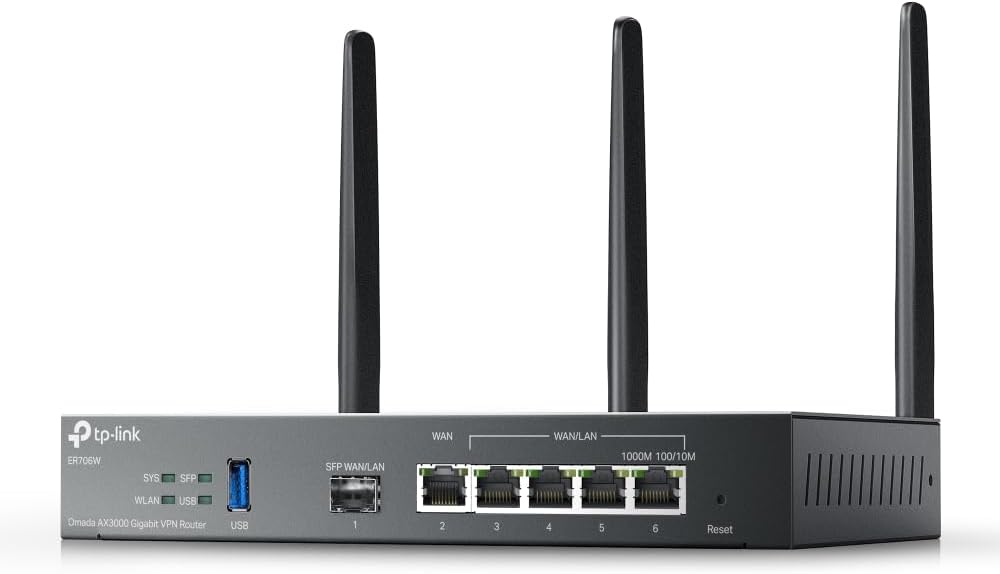
Omada ER706W
4.1Editor score
AX3000 dual-band Wi-Fi 6
Five Gigabit RJ45 ports
Gigabit SFP connectivity
Multi-WAN load balancing
Multiple VPN protocol support
Our Commercial Wireless Router guide compares ten business-focused models for coverage, management, security, VPN support, wired speed, and ease of deployment.
A Commercial Wireless Router must do more than provide fast Wi-Fi. It should separate business and guest traffic, support remote administration, secure access, and integrate cleanly with the wider network. The right choice depends on building size, client density, wired infrastructure, management preferences, and the security requirements of your organization.
We compared ten routers and access-point-based options using the specifications and features supplied for each product. The guide considers wireless generation, coverage, management options, VPN support, Ethernet capabilities, security, scalability, and practical deployment considerations, while distinguishing standalone routers from centrally managed systems.
Each entry shows what the product is best suited to, including its strongest capabilities and important trade-offs. Ratings and feature information reflect the supplied listing data, while practical results can vary with clients, site layout, internet service, and configuration. Product availability and pricing also change over time.
4.1Editor score
4.2Editor score

4.6Editor score
The comparison below highlights the principal hardware, connectivity, management, and security characteristics of all ten options. It includes a mix of standalone business routers, managed access points, a high-capacity Ruckus indoor access point, and a premium mesh system.




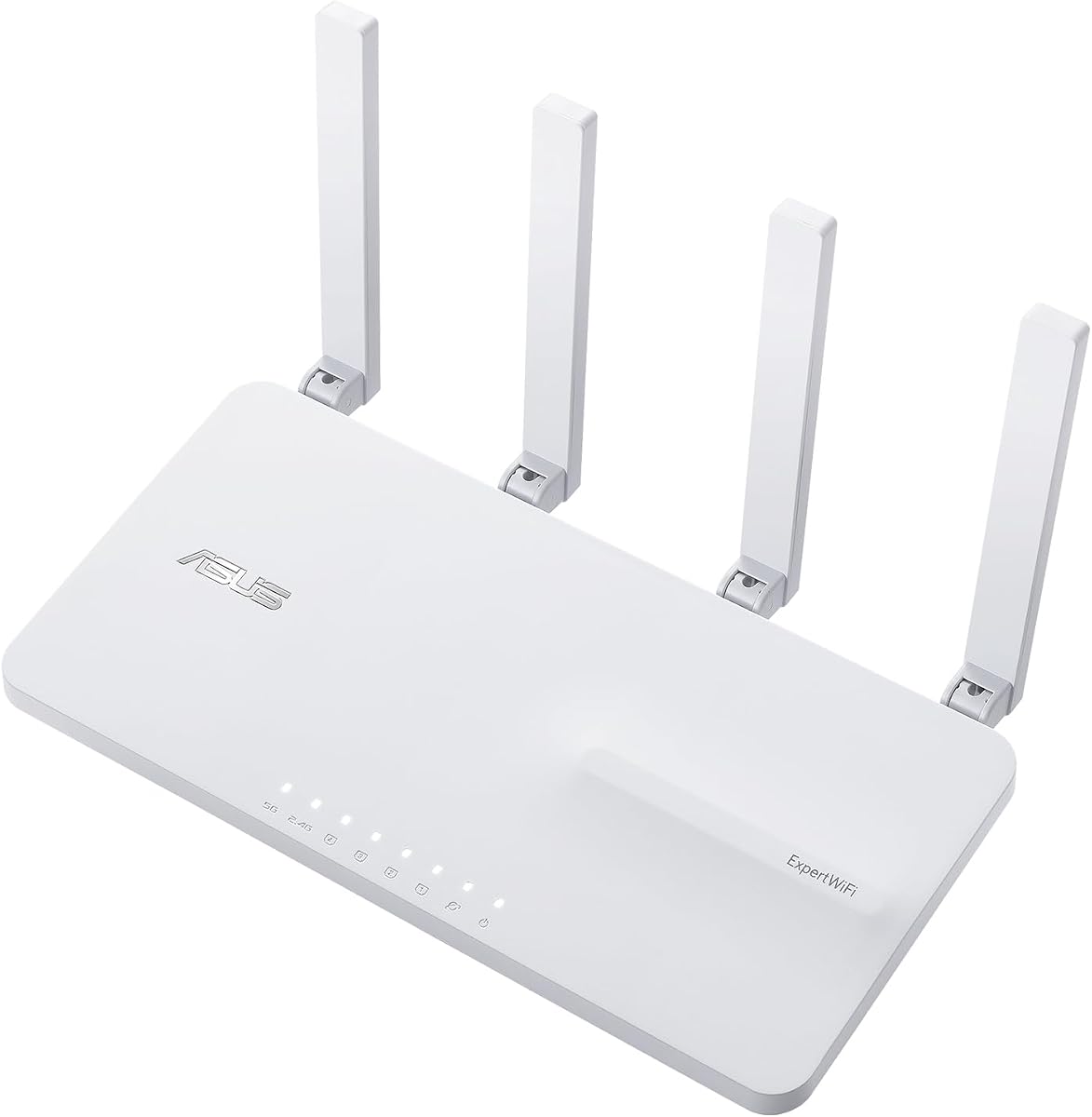
The ASUS ExpertWiFi EBR63 is a business-oriented AX3000 router with a 4.2 rating and a clear emphasis on network organization. It combines Wi-Fi 6, VLAN support, a customizable guest portal, and a free subscription to AiProtection Pro. Its strongest appeal is the balance between useful business controls and an approachable setup and management experience.
We may earn a commission when you buy through this link, at no additional cost to you.
Traffic separation is the feature that matters most in a professional environment. The router can provide up to five SSIDs, allowing employees, guests, IoT equipment, and other device groups to use separate wireless networks. The portal can be customized with the operator's name, templates, and portal style, making it possible to present a more consistent identity to visitors.
Connectivity resilience and security add further utility. The USB port can function as a backup WAN by connecting to a phone hotspot, which gives administrators another way to preserve connectivity. AiProtection Pro, safe browsing features, VPN support, and VLAN capabilities make the EBR63 more appropriate for business networks than a basic consumer router, even though it is not the newest wireless generation.
The ExpertWiFi app reduces the learning curve for initial configuration and ongoing management, while AIMesh provides a route to extend the system with compatible ASUS equipment. This makes the EBR63 a strong recommendation for small offices, retail spaces, clinics, and distributed small businesses that need segmentation and guest access without a large IT department.
Separate SSIDs and VLAN support allow different device groups to remain isolated while sharing the same router. This is particularly useful when staff computers, customer devices, and connected equipment have different access requirements.
The customizable guest portal is a standout feature for public-facing businesses. Operators can adjust the portal, templates, and brand name so visitors encounter a more deliberate access experience.
We may earn a commission when you buy through this link, at no additional cost to you.
The Omada ER706W is a 4.1-rated Gigabit AX3000 VPN router designed for organizations that need more WAN and routing flexibility than a conventional consumer router offers. It provides 2402 Mbps on 5 GHz and 574 Mbps on 2.4 GHz, along with a compact but capable wired interface.
We may earn a commission when you buy through this link, at no additional cost to you.
Its five Gigabit RJ45 ports and Gigabit SFP slot create useful options for connecting an internet source, local devices, and a fiber uplink. Load balancing across as many as five WAN ports can improve utilization of multiple broadband connections and provides a way to add resilience or aggregate available bandwidth.
VPN support is another major attraction. The listed protocols include SSL, IPSec, GRE, WireGuard, PPTP, L2TP, and OpenVPN. That range allows administrators to align remote-access choices with different users and systems rather than relying on a single protocol. The router can also mesh with Omada access points without requiring extra cabling or a switch.
The ER706W is most convincing for small and medium businesses that want professional gateway features at a comparatively restrained cost. It may not offer the newest Wi-Fi standard, but its emphasis on WAN options, VPNs, and Omada scalability makes it a practical choice where network routing and remote access matter more than Wi-Fi 7.
Supporting load balancing across up to five WAN ports gives administrators more ways to use multiple internet services. The SFP slot also offers a fiber-friendly path for certain network designs.
The extensive VPN protocol list makes the ER706W useful for employees connecting to company resources from outside the office. Selection should still be based on the security and compatibility requirements of the remote-access platform.
We may earn a commission when you buy through this link, at no additional cost to you.
The Ruckus WirelessR750 is an indoor Wi-Fi 6 access point explicitly designed for ultra-dense commercial environments. Its 4.3 rating reflects a generally favorable customer response, while the product identity centers on managing a high concentration of wireless clients rather than serving as a basic home router.
We may earn a commission when you buy through this link, at no additional cost to you.
Density is the defining consideration. Hotels, conference venues, educational campuses, offices with shared meeting areas, and other busy locations can place far more client devices into a small coverage area than a typical household. A purpose-built dense-environment access point is therefore a more logical choice than relying on a general consumer router.
The R750 supports the 802.11ax Wi-Fi 6 standard and belongs to Ruckus's established access-point range. That positioning indicates a product intended for integration into a broader network rather than use as a lone all-in-one appliance. Deployment would normally involve a suitable network design, cabling or an appropriate wireless backhaul, and centralized administration.
The main trade-off is that buyers seeking a self-contained router with built-in internet ports may find an access point less direct. In return, organizations with dense client requirements get hardware purpose-built for that environment. It is a strong candidate for installers and network teams prioritizing capacity and enterprise-style wireless infrastructure.
The WirelessR750 is designed for locations where many phones, laptops, and other clients compete for wireless resources. That specialization makes it more relevant to busy venues than a general-purpose home router.
As an access point, the R750 is better viewed as one layer of a wider infrastructure. Network managers should account for switches, power, addressing, and a management approach before installation.
We may earn a commission when you buy through this link, at no additional cost to you.
The Ruckus R670 Unleashed is a high-specification indoor access point aimed at organizations adopting Wi-Fi 7. It offers six spatial streams across 2.4 GHz, 5 GHz, and 6 GHz, a combined data rate of 9.34 Gbps, and a built-in multigigabit Ethernet path for demanding environments.
We may earn a commission when you buy through this link, at no additional cost to you.
BeamFlex+ adaptive antenna technology is a central part of its positioning. Ruckus describes the system as a way to improve signal coverage, throughput, network capacity, MIMO diversity, and spatial multiplexing potential. These features are particularly relevant in complex buildings where client locations, walls, and interference can make simple signal strength an unreliable guide.
The R670 also broadens the role of an access point. Built-in Bluetooth and Zigbee support with Matter and Thread capability allows it to help unify wireless device technologies, while the USB port offers a path for expansion. A 1, 2.5, or 5GbE connection can optimize multi-gigabit Wi-Fi performance when paired with suitable switching.
Management options include physical or virtual on-premises appliances, and the listing highlights enhanced security with WPA3, man-in-the-middle protections, and RUCKUS DPSK3. The product has no numerical customer rating in the supplied data, so its advanced specification is the strongest basis for evaluation. It is best suited to professional teams that need enterprise access-point capabilities and a modern tri-band platform.
Six spatial streams spread across three bands provide a broad foundation for Wi-Fi 7 deployments. The 6 GHz band can serve newer compatible clients while older Wi-Fi 5 and Wi-Fi 6 devices remain supported elsewhere in the system.
Bluetooth and Zigbee support gives the R670 value beyond conventional Wi-Fi. Matter and Thread support may help organizations consolidate more connected-device traffic through a unified infrastructure.
We may earn a commission when you buy through this link, at no additional cost to you.
The NETGEAR Orbi 970 Series is a three-piece Wi-Fi 7 mesh system with a 4.6 rating, the highest numerical rating among the listed products. It combines a router and two satellites with patented Quad-Band technology and a dedicated backhaul, aiming to preserve performance while extending coverage across large properties.
We may earn a commission when you buy through this link, at no additional cost to you.
The supplied listing states coverage of up to 10,000 square feet and support for as many as 200 devices on one network. Its up-to-27-Gbps aggregate Wi-Fi capability and use of dedicated backhaul are designed for homes, estates, and small commercial spaces where many high-bandwidth clients can be active simultaneously.
Wired connectivity is unusually strong for a mesh system. The package includes a 10 Gig internet port along with 10 Gig and 2.5 Gig LAN ports across the router and satellites. That makes the system suitable for users who need fast connections to a NAS, a gaming computer, or a home office while relying on mesh for broader wireless coverage.
NETGEAR includes guided setup, guest Wi-Fi management, automatic firmware updates, Advanced Router Protection, and an optional NETGEAR Armor subscription. The main limitation is that mesh is not automatically ideal for every commercial floor plan. Buyers should consider walls, wiring, satellite placement, and the concentration of clients rather than relying only on the stated coverage figure.
The dedicated backhaul lane is intended to carry satellite traffic separately from client traffic. This design targets a common weakness in mesh systems, where wireless repeaters can reduce client-facing performance.
The inclusion of 10 Gig and 2.5 Gig ports creates opportunities for high-speed wired connections alongside wireless coverage. These ports are particularly useful for local storage, demanding workstations, and service-provider equipment.
We may earn a commission when you buy through this link, at no additional cost to you.
The Omada EAP650 is a dual-band Wi-Fi 6 access point with a 4.5 rating and support for free Omada Essentials cloud management. It delivers a maximum wireless rate of 2,976 Mbps using 1024-QAM, HE60, and long OFDM symbols, making it a practical option for offices, hotels, classrooms, and cafes.
We may earn a commission when you buy through this link, at no additional cost to you.
Management flexibility is one of its biggest strengths. A network can be administered through Omada Essentials cloud management without separate hardware or software controllers, while the broader SDN platform can integrate access points, switches, and gateways. Standalone operation is also supported, which can make the device useful in a smaller or staged deployment.
Installation flexibility comes from its power options. The EAP650 supports 802.3at PoE+, 48V/0.5A passive PoE, and the included 12V/1.5A DC adapter. This allows administrators to select a suitable power method based on available infrastructure instead of requiring a single dedicated approach.
Wireless features include Mesh Wi-Fi, seamless roaming, WPA3, band steering, load balancing, airtime fairness, and beamforming. Some mesh and roaming functions require an Omada SDN controller, an important distinction during planning. With a five-year warranty and a low-profile design, the EAP650 is a strong choice for installers seeking capable, centrally managed access points.
Omada Essentials allows the network to be managed in the cloud without additional controller hardware or software. This can simplify administration for organizations with limited on-site infrastructure.
Support for PoE+, passive PoE, and the supplied DC adapter gives administrators flexibility in older and newer buildings. The appropriate method depends on switches, cabling, and access to power.
We may earn a commission when you buy through this link, at no additional cost to you.
The Ubiquiti U6+ is a dual-band Wi-Fi 6 access point offering up to 3 Gbit/s of wireless transmission speed. Its 4.6 rating places it among the strongest customer-rated options in the group, while the compact wall-mountable form makes it suitable for offices and other business environments.
We may earn a commission when you buy through this link, at no additional cost to you.
The device supports IEEE 802.11 a/b/g/n/ac/ax wireless standards, allowing it to accommodate both newer Wi-Fi 6 clients and older Wi-Fi generations. A Gigabit Ethernet port provides the wired path for client traffic, and the wall-mountable form factor makes placement above desks, in meeting rooms, or along corridors more practical.
PoE+ support is a major installation advantage. Power and data can travel through one cable, removing the need for a nearby power outlet in locations where wiring is inconvenient. The stated PoE+ allowance of up to 25.5 watts provides a clear infrastructure requirement for planners and installers.
The U6+ includes data encryption to help protect wireless traffic. As an access point, however, it does not replace a router, internet connection, or complete network-management system. It is most appropriate for a business that already has a suitable wired backbone and wants a discreet, high-performance ceiling or wall-mounted wireless endpoint.
PoE+ combines network data and power over one Ethernet run. This can simplify installation in retail spaces, offices, and hospitality environments where a nearby outlet would be inconvenient.
The wall-mountable U6+ is designed to blend into a working commercial environment. Its dual-band Wi-Fi 6 platform supports modern and legacy clients without requiring a large visible router enclosure.
We may earn a commission when you buy through this link, at no additional cost to you.
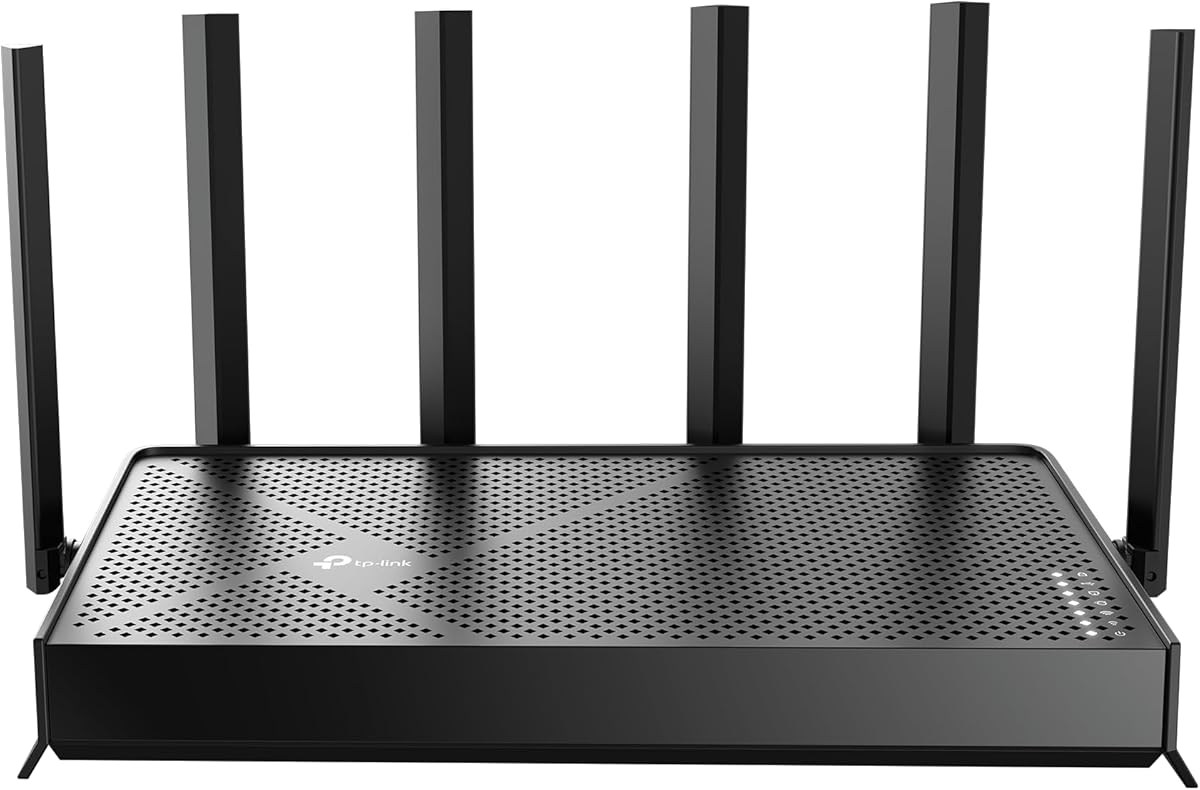
The TP-Link Archer BE400 is a dual-band Wi-Fi 7 router built around Multi-Link Operation, Multi-RUs, and 4K-QAM. Its 4.3 rating and up-to-6,452 Mbps combined band rate make it a compelling choice for small offices, remote teams, and users replacing aging Wi-Fi 6 equipment.
We may earn a commission when you buy through this link, at no additional cost to you.
Multi-Link Operation allows simultaneous data transfer across frequency bands, aiming to improve throughput, latency, and reliability. The product is designed to take advantage of newer Wi-Fi 7 clients while continuing to support conventional Wi-Fi devices, although real-world performance will depend on the client hardware and radio conditions.
Its wired configuration includes one 2.5 Gbps WAN or LAN port, another 2.5 Gbps LAN port, and three 1 Gbps LAN ports. That mix supports a multigigabit internet connection where available while retaining practical wired connections for office equipment, computers, and network infrastructure.
The Tether app provides setup, management, and firmware updates, while HomeShield adds parental controls, IoT security, and network protection. EasyMesh compatibility allows expansion with compatible routers and range extenders, although the Archer BE400 cannot be combined with TP-Link Deco systems. It is best viewed as a current-generation standalone router for organizations wanting Wi-Fi 7 without a complex access-point network.
Wi-Fi 7 features such as Multi-Link Operation and 4K-QAM are designed for demanding networks with many contemporary clients. Compatibility with older devices helps the router serve mixed client populations during an upgrade.
Two 2.5 Gbps ports and three 1 Gbps LAN ports provide enough flexibility for a small professional network. A multigig service can use the WAN capability, while wired devices can connect locally.
We may earn a commission when you buy through this link, at no additional cost to you.
The NETGEAR Nighthawk WiFi 7 is a dedicated tri-band router rated at 4.3. It offers an aggregate rate of up to 9.3 Gbps, coverage of up to 2,500 square feet, and support for as many as 100 connected devices, making it suitable for compact offices and demanding residential workspaces.
We may earn a commission when you buy through this link, at no additional cost to you.
Its third high-speed band gives compatible devices a separate lane, which is intended to keep demanding traffic from slowing other connections. The product also supports earlier Wi-Fi generations, allowing a mixed collection of phones, laptops, and smart-home devices to operate on the same system.
Wired connectivity includes a 2.5 Gbps WAN port, two 2.5 Gbps LAN ports, and two 1 Gbps Ethernet LAN ports. These options suit multigig internet plans, NAS systems, gaming computers, and smart displays, while the 2.5 Gbps WAN is particularly relevant where the business connection exceeds a basic gigabit connection.
The Nighthawk app supports guided setup, speed tests, device pausing, guest networks, and remote management. The router works with most cable, fiber, DSL, and satellite providers, although some modem-router combinations require bridge mode. Larger buildings may need Orbi mesh equipment, so the stated coverage should be treated as a planning guide rather than a guarantee.
The dedicated 6 GHz band can give compatible Wi-Fi 7 clients additional room to operate. This helps separate demanding traffic from activity on the more widely used bands.
Combining tri-band Wi-Fi 7 with two 2.5 Gbps LAN ports gives the router meaningful value for local high-speed devices. A multigig WAN also prepares it for faster business internet tiers.
We may earn a commission when you buy through this link, at no additional cost to you.
The ASUS RT-BE88U is a quad-band Wi-Fi 7 router that combines up to 7,200 Mbps of wireless throughput with unusually strong wired connectivity. Its two principal 10G interfaces—a 10G SFP+ port and a 10G WAN/LAN port—make it especially interesting for small businesses, creative studios, and advanced home offices with demanding local networks.
We may earn a commission when you buy through this link, at no additional cost to you.
The listed wired capacity can reach 34G, and a quad-core 2.6 GHz 64-bit processor provides the processing foundation for a high-throughput system. Wi-Fi 7 features including Multi-Link Operation and 4096-QAM support modern clients while the four-band design helps organize traffic across a broader range of devices.
Network resilience is another strength. AI WAN detection, versatile WAN configuration, and a USB port ready for 4G LTE or 5G mobile tethering can help maintain connectivity when the primary service is interrupted. Guest Network Pro can establish as many as five SSIDs for staff, guests, and IoT devices.
AiProtection Pro, one-tap security scanning, comprehensive VPN support, site-to-site VPN, parental controls, and AiMesh add business-relevant functions. The router is not as simple as a basic consumer model, and its advanced options require deliberate setup. It is best suited to buyers who prioritize fast wired connections, control, and a foundation for high-end Wi-Fi 7 expansion.
The SFP+ and RJ45 10G ports offer more flexibility than a typical business router. They can support advanced switches, high-speed storage, and high-capacity local workflows when properly designed.
Five SSIDs through Guest Network Pro help separate groups of connected equipment. AiProtection Pro, VPN support, and site-to-site VPN add security tools for business communications and remote access.
We may earn a commission when you buy through this link, at no additional cost to you.
The right commercial wireless system depends on more than headline speed. Site size, client density, wired architecture, management resources, security obligations, and future growth should guide the decision before comparing individual models.
Start by estimating the usable area rather than focusing only on a manufacturer's maximum square-footage figure. Walls, floors, storage racks, glass, electrical equipment, and neighboring networks can reduce practical coverage. Larger buildings often need multiple coordinated access points, while compact offices may be well served by one powerful router. A mesh system can help in sprawling properties, but centrally managed access points may be more appropriate where cabling, control, and predictable client capacity matter.
Choose a product whose coverage design matches the building, and expect installation quality to influence results as much as the hardware.
A high aggregate speed does not guarantee a good experience in a crowded venue. Phones, laptops, televisions, sensors, and guest devices all compete for available airtime. Products specifically designed for dense environments, such as the Ruckus WirelessR750, may be more suitable than a general router when dozens or hundreds of clients occupy the same area. Features such as band steering, airtime fairness, load balancing, and beamforming can also improve efficiency.
Prioritize capacity management and high-density design when serving busy offices, hotels, classrooms, or public spaces.
Choose a management approach that the person responsible for the network can operate consistently. The ASUS ExpertWiFi app emphasizes mobile management, the Omada products support cloud, controller, software, and standalone workflows, and the Ruckus R670 supports on-premises physical or virtual appliances. Consumer-style apps are convenient for small installations, but larger organizations may need centralized policies, multi-site visibility, scheduled changes, and detailed diagnostics.
Match management complexity to the administrator's experience and the number of sites being maintained.
A business router should fit the organization's internet arrangement rather than merely provide a single connection. Multiple-WAN load balancing, 2.5 Gbps or 10G WAN ports, SFP uplinks, and mobile-tethering options can improve capacity and resilience. VPN protocols are also important for employees and branch offices that need secure access to internal resources. Confirm that the required protocol and connection method are supported before purchase.
For continuity, compare available WAN ports, backup options, and VPN compatibility alongside wireless speed.
Every access point and high-end router needs a suitable path back to the network. Count the wired devices that must remain connected, then determine whether existing switches can support the required port speeds. PoE+ can simplify access-point installation by combining power and data over one cable, but compatible switches or injectors may be necessary. For local storage, workstations, and servers, multigigabit ports can offer more useful capacity than additional wireless speed.
Build the wired plan first, then choose wireless hardware that supports it.
Commercial Wi-Fi should separate employees, guests, IoT equipment, and sensitive systems where possible. Look for multiple SSIDs, VLAN support, WPA3, encrypted guest access, VPN capabilities, and centralized policy tools. A branded guest portal can improve the visitor experience, while dynamic passcode features can reduce the need to distribute one static password. The ASUS ExpertWiFi EBR63 and RT-BE88U offer particularly relevant business segmentation features in this list.
Treat traffic separation and access control as core requirements, not optional extras.
Wi-Fi 7 products can provide useful features such as Multi-Link Operation, 4K-QAM, and additional 6 GHz capacity, but benefits require compatible clients. A Wi-Fi 6 system may be more practical when most devices use older standards. Mesh expansion, roaming support, and mixed-band compatibility also influence long-term usability. Check the expected device mix, especially for older operational equipment, specialist sensors, and guest phones.
Buy for the clients that will actually connect, not only the fastest specification available.
The hardware purchase is only part of the investment. Consider the cost of switches, controllers, cabling, power adapters, installation, management subscriptions, and extended coverage. The EAP650 includes free Omada Essentials cloud management, while AiProtection Pro and NETGEAR Armor involve optional or subscription-based elements for some functions. A product with fewer premium features may offer better long-term value if it matches the site's actual requirements.
Estimate the complete deployment cost and include time, maintenance, and future expansion before deciding.
Begin with a site survey and a written plan. Record the internet service, existing modem or gateway, available Ethernet cabling, switch capacity, target SSIDs, guest-access requirements, and areas where reliable coverage matters most. If using an access point, confirm that a suitable controller or cloud service and an approved power method are available before mounting hardware.
Configure security from the beginning. Change default administrator credentials, use WPA3 where clients support it, create separate networks for staff, guests, and IoT devices, and restrict access according to business needs. Update the firmware, register the management service, configure remote administration securely, and test VPN connections before relying on them for daily operations.
After deployment, monitor client numbers, channel conditions, wired throughput, and problem areas. Reposition an access point or satellite when coverage is weak, and review SSID usage as device patterns change. Keep the access points ventilated, away from heat sources and obstructions, and maintain the security software and firmware. Periodic reviews help preserve performance as the client base grows.
It can be, particularly when the business needs VLANs, multiple guest and staff networks, VPN support, centralized management, or a more durable deployment plan. A consumer router may be sufficient for a very small site with simple requirements and few users. The right decision depends on management needs, client density, and the organization's security policy rather than appearance alone.
A single router may cover a compact office with a modest number of clients. Larger or denser locations often benefit from several access points because they can distribute capacity and place coverage where it is needed. The access points still require a suitable network backbone, power, addressing, and a centralized management approach.
Wi-Fi 7 can offer advantages for newer high-performance clients, additional 6 GHz spectrum, and features such as Multi-Link Operation. However, those benefits require compatible devices and a network designed to take advantage of them. For many offices, Wi-Fi 6 equipment, good placement, and appropriate wired connectivity can provide a more practical balance.
A guest network keeps visitor devices on a different wireless network from employees and internal systems. This improves organization and makes it easier to limit guest access. Businesses may also customize a portal so visitors receive instructions, acceptable-use information, or branded messaging before joining.
The correct number depends on area, walls, client density, channel conditions, and the capabilities of the selected hardware. A coverage estimate is only a starting point, and a high-density venue may need more access points than a large but sparsely occupied property. A professional site survey and live testing are the most reliable way to validate the design.
Most business routers are designed to work with an existing internet connection, but configuration details vary. Some gateways require bridge mode, and the appropriate WAN speed depends on the service and equipment. A router that supports multigigabit WAN is useful when the internet plan exceeds a single-gigabit connection and the local infrastructure supports it.
PoE can simplify access-point installation by delivering power and data over a single Ethernet cable, particularly where power outlets are inconvenient. It requires compatible switches, injectors, or other appropriate power equipment. The available power budget and cabling standards should be checked before selecting a model.
Firmware should be reviewed and applied promptly when the manufacturer provides a relevant update. Centralized management systems can make this easier by revealing pending versions across multiple devices. Before updating, check release notes, confirm that required services will remain available, and update in a controlled sequence for business-critical infrastructure.
The ASUS ExpertWiFi EBR63 is the most balanced overall choice because it combines multiple SSIDs, VLAN support, a customizable guest portal, backup WAN capability, and accessible mobile management. The Omada ER706W stands out for organizations prioritizing multi-WAN networking, fiber connectivity, VPNs, and value, while the NETGEAR Orbi 970 Series is the premium option for large properties seeking a dedicated-backhaul mesh system.
For high-density venues, the Ruckus WirelessR750 and R670 Unleashed deserve careful consideration because they are purpose-built access points rather than basic routers. The Omada EAP650 and Ubiquiti U6+ suit businesses that already have a strong wired network and want centrally managed endpoints. The Archer BE400, Nighthawk WiFi 7, and ASUS RT-BE88U are better choices for organizations wanting a standalone Wi-Fi 7 gateway with varying levels of multigigabit connectivity.
Before purchasing, map the site, count current and expected clients, verify the internet speed, check the management resources available, and confirm that the required ports and security features are present. Product specifications are only part of the decision, and actual performance depends on layout, installation, client compatibility, and configuration. Review current availability and pricing at the time of purchase, since both can change.