
RØDE Wireless Micro
4.6Editor score
Two pre-paired wireless microphones
Intelligent GainAssist level control
Charging case for portable power
This expert guide compares the best external smartphone microphone options for vlogging, interviews, podcasts, livestreams, and clearer mobile audio in 2026.
An external smartphone microphone can transform ordinary phone recordings into polished, intelligible content by capturing cleaner speech, reducing distracting room noise, and giving creators more control over sound. The right model depends on whether you record alone, interview subjects, stream live, or move freely while filming.
We compared the included microphones by examining their connection methods, pickup patterns, wireless capabilities, noise-control features, battery life, accessories, compatibility notes, and user ratings. The list covers wired shotgun microphones, compact wireless lavalier systems, a handheld reporter microphone, and a feature-focused USB-C recording microphone.
Each pick highlights a different use case, from affordable two-transmitter kits to advanced systems with automatic gain control, internal recording, and multiple polar patterns. Product specifications and ratings reflect the supplied listing information, while prices and availability can change, so confirm the current details before purchasing.
4.6Editor score

4.7Editor score
4.6Editor score
The comparison below highlights the connection style, recording configuration, core feature, and best-fit use case for each external smartphone microphone, helping you distinguish wired, wireless, lavalier, handheld, and multi-pattern options.


The Movo VXR10 is a compact wired shotgun microphone designed for creators who want clearer, more focused recordings from a phone, camera, camcorder, GoPro, or laptop. Its supplied rating is 4.3 out of 5, and its strongest attraction is the unusual breadth of device support for a simple 3.5mm microphone. It is particularly useful for vlogging, interviews, podcasts, social videos, and mobile recordings where a directional microphone is easier to manage than a full wireless kit.
We may earn a commission when you buy through this link, at no additional cost to you.
Directional pickup is the VXR10's defining feature. By focusing on sound in front of the microphone and rejecting distractions from the sides, it can help when the phone is several feet away or when nearby movement and environmental sounds would otherwise enter the recording. The solid aluminum body adds durability, while the built-in shock mount helps reduce bumps and handling noise without requiring a separate mount. A fuzzy windscreen is included for outdoor use, and the package also contains a carrying case, camera cable, original and Rycote shock mounts, and a smartphone cable.
The most important limitation is connection compatibility. The VXR10 requires a 3.5mm microphone input and plug-in power, so compatible Lightning or USB-C phones may require an appropriate 3.5mm adapter. The correct TRS or TRRS cable also matters, and the listing notes that some Canon Rebel T6/T7 cameras and certain Canon VIXIA camcorders do not support external microphones. Placement requires care: the recommended distance is one to five feet, with excessive closeness potentially causing distortion and excessive distance potentially producing muffled speech.
This is a strong choice for budget-conscious creators who prefer a traditional cable and want directional recording without managing transmitters, receivers, or battery charging. It is less suited to people who need true wireless freedom, automatic level control, or assured compatibility with a modern phone that lacks a headphone jack. For those priorities, the top three picks offer more streamlined wireless or processing-focused alternatives. Within the wired category, however, the VXR10 delivers an attractive mix of adaptability, included accessories, and focused sound capture.
The directional design makes the VXR10 most useful when the subject can remain in front of the microphone and unwanted movement occurs elsewhere. This can improve speech clarity without requiring a separate wind protection accessory in every indoor setting.
The carrying case, smartphone and camera cables, shock mounts, and fuzzy windscreen cover several common recording needs. That bundle also makes the microphone easier to use across different devices without purchasing each accessory separately.
We may earn a commission when you buy through this link, at no additional cost to you.
The Movo X1-Mini is a wired video microphone that bridges phone recording, traditional cameras, tablets, laptops, and other equipment. It carries a supplied rating of 4.4 out of 5 and offers both 3.5mm analog connections and a USB-C digital output. That versatility makes it attractive for creators who use more than one type of recording device or who want a microphone that can move between a smartphone and a dedicated camera setup.
We may earn a commission when you buy through this link, at no additional cost to you.
The microphone's stated supercardioid pattern gives it a focused approach to sound capture, while its digital mode can deliver audio at up to 24-bit resolution. It is built around a durable aluminum body and an integrated shock mount, reducing the need for a separate battery and helping control mechanical noise. The extensive package includes the X1-Mini, a Rycote shock mount, foam and furry windscreens, a 3.5mm TRS camera cable, a 3.5mm TRRS smartphone cable, a digital USB-C cable, and a hard-sided carrying case.
Its reliance on cables is both a strength and a limitation. A wired microphone eliminates wireless pairing concerns and avoids battery anxiety, but a connected cable can restrict movement and snag during handheld work. Users must also select the correct cable and make sure their phone or camera supports the relevant input. The analog and digital modes offer flexibility, although the highest-resolution mode is meaningful only with compatible devices and suitable recording software.
Choose the X1-Mini if you want one compact microphone for a mixed kit of phones, computers, and cameras. It is a better fit than the VXR10 for creators interested in digital output and higher-resolution capture, but it is not the answer for someone who needs wireless movement or hands-free operation. The included case, mounts, windscreens, and cables make it particularly appealing for creators building a versatile mobile recording package.
The combination of TRS, TRRS, and USB-C cables lets the X1-Mini follow a creator from a camera to a phone or computer. This broad support is valuable for hybrid workflows involving vertical social clips, camera footage, and voice recording.
In compatible digital setups, the microphone can record at up to 24-bit resolution while drawing power through the connected cable. The battery-free design reduces charging tasks and avoids the possibility of wireless batteries dying during a session.
We may earn a commission when you buy through this link, at no additional cost to you.
The DJI Mic Mini one-transmitter configuration is built for solo creators who want a discreet lavalier microphone without a complicated setup. The supplied rating is 4.4 out of 5, and the transmitter weighs only 10 grams, making it easy to wear or mount discreetly. It is aimed at mobile vlogs, livestreams, travel recordings, and interviews where a visible microphone would be distracting.
We may earn a commission when you buy through this link, at no additional cost to you.
The listed specifications include 48kHz sampling, support for sound levels up to 120 dB SPL, and a maximum transmission range of 400 meters. A charging case can extend total operation to as much as 48 hours, while two noise-cancellation levels provide options for quiet rooms or noisier surroundings. Automatic limiting is included to reduce the chance of clipping when the input becomes too strong, adding a useful layer of protection for variable-volume speech.
DJI ecosystem integration is another distinguishing feature. A transmitter can connect directly to several listed Osmo devices through DJI OsmoAudio without the mobile receiver, broadening the system's usefulness beyond a basic smartphone workflow. The included configuration nevertheless centers on one transmitter and a plug-and-play USB-C mobile receiver, so it is best suited to one-person recording rather than a two-person interview. The maximum range should also be understood as a technical specification rather than a guarantee of perfect performance in every environment.
This is an appealing option for anyone who prioritizes a tiny wearable transmitter, long battery planning, and straightforward phone capture. It offers more processing and wireless convenience than a basic wired lavalier, although it cannot capture a second speaker without an additional transmitter. For a creator who mainly records solo, values portability, and wants the phone to remain visually unobtrusive, the one-transmitter Mic Mini is a focused and capable solution.
At 10 grams, the transmitter is easy to wear for extended periods without demanding attention. The charging case's stated 48-hour potential makes it practical for multi-day trips and recurring mobile production.
Automatic limiting helps keep sudden increases from overwhelming the recording. It is not a substitute for correct gain control, but it adds valuable insurance during interviews, livestreams, and other situations with unpredictable sound levels.
We may earn a commission when you buy through this link, at no additional cost to you.
The Labstandard Professional Wireless Lavalier is a dual-transmitter system intended for interviews, videos, podcasts, vlogs, and livestreams. Its supplied rating is 4.2 out of 5. Rather than requiring a separate microphone for each participant, the kit provides two compact wireless units and a receiver designed to work with both Lightning and USB-C devices, making it a practical lower-cost choice for two-person smartphone content.
We may earn a commission when you buy through this link, at no additional cost to you.
The microphone uses 2.4GHz transmission with a stated latency of 0.008 seconds and relies on real-time automatic synchronization to keep recorded sound aligned with the video. A built-in noise-reduction chip is intended to improve intelligibility in busy environments, while directional pickup and a pronounced proximity effect are designed to emphasize nearby voices. The system also supports multi-channel real-time mixing, allowing background music and speech to be synchronized during phone recording.
The stated battery life is approximately six hours, which is shorter than the endurance offered by many of the premium and midrange wireless sets in this guide. It is still adequate for a typical short interview, vlog, or livestream, but extended production days may require planning around recharge time. The kit includes rechargeable wireless microphones, a receiver, a user manual, and a USB-C charging cable. Users should also review the manual because the listing contains multiple operating modes and compatibility functions.
This is a strong budget-oriented option for a creator who regularly records two people and wants wireless freedom with broad phone compatibility. It may not be the first choice for a full-day event or a creator who prioritizes advanced internal backup, but it covers the essentials with synchronized 2.4GHz capture and useful noise-control features. It is also more conversation-ready than a single wired lavalier because both participants can have their own transmitter.
Two included transmitters give each participant a dedicated microphone. This arrangement can produce more balanced dialogue than placing one shared microphone near both speakers, particularly for face-to-face interviews.
Real-time auto-sync and the stated low latency are designed to reduce visible drift between the speakers and the recorded footage. Confirming the correct adapter and function settings before recording is still important for reliable results.
We may earn a commission when you buy through this link, at no additional cost to you.
The RØDE Wireless Micro is a compact two-transmitter system designed for creators who want a simple phone workflow with more refined level management. The supplied rating is 4.6 out of 5, placing it among the strongest-rated products in this roundup. Its pre-paired transmitters connect when docked with the receiver, removing the need for a separate pairing process or required app setup.
We may earn a commission when you buy through this link, at no additional cost to you.
Intelligent GainAssist is the key technical feature. It automatically keeps the microphone levels in a usable range, reducing the need for frequent gain changes when subjects move or speak at different volumes. The kit includes two wireless microphones, a USB-C receiver, a charging case, and windshields. The case can deliver up to 21 hours of combined use, and the pocket-sized format suits travel, interviews, livestreams, and on-location mobile video.
Compatibility is the most consequential limitation. This USB-C version connects directly to iPhone 15 and later and Android USB-C devices, but it does not support Lightning iPhones. That distinction matters for mixed-device teams or anyone carrying an older iPhone. The supplied feature list also does not mention internal onboard recording, so the system should not be treated as an automatic backup system for every microphone on the market.
Choose the RØDE Wireless Micro when simplicity, automatic levels, and a two-person configuration matter most. It is especially helpful for creators who are new to wireless audio and want a receiver that begins working without a pairing ritual. It is a premium-oriented choice in this category, yet its feature list remains focused rather than crowded. The main purchasing task is simple: confirm that the device you intend to use has the correct USB-C connection.
GainAssist responds to changing speech levels, which can be useful when interview subjects differ in volume or move around the frame. The result is a more consistent recording with less manual intervention.
Because the microphones arrive pre-paired, simply docking the receiver can be enough to begin. This reduces setup time and makes the kit well suited to spontaneous mobile recordings and frequent social content sessions.
We may earn a commission when you buy through this link, at no additional cost to you.
The two-transmitter DJI Mic Mini is a strong all-around wireless microphone for mobile creators who need a speaker and interviewer. It has the highest supplied rating in the roundup at 4.7 out of 5. Each transmitter weighs only 10 grams, so two can be worn without creating a visually heavy setup, while the mobile receiver supplies a direct connection to compatible USB-C phones and computers.
We may earn a commission when you buy through this link, at no additional cost to you.
The listed 48kHz sampling, 300-meter maximum transmission range, and 11.5-hour maximum operating time make the system relevant to interviews, livestreams, and extended mobile production. Two noise-cancellation levels offer a choice between Basic processing for quiet indoor rooms and Strong processing for noisier locations. Automatic limiting is included to protect against unexpectedly high input levels and reduce the risk of clipping.
The larger DJI ecosystem is a major advantage for creators who also use compatible Osmo devices. A transmitter can connect directly to several listed Osmo models through DJI OsmoAudio without a receiver, and a separate Mobile RX is included for smartphone work. As with other USB-C systems, older Lightning iPhones are not directly supported by the included receiver, so compatibility should be confirmed before buying.
This configuration balances useful automatic features, low weight, and genuine two-person capability. It is an excellent choice for creators who want more flexibility than a single-transmitter system without moving to a larger multi-transmitter ecosystem. The 11.5-hour figure makes it capable of handling substantial sessions, although users should verify the exact battery arrangement for their chosen components. Overall, it is a compelling recommendation for modern USB-C mobile workflows.
The matched pair gives both participants an individual microphone while keeping the on-camera footprint minimal. That balance is especially useful for face-to-face interviews, reaction videos, and conversational podcast recordings.
Basic mode can preserve a more natural result in controlled rooms, while Strong mode helps suppress distracting noise in streets, cafés, and other active locations. Having both options makes the same kit adaptable to different shooting environments.
We may earn a commission when you buy through this link, at no additional cost to you.
The Shure MV88 USB-C is a feature-focused mobile microphone for creators who need more control than a conventional lavalier or shotgun can offer. It has a supplied rating of 4.3 out of 5 and connects directly to USB-C mobile devices. Its distinguishing strength is the selection of four polar patterns, allowing a single microphone to move from focused speech to stereo ambience and raw mid-side recording.
We may earn a commission when you buy through this link, at no additional cost to you.
Auto Level Mode adjusts gain in real time so voices are neither too quiet nor excessively loud. A real-time denoiser is included to reduce unwanted environmental sounds, which can be valuable in cafés, busy streets, and other unpredictable locations. Stereo mode supports wider environmental and music capture, while mono cardioid and bi-directional options suit more focused applications. Raw mid-side gives creators another route to flexible post-production control.
The product is strictly limited to USB-C mobile devices, so buyers with Lightning iPhones should not assume compatibility. The listing also provides a specific setup note: update the firmware to version 1.3.0.3 for uninterrupted iPhone use, and use MOTIV Mix or another device for the update when running iOS 26.4. This is a small but important detail because a microphone intended to simplify recording should first be fully configured.
The MV88 is best suited to a creator who records more than speech, such as someone making music clips, ambient soundscapes, spoken-word content, or live performance videos. It also works for interviews when a directional pattern is desired. It is less convenient than a wireless lavalier for two moving speakers, and its feature set may be more than a simple talking-head creator needs, but for flexible sound capture on a USB-C phone, it is a distinctive and capable option.
Changing between stereo, cardioid, bi-directional, and mid-side patterns allows the same microphone to serve dialogue, music, ambience, and performance work. This makes the MV88 especially interesting to creators who produce varied formats on mobile devices.
Auto Level Mode and the real-time denoiser work together to make inconsistent voices and environmental noise easier to manage. These controls can save editing time, although the creator still needs to choose an appropriate pattern and position.
We may earn a commission when you buy through this link, at no additional cost to you.
The DJI Mic 3 one-transmitter and mobile-receiver configuration is aimed at creators who want advanced reliability in a compact wireless system. Its supplied rating is 4.6 out of 5. The transmitter is designed to fit into a pocket or bag, making it practical for travel vlogs, street interviews, and capturing ideas quickly, while the mobile receiver provides a direct path to a compatible phone.
We may earn a commission when you buy through this link, at no additional cost to you.
Its standout protection is dual-file 32-bit float internal recording. Rather than relying entirely on the transmitted signal, the microphone can preserve a local copy of the recording. That safety net is valuable for important interviews or location shoots where wireless interference, a dropped connection, or a receiver problem could otherwise compromise a take. Dual-band anti-interference technology is also included to support stable transmission in crowded venues and busy offices.
The audio controls are unusually flexible. Adaptive gain control keeps speech balanced in quiet studios and active outdoor settings, while three voice tones and two noise-cancellation levels let the creator tailor the presentation. The system can also scale from this one-transmitter configuration to four transmitters and up to eight receivers, with four-channel output and synchronization across additional receivers for group interviews and podcasts.
This model is most appropriate for a solo creator who wants safety and control rather than a simple two-microphone package. Because only one transmitter is included, it is not the quickest way to outfit a conventional two-person interview, though the broader expansion capability gives that option a path forward. It is a premium pick for creators who value internal backup, dependable transmission, and adjustable vocal processing in a portable form.
Internal 32-bit float recording creates a backup independent of the live wireless path. That redundancy can be invaluable when an interview, performance, or documentary moment is too important to risk on a single connection.
Although the supplied package centers on one transmitter, the system supports expanded multi-transmitter and multi-receiver arrangements. A creator who later needs group discussion, synchronized output, or several isolated channels has room to scale.
We may earn a commission when you buy through this link, at no additional cost to you.
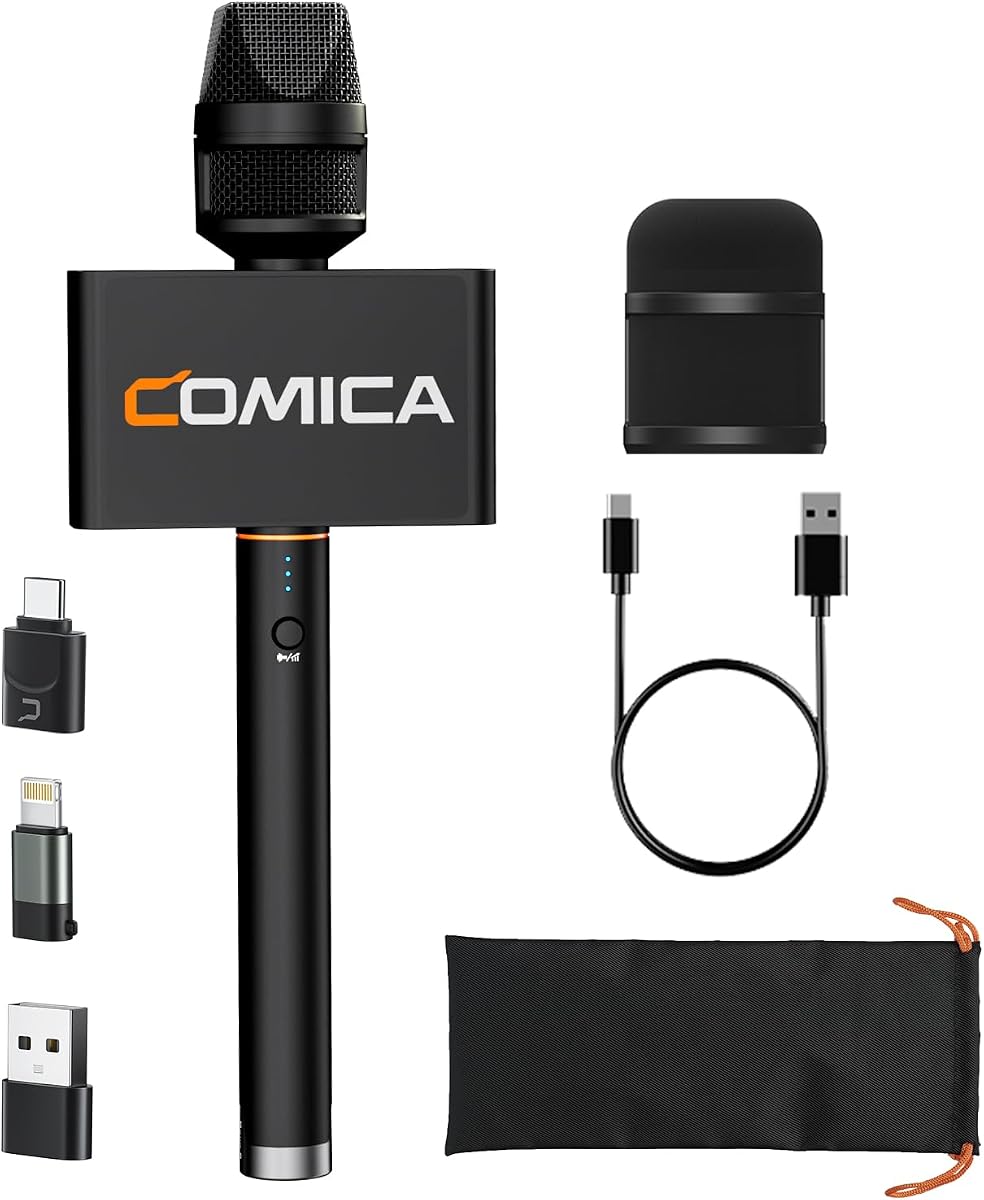
The COMICA Revo S is a wireless handheld microphone built for mobile interviews, reporting, podcasting, and video production. It has a supplied rating of 4.6 out of 5. Unlike a miniature lavalier intended to disappear on a speaker's collar, the Revo S gives the user a traditional handheld reporting tool that can be passed toward a subject or held close to a phone during a conversation.
We may earn a commission when you buy through this link, at no additional cost to you.
A 14mm condenser capsule and cardioid polar pattern are designed to capture detailed, natural sound while concentrating on the person speaking in front of the microphone. The system supports 48kHz and 24-bit recording, and a one-touch CalMix denoise function filters background noise for clearer interviews and videos. Three gain levels give the operator some control over sensitivity when recording quieter or more animated speakers.
Its built-in 350mAh lithium battery is rated for up to 15 hours of use, which is helpful for long reporting days, live sessions, and event coverage. The included USB-C receiver is broadly compatible with iPhone 16 and 15 models, Android phones, iPads, laptops, and computers. A Lightning iPhone requires an appropriate USB-C-to-Lightning adapter that supports OTG, and that extra requirement should be considered before purchase.
The Revo S is ideal for a reporter who wants handheld operation, uncomplicated level choices, and quick one-touch noise reduction. It is less appropriate for a two-person interview where each participant needs a separate microphone, because only one handheld unit is included. It also complements a camera-oriented workflow by allowing a phone to receive the microphone's signal through the receiver while the operator concentrates on positioning and conversation.
The handheld format is familiar to journalists, documentary makers, and podcast hosts. A cardioid capsule can prioritize the person directly in front of it, which helps when a microphone is shared between speakers during a live conversation.
Three gain levels and one-touch denoising allow quick changes without navigating a complex menu. These controls are useful when moving between a quiet interview room, a busy street, or a live event with unpredictable sound levels.
We may earn a commission when you buy through this link, at no additional cost to you.
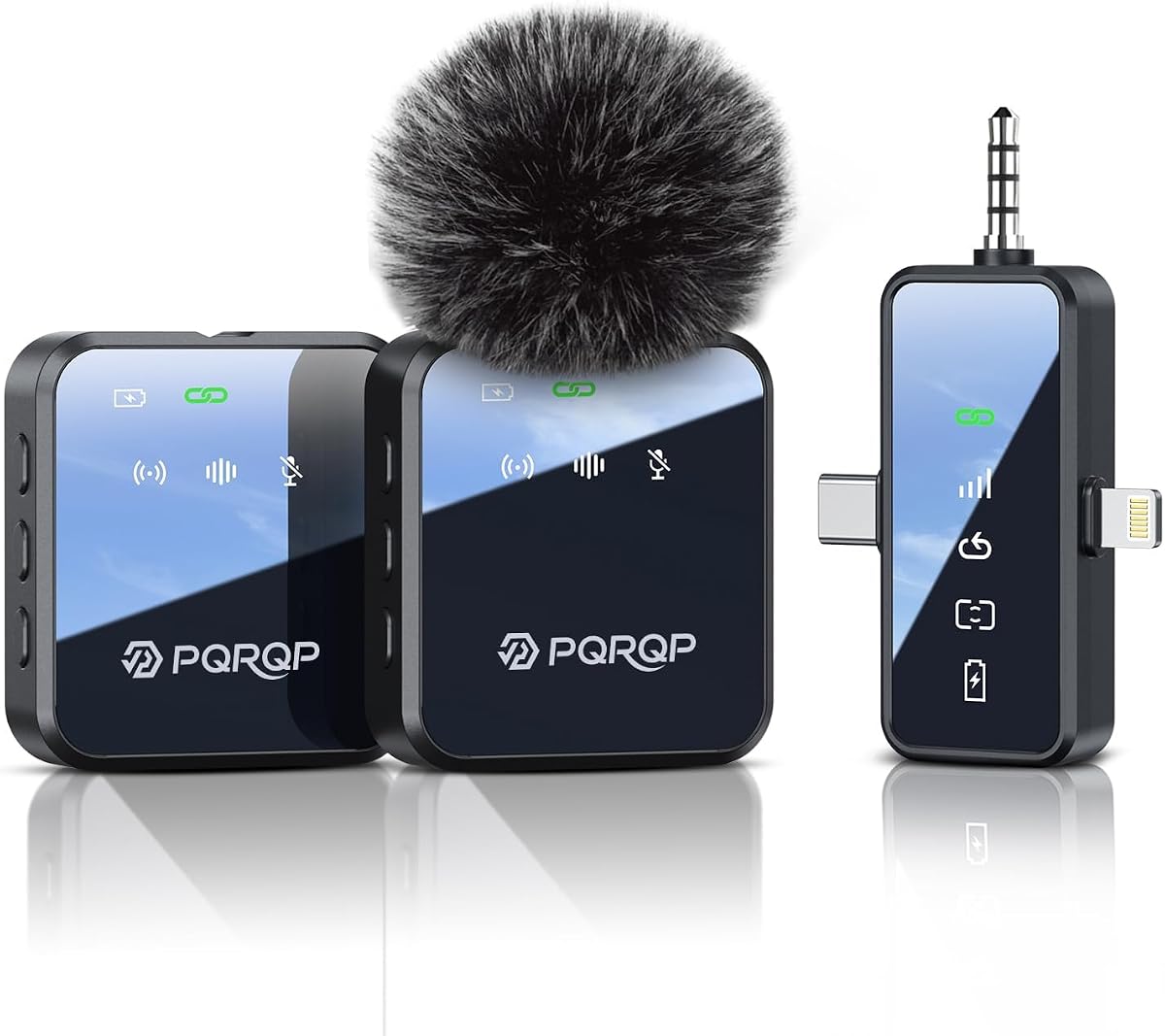
The PQRQP 3 in 1 Wireless Mini Microphone is a dual-transmitter system designed for creators who want an inexpensive wireless setup across phones, tablets, laptops, and cameras. It carries a supplied rating of 4.6 out of 5. The universal receiver concept and plug-and-play design make it appealing for social video, interviews, live streaming, karaoke, podcasts, and general mobile production.
We may earn a commission when you buy through this link, at no additional cost to you.
The stated audio specification is 48kHz and 24-bit, accompanied by advanced noise cancellation to reduce background clutter. A windproof cotton cover adds basic protection for outdoor use. The 2.4GHz system has a listed maximum range of 328 feet and is designed to maintain low latency, allowing speakers to move without constant concern about a long cable connecting them to the recording device.
Battery flexibility is another useful feature. Each microphone is described as lasting up to 10 hours on a single charge, allowing a combined total of up to 20 hours with the dual set. The system also provides one-touch mute and a built-in reverb option. Reverb can be useful for singing, narration, or stylized presentation, while mute lets the operator stop audio without disconnecting the system.
This kit is a value-oriented choice for a creator who needs two wireless microphones and a wide range of connection options. It is less suitable than higher-end systems for anyone who prioritizes internal recording backup, sophisticated polar-pattern selection, or extensive device ecosystem integration. Confirm the receiver and cable fit before a critical shoot, and evaluate the noise reduction and sound character in the recording environment. For general-purpose content, the generous feature set and long stated endurance make it a capable budget package.
The 3-in-1 receiver concept is designed to serve iPhones, Android devices, iPads, laptops, and cameras. That flexibility lets the same wireless system support a vertical phone clip, a computer-based podcast, or a camera-mounted recording setup.
One-touch mute provides an immediate way to pause speech without powering down the system. The built-in reverb option adds a creative effect for singing and narration, although it should be used selectively to maintain a natural vocal result.
We may earn a commission when you buy through this link, at no additional cost to you.
The right external smartphone microphone depends on your recording format, number of speakers, movement, device connection, and tolerance for manual controls. Use the following factors to narrow the category before comparing final features.
In short, verify native compatibility before buying and keep the required cable or receiver with the microphone.
Choose a focused pattern for a nearby subject and a wider or multi-pattern option when ambience, music, or multiple sources must be captured.
Buy one transmitter for solo work, two for interviews, and consider scalable systems for recurring group production.
Use noise control as support, not a substitute for close placement, controlled gain, and a suitable pickup pattern.
Compare runtime for the actual recording duration, then add enough charging-case or spare-power margin for a full event.
Choose wired operation for dependable simplicity and wireless operation when movement and flexible positioning are more important.
Prioritize onboard backup for important interviews and automatic level control for frequent, spontaneous smartphone content.
Choose the package that supports your actual recording locations and device changes, including weather protection and reliable storage.
Before recording, confirm that the microphone or receiver is compatible with the phone, tablet, computer, or camera. Charge every wireless component fully, connect or pair the equipment in an open location, and verify the correct input in the recording app. Test a short clip at the intended microphone position, listen back through headphones or speakers, and check that the subject's voice is present, clean, and free of distortion.
Position the microphone close to the speaker and aim its active side toward the voice. Lavalier transmitters should sit securely on clothing without rubbing against jewelry, fabric, or collars. For directional and handheld models, keep the microphone between one and five feet from the subject where possible, since excessive closeness can cause distortion and excessive distance can make speech sound muffled. Use the included windscreen outdoors and avoid unnecessary high gain if automatic or manual level control is already active.
For care, keep microphones dry and protect the capsule and receiver from dust, moisture, and impact. Windshields should be allowed to dry fully before storage, and wireless transmitters should be turned off when they are not in use to conserve battery. Store wired models with cables loosely coiled rather than tightly bent around the body. Before an important session, perform another recorded test because phone updates, app changes, adapter behavior, and connection settings can affect the result.
No, compatibility depends on the phone's physical connection and audio support. Many recent devices use USB-C, while some iPhone models use Lightning, and certain adapters may not carry microphone input correctly. Check the product's compatibility notes, confirm that the phone accepts external microphones, and test the complete chain before recording.
Wireless systems are usually better when the speaker needs to move, when a visible cable would be distracting, or when a presenter needs distance from the phone. Wired microphones remain attractive for dependable operation, simple setup, and continuous power. The right choice depends on the recording environment and how much freedom the subject needs.
A dual-transmitter wireless lavalier system gives each participant a dedicated microphone and avoids sharing one directional microphone. The Labstandard, RØDE Wireless Micro, DJI Mic Mini two-transmitter set, and PQRQP kit all provide two transmitters. Choose based on connection compatibility, runtime, automatic level features, and whether onboard backup is important.
Yes, provided the microphone sends a compatible audio signal to the phone and the streaming application recognizes the selected input. Plug-and-play USB-C receivers make this straightforward for many modern devices. Confirm the app's audio settings, monitor the level before going live, and keep a backup battery available for wireless systems.
It often does because wind can create low-frequency noise that is difficult to remove cleanly during editing. A foam or furry cover also helps reduce plosive sounds and air movement near the microphone. Protection still needs to be combined with correct positioning, and a windscreen cannot compensate for a microphone mounted too far from the speaker.
A shotgun microphone is useful when the camera or phone stays at a distance and the sound source can remain directly in front of it. A lavalier is more consistent for interviews because it stays close to the speaker and works even when subjects move. Consider whether you need a visible mounted microphone, hands-free operation, or the ability to record environmental sound.
It depends on the system. Most included mobile receivers provide the direct phone connection, while some ecosystems allow transmitters to connect directly to compatible cameras or devices without a traditional receiver. Check the stated compatibility list and make sure the included receiver supports the exact phone, tablet, or computer you intend to use.
Start by moving the microphone closer to the subject, choosing a directional pattern, recording in a room with soft surfaces, and using a windscreen outdoors. Wireless systems with noise cancellation, adaptive gain, or automatic limiting can help further, but excessive processing may sound artificial. Record a test clip, inspect it with headphones, and adjust placement before the important take.
The Movo VXR10 stands out as a versatile wired choice, while the Movo X1-Mini adds digital capability for creators working across phones, computers, and cameras. For wireless solo recording, the DJI Mic Mini one-transmitter package is compact and capable, and the Labstandard provides a budget-friendly dual-microphone option. The RØDE Wireless Micro, dual-transmitter DJI Mic Mini, DJI Mic 3, COMICA Revo S, Shure MV88, and PQRQP kit each bring distinct strengths for interviews, reporting, flexible recording, or creator control.
Prioritize the requirements that cannot change after filming: native device compatibility, the correct number of transmitters, a pickup pattern suited to the subject, and enough battery endurance for the session. Then consider automatic levels, noise control, internal recording, and accessories as usability improvements. The best microphone is not necessarily the one with the longest feature list, but the one that fits the creator, recording environment, and mobile workflow without adding avoidable setup complications.
Before buying, verify the current connector, included receiver, and any adapter requirements against the device you plan to record on. Product ratings, included accessories, and technical specifications can also evolve, and prices and availability change regularly. A brief test recording after setup is the final safeguard and can reveal problems with gain, placement, latency, or app input before a major shoot.