
AT&T ML17929 2-Line Corded Telephone
4.3Editor score
Two lines in one base
Twelve-minute answering system
Three-way conference calling
A reliable phone system helps a doctor’s office keep patients informed, support multiple clinical areas, and route urgent calls without unnecessary interruptions. The right setup should balance line capacity, answering-machine access, cordless coverage, call filtering, privacy features, and straightforward installation.
This guide compares ten office phone systems using their published specifications, including supported lines, handset capacity, caller information, recording options, connectivity, conferencing, speakerphone access, and call-blocking tools. It covers compact corded models, corded-cordless combinations, and multi-handset DECT systems for different practice sizes.
Each pick highlights a distinct way to handle everyday patient and staff communication, from simple two-line desksets to expandable systems with auto attendants, multiple mailboxes, Bluetooth cell connections, and larger message capacity. Product availability, features, and prices can change, so readers should verify current details before purchasing.
4.3Editor score

4.0Editor score
4.3Editor score
As an Amazon Associate we earn from qualifying purchases.
The comparison highlights the most important differences among these ten systems, including supported line counts, cordless expansion, answering capacity, connectivity, and call-management tools. It helps small practices match a straightforward desk phone with a multi-handset system suited to busy clinical spaces.


The VTech AM18447 is the most complete dedicated business phone system in this roundup, combining four analog lines, a digital answering machine, an auto attendant, intercom, and room for ten stations. Its 4.0 rating reflects a feature-rich option for offices that need more control than a basic two-line telephone offers.
We may earn a commission when you buy through this link, at no additional cost to you.
Its most valuable feature for a doctor’s office is the professional auto attendant. Each line can automatically answer, offer directory access, route calls to extensions, and record voicemail, reducing the chance that a patient reaches a busy desk. The system also supports up to 180 shared minutes for messages, announcements, and memos, while a customizable music-on-hold connection gives the practice a more polished call experience.
Installation is designed to be straightforward for a small office. The main console connects to analog lines through RJ11, and compatible cordless handsets or desksets use one-touch DECT 6.0 pairing. This avoids the need for a separate professional wiring setup, although the practice must already have suitable analog line service or a compatible line interface.
This is the strongest recommendation for a growing practice with reception, exam rooms, and administrative staff that need multiple extensions. It is less suitable for a solo clinician who only needs one desk phone, but for shared call routing and centralized voicemail, the AM18447 provides a notably business-focused feature set.
The per-line auto attendant can greet callers, present a company directory, and direct them to internal extensions. That makes it easier for patients to reach the appropriate department without requiring a receptionist to answer every call personally.
A shared 180-minute recording system stores incoming messages, announcements, and office memos. Staff can also use the console’s directory, speed dials, full-duplex speakerphone, and customizable hold music to manage routine communication.
We may earn a commission when you buy through this link, at no additional cost to you.
The AT&T DLP73590 is built around five cordless handsets and a large five-inch color base display, making it an attractive choice for clinics where staff move between reception, treatment rooms, and administrative areas. Its 4.2 rating and broad feature set position it as a flexible cordless-first alternative to a traditional console system.
We may earn a commission when you buy through this link, at no additional cost to you.
One-touch shortcuts on the base provide quick access to contacts, messages, call history, and the timer. The display offers easier menu navigation than a small monochrome screen, while DECT 6.0 technology, the antenna design, and noise filtering support long-range clarity. Conference calling can connect an outside line with up to four cordless handsets, and intercom permits internal communication across the system.
The standout clinical-office benefit is its Smart Call Blocker and one-touch block control. Robocalls on the landline are automatically blocked, while staff can blacklist an incoming number immediately and maintain a list of up to 1,000 names and numbers. That focus on reducing nuisance calls is especially useful when reception personnel are occupied with patient scheduling.
Choose this model when staff need dependable handsets in several rooms and a large, easy-to-navigate base. It is less appropriate when a practice requires multiple analog lines or a formal auto attendant because its published strengths center on cordless movement, call filtering, and internal communication.
A dedicated handset can remain at reception, while others serve consultation rooms, treatment areas, or administrative stations. Cordless intercom and paging reduce the need to walk across the office for internal communication.
Automated robocall filtering and a large blacklist reduce interruptions. The one-touch block action is particularly useful during busy patient intake periods when a staff member needs to dismiss an unwanted call quickly.
We may earn a commission when you buy through this link, at no additional cost to you.
The AT&T TL86103 combines a corded base, cordless handsets, a two-line answering system, and Bluetooth cell connectivity in a package designed for small offices and home offices. Its 4.1 rating reflects a balanced system that offers practical flexibility without requiring a large console.
We may earn a commission when you buy through this link, at no additional cost to you.
Its Connect-To-Cell feature allows two mobile phones to connect to the system, letting staff make and receive calls through the familiar office handsets while using their cellular plans. Up to 6,000 cellular phonebook entries can be downloaded, which is helpful for staff who rely on constantly changing personal contact lists. The base also includes two USB charging ports.
The digital answering system has two separate mailboxes with up to 22 minutes of recording time each. That separation can help organize business and personal messages or assign different reception and clinical destinations. A line-power mode supports continued use of the corded handset during a power outage, providing a valuable continuity feature for essential communication.
This system is a good middle ground for a small practice that wants cordless mobility, reliable desk calling, and cell connectivity without moving to a multi-line business console. Its two-line limit makes it less suitable for a clinic expecting several simultaneous external lines, but it offers generous handset expansion and strong everyday flexibility.
Line-power mode allows the corded handset to remain available during a power interruption. That gives the office a dependable station for urgent patient communication if the rest of the setup loses power.
Separate recording areas allow staff to divide messages by purpose or function. With up to 22 minutes in each mailbox, the system offers more recording space than many compact office alternatives.
We may earn a commission when you buy through this link, at no additional cost to you.
The Panasonic KX-TG9582B combines two lines, a corded base, two cordless handsets, an answering machine, and DECT 6.0 connectivity. Its 4.2 rating makes it a compelling option for a medical office that needs solid voice quality, flexible mobile integration, and a modest number of stations.
We may earn a commission when you buy through this link, at no additional cost to you.
Link2Cell allows up to four smartphones to connect with the home and office phones through Bluetooth, making it possible to answer cellular calls through the office handsets. The system also offers three-way conferencing among the corded telephone and two cordless phones, with hands-free operation through the base and handset speakers.
Automatic noise reduction suppresses background interference and enhances voice tones, which can be valuable in active offices where background sound is common. DECT 6.0 is designed for secure, wide-range communication and is particularly useful in buildings with thick walls. The handset has a 1.8-inch monochrome LCD, and the base connects to a compatible PC for Outlook calling when that integration is configured.
This Panasonic is well suited to a practice that wants better call clarity and smartphone bridging without moving to a large business console. It may be less appealing to administrators who prioritize a large color directory display or many included handsets, but its line control, conferencing, and noise filtering cover the core needs of a small clinic.
The system automatically reduces background interference and emphasizes voice tones. That makes the KX-TG9582B a practical choice for shared workspaces where clarity matters more than decorative displays.
Link2Cell can pair up to four smartphones, allowing staff to receive cellular calls at the office system. A compatible PC connection also supports Outlook contacts and incoming calls from a computer.
We may earn a commission when you buy through this link, at no additional cost to you.
The VTech DS6151-2 is a two-line, two-handset system with an answering mailbox for each line. Its 4.1 rating and expansion to twelve handsets make it suitable for a small medical practice that wants to begin with a modest number of stations and grow as the office adds staff.
We may earn a commission when you buy through this link, at no additional cost to you.
A major practical benefit is the two-line arrangement. The system supports conference conversations between an outside line and up to two cordless handsets, while intercom communication connects the handsets and base. This allows reception and clinical staff to coordinate without relying exclusively on mobile devices.
The digital answering system records up to 13 minutes, and each line has its own mailbox. Caller ID history holds 50 names and numbers, helping staff recognize repeat patients and routine business contacts. The menu supports English, Spanish, and French, which broadens accessibility for practices serving multilingual patient populations.
The DS6151-2 is a sensible pick for a growing office that prioritizes cordless flexibility and easy expansion. Its relatively limited recording time and modest display make it less attractive for a high-volume clinic that needs long voicemail archives or a large visual call-management interface.
The system can grow to twelve handsets, allowing a practice to add stations over time. This makes it easier to align equipment with new exam rooms, staff positions, or departmental needs.
English, Spanish, and French menu support helps staff and callers navigate the system. Per-line mailboxes also keep incoming messages associated with the correct telephone service.
We may earn a commission when you buy through this link, at no additional cost to you.
The AT&T ML17929 is a straightforward two-line corded telephone with a built-in speakerphone, caller ID, call waiting, and three-way conferencing. Its 4.3 rating makes it a practical selection for a small office or individual treatment room that needs dependable desk calling without a cordless ecosystem.
We may earn a commission when you buy through this link, at no additional cost to you.
The phone manages two separate lines through one base and adds a hands-free Clearspeak speakerphone with adjustable volume. A 99-name-and-number caller history gives reception staff useful context before answering, while line-status indicators make it easy to see which line is active. The last five numbers can also be redialed.
One particularly important feature for a medical office is power-failure operation on Line 1. The system can continue making and receiving calls on that line during an outage, offering a useful backup point for urgent communication. The phone is also headset compatible, which can make documentation and call handling easier for staff who prefer hands-free operation.
This is the budget-minded choice for a solo practitioner, small reception desk, or single room where two-line control matters more than voicemail or cordless mobility. It does not include an answering machine, so practices that need to capture patient messages after hours should look at the AT&T ML17939 or one of the multi-handset systems.
Line 1 remains usable during a power failure, creating a dependable fallback for urgent calls. This makes the ML17929 useful as a simple backup phone or as the main phone in a small, controlled workspace.
The adjustable base speaker supports hands-free conversations, while headset compatibility gives staff another way to work while on a call. Both features are useful at compact reception and consultation desks.
We may earn a commission when you buy through this link, at no additional cost to you.
The AT&T TL88102BK is a two-line DECT 6.0 system supplied with three cordless handsets. Its 4.1 rating and four-way conferencing support make it a strong fit for a doctor’s office that needs several wireless stations while retaining two external lines.
We may earn a commission when you buy through this link, at no additional cost to you.
DECT 6.0 is designed to reduce interference, improve clarity, increase wireless range, and provide enhanced security. The large LCD has an adjustable tilt, making the base easier to view at a reception desk, and the menu supports English, Spanish, and French. Dual caller ID and call waiting help staff identify incoming calls on both lines.
The three included handsets provide enough equipment to distribute the system immediately across reception and two other work areas. Expansion to twelve handsets gives the practice room to grow. Four-way conferencing allows multiple staff members to discuss scheduling, records, or patient questions from separate handsets without gathering around a single desk.
This AT&T model is a strong option for clinics that want more than two included cordless stations but do not need Bluetooth cell integration. It is a particularly balanced option for teams prioritizing line control, internal conferencing, and future handset expansion over smartphone pairing.
Staff can connect up to four parties through the system, making it easier to resolve scheduling or clinical-room questions while everyone remains at a separate station.
The package includes three cordless handsets, allowing immediate placement at reception, treatment, and administrative locations. The option to expand to twelve keeps the system practical as the practice grows.
We may earn a commission when you buy through this link, at no additional cost to you.
The VTech DS6151-11 combines a DS6151 cordless base with three DS6101-11 accessory handsets, creating a four-handset package for a two-line office. Its 4.1 rating makes it attractive for medical practices that need more than the standard two-handset configuration without moving to a large business console.
We may earn a commission when you buy through this link, at no additional cost to you.
DECT 6.0 technology at 1.9GHz is intended to provide interference-free operation, wide range, and stronger privacy. The published battery-life improvement is 30 percent, while the base and handset both provide speakerphone access. A large backlit LCD, backlit keypad, and adjustable handset volume help staff read and operate the phones in different clinical spaces.
The base includes a 13-minute digital answering system, caller ID and call waiting, a 50-entry phone directory, selectable ringtones, paging, a handset locator, and redial. The accessory handsets make it easier to place stations in several rooms, which can shorten internal communication and allow staff to answer the office line away from reception.
This package is a good fit for a small clinic with three or four staff members who need wireless extensions. It is less suitable for a high-volume practice that needs longer voicemail retention because the recording capacity remains modest, and the monochrome screens are simpler than those on the larger VTech color-display systems.
Three accessory handsets join the base phone to provide four stations. That distribution can improve access for staff working in treatment rooms, a records office, and a separate reception area.
A handset locator and paging function can help staff find a misplaced cordless phone. This is useful in busy offices where devices are frequently moved between work surfaces.
We may earn a commission when you buy through this link, at no additional cost to you.
The AT&T ML17939 is a two-line corded telephone with an integrated digital answering machine. Its 4.3 rating and combination of caller management, voicemail, speakerphone, and conferencing make it a straightforward choice for a small office that wants a single desk to handle both lines and after-hours messages.
We may earn a commission when you buy through this link, at no additional cost to you.
The integrated answering system records up to 12 minutes, supports a custom greeting, and allows remote access for checking messages from another telephone. Caller ID and call waiting display incoming name, number, and time, while the phone stores 100 names and numbers and provides 18 speed-dial entries. Three-way conferencing lets a staff member add another party to an active call.
A large backlit display, ClearSpeak speakerphone, and 2.5-millimeter headset jack support hands-free use and easier call review. The base can be placed on a desk or mounted on a wall. Line-status indicators and automatic line selection simplify operation when both lines are active.
This model is best for a solo provider, small front desk, or treatment room that needs voicemail but does not require cordless coverage. Buyers should confirm that the office has a standard RJ11 analog output; it will not connect directly to an Ethernet port, and a VoIP or fiber box must provide compatible RJ11 access.
Staff can retrieve voicemail from another telephone, allowing a provider away from the office to check whether a patient left a message. A custom greeting also lets the practice present a consistent call-handling message.
The telephone requires a standard RJ11 analog jack rather than Ethernet. Practices using VoIP or fiber should verify that their equipment supplies an RJ11 output before installation.
We may earn a commission when you buy through this link, at no additional cost to you.
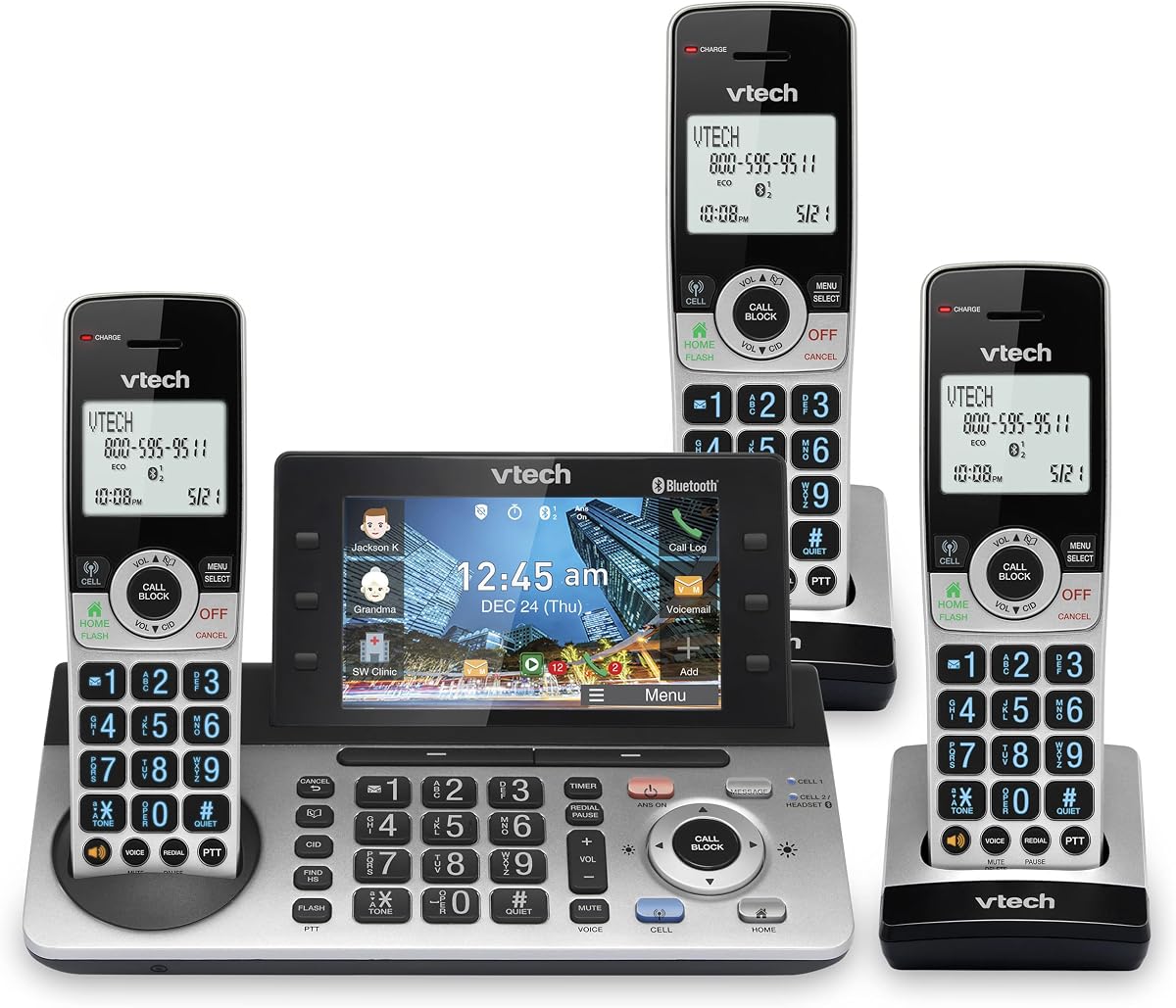
The VTech IS8251-3 is a business-grade cordless system with three handsets, a five-inch color base display, programmable shortcuts, advanced voicemail, Bluetooth cell connectivity, and smart call blocking. Its 4.3 rating makes it the most feature-forward visual and call-management option among the cordless-focused picks.
We may earn a commission when you buy through this link, at no additional cost to you.
The large display, large icons, and soft keys make the base easier to navigate than a traditional monochrome handset. Programmable shortcuts provide one-touch access to contacts, messages, call history, and the timer. Staff can also return a caller directly from the displayed message or history, saving time when patients are waiting for a response.
Its virtual two-line system manages landline and cell-line activity simultaneously. Users can pair up to two cell phones, or one cell phone and one Bluetooth headset. The advanced digital answering system displays caller information for recorded messages, lets staff choose which message to play, and offers 40 minutes of recording capacity. Smart Call Blocker stops many robocalls before they ring through.
This is the premium recommendation for a modern office that values a visual interface, flexible cell connectivity, and more voicemail capacity. It is less appropriate for a practice needing several conventional analog lines or a formal auto attendant, but it is particularly useful for smaller teams that want sophisticated cordless call management.
The five-inch screen shows caller information alongside the message list, allowing staff to select whom to listen to first. This is more informative than a small handset-only caller display when many patients leave messages.
Pairing up to two cell phones, or a phone and Bluetooth headset, lets staff use cellular service through the office system. At the same time, the virtual two-line design manages landline and cellular activity together.
We may earn a commission when you buy through this link, at no additional cost to you.
The best phone system for a doctor’s office depends on call volume, staffing, room layout, line infrastructure, and the need to manage patient messages. These factors help narrow a broad category of business and home-office phones to a setup that fits daily clinical work.
Begin by counting the external lines the practice needs and confirming how its telephone service is delivered. Some systems support two analog lines, while the VTech AM18447 handles four. Other cordless models create a virtual two-line experience by combining a landline with a cellular connection. Because this distinction affects installation, list every line used for incoming patient calls, outgoing appointments, fax lines, or other services before choosing equipment.
Summary: Match line capacity to the office’s real services and verify connection type before buying.
Think about where phones will be located, not just how many employees work there. A reception desk, several exam rooms, a records office, and a provider’s private office may each benefit from a dedicated handset. Some packages include two or three units, while others can expand to ten or twelve. Expansion is valuable when a practice expects to add staff or rooms, but it requires compatible accessories and enough charging capacity.
Summary: Choose enough included stations for immediate use and a clear expansion path.
Patients may call when the office is closed, during appointments, or while the reception desk is occupied. An answering system should provide a professional greeting, clear message playback, and enough recording time for a typical workload. The systems here range from 12 and 13 minutes to 40 or 180 shared minutes. Larger capacities are useful for high call volumes, while separate mailboxes can divide reception, clinical, and after-hours messages.
Summary: Prioritize recording capacity, mailbox separation, remote access, and caller identification.
Cordless handsets are most useful when they remain reliable throughout the clinical area. DECT 6.0 models are designed for improved range, clarity, and interference resistance, but walls, electrical equipment, and building layout still matter. Check the manufacturer’s stated range and avoid assuming that a handset will perform identically in every clinic. Perform a practical walk test after installation, moving from reception to remote treatment rooms.
Summary: Use DECT 6.0 for stronger cordless performance, then test coverage in every clinical area.
A medical office can become distracting when robocalls and unwanted solicitations interrupt patient scheduling. Smart Call Blocker, one-touch blocking, and large blacklist storage help reduce this problem. The AT&T DLP73590 and VTech IS8251-3 both advertise automatic robocall filtering. These functions do not replace careful call screening, but they can reduce the volume of interruptions that would otherwise reach the front desk.
Summary: Choose robust automated blocking and quick manual blacklist controls for a quieter office.
Hands-free operation can improve workflow when staff need to type notes, locate a file, or coordinate with another team member. Every product in this guide includes some form of speakerphone, while several support headsets. Conferencing ranges from three-way calls on basic models to four-handset and four-way conversations on the multi-handset systems. Choose based on whether the office mainly needs external collaboration or frequent internal group conversations.
Summary: Match speakerphone, headset, and conferencing features to the office’s daily workflow.
A larger display can save time by making contacts, messages, and call history easier to scan. The DLP73590 and IS8251-3 use five-inch color screens, while smaller monochrome displays keep the interface simple. Trilingual menu support on several VTech and AT&T systems can improve accessibility for multilingual staff or callers. Larger screens are not automatically better, however; a clear interface and quick shortcuts may matter more than color or size.
Summary: Favor an interface that is readable, accessible, and easy to operate under pressure.
A medical practice should consider how calls will work during a power interruption. The AT&T ML17929 supports line-power operation on Line 1, while the TL86103’s line-power mode helps keep its corded handset operational. Installation also varies: some products use only standard analog jacks, while business consoles and cordless bases require compatible line service. Confirm jacks, service compatibility, handset pairing, and intended mounting locations before setup.
Summary: Verify outage support, analog or VoIP compatibility, and the physical setup at each station.
Plan the layout before installing equipment. Place the main base at reception or another central location, keep cordless handsets near exam rooms where staff can answer reliably, and avoid placing bases beside unnecessarily loud equipment. Confirm that every analog jack, line connection, and charging station is in the correct location before pairing handsets or changing system settings.
Configure the office identity carefully. Record a concise greeting that identifies the practice, states when staff are available, and gives patients a useful next step. Test each line, extension, voicemail box, call transfer, speakerphone, headset, and recording. Publish internal extensions so staff know which number to use for urgent matters, scheduling questions, prescription requests, or other routine patient needs.
Maintain the system by regularly reviewing voicemail greetings, checking recorded messages, and updating directory names and speed dials. Keep handsets charged on their approved cradles, clean surfaces with a soft dry cloth, and avoid placing moisture near electrical ports. Test power-failure procedures so staff know which line and handset to use if the main setup becomes unavailable.
The best choice depends on staffing and call flow. A two-line corded model works for a solo practitioner or single desk, while a two-line cordless system suits offices with staff in several rooms. A multi-line console with an auto attendant is appropriate when reception needs automated routing and centralized voicemail. Match the equipment to existing telephone service rather than choosing only by feature count.
It depends on the specific telephone provider and whether the service supplies a compatible analog RJ11 connection. The AT&T ML17939 clearly requires a traditional RJ11 jack and does not connect directly to Ethernet. Other systems may support analog lines or offer Bluetooth cell connectivity, but buyers should verify line compatibility with their VoIP or fiber equipment before purchasing or installing.
Start with one station for each location that regularly handles calls, such as reception, an exam room, a treatment room, and a records desk. Staff do not always need a dedicated handset if rooms are close together, so walking the office and mapping call traffic is more useful than matching the phone to the total employee count. Expansion options matter if the practice plans to hire or add rooms.
The VTech AM18447 provides up to 180 shared minutes for incoming messages, announcements, and memos, making it the strongest choice in this group for extensive recording capacity. The VTech IS8251-3 follows with 40 minutes, while the AT&T TL86103 provides up to 22 minutes in each of two mailboxes. The right amount depends on call volume and whether separate message organization is more important than raw capacity.
A cordless system can be reliable when its range is tested in the actual building. DECT 6.0 products are designed to provide strong range, clarity, and interference resistance, but thick walls and electrical equipment may affect performance. Test calls between reception and remote rooms after installation. Keep a corded station available if uninterrupted communication during a power interruption is important.
Smart Call Blocker and one-touch blacklisting are among the most useful published features in this roundup. The AT&T DLP73590 supports a list of up to 1,000 blocked names and numbers and automatically filters robocalls, while the VTech IS8251-3 also provides automatic robocall blocking. These controls reduce interruptions, but staff should continue using appropriate call-screening procedures for patient privacy.
Yes, every listed phone includes speakerphone functionality, although the controls and placement vary. The AT&T ML17929 and ML17939 also support a 2.5-millimeter headset, and the VTech IS8251-3 can pair a Bluetooth headset with a cell phone. For regular headset use, confirm connector type and compatibility before installation.
An auto attendant is valuable when several lines need automated routing, directory access, or voicemail capture. The VTech AM18447 provides a professional per-line auto attendant, making it more suitable for a multi-line reception environment than the simpler two-line systems. Solo practices may not need one, while growing clinics can use it to reduce the burden of answering every incoming call.
The VTech AM18447 is the strongest all-around choice for a practice that needs four lines, auto attendant routing, centralized voicemail, and expansion to ten stations. The AT&T ML17929 is the most economical option for a simple two-line desk, while the VTech IS8251-3 offers the most polished cordless interface with a five-inch color display, substantial recording capacity, and cell connectivity.
Prioritize the features that match actual office work. Choose multiple handsets and strong DECT coverage for staff who move between rooms, separate mailboxes for organized message handling, and smart call blocking for a busy front desk. Verify the existing analog or VoIP connection, confirm power-outage behavior, and test every station before treating the installation as complete.
Finally, remember that product features, package contents, availability, and prices can change. Check the current listing and technical details before buying, especially for line compatibility, accessory handsets, headset connectors, and answering-system capacity. A short site-planning session can prevent an unsuitable purchase and keep patient communication running smoothly.