
Calibrite Display 123
4.0Editor score
Guided 1-2-3 setup
Supports two displays
USB-C connectivity
Our Colorimeter for Monitor Calibration guide compares ten devices for accuracy, HDR support, ease of use, multi-display workflows, and photo or video needs.
A colorimeter for monitor calibration measures the colors and brightness your display actually produces, then helps create a profile that improves consistency across editing, grading, design, and image review. A capable device can reveal color shifts, reveal clipping, and make your screen more dependable when judging photographs, video, and digital artwork.
The products in this guide were compared using their published specifications, supported display technologies, workflow features, software controls, and intended creative uses. The list includes approachable USB colorimeters, high-luminance sensors for modern HDR panels, and complete capture-to-edit kits that pair display profiling with camera-reference tools.
Each review explains the strongest reasons to consider a particular model, along with limitations that may affect your setup. The top selections show where the easiest, most advanced, and most complete approaches fit. Product features and availability can change, and prices fluctuate, so compare the current listing before purchasing.
4.0Editor score

4.2Editor score

4.0Editor score
This side-by-side comparison highlights each colorimeter's sensor capabilities, display support, software workflow, and strongest use cases, helping you choose the right tool for standard, HDR, multi-screen, photography, or video work.


The Calibrite Display 123 combines an approachable colorimeter with a guided workflow that is intended to make monitor calibration less intimidating. Its 4.0 rating reflects a practical product aimed at photographers and creators who want a clearer, more consistent display without navigating a complex collection of specialist settings.
We may earn a commission when you buy through this link, at no additional cost to you.
The defining feature is the Easy 1-2-3 software workflow. It walks the user through calibration while offering brightness target choices such as Native and Photo. The built-in before-and-after check provides immediate visual confirmation, which is particularly helpful for new users who may not know what an improved profile should look like. USB-C connectivity and an adjustable counterweight make the physical setup relatively tidy.
This model supports up to two displays, so it can cover a common two-screen editing arrangement without requiring a separate unit for each panel. Its limitations are most visible in advanced HDR production. The product does not advertise the very high luminance measurement range or extensive video-standard controls associated with specialist high-luminance instruments, and its target choices are simpler than professional grading tools.
It is a strong recommendation for a photographer, designer, student, or general creative professional working with standard laptop or desktop displays. Choose the Display 123 when straightforward setup, repeatable operation, and multi-display support matter more than measuring the brightest highlights available on premium HDR panels.
The guided setup reduces the chance that a first-time user will skip important preparation or misunderstand the calibration sequence. Clear prompts and selectable brightness targets help keep the process focused on producing a repeatable result rather than experimenting with advanced parameters.
Supporting two displays makes the device practical for photographers who keep a reference panel beside an editing monitor. Sequential profiling also helps color-management software manage each screen as an individual output rather than assuming every panel has identical characteristics.
We may earn a commission when you buy through this link, at no additional cost to you.
The Calibrite Display Plus HL is built for users who need to profile very bright, modern displays rather than only conventional standard-dynamic-range monitors. Its 4.0 rating accompanies an advanced high-luminance sensor that measures up to 10,000 nits, making it a compelling choice for HDR grading, color-critical video work, and super-bright laptop or desktop panels.
We may earn a commission when you buy through this link, at no additional cost to you.
Calibrite PROFILER gives users both Basic and Advanced modes. The latter exposes white point, luminance, contrast ratio, gamma, custom patch sets, and shared presets. The product supports LCD, mini-LED, OLED, Apple XDR, HDR-capable displays, and compatible projectors. Video-oriented features include Rec.709 support and BT.1886 tone-curve options for Rec.2020 workflows.
Professional validation features set it apart from simple colorimeters. Quick Check, Profile Validation, Uniformity Check, and Profiler Manager provide useful ways to inspect the result and monitor its condition over time. Multi-monitor profiling also supports the goal of matching color across a larger editing workspace. The trade-off is complexity: users who only need a simple photo workflow may find the advanced controls excessive.
This is the leading recommendation for video editors, colorists, HDR specialists, and serious creative professionals using very bright displays. It is especially relevant when highlight luminance, tone mapping, panel consistency, and professional validation matter. For ordinary SDR editing, its specialized capabilities may exceed what the task requires.
A 10,000-nit measurement capability allows the sensor to evaluate the extreme highlights associated with premium HDR displays. That range is important when the goal is not merely to create a profile but to profile a panel whose brightness behavior differs substantially from conventional monitors.
Quick Check, Profile Validation, and Uniformity Check help users verify performance after calibration. These functions can reveal whether a display is behaving consistently, making the product more useful for ongoing professional color-management maintenance.
We may earn a commission when you buy through this link, at no additional cost to you.
The datacolor Spyder Monitor Calibrator and Screen Color Calibration Tool offers a strong balance of speed, automation, and modern-display awareness. Its 4.2 rating reflects a device designed to make accurate color accessible, with an approximately 90-second calibration process that is among the quickest workflows represented in this guide.
We may earn a commission when you buy through this link, at no additional cost to you.
Compatibility is a major strength. The product supports laptop and desktop displays, including OLED, mini-LED, and Apple Liquid Retina XDR, along with current Windows and Mac operating systems. An integrated ambient light sensor measures room illumination and can recommend brightness and contrast adjustments, warn that recalibration is needed, or apply custom profiles linked to lighting levels.
The software serves both beginners and experienced users. A preset calibration option creates an accessible starting point, while customizable settings provide greater creative flexibility for professionals. DevicePreview beta adds another valuable layer by simulating how images may appear on other devices using the calibrated screen. One limitation is that the published specifications do not state a maximum high-luminance measurement range, so the most demanding HDR specialists may want more explicit information.
This is an excellent choice for users with recent premium displays who want fast, repeatable calibration without navigating an overly technical process. It works particularly well for photographers, general designers, hybrid creators, and anyone whose room lighting changes during the day. Its combination of modern panel support and automatic adaptation makes it especially attractive for a mixed creative workflow.
The ambient light sensor is more than a convenience feature in a variable workspace. By tracking room conditions, the software can help maintain a more suitable viewing brightness and alert the user when a new profile or recalibration would be preferable.
The roughly 90-second target process suits users who want a quick initial improvement, while customizable options preserve room for advanced work. This balance makes the tool relevant to both first-time colorimeter owners and experienced creative professionals.
We may earn a commission when you buy through this link, at no additional cost to you.
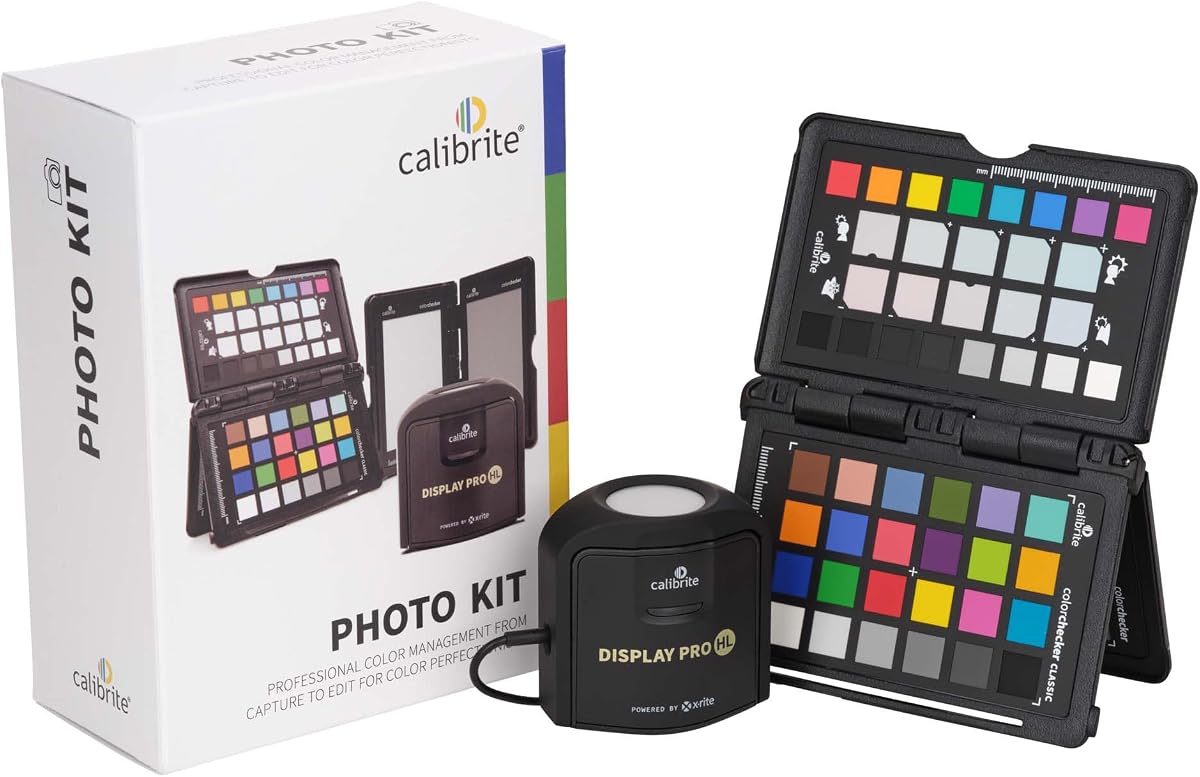
The Calibrite Photo Kit combines a Display Pro HL colorimeter with a ColorChecker Passport Photo 2 to address both camera capture and monitor viewing. Its 4.5 rating is the highest among the conventional colorimeters in this guide, reflecting the appeal of a coordinated photo workflow rather than a display-only accessory.
We may earn a commission when you buy through this link, at no additional cost to you.
Custom camera profiles for RAW stills are the key addition beyond traditional monitor calibration. Passport Photo 2 provides a reference for white balance and exposure, helping photographers establish repeatable starting conditions before grading or retouching. Display Pro HL calibrates modern mini-LED, OLED, and Apple XDR panels, so the kit can also support higher-end HDR editing environments.
Calibrite PROFILER supplies customizable targets, presets, white-point options, and gamma controls. Together, the colorimeter and reference target address a common source of inconsistency: differences between camera captures, editing displays, and final delivery. The limitation is that the bundle is more specialized than a simple colorimeter, and buyers interested primarily in video may find a video-oriented reference target more directly relevant.
Choose this kit when your photography process begins with RAW capture and extends into detailed screen-based editing. It is particularly useful for photographers seeking more repeatable color across sessions, locations, and lighting conditions. For a photographer who only needs to tune one standard display, the broader capture workflow may be more than required.
Using a dedicated reference target can reduce the guesswork involved in setting white balance and exposure. Establishing repeatable capture conditions makes it easier to separate lighting and camera effects from the color adjustments made later on the monitor.
Display Pro HL brings high-luminance profiling to a photography-focused bundle. That matters when an editing setup includes mini-LED, OLED, or Apple XDR displays whose brightness behavior differs from conventional panels.
We may earn a commission when you buy through this link, at no additional cost to you.
The Calibrite Creator Kit is an integrated color-reference system for photographers, filmmakers, and hybrid creators. It combines the straightforward Display 123 colorimeter with a ColorChecker Passport Video 2, earning the highest rating in this roundup at 5.0 and standing out for its connection between on-set reference control and post-production viewing.
We may earn a commission when you buy through this link, at no additional cost to you.
Passport Video 2 assists with white-point setup, exposure verification, and matching multiple cameras under changing or mixed lighting. Display 123 then profiles the editing display through an easy workflow. Together, these elements target a persistent production problem: footage captured with different cameras or lighting conditions can look inconsistent before editing even begins.
The bundle is especially relevant to videographers and hybrid shooters who want dependable color standards across cameras, monitors, and software platforms. It may also appeal to photographers who work with video. Its main limitation is display capability: Display 123 is designed for straightforward profiling and does not offer the extreme luminance range of the Display Plus HL or Display Pro HL.
This is a strong recommendation for creators who value a complete capture-to-edit system and do not need dedicated high-luminance HDR profiling. The kit offers a practical way to improve both reference control and display accuracy. For users working primarily on very bright HDR displays, however, a specialist high-luminance colorimeter would be the more logical primary instrument.
The included reference can help verify exposure and establish white balance before the footage reaches post-production. When several cameras are used in changing light, an objective on-set reference can reduce the need for later visual guesswork.
The combination serves both photography and filmmaking workflows, making it practical for hybrid creators. The Display 123 keeps the monitoring side approachable while Passport Video 2 adds capture control that a display-only colorimeter would not provide.
We may earn a commission when you buy through this link, at no additional cost to you.
The Calibrite ColorChecker Display Pro, identified as CCDIS3, is a capable display and projector colorimeter with a 4.2 rating. Its optical design emphasizes repeatability across repeated measurements and across different display types, which are essential qualities for anyone attempting to maintain consistent color from session to session.
We may earn a commission when you buy through this link, at no additional cost to you.
It works with ccProfiler or i1Profiler software and includes a rotatable diffuser arm that can serve as a tabletop projector stand, an ambient-light measurement aid, and a cover for the instrument optics. An integrated tripod mount is useful for profiling projectors in larger venues where the sensor must be positioned precisely.
The product is not limited to computer monitors, giving it a distinct advantage for installation work, presentations, projection environments, and users who need to profile more than one type of visual output. It does not advertise the very high luminance measurement range or modern panel-specific workflow found in newer HL products, so its strongest fit is traditional color-managed display and projector profiling.
Buy the ColorChecker Display Pro if projector profiling or repeatable optical measurements are priorities. It is also a sensible option for users already comfortable with the ccProfiler or i1Profiler ecosystem. For the newest HDR laptop and desktop panels, a newer high-luminance model may offer a more forward-looking feature set.
The rotatable diffuser arm is more than a stand. It can cover the optics for handling and ambient-light measurement while also supporting tabletop projector profiling, reducing the need for separate accessories across common tasks.
Consistent measurements make it easier to determine whether a profile reflects actual display changes. That repeatability is valuable for calibrating several screens or revisiting the same installation after adjustments to brightness, contrast, or ambient conditions.
We may earn a commission when you buy through this link, at no additional cost to you.
The Datacolor Spyder5PRO is a full color-management option for photographers and designers managing laptop and desktop displays. Its 4.3 rating reflects a well-rounded tool with room-light monitoring, multi-display analysis, and a roughly five-minute full calibration process that is still quick enough for regular use.
We may earn a commission when you buy through this link, at no additional cost to you.
Room-light monitoring is particularly useful for shadow and highlight judgment. The software evaluates the viewing environment to help determine an appropriate monitor brightness, making it easier to preserve subtle tonal information while editing. RGB monitor profiles are generated for the connected display, and the before-and-after evaluation lets users inspect the result through their own photographs rather than a generic comparison.
Display Analysis allows users to evaluate and compare multiple laptop and desktop monitors, a valuable feature for studios working across different screens. The main concern is timeliness: no high-luminance range is stated, and the product does not advertise the same explicit modern HDR breadth as the newest competitors. It may therefore be less suitable for users who require specialist profiling of very bright panels.
The Spyder5PRO remains a practical choice for photographers and designers who value a quick workflow, room-light awareness, and the ability to compare several displays. It is particularly helpful for anyone working across a laptop and desktop setup. Users specializing in high-end HDR grading should examine a newer model with clearly documented luminance capability.
A display does not produce the same visual result in a dark room as it does beneath strong daylight. Monitoring ambient light helps the software select a more appropriate brightness for judging shadow detail and tonal separation.
Display Analysis provides an overview of connected screens instead of treating calibration as a one-display task. This helps creators identify differences among panels that may otherwise be expected to look identical during image review and print preparation.
We may earn a commission when you buy through this link, at no additional cost to you.
The ASUS ProArt CaliContrO MCA02 is a three-in-one device combining an integrated colorimeter, on-screen display controls, and the ASUS Dial. Its stated measurement capability reaches 10,000 nits, but its 1.5 rating is the lowest in the guide and should be weighed carefully against its attractive hardware and software integration.
We may earn a commission when you buy through this link, at no additional cost to you.
The most distinctive feature is direct control of the display OSD through a five-way navigator and shortcut key. This puts frequently used settings closer to the user, while the ASUS Dial can be assigned shortcuts for creator software. The reversible USB-C connection supports quick setup, and the package includes a USB-C cable with counterweight, a quick-start guide, and a warranty card.
For an ASUS ProArt workflow, the integration may be compelling. Color measurement supports LED, OLED, mini-LED, and brighter HDR-capable displays, while hardware and software calibration are handled through ASUS tooling. However, tightly integrated devices can be less attractive to users who want broader software independence or a more established reputation for display profiling. The low rating may also indicate early product or support concerns, though the supplied information does not identify a specific defect.
Consider the MCA02 when you use ASUS ProArt displays and value direct OSD navigation as much as color measurement. It is less compelling for users who want independent calibration software, broad projector support, or a complete capture-reference bundle. Check the current software compatibility and user feedback before finalizing a purchase.
The integrated OSD controller makes it possible to adjust common monitor settings without separately navigating physical buttons. For a compatible ASUS ProArt setup, that convenience can reduce the number of devices required on the desk.
A stated 10,000-nit range positions the MCA02 among the more capable high-luminance options here. Reversible USB-C connectivity also simplifies setup across compatible laptops and desktop systems.
We may earn a commission when you buy through this link, at no additional cost to you.
The Datacolor Spyder4Pro S4P100 is an established colorimeter built around automated color and brightness calibration. Its 4.2 rating reflects a practical tool for photographers and designers who need repeatable results without elaborate manual tuning, particularly across systems already familiar with Spyder software.
We may earn a commission when you buy through this link, at no additional cost to you.
Its full-spectrum color sensor uses double-shielded filters intended to approach CIE color standards more closely and improve long-term stability. The published specifications also claim improved average accuracy and better consistency between Spyder units. A single sensor can calibrate multiple displays, which reduces the need to move separate hardware between each screen.
The ReCAL feature is especially relevant over time. Displays naturally change as they age, and ambient conditions and user settings can also alter their appearance. ReCAL provides a faster route to recalibrating when the original profile no longer represents the panel as intended. Its main limitation is generation: no high-luminance measurement figure is stated, and newer alternatives explicitly highlight modern OLED, mini-LED, or XDR support.
Choose the Spyder4Pro when a proven, straightforward colorimeter is needed for standard editing displays and multiple screens. It is a good fit for users who value automated brightness and color adjustment over high-end HDR instrumentation. For the latest peak-brightness panels, a newer model will usually offer a clearer long-term upgrade path.
The fourth-generation sensor design emphasizes repeatability and long-term stability. These characteristics help ensure that a new calibration remains useful as a display ages or as a workstation is reconfigured.
ReCAL focuses on a common maintenance need: bringing a display back to its saved profile after changes. A guided reassessment is more convenient than trying to diagnose drift through visual judgment alone.
We may earn a commission when you buy through this link, at no additional cost to you.
The Datacolor Spyder X Pro is designed to make monitor calibration approachable for first-time users while retaining features useful to experienced photographers. It carries a 4.4 rating, and its lens-based color engine, room-light monitoring, automatic profile changing, and quick workflow make it a popular general-purpose option.
We may earn a commission when you buy through this link, at no additional cost to you.
The wizard and single-click process can complete calibration in about a minute or two. Twelve predefined targets provide a sensible starting point for advanced accuracy, while automatic profile switching responds to changes in the viewing environment. SpyderProof creates a before-and-after evaluation using the user's own images, giving a more meaningful result than judging an abstract chart alone.
Multi-display support covers laptops and desktop monitors, a valuable feature for anyone comparing images across different screens. The tradeoff is that its published specifications do not state a maximum high-luminance measurement range, nor do they emphasize advanced broadcast standards. Video specialists working with exceptionally bright HDR panels should favor a more explicitly specialized instrument.
The Spyder X Pro is an excellent recommendation for a first colorimeter, a creator who prioritizes quick setup, or a photographer who wants automatic response to room lighting. It is also appropriate for standard multi-screen editing. Its combination of ease of use and image-based evaluation makes the calibration process feel concrete rather than abstract.
The wizard, single-click operation, and predefined targets allow new users to complete a meaningful calibration quickly. Automatic profile changing further reduces the need to remember when a different display profile is required.
SpyderProof presents the before-and-after result using personal photographs. Seeing familiar images makes subtle improvements easier to interpret and helps users judge whether the new profile works well for their actual subject matter.
We may earn a commission when you buy through this link, at no additional cost to you.
The right colorimeter depends on your display technologies, creative specialty, number of screens, and tolerance for complexity. Consider measurement range, software workflow, validation features, and whether you also need capture references.
Begin with the type of monitor you use. Some products explicitly support OLED, mini-LED, and Apple XDR panels, while older general-purpose units may focus on standard LCD displays. Compatibility matters because each panel technology can behave differently, particularly when it comes to brightness, black levels, dimming, and the way colors are reproduced at different luminance levels.
Choose a model that explicitly addresses your display type whenever possible. For standard office or editing monitors, a conventional sensor may be sufficient. For the newest premium panels, look for modern support, high-luminance capabilities, and appropriate tone or gamma controls rather than assuming every colorimeter will produce an ideal result.
The highest brightness your colorimeter can measure determines which displays it can profile effectively. Standard devices may handle typical SDR monitors, while specialist HL sensors are designed to measure extremely bright highlights found on premium HDR and super-bright displays. A stated range of 10,000 nits indicates capability for a much broader brightness environment.
Match the sensor to the brightest screen in your workspace. High-luminance hardware is unnecessary for ordinary SDR panels, but a standard device may be stretched beyond its intended scope on a very bright display. Review the published measurement range rather than relying only on HDR branding.
Software determines how much guidance you receive and how precisely you can control the result. Basic modes are ideal for beginners, while advanced controls for white point, luminance, contrast ratio, gamma, and custom patch sets serve colorists and experienced photographers. Look for software that feels understandable for your experience level.
A guided workflow is valuable if you want the device to recommend sensible settings. Advanced modes are worth prioritizing when you need to match specific standards or maintain a repeatable studio process. The best choice is not simply the interface with the most options, but the one that supports your required targets without making routine work unnecessarily difficult.
If you edit on more than one screen, confirm that the colorimeter can profile each display and that the software can maintain separate profiles. Multi-display analysis is also useful for identifying panel differences. Ambient-light monitoring goes a step further by measuring room conditions, recommending brightness changes, warning about recalibration, or applying profiles tied to lighting levels.
For frequent room-light changes, ambient sensing can make viewing more consistent. For a fixed studio, multi-monitor profiling may matter more. Check whether a single sensor supports the number of panels you use and how the software handles switching between them.
Video workflows may require more than accurate RGB photography color. Look for support for standards such as Rec.709 and tone-curve options associated with Rec.2020 workflows. HDR grading also benefits from tools that help control luminance, black levels, contrast ratio, and gamma while understanding the behavior of bright highlights.
A high-luminance sensor is only one part of an effective video setup. Professional validation utilities, project-oriented presets, and multi-monitor profiling can be equally important. If you work on ordinary SDR video, a simpler photo-oriented tool may provide everything needed without a steeper learning curve.
A colorimeter profiles the display, but it cannot make an inconsistent camera capture consistent after the fact. ColorChecker references can help establish exposure and white balance, create camera profiles for RAW workflows, and match multiple cameras during video production. Kits that include both a colorimeter and reference card cover more of the creative pipeline.
Choose a combined kit if your work regularly crosses capture and editing. Photo shooters may benefit from Passport Photo 2 and custom camera profiles, while filmmakers may prefer Passport Video 2 for camera matching. If you only edit images or video already produced elsewhere, a dedicated colorimeter may provide better value.
Calibration is not a one-time guarantee that a display will remain unchanged. Panels age, ambient conditions shift, and users alter brightness or contrast. Recalibration assistants, profile validation, uniformity checks, and quick-check routines help users monitor whether the display still behaves as expected.
Prioritize maintenance features if accuracy must be maintained over months or years. A tool that makes recalibration fast is often more valuable than one that adds another initial profile option. Validation features are especially helpful in professional studios where many people may use the same display.
A colorimeter must be positioned consistently against the screen, so its physical design matters. Counterweights, adjustable arms, reversible USB-C connectors, diffuser covers, and tripod mounts can improve setup convenience. Integrated display controls may also save desk space, although they can create dependence on a particular manufacturer's ecosystem.
Favor a device that is easy to position and connect without constant adjustment. A guided software flow is equally important for repeatability. First-time users should favor simplicity, while experienced color professionals may prefer more control provided the advanced options remain clearly organized.
Prepare the display before calibration. Let the monitor warm up for the period recommended by its manufacturer, set it to the native resolution, choose a standard sRGB color mode unless your workflow requires a specific working space, and disable features such as screen savers, dynamic brightness, night modes, or other automatic adjustments that could change during the process.
Control the viewing environment as well. Avoid direct sunlight or bright light reflecting from the screen, dim or turn off nearby lamps, and let the room settle. Position the colorimeter flat against the center of the display, using the supplied counterweight or arm where appropriate, and do not move it while the software is collecting measurements.
Run the supplied software from start to finish, accept or adjust the recommended targets, and avoid interrupting the measurement sequence. Review the before-and-after comparison, then use the profiled display at the brightness intended for your normal viewing environment. Recalibrate on a regular schedule and whenever you change the panel, room lighting, operating system, graphics driver, or major color-management setting.
A built-in monitor mode can provide a useful starting point, but it is not equivalent to measuring the panel with a colorimeter. An external device creates a profile based on the actual output of your display, which can improve consistency across more screens and reveal differences that are difficult to judge by eye. The benefit is greatest when you edit, grade, compare images, or prepare files for delivery.
Yes, most modern colorimeters can create and manage separate profiles for several compatible displays. You generally move the same sensor to each screen and run the calibration process individually. Software that includes multi-display analysis or automatic profile switching can make this easier, especially in studios using both laptops and desktop monitors.
It is strongly beneficial when your HDR display is much brighter than a standard monitor. A high-luminance sensor can measure extreme highlights and provide a more appropriate profile for accurate grading. For basic HDR compatibility or modest standard-dynamic-range editing, a general-purpose colorimeter may be sufficient, but its measurement range should match the display you use.
Recalibrate when you notice a visible change, move the display, change rooms, replace a connected computer, update major software, or alter brightness and contrast settings. A regular schedule is also sensible because display performance can drift over time. Recalibration assistants and validation tools make these maintenance checks easier to perform.
Calibration can improve each display's accuracy and help color-managed software present a more consistent appearance, but it cannot make panels with different capabilities perfectly identical. Contrast ratios, black levels, glare, brightness limits, and panel characteristics still vary. Matching multiple displays as closely as possible requires profiling each one and comparing their results.
The goal is to prevent changing or reflected light from interfering with measurements. Direct illumination on the screen should be avoided, and the room should be reasonably stable. Some colorimeters can measure ambient light and recommend a suitable viewing brightness, but controlling reflections and keeping conditions consistent remains important.
Choose a photography-oriented package when your priority is RAW capture, custom camera profiles, white balance, and still-image editing. Choose video-oriented tools when you need exposure references, multi-camera matching, broadcast standards, or HDR tone controls. A hybrid creator may prefer a bundle covering capture references alongside straightforward display profiling.
No. A colorimeter measures the display and helps create a profile, while color-managed software uses that profile to translate colors accurately between applications and output devices. Both are necessary for a dependable workflow, along with correctly configured software, a suitable viewing environment, and consistent application settings.
The Calibrite Display 123 stands out as the most approachable value, with a guided workflow, two-display support, and a useful before-and-after comparison. The datacolor Spyder Monitor Calibrator balances quick setup with modern panel support and ambient-light awareness, while the Calibrite Display Plus HL serves specialists who need high-luminance measurement, advanced video controls, and professional validation tools.
Prioritize compatibility with your actual display, then choose according to the work you perform. Standard editing calls for simplicity and dependable multi-screen profiles. HDR and video specialists should seek a larger luminance range, broadcast standards, and advanced controls. Photographers and filmmakers who also need capture consistency should consider a kit that includes a ColorChecker reference.
Before purchasing, verify operating-system support, included software, connectivity, and whether the tool covers every display in your workflow. Read the latest listing details and current customer feedback, as software support and product revisions can change. Prices also fluctuate, so compare current offers and choose the option that best matches both your display and your creative process.

