
Cable Matters Shielded Cat6A
4.4Editor score
Shielded S/FTP construction
600MHz bandwidth capacity
23AWG solid copper conductors
Our 1000 Foot Ethernet Cable guide compares 10 bulk options for speed, shielding, fire rating, conductor quality, outdoor use, PoE, and installation ease.
A 1000 foot Ethernet cable is a substantial wiring investment, so choosing the right category, conductor, jacket, and installation rating matters. The best options deliver dependable networking performance while accommodating projects that range from structured indoor cabling to direct-burial outdoor runs.
This guide compares ten 1000 foot bulk Ethernet cables across bandwidth, transmission category, conductor construction, shielding, PoE support, fire performance, weather resistance, reel handling, and termination compatibility. It also distinguishes indoor riser cable from products designed for outdoor and underground installation.
Each review identifies the cable’s strongest use case and its practical limitations, helping installers, homeowners, and network planners narrow the field. Product details and availability can change, and current prices should be checked before purchasing or planning a project.
4.4Editor score

4.8Editor score

4.6Editor score
The comparison below highlights the essential differences among these bulk cables, including network category, conductor type, shielding, installation environment, and intended level of performance.


The TRUE CABLE Cat6A Riser combines a 4.8 rating with an unusually ambitious specification set for a 1000-foot bulk cable. Its Cat6A construction, 750MHz bandwidth, 23AWG solid bare copper conductors, and support for networking up to 10 Gigabit Ethernet make it a strong overall choice for installers building a modern structured cabling backbone.
We may earn a commission when you buy through this link, at no additional cost to you.
A particularly useful feature is its CMR riser-rated PVC jacket, which is intended for vertical routes between floors and other non-plenum locations. The cable supports PoE, PoE+, and PoE++, including 4-pair PoE up to 100W, making it suitable for cameras, access points, and other powered network devices. Sequential two-foot markings and an easy-pull reel improve handling during large installations.
The primary trade-off is that the cable is unshielded. It may not be the ideal choice where severe electromagnetic interference, unusual grounding conditions, or highly aggressive alien-crosstalk environments are concerns. It is also specifically positioned for indoor riser and in-wall applications, so it should not be treated as a universal outdoor or direct-burial cable.
Buyers seeking a balance of category headroom, high-bandwidth capability, solid-copper construction, and commercial vertical-installation suitability will find this to be a strong recommendation. It is especially well aligned with professional offices, multistory homes, data centers, and other networks expected to support demanding traffic or high-power PoE devices.
Cat6A gives this cable the capacity to support 10 Gigabit Ethernet over extended runs rather than limiting the installation to shorter, category-dependent 10GbE distances. The stated 750MHz bandwidth also provides meaningful headroom for high-traffic networking, data servers, gaming, and demanding streaming applications.
The CMR jacket, solid bare copper conductors, 100W PoE++ capability, and marked pulling reel make this a practical choice for professional installations. These details reduce the uncertainty involved in long bulk runs and help installers plan cable paths and device power requirements more confidently.
We may earn a commission when you buy through this link, at no additional cost to you.
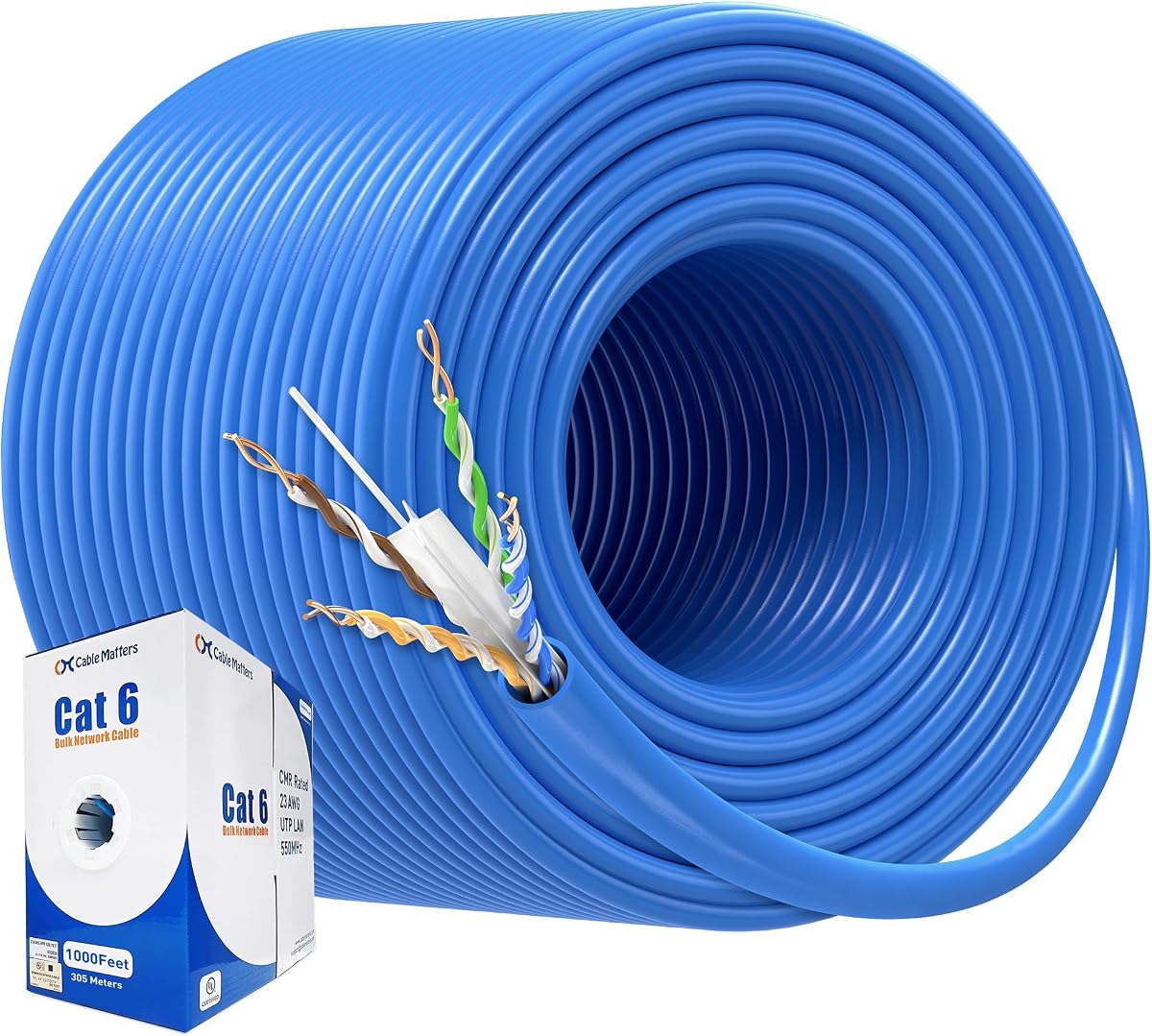
The Cable Matters 10Gbps 23AWG Cat 6 Bulk Cable holds a 4.7 rating and offers a balanced combination of performance, compliance, and handling convenience. It is designed for 10-Gigabit Ethernet while remaining backward compatible with Cat5e networks, making it a practical foundation for both new installations and mixed-category environments.
We may earn a commission when you buy through this link, at no additional cost to you.
Its 23AWG solid bare copper conductors support reliable data transfer and PoE, PoE+, and PoE++ devices. The cable supports up to 550MHz bandwidth and is listed under UL E485863, while its specifications meet or exceed TIA/EIA 568-C.2. The foot-marked jacket makes remaining length easy to track while the pull box supports smoother deployment.
Its CM rating is the main qualification to consider. Although suitable for general communications wiring, it does not carry the CMR designation associated with the vertical-riser cable in this guide. Because the cable is also unshielded, it offers less protection against severe interference than a shielded alternative. The stated 10GbE capability should also be considered in light of category and run-length rules.
This is a strong option for a home, office, or small business that wants a current-generation Cat6 backbone without moving into thicker Cat6A cable. It also makes sense for projects that want solid copper and broad device compatibility without paying for a fully shielded high-end installation.
Cat6 offers a useful middle ground between older Cat5e wiring and higher-capacity Cat6A. Backward compatibility allows it to integrate with existing network components while supporting newer high-bandwidth equipment and applications.
The marked jacket, easy-pull box, UL listing, and TIA/EIA 568-C.2 compliance are especially valuable for organized installations. Solid copper further helps create a dependable foundation for ordinary structured-cabling environments.
We may earn a commission when you buy through this link, at no additional cost to you.
The Cat5e 1000 Ft 24AWG UTP cable has a 4.6 rating and serves as an economical choice for homes and businesses that need dependable bulk Ethernet wiring without the specifications of a higher category. Cat5e remains widely used for home networks, offices, file sharing, internet access, video streaming, and IP-based surveillance.
We may earn a commission when you buy through this link, at no additional cost to you.
Its four twisted pairs help manage interference, and the cable is supplied in a convenient easy-pull box. With 1000 feet available, it is suitable for creating multiple permanent links through structured cabling systems, connecting security cameras to network video recorders, or extending connectivity through walls, closets, offices, and other standard indoor locations.
The limitations are inherent to Cat5e rather than defects in this particular product. It offers less bandwidth and future headroom than Cat6 or Cat6A, and its 24AWG construction is not a fit for every modern high-performance installation. No specific outdoor, direct-burial, or high-temperature rating is stated, so it should be treated as indoor wiring.
This cable is best for straightforward, budget-conscious projects where Gigabit Ethernet, voice, streaming, and surveillance are the core requirements. It is a sensible choice when a complete Cat5e network is not being upgraded for years, but buyers planning future expansion may prefer a higher category.
Cat5e is one of the most broadly recognized Ethernet categories and remains appropriate for many common LAN applications. Its simple installation and compatibility with standard network components make it useful for offices, home offices, and surveillance installations that do not require higher bandwidth headroom.
A 1000-foot pull box can support numerous shorter point-to-point runs. That makes it useful when standard pre-made patch leads do not align with wall locations, equipment positions, or custom cable routes.
We may earn a commission when you buy through this link, at no additional cost to you.
The Cable Matters 10Gbps 23AWG CMR Cat6 Cable pairs a 4.8 rating with a construction explicitly suited to vertical-riser installations. Its 23AWG solid bare copper conductors, 550MHz bandwidth, and compatibility with Gigabit and Fast Ethernet make it a strong fit for professional networks in homes and commercial buildings.
We may earn a commission when you buy through this link, at no additional cost to you.
The defining feature is the CMR-rated jacket. This makes the product more appropriate for routes between floors than a general CM cable, providing the fire-performance classification required for a riser environment. The easy-pull reel reduces tangling and handling issues, while the foot-marked jacket helps installers track consumption and cut accurate lengths.
As an unshielded Cat6 cable, it may not provide the same interference resistance as a shielded S/FTP model. The bulk reel can also be more cumbersome than a lightweight Cat5e pull box, although that is a normal consideration for higher-category structured wiring. Actual 10GbE performance also depends on the complete channel, including terminations and run length.
This cable is an excellent match for multistory homes, offices, schools, and commercial buildings where a Cat6 riser backbone is required. It is particularly attractive when installers want 10GbE capability and high-power PoE support while retaining the practicality of Cat6 rather than using a bulkier Cat6A cable.
The CMR jacket is the decisive feature for installers working between floors. It directly addresses the need for a cable specifically rated for vertical routes rather than relying on a general indoor communications jacket.
Solid bare copper, 10GbE support, and PoE capability create a dependable structured-cabling foundation. The combination is suitable for switches, access points, cameras, phones, servers, and other conventional network devices.
We may earn a commission when you buy through this link, at no additional cost to you.
The Cable Matters Shielded Cat6A cable has a 4.4 rating and offers the most specialized high-performance construction in this group. Its S/FTP design combines foil shielding around individual twisted pairs with a braided screen beneath the jacket, providing stronger protection against electromagnetic interference, radio-frequency interference, and alien crosstalk.
We may earn a commission when you buy through this link, at no additional cost to you.
The 23AWG solid bare copper conductors support a stated bandwidth of up to 600MHz and 10 Gigabit Ethernet. It is suited to demanding environments such as data centers, warehouses, offices, and home networks that may include UHD video, IP surveillance, cloud-computing connections, VoIP, or other high-bandwidth services.
Shielding adds an important installation requirement. The manufacturer notes that this thicker 23AWG cable is not recommended for standard RJ45 modular plugs and performs best when terminated with shielded Cat6A keystone jacks or patch panels. Its CM rating should also be checked against local requirements and the intended pathway. Shielded hardware, grounding practices, and compatible connectors are essential to a successful installation.
This is the premium selection for buyers who prioritize signal integrity and future headroom over simplicity or minimum cable size. It is best suited to professional installers, electrically noisy spaces, and projects designed around shielded Cat6A components from the beginning rather than adapted from ordinary unshielded hardware.
Layered shielding is the key advantage of this model. It is especially useful around high-power equipment, shared pathways, and installations where maintaining low noise and predictable transmission quality is important.
Shielded cable performs best when the complete channel is designed for it. Buyers should obtain compatible shielded keystone jacks, patch panels, connectors, and bonding or grounding solutions rather than mixing incompatible termination components.
We may earn a commission when you buy through this link, at no additional cost to you.
The fast Cat. Cat5e FastReel carries a 4.7 rating and combines a familiar Cat5e category with a more installation-conscious reel and solid bare copper conductors. It is a strong option for projects that need Gigabit Ethernet, dependable copper construction, and cable suitable for vertical-riser environments.
We may earn a commission when you buy through this link, at no additional cost to you.
Its FastReel package is designed to let the cable flow smoothly, reducing snags and the time lost while pulling a long spool. Four twisted pairs with multiple pitches are intended to reduce crosstalk, and the polyethylene insulation adds mechanical durability. The stated performance reaches 350MHz and Gigabit Ethernet speeds.
The cable is ETL and CSA certified, TAA and RoHS compliant, and CMR flame resistant under IEC 60332-3. A lot-tracking system also provides barcode traceability. As with other unshielded Cat5e products, however, it offers less headroom than Cat6 or Cat6A and may be less suitable in environments with severe electromagnetic interference.
This is a good fit for installers who prefer a Cat5e platform but value certified construction, a riser rating, and smoother reel handling. It can serve offices, homes, schools, and businesses needing reliable voice, data, streaming, and surveillance wiring without the added bulk of a higher category.
The FastReel format addresses one of the practical challenges of bulk Ethernet cable. Easier, snag-free payout can reduce installation time and help prevent avoidable damage during long routes.
CSA and ETL certification, TAA and RoHS compliance, CMR flame resistance, and barcode lot tracking add confidence for professional buyers. These attributes are useful when documentation and consistent cable provenance matter.
We may earn a commission when you buy through this link, at no additional cost to you.
The MEIPEK Cat 6 Outdoor Ethernet Cable is built for projects extending beyond conventional indoor pathways. Its 4.4 rating reflects a practical outdoor bundle with FTP shielding, a weather-resistant PVC shell, a stated 250MHz bandwidth, and support for direct burial without conduit.
We may earn a commission when you buy through this link, at no additional cost to you.
The cable uses four pairs of 23AWG copper-clad aluminum conductors. That construction can help control material weight and cost across very long outdoor runs, while the shield is intended to reduce EMI and RFI. The package includes 60 RJ45 connectors, and the bulk length can be cut into custom runs for different outdoor scenarios.
Copper-clad aluminum is an important trade-off because it differs materially from solid bare copper. It also needs appropriate shielded termination hardware rather than assuming every standard connector will achieve the intended result. The stated transmission target centers on 1Gbps, which is suitable for common outdoor networks but less ambitious than the high-bandwidth Cat6 and Cat6A alternatives in this guide.
This is a strong choice for connecting an outbuilding, garage, camera, gate, or remote network point where the cable must be buried directly. It is particularly useful for installers who want outdoor shielding and connectors in one package, provided the conductor type and performance target suit the planned application.
The outdoor-rated PVC jacket is designed to withstand moisture, temperature changes, and demanding installation environments. Direct-burial capability simplifies routes between structures where adding conduit would be inconvenient or expensive.
FTP shielding helps reduce electromagnetic and radio-frequency interference along outdoor runs. Compatible shielded connectors and careful installation remain important for obtaining consistent performance.
We may earn a commission when you buy through this link, at no additional cost to you.
The Outdoor Cat6 Tool Kit earns a 4.6 rating and stands out for bundling a 1000-foot outdoor cable with the equipment needed to create and repair custom lengths. The package includes a crimp tool, network cable tester, wire stripper, 50 shielded RJ45 connectors, 50 snagless cable boots, and 30 cable labels.
We may earn a commission when you buy through this link, at no additional cost to you.
The cable itself uses 24AWG copper-clad aluminum in four unshielded twisted pairs. HDPE insulation and cross-isolation splines help control interference, while the stated bandwidth reaches 550MHz and the listing supports up to 10GbE depending on length. A UV-resistant LLDPE outer jacket and PVC inner jacket provide two layers of protection for outdoor, garage, underground, in-wall, and in-ground locations.
Its primary trade-off is the unshielded copper-clad aluminum construction, which is less substantial than solid bare copper alternatives. It also may not be the right choice for electrically noisy locations that benefit from shielding. The included shielded connectors should be matched carefully to the cable and installation requirements, and performance ultimately depends on termination quality and run length.
This bundle is well suited to DIY enthusiasts, property installers, and technicians who want the necessary tools without assembling a separate termination kit. It is especially useful for outdoor cameras, garages, sheds, routers, switches, and other RJ45-connected equipment where custom lengths are required.
The included crimp tool, tester, stripper, connectors, boots, and labels cover the basic workflow for cutting and terminating the bulk cable. That convenience makes the package appealing for self-contained installations and field repairs.
Dual-layer construction and UV resistance make the cable suitable for exposed sunlight, underground routing, garages, and other harsh areas. Flexible installation is an added benefit for routes around corners and through walls.
We may earn a commission when you buy through this link, at no additional cost to you.
The 1000ft CAT5e Ethernet LAN Cable has a 4.6 rating and offers a straightforward indoor wiring option for basic data and voice networks. Its 24AWG solid copper-clad aluminum conductors, four-pair design, and easy-pull spool make it approachable for cost-conscious structured-cabling projects.
We may earn a commission when you buy through this link, at no additional cost to you.
HDPE and PVC insulation is intended to resist wear and interference, while the printed running-foot count helps installers measure and cut the cable. It is marketed for homes, offices, server rooms, gaming connections, VoIP, and surveillance systems that use standard RJ45 terminations.
Copper-clad aluminum is the key limitation. It is not equivalent to solid bare copper, which appears in several higher-ranked options, and it may present different installation and long-run characteristics. The cable is also limited to the bandwidth and future headroom of Cat5e, with no stated outdoor, direct-burial, or CMR qualification.
This cable is best for straightforward indoor projects where basic Ethernet functionality is the priority and the installation will not need higher-category headroom. It can work for a home LAN, a secondary office, or a basic surveillance system, but buyers planning sophisticated networks should prioritize solid copper and a higher category.
A printed running-foot count removes much of the guesswork when cutting custom lengths. The pull spool is similarly useful for keeping the remaining cable organized and reducing tangles during deployment.
The Cat5e rating and CCA construction are appropriate for ordinary LAN, voice, streaming, and surveillance use. They are less attractive for modern high-bandwidth expansion, critical links, or premium-quality installations.
We may earn a commission when you buy through this link, at no additional cost to you.
The Cat8 Bulk Ethernet Cable receives a 4.7 rating and targets the highest performance figures in the guide. Its stated capabilities include 40Gbps data transmission and bandwidth up to 2000MHz, supported by 26AWG copper conductors and F/FTP shielding.
We may earn a commission when you buy through this link, at no additional cost to you.
Four shielded foiled twisted pairs are covered by a UV-resistant PVC jacket designed for both indoor and outdoor use. The construction is aimed at data centers, servers, enterprise LANs, AI-related infrastructure, high-end gaming, and other bandwidth-intensive environments. The listing also describes compatibility with routers, switches, NAS devices, cameras, printers, smart TVs, consoles, and other RJ45-based equipment.
Those headline specifications should be treated as category capabilities rather than a guarantee of 40Gbps across every 1000-foot run. The cable is thicker than typical patch cable, and its shielding requires appropriate compatible terminations. Most ordinary home networks, small offices, and conventional structured-cabling projects will not need this level of performance, making the cable unnecessarily specialized for many buyers.
The product makes the most sense for specialized high-speed links, short data-center interconnections, and installers who deliberately plan around Cat8 hardware. For general building wiring, a Cat6A solution generally offers a more practical balance of capacity, cable size, compatibility, and installation cost.
The stated 2000MHz bandwidth and 40Gbps capability provide exceptional theoretical headroom. That makes the cable relevant to data-center switch-to-server interconnections and other demanding short-run applications where higher-category equipment is already in use.
F/FTP shielding helps reduce interference, while the UV-resistant jacket expands the installation options. The larger 26AWG construction should be considered when planning pathway space, pulling tension, and compatible connectors.
We may earn a commission when you buy through this link, at no additional cost to you.
The right bulk Ethernet cable depends on the network category, pathway environment, devices to be powered, conductor construction, and termination plan. Use the following factors to avoid buying a cable that is technically capable but poorly matched to the installation.
Cat5e supports Gigabit Ethernet and remains suitable for many homes, offices, voice systems, and surveillance installations. Cat6 raises the bandwidth ceiling to 550MHz and supports 10GbE within applicable distance and channel rules, while Cat6A offers 600MHz and stronger long-run 10GbE headroom. Cat8 is intended for specialized high-speed environments and is generally excessive for conventional LAN wiring.
Indoor structured cabling, vertical risers, plenum spaces, and direct-burial routes have different fire and environmental requirements. A general indoor or CM cable is not automatically suitable between floors, while a riser-rated CMR cable is intended for vertical installation. Outdoor or direct-burial cable needs a jacket designed to resist moisture, sunlight, temperature changes, and ground contact. Always compare the stated rating with local building and safety requirements.
Solid bare copper is the preferred choice for straightforward, dependable electrical and data performance. Copper-clad aluminum can reduce weight and cost over long bulk runs, but it is a different material and should be considered accordingly. The product data contains both CCA and solid copper options, so compare conductor type as carefully as category. Conductor diameter also affects cable thickness, pulling force, bend radius, and connector compatibility.
Shielded cable provides added resistance to EMI, RFI, and alien crosstalk, which can be useful near power equipment, in industrial spaces, or in dense commercial pathways. Unshielded cable is often easier to work with and less expensive because it does not require compatible shielded connectors and bonding. Shielding is not automatically required in every home, but the complete channel—cable, jacks, patch panels, connectors, and grounding—should be designed consistently.
PoE devices such as cameras, access points, and VoIP phones place both data and electrical power on the same cable. The listed cables vary in PoE support, with some Cat6A and Cat6 products supporting PoE, PoE+, and PoE++, including higher-wattage 4-pair PoE. Match the cable’s stated power capability to the combined power budget and operating temperature of the powered equipment. A faster data category alone does not guarantee every PoE standard is supported.
Bulk cable must be cut to length and properly terminated, and the connector must suit both the conductor and cable construction. Standard RJ45 plugs may not fit thicker 23AWG or 26AWG cable without larger openings or a different termination method. Shielded Cat6A and FTP cable should use compatible shielded keystone jacks, patch panels, plugs, and boots. Ordinary keystone jacks or modular plugs can also create installation bottlenecks, so plan terminations before pulling the cable.
A 1000-foot reel is substantial, and its box, markings, and payout method can affect installation time. Sequential footage markings and an easy-pull reel help installers measure, route, and cut cable without excessive tangles. Very stiff, thick, or shielded cables require more pathway space and pulling care. By contrast, a lighter Cat5e pull box may be easier to maneuver but can offer less capacity for future bandwidth.
A nominal 1000-foot reel is rarely consumed entirely without waste. Plan for service loops, bends, termination allowance, reroutes, and the possibility of mistakes. A reel may produce fewer complete permanent links than a simple division suggests, particularly when each run is long and cables do not share common pathways. Verify the actual route lengths and add sensible termination and service-loop allowances before ordering.
Plan the entire route before opening the reel. Identify wall pathways, vertical shafts, environmental restrictions, endpoint locations, and every required termination. Confirm that the cable category, jacket rating, shielding, and PoE capability fit the design, and gather compatible keystone jacks, patch panels, connectors, tools, labels, and testing equipment before pulling.
Pull the cable gradually without creating sharp bends, twists, or excessive tension. Observe the manufacturer’s bend-radius and installation guidance, keep the cable away from sharp edges, and secure it at appropriate intervals. Do not use staples or fasteners that could crush the jacket. When using shielded cable, maintain the intended shield continuity through compatible components and follow any grounding instructions associated with the selected hardware.
After installation, terminate the cable in accordance with the applicable wiring standard and the connector manufacturer’s instructions. Keep untwisted copper pairs as short as practical, preserve pair twist, and avoid nick or damage to individual conductors. Test each completed link with an appropriate cable tester, label both ends, and record the route and test result for future troubleshooting and maintenance.
Not necessarily, because a bulk reel is usually cut into several shorter runs. A 1000-foot box can provide multiple wall-to-wall, closet-to-room, or camera connections, but the number of finished links depends on the length and route of each run. Measure carefully and add service-loop and termination allowances before deciding how many reels to purchase.
CM cable is rated for general indoor communications use, while CMR cable has a flame rating intended for vertical risers between floors. The correct designation depends on the pathway, local code, and building design. A cable suitable for an ordinary room should not automatically be installed in a riser shaft merely because it is called Ethernet cable.
The listed Cable Matters Cat6 products are designed to support 10GbE, but actual performance depends on run length, terminations, installation quality, and network equipment. Category specifications do not guarantee that every full-length path will deliver advertised high-speed performance in every environment. Confirm the manufacturer’s distance guidance and test the completed links.
Solid bare copper is generally the preferred choice for dependable performance and straightforward long-run installation. Copper-clad aluminum can be lighter and less costly across large quantities, but it behaves differently and is not a direct substitute for solid copper. Consider conductor type alongside category, jacket, shielding, and the importance of the link.
A basic home network often works with unshielded cable, especially when runs are short and away from noisy equipment. Shielding becomes more valuable in offices, data centers, warehouses, or locations near strong electrical sources. If selecting shielded cable, use compatible shielded jacks, connectors, and patch panels so the installed channel is consistent.
Outdoor cable can generally be used indoors, but it may be thicker, less flexible, or more expensive than indoor-rated alternatives. Its outdoor jacket may also be unnecessary inside a protected pathway. Conversely, indoor cable should not be assumed suitable for direct burial, exterior exposure, sunlight, moisture, or temperature extremes.
Check the camera’s power standard and total power consumption first, then select cable that explicitly supports the required PoE mode and wattage. Cat6 or Cat6A is generally a sensible starting point for new camera wiring, while Cat5e may work for simpler or lower-power arrangements. Verify the full cable, connector, switch, and injector combination before installation.
You will generally need a modular crimp tool, cable stripper, appropriate plugs or keystone jacks, patch panels where needed, boots, labels, and a network tester. Shielded or thicker cable may require larger plugs, shielded connectors, or dedicated jacks. Matching the accessories to the cable before pulling helps prevent delays and incompatible terminations.
The TRUE CABLE Cat6A Riser is the strongest all-around selection because it combines 10GbE capability, solid bare copper, 750MHz bandwidth, CMR suitability, and high-power PoE support. The Cable Matters Shielded Cat6A is the premium choice for interference-sensitive installations, while the basic Cat5e pull-box cable is the budget option for straightforward indoor networking.
Prioritize the installation environment before the headline category. Choose the correct jacket rating, verify whether solid copper matters, match shielding to the pathway, confirm PoE requirements, and purchase compatible terminations. A lower-category cable can be the right value for a simple link, while a higher category provides valuable headroom for demanding equipment and future expansion.
Product details, certifications, availability, and prices can change, so verify the current listing and cable specifications before purchasing. Check the intended pathway, device requirements, and complete termination plan at the same time to ensure the selected 1000-foot cable is ready for the project.