
Skar Audio RP-1500.1D
4.4Editor score
1,500 watts RMS at 1 ohm
Selectable six or twelve dB bass boost
Remote subwoofer level control
Four-way protection circuitry
Compare the best 1500 watt car amp options for subwoofers, installation flexibility, protection, controls, and overall value in this expert guide.
A 1500 watt car amp is built to deliver serious low-frequency power, but the headline number alone does not tell the whole story. Load stability, continuous output, thermal design, filtering controls, protection, and installation requirements all influence how an amplifier performs after it is wired into a vehicle.
This guide compares ten monoblock and bridgeable amplifiers using the specifications and features supplied for each model. It covers intended subwoofer applications, output at common impedances, crossover and bass controls, protection systems, chassis design, connectivity, and the practical differences between Class D and Class AB designs.
Each review shows where a particular amplifier stands out, while the buying guide explains how to match power, speakers, wiring, and vehicle electrical systems. Ratings and specifications can change over time, and current prices, availability, manufacturer updates, and retailer terms should always be checked before purchase.
4.4Editor score
4.5Editor score

4.9Editor score
The comparison below highlights amplifier class, documented output, load support, tuning controls, and installation-oriented features. Because nominal peak power and RMS power are not interchangeable, the table prioritizes the continuous or explicitly stated power figures and calls out important configuration differences.


The Skar Audio RP-1500.1D combines a documented 1,500 watts RMS at 1 ohm with a 4.4 rating, making it a persuasive all-around option for shoppers who want meaningful subwoofer power without moving into the premium tier. It is a dedicated Class D monoblock, so its architecture is aimed squarely at powering a subwoofer rather than driving full-range speakers.
We may earn a commission when you buy through this link, at no additional cost to you.
Several details make the RP-1500.1D especially practical. It remains stable at a 1-ohm load, includes a remote subwoofer level control, and uses four-gauge power and ground terminals for current flow. Its four-way protection circuitry adds a layer of system safety, while the selectable bass EQ offers either six or twelve decibels of boost around 45 hertz for installers who want more low-end emphasis.
The trade-offs are that its published frequency response runs from 20 to 250 hertz and the feature list does not describe a continuously adjustable low-pass or subsonic filter. That means it offers fewer tuning choices than several highly configurable competitors. Its 1,900-watt peak figure should also not be confused with the more useful 1,500-watt RMS output when comparing specifications.
This amplifier is best suited to a single subwoofer or a multi-subwoofer system wired to a supported load where strong low-frequency power and straightforward remote control are priorities. It is a compelling choice for value-conscious builders who want specified RMS output, robust terminals, and basic bass controls without paying for a more elaborate premium monoblock.
The key advantage is 1,500 watts RMS at 1 ohm, giving installers a clear target for a high-output single-sub configuration. Four-gauge power and ground terminals also suit the demands of a high-current installation better than undersized connections would.
The included remote control lets the driver reduce or restore subwoofer level without reaching the amplifier. This is especially useful in vehicles where the monoblock is mounted away from the dashboard.
We may earn a commission when you buy through this link, at no additional cost to you.
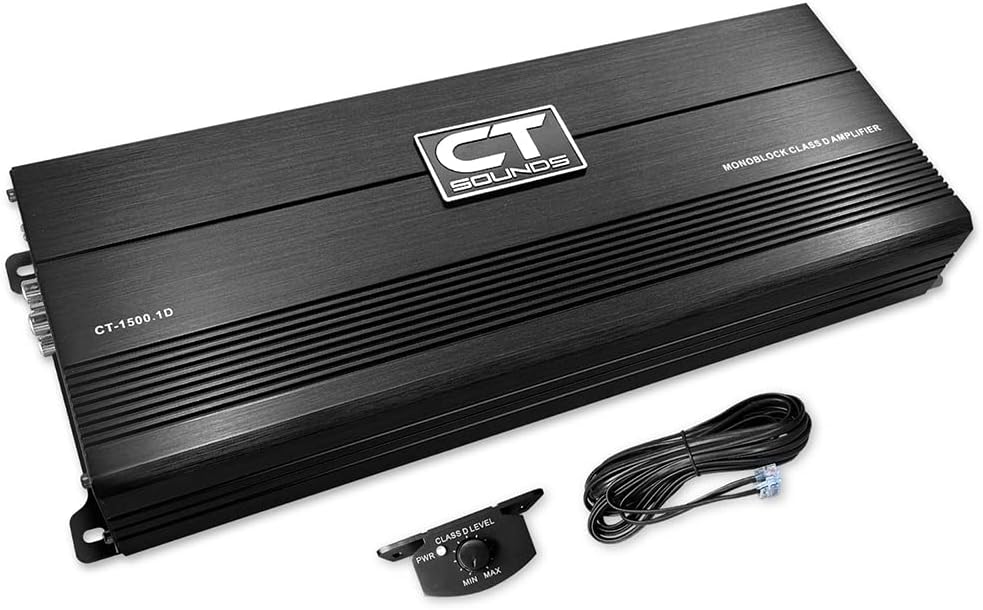
The CT Sounds CT-1500.1D earns a 4.5 rating and stands out for a combination of compact dimensions, 1,500 watts RMS at 1 ohm, and clearly stated output at higher impedances. That makes it one of the most straightforward amplifiers to shortlist for a serious subwoofer installation where space is at a premium.
We may earn a commission when you buy through this link, at no additional cost to you.
Its output scales from 1,500 watts at 1 ohm to 850 watts at 2 ohms and 450 watts at 4 ohms under the stated 14.4-volt conditions. The specified response extends from zero to 320 hertz, and a bass knob is included. Internally, the product description emphasizes a MOSFET pulse-width-modulated power supply, proprietary heat dissipation, and four-way protection covering high voltage, low voltage, overcurrent, and high temperature.
Compared with competitors that provide selectable subsonic filters, extensive phase controls, or multiple crossover slopes, the CT-1500.1D has a simpler tuning proposition. That simplicity can be an advantage for a clean installation, but it offers less freedom when aligning the subwoofer with front speakers or controlling very low frequencies.
The amplifier is well suited to installers who want a compact, efficient monoblock and understand the importance of a properly wired 1-ohm load. With strong continuous-power figures, thermal management, and a broad protection package, it is an excellent general recommendation for a high-output car subwoofer system.
The small footprint is particularly useful in compact cars, trunks with limited floor space, and installations where multiple components compete for room. Despite the small enclosure, the documented 1,500-watt RMS output remains the central attraction.
Protection against high voltage, low voltage, overcurrent, and high temperature gives the amplifier several safeguards against common installation and operating problems. The heat-dissipation design also supports more consistent performance.
We may earn a commission when you buy through this link, at no additional cost to you.
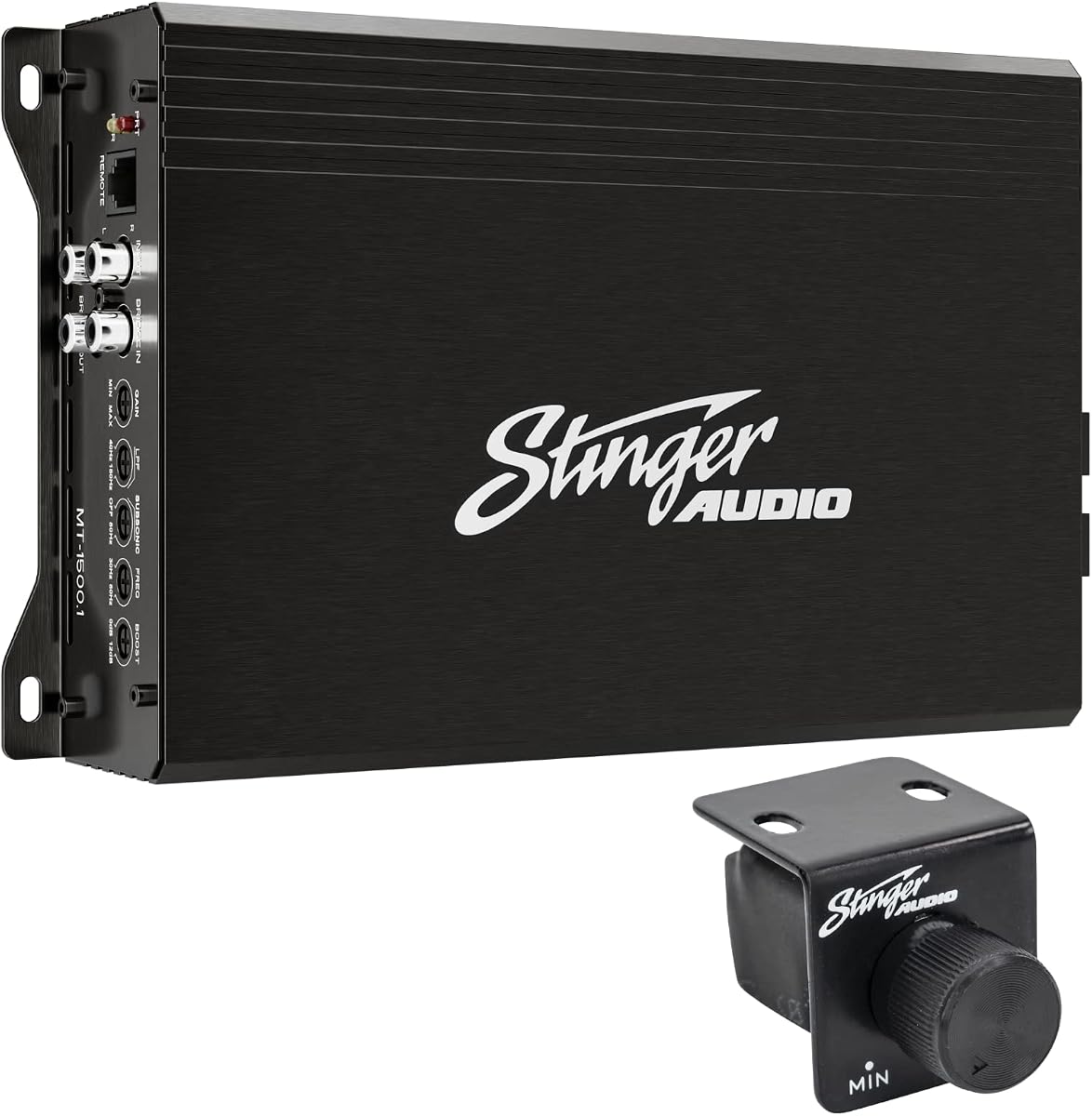
The Stinger Audio MT15001 has a 4.2 rating and differentiates itself through a dense feature set in a compact 6.10-by-10.16-by-2.09-inch chassis. It is designed for subwoofer systems and offers adjustable bass boost, a remote control, RCA line-level inputs, and a PWM power supply.
We may earn a commission when you buy through this link, at no additional cost to you.
The supplied information describes the amplifier as strapable into 4-ohm, 2-ohm, or 1-ohm configurations. It lists 1,000 watts RMS at 2 ohms, 550 watts RMS at 4 ohms, and a separate 2,800-watt bridged minimum-load figure. The 1,000-watt two-ohm rating is solid, although it is lower than the 1,200 to 1,500 watts RMS offered by several direct rivals.
Its least confusing strength is installation flexibility. The included remote can use the supplied dash bracket or be mounted flush within a console or dashboard panel, while direct-insert power and speaker terminals are intended to reduce resistance. A stated minus 93 dB signal-to-noise ratio, specialized Class X2 capacitor, and fast-switching design add technical refinement.
The MT15001 is a good match for installers who prioritize remote bass control, compact dimensions, and multiple configuration options. It deserves close attention when comparing a 1,500-watt-branded product against models with higher continuous output, since its most meaningful rated result is 1,000 watts RMS at 2 ohms.
The remote can be positioned with the included bracket or integrated into a custom dashboard treatment. That flexibility makes driver-side level adjustment more convenient than reaching into the trunk or cabin.
Strapable operation gives the installer more ways to work with the amplifier, but correct load configuration remains essential. Reviewing the supplied impedance and bridged figures carefully prevents mismatching the amplifier to the subwoofer wiring.
We may earn a commission when you buy through this link, at no additional cost to you.
The Sundown Audio SFB-1500D carries a 4.5 rating and offers one of the strongest combinations of documented RMS output and tuning flexibility in the group. It produces 1,500 watts RMS at 1 ohm, 1,200 watts RMS at 2 ohms, and 650 watts RMS at 4 ohms, while remaining stable at a 1-ohm load.
We may earn a commission when you buy through this link, at no additional cost to you.
For system tuning, it offers a variable 12 dB-per-octave low-pass filter, a high-pass filter, and bass boost adjustable from zero to 12 dB. Four-way protection addresses thermal, voltage, speaker-short, and DC-offset conditions, while a smart three-speed fan manages cooling. The chassis measures 7.25 by 6.75 by 2.5 inches, and the listed equipment includes a dual MOS-FET PWM power supply.
The main caution is that its cooling fan adds a mechanical and electrical element not present in many similarly powerful monoblocks. Installers must preserve airflow around the chassis and account for the fan's operating noise during a quiet listening test. Its documented output also makes correct wiring especially important, since the amplifier can deliver substantially more power than a weaker 1,500-watt-branded model.
This is an excellent choice for a serious subwoofer system where continuous output and precise crossover control are both priorities. The wired remote with clipping indicator is especially helpful for setting gain accurately, and the combination of protection, filtering, and power makes the SFB-1500D a well-rounded choice for experienced installers.
The low-pass and high-pass filters offer more control than a simple fixed-frequency monoblock. Meanwhile, the remote clipping indicator gives the installer a practical reference during gain setup, reducing guesswork when matching the amplifier to the source.
A three-speed smart fan is intended to keep the amplifier operating within a safe thermal range. Installation should leave the fan unobstructed and allow the exhaust path to remain clear.
We may earn a commission when you buy through this link, at no additional cost to you.
The Crunch Ground Pounder GP-1500.2 has a 4.1 rating and offers a different proposition from the dedicated monoblocks in this guide. It is a two-channel amplifier that can run in stereo, bridge one channel pair into mono, or use both modes simultaneously, making it useful for mixed speaker and subwoofer systems.
We may earn a commission when you buy through this link, at no additional cost to you.
In normal operation, each channel produces 750 watts at 2 ohms or 325 watts at 4 ohms. When bridged, one channel can produce 1,500 watts at 4 ohms. A variable 12 dB-per-octave electronic crossover supports system tuning. This flexibility lets one enclosure serve component speakers, full-range coaxial speakers, and a bridged subwoofer channel in a carefully designed setup.
The key limitation is that its 1,500-watt figure is a bridged output at 4 ohms, not the same operating condition as a one-ohm monoblock rated at 1,500 watts RMS. A dedicated Class D subwoofer amplifier can often be more efficient in a subwoofer-only installation and may provide more flexible low-pass or subsonic filtering.
The GP-1500.2 is most attractive to builders who want one compact amplifier to cover several channels or need simultaneous stereo and bridged-mono operation. It is less compelling when a single deep subwoofer is the only goal and the highest possible low-frequency power per watt is the priority.
Stereo, bridged-mono, and simultaneous operation make this amplifier useful in systems that combine front and rear speakers with a subwoofer. The variable crossover helps separate frequency ranges when the design calls for it.
Its bridged 1,500-watt specification applies at a 4-ohm load. Buyers comparing it with one-ohm monoblocks should not treat those numbers as directly equivalent, even though both products carry 1,500-watt branding.
We may earn a commission when you buy through this link, at no additional cost to you.
The Audiobank P1502 has a 4.0 rating and is a bridgeable, two-ohm-stable Class AB amplifier with broad application potential. Unlike many 1,500-watt products in this roundup, it is explicitly positioned for cars, trucks, motorcycles, recreational vehicles, ATVs, boats, and marine installations.
We may earn a commission when you buy through this link, at no additional cost to you.
Its headline specification is up to 1,500 watts maximum output in a bridged configuration, which should not be treated as equivalent to 1,500 watts RMS. The amplifier can operate as separate left and right channels, bridge the channels for one higher-power speaker, or run in tri-mode. A continuously variable low-pass filter spans 40 to 300 hertz, and the high-pass range covers 80 hertz to 4 kHz.
Its connection options are unusually accommodating. Nickel-plated RCA and speaker-level inputs allow it to work with aftermarket head units or factory-style sources, while the remote turn-on circuit coordinates activation. A stated 99 dB signal-to-noise ratio, 90 dB channel separation, MOSFET pulse-width power supply, and aluminum-alloy heatsink support a balanced installation.
The P1502 is a sensible choice for a multi-speaker mobile system that needs multiple operating modes and broad input compatibility. It is less suitable for someone seeking the most efficient one-ohm subwoofer amplifier, because the 1,500-watt claim is a maximum figure and Class AB designs generally draw more power than efficient Class D alternatives.
Both RCA and speaker-level inputs simplify integration with different source units. The stated suitability for numerous vehicle and marine environments also makes this a more versatile choice for nontraditional installations.
Stereo, bridged, and tri-mode configurations provide useful flexibility, but each requires correct speaker wiring. An installer should plan the channel layout before selecting cables or mounting the amplifier.
We may earn a commission when you buy through this link, at no additional cost to you.
The Skar Audio SA-1500.1D has a 4.6 rating and posts 1,550 watts RMS at 1 ohm, the highest stated RMS figure in this comparison. It is a modern Class D monoblock aimed at high-performance subwoofer installations, with an adjustable subsonic filter and a 10-to-250-hertz frequency response.
We may earn a commission when you buy through this link, at no additional cost to you.
Tuning features include adjustable bass gain, subsonic filtering, a low-pass filter, and bass boost. Installation conveniences include automatic remote turn-on, an LED status indicator, and a quick-disconnect terminal plug. The power and ground input size is listed as 4 AWG, which is appropriate for the high current expected from this output class.
Its headline peak figure of 2,800 watts should be kept separate from the 1,550-watt RMS rating. A peak number can reflect short-term conditions and is less useful for speaker matching than continuous output. Compared with the RP-1500.1D, this newer model offers more filter control, but the supplied specifications do not mention an included remote subwoofer knob.
The SA-1500.1D is a strong recommendation for an installer who wants high continuous power and several built-in tuning options without moving to the premium monoblock tier. It is especially appropriate for a single powerful subwoofer or a correctly wired multi-sub system operating at a supported low impedance.
The combination of bass gain, low-pass, subsonic, and boost controls allows the amplifier to be shaped around different subwoofer types. The subsonic filter can also help limit unwanted very-low-frequency content.
The LED status indicator gives the installer visible feedback from the chassis, while automatic remote turn-on simplifies integration with a powered source. The quick-disconnect plug can make service and reinstallation more convenient.
We may earn a commission when you buy through this link, at no additional cost to you.
The Rockford Fosgate Power T1500-1bdCP has a 4.7 rating and uses the brand's Constant Power technology to deliver 1,500 watts at 1 ohm, 1,500 watts at 2 ohms, and 1,000 watts at 4 ohms. That unusual consistency across impedance loads makes it appealing to installers who want useful output for several possible subwoofer configurations.
We may earn a commission when you buy through this link, at no additional cost to you.
Its efficient Class bd design is intended to maximize power while placing less strain on a vehicle's electrical system. The amplifier includes balanced differential RCA pass-through outputs, allowing another amplifier to receive the filtered signal. On-board Punch EQ provides up to 18 dB of boost at 45 hertz, and the 24 dB-per-octave Butterworth crossover offers a steep, controlled transition.
The physical footprint is the main practical drawback. At 2.14 by 8.14 by 14.91 inches, the chassis is considerably longer than many compact Class D monoblocks, so trunk and under-seat installation space must be checked carefully. A premium-tier product also needs to be evaluated against the complete system cost rather than amplifier specifications alone.
This amplifier is best suited to a serious, high-power build where electrical efficiency, strong output across different loads, and robust construction matter. Rockford Fosgate's stated two-year parts-and-labor warranty adds confidence for long-term ownership, while the balanced pass-through outputs support a more flexible multi-amplifier architecture.
The ability to maintain 1,500 watts from 1 to 2 ohms and still offer 1,000 watts at 4 ohms provides more planning flexibility. It is particularly relevant when a system may be reconfigured as subwoofers are added or changed.
Balanced differential RCA pass-through outputs can feed another stage after filtering. This makes the amplifier useful in a larger system where one unit manages a particular frequency range and another handles additional channels.
We may earn a commission when you buy through this link, at no additional cost to you.
The Alpine R2-A150M carries a 4.9 rating, the highest in this guide, and combines 1,500 watts at 1 ohm with Hi-Res certification. It is explicitly designed to match the power handling of two 10-inch or 12-inch R-Series subwoofers, or four 8-inch R-Series subwoofers at 1,200 watts into 2 ohms.
We may earn a commission when you buy through this link, at no additional cost to you.
Its installation-focused design is one of its strongest features. All speaker connections are placed on one side for easier access, while the amplifier controls sit on top beneath a removable plate. That arrangement allows gain and crossover adjustments without reaching awkwardly around the chassis. Integrated mounting brackets further simplify positioning within a vehicle.
The next-generation Class D amplifier circuit emphasizes sound quality and efficiency, which is valuable for a premium subwoofer system where detail and controlled output matter. The tradeoff is specialization: the product is described around exact R-Series power matching, and buyers using unrelated subwoofers should still compare impedance, RMS handling, and crossover requirements themselves.
For a high-end Alpine R-Series build, the R2-A150M is the standout choice in this roundup. Its combination of output, certification, accessible controls, and organized connection layout makes it particularly attractive to installers who value a clean, thoughtfully designed system rather than only headline power.
The stated matching for two 10-inch, two 12-inch, or four 8-inch R-Series subwoofers simplifies system planning for Alpine owners. It also reduces the risk of pairing the amplifier with a load that falls outside its intended operating envelope.
Top-mounted controls under a removable plate make setup more direct. Consolidating speaker connections on one side reduces cable routing complexity and improves service access.
We may earn a commission when you buy through this link, at no additional cost to you.
The Sundown Audio SAEv4-1500D has a 4.5 rating and combines 1,500 watts RMS at 1 ohm with an unusually deep control set. It is designed for installers who want to fine-tune low-frequency behavior, integrate a subwoofer carefully, and monitor clipping and protection status from the listening position.
We may earn a commission when you buy through this link, at no additional cost to you.
Its 12 dB variable low-pass filter covers 40 to 180 hertz, while a 12 dB subsonic filter spans 10 to 40 hertz. Phase shift is adjustable from zero to 180 degrees, providing a way to manage how the subwoofer integrates with front speakers. Output is stated as 1,500 watts RMS at 1 ohm, 800 watts RMS at 2 ohms, and 450 watts RMS at 4 ohms.
A dual MOS-FET PWM power supply and heavy-duty aluminum heat sink support efficient operation and thermal control. Protection covers thermal, voltage, speaker-short, and DC-offset faults, while power, clipping, and protection indicators provide real-time status. The enclosure measures 12.48 by 6.3 by 2.75 inches, so it is wider than many competing monoblocks.
The SAEv4-1500D is ideal for a carefully tuned high-output installation where phase and subsonic control are important. It is less compelling for a builder prioritizing maximum two-ohm output because several competing amplifiers publish stronger figures at that load, but its filtering, monitoring, and remote functions add meaningful installation value.
The zero-to-180-degree phase control gives an installer another tool for improving how the subwoofer interacts with front speakers. Correct use requires patience, test tracks, and repeated listening at different volumes.
The wired remote's clipping indicator helps identify excessive gain during setup, while chassis indicators show power, clipping, and protection status. The amplifier's four-way protection suite adds safeguards for thermal, voltage, wiring, and DC-offset faults.
We may earn a commission when you buy through this link, at no additional cost to you.
Choosing a 1500 watt car amp requires matching the amplifier to the subwoofer load, output requirements, electrical system, and desired level of tuning control. The most important step is comparing continuous RMS output at the exact impedance the speaker system will present.
Start with the impedance seen by the amplifier after every subwoofer is wired into its final configuration. A single 2-ohm subwoofer, two 4-ohm subwoofers in parallel, and a dual 1-ohm voice-coil subwoofer can present different loads even when the products appear related. Compare the amplifier's documented output at that precise impedance, not only its headline wattage.
Choose an amplifier that can safely and continuously support the intended load, then leave some power headroom for musical peaks. Match amplifier output with the subwoofer's power handling rather than targeting the largest possible number.
Peak power describes a maximum condition, while RMS power better represents sustained output. Some 1,500-watt products are rated at 1,500 watts RMS at 1 ohm, while others describe 1,500 watts as maximum bridged output at 4 ohms. These claims are not directly comparable. Review the test conditions, load, and whether the figure is RMS, maximum, or peak.
Give the most weight to continuous output at the load you will use. It is a better predictor of headroom, thermal demand, and speaker compatibility than a large peak number.
Class D monoblocks are the standard choice for efficient, high-power subwoofer amplification. They generally produce less heat and fit more easily into a vehicle than similarly powerful Class AB designs. Class AB or Class bd options can still be appropriate for multi-channel systems, especially when the amplifier must drive both subwoofers and full-range speakers.
Pick a dedicated monoblock for bass-only use and a flexible two-channel model when one amplifier must serve multiple speaker roles. Efficiency matters when the vehicle's charging system and space are limited.
A low-pass filter keeps the subwoofer focused on its intended range, while a subsonic filter can reduce excessively low content. Variable gain, selectable bass boost, and phase controls offer further refinement, although more controls are only useful when the installer understands them. A fixed-response amplifier may be adequate for a simple, carefully matched setup.
Prioritize adjustable low-pass and subsonic filtering for flexible installations. Choose phase control when integrating the subwoofer with front speakers, and avoid excessive boost unless the system is tuned to prevent distortion and overload.
Look for protection against overcurrent, high temperature, low voltage, speaker shorts, and DC offset. A properly sized heat sink, efficient power supply, and clean mounting environment help the amplifier sustain its output. Active cooling may be valuable in a high-power design, but it also requires unobstructed airflow and adds a mechanical element.
Treat protection as a safety system rather than a substitute for correct wiring. Use an appropriate fuse near the power connection, maintain clearance around the chassis, and ensure the amplifier is securely mounted.
Large power and ground terminals, direct-insert connections, and quick-disconnect plugs can make a meaningful difference in a real installation. Measure the trunk, seat cavity, or mounting location before buying, especially for long chassis designs. A remote bass control is also more convenient when the amplifier is mounted out of reach.
Plan the complete electrical system at the same time as the amplifier. Account for fuse location, cable length, chassis grounding, signal connections, speaker-wire gauge, and cooling clearance rather than focusing on the amplifier alone.
A high-output amplifier can place substantial current demands on the battery and alternator. The manufacturer's specified power requirements, when available, should be checked against the vehicle's charging system. Heavy-gauge power and ground cables reduce voltage drop, while an appropriate fuse protects the installation from a fault.
Do not assume every vehicle can support sustained full-power operation without an electrical-system upgrade. Have the alternator, battery, grounds, and cable paths evaluated for the complete amplifier and speaker load.
Remote controls, clipping indicators, LED status lights, pass-through outputs, and multiple operating modes are useful but should match the design. A bass knob adds daily convenience, while phase, filters, and bass controls matter during installation. Multi-vehicle compatibility may matter for a shared amplifier project, but output specifications should remain the deciding factor.
Make a feature checklist after determining load, power, and electrical requirements. This prevents a model with attractive controls from being chosen ahead of a model that better suits the speaker configuration.
Before installation, read the amplifier's manual, confirm its supported impedance, and plan the final speaker wiring. Mount the unit in a ventilated location, use the specified terminal orientation, and check that all fuses, cables, and connectors are appropriately rated for the planned current.
Set the low-pass and other filters before applying substantial gain. Disconnect the subwoofer if needed, turn the head unit down, adjust amplifier gain conservatively, and increase source level until clean playback is reached without clipping. A remote bass control should be used for normal listening adjustments rather than as a substitute for correct gain settings.
During the first drive, listen for distortion, unusual noise, odor, or repeated protection activation. Check connections and the subwoofer load if the amplifier behaves differently than expected. Periodically inspect terminals, fuses, grounding points, and airflow, and avoid placing luggage or cargo against a heat-sensitive chassis.
It can be, but only if the subwoofer's impedance and power handling align with the amplifier. A 1-ohm amp may require a stable 1-ohm speaker configuration, while a 2-ohm or 4-ohm subwoofer changes the available output. Match the final wiring configuration to the amplifier's supported load and avoid exceeding the subwoofer's RMS rating.
No. Output depends on speaker impedance, supply voltage, signal level, gain settings, and amplifier design. The 1500-watt figure may apply only at 1 ohm and under specified conditions, while output falls at higher impedances. RMS power is more useful for continuous output than a peak-power claim.
Yes, if the amplifier supports bridged-mono operation and the subwoofer's impedance is compatible with the bridged rating. A model offering 1,500 watts bridged at 4 ohms, for example, requires a correctly wired 4-ohm load. Check the manual and follow all bridging and grounding instructions.
Yes, a correctly rated fuse should be installed near the positive battery terminal or power-source connection, with the proper wire gauge and short protected run. The fuse protects the vehicle wiring if a fault occurs. Its rating should follow the amplifier manufacturer's guidance rather than being chosen from the amplifier's peak-power label alone.
It depends on how hard the amplifier is driven and the vehicle's electrical system. Play at moderate levels with efficient Class D design and an appropriately sized power and ground cable, monitor system voltage, and consider whether the alternator and battery can support the intended load. A professional electrical assessment may be appropriate for a sustained high-power system.
Class D is usually preferable for a subwoofer-only installation because it is efficient, compact, and produces less heat. Class AB or Class bd can be useful in a multi-channel amplifier that also drives full-range speakers. The best choice depends on the system layout, available space, and electrical requirements.
A low-pass filter controls the upper frequency limit of the subwoofer, helping keep it from trying to reproduce higher-frequency content intended for the main speakers. A subsonic filter limits very low frequencies below the subwoofer's useful range. Both can improve control, although their exact usefulness depends on the speaker and enclosure.
Bass boost can add low-frequency emphasis, but it also increases power demand and the risk of distortion or speaker overload. It is best used conservatively after gain and crossover settings are correct. If the system is already producing adequate output at low listening levels, substantial additional boost is usually unnecessary.
The Skar Audio RP-1500.1D is the best value-oriented choice, combining 1,500 watts RMS at 1 ohm with a remote control and strong terminal design. The CT Sounds CT-1500.1D stands out for compact construction, efficiency, and clearly documented output, while the Alpine R2-A150M is the premium selection for a carefully matched R-Series subwoofer system.
For other strong options, the Sundown Audio SFB-1500D and SAEv4-1500D prioritize detailed tuning, while the Rockford Fosgate Power T1500-1bdCP provides substantial output across several impedances. The Crunch GP-1500.2 and Audiobank P1502 are more versatile multi-channel alternatives, and the remaining monoblocks suit particular combinations of power, controls, and installation preferences.
Before buying, verify the amplifier's specifications against the exact subwoofer impedance, check the complete electrical system, and compare current ratings, warranty terms, availability, and prices. Product details and market conditions can change, so confirm the latest manufacturer information and retailer listing before making the final purchase.