
Dayton Audio XO2W-3K
4.8Editor score
Fixed 3,000 Hz crossover
Supports 4 or 8 ohm woofers
Rigid blue circuit board
Discover the best 2 Way Speaker Crossovers, comparing power handling, impedance support, crossover frequency, construction, and installation features.
A 2 way speaker crossover divides an audio signal between low- and high-frequency drivers, helping a woofer handle bass while a tweeter or midrange speaker reproduces higher frequencies. A well-matched crossover can improve clarity, reduce distortion, and make car or home audio systems sound more balanced across the audible spectrum.
We compared all ten crossovers using the supplied specifications, focusing on power handling, impedance compatibility, crossover frequency, filter construction, connection methods, and intended applications. The list includes compact DIY-friendly boards, linked-pair options, automotive models, and purpose-built units for multi-speaker installations.
Each review explains the product's strongest traits, practical trade-offs, and likely buyer profile, while the top picks highlight especially useful combinations of features. Ratings and specifications reflect the available product information, and prices can change, so readers should verify current details before purchasing.
4.8Editor score

4.8Editor score

4.6Editor score
This side-by-side comparison covers ten passive 2 way speaker crossovers with different power ratings, impedance options, frequency settings, and installation features, making it easier to identify the right model for a car, home audio project, or multi-speaker setup.


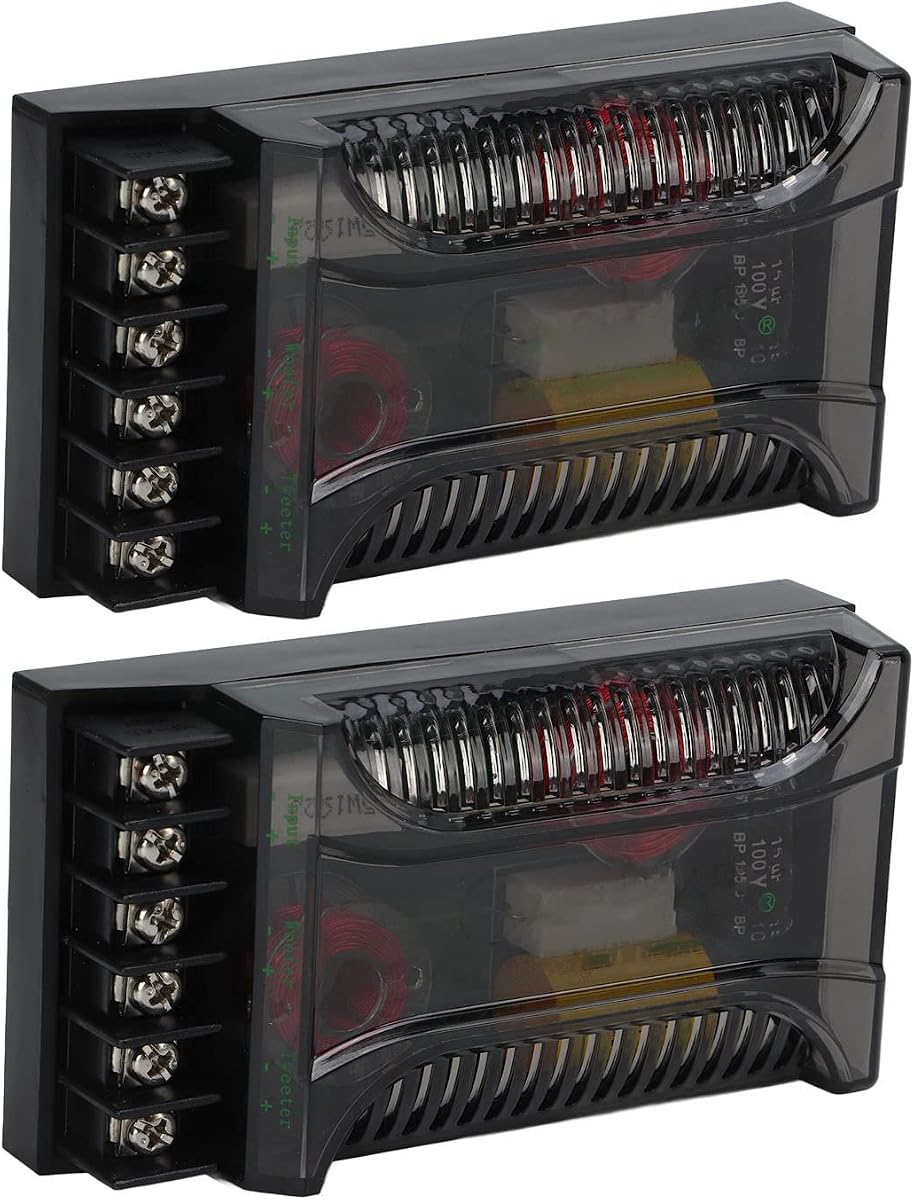

The CRX-203 is a passive two-pack of car-audio crossovers rated at 150 watts RMS and 300 watts peak per unit. Its 4.5 rating and clearly stated low- and high-frequency ranges make it a practical option for installers who want to separate a woofer from a tweeter or midrange driver without introducing an active processor.
We may earn a commission when you buy through this link, at no additional cost to you.
Gold-plated screw terminals are a standout feature for a model at this level, providing a practical way to create secure speaker connections. High-grade polymer capacitors support stable filtering, while the stated 20 Hz to 4.3 kHz woofer range and 3.39 kHz to 20 kHz tweeter range show a clear division of low- and high-frequency duties.
The main limitation is that the listing does not provide a published 4-ohm or 8-ohm compatibility range. Buyers should therefore verify their speaker wiring and amplifier configuration carefully. The fixed crossover point also offers less adjustment than models with selectable settings, although that can be advantageous when a predictable, repeatable setup is preferred.
This crossover is best suited to car-audio builders assembling a pair of front or rear speaker sets, particularly those who value screw-terminal convenience and need one unit for each channel. It is also a strong match for someone who wants a simple passive design rather than a configurable digital system.
The specified crossover bands provide an obvious allocation of bass and treble duties. This makes the CRX-203 approachable for standard car speaker sets where the goal is to keep low frequencies away from a smaller high-frequency driver.
Two crossovers are included, making the package suitable for balanced left-right installations. Buyers should still verify that their planned speaker system corresponds with the stated power and impedance characteristics.
We may earn a commission when you buy through this link, at no additional cost to you.
This 450W two-pack targets high-power car and home-audio installations using 4-ohm or 8-ohm speakers. Its 4.5 rating reflects a generally well-received feature set, with an adjustable division point, different filter slopes for the two frequency ranges, and a pair of capacitors intended to support the high-pass section.
We may earn a commission when you buy through this link, at no additional cost to you.
The low-pass side uses a second-order 12 dB slope, while the high-pass side uses a third-order 18 dB slope for phase compensation and cleaner separation. A switch allows the crossover point to be selected between 2,850 and 2,900 Hz, offering more flexibility than a completely fixed design without turning the board into a complex tuning interface.
Protective features include a tweeter capacitor and a self-recovering fuse, intended to reduce the chance of a sudden loss of treble output during demanding high-power operation. The wording of the supplied specification is broad, however, so installers should confirm exactly how those protections interact with their chosen tweeter and amplifier before relying on them.
The product is best for DIY builders who want a relatively high stated power capacity, selectable crossover points, and easy wiring without active electronics. The two-unit package also works well for stereo builds. Its small adjustment range makes it a better fit than fully variable models for drivers whose natural crossover point is known.
The 12 dB low-pass and 18 dB high-pass arrangement provides a meaningful difference between the two branches. That steeper treble transition can help isolate the tweeter from midrange and bass energy.
The 2,850 and 2,900 Hz choices allow modest system alignment while retaining a straightforward installation. This is useful when the ideal point is known but small component tolerances or driver characteristics warrant a choice.
We may earn a commission when you buy through this link, at no additional cost to you.
The DS18 PRO-CFX is a 2-pack of professional-style passive crossovers with power handling up to 300 watts. Its 4.6 rating, car-audio focus, and compact enclosure make it a strong choice for installers who want a purpose-built solution for separating tweeters and midrange speakers.
We may earn a commission when you buy through this link, at no additional cost to you.
A major practical advantage is efficient amplifier use: one amplifier channel can feed both sides of a two-way passive network, allowing a woofer and high-frequency driver to work within their appropriate frequency ranges. The 6.3 by 3.5 by 1.5-inch dimensions are intended to simplify mounting where space is limited.
The supplied information does not state a supported impedance range or detailed crossover frequency, so those points should be verified with the manufacturer or seller before installation. Those omissions do not erase the model's clear strengths, but they make it less convenient for buyers who need those figures immediately.
This is the most fitting option for a serious car-audio build where high power handling and a professional-style passive network matter. It is also attractive to installers who want to reduce channel demand without introducing a separate digital processor. For simpler indoor projects, the Dayton Audio models may offer clearer specifications.
The passive network lets a single amplifier channel serve a two-way speaker arrangement. That efficiency can simplify channel planning while helping each driver operate within the frequencies it was designed to reproduce.
The compact housing and explicit car-audio positioning suit projects where enclosure space and installation convenience are priorities. Secure mounting and correct wiring remain essential in a vehicle environment.
We may earn a commission when you buy through this link, at no additional cost to you.
The Dayton Audio XO2W-2.5K is a fixed 2,500 Hz passive crossover with a 4.8 rating. Its use of 12 dB per octave Linkwitz-Riley alignment gives it a clear technical identity and makes it a strong choice for builders who want purposeful, repeatable frequency division rather than a broad range of controls.
We may earn a commission when you buy through this link, at no additional cost to you.
The low-pass section accepts either 4-ohm or 8-ohm woofers, offering valuable flexibility when replacing part of an existing speaker system. Eighteen-gauge inductors are specified to minimize DC resistance, which can help reduce unwanted losses in the woofer branch and supports cleaner power transfer.
A fixed crossover point is both a strength and a limitation. It is straightforward for anyone who already knows that 2,500 Hz suits the driver combination, but it is less flexible if fine-tuning is required. Only one crossover is included, so a complete stereo installation will require two units unless the listing is ordered accordingly.
This model stands out as the most balanced overall pick because it combines a strong rating, a recognized filter alignment, flexible woofer impedance support, and low-resistance components. It is particularly well suited to DIY home or car audio projects where dependable construction and clear specifications outweigh adjustable controls.
The 12 dB per octave Linkwitz-Riley design offers a defined approach to dividing the signal. This is preferable for installers who want a known crossover architecture instead of an unspecified slope.
Allowing either 4-ohm or 8-ohm woofers in the low-pass section broadens compatibility. It also reduces the risk of buying the wrong model when replacing or combining speakers with different nominal impedances.
We may earn a commission when you buy through this link, at no additional cost to you.
The 400W adjustable two-pack is a budget-oriented option for separating treble and bass in a two-way system. Its 4.0 rating is the lowest among the ten products, but the inclusion of two units and accessible adjustment controls may appeal to first-time builders seeking a hands-on approach.
We may earn a commission when you buy through this link, at no additional cost to you.
The crossover uses inductors described as employing anaerobic copper winding and pure copper wire. The product also supports use with a high-frequency small satellite in a 2.1 arrangement, expanding its relevance beyond conventional two-speaker installations.
The supplied description is less precise than that of many competing models. It does not state a clear impedance range, exact crossover frequencies, or detailed filter slopes. That makes verification important, especially for high-power or permanently installed systems where accurate electrical compatibility matters.
This crossover is most appropriate for experimental DIY projects, automotive speaker boxes, and 2.1 systems where on-board adjustment is more valuable than comprehensive published specifications. Buyers who need transparent ratings, impedance information, and filter design should favor a more thoroughly documented model.
The controls make it possible to tune the transition after installation. This is useful when experimenting with different drivers or when the exact ideal crossover point is not yet known.
Compatibility with a high-frequency small satellite expands the product beyond standard stereo pairs. The subwoofer and satellite still need matching power and system design for a coherent result.
We may earn a commission when you buy through this link, at no additional cost to you.
This 250W two-pack supports speaker impedances from 4 to 8 ohms and beyond to 12 ohms, giving it one of the broader stated compatibility ranges in the group. Its 4.2 rating reflects a useful feature set centered on filter slopes, selectable crossover points, and installation-friendly terminals.
We may earn a commission when you buy through this link, at no additional cost to you.
The low-pass branch uses a 12 dB second-order slope, while the high-pass branch uses an 18 dB third-order slope. A switch selects a 2,750 or 2,800 Hz division point, and the board uses copper-clad aluminum inductors described as high-temperature resistant alongside a polypropylene high-voltage capacitor.
Solderless terminal blocks make this option convenient for builders who do not want to solder every connection. The 250-watt rating is adequate for many home and moderate car systems, though it offers less headroom than models advertised for 300, 400, or 450 watts.
This crossover is a good fit for stereo home audio, compact car systems, and speaker upgrades using varied nominal impedances. It is especially appealing to DIY users who want a selectable point and terminal-block convenience without moving to a more elaborate active crossover.
The stated 4–12 ohm range is useful when a system includes drivers with different nominal impedances. Actual compatibility should still be confirmed against the amplifier and the complete wiring plan.
Solderless terminal blocks reduce installation time and make the wiring easier to inspect. They are especially helpful in projects that may need future rewiring or component changes.
We may earn a commission when you buy through this link, at no additional cost to you.
The 300W junction-box crossover pairs a 4–8 ohm passive network with an integrated enclosure and straightforward connection options. Its 5.0 rating is the highest listed here, although ratings alone do not establish fit; the enclosure and connection design are equally important distinctions.
We may earn a commission when you buy through this link, at no additional cost to you.
Screw-down ohmic terminals provide a secure connection option, while banana plug ports allow quick plug-and-play access. The preinstalled junction box can be mounted directly to a speaker enclosure, reducing the need for a separate external wiring arrangement and helping avoid messy cable runs.
The product is specified for 300 watts maximum rather than 300 watts RMS, so the two power claims should not be treated as equivalent. It also does not provide an exact crossover frequency in the supplied information. Those details should be verified if exact system matching is essential.
This model is an attractive choice for DIY speaker builders who want an integrated, organized installation. It is also useful for mobile or temporary setups where quick connections are valuable. For a permanent stereo system, buyers may need two units to maintain a balanced installation.
The junction box makes the crossover part of the speaker cabinet rather than a separate loose board. That can simplify mounting, shorten wiring, and create a more finished installation.
Screw terminals suit permanent wiring, while banana sockets support quick changes. The combination gives builders a practical way to move between installed and temporary configurations.
We may earn a commission when you buy through this link, at no additional cost to you.
This 300W universal crossover is designed around practical car-audio installation. Its 4.5 rating and user-friendly enclosure make it appealing for vehicle builders who want a conventional passive network, straightforward connections, and physical protection around the components.
We may earn a commission when you buy through this link, at no additional cost to you.
A bass inductor and magnet are included to address bass sag, while a solderless plug-and-socket arrangement allows the unit to be connected without soldering. The high-gloss, double-layer ABS housing is designed to aid heat dissipation, which is relevant in compact vehicle installations where sustained high output can generate heat.
An overcurrent feature is also included as a safeguard for the system. However, the supplied listing does not provide exact impedance limits, filter slopes, or crossover frequency. Buyers requiring precise compatibility information should verify those specifications before committing to the product.
This crossover is best for standard car speaker upgrades and replacement of an existing passive divider. It is also useful for installers who value a complete housing and solderless setup over extensive adjustment. Home-audio buyers who need published crossover values may find a more transparent model easier to plan around.
The double-layer housing is intended to dissipate heat during sustained operation. Good airflow and secure mounting remain important because enclosure design should complement, not replace, sensible installation practices.
The solderless socket design and universal format reduce the work required for a straightforward passive upgrade. The enclosure is particularly relevant to projects where neat, compact wiring is desired.
We may earn a commission when you buy through this link, at no additional cost to you.
The 250W switchable crossover offers a broad 4–12 ohm impedance range and two selectable division points. Its 4.3 rating places it in the middle of the group, and the combination of solderless terminals, two units, and documented filter slopes makes it a practical option for approachable home-audio builds.
We may earn a commission when you buy through this link, at no additional cost to you.
Low frequencies pass through a 12 dB second-order filter, while the high-frequency branch uses an 18 dB third-order design for phase compensation and cleaner separation. The 2,750 and 2,800 Hz switch offers a small but useful amount of selection without introducing complicated controls.
The 1.0 mm copper-clad aluminum inductor wire and polypropylene capacitor are practical construction details for a passive divider. The primary constraint is the 250-watt capacity, which is lower than several higher-numbered alternatives and may not provide enough headroom for demanding high-output installations.
This product is best for home hi-fi, compact automotive systems, and builders who want two ready-made crossover units with easy connections. It is also a sensible choice when 4-, 8-, or higher-impedance speakers may be involved and solderless terminal blocks will simplify assembly.
The terminal block allows users to connect speakers without soldering, reducing setup time and making wiring changes easier. It is a meaningful convenience for first-time passive crossover builders.
The stated 12 dB and 18 dB slopes give the low- and high-frequency branches clearly differentiated filtering. This approach aims for clean separation without adding active controls to the installation.
We may earn a commission when you buy through this link, at no additional cost to you.
The Dayton Audio XO2W-3K is a fixed 3,000 Hz passive crossover with a 4.8 rating. It offers a simple, well-defined approach to two-way separation, making it a strong budget choice for builders who already know the suitable crossover point for their tweeter and woofer.
We may earn a commission when you buy through this link, at no additional cost to you.
The low-pass section supports 4-ohm or 8-ohm woofers, while 18-gauge inductors help minimize DC resistance. All components are glued or fastened down to reduce buzzing and vibration, and a high-quality blue circuit board is supported by a back plate for added rigidity.
Unlike several competing models, the supplied specifications do not state a power-handling figure. It also includes only one crossover and offers no frequency adjustment. Those limitations make it more suitable for a carefully planned build than for users who need broad compatibility information before installation.
This is the best budget pick for a straightforward home or car speaker project with a known 3,000 Hz crossover target. Its high rating, sturdy board construction, and flexible low-pass impedance support outweigh the lack of adjustment for buyers who value a clean, permanent design.
Glued or fastened components are less likely to shift and vibrate than loosely mounted parts. The reinforced board further supports a stable electrical layout in a finished enclosure.
A fixed 3,000 Hz point removes guesswork and unnecessary controls. This makes the crossover easy to integrate when the compatible driver pairing and desired transition are already established.
We may earn a commission when you buy through this link, at no additional cost to you.
Choosing a 2 way speaker crossover involves balancing impedance, power handling, crossover frequency, filter quality, and installation needs. The most important step is matching the network to the exact drivers and amplifier rather than selecting on power rating alone.
A crossover must be electrically compatible with both the low- and high-frequency speakers. The listed models variously support 4 ohms, 8 ohms, broader 4-to-8-ohm ranges, or wider 4-to-12-ohm ranges. Confirm the nominal impedance of every driver, the amplifier's permitted load, and whether the wiring plan presents one combined load or separate branches.
Choose a crossover whose published impedance range fully covers the intended speakers. If only the low-pass side is specified for 4 or 8 ohms, verify the tweeter branch separately before connecting the system.
Power ratings help indicate whether a crossover can withstand the amplifier output applied to its associated driver. Some products specify RMS power, others peak or maximum output, and several omit a figure. These terms are not interchangeable, so compare like with like and leave reasonable headroom for demanding listening.
A crossover rated for the same level as its speakers is a useful starting point, but system design matters more than the headline number. Avoid using a high-power amplifier on low-rated drivers merely because the crossover can handle the signal.
The crossover point determines where the two frequency paths overlap and hand off the signal. Fixed models such as the Dayton Audio units use 2,500 or 3,000 Hz, while several competitors offer a switch near the high-2 kHz range. Match the selection to the manufacturer's recommendations for the specific tweeter and woofer.
For most conventional systems, choosing a point supported by both driver manufacturers is safer than selecting solely by ear. Small differences can affect imaging and tonal balance, but an inappropriate crossover can also waste the capability of either driver.
Filter slope describes how rapidly frequencies are attenuated beyond the crossover point. A 12 dB per octave low-pass section provides a gentler transition, while an 18 dB per octave high-pass section offers stronger treble isolation. The Dayton XO2W-2.5K is specifically described as using 12 dB per octave Linkwitz-Riley alignment.
Asymmetric slopes can work effectively when they are properly designed, but a steeper filter is not automatically better. Consider the complete network, the amplifier response, and the drivers' natural response rather than judging one slope in isolation.
Inductors, capacitors, soldering quality, board rigidity, and component mounting all influence reliability. Look for low-resistance inductors, rigid boards, and firmly secured components that resist buzzing and vibration. Models with a back plate, glued parts, or fastened parts offer practical advantages in a permanently mounted enclosure.
Quality construction is especially valuable in vehicle environments, where vibration and temperature changes are routine. For home audio, it still reduces the chance of audible movement and helps maintain stable performance over time.
Screw terminals, gold-plated screw terminals, solderless blocks, plug-in sockets, and banana sockets all support different installation preferences. Permanently mounted systems often benefit from secure screw or solderless terminal connections, while quick-change setups may value banana sockets. The junction-box model combines a preinstalled enclosure with both terminal and banana options.
Choose connections that match the enclosure design and the installer's experience. Good contact, correct polarity, and strain relief are more important than connector style, so inspect every joint after assembly.
A crossover's physical design affects where it can be mounted and how much wiring is required. The DS18 PRO-CFX is listed at 6.3 by 3.5 by 1.5 inches, while the junction-box crossover is designed for direct external mounting. Integrated housings can produce a cleaner result but may be too large for restricted spaces.
Measure the available area before buying. Allow room for airflow, secure fasteners, and cable bending, and consider whether the network will be mounted inside the enclosure, beneath a vehicle seat, or directly on the speaker cabinet.
Switchable or adjustable crossover points can help align a system when the ideal transition is uncertain. Fixed models are simpler and often easier to document, while adjustable boards can introduce additional installation decisions. Protective features such as self-recovering fuses, overcurrent protection, and high-voltage capacitors may be valuable in high-output systems.
Use adjustment as a refinement rather than a substitute for correct driver pairing. Begin with manufacturer recommendations, make measured or careful listening changes, and ensure the final setting does not cause audible overlap or excessive attenuation.
Begin by disconnecting amplifier power and identifying the low- and high-frequency drivers. Test each speaker independently, confirm its nominal impedance, and consult its recommended crossover range. Mount the crossover in a stable location, maintain correct polarity, and use wire gauges and connection methods appropriate for the enclosure and amplifier.
Connect the amplifier output to the crossover input, then route the low-pass output to the woofer and high-pass output to the tweeter or midrange driver. Check all connections for correct polarity, secure the board against vibration, and keep crossover components away from moisture, excessive heat, and direct contact with moving enclosure parts.
Start with conservative amplifier gain, listen for clean low and high frequencies, and listen for excessive overlap, imbalance, or unintended silence. If a switch or adjustment control is present, change it only after establishing a safe reference level. Periodically check terminals, wiring strain relief, and mounting stability, especially in vehicles where vibration and temperature can affect connections.
A 2 way speaker crossover separates an audio signal into low- and high-frequency ranges. It sends lower frequencies to a woofer and higher frequencies to a tweeter or midrange speaker, allowing each driver to reproduce its intended range more efficiently. This can improve clarity, reduce unwanted distortion, and create a more balanced sound.
A passive crossover works with ordinary speaker outputs and requires no external power. An active crossover provides separate bass and treble signal paths, often with more adjustment and control, but it requires additional powered equipment and a more complex installation. Passive crossovers are simpler for basic systems, while active units suit advanced tuning.
Choose a crossover point supported by the manufacturer of both the woofer and tweeter or midrange driver. The 2,500 to 3,000 Hz range is common in many conventional two-way systems, but driver characteristics matter more than a general rule. An unsuitable point can cause frequency overlap, weak output, or excessive attenuation.
Only if the crossover supports both impedances on the relevant branch. Some models explicitly allow 4- or 8-ohm woofers in the low-pass section, while others list broader 4-to-8-ohm or 4-to-12-ohm compatibility. Also verify the amplifier's minimum load and the combined impedance of the complete wiring plan.
A stereo system normally needs two passive crossover units, one for the left channel and one for the right. Some listings include a two-pack, while others contain only one. A single crossover is sufficient for a mono or one-way installation, provided that a single amplifier channel is feeding both divided outputs.
Mount it inside the speaker enclosure when possible, in a dry location away from moisture and moving parts. Secure the board so components cannot vibrate, leave room around heat-producing components, and prevent wiring from pulling on terminal connections. Integrated junction-box models may be designed for direct mounting on the exterior.
It can if the original system lacks proper frequency division or uses an unsuitable factory network. Replacing or adding a crossover may allow the drivers to operate within their intended ranges and reveal more detail. The improvement depends on correct driver matching, crossover design, and installation rather than the component alone.
It means the filter reduces out-of-band signal by 12 decibels for each frequency doubling. A steeper slope can provide stronger separation between drivers, but it must be designed as part of a complete network. A 12 dB per octave Linkwitz-Riley filter, such as the one specified for the Dayton XO2W-2.5K, follows a defined alignment.
The Dayton Audio XO2W-2.5K stands out as the most balanced overall option, offering a 4.8 rating, defined Linkwitz-Riley alignment, and 4- or 8-ohm woofer compatibility. The Dayton XO2W-3K provides a similarly well-rated, straightforward 3,000 Hz alternative, while the DS18 PRO-CFX is the premium pick for higher-power car-audio builds.
Prioritize impedance, driver compatibility, and crossover frequency before considering any other feature. Adjustable and switchable designs can be useful, but a simple network with published specifications may be easier to install correctly. For car systems, consider vibration resistance, heat management, enclosure size, and secure terminal connections in addition to power handling.
Product prices, ratings, and availability can change, so confirm current details before purchasing. Check the manufacturer's guidance for the exact drivers, verify the crossover's electrical specifications, and inspect the complete package to ensure it contains enough units for the intended channel layout.