
EBL AIR III 8-Pack
4.8Editor score
Constant 1.5V output
1600-plus claimed cycles
Extreme temperature operation
Multi-format charger support
Aa Lithium Rechargeable Batteries compared for voltage, capacity, charger support, cycle life, safety, compatibility, and everyday device use.
Aa lithium rechargeable batteries combine a nominal 1.5-volt output with the convenience of recharging, making them useful for high-drain electronics, game controllers, cameras, flashlights, smart-home devices, and everyday household equipment. A good battery should provide stable voltage, dependable capacity, and broad device compatibility without introducing complicated charging requirements.
This guide compares ten Aa lithium rechargeable battery options using the information supplied for each product, including energy capacity, rated voltage, charger design, claimed recharge cycles, temperature range, safety features, and stated device compatibility. The list covers eight-battery and twelve-battery charging systems, with separate attention given to products that include their own dedicated chargers.
Each review highlights the strongest reasons to consider the battery, along with restrictions such as incompatible devices, proprietary chargers, or product-specific warnings. Ratings and specifications reflect the supplied listings, while availability and pricing can change, so readers should verify the current details and device requirements before ordering.
4.8Editor score
4.8Editor score

4.6Editor score
The comparison below places every rechargeable option side by side, emphasizing the differences that matter most: nominal energy capacity, voltage behavior, charging architecture, cycle claims, and device restrictions. Two Energizer entries are also listed because they are prominent Aa lithium batteries, but they are primary cells rather than rechargeable products.


The Dracutum 16-Pack is a 1.5-volt lithium-ion rechargeable option built around 3600mWh of energy per battery, equivalent to approximately 2400mAh at 1.5 volts. Its supplied rating is 4.1, and the most distinctive feature is the relatively large assortment, which provides plenty of cells for households or teams that regularly rotate batteries among several devices.
We may earn a commission when you buy through this link, at no additional cost to you.
Stable 1.5-volt output is a major strength for modern electronics that behave more consistently with primary alkaline or lithium cells than with declining 1.2-volt NiMH batteries. The stated 3-amp peak current is also useful for high-drain equipment such as digital cameras, video doorbells, game controllers, alarm systems, microphones, and flashlights. A claimed 2,000 charging cycles, low self-discharge, and charge retention during storage make the pack attractive for emergency-ready use.
The important limitation is charging compatibility. These cells require a charger designed specifically for 1.5-volt lithium batteries; the listing specifically says that a 1.2-volt NiMH charger and a 3.7-volt charger are not compatible. That restriction makes the pack less convenient than options that arrive with a matched charging case, so buyers should factor in a separate dedicated 1.5V lithium charger if they do not already own one.
This is a strong pick for users who want many batteries, steady voltage, and high peak current without moving to a larger battery format. It is particularly relevant to camera, microphone, flashlight, and clock users who can manage the correct charger. Those who prioritize a simple all-in-one package or charger flexibility should compare it with the EBL, Philips, and 12-battery charging kits.
The 3600mWh rating and 3A peak-current claim give this pack an advantage in devices that ask for power quickly. That makes it more relevant to cameras, doorbells, microphones, and illuminated equipment than batteries selected mainly for low-drain remote controls.
The charger requirement is not a minor footnote. A common 1.2V NiMH charger or a 3.7V lithium charger is unsuitable, so the total ownership experience depends on owning or purchasing a compatible 1.5V lithium charger.
We may earn a commission when you buy through this link, at no additional cost to you.
The Energizer Ultimate Lithium 8-Pack is not actually rechargeable, despite its relevance to the broader Aa lithium market. It is a primary lithium battery with a 1.5-volt output, a supplied rating of 4.7, and a strong emphasis on dependable storage. It can hold power for up to 25 years according to the supplied listing, making it useful for emergency kits and rarely used equipment.
We may earn a commission when you buy through this link, at no additional cost to you.
Temperature performance is another important attribute. The cells are stated to operate from minus 40 degrees Fahrenheit to 140 degrees Fahrenheit, covering very cold outdoor conditions and hot storage environments. Their leak-proof construction, guaranteed based on standard use, adds reassurance when the batteries are stored in a device or emergency organizer for extended periods.
The key trade-off is that these are disposable cells, not rechargeable lithium-ion products. They do not fit the request for batteries that can be cycled repeatedly, and their long storage life does not translate into lower waste during regular use. Buyers seeking a rechargeable alternative should treat this option as a benchmark for primary-cell reliability rather than a direct substitute.
This pack is best for emergency preparedness, seasonal equipment, and devices used infrequently enough that long storage life matters more than repeated charging. A household that uses Aa batteries every day will usually obtain more consistent long-term value from a rechargeable kit. Its primary advantage is dependable readiness, not rechargeability.
A claimed storage life of up to 25 years makes the pack useful for emergency kits, camping equipment, and other devices that may sit unused for long stretches. Periodic testing and replacement schedules remain sensible because storage claims do not guarantee the condition of a cell at every future date.
The stated minus 40F to 140F operating range is particularly useful for outdoor users. It distinguishes these primary lithium cells from many ordinary alkaline batteries when cold-weather reliability is important.
We may earn a commission when you buy through this link, at no additional cost to you.
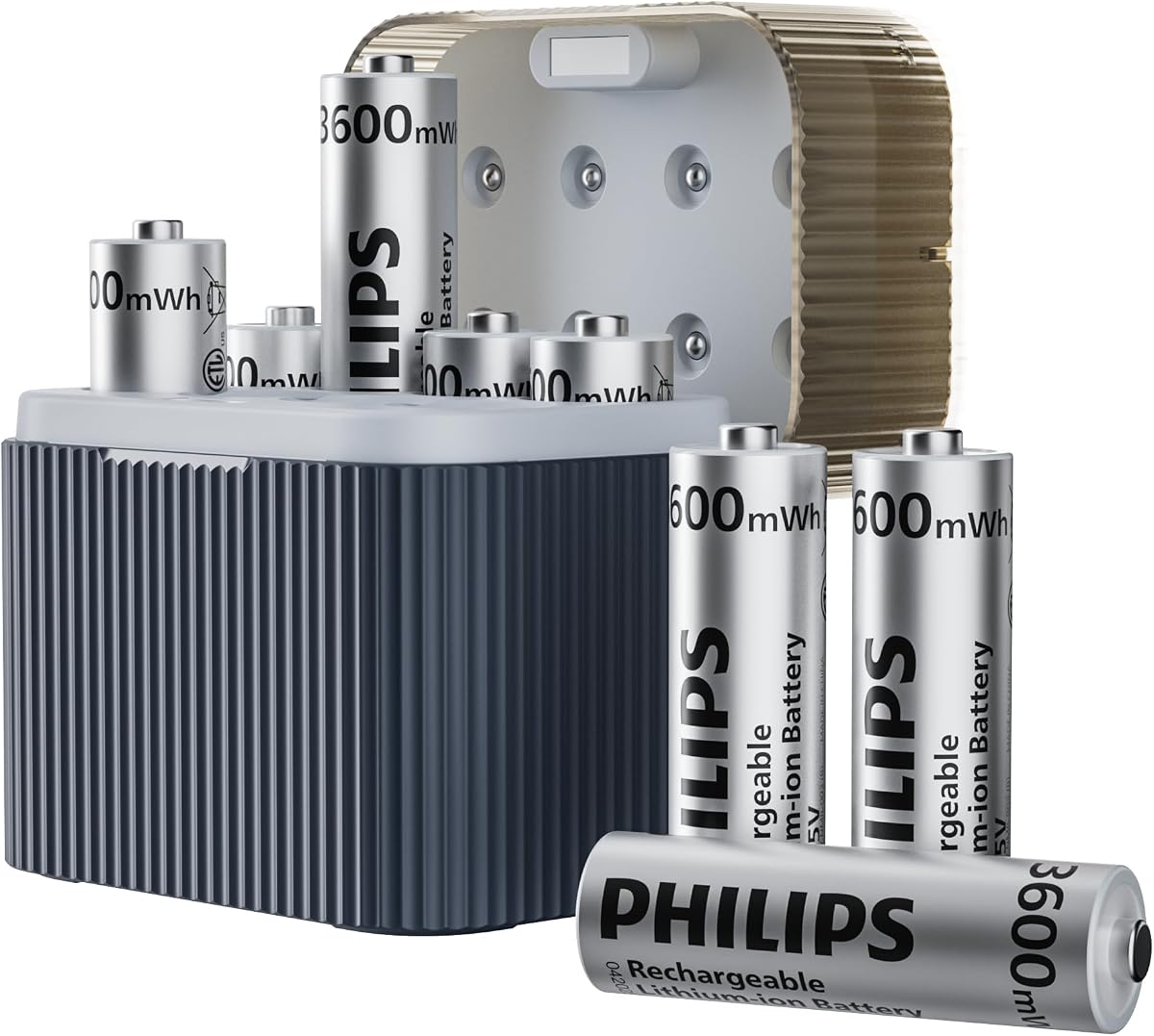
The Philips 8-Pack with Fast Charger combines 3600mWh cells, constant 1.5-volt output, and an integrated eight-slot charger. Its supplied 4.8 rating is the highest among the rechargeable products in this guide. The design is especially useful for users who want one dependable package to handle high-drain devices while keeping the batteries organized between uses.
We may earn a commission when you buy through this link, at no additional cost to you.
The magnetic charger supports one through eight cells in any combination, and its charging and storage function makes it easier to keep the full set together. The cells are claimed to support more than 1,200 charge-discharge cycles, have no memory effect, and maintain a steady 1.5-volt output until depletion. That combination addresses the common shortcomings users associate with 1.2-volt NiMH cells: declining output and reduced compatibility with modern electronics.
The listed applications are broad, including gamepads, VR grips, doorbells, cameras, flashes, door locks, microphones, radios, toys, alarm clocks, scales, blood-pressure monitors, and Blink cameras. That breadth makes the set a strong general-purpose choice. The trade-off is that the charger is designed for these specific lithium batteries, so it should not be assumed to accept arbitrary rechargeable AA cells.
This is the strongest general recommendation for readers who want high capacity, a full charger, stable voltage, and broad compatibility in one package. It particularly suits households that rotate batteries among controllers, cameras, smart-home accessories, and small household electronics. Buyers should still confirm that the intended device accepts 1.5-volt rechargeable lithium cells before installation.
The magnetic, independently slotted design simplifies both charging and organization. Instead of leaving eight loose cells in a drawer, the user can return them to the charger and keep the set ready for the next rotation.
Maintaining 1.5 volts until depletion can make a rechargeable cell more practical for cameras, smart-home equipment, and other electronics designed around primary-cell voltage. It also reduces the voltage-related concerns that often accompany NiMH alternatives.
We may earn a commission when you buy through this link, at no additional cost to you.
The EBL AIR III 8-Pack earns one of the guide's top ratings at 4.8 and stands out for charger flexibility. It includes eight 1.5-volt lithium rechargeable batteries and a charging box that accepts not only these cells but also 1.2-volt NiMH and Ni-CD rechargeable AA batteries. That versatility makes it a convenient option for a household with mixed rechargeable battery inventories.
We may earn a commission when you buy through this link, at no additional cost to you.
Each battery is rated at 3600mWh and maintains a constant 1.5-volt output. The listing states that the cells retain 80 percent capacity after 1,600 cycles, offers minimal self-discharge, and has no memory effect. It also claims a minus 40F to 140F operating range, making the set suitable for outdoor cameras, flashlights, and equipment exposed to seasonal conditions.
The claim about avoiding low-battery false alarms is especially relevant to Blink cameras, video doorbells, and smart-home devices. A stable output may help these products avoid interpreting a rechargeable cell's declining voltage as an immediate failure, although actual device behavior still depends on its battery-detection system. A further advantage is the broad charger compatibility, which reduces the need to maintain multiple charging bases.
This is a premium recommendation for people who want long cycle life, temperature tolerance, and one charger capable of handling several rechargeable AA formats. Its main limitation is that it does not solve every chemistry at once, and the eight-cell quantity may be modest for large camera installations. It is still one of the most balanced rechargeable packages in the comparison.
Support for 1.5V lithium, 1.2V NiMH, and Ni-CD cells is a meaningful household convenience. It allows the box to manage several rechargeable AA inventories without requiring the user to identify and maintain separate chargers.
The stated ability to retain 80 percent capacity after 1,600 cycles gives this pack a strong longevity story. As with all cycle-life claims, actual results depend on charging practices, temperature, discharge depth, and battery age.
We may earn a commission when you buy through this link, at no additional cost to you.
This 8-Pack combines 1.5-volt lithium-ion batteries with a dedicated Type-C charging and storage box. Its supplied rating is 4.3, while its most notable claims include a 3000mWh energy capacity and up to 2,500 recharge cycles. The charger also includes a detailed LED system for distinguishing charging, full charge, incompatible accessories, overheating, and other faults.
We may earn a commission when you buy through this link, at no additional cost to you.
The ability to reactivate a battery discharged to 0V is useful for long-term storage and emergency planning. The integrated box is also well suited to travel, since it keeps the cells organized and offers a three-hour charging design that requires a 5V 3A power supply. Claimed applications include Xbox controllers, digital cameras, Meta Quest equipment, solar lights, remote-control cars, flashlights, recorders, and Wii devices.
There are meaningful restrictions. The listing says the batteries and charger work only together and are not compatible with other brands. It also says the batteries are not compatible with smoke detectors or doorbells, with some Blink models likewise unsuitable. Using another charger or a power source above the specified input can create a safety risk, so the proprietary ecosystem requires careful attention.
This kit is best for users who want a high claimed cycle count, detailed charging feedback, and a case that handles both storage and charging. Its restrictions make it less attractive for mixed-device households, particularly anyone needing reliable doorbell or smoke-alert power. Those users should prioritize a clearly stated compatibility list over cycle count alone.
The multi-color LED system provides more information than a basic on-off charger. It can show active charging, full charge, and fault conditions, helping users distinguish a normal status from an incompatible battery or damaged cable.
The battery and charger are designed to work together, not with other brands. Users should not substitute a similar-looking charger, and they should follow the specified input requirements to avoid damaging the cells.
We may earn a commission when you buy through this link, at no additional cost to you.
The Energizer Ultimate Lithium 24-Pack is a high-volume primary-battery option rather than a rechargeable product. It carries a 4.7 rating and is positioned for critical devices, including smart-home equipment, outdoor surveillance systems, digital cameras, Blink outdoor cameras, and handheld games. The large count is practical for users who want many cells available at once.
We may earn a commission when you buy through this link, at no additional cost to you.
Like the smaller Energizer pack, these cells offer a claimed storage life of up to 25 years and an operating range from minus 40F to 140F. Leak-proof construction based on standard use helps protect devices during storage and operation. These characteristics make the pack attractive for emergency reserves, remote installations, and seasonal equipment.
Its primary limitation is also its defining distinction from the rest of the list: the cells are single-use. They offer reliable primary-cell voltage and storage behavior, but users cannot recover them through a charger. Frequent replacement may also create more waste than a rechargeable setup, particularly for equipment that consumes batteries regularly.
This pack is best for a large reserve, especially where the equipment needs cells that can sit for a long time and then work reliably in cold or heat. It is less compelling for everyday high-turnover use, where the rechargeable kits in this guide are more directly aligned with the request. Buyers should compare the convenience and longevity of their actual use pattern before choosing primary cells.
Twenty-four cells make this a convenient one-time supply for surveillance systems, cameras, and emergency inventories. The quantity is especially useful for users who prefer to check several devices at once rather than rotate smaller groups.
The long storage claim reduces the need for frequent checks in infrequently used equipment. It does not make the batteries rechargeable, so users should still follow sensible replacement and inspection practices.
We may earn a commission when you buy through this link, at no additional cost to you.
The 12-Pack 3600mWh kit is a strong value-oriented bundle for anyone who needs more than a standard eight-cell set. It includes 12 rechargeable 1.5-volt lithium batteries, each rated at 3600mWh or 2400mAh, plus a dedicated USB-C charging case. Its 4.6 rating reflects a favorable balance of features and customer feedback.
We may earn a commission when you buy through this link, at no additional cost to you.
The charger can charge all 12 cells simultaneously in approximately three hours and includes an attached USB-C cable. Twelve independent LED indicators show charging, full-charge, and fault conditions. This makes the system especially useful for larger households, game collections, camera users, or anyone who prefers to keep a substantial number of cells ready at once.
The cells claim up to 1,200 recharge cycles, low self-discharge, and constant 1.5-volt output. The stated device list is extensive, covering controllers, trail cameras, smart locks, flashlights, doorbells, scales, thermometers, clocks, weather stations, GPS devices, motion-sensor trash cans, and soap dispensers. Built-in protection is claimed against overcharging, over-discharging, overcurrent, short circuits, and overheating.
This is the best budget pick because it combines a high cell count with a capable charger and independent status feedback. The main trade-off is physical size and the lower cycle claim than several eight-cell competitors. Users should also follow the safety guidance and confirm that each intended device is designed for 1.5-volt rechargeable lithium batteries.
The twelve independent slots allow the user to charge only the cells needed or top up the entire group at once. That flexibility is valuable for multi-controller homes and camera installations that would exhaust an eight-battery set more quickly.
A claimed three-hour simultaneous charge and separate LED for every slot make it easier to see when the set is ready. The USB-C input also simplifies recharging the case from compatible power sources.
We may earn a commission when you buy through this link, at no additional cost to you.
The 3400mWh 12-Pack emphasizes both longevity and physical protection. Its 12 rechargeable cells deliver a stated stable 1.5-volt output, and the kit includes a magnetic clamshell-style charger inspired by the form of a wireless-earbud case. The supplied customer rating is 4.4, placing it in the middle of the guide while still offering several attractive features.
We may earn a commission when you buy through this link, at no additional cost to you.
The case provides all-around magnetic coverage and is described as dustproof and waterproof, making it convenient for travel or storage in environments where loose batteries could be exposed to dust or moisture. Its LCD display uses a scrolling battery icon while charging, a solid icon when full, and a flashing icon to signal an incompatible or damaged battery.
The battery claim is substantial: more than 2,000 recharge cycles, no memory effect, and 3400mWh of energy per cell. The charger is designed only for rechargeable AA lithium batteries, which simplifies its charging protocol but reduces flexibility. The supplied information also mentions dedicated support, although warranty and service terms should be confirmed directly with the seller.
This kit is a compelling choice for travelers, photographers, and users who want long cycle life in a protected case. It is less suitable for households that need one charger to manage mixed battery chemistries. Before buying, users should verify the device's charging environment and ensure the magnetic case will be kept away from excessive heat, moisture beyond its rating, and physical damage.
The magnetic full-coverage case does more than charge the cells. It organizes them and adds a physical barrier against dust and everyday impact, which is useful when equipment is carried between locations.
A claim of more than 2,000 cycles makes the set compelling for regular users. Real longevity still depends on avoiding physical damage, observing charging requirements, and keeping cells away from unsuitable temperatures.
We may earn a commission when you buy through this link, at no additional cost to you.
The Philips 8-Pack USB-C Kit provides eight 3600mWh rechargeable lithium AA batteries with a constant 1.5-volt output. Its 4.3 rating is supported by a broad set of features, including a Type-C charging case, intelligent battery identification, charging LEDs, and a claimed 1,200-cycle life. The product is positioned for controllers, cameras, toys, and household electronics.
We may earn a commission when you buy through this link, at no additional cost to you.
Its charging case combines storage with charging and can work with a power bank, car charger, or computer power supply according to the supplied listing. This flexibility is useful away from a wall outlet. The batteries are also claimed to support recovery from a deep discharge down to 0V, have no memory effect, and lose less than 3 percent per month through self-discharge.
A quad-protection charging system is listed for overcharging, over-discharging, short circuits, and overheating, with LEDs showing charging progress, full charge, or abnormal conditions. The major compatibility warning is that the batteries are not applicable to smoke alarms or doorbell cameras. Users should also treat the 40 percent endurance comparison with ordinary NiMH cells as a product claim rather than a universal result.
This kit is a versatile choice for users with controllers, digital cameras, voice recorders, remote-controlled toys, flashlights, and clocks. It is particularly convenient for travel because the case charges and stores together. Households that rely on doorbells or smoke detectors should choose another product, and all users should confirm the device voltage before installation.
The Type-C case is listed as compatible with power banks, car chargers, and computer power supplies. That flexibility helps when users are away from a dedicated wall charger and need to top up a set of batteries.
A claimed monthly self-discharge rate below 3 percent supports better readiness between uses. The intelligent identification chip and abnormal-status LEDs add another layer of charging oversight.
We may earn a commission when you buy through this link, at no additional cost to you.
The second Philips 8-Pack in this guide offers 3600mWh cells, a constant 1.5-volt output, and a Type-C charging case with a stated 5V 2A charging input. Its supplied rating is 4.3, and the overall feature set closely targets users who want a balanced rechargeable system for controllers, cameras, remotes, flashlights, toys, and voice recorders.
We may earn a commission when you buy through this link, at no additional cost to you.
The case combines charging and storage, while an intelligent identification chip is intended to detect battery status and avoid mismatched charging errors. Real-time LEDs report charging progress, a full charge, and abnormal alerts. The charging system is described as offering four layers of protection against overcharge, over-discharge, short circuit, and overheating.
The flame-retardant ABS shell is stated to withstand a one-meter drop, adding physical durability for travel or repeated handling. Cycle life is rated at up to 1,200 charges, with no memory effect, a claimed monthly self-discharge rate below 3 percent, and recovery supported down to 0V. These features make the kit practical for users who rotate the same eight cells among several devices.
The most significant restriction is voltage compatibility. The listing says the batteries are not compatible with 3V devices, giving smoke alarms and doorbell cameras as examples. Users should therefore check the voltage requirement of every device rather than relying only on the AA physical size. The set is best for modern household electronics and game controllers that accept 1.5-volt rechargeable lithium cells.
The flame-retardant shell and stated one-meter drop resistance help the cells tolerate ordinary handling. Combined with four charging safeguards, the design addresses both mechanical and electrical risks.
An AA shape does not guarantee electrical compatibility. The explicit exclusion of 3V devices means that users should confirm voltage requirements before inserting these cells into smoke alarms, doorbell cameras, or other specialized equipment.
We may earn a commission when you buy through this link, at no additional cost to you.
The best rechargeable Aa lithium battery depends on voltage behavior, runtime, charger design, cycle longevity, safety features, and the devices you intend to power. Paying attention to those details helps prevent an expensive mismatch between a sophisticated battery and a simple or incompatible charger.
Most rechargeable Aa batteries use NiMH chemistry and provide approximately 1.2 volts, while the lithium products in this guide advertise a nominal 1.5-volt output. The higher voltage can resemble a primary alkaline or lithium cell more closely, which may be necessary for cameras, smart-home accessories, and other devices with battery-health detection. It is still essential to read the device instructions because the physical AA size does not guarantee electrical compatibility.
Prioritize a 1.5-volt rechargeable lithium battery when the equipment specifically supports that chemistry, and verify every device before buying. Pay special attention to the repeated warnings concerning smoke detectors and doorbell cameras.
Battery capacity affects runtime, but comparing the number requires attention to units. A 3600mWh cell at 1.5 volts corresponds to approximately 2400mAh, while some listings express the same class of energy in milliamp-hours. More capacity can reduce replacement frequency in high-drain equipment, although actual runtime also depends on current draw, device behavior, temperature, and how deeply the cell is discharged.
Choose 3400mWh or 3600mWh cells when runtime matters most. The 3000mWh kit may still be adequate, but its lower figure makes it more relevant to moderate-use devices than to prolonged camera or controller sessions.
Rechargeable lithium Aa cells often require a charger designed for their specific chemistry and voltage. The Dracutum pack explicitly requires a 1.5V lithium charger and is not compatible with common 1.2V NiMH or 3.7V lithium chargers. Products that include a case generally use an intelligent or proprietary charging protocol, so users should avoid substituting a visually similar charger unless the manufacturer explicitly permits it.
A bundled matching charger offers the simplest ownership experience. If a kit uses a proprietary charger, confirm its input requirements and whether it accepts other battery formats before purchasing.
Cycle-life claims indicate how many times a battery can be charged and discharged under specified conditions. The products in this guide claim ranges from 1,200 cycles to as many as 2,500 cycles, with EBL also stating that its cells retain 80 percent capacity after 1,600 cycles. These figures are useful for comparing expected longevity, but they are not guarantees for every cell or every way of using it.
Favor a higher claim when batteries will be used daily, while lower claims may still be adequate for occasional use. Regardless of the rating, following the correct charger, avoiding physical damage, and keeping cells within suitable temperature conditions are essential.
A charging case can do more than recharge cells. It can keep them organized, protect them during travel, and offer status indicators that reduce uncertainty. The Philips eight-battery charger uses a magnetic design, the larger 12-battery systems provide individual LEDs or an LCD, and the 3400mWh set adds a protective clamshell enclosure. The useful system is the one that matches how many batteries you need to rotate and where you expect to use them.
Look for independent slot indicators, simple charging logic, and a power input that suits your routine. Very large cases offer more capacity but require more storage space, while smaller systems are easier to carry.
Rechargeable lithium-ion products should include safeguards against overcharging, over-discharging, overcurrent, short circuits, and excessive heat. Several listings also mention intelligent identification chips, abnormal-status lighting, flame-retardant shells, or physical drop resistance. These protections are useful because batteries can be dropped, left unattended, or connected to the wrong power source.
Look for visible status feedback and layered charging protection, but do not treat electronics as a substitute for sound handling. Use only the specified charger and power source, follow polarity instructions, and stop using cells that are swollen, punctured, leaking, or physically damaged.
The strongest use cases include game controllers, digital cameras, flashlights, microphones, radios, toys, clocks, scales, and some smart locks or trail cameras. Smart-home devices can be more demanding because a low-voltage reading may trigger a low-battery warning or cause an early shutdown. Products with stable 1.5-volt output may fit these applications better than declining 1.2-volt NiMH cells, but compatibility remains device-specific.
Create a list of intended devices and verify each one. Exclude smoke detectors, doorbells, and other systems with specialized voltage or battery requirements unless the manufacturer explicitly approves the rechargeable lithium cell.
The Energizer Ultimate packs in this comparison are not rechargeable. They remain relevant when long storage life, broad temperature performance, and immediate readiness matter more than repeated reuse. Primary lithium cells can be especially attractive for emergency kits, seasonal equipment, and devices that remain idle for long periods.
Choose primary lithium cells when simplicity and storage readiness outweigh cycling benefits. Choose rechargeable lithium cells for frequent use, where reducing repeated disposables and keeping a rotation of charged cells ready provides greater practical value.
Start by confirming that every device accepts 1.5-volt rechargeable lithium Aa batteries. Check the device manual, battery compartment markings, and the battery guide supplied with your charger. Do not assume that any AA-compatible device can safely use these cells, especially when a product specifically warns against use in smoke alarms, doorbells, or other 3V equipment.
Charge the batteries with their specified charger or case. Observe polarity, the required input voltage and current, and the manufacturer's charging instructions. Do not mix lithium, NiMH, Ni-CD, alkaline, and primary lithium cells in the same charging session unless the charger expressly supports each format. Remove any damaged, leaking, swollen, corroded, or punctured battery from use immediately.
Store charged cells in the supplied case, away from extreme heat, direct sunlight, moisture, and conductive objects. Rotate complete sets where possible so devices receive similar usage levels, and avoid leaving partially discharged cells in a device for months. Periodic checking is sensible, particularly after long storage, because a protective case does not eliminate age-related capacity loss or charging faults.
No. The physical AA size does not guarantee that a device supports 1.5V rechargeable lithium chemistry. Check the device manual or manufacturer support page, and pay special attention to warnings about smoke detectors, doorbells, and equipment designed around 3V operation. A device designed for 1.2V NiMH cells may also require an appropriate charge-detection method for 1.5V rechargeable cells.
Most 1.5V rechargeable lithium AA batteries require a charger designed for that chemistry and voltage. Common 1.2V NiMH chargers and bare 3.7V lithium-cell chargers may not be compatible. Some kits include a dedicated charger, while the Dracutum pack requires a separately obtained 1.5V lithium charger. Always follow the instructions for the exact battery model.
Milliwatt-hours describe stored energy, while milliamp-hours describe charge relative to a stated voltage. A 3600mWh cell at 1.5V is approximately 2400mAh, so the units can describe similar energy when the voltage is considered. For cross-brand comparisons, energy in mWh can be more useful, but actual runtime still depends on the device's current draw and efficiency.
They can be better for frequent use because they provide 1.5-volt output and can be recharged many times, reducing the need for regular disposables. The comparison is not universal: some devices are incompatible, rechargeable cells cost more initially, and dedicated chargers add complexity. Primary lithium or alkaline batteries may still be simpler for emergency reserves or very low-use equipment.
Some devices measure voltage to estimate remaining capacity and may be calibrated around 1.5V primary cells or 1.2V NiMH cells. A rechargeable lithium cell's behavior, protection circuitry, and discharge curve can be interpreted differently, leading to warnings or shutdowns. Compatibility depends on the exact model, so the device manufacturer should confirm support before use.
Yes, and their low self-discharge is one of their main advantages. Store them fully charged in their original case or another nonconductive container, away from heat, moisture, and metal objects. Periodically inspect and recharge them, and never rely on a stored battery without checking its condition, especially if it may be needed during a prolonged emergency.
The listed claims range from 1,200 to 2,500 cycles, and EBL states that its cells retain 80 percent of capacity after 1,600 cycles. Actual life can be shorter or longer depending on charging habits, temperature, discharge depth, physical damage, and cell quality. Following the specified charger and avoiding stressful operating conditions is the best way to protect expected service life.
Choose eight if you need a basic rotation for a game controller, a few remotes, or a small collection of battery-powered devices.
Choose twelve if you operate multiple cameras, controllers, toys, or household accessories and value having a complete charged set available. Larger kits also reduce the inconvenience of recharging every few batteries during normal use.
The Philips 8-Pack with Fast Charger is the strongest all-around choice because it combines 3600mWh cells, constant 1.5-volt output, a magnetic eight-slot charging case, and a high 4.8 rating. The EBL AIR III 8-Pack is an equally strong alternative for users who prioritize 1600-plus claimed cycles, temperature performance, and a charger that also accepts NiMH and Ni-CD rechargeable AA cells.
For buyers who want the most batteries in one organized system, the 12-Pack 3600mWh kit is the best budget-oriented option, offering twelve individual charging slots, USB-C input, simultaneous charging, and separate status lights. The 3400mWh 12-Pack adds a protective magnetic case, while the Dracutum 16-Pack is attractive for high peak current but requires a separate compatible charger.
Before buying, confirm that every intended device supports 1.5-volt rechargeable lithium batteries and review warnings concerning smoke detectors, doorbells, and specialized 3V equipment. Product prices, availability, and charger terms can change, so check the current listing carefully and use the included instructions to keep charging safe and the batteries performing as intended.