
Whirlwind IMP 2
4.8Editor score
Compact passive mono design
Balanced low-impedance XLR output
Rivet-mounted professional transformer
A bass direct box converts an instrument’s unbalanced output into a balanced signal suitable for a mixing console, recording interface, or stage box. The right model can reduce noise, handle long cable runs, and make a complicated setup easier while preserving the character of your instrument.
This guide compares ten passive and active direct boxes based on the supplied specifications, including channel count, transformer design, attenuation, ground-related features, outputs, power requirements, and construction. The list covers single-channel and stereo units for bass, guitar, keyboards, synthesizers, studio recording, rehearsal, and live performance.
Each review identifies the capabilities that distinguish one direct box from another and explains which musicians or engineers may benefit from its design. Featured selections include a practical entry-level model, a highly rated stereo option, and a premium active unit, while current product availability and pricing should be checked before purchasing.
4.8Editor score

4.8Editor score

4.7Editor score
As an Amazon Associate we earn from qualifying purchases.
The comparison below highlights each direct box’s channel configuration, power approach, signal controls, isolation features, and intended applications so bassists can quickly narrow down the most appropriate model.





The Pyle Premium Direct Injection Audio Box is a compact passive DI built around a quarter-inch instrument input and an impedance transformer for balanced and unbalanced XLR connections. Its 4.5 rating reflects a generally positive reception, while the listed hum-elimination, attenuation, and instrument-connectivity features make it a practical option for common bass-rig requirements.
We may earn a commission when you buy through this link, at no additional cost to you.
The useful distinction here is the combination of an input attenuator and transformer isolation. Attenuation can help match a strong instrument output to a console input, while the transformer helps reject hum and interference encountered between an unbalanced instrument and a balanced mixing environment. It can also accept keyboards, effects processors, sub-mixers, and the line output of a consumer stereo system, making the box less narrowly focused than a bass-only accessory.
The main limitation is its single-channel architecture. Players who need true stereo routing, multiple independent instruments, or a stereo keyboard signal through one enclosure will need a dual-channel model instead. Because it is passive, it also offers no active gain stage or power-source flexibility, although that simplicity can be an advantage in fixed installations and straightforward live setups.
This is a sensible choice for a bassist connecting one electric bass to a PA or recording mixer, especially when hum control and source attenuation are priorities. It is also worth considering for guitars, keys, and processors. The choice is strongest for straightforward, single-instrument work where a passive transformer and simple 1/4-inch connection are exactly what the signal path needs.
The impedance transformer is intended to convert the instrument’s unbalanced signal into a balanced connection while helping cancel buzz and hum. That makes the unit useful when the bass, pedalboard, and console do not share an ideal grounding arrangement or when a long cable run introduces potential interference.
The input attenuator gives the user a way to reduce a stronger source before it reaches the following device. It is especially relevant when a DI serves more than one instrument or when connecting line-level equipment alongside passive instruments.
We may earn a commission when you buy through this link, at no additional cost to you.
The Pyle PDC21 is described as a premium passive DI for guitars, basses, keyboards, and outboard processors. It earns a 4.5 rating and combines an all-steel chassis with a quarter-inch connector, input attenuation, and a transformer-based path designed to deliver balanced or unbalanced XLR output while reducing hum and buzz.
We may earn a commission when you buy through this link, at no additional cost to you.
Its strongest documented feature is physical construction. The steel chassis is presented as heavy-duty and durable, which is meaningful for a device that may live in a pedalboard, stage rack, rehearsal-room pile, or touring case. The electrical feature set also remains versatile: the same unit can carry an electric bass, guitar, keyboard, sub-mixer, or effects processor, provided the source levels suit the passive design.
Like the preceding Pyle model, this is a mono box, so it cannot maintain two stereo channels or independently manage two instruments. Its listed capacity to power multiple effects pedals is worth distinguishing from its audio role, and users should plan the actual signal path carefully. It also does not provide an active gain stage, so very low-output sources may require additional amplification.
The PDC21 is most appropriate for bassists who want a durable, flexible passive box for stage or studio use. It may particularly appeal to players with a varied collection of instruments and processors who want one compact unit to handle quarter-inch sources. Those seeking true stereo operation or multiple power options should look toward a dual-channel active model instead.
The all-steel enclosure gives the PDC21 a more substantial feel than a lightweight plastic utility box. It is a sensible specification for musicians who repeatedly move equipment between rehearsal spaces, stages, and studios.
Its compatibility with basses, guitars, keyboards, sub-mixers, and effects processors makes it adaptable to changing session or performance requirements. The source should still be checked against the passive input and attenuation controls before connection.
We may earn a commission when you buy through this link, at no additional cost to you.
The Radial Pro DI is a passive mono direct box built around a custom transformer and rugged I-beam construction. Its 4.7 rating is among the strongest results in this group, and the straightforward specification points toward a durable transformer-based solution for converting one unbalanced instrument signal to a balanced console-ready output.
We may earn a commission when you buy through this link, at no additional cost to you.
For a bassist, the main appeal is the combination of custom transformer design and rugged construction. A passive transformer can reduce the incompatibility between high-impedance instrument output and long balanced cable runs without introducing a power requirement. The I-beam enclosure is especially relevant for an accessory expected to tolerate transport, repeated setup, and regular use rather than remain stationary on a shelf.
The supplied information is intentionally concise, so additional controls cannot be claimed from the available facts. In particular, the product listing does not enumerate attenuation, parallel outputs, or a ground-lift switch, while more detailed models in this roundup explicitly identify those functions. Buyers who need visible signal-trimming controls may prefer a direct box whose specifications make them easy to find.
The Radial Pro DI is a strong recommendation for a serious bassist who values a rugged mono box, transformer isolation, and a well-regarded passive design. It is less suited to stereo keyboard rigs or setups that require two independent channels. For those situations, a dual-channel model offers more flexibility without changing the basic purpose of the direct box.
The custom transformer is the defining element of this direct box. It performs the conversion from an unbalanced instrument source to a balanced microphone-level output while contributing isolation from ground-related interference.
The rugged I-beam construction is a practical advantage for working musicians. A protective enclosure is valuable when a direct box is moved frequently between rehearsal rooms, stages, studios, and mobile recording sessions.
We may earn a commission when you buy through this link, at no additional cost to you.
The Whirlwind IMP 2 is a one-channel passive instrument direct box with a 4.8 rating, the highest numerical score among the featured products. It converts line- or instrument-level unbalanced signals into a low-impedance, microphone-level balanced signal, making it a focused solution for feeding a bass, guitar, or other instrument into a professional mixer.
We may earn a commission when you buy through this link, at no additional cost to you.
Its standout quality is the combination of a compact inline format and the Whirlwind TRHL transformer. The transformer is riveted rather than glued to the chassis, which is a thoughtful construction detail for a device likely to experience transport and repeated handling. The small footprint also makes the IMP 2 convenient for pedalboards, small stage boxes, and tightly arranged studio racks.
The trade-off is simplicity. It is a mono direct box, and the supplied specifications do not mention an attenuation pad, parallel output, or ground-lift control. Users must therefore ensure that their source level is appropriate for the input and that the console is ready for a balanced microphone-level signal. The passive design also means it cannot provide active gain or solve every low-output-source challenge.
For a bassist who wants a compact, professional passive box for stage or studio routing, the IMP 2 is a particularly persuasive option. It is also the budget-focused member of the top three because it offers the essential signal conversion and a strong rating without adding the extra circuitry or controls found in more elaborate units. Stereo rigs should instead consider a two-channel model.
The inline enclosure keeps the IMP 2 easy to place in a pedalboard, rehearsal amplifier, or compact stage setup. Bassists constrained by space can retain balanced console connectivity without carrying a large floor unit.
Using a riveted transformer rather than adhesive alone provides a stable mechanical connection to the chassis. It is a meaningful construction distinction in an accessory designed for regular movement and repeated setup.
We may earn a commission when you buy through this link, at no additional cost to you.
The Pyle PDC22 is a two-channel passive DI with a 4.4 rating. It is designed to carry guitars, basses, keyboards, sub-mixers, or effects processors, using quarter-inch input connections, input attenuation, and transformer isolation to send balanced or unbalanced XLR signals to a PA or recording mixer.
We may earn a commission when you buy through this link, at no additional cost to you.
Two channels are the defining advantage. A bassist can use one side for a single instrument, or the unit can accommodate a stereo keyboard or two separate sources. Its transformer-based approach helps manage buzz and hum, while the attenuator can accommodate stronger signals without relying on active gain. The steel chassis also suits a working-stage environment where durability matters.
Its limitations follow naturally from the passive, dual-channel design. It cannot supply phantom power, battery operation, or USB power, so it will not fit setups that specifically need an active device. The available information does not identify distinct attenuation, pad, or ground-lift controls for each channel, which could make it less flexible than the Radial ProD2 or Bolanle DB2. Its 4.4 rating is also the lowest of the ten products listed.
The PDC22 is a good match for players who need two passive channels in a single package, especially when routing a stereo keyboard or pairing an instrument source with another line-level device. It is less attractive for engineers seeking sophisticated per-channel switching, active gain, or multiple powering options. Confirm that passive level matching suits both sources before relying on it.
The dual-channel layout can reduce the number of separate boxes required for stereo keys, paired instruments, or a larger rehearsal rig. It also provides room to compare transformer-isolated routing options in a single package.
The transformer design handles conversion and hum reduction without a power supply. This keeps the signal path straightforward for stage use, rehearsal rooms, and fixed studio installations where power is inconvenient.
We may earn a commission when you buy through this link, at no additional cost to you.
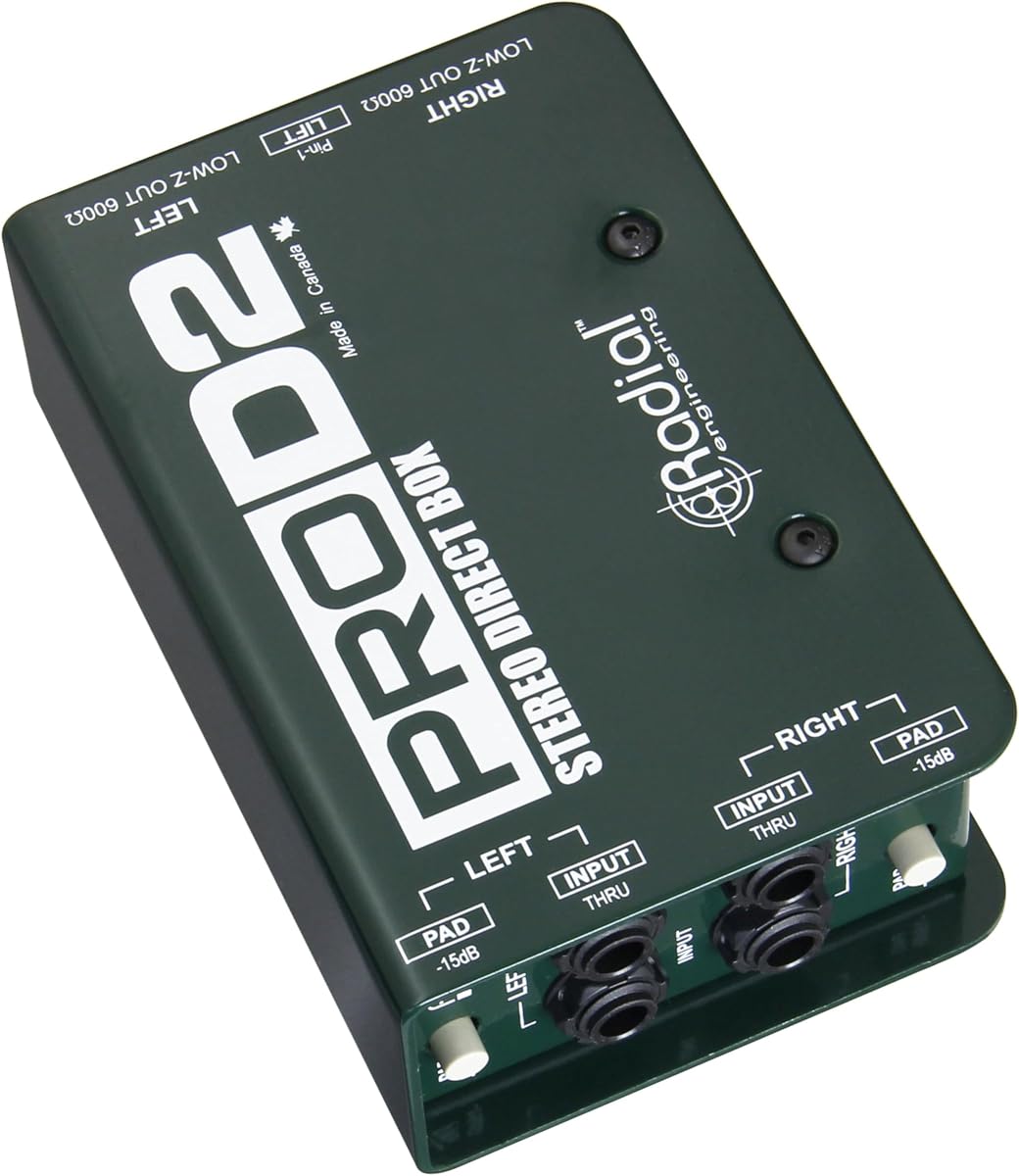
The Radial ProD2 is a passive stereo direct box with an isolation transformer, lift switch, and 15dB pad. Its 4.8 rating matches the highest score in the roundup, and the combination of true stereo routing and accessible signal controls makes it an excellent general-purpose solution for bass, guitars, keyboards, and stereo line sources.
We may earn a commission when you buy through this link, at no additional cost to you.
The lift switch is especially valuable because it gives the user a way to address ground-loop interference without abandoning the direct box. The 15dB pad provides a clear method for reducing overly strong signals, and the passive isolation transformer handles unbalanced-to-balanced conversion. Together, these controls solve common problems that a basic transformer box may leave to the user or mixing console.
As a passive design, the ProD2 cannot add gain, work without any input-level consideration, or provide phantom power. The stated features also do not include an input attenuator with multiple positions, polarity reversal, or USB and battery power. A musician seeking elaborate active processing may need a more specialized unit, but for conventional passive stereo routing, those omissions are not major drawbacks.
This is a leading choice for bassists who want more than a bare mono converter. It works particularly well for stereo keyboard rigs, two-instrument setups, and any situation where hum reduction or level control can improve the connection. The clear combination of transformer isolation, stereo channels, a lift switch, and a pad makes it one of the most complete passive designs in the comparison.
Two channels and a 15dB pad make the ProD2 practical for signals that would otherwise overload an input. The passive architecture keeps the box simple and independent of external power while still offering useful front-panel control.
The lift switch is a direct response to ground-loop hum in common live and studio systems. It gives an engineer another way to isolate the source when unwanted interference appears between the instrument and destination.
We may earn a commission when you buy through this link, at no additional cost to you.
The Bolanle DB2 is a passive two-channel DI box with a 4.6 rating. It converts high-impedance signals to low-impedance XLR output, includes a ground-lift switch for reducing ground-loop interference, and provides three attenuation settings at 0dB, negative 20dB, and negative 40dB for instruments and professional audio sources.
We may earn a commission when you buy through this link, at no additional cost to you.
Its most distinctive feature is the three-position attenuation control. Rather than relying on a single fixed pad, the DB2 gives users a broader range of level reduction, which can help match differing instruments, line sources, or processor outputs. Balanced stereo XLR outputs support long-distance transmission, while the ground lift provides another tool for reducing hum on stages and in studios.
The design is promoted as rust-proof, scratch-resistant, and road-ready, which addresses common concerns about touring accessories. It remains passive, though, so it has no active gain stage and no phantom, battery, or USB power options. The documentation does not mention a parallel output, so musicians who need to split a signal to an amplifier and mixer should verify the required connection in advance.
The DB2 is a strong fit for bassists working with more than one source or needing finer level control than a basic mono passive box offers. It is also appropriate for guitars, synthesizers, and stereo or reamp workflows. Compared with a dual-channel active model, it offers fewer powering options but keeps the basic signal path straightforward and dependable.
The 0dB, negative 20dB, and negative 40dB settings allow the operator to reduce stronger sources in meaningful steps. That flexibility is useful when several instruments or processors feed similar mixing-console inputs.
The stereo XLR outputs are designed to preserve signal integrity over longer cable distances and reduce interference. Balanced routing makes the box a practical intermediary between stage sources and a main console or recording mixer.
We may earn a commission when you buy through this link, at no additional cost to you.
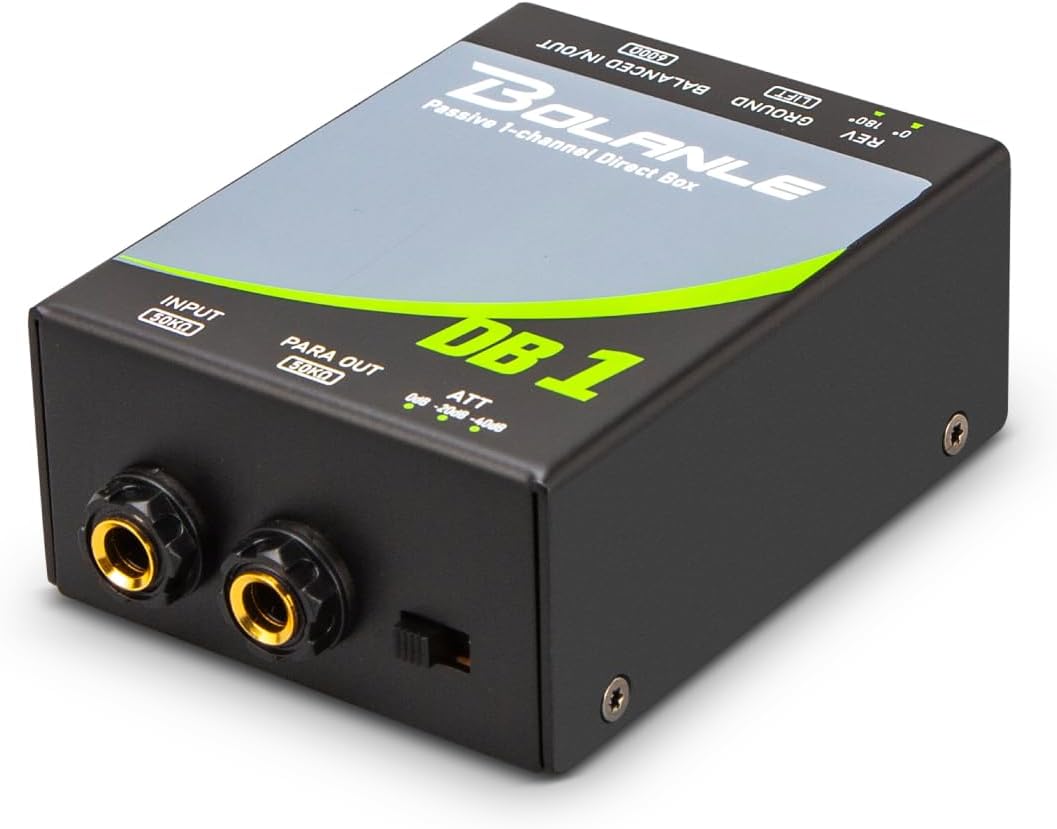
The Bolanle DB1 is a passive mono DI with a 4.5 rating, built for guitars, basses, synthesizers, live performance, and studio recording. It combines a balanced XLR output with a parallel output for guitar amplifiers, includes feedback and hum elimination, and provides signal attenuation and dual-mode functionality without requiring an external power supply.
We may earn a commission when you buy through this link, at no additional cost to you.
The parallel output is the most useful distinction for electric bass and guitar players. It allows a signal to travel to a mixer through the balanced XLR connection while also supporting an amplifier path, depending on the selected mode and hookup. Feedback and hum-elimination features address two common problems in live electric-instrument systems, while attenuation helps keep levels controlled.
The passive architecture is both a strength and a limit. It means there is no power supply to carry, remember, or connect, which is useful for mobile setups. It also means the DB1 cannot add gain for a very low-output instrument and offers none of the phantom, battery, or USB options found in the active J22. The mono layout also prevents true stereo operation within one unit.
The DB1 is well suited to a bassist who needs one dependable conversion box and values a parallel amp connection. It is also appropriate for reamp-style routing and compact rehearsal or stage setups. Those who need two instruments, stereo separation, or active gain should consider a dual-channel or powered alternative, while this model favors portability and straightforward passive operation.
The XLR output supports balanced console connections, while the parallel output offers a path to a guitar amplifier. This flexibility makes the DB1 useful in rigs that need to feed more than one destination.
Because the unit requires no external power, it can be packed and deployed with fewer accessories. That simplicity is useful for rehearsals, small stages, and studio sessions where a battery or phantom supply is unavailable.
We may earn a commission when you buy through this link, at no additional cost to you.
The Bolanle J22 is an active stereo direct box with a 4.6 rating and a particularly flexible power system. It can run from 48-volt phantom power, a 9V battery, or 5-volt USB, allowing bassists and keyboardists to use it with conventional mixers, standalone battery setups, or a USB power bank.
We may earn a commission when you buy through this link, at no additional cost to you.
Its dual-channel active design supports stereo keyboards, dual-output synthesizers, or two separate instruments without collapsing the signal into mono. Dual unbalanced quarter-inch TRS inputs feed dual balanced XLR outputs, and a 180-degree polarity-reversal switch adds control over signal polarity. The ground-lift switch is intended to break ground loops and reduce interference associated with lighting, effects, and shared power systems.
The active design creates a meaningful difference from passive boxes because the unit can operate independently of phantom power when a battery or USB supply is used. The trade-off is that a power source must be available, although three options reduce the chance of being stranded with an incompatible setup. The documentation states that batteries are not included, so users should obtain one separately if they intend to use that method.
The J22 is an excellent choice for a working musician who moves between powered mixers, rehearsal rooms, and locations without console power. It is particularly relevant to stereo keyboardists and synth players as well as bassists running two channels. Its combination of active signal conversion, flexible power, balanced outputs, ground lift, and polarity control goes beyond what a basic passive box offers.
Phantom power, a 9V battery, and 5-volt USB operation make the J22 adaptable to more environments. A bassist can use the mixer’s phantom supply, a standalone battery, or a power bank rather than being restricted to one power method.
Separate left and right XLR outputs preserve stereo separation for keyboards, dual-output synthesizers, and stereo line sources. This avoids the tonal and spatial compromises associated with folding a stereo instrument into a mono path.
We may earn a commission when you buy through this link, at no additional cost to you.
The Radial Pro48 is an active 48-volt phantom-powered direct box with a 4.7 rating. It is designed for high-resolution signal conversion and includes a negative 15dB pad for passive guitars and basses, positioning it as a compact, premium option for stage and studio routing.
We may earn a commission when you buy through this link, at no additional cost to you.
The active architecture is the defining distinction. Instead of relying entirely on passive transformer conversion, the Pro48 uses phantom power to drive its active electronics. The built-in pad addresses a common problem with passive instruments: a signal that is too strong for a particular input can be reduced by 15dB before entering the next device.
Its main constraint is the requirement for 48-volt phantom power, which can restrict use in rehearsal rooms, small acoustic setups, or locations with mixers that do not provide it. It is also a single-channel unit, so a stereo keyboard or two independent instruments would require another solution. The compact format offsets some of that limitation by making the box easier to incorporate into a stage or studio signal chain.
The Pro48 is best for bassists with access to a properly powered console or stage box and a source that benefits from active, high-resolution conversion. It is particularly compelling when a passive bass produces a strong preamp signal and the built-in pad can improve matching. Choose it for its active clarity and control, not as a universal answer to every power-constrained routing need.
The 48-volt active design provides a different operating principle from the passive units in this guide. It is suited to modern stage boxes and recording mixers that can supply stable phantom power.
The negative 15dB pad helps match powerful passive instruments to the receiving input. It can prevent overload and gives engineers a useful level-control option when the source output is too hot for the destination.
We may earn a commission when you buy through this link, at no additional cost to you.
The best bass direct box depends on signal level, routing, channel count, power access, and the likelihood of ground-related noise. These factors help separate a simple passive converter from a more versatile active or stereo instrument.
A passive direct box uses a transformer to convert an unbalanced instrument signal to a balanced output without needing external power. This makes passive units simple and portable, but the source must already provide a workable level. An active box adds powered electronics, which can provide greater control and flexibility while requiring phantom, battery, or USB power. The Radial Pro48 and Bolanle J22 are active options, while the other listed products are passive designs.
A single-channel direct box is enough when one bass feeds one mixer input. Stereo keyboards, dual-output synthesizers, and two-instrument rigs require two channels to preserve left-right separation or maintain independent control. The Radial ProD2, Bolanle DB2, Pyle PDC22, and Bolanle J22 are dual-channel models, while the remaining choices concentrate on one source at a time.
A bass with active electronics or a hot pickup output can overwhelm the receiving input. Direct boxes address this with pads, attenuators, or multi-position attenuation controls. The Radial ProD2 has a 15dB pad, the Bolanle DB2 offers 0dB, negative 20dB, and negative 40dB settings, and the Radial Pro48 includes a negative 15dB pad intended for passive instruments. Matching levels reduces distortion and makes downstream mixing more predictable.
A balanced XLR output is the standard way to connect a direct box to a mixing console, powered stage box, or recording interface over longer distances. The products in this guide are positioned around balanced or balanced-and-unbalanced transformer outputs, with the stereo models providing paired XLR connections. Balanced routing helps preserve signal integrity and resist interference, especially on stages with complicated electrical environments.
Ground loops can introduce hum when an instrument, amplifier, and console share interconnected power paths. A ground-lift switch breaks one connection and may remove the interference without requiring a different cable or signal route. The Radial ProD2 and Bolanle J22 explicitly include a lift switch, while several Pyle units emphasize transformer-based hum and buzz cancellation. The exact symptom and system layout still matter, so a lift control should be used as a diagnostic and routing tool rather than a guarantee against every noise source.
Power requirements can determine where an active direct box can be used. The Radial Pro48 operates from 48-volt phantom power, while the Bolanle J22 accepts phantom power, a 9V battery, or 5-volt USB. Passive boxes avoid the issue entirely, making them convenient for rehearsal rooms, acoustic stages, and fixed installations. Check the destination mixer or interface before choosing an active unit, and account for batteries or cables that may need to be carried separately.
A direct box should withstand being moved between rehearsal rooms, stages, studios, and storage cases. The Radial Pro DI uses rugged I-beam construction, the Whirlwind IMP 2 secures its transformer with rivets, and the Pyle PDC21 and PDC22 use steel chassis construction. The Bolanle units are described as scratch-resistant, rust-proof, and road-ready. Portability also depends on size, so musicians should consider whether a compact inline box or a larger dual-channel enclosure better fits the available space.
A direct box can serve more than bass guitar. Pyle models list compatibility with guitars, keyboards, effects processors, sub-mixers, and consumer stereo line outputs. The Bolanle DB1 and DB2 similarly support guitars, basses, synthesizers, and reamp-style use, while the Bolanle J22 is highlighted for stereo keyboards and dual-output synths. A wide feature set can be useful for working musicians who change instruments, but a model designed around the bass application may provide a simpler and more predictable path.
Begin by identifying the source and destination. Connect the bass, effects pedalboard, processor, or keyboard output to the appropriate quarter-inch input on the direct box, then run a balanced XLR cable from the output to a powered mixer, stage box, or recording interface. Confirm that the destination accepts an instrument-level or line-level signal in the mode selected on the direct box, especially when using a passive unit with an active bass.
Set attenuation, pad, ground-lift, and mode controls before raising the volume. If hum appears, try the ground-lift switch on an appropriate model, inspect the cable connections, and determine whether other equipment is introducing interference. For stereo operation, route left and right channels separately and keep their corresponding left and right outputs connected to matching mixer inputs. With an active box, install the required phantom power, battery, or USB supply before operating it.
Treat the direct box as part of the signal chain rather than as a powered speaker. Keep input and output connections secure, avoid placing the enclosure in a location where cables can be pulled or where liquids and extreme heat may cause damage, and coil cables properly for transport. Clean the casing with a dry soft cloth, inspect connectors for dirt or bent pins, and store the unit in a protected case when it is not in use.
A bass direct box converts an instrument’s unbalanced quarter-inch output into a balanced signal for a mixing console, stage box, or recording interface. It can also provide transformer isolation, help reduce hum, and attenuate a strong source. The exact functions depend on the model, so users should check the available controls before selecting one.
A passive box is simpler and requires no power, making it convenient in rehearsal rooms and fixed setups. An active box can offer additional control and more flexibility, but it needs a suitable power source. For a single passive bass with a normal instrument level, a well-matched passive transformer can be entirely sufficient.
Most electric basses produce a mono instrument signal, so a single-channel direct box is normally sufficient. A stereo box becomes more useful for stereo keyboards, dual-output synthesizers, effects processors with separate outputs, or two independent instruments. Choose based on the actual output structure of the source rather than the number of controls alone.
A ground-lift switch disconnects one side of the circuit’s ground path to help break a ground loop. It can reduce hum caused by interconnected equipment, although it may also remove the ground reference in some systems. It is best used as a controlled diagnostic step while checking cables and system topology.
Use the pad or attenuator when the source signal is too strong for the receiving input. Models such as the Radial ProD2, Bolanle DB2, and Radial Pro48 provide dedicated level reduction, while other direct boxes list broader input attenuation. Correct level matching reduces distortion and gives the mixer a more useful control range.
Yes, provided the interface has a compatible balanced input and the direct box output level matches that input. A passive DI generally requires an instrument-capable interface, while an active DI may feed a line or microphone-style input depending on its design. Consult the interface and direct box documentation to confirm the correct routing.
No. Passive direct boxes use transformer-based signal conversion and do not require batteries, phantom power, or USB power. That makes them convenient for mobile use. Active models such as the Radial Pro48 and Bolanle J22 do require an appropriate power source.
A DI box primarily changes the electrical path rather than adding a distinctive bass tone. It can improve clarity by providing balanced routing, transformer isolation, attenuation, and ground-related noise control. The audible result depends on the source, destination, settings, and the rest of the signal chain.
The Whirlwind IMP 2 stands out as a compact, highly rated mono passive option, while the Radial ProD2 is the most complete passive stereo choice in the group. The Radial Pro48 adds a premium active approach with phantom power, high-resolution conversion, and a useful pad for strong passive sources. Together, these selections cover practical, controlled, and active routing needs.
Prioritize channel count, power availability, attenuation, and noise control in the order that matters to your setup. A basic bass player can often use a dependable single-channel passive transformer, whereas stereo keyboardists should seek dual channels and working musicians may value the J22’s battery and USB options. Always verify the output level and connection type before deployment.
Product specifications, configurations, and current pricing can change over time. Review the latest listing details, confirm compatibility with the mixer or interface, and check current product information before making a final purchase decision.