
GardePro E5S
4.4Editor score
Solar panel compatible
Non-cellular efficient design
0.1-second trigger speed
Explore the best battery life trail camera options, comparing solar charging, rechargeable power, trigger speed, imaging, storage, and remote monitoring.
A trail camera with strong battery life is easier to trust because it can remain ready through changing weather, busy wildlife movement, and long stretches without frequent visits. The best model for you depends on your location, monitoring frequency, storage access, and whether remote alerts matter more than simple, dependable operation.
This guide compares ten trail cameras through their power systems, trigger response, image quality, night vision, detection range, weather resistance, connectivity, and recording options. It covers non-cellular models, WiFi-controlled cameras, and a cellular system while highlighting which features may reduce battery efficiency or simplify long-term deployment.
Each recommendation shows what the camera is best suited to, from inexpensive no-frills monitoring to solar-assisted setups and cellular intelligence. Product ratings and specifications can change, while marketplace prices and availability fluctuate, so readers should verify the latest listing details and accessories before making a final purchase.
4.4Editor score

4.2Editor score

4.3Editor score
The table below compares the ten cameras by power strategy, capture speed, imaging, connectivity, and practical outdoor features, making it easier to identify the model that best matches your monitoring needs.




The WOSPORTS Trail Camera combines a 4.3 rating with a flexible mix of conventional and renewable power options, making it a strong general-purpose choice. It supports eight AA batteries, separately sold WOSPORTS rechargeable lithium batteries, and a compatible solar panel. That range makes the camera adaptable to locations where standard batteries are convenient or where a more independent installation is preferable.
We may earn a commission when you buy through this link, at no additional cost to you.
Capture performance is a major strength. The camera offers adjustable photo resolution up to 64MP, 4K or 1440p video, a fast 0.2-second trigger, and a 120-degree detection field. Thirty-two 940nm infrared LEDs provide no-glow night illumination, while burst capture helps preserve sequences of moving subjects. A two-inch color LCD allows immediate preview without removing the memory card.
The main trade-off is that it has neither cellular nor WiFi connectivity. Remote viewing is unavailable, so footage must be retrieved directly from the camera's storage. The solar panel, rechargeable battery, and SD card are also separate considerations rather than a fully self-contained kit. For a buyer who values a broad power-selection menu and strong video specifications, those limitations are reasonable.
This is a good recommendation for hunters, wildlife observers, and property owners who want dependable offline recording with flexibility over power. It is less suitable for people who require phone alerts or remote camera checks without traveling to the site. Among the non-cellular models, it offers one of the most balanced combinations of resolution, trigger speed, detection coverage, and charging flexibility.
The camera can start with standard AA batteries and later be adapted to a rechargeable battery or compatible solar panel. This flexibility lets users match the installation to available sunlight and access rather than committing immediately to one power setup.
Adjustable still-image resolution, 4K video, burst shooting, and a 120-degree detection angle support both detailed observation and fast-moving wildlife. The 940nm no-glow infrared system is intended to illuminate dark scenes while minimizing visible disturbance.
We may earn a commission when you buy through this link, at no additional cost to you.
The Moultrie Edge 3 is the most feature-rich option in this guide, earning a 4.3 rating for its cellular intelligence, remote access, and hunting-focused tools. Unlike offline trail cameras that remain isolated from a phone, this system automatically connects to the strongest of four major U.S. networks without requiring a SIM card. It is designed for users who need to know what is happening at a remote property without making a physical visit.
We may earn a commission when you buy through this link, at no additional cost to you.
Its 40MP photos and 1080p HD video are backed by a 0.5-second trigger and a claimed 100-foot detection range. AI buck detection can identify deer and send high-resolution notifications, while live aim and built-in GPS help with camera placement and location tracking. The app also provides battery monitoring, settings adjustment, feed-level checks, and control of compatible feeders.
The trade-offs are inherent to cellular monitoring. A subscription is required for the service, and wireless communication can create more power demands than a basic non-cellular camera. The 0.5-second trigger is also not as quick as the 0.1-second and 0.2-second figures offered by several competitors. Nevertheless, rechargeable battery packs and compatible solar panels make extended deployment more practical.
This is the premium pick for hunters and serious remote-property users who value timely alerts, mapping, and feeder integration over the lowest purchase cost. It is less appealing for simple backyard observation or locations with weak cellular coverage. Buyers should confirm carrier support, subscription terms, and compatibility with their preferred battery and solar accessories.
Automatic carrier selection removes the need to manage a separate SIM card, while AI buck detection helps separate meaningful wildlife activity from routine movement. Together, these features can reduce unnecessary trips to the camera.
Compatibility with Edge Series lithium battery packs and solar panels gives users a path away from disposable battery replacement. Regular battery monitoring through the app also makes it easier to plan maintenance before the installation goes offline.
We may earn a commission when you buy through this link, at no additional cost to you.
The MAXDONE Solar Trail Camera is built around an integrated power solution that should appeal to users who want fewer battery changes. It combines a built-in 6000mAh rechargeable lithium battery with high-efficiency solar charging. The result is a self-contained option for wildlife monitoring, property security, hunting, and outdoor observation without requiring a separate battery pack as the primary power source.
We may earn a commission when you buy through this link, at no additional cost to you.
The camera also has strong capture specifications. It records 64MP images and 4K video, uses 65-foot low-glow infrared night vision, and detects motion with a fast 0.1-second trigger across a 100-degree angle. Five-shot burst mode helps capture multiple stages of movement. WiFi and Bluetooth allow phone-based viewing, downloading, and sharing through a free app, with data stored locally.
The important limitation is that the WiFi feature is a built-in hotspot rather than connection to an existing home, cellular, or 4G network. The stated hotspot range is up to 55 feet, and initial setup should occur with the phone very close to the camera. It therefore offers more convenience than a pure card-reader model but not the anywhere-access benefits of the Moultrie Edge 3.
This is an excellent choice for buyers prioritizing integrated solar charging, local wireless transfers, and high-resolution capture. It is best for people who can visit the camera occasionally but do not want to remove the memory card every time. Those seeking continuous remote access from distant locations should choose a cellular system instead.
The combination of a 6000mAh rechargeable battery and built-in solar charging is particularly useful in open or sunny locations. It reduces routine battery replacement and keeps charging and storage within the same camera body.
The companion app can view, download, and share recordings without physically removing the SD card. Its local hotspot approach supports privacy and avoids a subscription, although the effective range is much shorter than cellular remote access.
We may earn a commission when you buy through this link, at no additional cost to you.
The Meidase P70 is a compact-sounding, non-cellular trail camera with a 4.4 rating and several features associated with responsive monitoring. It captures 64MP still images and 1296p HD video through an f/1.6 aperture lens, while side sensors support a listed trigger speed of 0.1 second. That quick response is valuable when deer or other fast-moving animals cross a detection zone.
We may earn a commission when you buy through this link, at no additional cost to you.
At night, 940nm invisible LEDs provide a stated range of 100 feet. The camera is designed to pair with the separately sold Meidase SP350 solar panel, and eight AA batteries can serve as backup. Its H.264 encoding compresses MP4 or MOV files for easier playback and quicker downloads, which can also help limit storage demands.
As a non-cellular, non-WiFi device, the P70 cannot send images or alerts to a phone. Users must access the card or review footage on the camera. The solar panel and batteries are not included according to the supplied information, which adds setup work compared with the MAXDONE's integrated power system.
The P70 is best for users who prioritize trigger speed, high-resolution stills, efficient video files, and simple offline operation. It fits scouting locations where you can visit periodically and where a compatible panel receives useful sunlight. People who need constant remote notifications should look toward cellular or local WiFi models.
Side sensors and a listed 0.1-second trigger help the camera begin recording quickly when animals approach. This is a meaningful advantage for monitoring routes where subjects move through the frame without lingering.
The camera can operate from eight AA batteries and work with a compatible Meidase solar panel. This hybrid approach is flexible for changing seasons, provided the panel receives adequate sunlight and the batteries are kept available as a backup.
We may earn a commission when you buy through this link, at no additional cost to you.
The WOSPORTS Mini Trail Camera is designed for straightforward, portable wildlife monitoring. It has a 4.2 rating and uses four AA batteries to support a compact body measuring 4.25 by 4.21 by 3.43 inches and weighing 332 grams. That small footprint makes it easy to carry between locations, conceal on trees and posts, or position at a lower height for smaller animals.
We may earn a commission when you buy through this link, at no additional cost to you.
Capture quality is centered on 30MP photos and 1080p HD video. A sensitive PIR sensor supports fast activation, and 850nm infrared LEDs produce black-and-white nighttime imagery. The camera includes an adjustable strap for quick mounting and accepts SD cards up to 32GB, although the card and batteries are not included.
The compact size and four-battery configuration are advantages for casual observers, but they also place limits on the overall package. Thirty-two gigabytes is less storage capacity than several competing models offer, while 850nm illumination is visible to some degree compared with 940nm no-glow systems. There is no cellular or WiFi connectivity.
This camera is best for backyard observation, garden watching, bird monitoring, and users new to trail cameras who value portability and simple installation. It also works for short scouting trips where carrying a larger camera would be inconvenient. Users needing extensive storage or remote access should consider a larger-capacity alternative.
The lightweight camouflage housing is easy to move and less noticeable in gardens, farms, and wooded areas. A strap mounting system also allows fast changes in height or angle as target species and activity patterns shift.
Using only four AA batteries can simplify inventory and transport. The compact low-power design is intended to support extended standby time, making the camera practical for less demanding monitoring locations.
We may earn a commission when you buy through this link, at no additional cost to you.
The GardePro E5S combines a 4.4 rating with a deliberately low-power, offline design. It uses eight AA batteries and does not include cellular or WiFi communication, reducing the number of power-hungry wireless features that can affect standby performance. For remote wildlife monitoring, that simplicity can be an advantage when dependable local recording is the priority.
We may earn a commission when you buy through this link, at no additional cost to you.
Despite its power-focused simplicity, the camera offers 64MP photos, 1296p HD video, and a fast 0.1-second trigger. Three PIR sensors assist motion detection, and an IP66 waterproof rating provides protection in rain, dust, and other outdoor conditions. A 1/4-20 mounting thread makes it straightforward to secure on trees, posts, or fences.
Users who want to reduce battery changes can connect the separately sold GardePro SP350 solar panel. However, that accessory and the AA batteries are not included. The lack of remote access also means the memory card must be retrieved to view recordings, so maintenance planning remains important even though battery replacement may be less frequent.
The E5S is a strong choice for hunters, wildlife researchers, and property owners who want fast triggering and high-resolution capture without recurring wireless data use. It is particularly compelling in remote areas where cellular service is unreliable and visiting the camera is practical. Buyers should compare panel compatibility and their expected visit schedule before installation.
Operating without cellular or WiFi limits wireless overhead and keeps the feature set focused on local capture. Combined with solar-panel support, this makes the E5S suitable for remote installations where conserving standby power is a priority.
Three PIR sensors and a 0.1-second trigger support rapid activation, while the IP66 housing is built for long-term outdoor exposure. The standard mounting thread also broadens placement options.
We may earn a commission when you buy through this link, at no additional cost to you.
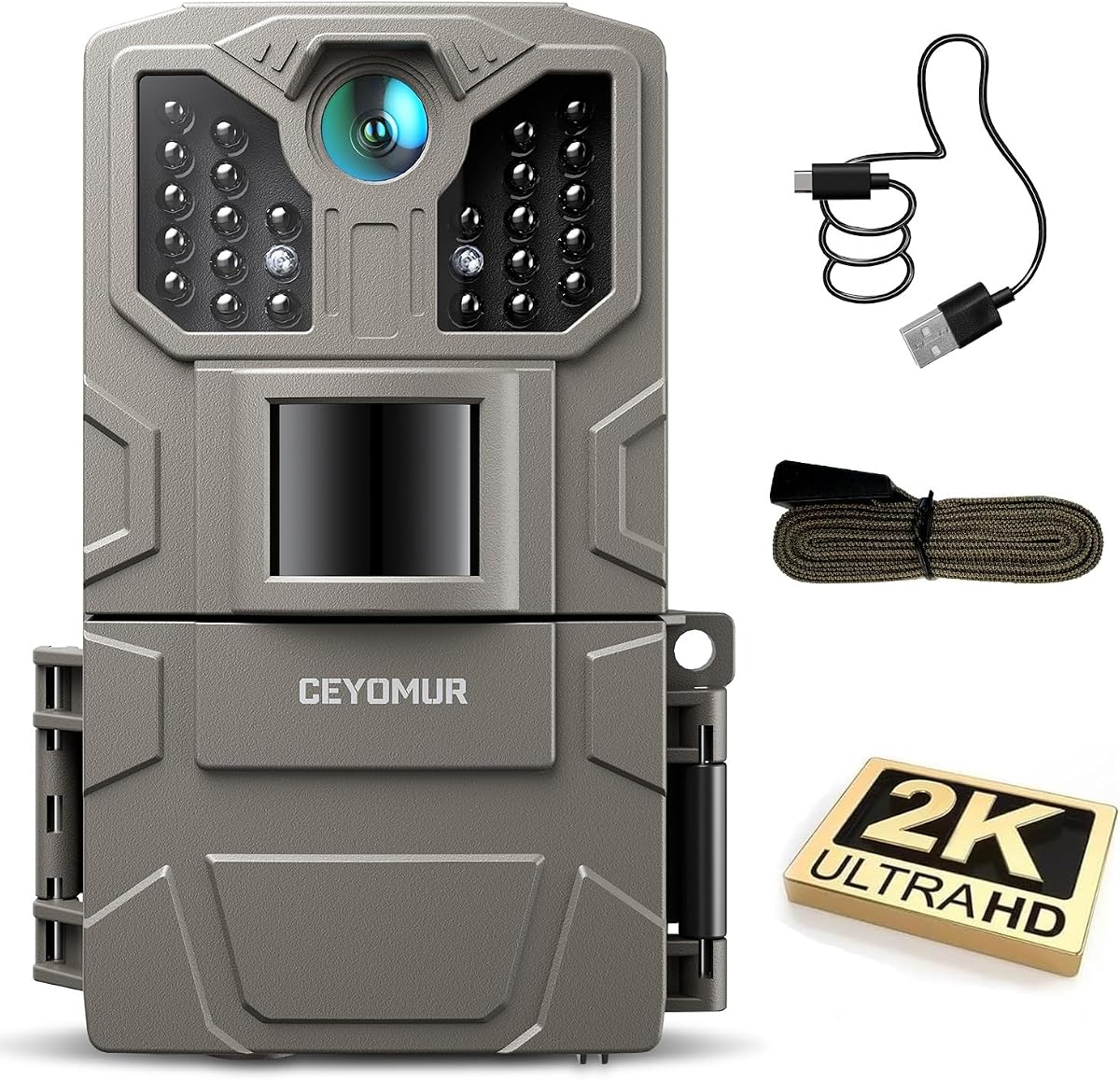
The CEYOMUR Trail Camera is positioned as an approachable, no-frills option for first-time users. Its 4.0 rating is the lowest among these ten models, but the camera focuses on ease of use, outdoor durability, and core wildlife-monitoring functions. A brown housing blends into common outdoor environments, while clear controls and a two-inch LCD make setup and playback more approachable.
We may earn a commission when you buy through this link, at no additional cost to you.
It captures 36MP photos and records 2K video day and night. Twenty-four 850nm infrared LEDs provide nighttime illumination, with the product information describing brighter, lower-noise results than 940nm alternatives. Fast trigger speed and quick recovery are intended to keep up with moving subjects. Other functions include time-lapse, motion detection, audio, timestamps, temperature display, and password protection.
The camera uses eight AA batteries, and neither those batteries nor the SD card are included. As with other non-networked models, recordings remain on the card until it is removed. Its IP66 housing is sealed for use in rain, dust, heat, or cold, but long-term monitoring still requires adequate storage and reliable power.
This model is best for beginners, backyard observers, and owners who want a simple camera without recurring app or subscription requirements. It is also suitable for farms and outdoor areas where accessible controls help with quick installation. Those prioritizing very high still resolution, remote alerts, or large storage support should examine the other options in this guide.
Keeping the lens, display, and controls on one side makes field setup more direct. Users can preview shots and adjust the angle without repeatedly opening or repositioning a traditional enclosure.
The 850nm infrared system is intended to provide clear black-and-white images in darkness. It can help identify animals and environmental details, though it is not described as a no-glow system.
We may earn a commission when you buy through this link, at no additional cost to you.
The WOSPORTS Mini Trail Camera 2 Pack is aimed at users who want to monitor two separate areas without buying and configuring cameras separately. Both units produce 30MP photos and 1080p HD video, and the package includes a 16GB SD card for each camera. That makes initial setup more complete than many competitor bundles.
We may earn a commission when you buy through this link, at no additional cost to you.
Each camera uses four AA batteries and a compact camouflage body designed to blend into forests, gardens, and farms. A sensitive PIR sensor and 0.3-second trigger help capture moving animals, while 850nm infrared LEDs support black-and-white nighttime recording. Adjustable straps allow each unit to be mounted on trees, posts, fences, or other suitable structures.
The two-camera format creates a larger power-management task because both installations need batteries and routine card checks. The batteries are not included, and there is no cellular or WiFi connection. Low-power consumption helps, but the absence of remote access means a user who wants timely alerts from several distant locations may find the package inconvenient.
This bundle is best for hunters or observers who need coverage along a game trail and at a second property entrance. It is also a practical choice for comparing movement in two nearby areas. Users should position each unit carefully, confirm that two separate monitoring angles are needed, and maintain a regular battery and card-checking schedule.
The included memory cards remove one common setup obstacle. With two cameras, users can monitor separate trails, approaches, or property boundaries while retaining the same compact design.
The small camouflage housing reduces visual prominence, while four-battery operation keeps the power system familiar. A 0.3-second trigger balances responsiveness with the needs of a compact multi-camera package.
We may earn a commission when you buy through this link, at no additional cost to you.
The WOSODA Mini 4 Pack is the most complete multi-camera bundle in this roundup. It includes four mini trail cameras, four 16GB SD cards, and 16 AA batteries. The package reaches a 4.3 rating and is positioned for users who want immediate coverage across multiple wildlife routes, farm areas, or property access points.
We may earn a commission when you buy through this link, at no additional cost to you.
Each camera captures 30MP color photographs during the day and black-and-white imagery at night, with 1080p HD video. A 0.3-second trigger supports prompt recording, and the compact camouflage body is designed to blend into natural settings. Low power consumption is particularly relevant because servicing four separate battery compartments takes more effort than servicing a single camera.
The cameras cannot connect to a phone, so users must remove an SD card to access recordings. The included cards and batteries make the package turnkey, but a four-camera installation still requires regular checks, storage management, and secure placement. The relatively modest 16GB capacity per camera may also fill sooner in locations with heavy activity, especially if long video clips are common.
This bundle is best for a hunter establishing several scouting points, a farm operator monitoring broad property, or a homeowner who wants several concealed cameras. It is less suitable for buyers seeking remote alerts or a single low-maintenance installation. Before deploying all four units, map coverage and motion zones to avoid redundant recordings and unnecessary storage use.
Four cards and sixteen batteries remove the need to source basic accessories separately. This makes the package convenient for a coordinated setup across several monitored locations.
Multiple compact cameras can reveal movement patterns that a single unit may miss. Strategic placement along trails, near feeding areas, and around property boundaries provides broader situational awareness.
We may earn a commission when you buy through this link, at no additional cost to you.
The GardePro E5S 2 Pack combines two of the guide's strongest high-resolution offline cameras. Each has a 4.4 product rating, captures 64MP photos and 1296p HD video, and uses three PIR sensors for a listed 0.1-second trigger. The package is suited to hunters and property owners who want two detailed monitoring points without introducing cellular power demands.
We may earn a commission when you buy through this link, at no additional cost to you.
Each camera runs on eight AA batteries and supports the separately sold GardePro SP350 solar panel. The non-cellular, non-WiFi architecture keeps operation focused and can reduce unnecessary wireless energy use. If both cameras are used with panels, they can operate without regular disposable battery replacement, provided the installation receives suitable sunlight.
Storage support extends to standard SD cards up to 512GB, which is useful in busy locations or when recording longer video sequences. Motion Detection, Time-Lapse, and Hybrid modes offer different ways to document activity, while loop recording and in-camera playback help manage storage. The IP66 housing protects against weather, and a 1/4-20 thread supports secure mounting.
This two-pack is best for users who prioritize image quality, high storage capacity, and solar-ready local recording. It is less suitable for those who need immediate phone notifications, because footage can only be accessed through the cameras. Buyers should confirm compatible panel availability, card capacity needs, and whether two separate placement zones justify the larger setup.
Support for cards up to 512GB gives each camera more room for extended deployments. This is especially helpful when high-resolution photos, long clips, and multiple recording modes are all in use.
Both cameras can use eight-battery power and compatible solar panels. The non-networked design emphasizes local capture while allowing remote installations to avoid frequent disposable battery changes.
We may earn a commission when you buy through this link, at no additional cost to you.
Battery life depends on the power architecture, trigger frequency, recording settings, climate, sunlight, and storage demands. Use the following factors to balance endurance with the monitoring features that matter most to you.
Basic AA-powered cameras are familiar, easy to service, and often suitable for moderate activity. They are not automatically the longest-lasting option, because frequent triggering, high-resolution recording, and low temperatures can increase consumption. Rechargeable and solar-capable systems reduce routine battery replacement but may involve larger initial costs, additional accessories, and more complex compatibility requirements. The MAXDONE stands apart with an integrated 6000mAh battery and built-in solar charging, while several other models accept separate rechargeable packs or solar panels.
A camera that wakes constantly, records long clips, or captures large bursts will use more energy than one that remains idle between occasional events. Trigger speed affects how quickly the camera records, but the more important energy consideration is how often the detection zone is activated. Forest edges, roads, and livestock areas may generate frequent false or irrelevant movement, while a narrow trail might remain quiet. Adjustable sensitivity, time-lapse, scheduled operating hours, and motion zones can reduce unnecessary recordings when the model supports them.
Non-cellular cameras generally provide a straightforward path to longer standby operation because they do not need to maintain a constant cellular or WiFi connection. The trade-off is physical card retrieval. Local WiFi models make transfers easier when you are near the camera, while cellular models allow remote viewing and alerts from a distance but require a suitable network and service plan. The Moultrie Edge 3 is the only listed cellular option, while the MAXDONE uses a short-range built-in hotspot.
Solar charging can extend deployment, but it is not independent of location. A panel needs direct and sustained sunlight, and shade from dense trees can sharply reduce charging potential. Seasonal changes in leaf cover, snow, and weather may also alter the amount of energy available. Battery-backed systems still require maintenance planning because stored power can be depleted during dark or stormy periods. For cameras designed around eight AA batteries, using high-quality cells in cold conditions can help preserve performance.
A camera can produce sharp images while producing files that consume considerable storage. 64MP stills offer more visible detail than 30MP or 36MP options, and 4K or 2K video provides more information for later inspection. Night performance depends on the infrared system, detection range, lens quality, and available ambient light. No-glow 940nm illumination is less conspicuous, while 850nm systems may appear brighter but are more visible to wildlife. A 100-foot no-glow range does not necessarily mean equally clear identification at that full distance.
Storage capacity should reflect how active the monitored location is. Cards from 16GB to 32GB suit lighter use, while the GardePro E5S 2 Pack supports cards up to 512GB for more demanding recording. Motion, time-lapse, and hybrid modes can suit different objectives, and loop recording automatically reuses available space. Larger files may take longer to transfer, particularly over a local hotspot. Consider whether you need many short bursts, longer clips, or time-lapse sequences before choosing a card and recording configuration.
Outdoor cameras should be selected for the conditions they will encounter. IP66 ratings indicate protection against dust and water jets, but housing quality, sealing, and installation still matter. A standard 1/4-20 thread makes mounting to a standard tripod or support easier, while straps are convenient for trees and fences. Compact cameras are easier to conceal and reposition, whereas larger units can accommodate more visible components. Aim the camera at the expected path and mount it high enough to discourage interference while retaining a clear field of view.
The strongest power system cannot compensate for a poor installation. Test motion detection in real conditions, confirm that the time stamp is correct, and use a suitable card format. Night scenes, rain, insects, moving branches, and temperature changes can affect false triggers and image quality. High-resolution continuous recording may be unnecessarily demanding if the primary goal is a few quick images. A balanced setup combines an appropriate power source with restrained recording settings, sensible detection placement, and a realistic maintenance schedule.
Before installation, fully read the camera's manual and identify the required battery type, card capacity, formatting method, and compatible charging accessories. Install the card while power is off, confirm the date and time, and test both daytime and infrared operation near the intended location. If using a solar panel, position it where it receives unobstructed sunlight and connect it according to the camera's instructions rather than assuming every panel is interchangeable.
Mount the camera securely, keep the lens clean, and aim it across the expected movement path rather than directly at nearby vegetation. Avoid placing too close to trees or reflective surfaces that can trigger unwanted recordings. Adjust sensitivity, detection zones, operating hours, and recording modes to match the environment. Run a short test after installation, then wait for a motion event and review both the image quality and trigger behavior before relying on the camera unattended.
Plan a maintenance schedule based on activity, season, and power type. Check battery or recharge levels, inspect the panel for dirt and damage, confirm that the card has free space, and review recent recordings for excessive false triggers. Clean the lens and housing gently, keep the battery compartment dry, and replace batteries on a consistent schedule. If the camera uses a cellular plan or app, update settings and check service status before each monitoring period.
A camera with a rechargeable battery and effective solar charging is often the most convenient for unattended installations because it reduces disposable battery changes. Actual endurance depends on sunlight, trigger frequency, temperature, recording mode, and battery capacity. A well-positioned solar camera can perform well, but a reliable non-cellular AA model may still be easier to service and less expensive to maintain.
They can, but dense tree cover may restrict sunlight and reduce charging. A solar panel needs a clear view of the sky and enough exposure throughout the seasons in which it will operate. In heavily shaded areas, the camera should still be supported by adequate batteries or another verified power source rather than relying entirely on the panel.
Not necessarily. Cellular communication can increase power demands, particularly when the camera frequently searches for or maintains a network connection. It provides valuable remote alerts and live access, while a non-cellular camera often has a simpler and potentially more efficient local-recording design. Rechargeable battery packs, compatible solar panels, and sensible alert settings can help a cellular camera manage its energy use.
The interval depends on motion activity, temperature, image resolution, and whether solar charging is effective. Active locations with frequent triggers can consume power and storage quickly, so weekly checks may be appropriate during busy periods. Remote installations should use the most conservative interval supported by their power budget, and important footage should be backed up before a card reaches full capacity.
Not by itself. A fast trigger helps capture moving subjects, but the greater effect on power use usually comes from how often the sensor activates and how much the camera records afterward. Narrowing the detection zone, lowering sensitivity where possible, and choosing efficient recording modes can reduce unnecessary energy consumption.
Continuous high-resolution capture can consume substantial battery power and fill a card quickly. Many users get better overall value from motion-triggered photos, short clips, and lower settings during periods of low activity. High resolution remains useful for identifying animals, but it works best as part of a deliberate storage and power plan rather than an always-on default.
The numbers refer to the infrared wavelengths used by the camera's night illumination. 940nm systems are generally described as no-glow because their infrared light is not visible to humans or many animals, while 850nm systems can produce brighter images but emit a faint red glow. Both can be effective, but image clarity also depends on sensor quality, optics, distance, and scene conditions.
Not necessarily. If you can visit the camera and remove its memory card without disrupting your routine, a non-cellular model offers a simpler experience and may be easier to power. WiFi helps when you want convenient nearby transfers without removing the card, while cellular connectivity is most valuable when timely remote alerts and live viewing are essential.
The MAXDONE Solar Trail Camera stands out for its integrated 6000mAh battery, built-in solar charging, and local WiFi transfers, making it a strong choice for users seeking self-contained power and convenient nearby access. The GardePro E5S delivers a compelling alternative for simple, low-power offline operation, while the Moultrie Edge 3 is the premium option for remote cellular monitoring, AI buck detection, and feeder control.
Prioritize the power architecture that suits the actual installation rather than focusing only on trigger speed or image resolution. Integrated solar works best in open, sunny locations; non-cellular AA systems remain serviceable and efficient; and rechargeable cellular systems make the most sense when remote access justifies their additional power needs. Detection placement, recording settings, storage capacity, and realistic maintenance intervals are just as important as the battery itself.
Before buying, verify the current listing, included accessories, compatibility requirements, service terms, and card capacity. Product details, ratings, availability, and prices can change, so the latest marketplace information should guide the final purchase. With the right match between location, power access, and monitoring goals, a trail camera can remain a dependable part of your outdoor security or wildlife-scouting setup.