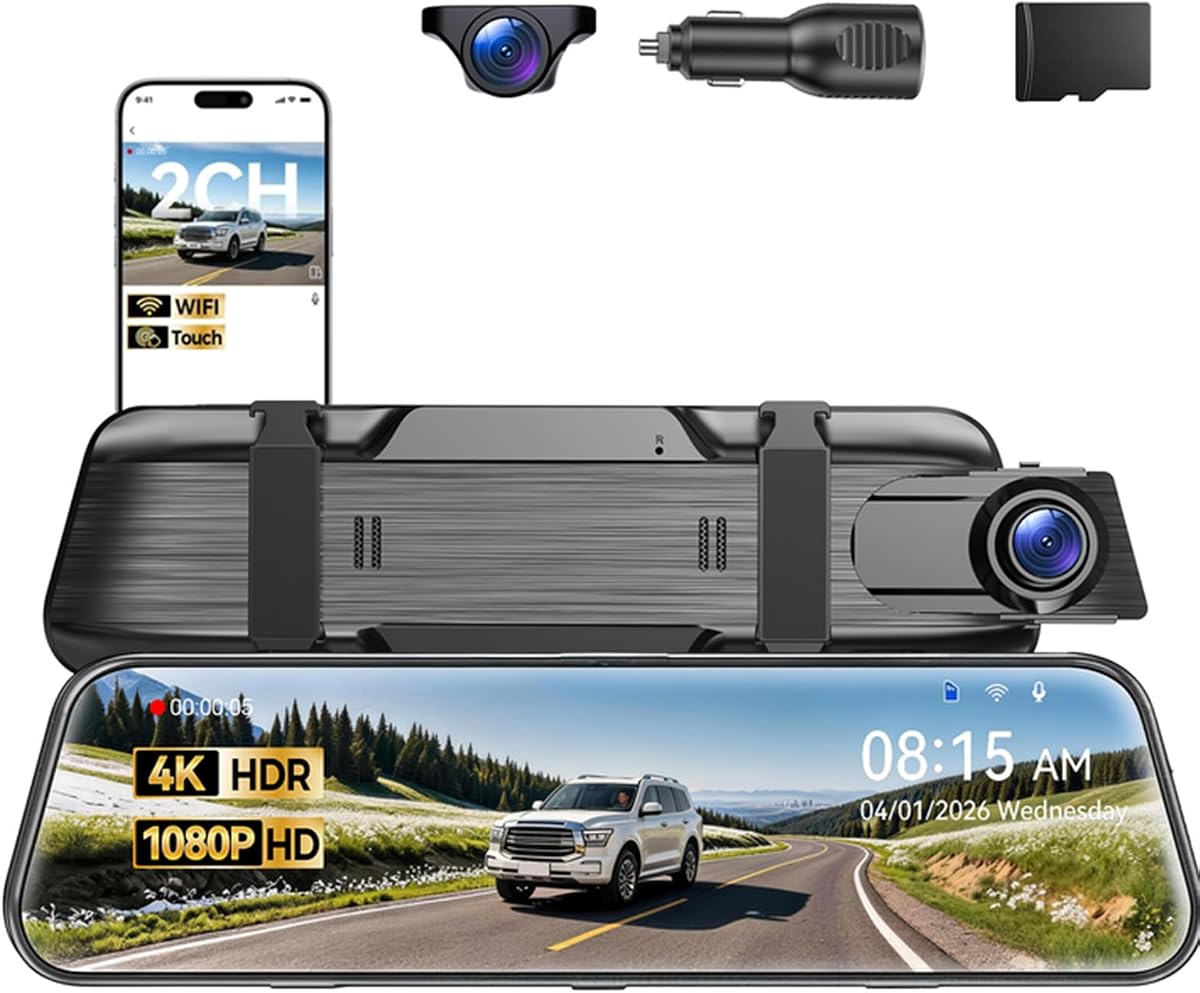
4K Mirror Dash Cam with Full Touch Screen
4.5Editor score
10-inch touch display
4K front camera
Wi-Fi file access
Bluetooth rear view mirror dash cams combine forward and rearward recording, a large display, and phone connectivity in one replacement-style mirror. The strongest models improve visibility, capture useful evidence, support navigation, and offer parking assistance without asking drivers to manage several separate accessories.
We compared these ten products by examining front and rear recording specifications, screen dimensions, Bluetooth or Wi-Fi functions, driving assistance, parking-monitor support, storage, mounting style, and ease of operation. The list covers strap-on streaming mirrors, an OEM-style replacement design, and models with different combinations of CarPlay, Android Auto, GPS, ADAS, and night-vision features.
Each review identifies the product’s most useful strengths and its practical limitations, helping you match the hardware to your vehicle and priorities. Product availability, promotions, and pricing can change, so confirm the current listing, compatibility, included accessories, and installation requirements before purchasing.
4.5Editor score

4.6Editor score

4.3Editor score
As an Amazon Associate we earn from qualifying purchases.
The comparison below highlights each mirror dash cam’s display, recording capabilities, connectivity, and parking-oriented features. These differences help separate basic dual-camera recorders from advanced systems with wireless phone integration, GPS, driver-assistance features, or OEM-style installation.


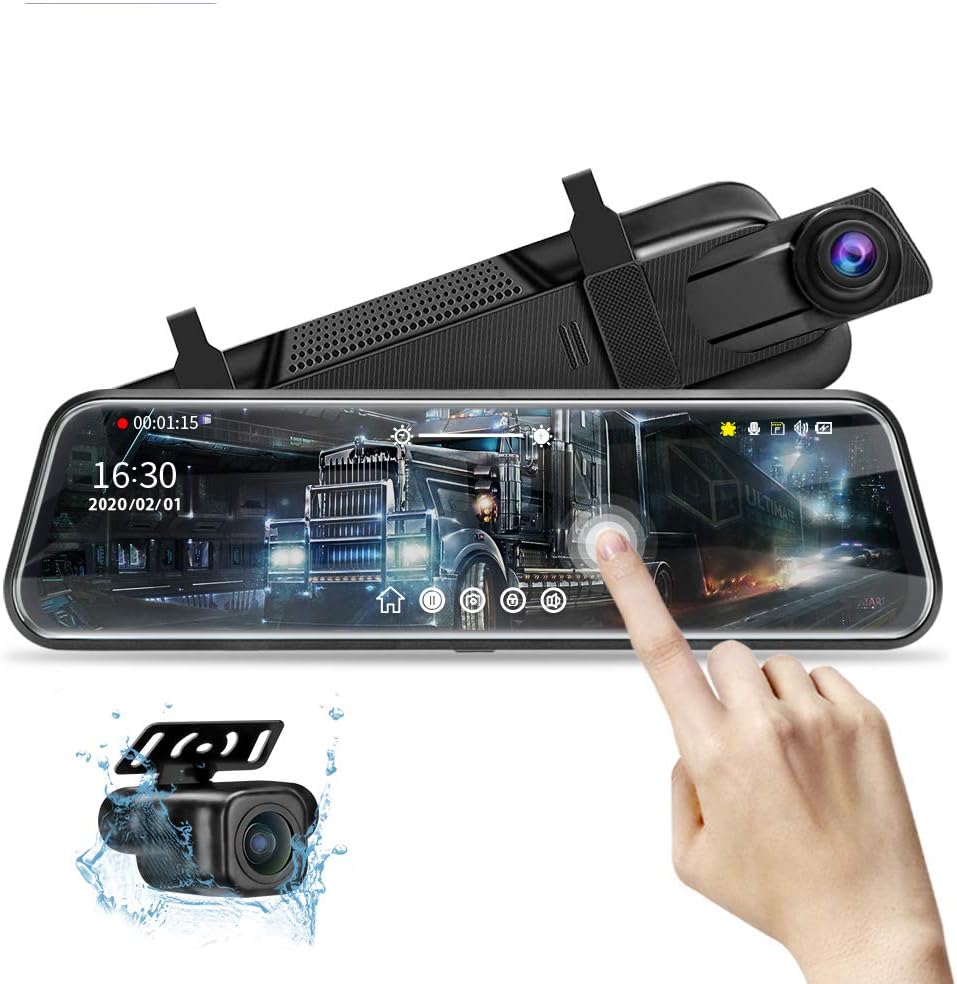
The 4K Rear View Mirror Camera with Carplay&Android Auto 12" Mirror Dash Cam stands out as the most complete all-around option in this guide. It carries a 4.6 rating, combines a 4K front camera with a 1080p rear camera, and places both feeds behind a large 12-inch IPS touchscreen. Its broad viewing angles, responsive touch controls, wireless smart-device functions, and parking-related features make it especially appealing for drivers who want more than a basic event recorder.
We may earn a commission when you buy through this link, at no additional cost to you.
The core appeal is the balance between recording quality and everyday convenience. The front camera records in 4K, the rear camera records in 1080p, and their stated 170-degree and 140-degree angles are intended to reduce the visual limitations of a conventional mirror. The display uses 1920×480 resolution beneath 2.5D curved glass, while Bluetooth connectivity supports CarPlay or Android Auto functions such as navigation, calls, music, and selected video applications. Voice control reduces the temptation to touch the screen while moving.
It also includes the recording protections expected from a serious dash cam. Loop recording automatically replaces older unlocked files when the 64GB card fills, while the G-sensor locks footage after a collision. Reverse assist can help during backing, and a 24-hour parking monitor can trigger recording after an impact, although the necessary hardwire kit is sold separately. The trade-offs are installation-related: this is a strap-on display rather than a direct replacement for the factory mirror, and it cannot function as a standard mirror when the screen is off.
This is our top overall recommendation for drivers seeking a large, feature-rich mirror with high-resolution front recording and flexible phone connectivity. Before buying, verify that the factory mirror is longer than 6.3 inches, allow room for the rear camera wiring, and plan how you will power parking monitoring. Drivers wanting a clean, integrated look rather than a strapped-on unit may prefer the AUTO-VOX model reviewed later.
The practical appeal is the balance between recording quality and everyday convenience. The front camera records in 4K, the rear camera records in 1080p, and their stated 170-degree and 140-degree angles are intended to reduce the visual limitations of a conventional mirror. The display uses 1920×480 resolution beneath 2.5D curved glass, while Bluetooth connectivity supports CarPlay or Android Auto functions such as navigation, calls, music, and selected video applications. Voice control reduces the temptation to touch the screen while moving.
It also includes the recording protections expected from a serious dash cam. Loop recording automatically replaces older unlocked files when the 64GB card fills, while the G-sensor locks footage after a collision. Reverse assist can help during backing, and a 24-hour parking monitor can trigger recording after an impact, although the necessary hardwire kit is sold separately. The trade-offs are installation-related: this is a strap-on display rather than a direct replacement for the factory mirror, and it cannot function as a standard mirror when the screen is off.
This is our top overall recommendation for drivers seeking a large, feature-rich mirror with high-resolution front recording and flexible phone connectivity. Before buying, verify that the factory mirror is longer than 6.3 inches, allow room for the rear camera wiring, and plan how you will power parking monitoring. Drivers wanting a clean, integrated look rather than a strapped-on unit may prefer the AUTO-VOX model reviewed later.
The 12-inch IPS panel gives the front and rear feeds more room than a traditional mirror, while 2.5D curved glass gives the unit a streamlined appearance. Touch gestures, split-screen viewing, and adjustable vertical framing make it easier to inspect blind areas and rear traffic without handling a separate screen.
Bluetooth pairing with CarPlay or Android Auto brings navigation, music, calls, and compatible applications onto the mirror. Voice commands are particularly useful because they let drivers request directions or change functions while keeping their attention directed toward the road.
We may earn a commission when you buy through this link, at no additional cost to you.
The WOLFBOX G840S is a 12-inch mirror dash cam aimed at drivers who want high-resolution recording, GPS information, and wireless file access. Its 4.3 rating reflects a generally well-rounded feature set, with 4K UHD recording from the front camera, 1080p from the rear, a low-reflectivity LCD, and a curved screen. The included external GPS antenna distinguishes it from models that depend entirely on phone location data.
We may earn a commission when you buy through this link, at no additional cost to you.
Its 170-degree front and 140-degree rear lenses support a broad field of view, while a smart split-screen function allows both directions to be monitored together. The 5.8GHz Wi-Fi system connects to the WOLFBOX app for live viewing, playback, downloads, and sharing on iOS or Android. Real-time GPS data can appear on the device, and recorded videos can be reviewed with location information in the compatible player.
Image processing is another strength. WDR and HDR are used to balance bright and dark areas, while a professional-grade sensor and six-glass lens support the stated night and challenging-light performance. The parking monitor can use time-lapse recording to conserve storage, but it requires a hardwire kit. WOLFBOX also advises using original accessories and notes that damage or losses associated with non-original parts or improper installation may not be covered by the guarantee.
Choose the G840S when GPS tracking, a generous screen, and a balanced front-and-rear recording system matter to you. It is a strong option for road trips and everyday security, though buyers who want direct touch operation, built-in advanced driver assistance, or a complete factory-style replacement should examine the AZDOME or AUTO-VOX alternatives. Confirm the parking-monitor power plan before installation.
The included GPS antenna can display real-time location data and add route context to recorded drives. Paired with 5.8GHz Wi-Fi, it also makes it easier to retrieve and share a clip through the WOLFBOX app without repeatedly removing the memory card.
WDR, HDR, a low-reflectivity screen, and a six-glass lens work together to improve visibility where contrast changes quickly. These features are particularly relevant for tunnels, shaded roads, and nighttime scenes illuminated by oncoming headlights.
We may earn a commission when you buy through this link, at no additional cost to you.
The 10" Mirror Dash Cam with Android Auto&Carplay 2.5K Rear View Mirror Camera is a flexible connected recorder with a 4.0 rating. Its 9.66-inch IPS touchscreen is smaller than the top two models, but it combines 2.5K front recording, 1080p rear recording, WDR, Bluetooth connectivity, and an included 64GB card. The result is a practical package for drivers who care about navigation, voice control, and how recorded audio reaches the vehicle’s speakers.
We may earn a commission when you buy through this link, at no additional cost to you.
One unusual strength is the number of audio routes. The built-in speaker can play the system’s sound, and that audio can be sent through Bluetooth, an auxiliary cable, or the vehicle’s FM radio frequency. This makes the unit easier to integrate with older or more basic car stereos that lack a touchscreen. The display also supports swiping between front, rear, split, and CarPlay views, plus vertical adjustment of the visible area.
Recording tools include one-, three-, and five-minute loop intervals, manual video locking, and automatic reverse assistance when the transmission changes into reverse. A parking monitor is supported, but its cable is not included. Voice commands can switch camera views and turn the display on or off, while Siri or Google Assistant commands are handled through the connected phone. Its 2.5K front camera offers strong detail, though it does not match the 4K resolution of several competitors.
This model makes sense if your vehicle has a conventional stereo and you want the mirror to serve as both a dash cam and a connected media display. The preinstalled card and flexible audio options improve the out-of-box experience. Be aware that the product carries the lowest 4.0 rating in this group, so reading current customer feedback is advisable. It is best suited to buyers who prioritize connectivity and audio routing over maximum recording resolution.
Bluetooth, auxiliary input, FM transmission, and the built-in speaker provide several ways to hear navigation prompts and media. That flexibility is especially useful in vehicles whose factory systems do not support modern smartphone projection standards.
Horizontal swipes change the active camera or reveal a split view, while vertical gestures adjust the visible range. Built-in voice commands offer a practical way to change views without reaching for the screen during a drive.
We may earn a commission when you buy through this link, at no additional cost to you.
The AZDOME 12" 4K+2.5K Rearview Mirror Dash Cam is the most feature-focused driver-assistance option here. It has a 4.2 rating, a large 12-inch touchscreen, and unusually high dual-camera specifications: 3840×2160 recording at the front and 2560×1440 at the rear. Those figures exceed the rear resolution offered by most competitors, making the AZDOME appealing when fine detail in both directions is a priority.
We may earn a commission when you buy through this link, at no additional cost to you.
ADAS, Blind Spot Detection, and Lane Change Assist can provide warnings or visual guidance when merging, changing lanes, or traveling on busy multi-lane roads. The AZDOME app adds AI-powered augmented-reality overlays to downloaded footage, including recognized license plates, vehicle distance, speed, and lane guidance. Timeline playback, wireless preview, downloads, sharing, and settings control are handled through 5.8GHz Wi-Fi, while ten English voice commands support common actions.
Parking functions are comprehensive. Reverse assistance can display the rear view with guide lines when the vehicle shifts into reverse. For an unattended vehicle, the system supports time-lapse parking recording and collision-triggered recording, with collision clips protected from being overwritten. A 3-lead Type-C hardwire kit with 3A output is required and sold separately. Night-vision recording is also offered for low-light roads, garages, dim streets, and rainy conditions.
This is a strong choice for drivers who want advanced visual assistance and detailed recordings on both sides of the vehicle. Just remember that ADAS, blind-spot detection, and lane-change assistance are driver aids rather than substitutes for attentive driving, mirrors, or safe following practices. Check whether your vehicle, windshield, and mounting point provide a safe, unobstructed installation, and plan for the optional hardwire connection before purchase.
Blind Spot Detection and Lane Change Assist add visual context around lane changes, intersections, and dense traffic. These tools can reinforce a driver’s own scanning, but they should never replace checking mirrors and blind spots manually.
The app’s timeline playback and AR overlays can surface license plates, speed, distance, and lane information without examining every frame individually. That makes a downloaded incident clip more useful when the relevant moment is buried within a longer recording.
We may earn a commission when you buy through this link, at no additional cost to you.
The WOLFBOX G930 combines 4K front recording, 1080p rear recording, a 10-inch display, and 5.8GHz Wi-Fi in a straightforward mirror package. Its 4.3 rating places it among the stronger choices in the group. The product is a natural fit for drivers already familiar with the WOLFBOX app or those who want fast wireless transfer without taking the storage card out of the unit.
We may earn a commission when you buy through this link, at no additional cost to you.
The front and rear images can be viewed together, and vertical swiping changes the viewing angle. The low-reflectivity LCD is intended to reduce daytime glare, while WDR balances exposure in high-contrast conditions. A six-glass lens and night-vision functions support low-light recording. Once the included GPS receiver is inserted, the screen can show real-time speed and direction, and the WOLFBOX player can display valid GPS information in recorded videos.
Loop recording can be set to one, two, or three minutes, with older unlocked footage overwritten as new material is captured. The G-sensor locks a video when it detects a collision, preserving that event from routine loop replacement. The main limitation is rear-image resolution: 1080p is perfectly usable, but it falls short of the 2.5K rear camera found in the AZDOME. Detailed parking-monitor specifications are less clearly presented than those of several rivals.
We recommend the G930 for drivers seeking a proven-looking balance of recording quality, app connectivity, GPS, and glare control without moving to a very large display. It is a particularly logical choice for someone comparing WOLFBOX models: the G840S offers a larger screen, while the G930 offers a more compact 10-inch format. Confirm accessory inclusion and parking-mode power requirements for your specific setup before ordering.
The upgraded 5.8GHz Wi-Fi system is designed for smooth connections and rapid downloads through the WOLFBOX app. This is useful for quickly sharing a road clip or checking a nearby event without physically transferring the memory card.
A low-reflectivity screen, WDR, and a six-glass lens form a practical approach to maintaining visibility in bright daylight and uneven lighting. The result is a more comfortable display during long drives, particularly when sunlight falls across the mirror.
We may earn a commission when you buy through this link, at no additional cost to you.
The AUTO-VOX Dual 2K OEM Rear View Mirror Camera with Carplay takes a different approach from the strap-on products in this guide: it replaces the original mirror at the factory mounting position. That produces a clean, built-in appearance without straps, suction cups, or a separate dash-mounted screen. Its 4.3 rating and 2K front-and-rear imaging make it the premium choice for drivers who prioritize integration and appearance.
We may earn a commission when you buy through this link, at no additional cost to you.
The 9.36-inch streaming-media touchscreen gives the unit a more substantial visual field than a conventional mirror, and the front and rear cameras support a broader view of the road. HDR and WDR are used to manage bright headlights and changing exposure. Automatic brightness is another comfort-focused feature, adjusting the display in daylight and dimming it at night to reduce glare.
CarPlay and voice control allow drivers to request directions, handle calls, and play music without physically interacting with a phone. The package includes four bracket adapters intended to fit many vehicles, but exact compatibility must be confirmed before purchase. Installation may also require a vehicle-specific mounting solution. The product information does not list a dedicated parking monitor, so buyers who need unattended surveillance should consider a model that expressly supports that function.
This is the pick for drivers who dislike the appearance of a strap-on mirror and want their dash cam to look integrated with the cabin. It also offers a useful touchscreen, solid 2K recording, and a straightforward CarPlay experience. Verify mirror-stem shape, connector layout, camera-cable routing, and screen clearance with the seller before ordering. Once compatibility is established, the factory-style presentation is among the most polished in this category.
Mounting the camera at the original mirror location removes the bulky straps used by conventional mirror cams. The included adapters cover many vehicles, while support and fitment information help determine whether an additional vehicle-specific solution is necessary.
Automatic brightness adjustment changes the screen according to surrounding light, reducing the need to fiddle with settings during a journey. HDR and WDR further help balance the live image when headlights, tunnels, or bright skies create sharp exposure differences.
We may earn a commission when you buy through this link, at no additional cost to you.
The 10-inch 4K full-touch Mirror Dash Cam delivers a surprisingly capable feature set for buyers seeking value. It has a 4.5 rating, 4K front recording, a 1080p rear camera, a 10-inch HD IPS touchscreen, Wi-Fi, night vision, and an included 32GB card. These fundamentals make it the best budget selection in this guide, particularly for drivers who want a large display and high-resolution front footage.
We may earn a commission when you buy through this link, at no additional cost to you.
The front and rear lenses are listed at 130 degrees and 145 degrees respectively, giving the rear camera a wider stated angle than the front. Switching into reverse automatically changes the display to the backup view, and the touchscreen makes it straightforward to select recording feeds or adjust settings. Night-vision functions and an F1.8 aperture are intended to support clearer recording in low-light conditions.
Wi-Fi provides app-based connection for viewing, downloading, and sharing clips. Parking-monitor mode is accessed through an OBD connection, and the G-sensor locks footage after a collision to preserve the relevant event. The necessary OBD arrangement adds installation complexity, and the listing does not describe every parking-recording detail as clearly as products that explicitly identify time-lapse and impact-triggered modes.
Choose this model if a 4K front camera, generous touchscreen, and essential Wi-Fi functions are your priorities without moving to the most advanced feature set. It is also a good option for anyone who wants something simpler than the 12- and 13-inch models. Check the available OBD parking accessory, confirm that your mirror and windshield provide a secure mounting location, and review the included-card and app requirements before installation.
A 4K front camera is often the most important specification for identifying vehicles, signs, and road details. This model delivers that resolution alongside a 1080p rear camera and a large touchscreen, creating a capable core package without requiring every premium driver-assistance feature.
The app-based Wi-Fi connection lets drivers download and share recordings without routinely removing the memory card. That convenience makes it easier to save a useful clip after an incident and continue driving without fiddling with the mirror itself.
We may earn a commission when you buy through this link, at no additional cost to you.
The 2026 Ultrawide 13-inch 4K Rear View Mirror Camera is the largest display in the group, offering a spacious split-screen canvas and enlarged touch icons. Its 3.9 rating is the lowest among these products, but the hardware remains competitive: 4K front recording, a 1080p waterproof rear camera, 5.8GHz Wi-Fi, wireless CarPlay and Android Auto, and a preinstalled 64GB card.
We may earn a commission when you buy through this link, at no additional cost to you.
The broad screen can show front and rear road conditions simultaneously and is intended for vehicles with larger cockpits. A 160-degree front camera and 140-degree rear camera cover a wide field, while touch controls let drivers switch views with a single tap. Bluetooth pairing supports hands-free calls, music, messaging, navigation, and live traffic information through Apple Maps or Google Maps, subject to phone and vehicle compatibility.
A particularly useful section addresses Android Auto disconnections by directing users to the evelink or eWLink app and outlining a Wi-Fi Direct connection process. Loop recording overwrites older unlocked files, and the G-sensor locks footage during a collision. Reverse assist is included, while 24-hour monitoring requires a separately sold parking-monitor cable. The very large housing may also be less suitable for compact vehicles or crowded windshields.
This model is best for drivers with a spacious dashboard who want the largest available view and a full connected dashboard experience. Its lower 3.9 rating warrants checking recent customer feedback, particularly regarding fit, interface behavior, and wireless connectivity. Confirm your vehicle’s available space, verify the phone-pairing process before relying on it, and account for the separate parking cable if unattended monitoring is important.
The 13-inch panel gives side-by-side camera views and navigation maps more room than conventional mirror displays. Enlarged icons can reduce accidental touches, making the large touchscreen easier to operate at a glance during normal driving.
The listed SuperLink setup process gives Android Auto users a defined route for reconnecting through Wi-Fi Direct. This is particularly useful for vehicles or phone configurations that repeatedly drop the initial wireless connection.
We may earn a commission when you buy through this link, at no additional cost to you.
The Hikity 2.5K Rear View Mirror Dash Cam offers a balanced combination of 2.5K recording, wireless smartphone integration, and parking functionality. It has a 4.2 rating and a 9.66-inch IPS touchscreen behind 2.5D curved glass. The anti-glare treatment is intended to keep the display comfortable in direct sun and at night, while the included 64GB card allows recording to begin without another storage purchase.
We may earn a commission when you buy through this link, at no additional cost to you.
The front camera records at 2.5K through a 150-degree lens, and the rear camera has a 120-degree angle. Horizontal swiping changes the active front or rear feed, vertical swiping adjusts the viewing range, and split-screen mode presents both road conditions together. Wireless CarPlay and Android Auto support can provide maps, messages, music, and video applications, with Siri and Google Assistant voice control adding hands-free operation.
Parking monitoring is designed to activate a short recording when motion or a person is detected near the parked vehicle, but the required parking-monitor cable is not included. The system also supports continuous driving recording and playback using the installed TF card. For installation or troubleshooting, the product directs customers to the Hikity Tech support page rather than relying only on automated responses.
This is a good general-purpose choice for drivers who want a connected mirror without moving to a 4K front camera. It is also suited to cars and trucks because of the stated compatibility and flexible viewing controls. Compare it with the KOUENOM model if audio-routing options are important, or with the 4K Touch Mirror if maximum front resolution is your top priority. Plan the parking-cable purchase before expecting 24-hour monitoring.
Wireless CarPlay, Android Auto, and voice assistants turn the mirror into more than a recorder. The display can provide navigation and familiar communication or media functions while keeping a larger rearward view available through swipes.
The curved IPS screen uses anti-glare processing to remain legible in sunlight and reduce nighttime reflections. Vertical view adjustment lets the driver choose the most useful portion of the camera image for a particular vehicle and driving position.
We may earn a commission when you buy through this link, at no additional cost to you.
The 10-inch Dual 1080p Mirror Dash Cam is a straightforward choice for drivers who prioritize dependable front-and-rear capture rather than 4K resolution or advanced connectivity. Its 4.1 rating reflects a capable basic package: a 10-inch IPS full-touchscreen, 1080p front and rear cameras, an IP68 waterproof rear camera, improved night vision, loop recording, collision locking, and automatic reverse assistance.
We may earn a commission when you buy through this link, at no additional cost to you.
The rear camera uses a six-layer glass lens and improved low-light exposure processing to capture more detail in dark conditions. When reverse is selected, the rear image fills the screen and displays parking guide lines. The guide height can be adjusted across six settings, and the camera view can be moved vertically to suit different vehicles. Touch gestures also control front and rear switching, exposure, brightness, date and time, recording, and playback.
Storage capacity reaches 128GB, although a card is not included. Loop recording overwrites older footage, while the G-sensor locks a collision file so it will not be removed by the loop. A hardwire kit is needed for time-lapse and 24-hour parking monitoring. The rear camera also supports vertical image flip, which is useful for roof, trailer, or other unusual mounting positions.
Choose this model for a simple, well-understood dash cam with a large display and a capable rear camera. It may be the easiest option for owners who do not need smartphone projection or Wi-Fi management. Before buying, measure the original mirror and check its size and weight capacity: the listing notes that the replacement-style mirror is 9.06 inches wide at the top and 10.24 inches at the bottom, with a weight of about 0.72 pounds. Remember that the screen cannot act as a reflective mirror when turned off.
A six-layer rear lens, improved light suppression, and dedicated night-exposure processing help make the backup view more useful after dark. The rear camera is also rated IP68 for resistance to water, supporting its use in exposed exterior positions.
Six guide-line heights and a manually adjustable image range make it easier to align the displayed guide with a particular bumper or parking space. Automatic switching to the rear view reduces the need to manually change screens after selecting reverse.
We may earn a commission when you buy through this link, at no additional cost to you.
The best mirror dash cam should fit your vehicle, capture useful footage in both directions, and remain easy to operate. Compare resolution, screen size, connectivity, storage, parking functions, mounting method, and power requirements rather than treating one specification as decisive on its own.
Resolution determines how much fine detail a camera can preserve, but it should be considered alongside lens quality, exposure control, night performance, and storage support. The products here range from dual 1080p systems to combinations of 4K front and 2.5K rear recording. A 4K front camera can make distant vehicles, signs, and license plates easier to inspect, while 2.5K or 1080p rear footage is generally adequate for documenting following traffic and parking incidents.
Choose the highest front resolution your storage can sustain, but do not assume it compensates for poor nighttime exposure. WDR, HDR, a low-reflectivity screen, and a capable sensor are often more noticeable in ordinary use. For most drivers, 4K at the front with 1080p at the rear provides a strong balance, while the AZDOME leads this group with a 2.5K rear camera.
Mirror-style dash cams range from roughly 9.66 inches to 13 inches in this roundup. A larger panel can make split-screen views and navigation maps easier to read, but it may obstruct visibility or look out of place in a compact vehicle. Strap-on models must also clear the original mirror, mounting straps, camera housing, and any sensors near the top center of the windshield.
Measure your existing mirror before ordering and compare the product dimensions with the available space. OEM-style systems require a different check: confirm the mirror-stem shape, connector, camera-cable route, and included adapter. The 13-inch model suits spacious cockpits best, while the 9.36-inch AUTO-VOX prioritizes a clean replacement appearance over maximum screen area.
Bluetooth connectivity can support hands-free calling, audio streaming, and voice commands, while wireless CarPlay and Android Auto can place navigation and compatible applications directly on the mirror. This transforms the device from a standalone recorder into a central dashboard display. Compatibility remains important because phone models, vehicle systems, and operating-system versions can behave differently.
Look for clear instructions for pairing, reconnecting, and controlling audio. The KOUENOM provides several audio-routing options, the AZDOME emphasizes app-based management, and the 13-inch model includes specific troubleshooting guidance for Android Auto disconnections. If smartphone integration is secondary, a simpler dual-camera system may still satisfy your needs more cleanly.
Wi-Fi provides a convenient way to preview recordings, download clips, and share them from a phone without removing the memory card. The WOLFBOX models use 5.8GHz Wi-Fi, and the AZDOME adds timeline playback and AR-based analysis of recognized details. App usefulness depends on the quality of the connection, the phone operating system, and whether the manufacturer continues to support the software.
For drivers who regularly review incidents, a dedicated app and timeline playback are valuable additions. Keep the app updated, protect the dash cam account credentials, and understand whether downloads are stored locally or uploaded automatically. A model without Wi-Fi can still record reliably, but accessing a clip will require a card reader or direct screen operation.
Parking monitoring extends recording beyond active driving, but most of these products require a hardwire kit, OBD connection, or separate parking cable. Collision-triggered recording preserves an impact, while time-lapse mode reduces storage consumption during long periods. Neither feature should be confused with continuous subject recognition or professional-grade surveillance.
Check every accessory named in the listing before ordering. The first-ranked camera, KOUENOM, 13-inch model, and Hikity require separate parking cables or kits; the AUTO-VOX does not list a parking monitor. A hardwire installation also involves connecting the device to the vehicle’s electrical system, so follow the instructions, avoid unsafe routing, and confirm that the parking mode does not drain the battery unexpectedly.
A mirror dash cam needs adequate memory-card capacity and a sensible loop-recording system. The products shown support bundled cards ranging from 32GB to 64GB, while some also allow larger cards. A G-sensor is essential because it locks an incident file before routine loop recording can overwrite it.
Check the supported card type and maximum capacity, and format cards according to the manufacturer’s instructions. Loop intervals should be short enough to locate events but not so short that they create excessive file turnover. Protected videos still depend on regular card maintenance, and a full storage card or failing card can prevent new footage from being recorded.
Night performance depends on more than a night-vision label. HDR, WDR, sensor quality, lens construction, aperture, and exposure processing all influence whether a vehicle remains recognizable in darkness. Oncoming headlights can overwhelm a camera even when the road ahead is visible, so balanced exposure is especially important for rear-facing footage in heavy traffic.
Stated viewing angles range from 130 to 170 degrees at the front and 120 to 145 degrees at the rear. A wider lens can reduce blind spots, but it may also introduce more edge distortion or reduce the effective detail near the center. Compare the angle and resolution together, and ensure the screen allows you to adjust the visible region to suit your vehicle.
ADAS, Blind Spot Detection, and Lane Change Assist can provide useful prompts, but they do not make a mirror cam an autonomous safety system. These features depend on sensor performance, software interpretation, lighting, road markings, and proper calibration. The driver remains responsible for scanning the surroundings and maintaining safe control of the vehicle.
Treat advanced assistance as supporting information rather than a guarantee that a hazard will be detected. Keep conventional mirrors clean and usable, check local laws concerning screen use, and avoid interacting with the touchscreen while driving. Voice commands and steering-wheel-compatible controls are preferable to reaching toward the mirror when the vehicle is moving.
Begin by reading the manufacturer’s installation diagram and checking your vehicle before mounting anything. Confirm mirror clearance, camera-cable length, connector access, memory-card format, and the power method for parking monitoring. Install the rear camera in a protected location, route its cable away from sharp edges, and test both front and rear images before tightening every bracket or strap.
After the hardware is secure, format the recommended card, set the correct date and time, and choose a practical loop interval. Calibrate the display brightness, rear-image orientation, and parking guides for your vehicle. Pair Bluetooth or wireless projection, test the app, and verify that a short recording can be viewed, downloaded, and shared before relying on the system for incident evidence.
Care for the unit by keeping the lens and display clean, avoiding harsh chemicals, and checking the mounting straps or adapters periodically. Review storage capacity and protected files regularly, and preserve important clips before loop recording replaces them. For a hardwired parking mode, follow the manual’s power-management guidance and ensure the vehicle battery is not being depleted during long parked periods.
It depends on the model. Strap-on units such as the 4K 12" Mirror Camera cover the original mirror and cannot serve as a conventional reflective mirror when powered off. The AUTO-VOX is designed to replace the original mirror at its factory mounting position, but buyers should verify stem shape, connectors, and included adapters before ordering. Always follow the manufacturer’s installation instructions.
No, but it can improve the amount of visible detail in a front recording, especially when identifying distant signs, vehicles, or license plates. The rear camera is often 1080p even on premium models, so dual-camera quality should be evaluated separately. Lens quality, HDR or WDR, night exposure, storage speed, and stable mounting also influence the final result.
Core recording, playback, loop recording, and reverse assistance generally do not require Bluetooth. Bluetooth is mainly used for phone connection, hands-free functions, audio streaming, and wireless CarPlay or Android Auto features. Some models also offer Wi-Fi for file management, so confirm which wireless functions are standard and whether an app is required.
Most of the listed products require a separate hardwire kit, OBD connection, or parking-monitor cable. A few include the needed card but not the power cable, while the AUTO-VOX does not advertise a dedicated parking monitor. Check the product listing carefully because a hardwire kit is not automatically included, and follow the instructions for safe power routing and battery protection.
When the G-sensor detects a collision, the relevant file should be locked and protected from routine loop overwriting. Depending on the model, you can locate it through the touchscreen, mobile app, Wi-Fi connection, or memory card. Download it promptly and keep a separate copy, because cards can fail and manually stored files still depend on adequate free space and proper card handling.
Potentially, so measure before purchasing. Display sizes in this guide range from 9.36 to 13 inches, and strap-on units add housing depth around the original mirror. Check that the device does not block important sight lines, driver-assistance sensors, or factory equipment. Vehicles with a small windshield or crowded rearview area may favor a more compact model.
Some models are marketed for cars and trucks, and rear-camera image flip options can support unusual mounting positions. The Hikity listing explicitly mentions cars and trucks, while the final product offers vertical rear-image flip for roof or trailer applications. Cable length, weather resistance, secure mounting, and local regulations should still be checked before using a camera on a trailer or exterior accessory.
Voice commands are designed to reduce the need to touch or look down at the mirror while the vehicle is moving. You should still speak clearly, set up commands before traveling, and avoid handling the screen. The car remains the driver’s responsibility, and even advanced ADAS, blind-spot detection, and lane-change prompts cannot replace attentive driving and physical mirror checks.
The 4K 12" Mirror Camera is the strongest all-around choice because it combines a large touchscreen, 4K front recording, 1080p rear recording, wireless CarPlay and Android Auto, voice control, reverse assistance, and collision locking. The 10-inch 4K Touch Mirror stands out as the best budget-oriented option, while the AUTO-VOX Dual 2K OEM earns the premium distinction for its clean factory-style installation and automatic brightness control.
Prioritize the features you will actually use. Dual-camera resolution, night exposure, secure mounting, and dependable storage matter in every installation, while GPS, ADAS, app analysis, touchscreen controls, and parking-monitor support depend on your budget and habits. Measure the mirror area, verify cable routing, and check whether a hardwire kit or parking cable must be purchased separately before committing.
Finally, review the current product listing, included accessories, compatibility notes, and customer feedback before ordering, because configurations and support details can change. Product availability, promotions, and pricing also change, so confirm the current terms and choose the mirror cam that best matches your vehicle, recording needs, and preferred connection method.