
AFWFilters Clack Acid Neutralizer
4.3Editor score
Dedicated acid neutralization
Designed for well water
Clack system configuration
Calcium filters for well water help address different problems that are often grouped under the same label. Some systems soften hard water, while others neutralize acidic water, inhibit mineral scale, remove sediment, or reduce iron and manganese. Choosing correctly starts with identifying what your well water actually contains.
The products in this guide were compared using their stated filtration media, treatment purpose, housing requirements, flow capacity, certification information, maintenance guidance, and suitability for well water. The list includes complete systems, replacement media, sediment cartridges, acid neutralizers, and scale-control components rather than treating every cartridge as a stand-alone solution.
Each review explains the product's strongest use case and its practical limitations, helping you distinguish between a true calcium-removal device, a scale inhibitor, a pH neutralizer, and a protective prefilter. Product details and availability can change, so verify current specifications and costs before purchasing.
4.3Editor score
3.9Editor score

4.7Editor score
As an Amazon Associate we earn from qualifying purchases.
This comparison highlights the treatment role, physical format, well-water relevance, and practical maintenance requirements of each product, from complete filtration systems to media cartridges and replacement components.


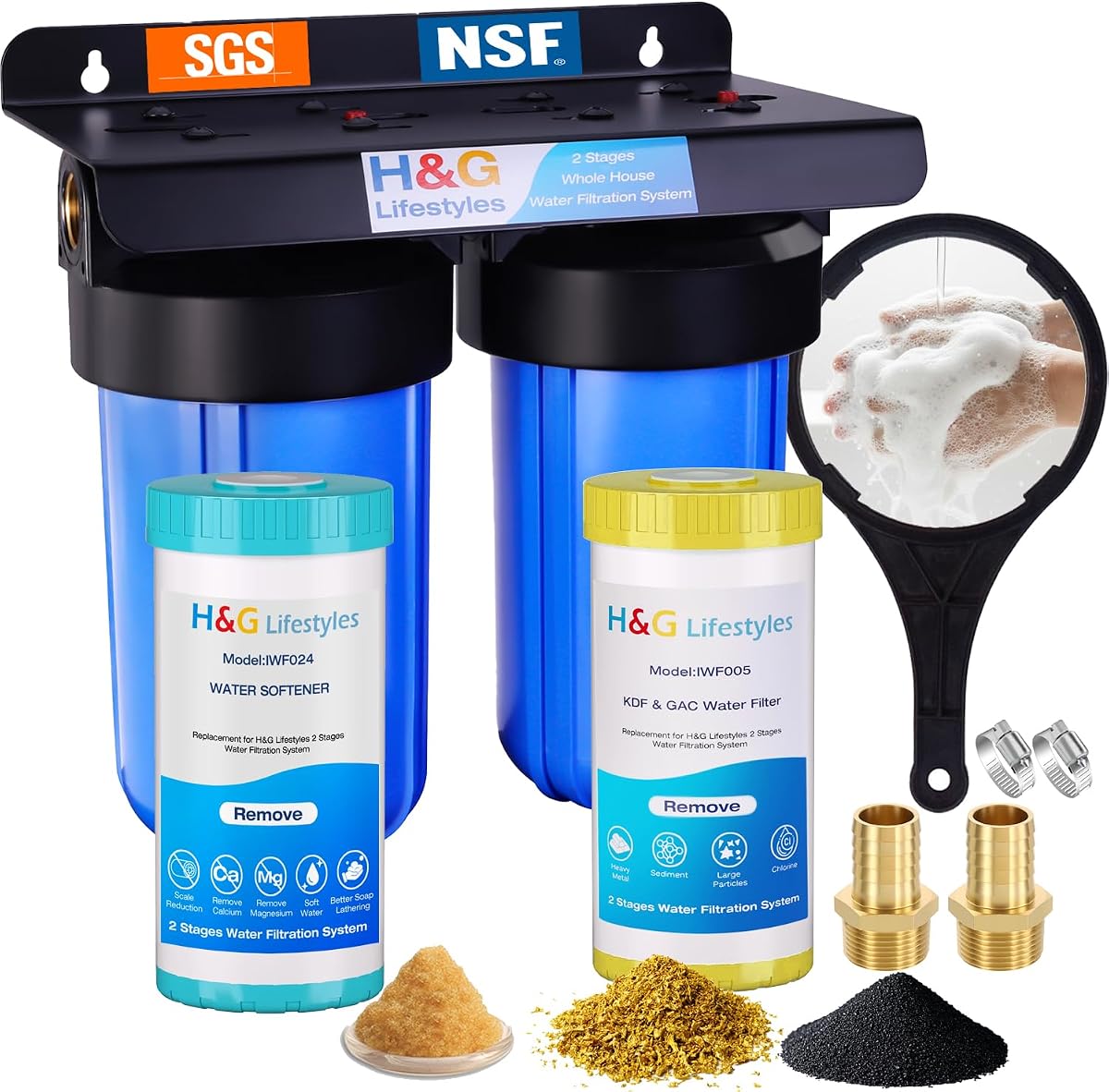
The H&G Lifestyles Whole House Water Filter and Softener Filtration System is the most comprehensive product in this guide because it combines a cation resin cartridge with a KDF and granular activated carbon cartridge. Its 3.9 rating does not lead the field, but the two-stage design addresses several common household water concerns in one 10-inch by 4.5-inch assembly.
We may earn a commission when you buy through this link, at no additional cost to you.
The resin cartridge is intended to reduce calcium and magnesium, helping control hard-water scale in pipes, heaters, and appliances. The second cartridge uses KDF and GAC media to reduce chlorine, heavy metals, and unpleasant odors, including sulfur smell associated with some well-water conditions. The stated 7–12 GPM range and 70,000-gallon capacity make it most relevant to homes that need centralized treatment without a very large footprint.
The system also uses precision-sealing O-rings and solid fittings intended to limit installation leaks. Its 10% crosslink resin provides better chlorine resistance than conventional 8% material, although the stated design is primarily intended for chlorinated municipal water. Actual performance on a well depends heavily on hardness, sediment, iron, manganese, and other local conditions, so the maximum capacity should not be treated as a universal service life.
This is a strong choice for homeowners seeking one compact two-stage assembly rather than separate softening and filtration units. Verify pressure, available flow, plumbing connections, and replacement availability before installation. It is less appropriate if a laboratory report shows that sediment, iron, or manganese requires dedicated pretreatment.
For a broad whole-house solution with both ion exchange and carbon-based filtration, this system offers the strongest all-around feature set. Its compact format, sealed fittings, and stated capacity make it the top overall pick, while acknowledging that actual results depend on accurate sizing and suitable source water.
Combining two treatment stages reduces the need for separate components when the goal is softer water alongside broader filtration. The KDF and GAC stage addresses taste, odor, chlorine, and selected metal concerns that a softener alone would not target.
The stated flow range and operating pressure should be matched to the home's peak demand and plumbing conditions. A restrictive filter, undersized supply line, or unsuitable pressure can reduce effective flow even when the housing design supports high throughput.
We may earn a commission when you buy through this link, at no additional cost to you.
The PUREPLUS 10"x4.5" Whole House Scale Inhibitor & Sediment Water Filter is a three-pack of replacement cartridges centered on scale prevention rather than conventional ion-exchange softening. Its listing explicitly warns that users with well water may not achieve the expected filtering effect, making that limitation central to any recommendation.
We may earn a commission when you buy through this link, at no additional cost to you.
The cartridge uses PHO polyphosphate, composite silica-phosphate beads, a three-layer polypropylene construction, and a coconut-shell activated-carbon layer. These media are intended to bind with calcium and magnesium, reduce scale formation, and capture sediment while leaving beneficial minerals in the water. Compatibility with numerous 10-inch by 4.5-inch housings adds flexibility for existing whole-house systems.
The stated capacity is up to 30,000 gallons, with a suggested replacement interval of three to six months for an average household. Both figures are conditional because sediment load, hardness, water usage, and cartridge condition can materially affect service life. The multi-layer format also makes this more than a simple phosphate cartridge.
This product is best suited to a system already equipped with a compatible housing and a need for scale and sediment control. It is less compelling as a new well-water treatment solution because the seller itself recommends a different product for well sources. Buyers should not confuse scale inhibition with complete calcium removal or comprehensive well-water purification.
The three-pack is a practical maintenance option for compatible whole-house setups, particularly where the goal is appliance protection rather than comprehensive contaminant removal. Confirm the housing dimensions, incoming water quality, and the correct treatment sequence before using it on a well.
Phosphate-based media can help keep dissolved hardness minerals from forming scale on pipes and heating equipment. This protects equipment without converting the cartridge into a complete softening system that removes calcium and magnesium through ion exchange.
The stated warning against expecting the same result with well water is important. Well conditions can vary considerably, and a scale-inhibiting cartridge cannot substitute for sediment protection, iron removal, disinfection, or other treatment that the water may require.
We may earn a commission when you buy through this link, at no additional cost to you.
VICAL 1000 Calcite Media is a bulk neutralization medium rather than a complete household filtration system. Its 4.0 rating reflects a straightforward, well-defined purpose: raising or stabilizing the pH of acidic water by gradually dissolving calcium carbonate as untreated water passes through a compatible media tank.
We may earn a commission when you buy through this link, at no additional cost to you.
The uniform 16-by-40 mesh is designed to support consistent flow and adequate contact time. The media is made from natural limestone and contains approximately 96% calcium carbonate, while its NSF/ANSI Standard 60 certification makes it suitable for use in potable-water treatment applications when properly installed.
Compared with many household cartridges, this product requires a different level of planning. You need an acid neutralizer tank sized to the household's flow and treatment goals, appropriate underdrain components, and space for media replacement. The half-cubic-foot volume makes it a substantial starting quantity, but consumption depends on acidity and usage.
Calcite neutralization is most relevant when the concern is low-pH water, corrosion, or a related imbalance rather than hard-water scale or sediment. It does not remove hardness, iron, manganese, microbes, or most dissolved contaminants, so those issues require additional treatment. A water test should establish whether pH adjustment is actually needed.
For homeowners seeking a certified professional media for an existing neutralizer or a new well-water installation, VICAL offers clear material specifications and consistent grading. It earns the premium recommendation for media quality and certification, provided the surrounding tank and treatment plan are properly designed.
Calcite dissolves gradually as water moves through the bed, helping counteract moderate acidity. The gradual reaction can support a more stable pH without requiring the aggressive chemical dosing associated with some treatment approaches.
NSF/ANSI Standard 60 certification addresses material safety for drinking-water treatment, while controlled 16-by-40 mesh grading supports predictable tank behavior. Certification applies to the media material and does not mean the media independently treats every possible contaminant.
We may earn a commission when you buy through this link, at no additional cost to you.
Aqua-Pure C-050P Calcium Carbonate Media combines a 4.6 rating with a clearly defined role in 3M Aqua-Pure automatic backwash filters. Rather than softening water, the calcium carbonate medium neutralizes moderate acidity and can help reduce corrosion affecting copper pipes and fixtures.
We may earn a commission when you buy through this link, at no additional cost to you.
Its primary advantage is equipment compatibility. Homeowners already using a compatible Aqua-Pure automatic backwash filter can select media designed for that platform, avoiding the need to interpret a generic loose-media specification. Automatic backwash operation may also suit larger installations where regular manual service is less convenient.
The product's limitations come from the same focused purpose that make it dependable. It is intended for moderate acidity and corrosion-related conditions, not for broad sediment, iron, manganese, hardness, or microbial treatment. It also does not provide the same flexibility as loose bulk media when designing a custom neutralizer tank.
Before purchasing, confirm that the existing filter is an Aqua-Pure automatic backwash model that accepts C-050P media. Testing the source water is advisable because perceived acidity, metallic taste, or colored staining can have several causes. Correct diagnosis prevents buying neutralization media when sediment or another treatment stage is actually needed.
This is an excellent option for a compatible Aqua-Pure installation with confirmed moderate acidity. Its strong rating and focused purpose make it preferable to generic calcite media when the manufacturer's equipment and media pairing can be maintained.
Neutralizing moderate acidity can help address one of the conditions associated with corrosion of copper pipes and fixtures. It should be viewed as a focused treatment for a measured water-balance issue rather than a general-purpose purification device.
Media formulated for 3M Aqua-Pure automatic backwash filters simplifies replacement within that platform. Verify the exact model and media designation because similar names do not necessarily indicate interchangeable equipment.
We may earn a commission when you buy through this link, at no additional cost to you.
The AFWFilters Acid Neutralizer for Well Water pH Filter Calcite is a complete acid-neutralizing system from Clack, and its 4.3 rating reflects a strong fit for the stated task. Unlike a cartridge replacement, it provides a dedicated system intended specifically for pH adjustment in well-water applications.
We may earn a commission when you buy through this link, at no additional cost to you.
Its primary benefit is integration. A neutralizer tank, calcite medium, and the necessary flow path are combined in one product rather than requiring the buyer to select a tank, underdrain, media, and fittings independently. That convenience is especially useful for installers working with a recognized filtration-system brand.
The available product information is limited, however, so flow rate, tank dimensions, media amount, pressure range, and service interval are not provided in the supplied listing. Those omissions make careful model verification essential. An acid neutralizer must be selected according to household flow and measured acidity rather than appearance alone.
This system does not appear intended to address hardness, sediment, iron, manganese, or microbial contamination. If a well test reveals those issues, they require separate stages, with sediment protection generally placed ahead of more sensitive treatment media. It is also not a substitute for deciding whether pH correction is the right solution to a plumbing complaint.
For a homeowner seeking a dedicated, branded acid neutralizer specifically intended for well water, this is a strong choice. The complete-system format and positive rating outweigh the limited listing detail, provided the installer verifies tank capacity, flow, plumbing connections, and media replacement requirements.
Using a system designed around calcite treatment reduces the risk of mismatching generic components. The installer can focus on selecting the correct vessel and flow capacity for the home rather than assembling a neutralizer from unrelated parts.
A neutralizer should respond to measured low pH or confirmed corrosion conditions. Testing helps distinguish an acid-balance problem from sediment, metal, or biofilm-related issues that would require a different treatment approach.
We may earn a commission when you buy through this link, at no additional cost to you.
The 20-Inch Calcium, Magnesium TDS Hardness Reduction Water Softening Cation Resin Filter is a focused ion-exchange cartridge for reducing calcium and magnesium. Its 4.0 rating aligns with a clear purpose: treating hard water before it reaches an espresso machine, washing machine, or other scale-sensitive appliance.
We may earn a commission when you buy through this link, at no additional cost to you.
The cartridge fits 4.5-inch by 20-inch Big Blue housings and has a stated softening capacity of 4,500 grains. Maximum flow is 2 GPM, with an operating range of 40°F to 100°F. Those details make it more appropriate for a dedicated appliance line or another controlled flow point than for supplying an entire busy home.
A significant maintenance consideration is regeneration. Cation resin does not remain effective indefinitely and must be periodically restored or replaced according to usage, water hardness, and the cartridge's service schedule. The seller recommends using the resin between sediment prefiltration and carbon postfiltration, which can extend cartridge life and improve taste.
Well water can contain sediment, iron, and manganese that may interfere with resin performance. A sediment filter ahead of the resin is therefore important, and heavily mineral-laden water may need additional treatment. The cartridge is not intended to address microbial contamination or every dissolved metal found in a well.
This cartridge is best for a small flow application where hardness reduction has been documented and a 20-inch Big Blue housing is already available. It provides direct ion-exchange treatment in a familiar format, but the 2 GPM limit and need for regular regeneration make it unsuitable as an unrestricted whole-house solution.
Reducing hardness minerals before they reach sensitive equipment helps limit scale accumulation and supports more consistent appliance operation. A dedicated installation can avoid the cost and complexity of treating every gallon used throughout the home.
Sediment protection should precede the cation resin, while carbon filtration can follow it. The recommended sequence helps keep particles from fouling the resin and helps manage taste or odor associated with the softened water.
We may earn a commission when you buy through this link, at no additional cost to you.
The iSpring WSP-50SL Spin Down Sediment Filter is a reusable first-stage filter designed to remove sediment, rust, dirt, sand, and larger particles before they reach finer equipment. Its 4.6 rating makes it one of the stronger customer-rated options, although its 50-micron rating defines it as coarse protection rather than fine filtration.
We may earn a commission when you buy through this link, at no additional cost to you.
The spin-down design provides a practical maintenance advantage. Rather than replacing a cartridge on a fixed schedule, the user can flush accumulated material from the screen and continue using the housing. This takes the considerable particle workload off downstream filters, potentially extending their service life.
The housing includes Siliphos intended to help soften water, prevent scale, and reduce corrosion. It also features a see-through body for visual inspection, a garden-hose flush connection, and 1-inch male and 3/4-inch female threaded connections. The stated operating range is 40°F to 100°F, 20–100 PSI, and indoor use only.
The recommended replacement interval of three to six months should not be confused with the life of the spin-down screen. The screen can be cleaned, but the scale-control media has a finite useful life and may still require replacement according to use and water conditions. A 50-micron filter will not catch fine sediment or dissolved calcium.
This is a useful first stage for a well-water treatment plan, particularly where coarse sediment would otherwise overload a finer filter. It works best as part of a staged system, with a correctly sized housing and a plan for replacing the scale-control material as it becomes exhausted.
A flushable spin-down screen offers a different maintenance model from disposable cartridges. It can remove a meaningful portion of larger sediment before that material reaches a more expensive downstream filter.
The included Siliphos is intended to help inhibit scale and corrosion. Its effectiveness depends on correct dosing, housing orientation, water conditions, and timely replacement, so it should not be treated as permanent scale protection.
We may earn a commission when you buy through this link, at no additional cost to you.
The Membrane Solutions 5 Micron 10"x2.5" String Wound Whole House Water Filter Replacement Cartridge is a six-pack of polypropylene sediment filters designed specifically as prefilters for well water and other whole-house applications. Its 4.7 rating is the highest listed customer score among these products.
We may earn a commission when you buy through this link, at no additional cost to you.
The string-wound construction uses a deep graded honeycomb structure, with denser material near the core and a more open area near the outside. This arrangement is designed to capture larger particles first and progressively smaller particles toward the center. The product is made from food-grade polypropylene and is described as lead- and BPA-free.
The cartridges claim up to 99% sediment reduction and a service life of approximately 15,000–20,000 gallons, although actual results depend heavily on incoming water quality. Replacement is recommended at least every six months. A five-micron nominal rating provides substantially finer protection than a 50-micron spin-down screen while remaining available in a common cartridge size.
It is a prefilter, not a complete calcium-removal system. It does not soften water, neutralize acidity, reduce dissolved iron or manganese, or disinfect the supply. Its value lies in keeping rust, silt, sand, and other undissolved particles from clogging downstream softeners, neutralizers, carbon filters, and appliances.
For homeowners needing economical bulk sediment protection, this six-pack offers strong capacity, fine filtration, and a widely compatible size. It is the best budget selection in this guide, particularly when a standard 10-inch housing is already installed and reliable first-stage protection is the immediate need.
At a five-micron nominal rating, these cartridges offer finer particle capture than coarse spin-down filters. That makes them suitable for protecting downstream stages that can be sensitive to suspended sediment.
The six-cartridge pack supports staggered replacement, allowing one cartridge to be swapped without requiring a full set purchase. Actual intervals should be shortened when the well produces heavy sediment or frequent pressure changes.
We may earn a commission when you buy through this link, at no additional cost to you.
The Waterdrop WHF21-FG 2-Stage Whole House Water Filter System is built around the challenges commonly found in both municipal and well water. Its 4.4 rating and two-stage configuration make it a strong filtration choice, particularly for iron, manganese, rust, sediment, chlorine, and selected metal concerns.
We may earn a commission when you buy through this link, at no additional cost to you.
The first stage combines iron and manganese reduction media with natural coconut-shell granular activated carbon. Third-party testing cited in the listing shows reductions of up to 96.4% for iron, 98.2% for manganese, and 95.63% for chlorine. The system also targets particles larger than five microns and selected heavy metals including mercury, lead, cadmium, chromium, and copper.
Flow is a major strength. The system uses standard 1-inch NPT inlet and outlet connections and is rated for up to 15 GPM, making it more appropriate than many compact cartridges for simultaneous use of showers, faucets, and appliances. The stated capacity is 50,000 gallons or six months, with actual life varying according to source-water quality and use.
The cartridge materials meet NSF/ANSI 372 lead-free requirements, and the iron and manganese media is listed as meeting several additional NSF/ANSI standards. The reinforced brass threads, dual O-rings, pressure testing, and water-hammer-cycle testing indicate attention to mechanical reliability.
This system is ideal when the primary goal is high-flow filtration rather than hardness reduction. It should not be called a calcium filter: no ion-exchange softening stage is stated. If a well has heavy sediment, a dedicated spin-down or sediment prefilter may extend media life and improve reliability.
The first stage targets two metallic contaminants that can stain fixtures, affect taste, and support bacterial growth. Its stated third-party reduction results make this a strong option for wells with confirmed iron or manganese concerns.
The 15 GPM maximum flow and standard one-inch ports suit homes that need treatment at multiple simultaneous outlets. Installation still depends on adequate incoming pressure, suitable pipe sizing, and compliance with the manufacturer's instructions.
We may earn a commission when you buy through this link, at no additional cost to you.
The H&G Lifestyles Water Softener Cartridge is a 20-inch replacement cartridge for selected whole-house filtration systems. Its 4.1 rating reflects a conventional ion-exchange softener with NSF-certified food-grade resin, designed to reduce calcium and magnesium and limit scale accumulation in household plumbing and appliances.
We may earn a commission when you buy through this link, at no additional cost to you.
The cartridge uses 10% crosslink cation resin, which the manufacturer says offers stronger chlorine resistance and durability than conventional 8% crosslink media. It also incorporates silver-ion enhancement. Compatibility is listed for WGB32B, WCB32C, DB20P-3, AB-WH, and WH-300RS systems, so accurate model identification is essential.
As a replacement-only product, it is most useful for owners with a compatible housing and an established softening setup. It does not include the complete tank, brine controls, drain line, or other components required for a new installation. Those system elements matter greatly because ion-exchange resin requires controlled regeneration to remain effective.
Well water that contains significant sediment, iron, or manganese can degrade resin performance. The cartridge should therefore be protected by suitable pretreatment, and the system must be operated according to its specific requirements. Silver-ion enhancement should also not be mistaken for comprehensive disinfection of the well supply.
For households seeking a straightforward replacement cartridge, this product offers certified resin and a familiar size. It is less suitable as an independent purchase without an existing compatible system, and it should be chosen after confirming that the existing softener's regeneration and control components are working correctly.
The cartridge's NSF-certified resin is designed to exchange hardness ions and reduce scale-forming calcium and magnesium. Certification supports suitability for drinking-water treatment when the cartridge is properly installed and maintained.
The 4.5-inch by 20-inch dimensions and listed compatible systems make this a targeted replacement. Measuring the existing housing and checking the model number is safer than relying only on cartridge diameter.
We may earn a commission when you buy through this link, at no additional cost to you.
The most useful calcium filter depends on whether the objective is hardness reduction, scale inhibition, acid neutralization, sediment control, or broader well-water filtration. Begin with a water test and then match the treatment method, housing, capacity, and maintenance requirements to the property.
A water test should measure hardness, pH, iron, manganese, sediment, alkalinity, and any locally relevant contaminants before a filter is selected. Calcium hardness and acidic water require different treatment: ion exchange or phosphate media address hardness-related scale, while calcite raises pH and reduces acidity. Sediment, iron, manganese, and microbial concerns demand their own compatible stages.
Cation-exchange softeners reduce dissolved calcium and magnesium through ion exchange, producing genuinely softer water. Scale-inhibiting cartridges bind hardness minerals to help protect pipes and heaters without fully removing them. A softener is more appropriate when lower hardness throughout the home is the goal; an inhibitor may be considered when the priority is equipment protection and mineral retention is important.
Check flow rate, treatment capacity, service volume, and cartridge size together. A small resin cartridge with a 2 GPM limit may protect one appliance but struggle to serve a whole home. Larger systems with higher flow ratings need adequate pipe diameter, pressure, and tank or housing space. Gallon claims are comparative rather than guaranteed because well-water quality and consumption can vary widely.
Well-water systems usually work best as a sequence. Coarse sediment or spin-down filtration often comes first, followed by the required fine filtration, softening, neutralization, or carbon stage. The cation resin seller specifically recommends sediment prefiltration and carbon postfiltration. Placing sensitive media after sediment protection can improve reliability, life, and taste.
A cartridge cannot operate without the correct housing, and a replacement is only useful when its dimensions, threads, control valve, and model designation match. Common formats include 10-inch by 2.5-inch inline cartridges, 10-inch by 4.5-inch whole-house housings, and 20-inch Big Blue systems. Always check the existing model and whether the product includes a complete system or only media.
Ion-exchange resin needs regular regeneration, replacement, or both according to hardness and usage. Phosphate and Siliphos media also have finite service lives, while sediment cartridges need replacement as particles accumulate. A flushable spin-down filter reduces cartridge waste but still requires routine inspection and eventual media replacement. Maintenance commitments should be included in the total ownership decision.
Certifications can add confidence, but their scope matters. NSF/ANSI Standard 60 applies to drinking-water treatment media, while NSF/ANSI 372 addresses lead-free material requirements and NSF/ANSI 42 addresses certain particulate filtration claims. A certified material does not make an entire treatment train safe for every contaminant, so certification should complement rather than replace water analysis.
Consider available space, plumbing locations, drain requirements, pressure range, temperature limits, and access for cartridge changes. Some products support easy DIY replacement, while neutralizer tanks and dedicated systems may be better installed and sized by a qualified technician. For outdoor or unheated locations, indoor-only ratings and temperature limits can rule out an otherwise suitable product.
Begin with a complete water test and identify the treatment stage each product is intended to perform. Install the system at the appropriate point in the treatment sequence, following the manufacturer's instructions, local plumbing requirements, and the system's stated pressure and temperature limits. Shut off water, relieve pressure, use compatible fittings, and check connections carefully after opening the supply.
For cartridge systems, flush or condition the media as directed and confirm that flow direction and bypass settings are correct. For ion-exchange softeners, follow the control valve's regeneration schedule rather than changing settings without understanding the brine and drain configuration. For calcite neutralizers, monitor pH and media level because gradual media consumption is part of normal operation.
Track pressure differences, flow changes, taste, odor, staining, and appliance behavior. Replace sediment cartridges when capacity or pressure suggests they are loaded, service spin-down screens on a regular schedule, and replace exhausted phosphate, resin, or neutralizer media. Periodic professional testing is useful for wells because source conditions can change with seasons, aquifer conditions, and nearby land use.
A calcium filter may refer to several products, including media that reduces hardness, inhibits scale, or neutralizes acidic water. A water softener normally uses cation-exchange resin to reduce calcium and magnesium and make the water measurably softer. Always confirm the stated treatment mechanism rather than relying on the product name.
No. Calcite media is primarily used to neutralize acidity and raise or stabilize pH. It gradually dissolves and contributes calcium carbonate, but it does not perform the same ion-exchange function as a cation resin softener. Hardness reduction requires a suitable softening system or another specifically designed treatment.
Usually not by themselves. Many scale-inhibitor cartridges are designed primarily for sediment and scale control and are not optimized for the mineral, iron, sediment, or microbial conditions found in a well. A water test and properly sequenced treatment plan are important before selecting a cartridge.
Pretreatment is usually advisable because sediment and iron can foul resin and reduce its effective capacity. A spin-down filter can capture larger particles, while a fine string-wound cartridge can provide stronger protection. The appropriate stage depends on measured sediment and metal levels and the softener manufacturer's recommendations.
Choose a system based on peak household flow, water pressure, hardness or contaminant load, and cartridge capacity. A 2 GPM cartridge may suit one appliance, while a higher-flow system may be required for multiple simultaneous fixtures. Confirm the housing dimensions, connection sizes, temperature range, and available installation space.
Replacement depends on gallons used, incoming water quality, cartridge type, and measured pressure or performance changes. General guidance ranges from three to six months for some cartridges, while sediment filters may last longer in clean water and much less in heavily sedimented wells. Follow the manufacturer's schedule and replace sooner when performance declines.
A multi-stage system can address several conditions, but each stage has a specific function and may not be equally effective against every contaminant. Dedicated prefiltration, softening, neutralization, iron removal, and disinfection may be needed. A complete water test is the safest way to build a treatment train without paying for ineffective stages.
No single treatment should be assumed to make well water safe without appropriate testing and disinfection. Filters can address specific mineral, sediment, taste, or corrosion concerns, while microbial safety may require disinfection and regular bacterial testing. Obtain a certified laboratory analysis and follow local public-health guidance for drinking-water safety.
The H&G Lifestyles whole-house system is the broadest all-in-one choice, combining cation resin with KDF and GAC filtration. The AFWFilters Clack neutralizer is the strongest dedicated option for correcting acidic well water, while the Membrane Solutions six-pack offers economical, high-capacity sediment protection for an existing compatible housing.
Prioritize the condition confirmed by a water test rather than the word calcium on a listing. Hardness calls for ion exchange, low pH calls for a neutralizer, scale prevention calls for appropriate phosphate or Siliphos media, and sediment calls for a robust prefilter. Also account for flow, housing compatibility, regeneration, replacement intervals, and access for maintenance.
Finally, check current product specifications, certification details, included components, and current costs before purchasing. Well-water needs can change, and a filter that is correctly selected today may need a revised treatment plan after a new test or a change in household demand.