
LISEN 69W Car Charger
4.6Editor score
Two-device simultaneous charging
36W USB-C Power Delivery
18W USB-A Quick Charge
Compact aluminum two-pack
Car Lighter USB Adapters for fast charging compared by power, ports, fit, safety, and compatibility to help you choose the right model for your vehicle.
Car lighter USB adapters turn a vehicle’s 12-volt accessory socket into a convenient charging station for phones, tablets, navigation devices, and other compatible electronics. The best models balance usable power, multiple connections, compact construction, effective heat management, and dependable protection, while the poorest choices tend to feel cluttered, run hot, or offer only basic charging speeds.
This guide compares ten car lighter USB adapters using the specifications and features listed for each product, including total power, port configuration, supported fast-charging protocols, physical size, construction, safety features, and device compatibility. It covers everything from dual-port USB-A adapters to compact models with USB-C Power Delivery and high-output multi-device options.
Each review explains who benefits most from the featured design and where its trade-offs may matter. The top picks highlight a recognized all-round charger, a budget-friendly two-pack, and a high-power option, while the remaining entries expand the comparison for drivers who prioritize port mix, low-profile fit, heat dissipation, or the ability to charge several devices at once. Availability and purchase terms can change.
4.6Editor score

4.7Editor score
4.6Editor score
The comparison below places all ten adapters side by side, emphasizing maximum output, port configuration, construction, and the charging protocols that distinguish each model.


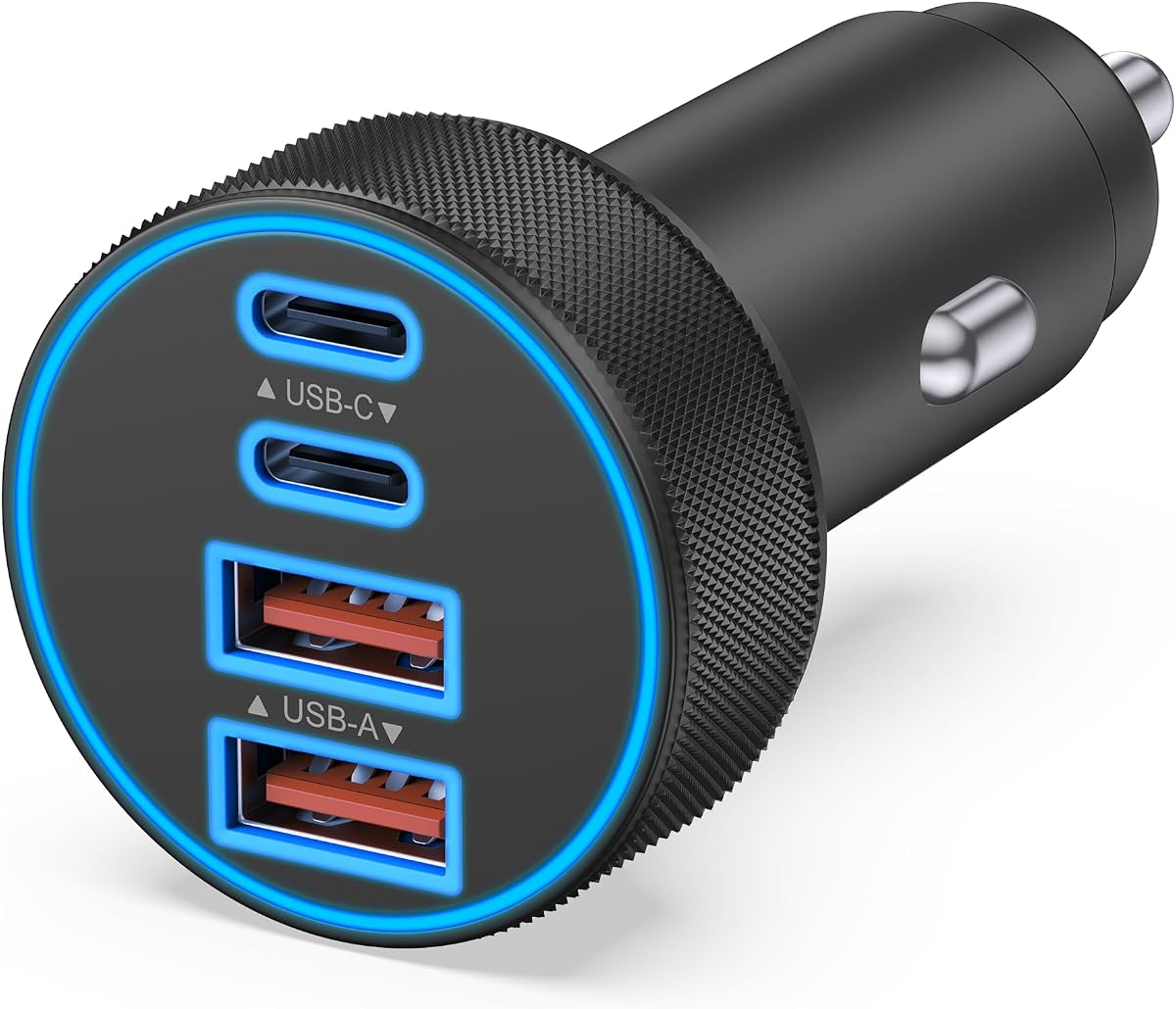
This four-port adapter is the most flexible high-output model in the group, combining two USB-C connections with two USB-A ports and a listed maximum output of 90W. It carries a 4.6 rating, and its broad device support makes it a practical centerpiece for households or vehicles that regularly carry several types of electronics. The listing particularly emphasizes phones, tablets, power banks, cameras, navigation units, and driving recorders.
We may earn a commission when you buy through this link, at no additional cost to you.
Its standout feature is the balance between port quantity and power. The product information states that the USB-C side supports PD output up to 45W and the USB-A side supports QC output up to 45W, while the overall adapter can charge four devices simultaneously. Fast-charging claims include reaching approximately 80% on supported iPhone series and Samsung Galaxy models within 30 minutes, and up to 60% on supported iPads within that period. Actual results depend on the device, cable, battery condition, and charging protocol.
The trade-off is size. At 2.71 by 1.56 inches, it is not as discreet as the thumb-sized MOSWAG, LISEN, MRGLAS, or AINOPE options, so it may protrude more noticeably from the socket. Also, the headline 90W figure is the maximum system capability rather than a guarantee that every connected device receives 90W. Nevertheless, the intelligent power-management chip, over-current, over-voltage, overload, overheating, and short-circuit protections make this a reassuringly engineered premium choice.
Choose this adapter if your vehicle regularly carries multiple phones, a tablet, and legacy USB-A accessories, and you want one socket to handle the entire group. It is less compelling for a single-device driver who values invisibility over versatility. For anyone who needs high output, broad compatibility, and fewer cables, however, it is the most capable overall design in this comparison.
Four ports eliminate the need to carry a separate adapter for each device type. USB-C handles modern phones, tablets, and compatible accessories, while USB-A covers older cables, power banks, and devices that have not moved to the newer connector.
The listed protections and all-metal shell address the two common concerns with high-output adapters: electrical faults and heat. Smart output allocation also makes the charger more adaptable than a simple fixed-output splitter.
We may earn a commission when you buy through this link, at no additional cost to you.
This LISEN two-pack offers a straightforward mixture of useful capacity and portability. Each adapter combines a USB-C port with a USB-A port and is rated for 69W combined maximum output, with the USB-C side listed at up to 36W PD and the USB-A side at up to 18W QC. The 4.6 rating reflects a favorable customer response, and two units allow one charger to remain in each of two vehicles or provide a backup.
We may earn a commission when you buy through this link, at no additional cost to you.
The product information deliberately positions the design as a less cluttered alternative to chargers with three or four ports. A two-port layout requires fewer cables and concentrates the available power across fewer devices. The aluminum alloy shell is designed for better heat dissipation than plastic, while the small, flush-fitting form should remain tidy in most cigarette lighter sockets. The listing also identifies suitability for commuting, road trips, shared vehicles, and business fleets.
Its limitation is straightforward: two devices is the maximum, and a user who regularly travels with a phone, tablet, smartwatch, and power bank may need more capacity. The product also lists a 24-month replacement promise, which is a notable support detail, although warranty terms should be confirmed directly with the seller. Its advertised charging coverage is broad across recent iPhone series, Android phones, tablets, and accessories, but actual fast-charge speed remains device-dependent.
This is a strong pick for couples with two vehicles, commuters who want a spare in the glove box, or drivers who want one inexpensive way to modernize an older USB-A setup. Pick it if two ports, a compact form, and dual-device use are more important than maximum simultaneous device count. It offers more than a basic splitter without creating the cable clutter of a larger adapter.
The two-pack removes the need to move one adapter between cars or wonder whether the spare is still in the glove box. It is also convenient for families sharing a vehicle and for drivers who want a backup during long journeys.
One USB-C connection serves compatible modern devices, while USB-A preserves compatibility with older accessories. This mixed arrangement is often more practical than buying a USB-C-only adapter with no fallback.
We may earn a commission when you buy through this link, at no additional cost to you.
The Anker 323 combines a 4.7 rating—the highest listed rating in this group—with a compact two-port format and 52.5W total output. Its USB-C port is rated up to 30W, while the USB-A port delivers up to 22.5W, allowing two devices to charge at the same time. The product information also cites PowerIQ 3.0 recognition, making it a broadly appealing choice for drivers who want fast charging without a bulky four-port body.
We may earn a commission when you buy through this link, at no additional cost to you.
The claimed charging performance is substantial for a relatively modest adapter. The listing states that an iPhone 14 Pro can reach 50% in 25 minutes and a Samsung S23 can reach 27% charge in 27 minutes. Those are device-specific claims rather than a promise for every connected product, but they indicate that the adapter is designed to negotiate useful output rather than operate only as a basic 5V charger. Compatibility extends across iPhone, Samsung, USB-C tablets, and other mobile devices.
ActiveShield 2.0 is another meaningful strength. According to the listing, it monitors temperature and adjusts power output to help protect connected devices. The drawback is that the 52.5W ceiling and two-port design cannot match the four-port 90W model or even the three-port 67W and 70W alternatives. It also may not offer the same fast-charging headroom for two power-hungry tablets at once.
For most daily drivers, however, that compromise is sensible. One person can charge a phone and smartwatch, or a couple can charge two phones, without carrying a large multi-port unit. The 18-month warranty and the brand’s established charging focus add confidence. The Anker 323 is the most balanced recommendation here: strong enough for quick top-ups, simple enough for daily use, and backed by a well-known protection approach.
A 30W USB-C connection is sufficient for many modern phone fast-charging routines while preserving a familiar USB-A port. This makes the adapter useful to a broad mix of drivers without filling the socket with unnecessary connections.
ActiveShield 2.0 continuously monitors temperature and changes output as needed. That focus on heat and electrical conditions is especially relevant in a vehicle, where summer interiors can become hot and sockets can be used for extended periods.
We may earn a commission when you buy through this link, at no additional cost to you.
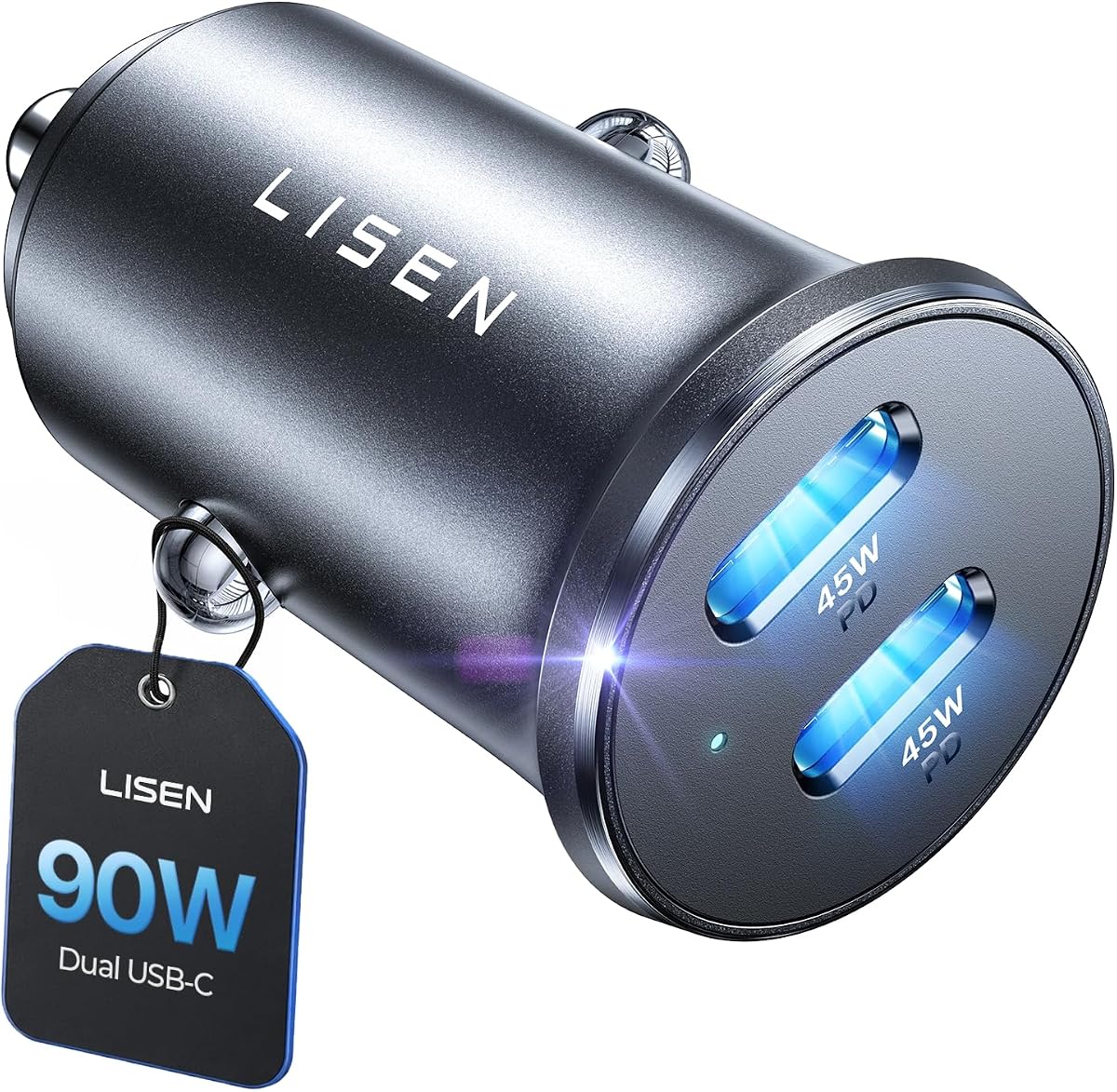
This LISEN adapter specializes in a configuration that is increasingly relevant: two USB-C ports with up to 45W from each, producing a listed 90W total maximum. It holds a 4.6 rating and is especially relevant to drivers carrying two modern phones or a phone and tablet. Power Delivery 3.0 support provides the basis for the listed fast-charging performance, including a claim that an iPhone 18 Pro can reach 83% in about 30 minutes.
We may earn a commission when you buy through this link, at no additional cost to you.
Its physical design is a major advantage. The body is listed at 2.1 by 0.9 inches, smaller than most multi-port adapters in the comparison, and the all-metal shell is intended to dissipate heat while giving the charger a refined appearance. The listing also cites UL, CE, FCC, and RoHS certification, along with V-0-grade PC fuel-barrier material in its construction. These are meaningful differentiators for buyers who want a compact, modern-looking unit.
The obvious compromise is the absence of USB-A. Anyone traveling with an older cable, legacy power bank, older tablet, or accessory that still relies on the traditional connector must carry an additional adapter. Also, two connected high-power devices share the adapter’s overall capability, so the 45W-per-port description should not be interpreted as guaranteed simultaneous 90W delivery under every combination of devices.
This charger is best for USB-C-focused households that have moved away from legacy cables and value a nearly flush, understated installation. It is less suitable for older vehicles full of USB-A accessories or for drivers who expect to connect four devices simultaneously. For a clean, modern two-device setup, however, the balance of power, size, and listed safety credentials is compelling.
Two USB-C ports avoid the visual and practical awkwardness of carrying several generations of cables. Drivers with compatible modern devices can use the same connector type across phones, tablets, and other accessories.
At 2.1 inches long and 0.9 inches wide, the charger is designed to sit close to the socket face. That makes it a strong choice where dashboard space, storage lids, or the surrounding trim are tight.
We may earn a commission when you buy through this link, at no additional cost to you.
The KENHAO adapter delivers a 4.7 rating and combines two USB-C ports with one USB-A port for a maximum listed output of 67W. That middle-ground configuration makes it one of the most versatile options in the guide: it supports more devices than a two-port charger while remaining less elaborate than the four-port 90W model. The USB-C side is listed at up to 37W PD, and the USB-A side at up to 30W QC.
We may earn a commission when you buy through this link, at no additional cost to you.
The listing says the charger can bring supported iPhone and Android devices from zero to 60% in about 35 minutes and can fast-charge devices such as iPads or MacBook Air models at high speed, subject to their own input limits. Compatibility covers a wide range of modern phones, tablets, smartwatches, driving recorders, GPS units, and car vacuum cleaners. Automatic cessation of charging when a battery is full provides another practical safeguard.
Its all-metal housing is designed to improve heat dissipation and resist impacts, while an intelligent chip provides over-current, over-voltage, overheating, and short-circuit protection. As with the other multi-port products, the 67W figure is a total maximum rather than a promise for every port. Adding three devices simultaneously can also reduce the speed of the most demanding one, and the additional connections make the unit less visually minimal than a dual-port design.
This is a good match for couples or families who need three connections without moving to a four-port unit. The dual USB-C arrangement also allows two newer devices to charge together, while USB-A remains available for an older accessory. It is a particularly balanced recommendation for mixed device families, road trips, and vehicles that carry a phone, tablet, and smartwatch on the same journey.
The three-port configuration gives drivers room for several devices while preserving one USB-A connection. It can cover a common family travel load without requiring a second adapter for a legacy cable.
A 67W system has enough headroom for phones and many tablets, but demanding devices compete for the available pool. Drivers should treat the headline number as a combined ceiling and use the product’s intelligent output allocation rather than expect every port to run at maximum simultaneously.
We may earn a commission when you buy through this link, at no additional cost to you.
This 70W three-port adapter arrives as a two-pack, giving buyers a ready solution for two vehicles or a primary unit and a backup. Each charger combines one USB-C port with two USB-A ports and has a 70W combined maximum. Its listed USB-C output reaches 40W under PD 3.0, while the USB-A connections use Quick Charge 3.0. The 4.6 rating makes it a well-regarded alternative to the single four-port model.
We may earn a commission when you buy through this link, at no additional cost to you.
The listing states that supported iPhone 18 and 17 series devices can reach 75% in 30 minutes, while supported Samsung Galaxy S26, S25, and S24 models can reach 70% in that period. Compatibility extends across phones, tablets, MacBook models, GPS units, dash cams, and many other USB-A or USB-C accessories. An integrated smart chip recognizes connected devices and adjusts output, while the listed protections cover over-voltage, over-current, overcharging, overheating, and short circuits.
The dual USB-A configuration is the main limitation for a modern device collection. Two newer USB-C products require at least one additional adapter or a compatible USB-A connection, whereas the KENHAO and four-port 90W options include two USB-C ports. The two-pack also creates more items to store, although the individual units are described as compact and able to sit close to the socket edge.
Choose this product for households with a mix of USB-C and USB-A devices that need three connections in each of two cars. It is also a sensible travel setup, since one charger can remain in the vehicle while the other acts as a spare. Drivers committed entirely to USB-C should favor the dual-USB-C LISEN, while those wanting one adapter with the broadest port mix should examine the 90W four-port option.
Including two units makes the pack especially useful for road trips. One can remain permanently installed while the other is carried as a backup or divided between two vehicles.
The integrated smart chip is designed to identify connected hardware and distribute output appropriately. That makes the 70W total more useful in mixed-device situations than a fixed-output adapter of the same nominal size.
We may earn a commission when you buy through this link, at no additional cost to you.
The AILKIN model is the straightforward traditional option in this comparison: a two-pack of compact adapters with two USB-A ports each and a combined maximum current of 3.4 amps. It carries a 4.6 rating, and the product information emphasizes broad compatibility with phones, tablets, smartwatches, Kindles, Samsung devices, Google Pixel phones, and other USB-A hardware.
We may earn a commission when you buy through this link, at no additional cost to you.
Output is divided between a 1A port and a 2.4A port. The higher-current connection can provide a faster charge for compatible equipment, while the lower-current connection is suitable for smaller accessories. A blue LED confirms that the charger is connected, and the listing states that charging stops automatically when the battery is full. The ABS and PC fireproof material is designed to resist heat, while RoHS, CE, and FCC certification are also cited.
The main limitation is that this is not a USB-C or PD charger, as the product information explicitly clarifies. It cannot deliver modern high-wattage fast charging to a USB-C phone, and it offers far less headroom than the Anker, LISEN, MRGLAS, or four-port alternatives. Buyers with a mixed collection of legacy USB-A accessories may still find it useful, but anyone seeking future-ready charging should pay closer attention to connector type and protocol support.
This pack makes sense for older vehicles, work fleets still using USB-A equipment, or travelers who want a simple spare that does little more than reliably charge basic accessories. It is less appropriate for modern tablets, USB-C laptops, or people expecting quick phone top-ups. Within the limited brief of basic USB-A charging, it is a compact and approachable choice.
Many older power banks, e-readers, simple navigation devices, and older phone models still rely on USB-A. This adapter covers those needs without adding complexity or requiring protocol-specific features.
The 1A and 2.4A arrangement is easy to understand and gives one port more priority for compatible accessories. The blue LED also provides a quick visual check that the adapter is seated and receiving power.
We may earn a commission when you buy through this link, at no additional cost to you.
The MOSWAG charger emphasizes a tiny, unobtrusive installation. Its 4.5 rating is the lowest in the group, but that should be viewed in the context of a product designed primarily around compact dimensions, clean appearance, and mixed-port convenience. It combines USB-C and USB-A, supports up to 7.5W on USB-C and 18W on USB-A, and is designed to sit nearly flush in the cigarette lighter outlet.
We may earn a commission when you buy through this link, at no additional cost to you.
The all-aluminum housing is presented as a way to improve heat dissipation and avoid the melting concerns sometimes associated with plastic adapters. An intelligent power-management chip provides the listed safety controls, and the product information cites CE, FCC, and RoHS standards along with V-0-grade PC fuel-barrier material. Compatibility covers recent iPhone series, Samsung Galaxy phones, iPads, AirPods, smartwatches, driving recorders, GPS units, car vacuum cleaners, and power banks.
Its most significant limitation is the relatively low 7.5W USB-C maximum. It can charge compatible USB-C devices, but it cannot provide the fast-charging experience of the 30W to 45W USB-C connections elsewhere in the guide. The listing also includes a specific warning not to use it to charge a dash cam, a detail worth checking against the accessory manufacturer’s requirements.
Choose the MOSWAG when the adapter should disappear into the console, the lighter socket is narrow, and you want a metal body without a large multi-port footprint. It is best for light top-ups and mixed accessories rather than demanding tablets or laptops. For drivers who need modern fast charging, the compact Anker or dual-USB-C LISEN offers a better balance.
The minimal body is intended to protrude very little, preserving storage-lid access and reducing visual clutter. It is especially attractive in older cars with recessed or awkwardly positioned accessory sockets.
Using aluminum rather than relying entirely on plastic helps move heat away from the internal electronics. The result still needs sensible use, but it can look and feel more robust in a daily carry role.
We may earn a commission when you buy through this link, at no additional cost to you.
The MRGLAS adapter brings 90W total output into a very small, flush-fitting form. It includes one USB-C port and one USB-A port, each listed at up to 45W, and carries a 4.6 rating. The product information states that an iPhone 18 Pro Max and Samsung Galaxy S26 can each charge from zero to 89% in 30 minutes, subject to device support and other charging conditions.
We may earn a commission when you buy through this link, at no additional cost to you.
Its most notable design feature is the pull ring. Because the body sits so close to the lighter socket, the ring helps the user remove it without forcefully pulling on the socket or surrounding trim. The all-metal enclosure is described as offering heat dissipation, scratch resistance, and a sturdy feel. A built-in smart identification chip supports PD 45W and QC 45W output, while the listed protections cover over-current, short circuits, over-voltage, under-voltage, over-temperature, and excessive power.
Two ports are fewer than the four-port 90W model, the three-port KENHAO, and the three-port 70W option. The major benefit is that this smaller design can still deliver high output to each of two connected devices, provided the power-sharing arrangement and the devices’ own requirements allow it. The 90W headline should therefore be read as the maximum combined capability.
This charger suits a driver who wants USB-C fast charging and USB-A compatibility without a bulky body. It is especially useful where the lighter socket has a tight surrounding trim or where a protruding adapter could be inconvenient. The pull ring and low-profile body improve usability, while the high-output rating and protection features make it a compelling middle ground between compact dual-port models and larger four-port designs.
The 45W outputs give the adapter genuine fast-charging potential while its small body remains close to the socket. This combination makes it useful in vehicles where every millimeter of dashboard space matters.
A low-profile charger can be difficult to grip, particularly for users with limited dexterity. The pull ring provides a more practical way to remove it and reduces the temptation to pull against the lighter socket.
We may earn a commission when you buy through this link, at no additional cost to you.
The AINOPE adapter is one of the smallest products in the guide, with a listed body size of 1.79 by 0.94 inches. It uses two USB-A ports, supports up to 3.4A combined output, and carries a 4.6 rating. Its appeal is simplicity: it provides a metal-bodied, dual-USB solution for basic charging without the larger footprint or higher electrical demands of a modern multi-protocol adapter.
We may earn a commission when you buy through this link, at no additional cost to you.
The all-metal construction is intended to resist burning and improve heat dissipation. Multiple protections are listed against over-current and overcharging, and the product is described as compatible with Android and iOS mobile devices, including recent iPhone and Samsung Galaxy families. Each connected device is said to charge at the maximum speed it supports, although that remains subject to the device, cable, and the adapter’s total output ceiling.
A useful note in the listing explains that the metal shell may feel hot sooner than a plastic housing, but that this is presented as evidence of active heat dissipation rather than a fault. Even so, users should still avoid leaving the adapter under heavy load in an extremely hot vehicle. The larger issue is that two USB-A ports exclude direct USB-C charging and do not provide the high-wattage headroom needed for modern tablets or laptops.
The AINOPE is a good fit for older vehicles, simple phone charging, or travelers who prefer a small metal adapter with no excess ports. It may be particularly useful in cars where the lighter socket is recessed and a larger unit would feel intrusive. For current-generation devices or quick top-ups, an option with USB-C Power Delivery would be more appropriate.
At only 1.79 inches long, the charger is among the least intrusive options. Its small body can preserve access to adjacent controls and make the center console look cleaner.
The aluminum shell gives the charger a more substantial feel and provides an alternative to plastic construction. It also supports heat dissipation during sustained use, although sensible loading remains important.
We may earn a commission when you buy through this link, at no additional cost to you.
The right car lighter USB adapter depends on your device mix, charging speed, available socket space, and tolerance for heat or cable clutter. The following factors help narrow a large category of otherwise similar-looking chargers.
Start with the connectors your devices actually use. USB-C is essential for modern fast charging because it supports Power Delivery and other high-wattage protocols, while USB-A remains valuable for older accessories, power banks, and legacy devices. The best configuration for many drivers is one of each, although a two-USB-C adapter is cleaner when every device has migrated. A USB-A-only model may still work for basic charging, but it cannot unlock USB-C fast charging and may deliver disappointing results with demanding devices.
Headline wattage can be misunderstood. A charger advertised at 90W may provide 45W per port under favorable conditions, but its overall 90W is shared among connected devices. The same applies to 67W, 70W, and 52.5W models. Reviewers of the product listings should look for both total output and maximum output per port, then assess whether the device and protocol can use it. A high total rating is most useful when connected equipment can negotiate the available PD or QC levels.
Two-port adapters are ideal for individuals, couples with two phones, or drivers who value a clean dashboard. Three ports offer a better compromise for a phone, tablet, and smartwatch, while four ports suit larger families, shared work vehicles, and anyone carrying several legacy accessories. More ports do not automatically mean faster charging because available power is divided. Match the number of connections to typical trips rather than carrying unused cables on every journey.
A low-profile charger can improve the appearance and usability of a vehicle, particularly when the socket is recessed or surrounded by a storage lid. The smallest products in this guide measure approximately 1.79 to 2.1 inches, while the four-port 90W unit is larger. Extremely compact designs may be harder to grip, which is why the MRGLAS model adds a pull ring. Before buying, consider whether the adapter blocks the lighter socket cover, interferes with a gear selector, or is simply too noticeable for your dashboard.
Vehicle interiors can become extremely hot, and an adapter that supports fast charging is working harder than a basic 5V charger. All-metal housings appear across many of the stronger choices because metal is intended to move heat away from the electronics. Look for intelligent power management, temperature monitoring, and protections against overheating, over-current, over-voltage, and short circuits. These features do not eliminate sensible usage habits, but they indicate a more considered design than a basic splitter.
Recognized certifications and documented protection systems provide useful evidence that a charger has been designed to meet electrical and material requirements. Among the listed products, claims include RoHS, CE, FCC, UL, or related certifications, but certification marks should be verified on the actual listing and packaging. Built-in controls against overcharging, short circuits, overload, and temperature extremes are equally important because a vehicle socket provides a different operating environment from a wall outlet.
A long compatibility list can be reassuring, but it should be read in context. The important questions are whether the adapter supports the exact connector, protocol, and power level of the device you own. PD and QC versions differ, and older phones or accessories may accept only basic USB-A output. Tablets, laptops, cameras, and GPS units may have different charging inputs. Verify your own model in the product information, and look for an adapter that can negotiate output rather than force a fixed voltage.
A two-pack is particularly useful for drivers with two vehicles, shared family cars, delivery fleets, or a preference for keeping a spare. It also reduces the inconvenience of moving a single adapter between a daily car and a rental. Single-unit options are simpler to store and may be preferable when minimizing duplicate gear matters. The same principle applies to fleet use: consistent, compact hardware can be easier to deploy than a collection of unrelated adapters.
Begin by checking the vehicle’s accessory socket and confirming that the adapter is rated for its 12–24V input range. The ignition should generally be in the accessory or on position when using the socket, following the vehicle manufacturer’s guidance. Insert the adapter with moderate pressure, pull the attached cables firmly from their connectors rather than yanking them from the socket, and avoid forcing a charger into a socket that feels loose or obstructed.
Use cables and devices that support the charging protocol offered by the adapter. For the fastest results, connect a compatible USB-C cable to a device capable of PD or high-speed charging, and confirm that the cable itself can carry the advertised current. Do not interpret a charger’s maximum wattage as guaranteed device speed. Battery age, temperature, remaining capacity, and the device’s own charging curve can all affect the result, so compare the expected charging level with the original manufacturer’s guidance.
Do not overload the adapter, cover it with thick objects, or use it in visibly damaged sockets. Unplug it before cleaning the area, and avoid liquids around the connection point. If a port smells unusual, the shell becomes excessively hot, charging repeatedly stops, or a connector feels loose, stop using it and investigate the socket, cable, and adapter. For long summer trips, avoid sealing the charger beneath clutter and give connected devices adequate ventilation.
No. A higher maximum wattage only helps when the connected device, cable, and charging protocol can use it. For a basic phone top-up, a compact two-port charger may be entirely adequate. For tablets, demanding phones, or several simultaneous connections, a model with a larger shared power pool and current fast-charging protocols is generally more useful. The best adapter is the one that matches your devices and fits your vehicle cleanly.
It can charge compatible devices if the adapter, cable, and device all support a suitable power level. Some products list USB-C laptops and tablets among compatible devices, and a 90W adapter has more theoretical headroom than a compact 25.5W model. However, a general-purpose laptop may require a specific voltage profile and a capable USB-C cable. Check the device manufacturer’s requirements before assuming every USB-C car adapter will work.
Not directly unless the adapter includes a USB-A port and the phone’s charging cable uses that connector. A USB-C-only adapter, such as the dual-USB-C LISEN, requires a compatible USB-C cable and device. Drivers with mixed generations of equipment will usually find one USB-C and one USB-A port to be the most adaptable arrangement, provided they do not expect the older port to provide modern fast-charging speeds.
It can. Most multi-port adapters share a total power budget, so connected devices divide the available output. One phone may still receive full fast-charging power while a second device is active, but two demanding tablets can reduce the rate available to each. Check the listed total output, individual port maxima, and the manufacturer’s guidance on simultaneous use rather than assuming every port always delivers its headline rating.
Heat is a normal byproduct of power conversion, and a metal shell is often used to move that heat away from internal components more effectively than plastic. Some listings specifically note that a metal shell may feel warm sooner. A moderate increase in temperature is not the same as a malfunction, but persistent extreme heat, odor, discoloration, or repeated shutdowns should prompt you to disconnect the adapter and check the socket, cables, and connected equipment.
Port count alone does not determine safety. A well-designed multi-port adapter can include smart output allocation, temperature monitoring, and protections against over-current, over-voltage, overheating, overcharging, and short circuits. A basic two-port unit may provide less electrical complexity, but quality still depends on its internal design and construction. Compare protection systems and certification information rather than assuming more ports are automatically better or worse.
Compact models around 1.79 to 2.1 inches are most likely to sit nearly flush, although exact fit varies by vehicle. The four-port 90W adapter in this guide is larger at 2.71 by 1.56 inches and may be more noticeable. Measure the socket face, inspect nearby trim, and check the manufacturer’s dimensions. A model with a pull ring, such as the MRGLAS, is also easier to remove when it sits close to the socket.
For extended parking, unplugging the adapter is a sensible precaution, particularly in hot weather or if the vehicle has a continuously powered socket. It can reduce unnecessary standby draw and limits heat accumulation. If you need to keep a dash camera or other device charging, follow that accessory manufacturer’s guidance and confirm that the charger supports the intended device. The MOSWAG listing, for example, specifically warns against charging a dash cam with that model.
The Anker 323 stands out as the strongest all-round daily choice because it combines the highest listed rating in the group, useful 30W USB-C output, a practical USB-A connection, and ActiveShield 2.0 temperature monitoring in a simple two-port design. The LISEN 69W two-pack is an attractive budget-oriented alternative for drivers who want a spare, a second vehicle, or a compact mixed-port charger. For the highest power and widest port access, the 90W four-port model is the most flexible option.
Prioritize connector compatibility before maximum wattage. Make sure your phone or tablet supports the protocol the adapter offers, then choose enough ports for the devices you regularly carry without creating unnecessary dashboard clutter. A metal housing, intelligent power management, and documented electrical protections are especially worthwhile in a hot vehicle. Drivers who need multiple backups, family travel, or a mix of legacy and modern accessories can also consider the two-packs and three-port models in the guide.
Finally, verify the latest listing, seller information, warranty terms, vehicle fit, and current purchase conditions before ordering. Charging performance can vary with the device, battery, cable, temperature, and power-sharing arrangement, so treat advertised percentages and times as product claims rather than guaranteed results. The most suitable adapter is the one that safely supports your usual device mix and disappears into your daily driving routine.