
Bates Long Reach Extension Scraper
4.6Editor score
Extended 11-inch handle
Mixed blade selection
Enhanced leverage and control
A car window scraper for stickers should lift old inspection decals, adhesive labels, vinyl graphics, and residue without damaging glass or tint. The most useful tools combine a controlled cutting edge with a comfortable grip, a secure blade holder, and enough reach to navigate curved windows, narrow edges, and awkward areas around a vehicle.
The ten products in this guide were compared using their stated blade types, handle construction, reach, replacement-blade system, surface applications, and customer ratings. The list covers compact plastic-only scrapers, long-reach models, mixed plastic-and-metal blade kits, and a low-profile detailing tool designed for windshield and vehicle surfaces.
Each review explains how a product fits a particular sticker-removal task, highlights relevant benefits, and identifies practical limitations based on the supplied product information. Ratings reflect the listed customer feedback, while product availability and prices can change, so shoppers should compare the current listing, included accessories, and surface compatibility before buying.
4.6Editor score

4.7Editor score
4.5Editor score
As an Amazon Associate we earn from qualifying purchases.
This side-by-side comparison highlights the blade materials, reach, included accessories, and intended uses of all ten scrapers, helping readers identify the right tool for windshield labels, window decals, adhesive residue, and general household cleaning.


The EHDIS 1.5-inch plastic razor scraper is a budget-oriented option for removing stickers, labels, decals, glue, and caulk from glass and other smooth surfaces. It carries a 4.4 customer rating and includes ten double-edged plastic blades, making it a straightforward kit for households that want a dedicated tool without a large collection of accessories.
We may earn a commission when you buy through this link, at no additional cost to you.
Its main advantage is the plastic blade design. The manufacturer positions the scraper as a way to minimize scratching, which is particularly relevant when working on automotive glass, windows, and other smooth finishes. The ergonomic handle is designed to improve control and strength, while two slots hold the blade firmly so it does not shift during use.
The compromise is specialization. With a 1.5-inch body and no listed extension handle, it may require more repositioning than a long-reach scraper when working around a windshield or inside a recessed window edge. It also includes no metal blade, so it is better suited to delicate jobs than to aggressive residue removal on hard surfaces.
This scraper is a strong choice for budget-conscious owners who mainly need to lift old window labels, parking stickers, and light adhesive from glass. It is also useful around a kitchen, workshop, countertop, or vehicle. For those willing to work in short sections and replace the blade as it dulls, it provides a practical and focused sticker-removal setup.
Using plastic blades helps reduce the risk of deep scratches compared with a sharp metal edge. That makes the EHDIS a sensible starting point for old decals on visible glass where preserving the finish matters more than removing every hardened trace as quickly as possible.
The compact body can be carried in a pocket, glove compartment, or toolkit. With ten replacement blades included, it is well suited to household cleanup, vehicle detailing, and general removal of labels, debris, glue, and light residue.
We may earn a commission when you buy through this link, at no additional cost to you.
The Bates Long Reach Extension Scraper combines an 11-inch handle with a 4.6 customer rating, making it a strong all-around choice for vehicle stickers and general adhesive work. Its extended format helps users reach confined or awkward areas where a short scraper would require awkward wrist angles or frequent repositioning.
We may earn a commission when you buy through this link, at no additional cost to you.
The included selection of three double-edged plastic blades and three metal blades gives the tool flexibility. Plastic blades are suited to delicate surfaces, while metal blades can tackle tougher paint, adhesive, and residue. The long handle also provides added leverage, helping translate controlled pressure into a more effective scraping action.
Users must still match the blade to the surface. A metal edge is valuable for hardened material but can damage paint or tint if used aggressively. The product description also provides only three blades of each type, so intensive or multi-vehicle projects may require additional replacements sooner than a larger accessory kit.
The Bates scraper is well suited to owners who want one tool that can handle windshield labels, window decals, adhesive, and demanding household residue. It is particularly attractive for hard-to-reach locations around a vehicle. The combination of reach, leverage, and mixed blade options makes it a versatile choice for regular maintenance and restoration projects.
The 11-inch handle extends the scraper into narrow gaps and across portions of a windshield without requiring the user to bend awkwardly. Better positioning can also make it easier to keep the blade angle shallow and consistent as a sticker separates from the glass.
The plastic blades cover safer work on smooth surfaces, while the metal blades add capability for stubborn deposits. That flexibility makes the Bates tool useful for both careful decal removal and heavier scraping tasks around the home or workshop.
We may earn a commission when you buy through this link, at no additional cost to you.
The DEKEones Razor Blade Scraper is built around a 9.25-inch curved handle and a 4.5 customer rating. It is designed for removing stickers, vinyl, decals, glue, caulk, and paint from windows, cars, glass, windshields, and household surfaces, giving it a broader role than a simple windshield label remover.
We may earn a commission when you buy through this link, at no additional cost to you.
Its blade system is a key strength. Five metal blades are included for hard surfaces, while five plastic blades support cleaner work on glass and other delicate finishes. A hand-tightening screw allows blades to be changed without additional tools, reducing interruptions when an edge becomes dull or contaminated.
The long design can feel less maneuverable in very tight areas than a compact low-profile tool. Metal blades also require careful angle control to avoid gouging a surface, and the handle is large enough that users with limited hand mobility may prefer a smaller option. Even so, the curved shape supports grip and leverage.
This is a good recommendation for someone who regularly removes adhesive from vehicles and also wants a dependable scraper for renovation or kitchen cleanup. The combination of ten blades, a tool-free replacement system, and broad applications gives it more versatility than a single-purpose plastic scraper.
The curved handle places the hand in a more natural position and is designed to improve control. That ergonomic shape can reduce fatigue when repeatedly working across a large windshield, window, countertop, or painted panel.
A knurled hand knob and tightening screw let the user remove or install a blade without hunting for a screwdriver. This is particularly useful when moving between a plastic blade for glass and a metal blade for hardened adhesive.
We may earn a commission when you buy through this link, at no additional cost to you.
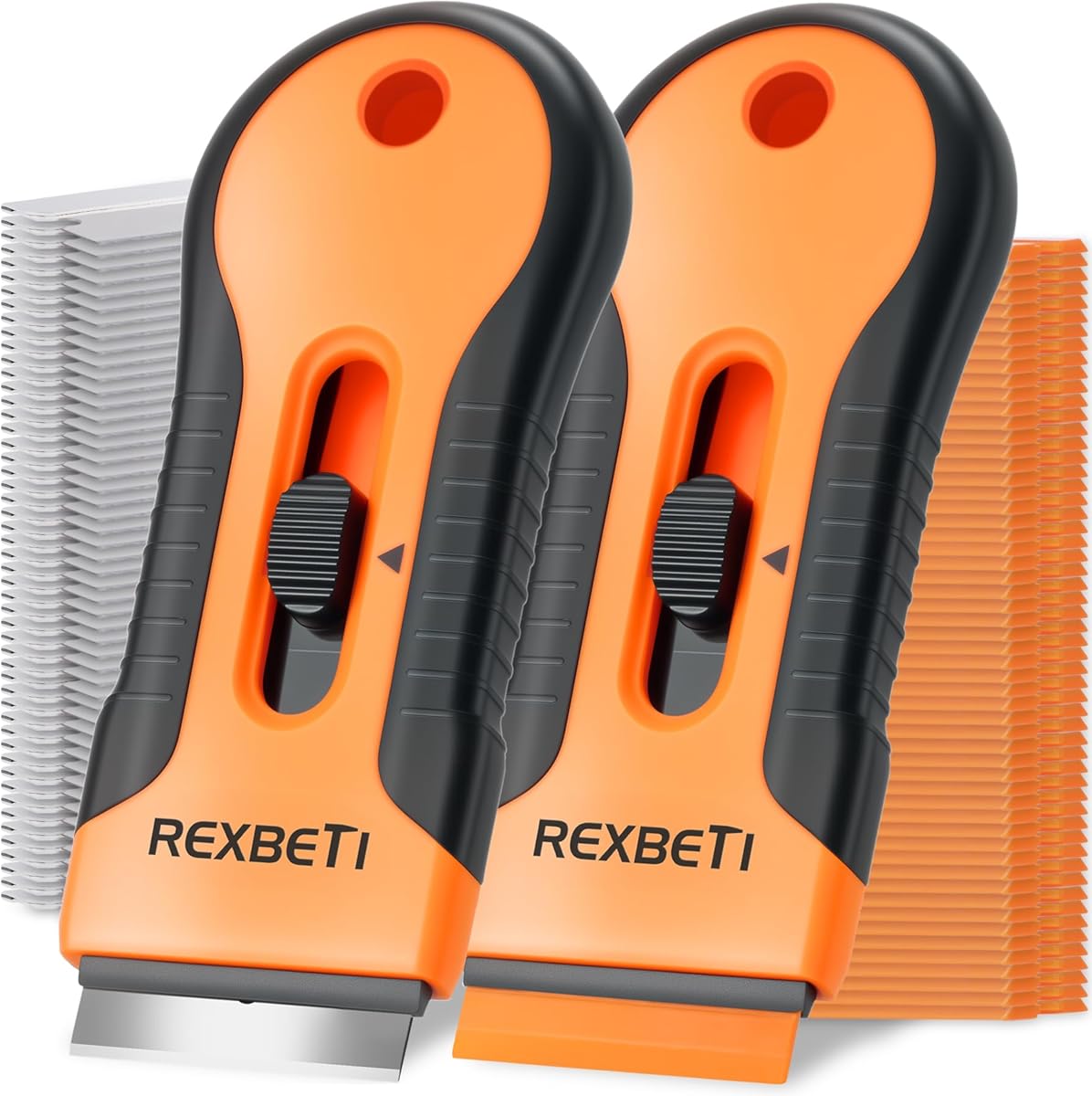
The REXBETI Razor Blade Scraper Tool is an accessory-heavy kit rated 4.5 by customers. It includes two scraper handles, 30 metal blades, and 50 plastic blades in a reusable plastic box, providing ample material for repeated vehicle, kitchen, and renovation cleanup.
We may earn a commission when you buy through this link, at no additional cost to you.
Its three-position blade system is designed for quick retraction and extension. Users can adjust the blade without complicated steps or extra tools, which makes it easier to work with different angles and to retract the edge safely when the scraper is not in use. Ergonomic handles are intended to provide grip and control during extended work.
The large number of accessories may feel excessive for a single sticker-removal job, and the total package is more elaborate than a basic scraper. Metal blades remain appropriate for tougher surfaces but should not be used indiscriminately on automotive paint, glass tint, or laminated plastic.
The REXBETI kit makes the most sense for households, car owners, and detailers who expect to remove multiple labels, decals, adhesive deposits, paint residue, or baked-on grime over time. The included plastic blades protect delicate surfaces, while the metal blades and generous spare supply handle more demanding work.
With 30 metal and 50 plastic blades included, the kit is well prepared for heavy turnover. The reusable box also helps keep the scrapers, blades, and other small components organized instead of leaving them scattered around a workbench.
Three blade positions let the user alter how far the edge projects from the holder. This is useful when transitioning between careful surface cleaning and more assertive work on stubborn residue, provided the blade remains controlled.
We may earn a commission when you buy through this link, at no additional cost to you.
The Lisle 52000 Razor Blade Scraper has the highest customer rating in this group at 4.7. It is purpose-built for tasks such as removing stickers from windshields and bumpers, while the included plastic blade adds a more scratch-conscious option for safety-plastic laminated windshields.
We may earn a commission when you buy through this link, at no additional cost to you.
Five stainless steel blades support routine work on adhesive and labels, and the spring-release mechanism allows quick blade interchange. The hollow handle stores the blades when they are not being used, keeping the tool compact and helping prevent loose blades from being scattered on a work surface.
The package has fewer replacement blades than several multi-handle kits, and only one plastic blade is listed. The steel blades require controlled use on coated, tinted, painted, or plastic surfaces, where a more aggressive blade could cause damage if the angle and pressure are not carefully managed.
This scraper is an excellent choice for owners who remove multiple vehicle stickers or work on windshields regularly and value compact storage with rapid blade changes. The dedicated plastic blade for laminated windshields is a thoughtful detail, making the Lisle particularly well matched to sensitive automotive glass applications.
The product is specifically described for removing windshield and bumper stickers, making its application more focused than many general-purpose kits. That specialization is useful for inspection stickers, registration decals, and adhesive labels that need a controlled scraping edge.
The hollow handle stores the included blades inside the tool, reducing clutter and making it easier to keep a complete scraper in a vehicle, toolbox, or detailing bag. The spring release further simplifies swapping a worn blade for a fresh one.
We may earn a commission when you buy through this link, at no additional cost to you.
The KUSUFEFI Plastic Razor Blade Scraper is a 4.4-rated, two-handle kit designed primarily for light sticker, decal, tape, and adhesive removal from smooth surfaces. It includes 60 plastic blades, giving the set a substantial supply without adding more aggressive metal edges.
We may earn a commission when you buy through this link, at no additional cost to you.
The curved ABS handle has a thumb rest for grip, and two locking slots secure the replaceable blade. Because plastic is less likely to dig deeply into a surface than metal, the tool is presented as a safer option for glass, mirrors, ceramic cooktops, tiles, and stainless steel.
Its scope is intentionally narrower. The product information specifies light-duty cleaning and recommends softening stubborn adhesive with remover or warm soapy water before scraping. Users attempting deeply hardened paint, caulk, or adhesive will likely need a more aggressive edge or additional chemical assistance.
The KUSUFEFI is well suited to careful vehicle window work, household label removal, and light buildup on smooth surfaces. Two handles make it convenient for a household or small detailing operation, while the 60-blade supply reduces the likelihood of running out during routine maintenance.
The all-plastic configuration prioritizes smooth finishes over maximum cutting power. This makes the scraper attractive for visible automotive glass and household surfaces where a deep scratch would cost more than the time saved through aggressive scraping.
Two separate handles can be kept in different vehicles, stored in separate cleaning kits, or used by two people on the same project. The large supply of plastic blades supports repeated use as edges dull or pick up adhesive residue.
We may earn a commission when you buy through this link, at no additional cost to you.
The four-piece plastic razor scraper set is built around a 4.4 rating and a generous accessory package. It includes four scrapers and 100 extra double-edged plastic blades, making it a practical choice for users who want several tools available in different parts of a vehicle, workshop, or home.
We may earn a commission when you buy through this link, at no additional cost to you.
The blade design is intended to remove decals, labels, glue, stickers, grease, and paint without penetrating the underlying surface. An indentation in each handle provides a natural place for the thumb, improving control, while the replacement process requires only a flick of the wrist and a light press.
All listed blades are plastic, so the set is most appropriate for delicate surfaces and moderately stubborn residue rather than heavy paint or caulk removal. Four handles may also be unnecessary for a casual user, although they are helpful for shared workspaces, multiple vehicles, and keeping tools close at hand.
This set is a good fit for households that remove stickers regularly from glass, walls, appliances, and metal. It also has stated uses for labels, dripped wax, and melted plastic from 3D printer beds, extending its usefulness beyond automotive detailing without changing its basic plastic-blade construction.
Keeping a scraper in the car, garage, kitchen, and workshop avoids the inconvenience of searching for one tool between tasks. It also makes the four-piece configuration useful for families, detailers, or renovation projects that operate in several areas at once.
The user can remove a spent blade with a quick wrist movement and press a replacement into position. This uncomplicated approach helps keep the tool productive and reduces the chance of continuing with a dull edge that tears rather than cleanly lifts a sticker.
We may earn a commission when you buy through this link, at no additional cost to you.
The Performance Tool W233 is a 12-inch long-reach razor blade scraper with a 4.6 customer rating. Its extended design is intended for confined areas that standard scrapers cannot easily reach, making it particularly relevant when removing inspection stickers from a windshield.
We may earn a commission when you buy through this link, at no additional cost to you.
The tool includes three double-edged plastic blades and three carbon steel blades. Plastic blades support gentler work on smooth glass, while carbon steel blades provide stronger cutting capability for difficult residue. Extra blades can be stored in the handle, which keeps the set organized and readily available.
Reach is the central benefit, but the same 12-inch length can require more space when turning the tool around a tight panel or using it in close quarters. Users must also select the carbon steel blade carefully around tint, paint, and plastic because an aggressive edge can damage surfaces quickly.
The W233 is a strong recommendation for drivers who regularly encounter old inspection stickers and need access along the edges of a windshield or into recessed areas. It also supports general sticker, decal, and residue removal, giving long-reach users a useful mix of plastic and steel options.
The extended construction helps the blade reach narrow spaces and areas that are difficult to address with a short handheld scraper. It can also support a steadier angle when working along a sticker edge, reducing the need to awkwardly reposition the wrist.
Plastic blades cover the more sensitive side of the job, while carbon steel blades are available when more cutting force is necessary. Storing the extras in the handle keeps the tool ready for quick changes during a detailing session.
We may earn a commission when you buy through this link, at no additional cost to you.
The HELEMAN Plastic Razor Blade Scraper Kit is a 4.4-rated bundle that includes two scrapers and 100 replacement plastic blades. Its construction is described as high-quality hot injection-molded plastic designed to provide strength and stiffness without using metal cutting edges.
We may earn a commission when you buy through this link, at no additional cost to you.
The curved ergonomic handles offer a substantial grip, and two slots hold each blade firmly to prevent slipping. The large blade supply is useful for regular household and automotive cleanup because plastic edges collect adhesive, paint, and debris and should be replaced when they become dull or contaminated.
Because the kit contains only plastic blades, it is better aligned with smooth surfaces and careful residue removal than with heavy paint stripping or deeply cured caulk. The manufacturer emphasizes that plastic blades can perform similar work without the deep scratching associated with a steel blade, though forceful technique can still damage a surface.
This kit is a good option for owners who prioritize finish protection and expect ongoing use. It works for car glass, wood, floors, stoves, kitchens, vinyl, adhesive, and decals, while two handles and 100 blades make it particularly practical for a busy household, workshop, or mobile cleaning kit.
The injection-molded body is intended to resist bending and breaking while maintaining a firm grip. That durability supports repeated use across household and vehicle surfaces, although a fresh blade remains important for clean sticker removal.
The plastic blade design focuses on removing labels and residue without gouging the finish. It is particularly suitable for automotive glass, window tint, appliances, floors, and other surfaces where a metal edge could leave visible marks.
We may earn a commission when you buy through this link, at no additional cost to you.
The three-piece Decal Remover is a low-profile label and sticker removal tool with a 4.6 customer rating. Its one flat side and one slightly beveled side give users different ways to approach a decal, while rolled edges are designed to make the tool more comfortable to hold against a surface.
We may earn a commission when you buy through this link, at no additional cost to you.
A center thumb spot improves grip and helps the user maintain control close to the working edge. The product is specifically listed for vinyl graphics, windshields, auto detailing, kitchen tasks, adhesive removal, and use around Teflon and ceramic surfaces, giving it a particularly relevant automotive profile.
The supplied information does not list a supply of replacement blades, so buyers should confirm the exact construction and replenishment options on the current listing. Its low profile also makes it better suited to controlled removal than to cutting through thick, deeply cured caulk or large quantities of hardened paint.
This remover is ideal for someone who wants precise contact with a windshield or glass panel and prefers a small detailing-style tool over a long extension handle. The three-piece format provides multiple tools for different tasks, making it a practical addition to a vehicle detailing kit.
The low-profile design keeps the working edge close to the glass, which can help the user follow the boundary of a sticker and avoid pushing residue across the surrounding area. It is especially useful for controlled work on inspection decals and vinyl graphics.
The flat side offers broad contact for lifting stubborn sections, while the slightly beveled side can help the edge get beneath a decal or work into a narrow transition. Rolled edges improve comfort when the handle is pressed against the panel.
We may earn a commission when you buy through this link, at no additional cost to you.
The most useful scraper depends on the surface, the age and stubbornness of the sticker, and how much reach or control you need. Comparing blade material, handle design, replacement parts, and intended applications will help prevent unnecessary scratching and make each pass more effective.
Plastic blades are the most conservative choice for automotive glass, window tint, and laminated plastic because they are less likely to dig deeply into the surface. They work well for labels, decals, and moderate adhesive residue, although a dull or contaminated edge may tear the sticker rather than lift it cleanly. Metal blades cut more aggressively and are useful for hardened paint, caulk, and stubborn residue, but they require shallower angles, lighter pressure, and careful testing on a hidden section.
A compact scraper offers direct control and fits easily into tight storage spaces, while a long-reach handle is valuable around windshield edges, recessed areas, and the middle of broad glass panels. Extension tools can improve access and reduce awkward wrist positions, but they may feel cumbersome in confined corners. Consider the size and shape of the vehicle areas you clean most often rather than assuming a longer handle is automatically better.
A comfortable, non-slip grip makes it easier to keep the blade angle steady, which is important when a sharp edge is lifting adhesive. Curved handles, thumb rests, textured grips, and recessed thumb spots can all reduce fatigue and improve control. Since decal removal often involves repeated strokes, a handle that feels secure in the hand may be more valuable than a small difference in overall tool length.
A secure holder prevents the blade from shifting, twisting, or slipping during a pull. Tool-free or spring-release systems speed up changes when an edge becomes dull, while retractable designs can make the tool safer to store. The number and type of included blades also indicate how well the kit supports ongoing use. A larger supply is useful for frequent work, but it adds bulk and may be unnecessary for occasional single-sticker removal.
The same sticker can be attached to glass, tint, paint, plastic, chrome, ceramic, or adhesive-coated trim, and each material responds differently. Some scrapers are explicitly intended for smooth glass and delicate surfaces, while others are designed to tackle paint and caulk on hard surfaces. Check whether the tool has a plastic option and whether the manufacturer identifies automotive glass, windshield, tint, paint, or laminate compatibility before applying an aggressive blade.
A sharp scraper can lift the main sticker, but old adhesive may remain after the decal comes away. Heat, warm soapy water, or an appropriate adhesive remover can soften residue before a second pass with a plastic blade. This two-stage approach is often safer than forcing a metal edge through the entire label. It also produces a cleaner result because softened adhesive releases more readily than hardened glue that has already torn or stretched.
A versatile kit can handle inspection stickers, parking permits, window decals, label residue, paint marks, caulk, and cleanup around counters or appliances. This makes it useful beyond a single vehicle. However, a focused low-profile detailing tool may be easier to control for windshield work, while a long-reach scraper is better suited to broad or inaccessible panels. Choose based on the range and frequency of tasks rather than on the number of listed accessories alone.
Begin by cleaning the glass with warm soapy water and drying it with a clean microfiber cloth. Test the scraper in a small corner, especially if the window has tint, ceramic coating, or laminated plastic. Install a fresh plastic blade for delicate surfaces, hold the tool at a shallow angle, and work from the edge of the sticker rather than digging directly into its center.
Apply steady, light pressure while overlapping each pass with the previous one. Peel the sticker back as it loosens and move to a clean section of glass frequently, especially when adhesive builds up on the blade. If residue remains, avoid immediately switching to metal; soften it with a compatible remover or warm soapy water, then use a fresh plastic blade for a final cleanup.
After use, release or retract the blade according to the tool's instructions and remove any adhesive or debris from the holder. Replace dull or damaged blades, store the scraper in a dry tool kit, and keep metal edges away from children. Periodically inspect the plastic body and handle for cracks, and avoid striking the blade against hard edges.
A plastic blade is generally the safest starting point because it is less likely to dig deeply into glass, tint, or laminated plastic. Begin with light pressure and a shallow angle, and test the tool in a discreet area first. Replace the blade when it becomes dull or carries a buildup of adhesive, since a dirty edge can scratch the surface.
A sharp scraper can lift the sticker itself, but old adhesive may remain after the paper or vinyl separates. Removing residue often requires an additional step, such as applying a compatible adhesive remover or using warm soapy water, followed by careful scraping with a clean plastic blade. The two-stage method is generally gentler than forcing a metal blade through stubborn residue.
Long-handle models are specifically designed to improve access to confined areas, windshield edges, and recessed sections. Their extended reach can also help maintain a consistent blade angle. The trade-off is that the tool may feel less maneuverable in very tight corners, so a compact or low-profile scraper can still be useful for localized work.
Metal blades are more aggressive and can scratch or cut tint if used at a steep angle or with excessive pressure. Plastic blades are better suited to tinted windows unless a metal blade is genuinely needed for very tough residue. Always test carefully and avoid dragging a metal edge across the film.
Replace the blade when it becomes dull, chipped, bent, or coated with adhesive and debris. A clean edge lifts stickers more predictably and reduces the need for extra force. High-volume detailing work will require more frequent changes, while occasional household use may need only a few replacements from the included supply.
Many of the listed tools are advertised for glass, ceramic cooktops, tiles, stainless steel, counters, and appliances. The safest approach is to use a plastic blade on smooth or coated surfaces and reserve a metal blade for hard, non-sensitive areas. Check the surface manufacturer's care guidance before scraping.
A flat blade provides broader contact with the surface and can be useful for lifting flatter sections of a label. A slightly beveled blade can reach under an edge and work into narrower transitions. The low-profile three-piece remover in this guide provides both geometries for different detailing tasks.
Gentle heat can soften adhesive and make removal cleaner, but the window should not become dangerously hot, and the method should suit the glass, tint, and surrounding trim. Warm soapy water is another common option. After softening, use a fresh plastic blade and avoid excessive pressure.
The Bates Long Reach Extension Scraper is the most balanced general choice because its 11-inch handle improves access while the included plastic and metal blades cover both delicate and demanding work. The Lisle 52000 stands out for vehicle-specific design, a 4.7 rating, rapid blade exchange, and a plastic blade intended for laminated windshields, while the REXBETI kit is ideal for users who want two handles and a large replacement-blade supply.
Prioritize blade material, reach, grip, and the surface you intend to clean rather than focusing only on the number of accessories. Plastic blades are the sensible default for visible automotive glass and tint, while metal blades should be reserved for hardened residue and used with greater control. A compact low-profile tool may handle precise detailing better, whereas an extension scraper can make broad windshield work easier.
Before ordering, verify the current product listing, included components, and availability because offers can change. Check that the blade mechanism fits your hand, confirm the tool is suitable for the window's finish, and keep a fresh plastic blade ready for the final adhesive-removal pass.