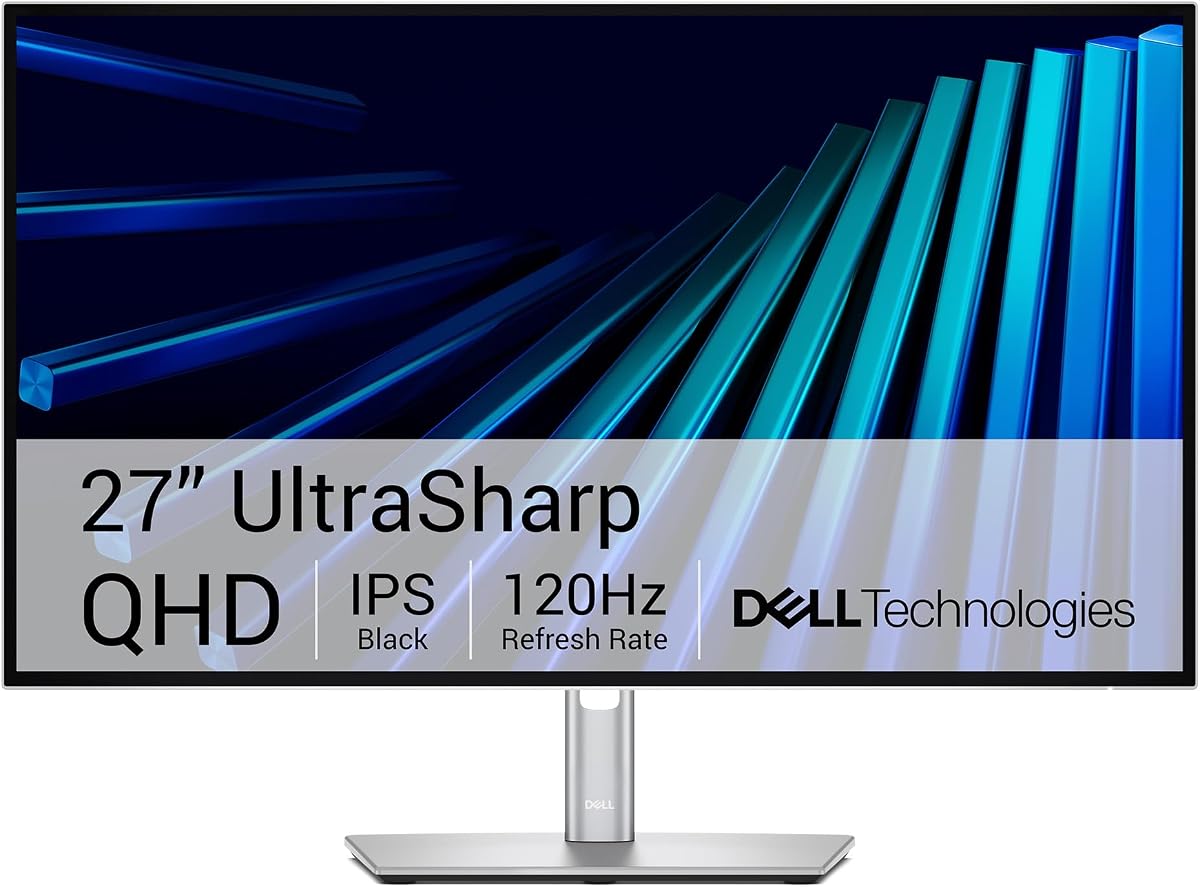
Dell UltraSharp U2726DER
5.0Editor score
98% Display P3 coverage
Factory-calibrated accuracy
Thunderbolt hub connectivity
Built-in KVM switching
A MacBook Pro can deliver exceptional performance, but its built-in display may not provide the screen size, color coverage, or flexible connectivity needed for serious creative and professional work. The right external monitor should complement macOS while reducing cable clutter and improving focus, productivity, and viewing comfort.
We compared these ten monitors by examining resolution, panel technology, refresh rate, color gamut, USB-C power delivery, video inputs, built-in speakers, and ergonomic adjustment. The list covers options for creative professionals, developers, office users, gamers, and buyers who want a Mac-focused display without a complicated dock.
Each review explains the monitor's strongest qualities, practical limitations, and ideal owner. The featured choices include a Mac-specialized BenQ, a color-accurate Dell UltraSharp, and a capable budget Dell, while prices and availability can change, so verify current listings and compatibility before purchasing.
5.0Editor score

4.3Editor score

4.4Editor score
As an Amazon Associate we earn from qualifying purchases.
This side-by-side comparison highlights each monitor's resolution, color coverage, charging capability, and key feature, making it easier to match a display to a particular MacBook Pro workflow.



The BenQ MA270UP is the most explicitly Mac-oriented display in this guide, earning a 4.3 rating for its combination of 4K resolution, P3 color coverage, and native integration with MacBook workflows. Its defining feature is not merely USB-C compatibility, but a collection of Mac-aware functions designed to make the transition from a laptop screen feel more natural.
We may earn a commission when you buy through this link, at no additional cost to you.
BenQ's exclusive color tuning is configured for MacBook Pro and MacBook Air, while the vibrant P3 wide gamut is valuable for photography, video, interface design, and other color-sensitive work. A single USB-C connection can carry video and data while supplying up to 90W of power, reducing the need for a separate charger. The second USB-C port delivers 15W, and the built-in hub broadens peripheral options.
The strongest convenience is control from the Mac keyboard. Users can adjust brightness and volume directly, which removes the need to reach for separate display controls for common tasks. Two HDMI and two USB-C connections add flexibility when switching between a MacBook, an iPad or iPhone, and other devices. Height, tilt, swivel, and pivot adjustments also make the stand unusually versatile for a creative desktop.
This is the strongest recommendation for a MacBook Pro owner who values color, charging, and operating-system integration more than minimizing the purchase cost. It is especially attractive for designers, photographers, and developers who want a single-cable setup and native control convenience. Buyers working across several operating systems will still benefit from its connectivity, but the Mac-focused features make it most compelling within its intended ecosystem.
Mac Color Match, keyboard brightness and volume control, and 90W USB-C power delivery create a more cohesive experience than a generic monitor. These features reduce setup friction and keep everyday controls close at hand.
The 27-inch 4K panel and P3 gamut suit detailed work, while dual USB-C, HDMI, and a hub simplify connections to a MacBook and peripherals. The adjustable stand helps maintain a comfortable viewing position.
We may earn a commission when you buy through this link, at no additional cost to you.
The Dell UltraSharp U2726DER combines a 5.0 rating with a specialized Thunderbolt hub design, making it a compelling premium option for MacBook Pro users. Its 27-inch QHD canvas offers more room than a laptop display without requiring a 4K panel, a combination that can be particularly practical for coding, document review, and side-by-side application work.
We may earn a commission when you buy through this link, at no additional cost to you.
Color accuracy is the standout feature. The monitor covers 98% of Display P3 and is factory calibrated, allowing photos, videos, and designs to appear close to their intended presentation. It also supports a smooth 120Hz refresh rate and deep contrast, useful for motion and visually demanding work. For developers, built-in KVM switching allows two computers to share one keyboard and mouse.
The trade-off is resolution. At 2560 by 1440, it offers less pixel density than the 4K choices in this guide, and its premium feature set places it at the upper end of the category. MacBook Pro owners should also verify that the hub's full peripheral and charging capabilities align with the ports available on their specific system and chosen connection method.
The U2726DER is best for professionals who prioritize calibrated color, a refined physical design, and a high-end hub ecosystem over maximum pixel density. It is especially convincing for creative teams, developers using multiple computers, and Mac users who want a display specifically tested with macOS devices.
Factory calibration and 98% Display P3 coverage give the U2726DER a clear advantage for work where visual consistency matters. The 120Hz refresh rate also keeps motion and interface transitions smooth.
Thunderbolt connectivity and built-in KVM switching streamline mixed-device setups. Users can move between a personal MacBook and a work computer while sharing input devices.
We may earn a commission when you buy through this link, at no additional cost to you.
The Dell S2725QC offers an unusually balanced combination of 4K sharpness, a 120Hz refresh rate, USB-C charging, and improved built-in sound. Its 4.4 rating reflects a versatile display that can serve as a MacBook Pro companion for general productivity, content viewing, and lighter creative work.
We may earn a commission when you buy through this link, at no additional cost to you.
Its 27-inch IPS panel delivers 3840 by 2160 resolution, 99% sRGB color coverage, and a 1500:1 contrast ratio. An ultra-low 0.03ms response time and AMD FreeSync Premium support help produce smooth, tear-free motion. ComfortView Plus reduces harmful blue light emissions to 35% or less without sacrificing color accuracy.
Connectivity is refreshingly simple. A single USB-C cable can carry the display signal and provide up to 65W of power delivery, which may suit many MacBook configurations. The monitor also features re-engineered sound with greater output power, deeper frequency response, and a wider decibel range than an earlier generation.
The main limitation is color breadth: 99% sRGB is excellent for general use, though creative professionals working in Display P3 may prefer a wider-gamut display. Charging capacity can also be less generous than premium USB-C alternatives. Even so, the S2725QC is an excellent general recommendation for a MacBook Pro owner seeking 4K detail and smoother motion at a moderate tier.
The combination of 4K resolution and 120Hz refresh rate makes text, interfaces, video, and everyday motion look crisp. FreeSync Premium adds value for compatible gaming and dynamic content.
USB-C video and up to 65W of charging allow a MacBook to connect with one cable. Improved integrated speakers add convenience without requiring separate desktop audio.
We may earn a commission when you buy through this link, at no additional cost to you.
The LG 27UP850K-W is a well-rounded 4K IPS display with a 4.5 rating, broad color coverage, and extensive connectivity. Its 95% DCI-P3 gamut makes it a strong candidate for MacBook Pro users who want more saturated color than a standard sRGB display while retaining a conventional office-friendly form.
We may earn a commission when you buy through this link, at no additional cost to you.
VESA DisplayHDR 400 support adds useful dynamic range for compatible content, while 4K UHD resolution provides ample space for creative applications and side-by-side workflows. The port selection is particularly comprehensive: USB Type-C with up to 90W power delivery, DisplayPort, two HDMI connections, two USB 3.0 ports, and a headphone jack.
Built-in stereo speakers use Waves MaxxAudio, adding a more convenient alternative to relying entirely on a MacBook's speakers. The Switch app can divide the screen into as many as six sections and assist with switching among a computer and the monitor's built-in webOS streaming platform. Gaming-oriented features include Black Stabilizer and Dynamic Action Sync.
This monitor is best for a mixed-work user who wants one display to handle documents, media, creative color, and occasional gaming. It may not offer the same explicit macOS integration as the BenQ MA270UP, and some extra functions add complexity, but its 90W USB-C connection and broad port selection make it a practical MacBook Pro partner.
The 95% DCI-P3 gamut and 4K resolution support saturated visuals and detailed editing. DisplayHDR 400 improves compatible HDR presentation, though it is a modest HDR tier rather than a high-brightness reference standard.
The Switch app supports multiple screen layouts, while built-in audio and extensive inputs reduce the need for separate desktop accessories. The adjustable stand helps position the large screen comfortably.
We may earn a commission when you buy through this link, at no additional cost to you.
The Dell S2425HSM is a compact Full HD monitor with a strong 4.7 rating and a 144Hz refresh rate. Its 23.8-inch size fits neatly beside a MacBook Pro, making it a practical secondary display for users who want more workspace without committing to a large 4K panel.
We may earn a commission when you buy through this link, at no additional cost to you.
Motion performance is the model's defining strength. A 1ms Moving Picture Response Time and AMD FreeSync support help deliver a smooth, tear-free experience, while the 1500:1 contrast ratio adds definition to the Full HD image. Integrated dual 3W speakers provide a wider range of frequencies than a typical monitor's minimal audio.
Ergonomics are unusually good for a compact display. The stand supports height, tilt, pivot, and swivel adjustment, allowing the screen to be aligned with a MacBook more comfortably. A four-star TÜV certification and reduced blue-light emissions support longer viewing sessions, while Dell Display and Peripheral Manager assists with workspace optimization.
The main compromise is resolution. At 1920 by 1080, text and interfaces are less fine than on a 4K display, and the listed connectivity centers on HDMI rather than laptop charging. It is best for a secondary display, competitive or casual gaming, and compact desk arrangements, rather than high-resolution photo editing.
The 144Hz rate and 1ms MPRT suit games and motion-heavy content, while the smaller footprint makes a dual-screen MacBook setup easier to manage. Full HD resolution remains adequate for everyday productivity.
Height, tilt, pivot, and swivel controls make it easier to align the monitor with a laptop and adjust the screen over a long workday. Eye-comfort features add further value for extended sessions.
We may earn a commission when you buy through this link, at no additional cost to you.
The Philips 241V8LB is a straightforward 23.8-inch Full HD monitor with a 4.6 rating, a 100Hz refresh rate, and a VA panel. It prioritizes the fundamentals of everyday computing: crisp visuals, consistent off-axis viewing, a modern borderless design, and tools for comfortable document work.
We may earn a commission when you buy through this link, at no additional cost to you.
Its VA panel produces brighter whites and deeper blacks, with support for 16.7 million colors and 178-degree horizontal and vertical viewing angles. The 100Hz refresh rate gives menus, scrolling, and video a smoother appearance than a conventional 60Hz office panel, making it a pleasant companion to a MacBook Pro.
The virtually bezel-free design covers three sides, which looks clean on a desk and supports multi-monitor arrangements. EasyRead mode creates a more paper-like presentation for long documents, while VESA flicker-free operation helps reduce visual fatigue during extended work.
This is a strong recommendation for students, office workers, and general users who prioritize readability and value. It lacks stated USB-C power delivery and detailed professional color calibration, so creative professionals or users seeking a one-cable charging setup should look elsewhere. As a conventional second screen, however, it covers the essentials effectively.
EasyRead mode adjusts the viewing experience for lengthy text, while the VA panel's contrast and 100Hz refresh rate make videos and everyday interfaces look clear and fluid.
The narrow three-sided bezel creates a modern appearance and leaves little visual clutter when the display is paired with a MacBook or another monitor.
We may earn a commission when you buy through this link, at no additional cost to you.
The LG 27US500-W delivers 4K UHD resolution in a clean, borderless white design, earning a 4.4 rating for its balance of clarity, color capability, and productivity features. It is a sensible option for MacBook Pro users who want a detailed canvas without selecting a monitor packed with specialist controls.
We may earn a commission when you buy through this link, at no additional cost to you.
The 27-inch IPS display offers a 1000:1 contrast ratio and wide viewing angles, supporting clear rendering of detailed digital imagery. Up to 90% DCI-P3 coverage and HDR10 compatibility provide a broader and more dynamic color presentation than standard SDR office displays.
LG's Onscreen Control lets users split the display and adjust basic options with a mouse, offering a practical way to organize creative applications, documents, and communication windows. Reader Mode, Flicker Safe operation, and a minimal three-sided border support a comfortable, uncluttered workspace.
This model is best for office professionals, students, and creative users who need 4K sharpness and broad color without requiring USB-C charging. Its listed stand offers tilt adjustment only, so buyers who need substantial height movement should verify physical specifications. It also lacks some of the port and hub conveniences found on the higher-end LG and Dell choices.
The 4K canvas and 90% DCI-P3 coverage suit detailed documents, editing, and media review. HDR10 adds presentation benefits for compatible content without making the display excessively complex.
Onscreen Control supports split layouts and straightforward adjustments, helping a MacBook Pro user arrange applications without reaching for a separate control application.
We may earn a commission when you buy through this link, at no additional cost to you.
The BenQ PD2706QN is a 4.5-rated QHD monitor designed around color consistency, Mac readiness, and professional ergonomics. It offers 95% P3 coverage, full sRGB and Rec.709 coverage, and an average Delta E of two or less after factory calibration, making it a compelling choice for color-sensitive work.
We may earn a commission when you buy through this link, at no additional cost to you.
Its ICCsync feature automatically matches and synchronizes ICC profiles between the Mac and BenQ monitor when color modes change. That attention to consistency is particularly useful for creators working across multiple displays. The nano matte surface diffuses ambient light to preserve contrast and reduce glare during extended design sessions.
A 90W USB-C connection handles display, data, and MacBook charging through a single cable. The 27-inch QHD IPS panel runs at 100Hz, while height, tilt, swivel, and pivot adjustments allow a comfortable working position. MST daisy chaining is also included for workflows involving connected displays.
The trade-off is pixel density. QHD gives less fine detail than 4K, making it most appropriate when 90W charging, calibration, and anti-glare comfort matter more than maximum text density. It is best for designers, photographers, and developers seeking a dependable, color-consistent Mac companion with comprehensive stand adjustment.
Factory calibration, broad gamut coverage, and ICCsync help maintain consistent output between the MacBook and external display. The average Delta E specification supports confidence in everyday creative workflows.
The nano matte panel spreads ambient light and reduces distracting reflections. Combined with 90W charging and full ergonomic adjustment, it supports a practical long-session workstation.
We may earn a commission when you buy through this link, at no additional cost to you.
The Samsung 32-inch Flat Computer Monitor is a large-screen option with a 4.5 rating, designed for users who want considerably more workspace than a MacBook Pro provides. Its expansive canvas can support side-by-side documents, timelines, communication windows, and other applications that benefit from extra room.
We may earn a commission when you buy through this link, at no additional cost to you.
A 75Hz refresh rate keeps ordinary motion fluid, while AMD FreeSync synchronizes the display with a compatible graphics card to reduce image tearing. Game Mode adjusts picture settings for stronger contrast and fuller-screen presentation, and Samsung's eye-care features include Flicker Free technology and Eye Saver Mode for reduced blue-light output.
The three-sided borderless design gives the monitor a clean, modern look and helps paired displays line up with minimal visual interruption. It is a good fit for a spacious desk where a 32-inch panel is preferable to a compact secondary screen.
Because the supplied information does not specify USB-C charging, detailed gamut coverage, or advanced calibration, this monitor is best positioned as a versatile productivity and entertainment display rather than a color-reference monitor. MacBook Pro owners who need a one-cable setup should confirm the available ports and adapters before buying.
The 32-inch screen can reduce constant application switching by placing documents, browser windows, messages, and media side by side. It works particularly well as a primary productivity display on a larger desk.
A 75Hz refresh rate, FreeSync support, and Game Mode provide useful motion features. Flicker-free operation and Eye Saver Mode add comfort during long viewing sessions.
We may earn a commission when you buy through this link, at no additional cost to you.
The LG 27U631A-B is a versatile 27-inch QHD IPS monitor with a 4.3 rating and a generous set of productivity and entertainment features. Its 2560 by 1440 resolution offers a useful balance between screen area and pixel density, making it an accessible alternative to a 4K model.
We may earn a commission when you buy through this link, at no additional cost to you.
A 100Hz refresh rate and 5ms GTG response time create smooth motion for general use, while HDR10 support and up to 99% sRGB color coverage improve the presentation of compatible games, films, and general content. IPS technology preserves vivid color and consistent viewing from wider angles.
USB Type-C with up to 15W of power delivery provides a convenient connection, though it is not intended to fully charge a MacBook Pro. The Switch app can divide the display into up to six sections, and features such as Reader Mode, Flicker Safe, Black Stabilizer, and Dynamic Action Sync cover work, reading, and gaming needs.
This monitor is best for general productivity, hybrid work, and casual gaming, particularly when a QHD panel at 100Hz is preferred over a more expensive 4K display. It is less suited to buyers requiring full laptop charging or a wide professional color gamut. Its black, virtually borderless design remains clean and unobtrusive on most desks.
The QHD canvas provides enough resolution for detailed documents and application layouts, while 100Hz motion keeps daily interactions smooth. IPS viewing angles make it suitable for shared workspaces.
The Switch app makes it easy to divide the screen into several work areas. Reader Mode and Flicker Safe improve comfort, while USB Type-C offers a more convenient physical connection.
We may earn a commission when you buy through this link, at no additional cost to you.
The right display depends on how you use your MacBook Pro, which MacBook model you own, and whether color accuracy, charging, resolution, or gaming performance takes priority. These factors help narrow the options before you make a final choice.
A USB-C connection that carries video, data, and power can replace a charger and simplify a one-monitor desk. The listed monitors range from 15W to 90W of USB-C power delivery, with the BenQ MA270UP, LG 27UP850K-W, and BenQ PD2706QN supporting 90W. Higher delivery is generally more appropriate for demanding MacBook Pro configurations, although exact compatibility should be checked against the laptop and the chosen port.
Choose enough power delivery for your MacBook Pro configuration, and verify whether the monitor also supplies data and video through the same cable. A low-wattage USB-C port may be useful for accessories but will not replace a proper laptop charger.
The guide includes 23.8-inch Full HD, 27-inch QHD, 27-inch 4K, and 32-inch options. Full HD is compact and affordable but offers limited fine detail. QHD provides a practical middle ground, 4K maximizes text and image clarity on a 27-inch screen, and 32 inches favors large workspaces over pixel density. Mac users should also consider how macOS scaling interacts with each resolution.
Prioritize 4K for dense text and detailed creative work, QHD for balanced productivity, and a larger screen when multitasking matters more than fine detail. Choose the size that fits your desk and intended viewing distance.
sRGB coverage is appropriate for general computing, web content, and many office applications. A wider P3 or DCI-P3 gamut is more useful for photography, video, and design because it can display more saturated colors. Factory calibration, a stated Delta E figure, and ICC profile synchronization offer stronger evidence of consistency than gamut coverage alone.
Choose sRGB for general productivity and a calibrated wide-gamut panel for professional color work. Compare coverage, calibration, profile syncing, and your specific application requirements rather than relying on one color specification.
Refresh rate affects how smoothly menus, scrolling, video, and games appear. The list spans 75Hz, 100Hz, 120Hz, and 144Hz. Higher rates are especially noticeable during fast motion and competitive gaming. Response-time figures are not directly interchangeable across manufacturers, so they should be considered alongside panel type, refresh rate, and FreeSync support.
Pick 100Hz or higher for smooth everyday interaction, 120Hz for fluid mixed work and entertainment, and 144Hz when gaming performance is a major requirement. Variable-refresh support can further improve synchronization with compatible graphics hardware.
A monitor can be Mac-compatible through USB-C, HDR support, and broad color coverage, but some models add operating-system-specific features. The BenQ MA270UP provides Mac Color Match, keyboard brightness and volume control, and 90W charging. The Dell UltraSharp U2726DER was tested with devices on macOS and offers a Thunderbolt hub with KVM switching for users working across two computers.
Native Mac controls and profile synchronization improve convenience when available, but standard USB-C operation remains the essential requirement. Confirm that your applications, peripherals, and planned multi-computer workflow are supported before paying for Mac-specific features.
A good monitor can act as a dock, reducing the number of adapters attached to a MacBook Pro. Look for USB Type-C with power delivery, USB-A ports, video inputs, and a headphone jack. Thunderbolt hubs may support more demanding peripherals and KVM workflows, while dual USB-C and HDMI arrangements provide flexibility for phones, tablets, game consoles, and additional computers.
List the peripherals you already own before choosing a hub. Match connector types and charging requirements to the devices, and avoid buying extra monitors or a separate dock unless the included connectivity genuinely serves your setup.
Height, tilt, swivel, and pivot adjustments help a display align with a laptop and reduce neck strain. The Dell S2725QC, LG 27UP850K-W, Dell S2425HSM, and BenQ MA270UP offer particularly flexible stands. Eye-comfort features such as low-blue-light modes, Flicker Safe, ComfortView Plus, and EasyRead can make long work sessions more comfortable, although they do not replace breaks or an ergonomic viewing position.
Prioritize height adjustment for a long-term desk setup, then add tilt, swivel, or pivot when needed. Position the top of the screen near eye level and keep viewing distance consistent for better comfort.
Integrated speakers can provide simple audio for video calls, system notices, and casual viewing. The Dell S2725QC, Dell S2425HSM, and LG 27UP850K-W explicitly feature enhanced or stereo audio. They are convenient, though monitor speakers rarely replace a dedicated speaker system for music, movies, or detailed editing.
Choose built-in audio for a simpler and tidier desk, but consider separate speakers when sound quality matters. Always use headphones for focused editing or calls in shared spaces.
Begin by checking the MacBook Pro's available ports and selecting a compatible cable. Connect the display through USB-C when you want video, data, and charging through one lead, or use HDMI or DisplayPort when that better matches your Mac configuration. After macOS detects the display, open System Settings, select Displays, and choose the native resolution before adjusting scaling, brightness, and arrangement.
If color accuracy matters, use a monitor's calibration or profile tools and compare the display under controlled lighting. Avoid setting the monitor and laptop to radically different brightness levels when judging photographs or video. The BenQ models in this guide provide color tuning or ICC synchronization features that can simplify matching, while other displays may require manual profile selection and routine verification.
Care for the panel by allowing it to cool before cleaning, never spraying liquid directly onto the screen, and using a soft microfiber cloth. Keep vents unobstructed, avoid placing the panel in direct sunlight, and use the stand's adjustment controls rather than lifting the monitor by the display. Periodic firmware, macOS, and monitor-software updates can also improve compatibility and preserve access to new features.
Most modern MacBook Pro models use USB-C for power, but not every monitor provides enough power or the right data and video support. Look for a USB-C port that explicitly supports DisplayPort Alt Mode, data transfer, and sufficient power delivery. The 90W options are more likely to suit demanding configurations than the 15W option, but compatibility should always be confirmed with the exact MacBook model.
For most productivity and creative uses, 4K on a 27-inch display provides sharper text, more interface space, and more room for detailed applications. It can also make macOS scaling options more useful. QHD remains a good balance when cost matters, while a 32-inch screen can prioritize workspace area over pixel density. Viewing distance, desk size, and personal preference should guide the final choice.
A wide-gamut monitor covering Display P3 or DCI-P3 is the stronger choice for photography, video, and graphic design. Coverage tells you the range the display can reproduce, while factory calibration and profile synchronization indicate how consistent that output may be. General office work can be handled well by a quality sRGB display, but creative users may notice richer color and a broader working gamut on a P3-capable panel.
A 90W USB-C connection is convenient because it can power the laptop, carry the image, and provide data through one cable. Whether it is necessary depends on the MacBook model and workload, as power requirements vary. Monitors with lower delivery may work best as secondary displays or with lighter configurations, and a separate charger may still be needed in demanding use.
Yes, although the largest difference appears during scrolling, animation, video, and games. A 100Hz or 120Hz panel feels smoother than a standard 60Hz display, while 144Hz offers additional headroom for fast motion. For static office work, resolution, color, ergonomics, and connectivity may matter more than the highest available refresh rate.
A 27-inch display can serve as the main screen for many workflows, while the MacBook's built-in display can remain available for tasks, calls, or previews. macOS supports extended and mirrored arrangements, and compatible monitors can provide split-screen controls. Closing the lid may place the MacBook in a clamshell state that requires external power and input devices, so check the system's requirements before adopting that arrangement.
A QHD monitor has 2560 by 1440 pixels, while a 4K monitor has 3840 by 2160. At a similar size, 4K provides finer text and more apparent detail, while QHD can be easier on the budget and may avoid demanding scaling. For a MacBook Pro, the better choice depends on whether pixel density, screen size, charging features, or overall value is the priority.
Built-in speakers are useful for system sounds, presentations, video calls, and casual viewing, and they can keep a desk uncluttered. Their sound quality is generally limited compared with dedicated speakers or headphones. If the monitor is primarily for editing, entertainment, or professional audio, a separate audio solution will provide better control and output.
The BenQ MA270UP is the clearest choice for a Mac-focused setup because it combines 4K resolution, P3 color, 90W USB-C charging, Mac color tuning, and keyboard-based brightness and volume controls. The Dell UltraSharp U2726DER leads for premium professional use with 98% Display P3 coverage, factory calibration, Thunderbolt hub functionality, and KVM switching, while the Dell S2725QC offers the strongest balanced value with 4K detail, 120Hz motion, and 65W USB-C power.
For a different set of priorities, the LG 27UP850K-W provides extensive 4K features and connectivity, the BenQ PD2706QN emphasizes calibrated color and profile synchronization, and the Dell S2425HSM suits a compact high-refresh setup. Budget-conscious office users can consider the Philips 241V8LB, while the Samsung 32-inch and LG 27U631A-B make sense when a larger workspace or smooth QHD output takes priority.
Before purchasing, verify the physical ports on your exact MacBook Pro, confirm the monitor's charging capability, and assess the desk space and applications you will use. Current prices, promotions, and availability can change over time, so compare the latest listing and warranty details rather than relying solely on this guide.