
PRORECK DC21
5.0Editor score
Balanced XLR recording output
Ground lift reduces interference
Thru output supports live monitoring
A direct box converts an instrument-level or line-level signal into a balanced, microphone-level output that can travel cleanly into a recording console, audio interface, or stage mixer. The right model can reduce hum, protect your signal chain, and make tracking guitars, basses, keyboards, and other sources far more dependable.
We compared ten direct boxes based on their supplied channel configurations, passive or active design, transformer construction, input and output options, attenuation, ground-lift functions, filtering, and intended recording applications. The list covers single-channel and stereo units for home studios, rehearsal spaces, live venues, and compact mobile recording setups.
Each review explains where the box is most practical, what technical features distinguish it, and where compromises may arise. Ratings reflect the supplied customer feedback, while feature assessments are based strictly on published product information. Availability, configurations, and prices can change, so confirm the current listing before buying.
5.0Editor score

5.0Editor score
4.8Editor score
As an Amazon Associate we earn from qualifying purchases.
This side-by-side comparison highlights the most important differences in channel count, power requirements, signal conversion, and recording-focused features across all ten direct boxes.


The Radial Pro DI is a passive mono direct box built around a custom transformer and rugged I-beam construction. Its supplied customer rating is 4.7, and its design is aimed at engineers who want dependable conversion without an external power supply. For recording guitars, basses, and other unbalanced sources, it provides a focused one-channel solution.
We may earn a commission when you buy through this link, at no additional cost to you.
The custom transformer is the defining feature. It converts the incoming instrument signal into a balanced, microphone-level output while helping isolate the source from connected equipment. The passive design also means there is no battery or power supply to manage, making the box convenient for mobile sessions, rehearsal rooms, and stages where reliable operation matters.
Its main limitation is that it handles only one channel at a time. A stereo keyboard, dual-output synthesizer, or stereo recording chain would require additional boxes. The supplied specifications also do not list a pad, filter, or dedicated ground-lift switch, so users needing those controls should look elsewhere in this roundup.
The Pro DI is best for a musician recording a single source at a time who values a straightforward transformer path and durable construction. It is a sensible choice for stage-box duty, overdubs, and home-studio tracking when stereo operation or extensive switching is not required.
The custom transformer provides electrical isolation between the source and recording destination. That isolation can reduce ground-loop interference and helps the balanced output travel more predictably through a cable run.
Because the box requires no external power, it is easy to deploy in a rehearsal room, home studio, or live venue. The rugged I-beam enclosure also suits repeated transport and stage use.
We may earn a commission when you buy through this link, at no additional cost to you.
The Pyle Premium Direct Injection Audio Box is a compact passive unit for converting unbalanced instrument or line-level signals into balanced outputs. It has a supplied rating of 4.5 and a useful combination of a quarter-inch input, impedance transformer, XLR output, input attenuation, and hum-elimination functions.
We may earn a commission when you buy through this link, at no additional cost to you.
Its input attenuator is the most recording-relevant control. It gives the user a way to reduce stronger source levels before they enter the recording chain, which can be valuable with active basses, keyboards, stereo outboard processors, and amplified instruments. The transformer-based design also provides isolation that can help reduce buzz and hum from ground-related problems.
The product is limited to mono signal handling, which may make it less attractive for stereo recording. The listed product information also does not describe a dedicated phase-invert switch or low-pass filter. Nevertheless, the straightforward input-attenuation control covers a common need without adding complicated setup requirements.
This Pyle box suits home-studio owners and mobile recordists who need an inexpensive, passive mono converter with practical attenuation. It can also work with consumer stereo line outputs when only one channel is being sampled. Buyers with demanding stereo tracking needs should consider a two-channel model.
The built-in attenuator gives engineers another level of control when a source delivers a strong signal. Matching the source to the recorder can help prevent overload and preserve headroom.
The quarter-inch input and transformer make the box useful with guitars, basses, keyboards, effects processors, submixers, and consumer line outputs. That broad compatibility suits quick sessions and problem-solving recording tasks.
We may earn a commission when you buy through this link, at no additional cost to you.
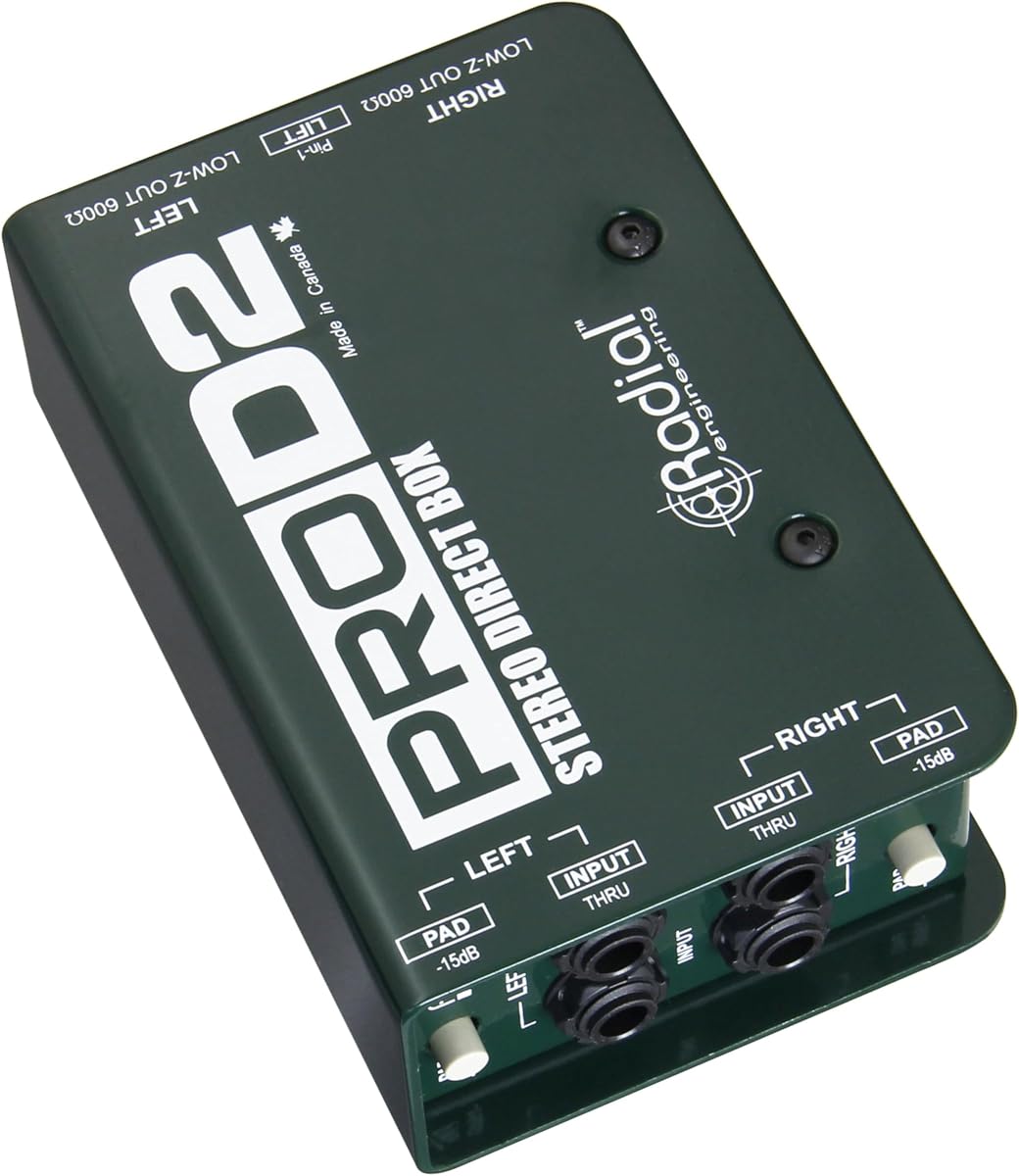
The Radial ProD2 is a passive stereo direct box with an isolation transformer, lift switch, and 15dB pad. Its supplied rating of 4.8 reflects a well-regarded feature set, and the two-channel format makes it especially attractive for stereo recording with keyboards, synths, or paired instruments.
We may earn a commission when you buy through this link, at no additional cost to you.
The isolation transformer is the centerpiece of the design. It separates the input side from the output side, helping address ground loops and unwanted hum. The lift switch provides additional control over that relationship, while the 15dB pad gives engineers a way to accommodate hotter instrument or line-level sources.
As a passive unit, the ProD2 does not require batteries or an external power supply. That simplifies mobile operation and reduces the number of failure points on stage. The trade-off is that it does not provide the internal electronics of an active box, and the supplied features do not include a phase-invert or low-pass control.
The ProD2 is the premium choice in this roundup for users who need a passive stereo recording path with practical noise-control and attenuation options. It is particularly suitable for keyboardists, electronic performers, and engineers tracking two separate sources through one compact unit.
Two channels make it possible to preserve the left and right relationship of a keyboard or synthesizer. This is a meaningful advantage over buying two separate mono direct boxes.
Transformer isolation and the lift switch address ground-related interference, while the 15dB pad provides room for stronger outputs. Together, these controls support more deliberate recording setups.
We may earn a commission when you buy through this link, at no additional cost to you.
The Whirlwind IMP 2 is a one-channel passive instrument direct box with a supplied rating of 4.8. It converts line- or instrument-level unbalanced signals into low-impedance, microphone-level balanced signals, making it a straightforward choice for recording individual instruments.
We may earn a commission when you buy through this link, at no additional cost to you.
The TRHL transformer is riveted to the chassis rather than glued. That construction detail suggests attention to mechanical durability, useful for a product likely to move between a studio, rehearsal space, and stage. The transformer also provides a passive, dependable conversion method without batteries or power adapters.
The main trade-off is simplicity. The supplied information does not identify an input pad, phase reversal, low-pass filter, or manual ground lift. Users who need those controls may prefer another model, but recordings that simply require a clean mono instrument capture may not need them.
The IMP 2 is well suited to guitarists, bassists, and engineers who want a compact transformer box with a strong customer rating. It is especially attractive for straightforward overdubs where a balanced recording output is the central requirement.
Riveting the transformer to the chassis reduces reliance on adhesive for a critical internal component. That mechanical approach is well suited to mobile use and long-term stage deployment.
The passive transformer handles the conversion to a low-impedance balanced signal. The result is a familiar workflow for interfaces, consoles, and preamps with conventional XLR inputs.
We may earn a commission when you buy through this link, at no additional cost to you.
The PYLE-PRO PDC22 is a passive dual-channel direct box with a supplied customer rating of 4.4. It offers quarter-inch inputs, transformer-based conversion, balanced XLR outputs, and input attenuation, making it a functional two-channel option for recording instruments or stereo sources.
We may earn a commission when you buy through this link, at no additional cost to you.
The all-steel chassis is a notable feature for a unit intended for rehearsal rooms, stages, or mobile production. Dual-channel operation removes the need to carry two mono boxes when tracking a stereo keyboard or a pair of sources. The transformer-based design also provides isolation and hum-elimination potential.
The lower supplied rating compared with the other entries suggests that some buyers may have found aspects of the product less satisfactory, although the available information does not explain their complaints. The feature description also repeats itself and lists a detachable AC power cord even though the product is described as passive, so buyers should verify the physical contents and operating details on the current listing.
Despite those uncertainties, the PDC22 can be a practical choice for users who need a durable, passive two-channel box with attenuation. Confirm the connector layout, included accessories, and exact channel behavior before finalizing a purchase.
Stereo and dual-source recording can be handled with one enclosure. This can simplify cable management and reduce the amount of equipment carried to a session.
The steel enclosure is appropriate for repeated transport and stage work. It gives the box a more substantial feel than lightweight plastic alternatives.
We may earn a commission when you buy through this link, at no additional cost to you.
The Bolanle J22 is an active stereo direct box with a supplied rating of 4.6. Its two unbalanced quarter-inch TRS inputs feed dual balanced XLR outputs, and it supports 48V phantom power, a 9V battery, or 5V USB power for unusually flexible deployment.
We may earn a commission when you buy through this link, at no additional cost to you.
The three power choices solve a common live and mobile problem. Phantom power is available from many mixers and interfaces, USB power can come from a power bank, and battery operation supports setups without conventional power infrastructure. Because it is active, the J22 needs one of these sources, but it does not require a dedicated power supply unit.
The ground-lift switch is designed to break ground loops, while the 180-degree polarity reversal control provides another way to address phase problems. These features are useful in complex signal chains. One caveat is that the batteries are not included, so users intending to rely on the 9V option must supply their own.
The J22 is a strong match for keyboardists, synthesizer players, and engineers who need two channels and portable power choices. It works especially well for rehearsals, small stages, and mobile sessions where access to phantom power or USB may be inconsistent.
Phantom, battery, and USB power give the J22 more deployment options than a conventional active box. A user can select the most convenient source for a rehearsal room, stage, or field session.
Separate left and right paths preserve the programmed image of a keyboard or stereo synth. Dual XLR outputs also make the box convenient to feed directly into a console or interface.
We may earn a commission when you buy through this link, at no additional cost to you.
The Radial Engineering ProDI Bundle combines a passive instrument direct box with a Pig Hog microphone cable and Liquid Audio polishing cloth. It carries a perfect supplied rating of 5.0, and the package is unusually complete for a mono direct box intended for recording and performance.
We may earn a commission when you buy through this link, at no additional cost to you.
Its custom-wound transformer has a high 140kΩ input impedance and is designed to handle extreme signal levels without distortion across the frequency range. Transformer-isolated output helps remove ground-loop noise, while the plug-and-play approach reduces setup complexity. The included microphone cable means a user can connect the box to a common recorder or mixer without first sourcing a separate cable.
The bundle is still a single-channel solution, so it will not independently preserve a stereo keyboard signal. The polishing cloth is a small but useful extra for maintaining the equipment. Users who need advanced switching, dual-channel routing, or a built-in headphone monitor will need a more specialized box.
This is the most complete package for a musician who records one source at a time. The combination of a high-impedance transformer, isolation, a strong customer rating, and a usable cable makes it an easy recommendation for a first serious direct box or a dependable overdub tool.
The stated 140kΩ input impedance is designed to accommodate demanding source levels while preserving frequency detail. It is a notable strength for passive instrument capture.
The included microphone cable removes a common initial obstacle for new users. A recording interface or mixer can often be connected immediately after plugging in the instrument.
We may earn a commission when you buy through this link, at no additional cost to you.
The PRORECK DC21 is a passive mono direct box with a supplied customer rating of 5.0. It combines a 50kΩ input impedance, transformer conversion, input attenuation, a ground-lift switch, balanced XLR output, and a Thru output, giving it a useful set of functions for both recording and performance.
We may earn a commission when you buy through this link, at no additional cost to you.
The balanced XLR output is the primary path into a recording console, mixer, or interface. The Thru jack allows the unbalanced source signal to continue toward an amplifier or other device, making it possible to monitor the instrument while capturing the isolated signal. That flexibility is valuable for guitarists and bassists working in rehearsal or live-tracking environments.
The transformer is described as physically isolating input and output signals to reduce hum and buzz from ground loops. The ground-lift switch provides an additional means of troubleshooting interference. As with other mono boxes, however, users must use a second unit for independent stereo tracking, and the supplied feature list does not mention phase inversion or filtering.
The DC21 is a highly practical budget choice for guitar, bass, keyboard, effects, and submix recording. Its combination of a thru output, balanced recording output, attenuation, and ground-lift control is especially useful for musicians who move between rehearsal and recording setups.
The Thru output lets the original unbalanced signal reach an amplifier while the balanced XLR path feeds a recorder. That arrangement supports performance and capture without splitting the signal incorrectly.
The ground lift and input attenuator address two common stage and studio issues. They help manage ground-related hum and unusually strong source levels.
We may earn a commission when you buy through this link, at no additional cost to you.
The Radial USB-Pro is a two-channel active instrument direct box with a supplied rating of 4.6. Unlike a conventional passive box, it includes stereo USB laptop recording, 24-bit/96kHz converters, balanced low-impedance outputs, switchable isolation, and a built-in headphone amplifier.
We may earn a commission when you buy through this link, at no additional cost to you.
The integrated USB path is especially useful for musicians who want to record directly into a computer. At the same resolution, the two-channel design can capture stereo instruments or a pair of mono sources, and the balanced outputs allow conventional recording destinations to be used as well.
The built-in headphone amplifier simplifies direct monitoring, while switchable isolation offers control over ground-related behavior. Unlike a passive transformer-only unit, the USB-Pro contains active electronics, so it requires an appropriate power source. It also performs more signal processing than a simple box, which may make it less attractive when a minimal passive path is preferred.
The USB-Pro is ideal for home-studio musicians who want a direct instrument-to-computer workflow without relying on a separate interface. It is also useful for live stereo capture and mobile production where USB connectivity, balanced backup outputs, and headphone monitoring are valuable.
Built-in 24-bit/96kHz conversion removes the need for a dedicated interface in many simple recording workflows. The stereo USB connection is convenient for laptops and compact production setups.
A built-in headphone amplifier supports direct monitoring, while balanced low-impedance outputs provide a conventional recording path. Switchable isolation adds another layer of signal management.
We may earn a commission when you buy through this link, at no additional cost to you.
The ART DualZDirect is a fully passive, dual-channel direct box with a supplied rating of 4.6. It converts 50kΩ inputs to 600Ω balanced outputs and provides switchable attenuation, a low-pass filter, phase inversion, and ground lift without requiring a battery.
We may earn a commission when you buy through this link, at no additional cost to you.
Its controls make it unusually versatile for a passive box. The 0, -20, and -40dB attenuation options accommodate a broad range of source strengths. The selectable low-pass filter can remove unwanted high-frequency content, phase inversion can help resolve compatibility issues, and the ground lift fully isolates inputs from the chassis and outputs.
The trade-off is that these controls are switches rather than continuously adjustable processors. Users still need to know when a filter or attenuation setting is appropriate. It also lacks active USB conversion, so the box depends on a traditional mixer, console, or interface for recording.
The DualZDirect is a strong choice for engineers who want two passive channels and detailed switching options. It works particularly well for guitar and bass recording, stereo instrument capture, and situations involving persistent hum, phase concerns, or widely varying source levels.
Three attenuation positions let users accommodate both ordinary instrument outputs and stronger line-level sources. The range provides useful flexibility without requiring active gain control.
The fully passive transformer design, ground lift, low-pass filter, and phase reversal cover several common recording concerns. These controls make the box practical for troubleshooting rather than merely converting connectors.
We may earn a commission when you buy through this link, at no additional cost to you.
The most useful direct box depends on your sources, recording destination, signal level, and tolerance for additional controls. These factors help separate a simple passive converter from a more flexible recording tool.
A passive direct box transforms the signal with a transformer and needs no external power. This makes passive models simple, dependable, and well suited to stage boxes, rehearsals, and mobile sessions. An active direct box includes electronics that may provide gain, extended headroom, or digital connectivity. Active designs can be excellent for studio and computer recording, but they require a suitable power source and may be less convenient where only a minimal signal path is desired.
A mono box handles one source at a time, which is enough for most guitar and bass overdubs. Stereo recording requires two paths, either from a dedicated dual-channel box or from two separate mono units. Look for separate left and right outputs if preserving the image of a keyboard, stereo synthesizer, effects processor, or paired instrument matters. Dual-channel boxes also reduce cable clutter and make level-matching more convenient.
The transformer is the core of most passive direct boxes. A high input impedance can help accommodate strong source levels while maintaining a balanced output, and transformer isolation can reduce ground-loop noise. Specifications such as 50kΩ or 140kΩ describe how the input is designed to interact with the source. Compare these figures with your instrument output and the preamp or interface input you plan to use.
Most recording setups require a balanced XLR output, although some direct boxes also offer USB or quarter-inch outputs. Check the input on your audio interface, console, or preamp before buying. A box with both a Thru output and an XLR output can send the original signal to an amplifier while feeding a recorder. Dual-output models may be especially useful when comparing a processed source with a clean capture.
Active basses, hot pedals, stereo outboard processors, and amplified instruments can produce levels that need management before reaching a preamp. A selectable pad, attenuator, or 15dB setting gives engineers a way to reduce the signal and preserve headroom. Without attenuation, the user may need to rely on lower input sensitivity, which can reduce the available signal-to-noise ratio.
Ground loops frequently appear as buzz, hum, or other low-frequency interference. Transformer isolation provides inherent separation between the source and output sides, while a ground-lift switch can offer additional control. A passive box with both features is useful in studios where instruments, amplifiers, computers, and power systems share a grounded building. A ground lift should be used thoughtfully because it changes the electrical relationship between connected equipment.
Phase inversion and polarity reversal can address compatibility problems between microphones, preamps, and other sources. A switchable low-pass filter can help narrow the recorded bandwidth of an instrument, although it changes tone rather than repairing a wiring problem. These controls are most useful for experienced engineers who understand when and why they should be engaged. A simpler passive box may be preferable when a transparent, direct path is the priority.
A recording direct box may live permanently in a studio, but it can also travel to rehearsals, stages, and remote sessions. Metal enclosures and transformer mounting methods can improve durability, while compact dimensions simplify cable management. Active models add power-management considerations, including phantom power, batteries, or USB power. Evaluate the entire system rather than focusing only on the box, since a sturdy enclosure is less useful if its required accessories are difficult to organize.
Begin by identifying the source output and the recording destination input. Connect the instrument or line-level device to the direct box with the appropriate quarter-inch or TRS cable, then run the box's balanced output to the input on the audio interface, console, or preamp. For passive models, no power connection is required. For active models, apply phantom power, USB power, or the specified battery only after confirming the destination can provide it safely.
Set the recording input to a conservative level, play the loudest expected passage, and watch for clipping. If the source is unusually hot, engage the direct box's pad or attenuator. To troubleshoot hum, try the ground-lift switch while listening carefully for changes in noise or signal integrity. Use the phase-invert or polarity-reversal control only when a phase relationship needs correction, and engage the low-pass filter only when a deliberate bandwidth change is appropriate.
For stereo tracking, confirm that the left source reaches the left output and the right source reaches the right output. Keep cables supported and avoid placing power adapters beside sensitive audio paths when practical. Before storing the unit, unplug all connections, remove any batteries used for active operation, and inspect connectors for debris. Store it in a dry environment, clean the enclosure with a soft cloth, and periodically check the transformer, switches, and sockets for looseness or damage.
Often, yes. An electric guitar output is unbalanced, while many recording inputs are designed for balanced microphone-level signals. A direct box converts and isolates that source for a cleaner connection. Some audio interfaces include instrument inputs that already perform a similar function, so check the interface before buying a separate box. A direct box remains useful when more routing flexibility, isolation, or a specific transformer path is needed.
A passive direct box uses a transformer to perform conversion and does not require external power. An active direct box contains additional electronics and needs a power source such as phantom power, USB, or batteries. Active models may offer features such as gain control, higher headroom, or direct USB recording, while passive models are valued for simplicity and a minimal signal path. The best choice depends on the destination and required features.
Yes, provided it has two channels and separate balanced outputs. A mono direct box can capture only one side at a time unless the interface handles stereo summing. A dual-channel model preserves the keyboard's left-right image and makes level matching easier. When stereo accuracy matters, confirm that both input and output channels are discrete rather than a duplicated mono signal.
Hum is frequently caused by a ground loop formed between connected equipment. Start by checking every cable and connection, then try the direct box's ground-lift switch if one is available. Transformer isolation in the box may already help. Also test with other power cables or outlets, because lighting, power stages, computers, and amplifiers can all contribute to electrical noise. Persistent problems may indicate a wiring fault rather than a limitation of the direct box.
An attenuator is useful when the source level is high enough to overload the recording preamp. Active basses, hot effects units, and certain stereo processors can produce strong outputs. A pad gives the input more headroom and can preserve signal-to-noise ratio. If your interface has plenty of gain and a suitable input trim, it may handle the level without a separate pad, but adding one can provide more predictable results.
A USB direct box is convenient when the goal is direct computer recording with minimal equipment. It can reduce the number of connections between the instrument, interface, and computer. However, the quality of the built-in converter and monitoring workflow should be considered alongside the rest of the studio signal chain. For maximum routing flexibility, a conventional direct box feeding a high-quality interface is often easier to integrate with preamps, plugins, and monitors.
Passive models can be excellent for live recording because they require no power and often provide transformer isolation with very few controls. They are easy to deploy and difficult to disable accidentally during a performance. Active boxes can still be preferable when the recording setup needs stereo USB capture, electronic gain control, or other powered functions. Reliability should be judged around the source, destination, and venue rather than by the passive-versus-active label alone.
A low-pass filter reduces high-frequency content passing through the recording path. It can help isolate a source or create a deliberately darker tone, depending on the application. It is not a general-purpose repair for harsh recordings, and using it changes the character of the captured signal. Switchable filtering is most useful when an engineer understands the desired bandwidth and has a way to compare the filtered and unfiltered results.
The Radial Engineering ProDI Bundle stands out for its high-impedance custom transformer, isolation, included cable, and perfect supplied rating. The PRORECK DC21 is an attractive budget choice with a balanced recording output, Thru connection, attenuation, and ground lift, while the Radial ProD2 offers the most refined passive stereo option in this group.
Prioritize the features your actual session requires rather than assuming the largest or most control-rich box is always best. A single-source musician may need only a dependable passive mono converter, while a keyboardist may prioritize stereo paths and a recording engineer may want attenuation, phase reversal, or filtering. Confirm connectors, channel behavior, power requirements, and included accessories before purchasing.
Finally, check the current listing and price at the time of purchase. Product configurations and availability can change, and a recording setup is only as useful as its compatibility with the instruments and equipment already in the room. Choose the simplest direct box that cleanly handles the source, destination, and practical control requirements.