
Lowrance Active Imaging 3-In-1
4.6Editor score
CHIRP and imaging combined
FishReveal target identification
Multiple display platforms supported
Our Down and Side Imaging Transducer guide compares ten leading options for coverage, compatibility, detail, installation, and overall value for anglers.
A down and side imaging transducer gives anglers a clearer view of submerged structure by combining detailed scans beneath the boat with wide views to either side. The right model depends heavily on fish finder compatibility, supported frequencies, mounting method, and the type of terrain you regularly fish.
We compared ten transducers and one complete fish finder bundle using their published specifications, including imaging modes, frequency support, coverage, sensor features, cable length, connector requirements, and compatible Humminbird, Lowrance, and Simrad units. The list includes premium imaging packages, focused down imaging options, and transom-mounted alternatives.
Each pick below highlights the strongest feature for different needs and also identifies important limitations. Ratings reflect the supplied customer feedback rather than personal testing. Product availability, compatibility details, and prices can change, so verify the current listing and your fish finder requirements before purchasing.
4.6Editor score

5.0Editor score

4.6Editor score
The table below compares all ten options by imaging capability, supported frequencies, installation style, and major platform compatibility. It makes the differences between full side-and-down imaging systems, single-purpose down imaging transducers, and complete display bundles easier to see.


The Humminbird XM 14 HW CMSI T combines MEGA Side Imaging+, MEGA Down Imaging, and Dual Spectrum 2D CHIRP in one compact transom-mounted unit. It holds a 5.0 customer rating in the supplied data, and its standout appeal is the combination of 455 kHz and 1.1 MHz frequencies with broad scanning capability.
We may earn a commission when you buy through this link, at no additional cost to you.
This transducer is built for anglers who want more than a basic down view. Its side imaging can scan up to 400 feet to the left and right, while the down imaging is also listed at up to 400 feet. The 1.1 MHz frequency adds fine-detail potential, and the CHIRP modes offer selectable ranges for different search situations.
The trade-off is platform dependence. Compatibility is limited to specified XPLORE, APEX, and SOLIX G3 models, so a fish finder from another brand—or even an incompatible unit within those families—will not work. The 20-foot cable and screw-on connector also require adequate transom space and cable routing, although the package includes a durable mounting design.
This is the strongest all-around pick in the guide for a compatible modern Humminbird setup. Choose it when broad side coverage, deep down imaging, high-frequency detail, and conventional CHIRP sonar all matter. Confirm your exact model number before ordering rather than relying on a broad family name.
Using both 455 kHz and MEGA 1.1 MHz frequencies, the XM 14 HW CMSI T can provide sharper structural detail than a conventional imaging setup. It is particularly useful when separating fish from closely spaced cover or inspecting steep drop-offs.
Combining Side Imaging+, Down Imaging, and Dual Spectrum 2D CHIRP reduces the need for multiple transducers. The CHIRP full, narrow, and wide ranges also let anglers balance coverage against target separation.
We may earn a commission when you buy through this link, at no additional cost to you.
The Lowrance Active Imaging 3-In-1 combines CHIRP, SideScan, and DownScan with FishReveal in a single transducer. Its 4.6 rating reflects a well-regarded feature set, while its support for Lowrance HDS LIVE, Elite FS, and Simrad NSS evo3s and GO displays makes it appealing to anglers who may not use only one brand.
We may earn a commission when you buy through this link, at no additional cost to you.
The major benefit is the ability to interpret structure and cover without treating every bright return as a fish. FishReveal Smart Target view combines CHIRP and DownScan information, helping separate fish from rock piles, standing timber, weed beds, ditches, and drop-offs. Medium and High CHIRP operate at 83/200 kHz, while imaging uses 455/800 kHz.
The main complication is the connector and display ecosystem. Although the unit supports several premium display families, the correct cable and configuration must match the electronics. It is also more specialized than a basic down imaging transducer, so buyers who only need a narrow under-boat view may not use all three modes.
This is the best premium choice for a compatible Lowrance or Simrad system, especially when FishReveal and detailed structure interpretation are priorities. It is less attractive for an unsupported display, so review the manual and connector requirements before making a final decision.
FishReveal is the defining feature of this package because it presents CHIRP and DownScan information in a way designed to distinguish targets from nearby cover. That can make narrow channels, weed edges, and timber more useful to interpret.
Support for current Lowrance displays and selected Simrad systems gives the transducer broader appeal than a single-brand installation. Compatibility still depends on the exact unit, software, and connector, so the model list is essential.
We may earn a commission when you buy through this link, at no additional cost to you.
The Humminbird XM 14 20 MSI T delivers MEGA Side Imaging, MEGA Down Imaging, and DualBeam PLUS sonar through one transom-mounted transducer. It carries a 4.3 customer rating and offers a more balanced feature set than a down-only unit while remaining focused on Humminbird platforms.
We may earn a commission when you buy through this link, at no additional cost to you.
Its side returns extend 125 feet on each side of the boat, which provides a broad search area for weed edges, rock ledges, drop-offs, and submerged timber. DualBeam PLUS adds conventional 2D sonar coverage, while the built-in temperature sensor supplies water temperature without requiring a separate sensor.
Compatibility is broad but not complete. The unit works with XPLORE, APEX, SOLIX, and ONIX models that support side imaging, although ONIX SI owners are limited to 455/800 kHz for side and down imaging. The supplied 20-foot cable simplifies many transom installations, but connector layout and cable routing still need checking.
This model is a good middle ground for a compatible Humminbird angler who wants side and down views plus traditional sonar. It is particularly sensible for anglers moving between a modern MEGA display and older supported units, provided they accept the frequency limitation on ONIX SI models.
The 125-foot reach to each side makes the transducer useful for scanning large structural areas without changing direction constantly. It is well suited to finding the outer edges of weed beds, channels, and steep banks.
The integrated temperature sensor and DualBeam PLUS mode make this more versatile than a basic imaging-only design. Anglers can track conditions while using conventional sonar to inspect targets and nearby terrain.
We may earn a commission when you buy through this link, at no additional cost to you.
The Humminbird XNT 9 SI 180 T is a transom-mount side and down imaging transducer aimed especially at owners of established Humminbird systems. Its 4.6 rating and unusually broad compatibility list make it a practical option when an angler wants imaging capability without replacing an entire display.
We may earn a commission when you buy through this link, at no additional cost to you.
The supported list covers HELIX 5 SI GPS, multiple HELIX 7 and HELIX 9 models, 899CI HD SI, 798ci variants, 698ci HD SI, 598ci HD SI, and 398C SI. Performance is tied to the maximum capability of each display, so a newer model does not necessarily unlock MEGA features with an older transducer.
Its main limitation is generational. The listing does not advertise the same 1.1 MHz imaging or broad 400-foot coverage associated with newer compact models. It is most valuable when compatibility with an older supported fish finder is the deciding requirement.
Choose the XNT 9 SI 180 T if you own one of the listed legacy systems and want to add both side and down imaging. Verify the display model carefully, and do not expect the newest transducer technologies simply because the transducer itself supports multiple imaging modes.
Because it supports numerous older Humminbird units, this transducer can extend the useful life of a compatible display. That makes it attractive for anglers who need imaging on a trusted, previously installed system.
The product information notes that operation is limited to the maximum capability of each compatible unit. Display resolution, processing features, and supported frequency bands remain important even when the physical connector fits.
We may earn a commission when you buy through this link, at no additional cost to you.
The Humminbird HELIX 7 G4 bundle combines a GPS fish finder with its transducer, making it different from every other product in this guide. It is not simply an add-on component: buyers receive the HELIX 7 G4 unit with MEGA Side and Down Imaging, navigation functions, and a complete charting package.
We may earn a commission when you buy through this link, at no additional cost to you.
The specified coverage extends 125 feet to either side and 125 feet directly beneath the boat. Dual Spectrum CHIRP provides Wide and Narrow modes, while the display includes a Humminbird basemap, AutoChart Live, and eight hours of built-in recording time. Premium mapping cards and services are also supported.
The obvious trade-off is flexibility. Someone who already owns a compatible HELIX 7 display may prefer a dedicated transducer, while a new angler may find the integrated package more convenient. Software, menu operation, and mapping options add value, but they do not make the bundle the right choice for every installation.
This is the best choice for someone starting a new Humminbird system rather than replacing one component. It provides the display, transducer, navigation, mapping, and side-and-down imaging in one coordinated package. Existing owners should compare the bundled model and its extras against a standalone transducer first.
Scanning 125 feet to each side and 125 feet beneath the boat gives the bundle a balanced search area. That combination is useful for locating fish-holding contours and understanding how structures extend across a channel or shoreline.
AutoChart Live can build depth contours, bottom hardness, and vegetation maps as the boat travels. The eight hours of recording time and support for additional mapping options add utility beyond the sonar hardware.
We may earn a commission when you buy through this link, at no additional cost to you.
The Humminbird XNT 9 HW SI T is designed for HELIX 7 CHIRP SI GPS G4 models, with CHIRP Side Imaging, CHIRP Down Imaging, and Dual Spectrum CHIRP 2D sonar. It carries a 4.5 rating and offers a focused way to add all three functions to a supported display.
We may earn a commission when you buy through this link, at no additional cost to you.
Side imaging operates at 455 kHz, while the 2D sonar covers a 150–220 kHz CHIRP range. The 20-foot cable, built-in temperature sensor, and included mounting hardware make it a reasonably complete installation package for a compatible boat.
Compatibility is the central limitation. The listing explicitly says MEGA Side Imaging models are not supported, so owners of newer MEGA-equipped HELIX 7 units should not assume this is a direct replacement for a higher-end transducer. Its value is greatest for a standard CHIRP SI G4 unit.
Pick this transducer when your fish finder is a supported HELIX 7 CHIRP SI GPS G4 and you want side imaging, down imaging, and 2D CHIRP in one unit. It is a focused, practical choice rather than a universal Humminbird upgrade.
Combining side imaging, down imaging, and Dual Spectrum 2D sonar gives the operator several ways to inspect the same area. The side view covers nearby structure, while the down view provides a fish-eye perspective directly beneath the hull.
A built-in temperature sensor, 20-foot cable, and mounting hardware cover the main transom installation needs. Correct alignment remains important because imaging quality depends on a clean, unobstructed sonar view.
We may earn a commission when you buy through this link, at no additional cost to you.
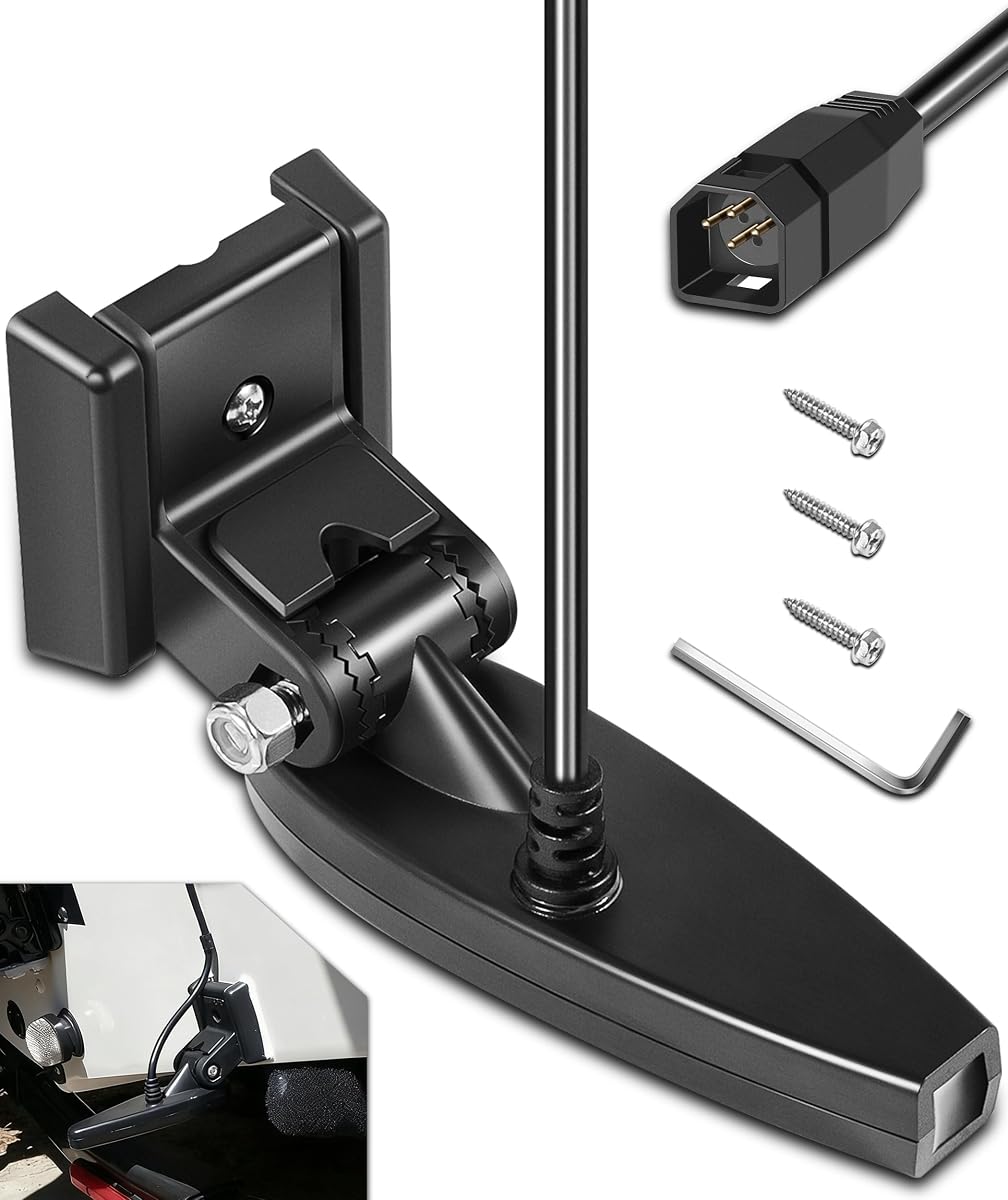
The Lowrance Active Imaging 3-in-1 with a six-foot cable is designed for installations where installation space is limited. It supports CHIRP, SideScan, and DownScan, fits compatible HDS LIVE, HDS Carbon, and Elite Ti2 units, and uses a nine-pin connector.
We may earn a commission when you buy through this link, at no additional cost to you.
The short cable can be especially useful on smaller boats or transoms where excess cable creates clutter or interferes with other equipment. The transducer mounts at the transom and retains the three-mode functionality expected from the Active Imaging family.
The major practical issue is that an adapter cable is required. A six-foot lead also provides less routing flexibility than the 20-foot leads offered by several Humminbird choices, so buyers should map the distance between the display and mounting location before ordering. The listed 4.2 rating is also the lowest among the shortlist.
This is a worthwhile choice for a compatible Lowrance boat with a tight installation area. If ample cable routing space exists, compare a longer alternative. If the installation requires a long run or a connector that is not natively supported, a model with fewer adapter requirements may be simpler.
A six-foot cable reduces excess cable around a transom, which can improve tidiness and simplify routing. The shorter lead is most useful on small craft or in installations with the display positioned close to the stern.
CHIRP, SideScan, and DownScan provide a versatile sonar package. The nine-pin connector and required adapter must be accounted for before installation because the transducer will not connect to every display without that additional cable.
We may earn a commission when you buy through this link, at no additional cost to you.
The product titled Lowrance Bracket/Fitting kit is presented as an Active Imaging 2-in-1 solution with SideScan and DownScan at 455/800 kHz. Its 4.1 rating and product description make it a potential fit for compatible Lowrance and Simrad displays, although the unusual listing title calls for careful verification.
We may earn a commission when you buy through this link, at no additional cost to you.
The imaging specification is focused rather than expansive. It supports side and down views designed to reveal structural features such as rock piles, standing timber, weed beds, ditches, and drop-offs. This gives an angler two complementary perspectives without including a conventional CHIRP mode in the stated feature set.
Compatibility includes Lowrance HDS LIVE, Elite Ti, and Simrad NSS evo3 and GO displays. Because the title does not clearly identify the exact transducer model, buyers should check the connector, physical mounting arrangement, and complete package contents. The limited 2-in-1 feature set may be adequate, but it is not as versatile as the three-in-one model.
Consider this option only after confirming the exact product identity and compatibility. It may suit a compatible installation that prioritizes side and down imaging without needing CHIRP. Otherwise, the more clearly specified Lowrance 3-in-1 products are safer choices.
SideScan and DownScan work together to show both lateral structure and the area beneath the boat. That pairing remains useful when a full CHIRP and imaging package is unnecessary.
The product title and described function do not align as cleanly as they do for the other options. Confirm the model number, connector, mounting hardware, and display compatibility before making a purchase decision.
We may earn a commission when you buy through this link, at no additional cost to you.
The Bonbo 710226-1 XNT 9 DI T is a down imaging and DualBeam PLUS transducer for a broad range of Humminbird displays. It has a 4.5 rating, a 20-foot cable, and an impact-release mounting bracket, making it an interesting lower-cost option for compatible systems.
We may earn a commission when you buy through this link, at no additional cost to you.
Down imaging uses 455/800 kHz frequencies with 75-degree and 45-degree beam angles for detail, while 200/455 kHz frequencies are paired with 25-degree and 16-degree beams for wider conventional coverage. The listed compatibility includes HELIX DI models ranging from HELIX 5 through HELIX 12, PiranhaMAX Down Imaging models, and selected legacy units.
This product does not provide the side imaging offered by the top picks, so it should not be chosen for a side-and-down search. The listing also includes broad performance and compatibility claims that are best confirmed against the display manual and the official Humminbird transducer documentation. Proper submersion during operation is critical because air pinging can damage the unit.
For a compatible Humminbird user focused on down imaging, DualBeam PLUS, a long cable, and an included bracket, this is a capable budget-oriented option. Buyers seeking side scans should move up to a dedicated side imaging model.
The combination of wider conventional beams and narrower down-imaging beams supports both broad terrain coverage and detailed under-boat inspection. That makes it a flexible sonar package despite lacking Side Imaging.
The included impact-release bracket and 20-foot cable support a practical transom setup. The transducer must remain fully submerged while operating because sonar signals cannot travel through air.
We may earn a commission when you buy through this link, at no additional cost to you.
The Humminbird XNT 9 DI T is a straightforward down imaging and DualBeam PLUS transducer with a 4.6 rating. It suits anglers who want a clear under-boat view and traditional sonar from a Humminbird-compatible display but do not need side scanning.
We may earn a commission when you buy through this link, at no additional cost to you.
Down Imaging operates at 455/800 kHz, providing a fish-eye view of structure and fish below the boat. DualBeam PLUS combines two sonar beams for detail and broader coverage, while the built-in temperature sensor and 20-foot cable make the package installation-ready for many transoms.
The crucial limitation is that this model does not provide Side Imaging. It works with select HELIX Down Imaging units, PiranhaMAX Down Imaging models, and legacy systems such as the 788ci HD DI Combo, 597ci HD DI Combo, 596c HD DI Combo, and 570 DI. It is not an upgrade for a display that specifically requires side imaging.
This is the best budget pick for a compatible fish finder where down imaging is the priority. Its focused feature set, long cable, and temperature sensor offer strong utility without paying for side-imaging hardware. Confirm the exact display model before ordering.
The 455/800 kHz down imaging channels create a direct view of fish, cover, and bottom contours beneath the hull. This is useful when narrow channels, steep drop-offs, or submerged structure deserve close inspection.
DualBeam PLUS adds conventional coverage alongside the down view, and the temperature sensor supplies another useful data point. The 20-foot lead provides good routing flexibility for a transom-mounted installation.
We may earn a commission when you buy through this link, at no additional cost to you.
Choosing a transducer is less about finding one universal winner and more about matching imaging capabilities to your fish finder, boat, and fishing conditions. The following factors cover the details that most strongly affect installation, image quality, and long-term usefulness.
Begin with the exact model number of your fish finder, not merely the brand or product family. A physical connector that looks similar may not carry the same signals, and a display may support only selected frequencies or imaging modes. The products in this guide list compatibility with particular Humminbird, Lowrance, and Simrad families, including exclusions such as MEGA models on the XNT 9 HW SI T and frequency limits for ONIX SI systems.
Side imaging scans to the left and right of the boat, revealing contours, channels, weed edges, drop-offs, and structure that may be difficult to interpret from a narrow down view. Published side coverage varies substantially: the XM 14 HW CMSI T is listed at up to 400 feet, while the XM 14 20 MSI T and HELIX 7 G4 bundle are described at 125 feet to each side. Actual useful range depends on water conditions, installation alignment, display processing, and target contrast.
Down imaging produces a fish-eye perspective directly beneath the boat. Higher frequencies can support finer structural detail, while broader beam angles create a wider under-boat area. The XM 14 HW CMSI T supports 1.1 MHz alongside 455 kHz, and the down-only XNT 9 DI T options use 455/800 kHz with 75-degree and 45-degree imaging beam angles. Look for enough detail to separate fish from cover without sacrificing the coverage area you need.
A capable imaging transducer may also include 2D CHIRP, DualBeam PLUS, or other conventional sonar. These modes are useful for tracking individual targets, understanding bottom composition, and navigating between image sectors. The Humminbird XM 14 HW CMSI T includes adjustable Dual Spectrum 2D CHIRP ranges, while the XM 14 20 MSI T and both XNT 9 DI T options use DualBeam PLUS. Integrated conventional sonar can make one installation more versatile.
Most options here use a transom mount, but cable length and connector requirements can make installation easier or harder. Twenty-foot cables offer flexible routing on larger boats, while the six-foot Lowrance cable suits a compact installation with nearby display positioning. Some Lowrance units require an adapter cable. The Bonbo model includes an impact-release bracket, while other packages include mounting hardware. Measure the intended route and check for interference with the trolling motor, shallow-water bracket, and other cables.
A built-in temperature sensor provides immediate water-temperature information through compatible fish finders. It is especially useful when searching different depths, changing weather, or locating temperature breaks. Many options include one, including the Humminbird XM 14 models, XNT 9 HW SI T, and both XNT 9 DI T products. Sensor usefulness depends on correct mounting and display support, so it should complement rather than outweigh your imaging requirements.
Image clarity matters only if you can distinguish fish from structure. The Lowrance Active Imaging 3-In-1 uses FishReveal Smart Target view to combine CHIRP and DownScan information for easier recognition. Other systems rely on their processing, contrast, and side or down imagery to reveal targets. Consider the display's trackball, color palette, zoom controls, and target-processing features alongside the transducer, because the sonar hardware and display work together as one imaging system.
The Lowrance Active Imaging options support selected Lowrance and Simrad platforms, which can be helpful if you rotate between boat electronics or plan a future platform change. Humminbird choices provide a similar benefit within supported families, but compatibility is often model-specific. A widely compatible unit may have more long-term value if you upgrade displays often. However, no cross-platform guarantee replaces checking the manufacturer documentation for the exact model and connector.
Install the transducer on a clean, level section of the transom according to its bracket instructions, and route the cable away from sharp edges, moving hardware, and the trolling motor. Keep the mounting screw secure but avoid overtightening. The sonar face must remain fully submerged during operation because a signal cannot pass through air, and air pinging can damage the transducer.
Before fishing, enter the compatible mode for your display and begin with a familiar area. Use side imaging to scan the larger surrounding structure, then switch to down imaging for a closer look at cover beneath the boat. Conventional CHIRP or DualBeam views can help track targets and confirm bottom conditions. Adjust brightness, contrast, sensitivity, zoom, and color carefully, as excessive settings can make noise look like structure.
Rinse the transducer with fresh water after use, especially after fishing in salt or brackish water. Inspect the face for debris, damage, and marine growth, and check the bracket and cable for looseness. Before storage, disconnect the cable according to the display instructions rather than pulling it from the socket, and store the unit where it will not be crushed or exposed to prolonged direct sunlight.
Yes, several products in this guide combine Side Imaging, Down Imaging, and conventional sonar in one housing. The Humminbird XM 14 HW CMSI T, XM 14 20 MSI T, and XNT 9 HW SI T support both imaging directions, while the Lowrance Active Imaging 3-In-1 uses SideScan and DownScan alongside CHIRP. Compatibility with your display remains essential.
Side imaging scans horizontally to the left and right, revealing structures such as drop-offs, channels, weed edges, and rock piles. Down imaging looks vertically beneath the boat and provides a fish-eye view of bottom contours, cover, and fish directly below you. Using both together gives a more complete picture of the surrounding water.
Look up the exact fish finder model number and compare it with the transducer's supported unit list, connector, and frequency requirements. Do not rely on the Humminbird name alone because compatibility varies between HELIX, XPLORE, APEX, SOLIX, ONIX, PiranhaMAX, and legacy models. If the manual is unavailable, contact Humminbird or a qualified marine-electronics installer before purchase.
No. A 20-foot cable provides useful routing flexibility but may be excessive on a small boat or a tightly arranged transom. The six-foot Lowrance Active Imaging option is better suited to compact installations, although it may require an adapter and limits the distance between display and transducer. Measure the actual route before choosing.
Only when the display and its supported transducer list explicitly permit that combination. A down-only XNT 9 DI T will not add side imaging to a fish finder that requires a side-capable unit. Conversely, installing a side-and-down transducer on a compatible down-only display may not unlock every advertised feature.
Sonar signals travel through water and cannot pass through air. If the transducer becomes exposed while the unit is pinging, the system may continue transmitting into the air, which can produce incorrect readings and may damage the electronics. Mounting it at a level angle and keeping it submerged protects performance and reliability.
MEGA Imaging can offer greater detail and useful coverage, but it still depends on a compatible display, supported frequencies, water conditions, and installation quality. For an older Humminbird system, a broadly compatible standard side-and-down transducer may deliver more practical value than an advanced unit the display cannot fully support.
Rinse the unit with fresh water after use and periodically inspect the sonar face for dirt, algae, abrasion, or impact damage. Confirm that the mounting bracket is secure and the cable is not pinched. Avoid operating the transducer in air, and disconnect it by the connector rather than tugging on the wire.
The Humminbird XM 14 HW CMSI T is the strongest all-around choice for compatible XPLORE, APEX, and SOLIX G3 systems, combining MEGA Side Imaging+, MEGA Down Imaging, and Dual Spectrum CHIRP. The Lowrance Active Imaging 3-In-1 stands out for cross-brand display support and FishReveal, while the Humminbird XNT 9 DI T is the most focused budget option for compatible down-imaging systems.
Prioritize exact display compatibility before considering resolution, range, or extra modes. Side-and-down systems are more versatile, but a down imaging and DualBeam PLUS transducer can be entirely sufficient when the boat is small, the target water is relatively clear, and the goal is to inspect structure directly below the hull.
Finally, check the current listing, connector, included hardware, and model-specific compatibility before ordering. Product configurations, supported displays, availability, and prices can change, so current details should guide the final purchase decision.