
Uneviesyka Drawing Robot for Kids
4.8Editor score
200 themed drawing cards
Step-by-step voice guidance
Reusable board and art supplies
Explore the best drawing robots for kids, comparing card libraries, AI features, voice guidance, art supplies, ease of use, safety, and learning benefits at
Drawing robots combine guided art, independent play, and early learning in a format that appeals to children who enjoy drawing but need help getting started. A useful model should offer approachable controls, engaging content, safe materials, and enough creative variety to keep regular play sessions interesting rather than repetitive.
We compared all ten products by examining their card libraries, voice and AI capabilities, drawing mechanisms, included markers and boards, recommended ages, setup requirements, safety features, and educational value. The list covers screen-free card-guided robots, touchscreen models, cloud-connected choices, and one product for which no descriptive data was supplied.
Each review explains what stands out, where the compromises may be, and which families are most likely to enjoy the toy. Ratings and product details reflect the supplied listings, while prices and promotions change frequently, so shoppers should confirm the current listing and total package contents before purchasing.
4.8Editor score
4.5Editor score
4.5Editor score
The table below compares the ten listed drawing robots by their core creative system, content library, learning features, and included accessories, making it easier to identify the right style for a child.
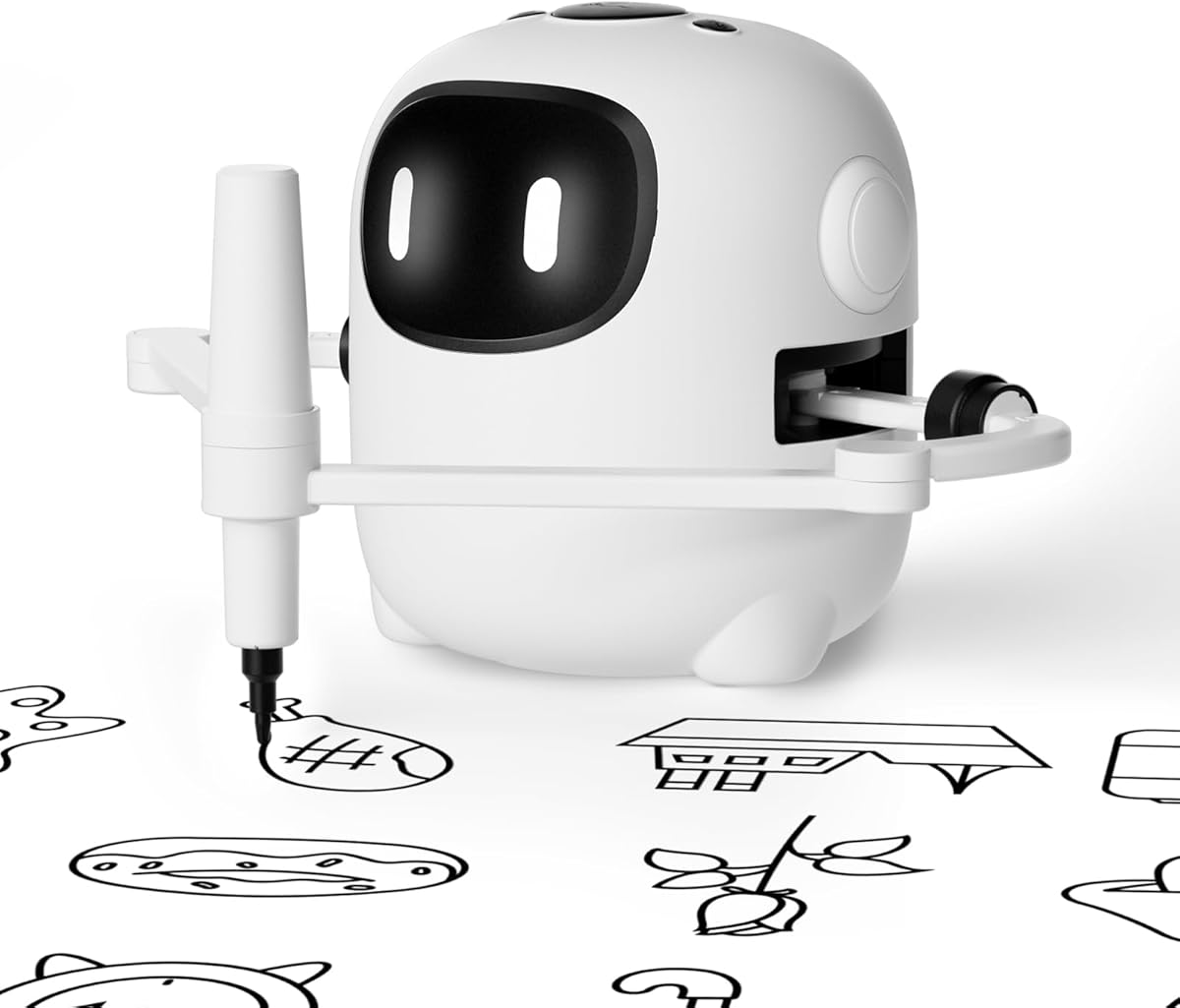


The RIVGOT Drawing Robot for Kids earns a 4.6 rating and offers one of the strongest conventional card-guided experiences in this roundup. It combines 150 drawing cards with voice interaction, built-in music, and a reusable drawing board, giving children a complete art activity rather than a standalone machine. Its stated appeal spans children ages three through eight, making it a flexible choice for preschoolers and early elementary-aged artists.
We may earn a commission when you buy through this link, at no additional cost to you.
The strongest feature is the balance between structured guidance and hands-on creativity. Children can follow the robot through a drawing, then use the 12 colorful markers and five drawing pens to add their own color and details. The supplied themes include animals and everyday objects, and the 150-card count provides enough variety for repeated use. Music adds a playful atmosphere without becoming the central activity.
The package is thoughtfully assembled with one drawing robot, 150 cards, 12 colorful markers, five drawing pens, a reusable board, and a Type-C charging cable. One inconvenience is that the listing specifically notes that a 5V/2A power adapter is required for charging, so households should not assume the included cable comes with a wall plug. This is a practical detail worth checking before the robot is presented to an eager child.
This is a strong all-around choice for families seeking a Montessori-inspired drawing toy that supports fine motor practice, problem-solving, concentration, and independent play. It may be especially useful for a child who can attempt freehand drawing but benefits from a model to follow. Verify the charging requirements, confirm that the desired card themes suit the child's interests, and consider whether a higher-card model would offer greater longevity.
The card-based format gives children enough structure to see how a picture develops without turning art time into a worksheet. Once the robot lays down the guide, the child can add colors, patterns, and original details, creating a balance between imitation and personal expression.
With 150 cards covering animals and familiar objects, the collection offers considerable variety for home, travel, or shared play. The reusable board also reduces the need to begin each session on a fresh sheet, making the toy practical for regular use.
We may earn a commission when you buy through this link, at no additional cost to you.
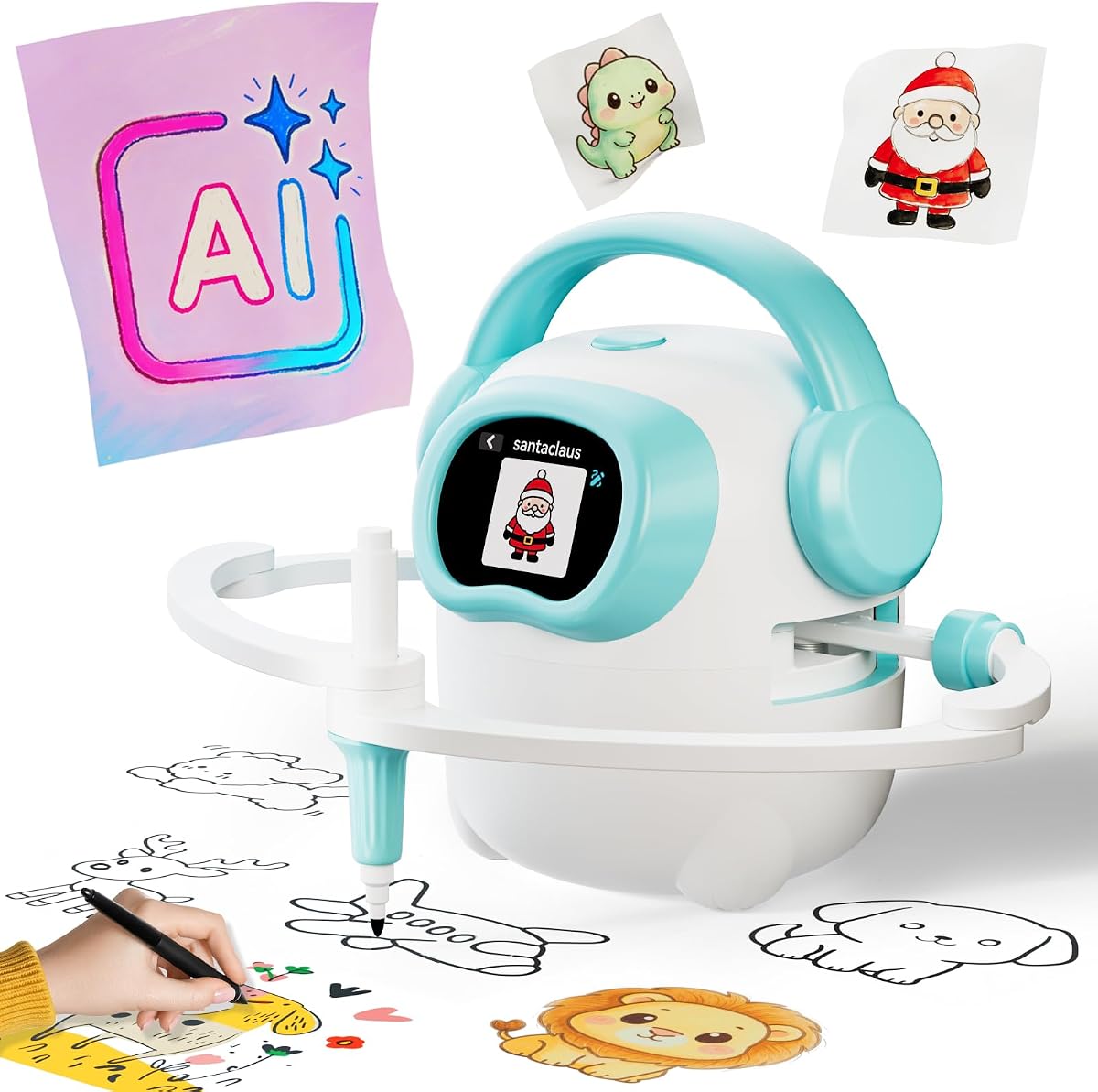
The AI Drawing Robot for Kids is the standout technology pick in this guide, carrying a 4.5 rating while offering a very different approach from card-only competitors. Children can describe a subject by voice, connect to Wi-Fi, and ask the system to generate an image for the robot to draw. The stated library includes more than 10,000 AI-generated images and is regularly updated.
We may earn a commission when you buy through this link, at no additional cost to you.
Its touchscreen adds another layer of choice. Children can tap local images directly, use the cloud-connected library, or make use of the included card functionality. Built-in storage helps keep favorite images accessible, while the voice prompt feature introduces a creative way to practice communication, logical thinking, and describing ideas in age-appropriate terms. Parents can model effective prompts before handing control to a child.
Privacy controls are especially important for a connected children's product. The supplied description says parents can activate Parental Mode to disable network access for offline use or turn off the microphone to avoid recording risks. The set includes the robot, 16 drawing pens, a reusable drawing board, and a Type-C charging cable, providing a solid creative package without requiring additional purchases.
This robot is a compelling choice for families comfortable with connected play and children who may tire of a finite card collection quickly. It is less convenient for families seeking a fully screen-free or offline experience, since the most distinctive AI functions require a connection. Still, the combination of voice ideation, touchscreen selection, parental controls, and a regularly updated library makes it the most creative and future-facing option here.
Instead of selecting only from a fixed deck, children can articulate what they imagine and watch the robot translate that idea into a drawable image. Parent-child prompt sessions can become a useful exercise in descriptive language, iterative thinking, and cooperative creativity.
Parents who prefer limited connectivity can disable network access and turn off the microphone. That flexibility lets the same product move between cloud-powered AI sessions and more conventional local or offline drawing activities.
We may earn a commission when you buy through this link, at no additional cost to you.
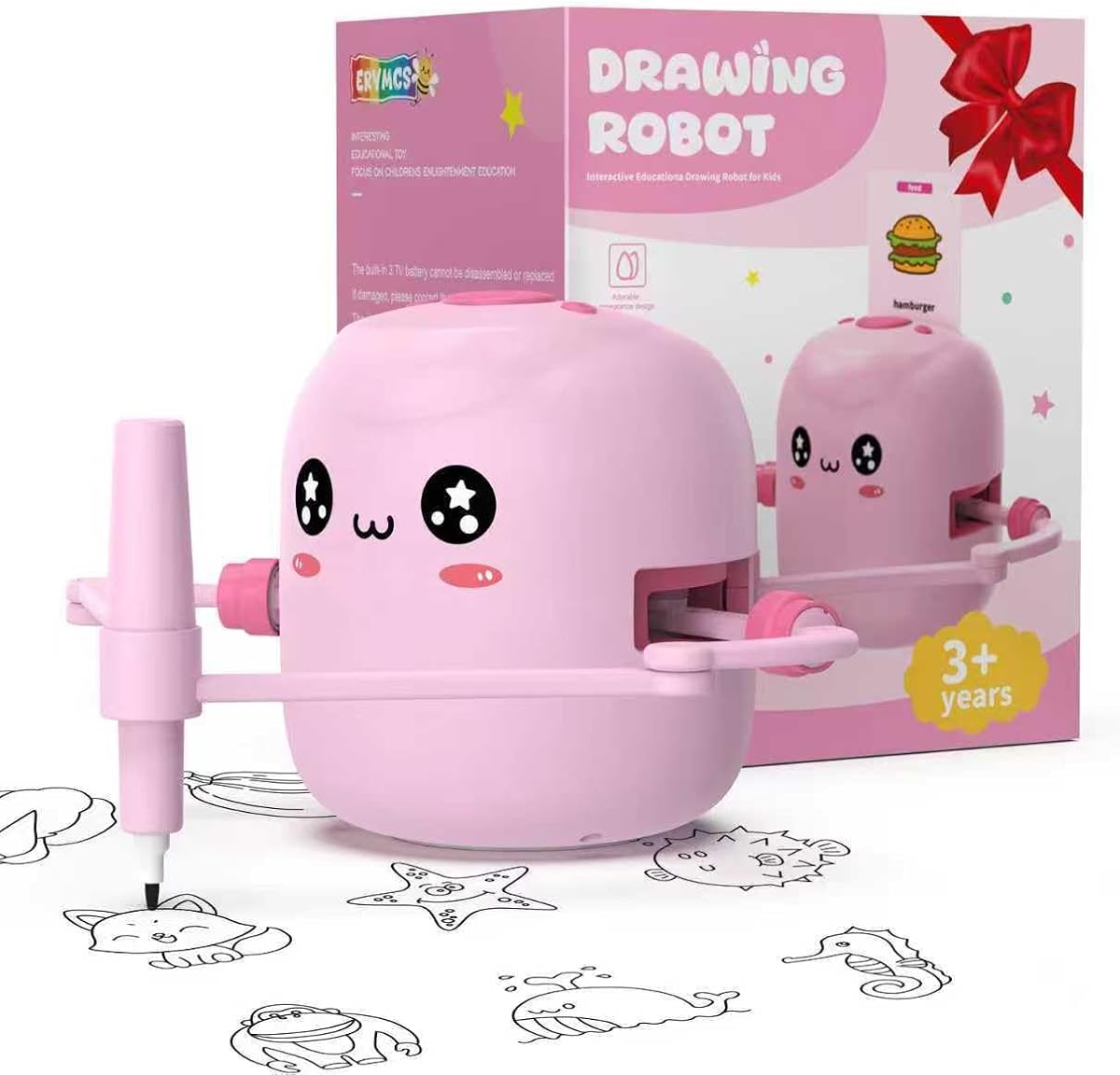
The ERYMCS Drawing Robot has a 4.5 rating and focuses on the qualities that matter most in a straightforward children's drawing toy: simple operation, a generous card collection, minimal setup, and all necessary accessories. The product is described for children aged five through ten, while its broader title positions it as an option for ages four through eight.
We may earn a commission when you buy through this link, at no additional cost to you.
Operation is refreshingly uncomplicated. A child inserts one of the 150 cards and presses the button; no application is required. Card categories include animals, plants, transportation, and food, providing familiar subjects that make it easy for children to recognize what they are about to draw. The robot's interactive function adds entertainment while supporting skills such as hand-eye coordination, color perception, painting, and literacy.
The complete package contains one drawing robot, 150 drawing cards, four drawing pens, 12 color pens, a charging cable, a drawing board, and an instruction manual. That balance is helpful for gift buyers and parent-child activities because the main tools are already included. The stated use of child-safe materials and a rounded, child-oriented appearance also supports its positioning as a preschool and early elementary activity.
The ERYMCS is a good fit for families who want a familiar, app-free robot that works quickly and does not depend on a Wi-Fi account. It lacks the open-ended AI potential of the second-ranked model, but that limitation can also make it more predictable and easier to supervise. For a child who wants guided drawing with simple controls and recognizable themes, it remains a strong and uncomplicated option.
The insert-and-press format removes setup barriers, so children can begin a creative session with little adult assistance. This makes the robot practical for quiet time, playdates, and children who are still learning how to follow a multi-step activity.
Animals, plants, transportation, and food give children recognizable subjects to discuss while they draw. Connecting the image, spoken content, and finished artwork can reinforce vocabulary as well as visual and motor skills.
We may earn a commission when you buy through this link, at no additional cost to you.
The TREEFIA Drawing Robot carries a 4.3 rating and combines guided drawing with a built-in music player. It is designed as a screen-free activity for children who enjoy drawing, coloring, music, and creative play. The title places particular emphasis on ages six through twelve, while the product information also describes suitability for children age three and up.
We may earn a commission when you buy through this link, at no additional cost to you.
The robot includes 100 themed drawing cards and 16 color pens. Subjects span animals, vehicles, plants, and daily objects, which provides enough variety for regular use while keeping the card library easier for a child to understand. Inserting a card starts the activity without a phone, tablet, or complicated setup, making the toy convenient for homes, classrooms, and parent-child play.
Music helps sustain attention and adds rhythm to the drawing process. According to the supplied features, it can support listening, language awareness, and creative expression. The broader educational intent includes hand-eye coordination, color recognition, basic drawing skills, imagination, and independent learning, so it occupies a useful middle ground between entertainment and practical preschool practice.
TREEFIA is a good option when the main goal is uncomplicated, guided drawing with an added music element. Its 100-card collection is smaller than the 150- and 200-card alternatives, and it does not offer AI generation. In exchange, it avoids account setup, network dependence, and more complex interfaces, making it a practical choice for parents who value simplicity and children who respond well to rhythmic, playful activities.
The built-in music gives each drawing session a lively soundtrack and helps maintain focus for children who may lose interest in silent activities. It also adds a language and listening dimension without complicating the core card operation.
A child can move from choosing a card to drawing without an application, account, or device. That low-friction workflow makes the robot especially useful for independent play, classroom demonstrations, and family activity rotations.
We may earn a commission when you buy through this link, at no additional cost to you.
The Kids Drawing Robot with 200 Cards earns a 4.7 rating and stands out for its large content library and especially accessible setup. Children simply choose a card, insert it into the robot's head, press the drawing button, and watch the machine begin. There is no assembly or complicated configuration, which makes independent creative play easier for younger users.
We may earn a commission when you buy through this link, at no additional cost to you.
The 200 cards cover a broad selection of pictures and themes, reducing the chance that a child quickly exhausts the available material. When a card is inserted, the robot reads its word aloud, connecting the image with vocabulary. Cheerful music adds engagement, and the sound can be turned off for quieter homes or focused work. Children can then color the robot's outlines with the included markers and add their own details.
The bundle includes 200 cards, 12 colorful markers, four black drawing pens, a reusable board, and a Type-C charging cable. These components support a complete workflow: select and insert a card, listen, watch the robot draw, then color and personalize the result. The product is listed for children ages three through eight, covering a broad range of preschool and early elementary use.
This model is an attractive choice for a child who loves variety but prefers a clearly guided, finite card system rather than a connected AI toy. It offers a larger library than most competitors and makes the activity easy to begin. The trade-off is that creativity remains tied to existing card images, but the option to add colors and original details helps preserve a strong sense of ownership and personal expression.
A large collection is particularly useful for children who play regularly. The wider range of images supports selection, decision-making, and repeated drawing practice without requiring families to maintain a continually rotating supply of separate activity sheets.
Reading the card word aloud adds a learning element before the robot begins. The ability to turn music off gives caregivers another way to adapt the activity to a quieter environment or a child who prefers to concentrate on the drawing itself.
We may earn a commission when you buy through this link, at no additional cost to you.
This listing is represented by ASIN B0GVS57ZBS, but the supplied data does not include a product title, rating, image, price, or descriptive feature information. As a result, it is impossible to make a reliable assessment of its drawing mechanism, content library, included accessories, recommended age, or educational benefits from the information available.
We may earn a commission when you buy through this link, at no additional cost to you.
Because the product is categorized as a drawing robot, it may offer a card-guided, touchscreen, voice-controlled, or another type of creative experience. However, those are categories of possible features rather than confirmed attributes of this specific listing. Treating any of them as established would go beyond the available product data and could mislead a shopper comparing models.
The most responsible next step is to inspect the linked Amazon product page for the exact model name, displayed rating, package contents, charging requirements, dimensions, age recommendation, and whether an app or network connection is necessary. Buyers should also verify that the listing corresponds to a physical drawing robot and not an accessory, replacement part, or unrelated item.
This entry is included to preserve a complete comparison of all ten supplied products, but it is not recommended as a confident selection without further verification. The other nine listed models have enough descriptive information to compare their features, while this one does not. Anyone considering it should treat the current listing and its customer-facing documentation as the deciding sources.
Check the page title, images, specifications, and included components before adding this option to a shortlist. The ASIN alone is not enough to determine how the product operates or whether it meets a child's age and developmental needs.
Families can use the fully documented options in this guide as a baseline. Compare card count, app requirements, voice functions, art supplies, and battery details against what the product page displays for this ASIN.
We may earn a commission when you buy through this link, at no additional cost to you.
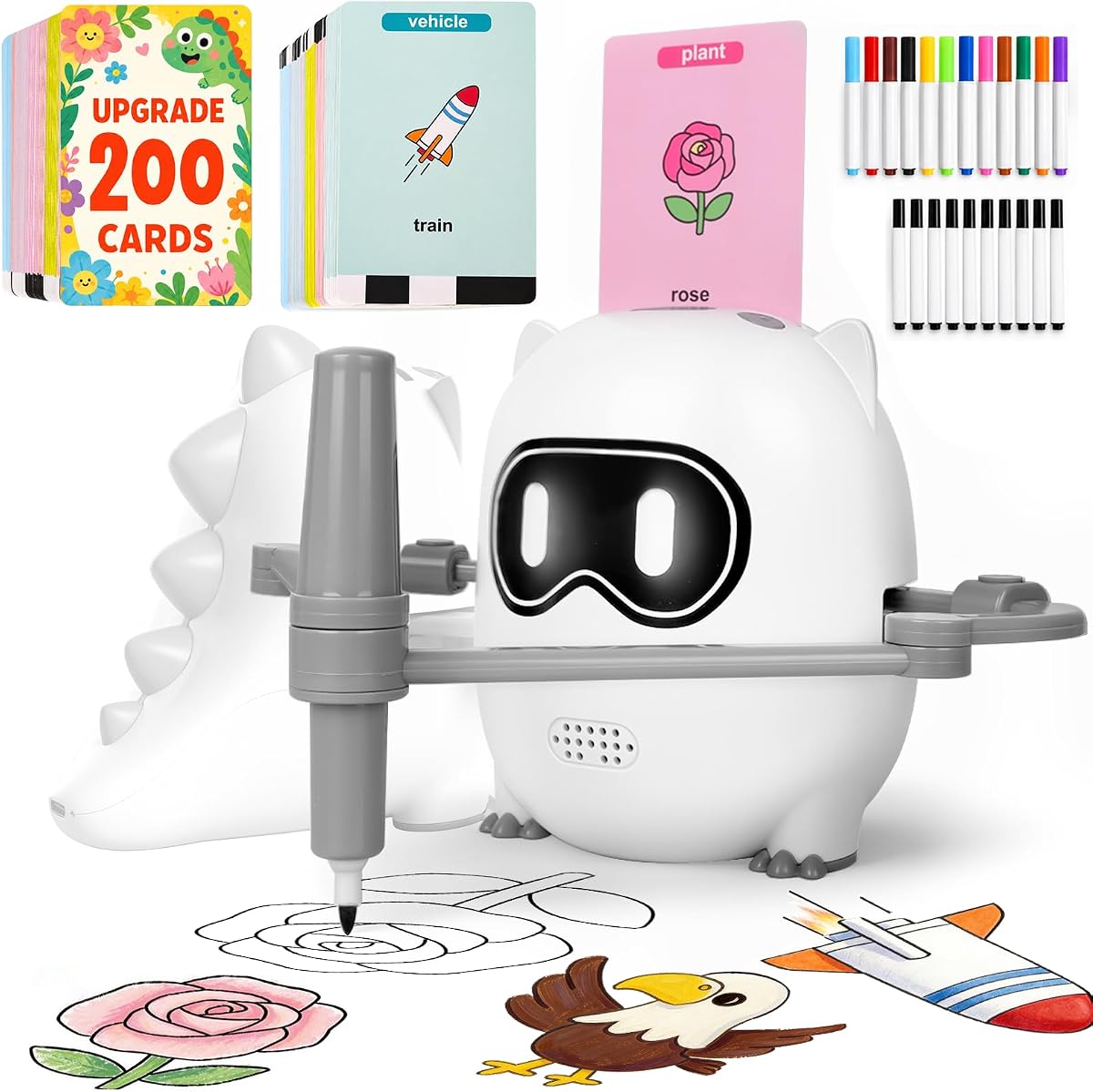
The Uneviesyka Drawing Robot holds the highest supplied rating at 4.8 and is our best budget-oriented pick for a reason. It combines 200 drawing cards, voice instruction, built-in music, a reusable board, and a straightforward card-insert operation. The product is aimed at children age three and up and is designed to support creative exploration through guided drawing.
We may earn a commission when you buy through this link, at no additional cost to you.
Its voice feature does more than accompany the activity. After a child inserts a card and presses the Power/Start button, the robot reads the word aloud and demonstrates the drawing process step by step. This creates a natural link between seeing an image, hearing its name, and reproducing its shapes. The Montessori-inspired approach is intended to encourage independent thinking, concentration, creativity, and hand-eye coordination.
Construction and care are also selling points. The robot is made from ABS plastic with rounded edges designed to reduce scratches, while its expressive robot face gives it an appealing appearance for younger children. The complete kit contains one drawing robot, 200 cards, four drawing pens, 12 colored markers, a reusable drawing board, a charging cable, and a user manual.
This is a strong recommendation for families seeking a generous card library and rich guided features without AI complexity. The one-touch design helps children understand the activity with minimal help, while the 200 cards can sustain frequent use. Its main limitation is that the creative possibilities are defined by the included library rather than a growing digital service, but for a child who enjoys structured art activities, that predictability can be a benefit.
The spoken word and step-by-step demonstration give children two ways to understand each activity. Hearing the name of the subject before drawing also introduces a basic vocabulary connection without requiring a separate lesson.
The ABS body and rounded edges are intended to support safer everyday handling. Clear physical design, simple startup, and a reusable work surface make the toy feel thoughtfully prepared for independent creative play.
We may earn a commission when you buy through this link, at no additional cost to you.
The Drawing Robot Toy for Kids Ages 3-8 has a 4.5 rating and is our best premium pick because it pairs a large content library with strong accessory support, rechargeable operation, and a five-year limited warranty. It is designed for children ages three through eight and provides a screen-free experience without requiring Wi-Fi.
We may earn a commission when you buy through this link, at no additional cost to you.
The robot includes 200 drawing and learning cards distributed across ten themes, including animals, plants, vehicles, and everyday objects. This organization helps children move between interests and supports shape recognition, vocabulary, and observation. The art set contains 12 colorful markers for children and 10 black markers for the robot, providing a good division between guide lines and personal coloring.
The supplied information says USB-C charging provides up to three hours of working time. Most pictures take about two minutes, creating a focused activity without requiring very long periods of sitting. It also mentions compliance with applicable FCC and CPC requirements, use of GRS-certified recycled materials, and a five-year limited warranty for setup, operation, missing parts, and product concerns.
This model is a well-rounded premium choice for families who value a complete package and long-term support. It remains card-driven rather than AI-powered, so creative variety is bounded by the 200 included designs. The rechargeable battery, screen-free operation, reusable-board workflow, large art supply selection, and warranty nevertheless make it particularly convenient for regular home use.
An estimated three hours of working time reduces the interruptions associated with disposable batteries. For a child who draws regularly, that makes the toy easier to integrate into an everyday routine.
Ten black markers serve the robot's line work, while 12 colorful markers let children finish and personalize the image. Having both categories in the box avoids an abrupt transition from guided drawing to a separate coloring activity.
We may earn a commission when you buy through this link, at no additional cost to you.
The GROWNSY Scan Drawing Robot carries a 4.2 rating and offers a more immersive presentation than many straightforward card-guided competitors. Rather than only inserting a card, children scan the included examples to start the experience. The system then provides sound effects, step-by-step voice guidance, and responsive lighting designed to make drawing feel more interactive.
We may earn a commission when you buy through this link, at no additional cost to you.
The robot is intended for children ages three through eight and is described as a Montessori-inspired tool for creativity, independent thinking, hand-eye coordination, color perception, and observation. Automatic standby and a long-lasting battery are highlighted as convenient features. It also works without a mobile application, keeping the setup process straightforward for both children and adults.
The package includes 150 cards, 12 markers, five drawing pens, one reusable board, and a Type-C cable. The child-safe construction is another stated priority, and the responsive lighting is designed to adjust to the surrounding environment. These features make the toy feel more like an interactive learning station than a simple mechanical doodler.
GROWNSY is a good pick for a child who responds well to light, sound, and spoken instructions. The 150-card collection is smaller than the largest libraries, and the multi-sensory presentation may not be equally appealing to every child. Even so, its scan-based start, voice guidance, automatic standby, and complete accessory set provide a distinctive and convenient approach to guided art.
The lighting response gives the robot a more animated presence and can help direct attention toward each stage of the activity. It adds a playful dimension while making the guided process feel less static.
Scanning the example card gives children a clear action that signals what comes next. Because no mobile application is required, the experience remains easy to begin and suitable for a variety of home settings.
We may earn a commission when you buy through this link, at no additional cost to you.
The Shovira Drawing Robot has a 4.3 rating and is designed as a step-by-step educational painting toy for children ages three through eight. Its guided process turns complex illustrations into manageable lines and shapes, allowing a child to observe the robot's movement and follow along at a comfortable pace.
We may earn a commission when you buy through this link, at no additional cost to you.
The operating sequence is clear: the child inserts a card, the robot speaks the name of the image, a marker is loaded, and the button is pressed. The robot then draws the subject line by line while cheerful background music plays. Once the outlines are complete, children can use 12 washable colorful markers to fill in the picture and add their own artistic choices.
The set includes one drawing robot, 150 themed learning cards, 12 washable markers, five black refills, a USB charging cable, and an instruction manual. The robot is made from child-safe ABS plastic with a smooth, rounded design intended for easier independent handling. Its Montessori-inspired approach emphasizes practice, repetition, confidence, and hand-eye coordination.
This is a dependable choice for families looking for a conventional guided drawing robot without connectivity requirements. The 150-card selection provides plenty of subjects, and spoken names can introduce useful language exposure. Adult supervision is still sensible around writing instruments, particularly for very young children, but within that normal context the toy offers a satisfying sequence of watching, drawing, and coloring.
The robot divides a complete illustration into a sequence of manageable movements. Watching those steps can help a child understand how an image is assembled and make the transition from guided drawing to independent coloring feel rewarding.
The 12 colorful washable markers are intended for finishing the robot's outlines and adding creative details. This gives children ownership of the final artwork while preserving a clear connection to the original card subject.
We may earn a commission when you buy through this link, at no additional cost to you.
The right drawing robot depends on a child's age, attention span, creative interests, and family preferences about connectivity. Comparing content variety, operation, accessories, and learning features helps narrow the field before making a purchase.
A larger card library can keep a drawing robot fresh for longer, particularly when a child plays with it regularly or wants to select subjects independently. Options in this guide range from 100 cards to 200 cards, with themes including animals, plants, vehicles, food, and familiar daily objects. More cards are useful only if the artwork genuinely interests the child, so the quality and range of themes matter more than the number alone. Buyers should also consider whether the robot can read or describe each card, because that adds vocabulary and attention to the activity.
Most products in the list use physical cards and do not require a phone, tablet, application, or Wi-Fi connection. That makes them predictable and easy to use during quiet time, travel, or playdates. The AI Drawing Robot for Kids offers a different proposition: children can create images through voice prompts, browse local images on a touchscreen, and access a regularly updated cloud library. Families should decide whether they want an open digital creative tool or a more traditional screen-free drawing experience. Connectivity should be considered alongside parental controls, account requirements, and whether offline functions remain useful.
Age recommendations range from children age three and up to older children who enjoy structured drawing activities. Younger users generally benefit from few controls, bright guidance, simple card insertion, and a short drawing cycle. Older children may appreciate more themes, challenge, creative prompts, or opportunities to customize outlines. The supplied listings include broad age claims, so parents should also consider reading ability, fine motor control, attention span, and the amount of supervision available. A toy that is technically suitable for a broad range can still fit one child better than another.
Voice guidance can explain what image is being drawn and walk a child through the process. This is useful for early learners, while also making the robot feel more like a tutor or drawing companion. Music adds energy and can help sustain engagement, but adjustable sound or a mute option is valuable for shared spaces and children who are more easily distracted. Compare the products that read words aloud, guide each drawing step, or merely provide background music. The richest option may be the one whose audio supports the child without overwhelming the core art activity.
A useful drawing robot set should include enough supplies to begin immediately. The listed packages contain between 16 and 22 drawing tools, generally combining black pens or refills for the robot with colorful markers for children. The reusable drawing board is another important part of the workflow because it gives the robot a consistent surface on which to work. Check whether markers are washable, whether replacement refills are included, and whether the board is large enough for the robot's lines. A complete bundle is particularly helpful for gifting, but replacement supplies should still be considered for long-term use.
Most models use USB-C charging, which is convenient for households with compatible cables and power banks. One RIVGOT listing specifically requires a 5V/2A adapter for charging, and the Drawing Robot Toy for Kids Ages 3-8 states that its battery provides up to three hours of working time. A long operating period is especially valuable for children who draw frequently, while automatic standby can reduce unnecessary power use. Buyers should check whether a wall adapter is included, how long the robot takes to charge, and whether it can be used while connected.
Several products use ABS plastic and rounded edges, which can make them more comfortable and less concerning for younger hands. Marker use still calls for ordinary adult supervision, particularly with children prone to placing pens near their mouths. For the connected AI model, privacy controls are equally important: the supplied listing highlights a parental mode that can disable network access and a microphone switch. A five-year limited warranty on another model adds reassurance, but warranty terms should be read directly on the listing. Build quality, rounded construction, protected controls, and clear privacy or support policies are all worth considering.
A drawing robot becomes more valuable when children can personalize what the machine creates. The strongest packages provide colorful markers and a reusable board, allowing the outline to become the starting point for a child's own coloring, patterns, additions, and storytelling. AI-generated images can offer greater open-ended variation, but a finite card set can still support repeat play through different color choices and creative edits. Consider how long each outline takes, whether the activity can be paused, and whether the board supports repeated use. A robot that encourages the child to finish the image is more useful than one that simply demonstrates drawing.
Begin by reading the product instructions and identifying the robot, cards, guide pens, coloring markers, reusable board, charging cable, and any adapter included with that specific set. Charge the robot according to its instructions before the first session, especially if the package does not include a compatible power adapter. Place the reusable board on a flat, clean surface and make sure the drawing pen is seated securely in the robot before inserting a card.
Show the child the complete sequence once: select a card, place or scan it in the correct orientation, load the guide pen if requested, and press the drawing control. The robot will generally speak the image name or describe the guide before drawing line by line. Children should keep their hands clear of the moving arm and wait until the drawing is complete before adding color. Afterward, let them use the colorful markers to fill in the outlines or invent new details, then remove and store the card properly so it remains clean and easy to identify.
Clean the reusable board and robot exterior with a lightly damp cloth, but do not immerse the machine or pour liquid into openings. Remove used guide pens and markers when the session ends, and inspect the card slot for debris. Keep the device dry, store the cards flat rather than folded, and use the included charging system. A connected model should be returned to the appropriate parental mode after online play, while every model benefits from adult supervision around writing instruments and during the robot's moving phases.
Many models in this guide are intended for children age three and up, including the RIVGOT, TREEFIA, Uneviesyka, GROWNSY, and Shovira options. Preschoolers generally respond well to card-guided operation, voice cues, simple controls, and short activities. Parents should still consider the child's fine motor skills, attention span, and ability to handle markers safely.
Most card-guided models are designed to work without Wi-Fi, a phone, a tablet, or an application. The AI Drawing Robot for Kids is the notable connected option, using Wi-Fi for voice-driven image generation and access to its cloud library. It also includes local touchscreen content and parental controls for limiting network access.
The main difference is the amount of ready-made subject matter available to a child. A 100-card set may be sufficient for occasional use, while 150 or 200-card collections can support more frequent sessions and broader theme selection. The artwork quality, subject variety, voice features, and whether children can personalize outlines are also important considerations.
Yes, and that is a central part of the experience for most of these toys. The robot creates the outline with a guide pen, after which children can use the included colorful markers to fill in the image, change the colors, or add original details. The reusable board provides a consistent surface for this follow-up coloring stage.
The connected AI model includes parental features intended to support child privacy, including a mode that disables network access and a control for turning off the microphone. Families should review the current privacy policy and understand exactly when network features are active. Adult supervision remains appropriate for younger children regardless of whether the toy is connected.
They provide structured drawing practice by demonstrating images one line at a time, and many also read the subject name aloud. That can help children observe shapes, connect images with vocabulary, build hand-eye coordination, and gain confidence before adding their own colors. They are most effective as guided creative tools rather than as a replacement for varied hands-on art experiences.
Check the recommended age, included card count and themes, charging requirements, presence of a wall adapter, art supplies, board, voice features, and any app or network requirements. Also review the physical safety details, warranty, support policy, and whether the drawing style and subjects are likely to engage the intended child.
It depends on the robot, card, and child, but the Drawing Robot Toy for Kids Ages 3-8 states that most pictures take about two minutes. That short duration can suit younger children who benefit from focused activities. Older children may spend longer because they can add extensive coloring, patterns, and personal details after the robot finishes.
The Uneviesyka Drawing Robot is the strongest value-oriented recommendation, combining 200 cards, voice guidance, music, and a complete art set with the highest supplied rating. The AI Drawing Robot for Kids takes the lead for families interested in connected creativity, extensive image generation, touchscreen selection, and adjustable privacy controls. For a polished, rechargeable package with a large card library and warranty support, the Drawing Robot Toy for Kids Ages 3-8 is particularly compelling.
Prioritize the features that match your child rather than choosing solely by card count. Younger children may benefit most from a simple screen-free format, spoken instructions, and a short drawing cycle, while more independent artists may value larger collections, varied themes, and extensive coloring supplies. Families interested in open-ended ideation should examine the AI model, though they should also consider account, connectivity, and microphone settings.
Before purchasing, confirm the latest product details, customer rating, included accessories, charging requirements, and warranty terms on the current Amazon listing. Prices, promotions, and package contents can change, and the linked page should remain the final source for current availability. With that final check in place, one of the ten models can provide a strong starting point for a child's guided creative play.