
2 Pack AUX Cable 10ft
4.7Editor score
Two-cord value pack
20,000+ bend lifespan
Double-braided nylon exterior
Durable Aux Cable guide comparing 10 top options for sound quality, bend strength, connector design, portability, device compatibility, and everyday reliability
A durable AUX cable should do more than survive a trip in a pocket. It needs a secure connection, dependable stereo transmission, and a jacket that tolerates repeated bending, twisting, and storage. The right cable also depends on where you use it, from crowded car dashboards to home speakers and phone cases.
We compared ten AUX cables based on their stated construction, connector designs, shielding, bend-test claims, supported devices, and intended uses. The list includes short and long options, right-angle models, slim case-friendly plugs, and a two-cord pack for buyers who want a spare.
Each review explains the strongest reasons to consider that cable, along with any limitations or compatibility considerations stated in its product information. Ratings and availability can change, and current prices fluctuate, so check the latest listing details before buying.
4.7Editor score
4.8Editor score

4.6Editor score
The comparison below highlights each cable's length, connector layout, core construction, and most relevant durability feature, helping you narrow the field based on your devices and routine.


This six-foot AUX cable combines a practical 90-degree right-angle connector with a nylon-braided exterior and a stated bend-test endurance of more than 20,000 bends. Its 4.6 rating reflects a well-regarded design that addresses two common durability problems: bending in cramped spaces and fraying around frequently handled connectors.
We may earn a commission when you buy through this link, at no additional cost to you.
The angled plug is especially useful when the AUX socket sits close to a dashboard, console, or speaker housing. Rather than forcing a straight plug into a direction with little clearance, the connector approaches the port laterally. The product information also highlights pure copper cores, triple shielding, and reinforced connectors designed to reduce static, distortion, and mechanical stress.
Compatibility is broad for standard 3.5mm TRS equipment, including car stereos, headphones, speakers, PCs, tablets, and compatible gaming controllers. The tradeoff is that right-angle connectors are not equally convenient in every location, and a device without a native AUX jack still requires a separate adapter. The listing also notes that the cable carries audio rather than microphone controls.
This is a strong choice for people who regularly connect a phone inside a car or use audio equipment in tight spaces. Its six-foot length provides useful flexibility without creating a long cable to manage, while the braid and reinforced construction address frequent bending. For those applications, the right-angle geometry is as valuable as the raw durability ratings.
The right-angle connector helps prevent a straight plug from taking the full force of a bent cable. That geometry can reduce leverage at the socket, which is especially helpful in crowded vehicle interiors or near desktop equipment positioned close to a wall.
A nylon-braided jacket, reinforced connector construction, and a stated 20,000-plus bend test target the areas that usually fail first. The six-foot length is long enough to permit relaxed routing while remaining manageable in a bag or vehicle.
We may earn a commission when you buy through this link, at no additional cost to you.
The Syncwire cable offers a balanced combination of 6.5-foot reach, nylon braiding, gold-plated contacts, and a stated bend lifespan of more than 15,000 bends. Its 4.6 rating places it among the well-regarded options in this guide, particularly for buyers who need a conventional cable for a car, stereo, or portable speaker.
We may earn a commission when you buy through this link, at no additional cost to you.
The braid is designed to resist tangles and kinks when the cable is wound for storage. Polished gold-plated connectors are intended to support reliable signal transfer and reduce potential signal loss or noise. Its universal 3.5mm format makes it suitable for devices such as smartphones, tablets, MP3 players, car stereos, and compatible home audio equipment.
Case fit deserves attention before purchase. The product information says the cable is designed to fit almost all aftermarket cases but excludes LifeProof and OtterBox cases. A straight connector also may be less convenient in confined spaces than a right-angle model, and the included three-year card adds a modest ownership benefit without changing the core design.
Choose this cable if you want a versatile 6.5-foot option that can move between a phone, a car stereo, and a home setup without requiring specialized routing. It is particularly attractive for people who store cables in bags or pockets because the braided exterior and winding design emphasize fewer frustrating knots.
The nylon braid is intended to remain flexible while resisting the sharp kinks that can occur when a basic rubber-coated cable is forced into a small compartment. That makes the Syncwire a practical choice for commuters and travelers who regularly coil their accessories.
Standard 3.5mm male-to-male connections allow the cable to move between phones, tablets, car stereos, speakers, and compatible headphones. Check the dimensions of your device and case first if you expect to use it with a particularly protective cover.
We may earn a commission when you buy through this link, at no additional cost to you.
UGREEN's three-foot cable is a versatile all-rounder with a 4.6 rating, a nylon-braided jacket, slim step-down connectors, and a construction designed for regular use. It is a natural choice when you want one dependable cable for a nearby car stereo, speaker, laptop, tablet, or pair of headphones without the bulk of a longer lead.
We may earn a commission when you buy through this link, at no additional cost to you.
Signal construction receives careful attention in the product information. The cable uses a silver-plated wire core, 24K gold-plated corrosion-resistant connectors, sturdy brass shells, and double-layer shielding. These features are intended to support clear treble, defined bass, and reduced interference from external electrical noise.
Durability comes from a nylon braid that passed more than 10,000 bending tests, along with reinforced brass shells intended to resist cracking and connector damage. The three-foot length is less useful when the source and destination are far apart, and the cable is a three-pole TRS design without microphone support. It also needs devices with standard 3.5mm audio connections rather than USB or Bluetooth-only ports.
This cable earns its place as an Editor's Choice because it does not force buyers to specialize. It combines a compact footprint, flexible storage, case-conscious connectors, shielding, and broad device support. It is especially suitable for desk use, short car runs, and replacing a worn headphone lead with a standard 3.5mm connection.
The product listing identifies compatibility with car stereos, TVs, headphones, speakers, amplifiers, soundbars, laptops, tablets, compatible smartphones, and other standard 3.5mm equipment. That versatility makes it useful for households with several generations of audio hardware.
The three-foot length is easy to coil and carry, while the braided jacket and reinforced shells address the bending and cracking associated with thinner conventional cables. Its slim step-down connector is also designed for a more consistent fit in many ports.
We may earn a commission when you buy through this link, at no additional cost to you.
This two-pack gives buyers two 10-foot, double-braided AUX cables with a 4.7 rating. The package stands out because one cable can remain in a car while the other serves a home stereo, speaker, or travel bag, reducing the need to unplug and move equipment every time.
We may earn a commission when you buy through this link, at no additional cost to you.
Each cable uses 24K gold-plated connectors and an enameled wire core, while the copper connector shell is intended to support consistent performance and reduce signal loss. The product information states a bend lifespan of more than 20,000 bends and emphasizes a tangle-free design for easier carrying and storage.
The 10-foot length offers considerable placement freedom, which is useful when a device sits in a bag, on a workbench, or behind a piece of furniture. The trade-off is added cable to manage, and a straight connector may be less effective in a deeply recessed socket. Standard 3.5mm ports are required, so newer USB-C or Lightning-only devices need an appropriate adapter.
This is a strong value-oriented recommendation for people who regularly move between devices or want a backup cable. The included quantity, lengthy reach, and substantial stated bend testing make it more versatile than a basic short cable, while the two-cord format adds flexibility that a single-cable purchase cannot offer.
Keeping one cable permanently installed in a vehicle or home system prevents constant plugging and unplugging. The second can then serve as a travel lead, backup, or connection for another room without extending the reach of a single cable.
At 10 feet, the cable provides ample room for routing around furniture, dashboard components, or desk setups. The double-braided exterior and stated 20,000-plus bend endurance are intended to withstand handling despite the greater opportunities for accidental pulls.
We may earn a commission when you buy through this link, at no additional cost to you.
The VIOY cable is built for buyers who need more reach than a standard desktop or vehicle lead can provide. At 20 feet, it can connect a phone or laptop across a room, reach a dashboard-mounted receiver, or link equipment positioned on opposite sides of a workspace. Its 4.6 rating reflects a strong feature set for this extended-use niche.
We may earn a commission when you buy through this link, at no additional cost to you.
The cable uses a pure copper core, dual shielding, copper shells, and gold-plated plugs. Its step-down connector design is intended to fit smartphones and tablets without requiring removal of the case. The nylon braid is designed to resist twisting, tugging, and tangling while remaining flexible enough to roll up for storage.
Compatibility requires more attention than with a shorter cable. The manufacturer identifies it as a 3.5mm TRS audio lead for listening and stereo sound, not microphone use. It also notes a 6.0mm outer-diameter standard and warns that some headphone jacks, including certain Sony examples, may not fully accept the plug.
Choose the VIOY when distance is the central requirement and you can manage the extra cable responsibly. Its long length, shielding, and reinforced braided construction make it a premium-feeling option for fixed installations, larger rooms, and dashboard accessories, but it is less convenient for users who want the smallest possible everyday carry cable.
Twenty feet is enough distance for many source-to-speaker arrangements without requiring an intermediate extension. That makes the cable useful for home stereo layouts, worktables, and vehicle installations where a short lead would be stretched awkwardly.
The product information highlights a specific 6.0mm connector outer-diameter standard. Buyers should compare that detail with the headphone socket on their device, particularly when using equipment with unusually narrow or nonstandard jack dimensions.
We may earn a commission when you buy through this link, at no additional cost to you.
DUKABEL's four-foot cable delivers a 4.6 rating and emphasizes practical connector construction. Its most useful feature is the step-down ring on the plug, which is designed to let the connector seat fully even when a phone is in a protective aftermarket case.
We may earn a commission when you buy through this link, at no additional cost to you.
The product information also highlights 24K gold-plated contacts, triple shielding, a pure-metal housing, and an oxygen-free copper core. Together, these elements are intended to improve resistance to interference, oxidation, connector wear, and signal degradation while the nylon-braided exterior protects the cable during regular use.
Compatibility covers phones, tablets, laptops, portable speakers, car radios, MP3 players, and other equipment with a standard 3.5mm port. As with most three-pole stereo AUX cables in this guide, the design focuses on audio playback rather than microphone functionality. The four-foot length is convenient for close-range use but may be insufficient for a source and destination on opposite sides of a room.
This is an appealing choice when a previous cable could not physically fit around your phone case. It also suits people who want a conventional, easy-to-store braided lead without paying extra for right-angle geometry or an unusually long cable. The material focus and case-aware connector give it a well-rounded profile for everyday use.
The connector's stepped profile reduces the chance that a thick protective case will prevent full insertion. That practical detail can eliminate the need to remove a case every time you connect a phone to a car or speaker.
Triple shielding and an oxygen-free copper core are intended to preserve stereo audio and reduce noise. Gold-plated contacts and metal housings add corrosion and wear resistance at the connection points.
We may earn a commission when you buy through this link, at no additional cost to you.
VANAUX's five-foot right-angle cable is aimed at car users, portable speakers, and other setups where the AUX socket is recessed. It carries a 4.6 rating and includes a 90-degree connector, cotton braided exterior, and a stated 10,000-plus bend lifespan.
We may earn a commission when you buy through this link, at no additional cost to you.
Sound-related construction includes 24K gold-plated connectors, an enameled pure copper core, and aluminum connector housings. The product information describes the cotton braid as durable and flexible, while the right-angle geometry is specifically intended for hard-to-reach ports where a straight plug would be awkward or create unnecessary bending.
The slim connector is designed to fit many phones without removing their cases, although buyers with bulky protective covers may need to remove them. The five-foot length is sufficient for many dashboard arrangements but not for a large room or a vehicle with an unusually distant connection point. Compatibility is limited to equipment with a standard 3.5mm audio port.
This cable makes the most sense for a driver whose car stereo socket is close to a dash-mounted Bluetooth receiver or for a speaker with a recessed input. It combines the most useful right-angle feature with a moderate length, while the braided exterior and metal housing support regular handling.
The angled connector can sit close to a dashboard or receiver, reducing the gap through which a straight cable must bend. This helps with routing and may reduce strain around the device's socket during travel.
The cotton yarn exterior is intended to resist wear while maintaining flexibility. Combined with aluminum housings and gold-plated contacts, it presents a practical construction for a cable that will be connected and removed regularly.
We may earn a commission when you buy through this link, at no additional cost to you.
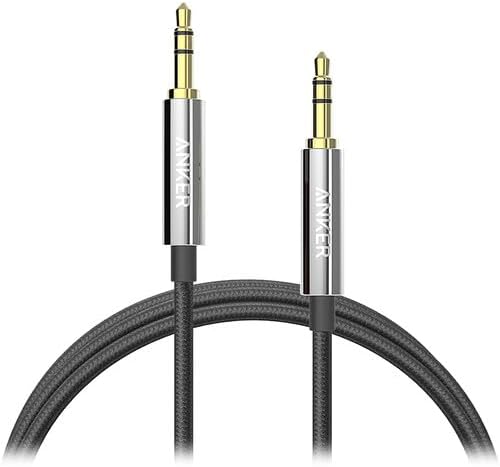
The Anker Powerline 4ft earns the highest customer rating in this selection at 4.8. It presents a balanced four-foot cable with gold-plated contacts, a slim case-friendly connector, a flexible tangle-resistant design, and a stated durability rating of more than 10,000 bends.
We may earn a commission when you buy through this link, at no additional cost to you.
The product information emphasizes clear stereo sound for music, calls, podcasts, and everyday playback. Its 24K gold-plated connectors are intended to reduce signal loss, while the flexible construction supports convenient routing and storage. The cable can serve car stereos, headphones, speakers, home audio systems, phones, tablets, laptops, and MP3 players equipped with standard 3.5mm connections.
The four-foot length suits a broad range of desk, bedside, and vehicle uses without becoming unwieldy. A straight connector is less specialized than the right-angle options, so it may be less suitable for deeply recessed or unusually constrained sockets. Newer phones and computers without a native AUX port will still need a suitable adapter.
This is the most complete general recommendation in the guide because it combines the strongest rating with a balanced feature set. It does not require a long reach, a second cable, or a specialized angled design, yet it addresses the essentials: reliable audio, a case-conscious fit, bend resistance, and convenient storage.
The four-foot length is short enough for simple storage but long enough for normal positioning around a desk, bedside table, or vehicle console. That makes the cable easier to adopt for multiple locations than a very long or extremely short lead.
A flexible, tangle-free design helps the cable remain usable after repeated coiling and transport. The stated 10,000-plus bend endurance adds confidence for buyers who expect frequent connection changes or regular movement.
We may earn a commission when you buy through this link, at no additional cost to you.
This three-foot AUX cable differentiates itself with a hydrophobic braided exterior, a mechanical screw-lock connector design, and a 4.6 rating. Those features target buyers who carry cables through hot bags, crowded work environments, or other places where perspiration and spilled liquid can quickly affect a conventional cable.
We may earn a commission when you buy through this link, at no additional cost to you.
The connector housing threads directly onto the cable core rather than relying on a glued connection, according to the product information. That approach is intended to prevent the shell from sliding off when a cable is pulled from a tight car socket or heavier audio equipment. Gold contacts, a pure copper core, and dual shielding are used to support clear stereo sound and reduce interference.
The hydrophobic braid is described as repelling liquids such as coffee, limiting pilling, and making the surface easier to wipe clean. A slim aluminum housing is designed to pass through tight case openings. As with the other basic three-pole TRS options, the cable does not provide microphone input or inline volume controls.
This is a smart pick for commuters, gym users, travelers, and anyone prone to carrying a cable beside drinks or damp items. It also works for home and car audio when a short lead is sufficient. The screw-lock housings and liquid-resistant exterior make it especially distinctive among otherwise conventional three-foot braided cables.
The hydrophobic outer braid is designed to prevent liquids from soaking in, allowing coffee or other moisture to bead on the surface. That makes the cable easier to wipe down and helps reduce persistent odors or dirt around the connector area.
The mechanical screw-lock connection is intended to keep the metal housing attached to the cable core during pulls. This construction addresses a familiar failure point: a plug that separates from its cable or develops strain at the joint.
We may earn a commission when you buy through this link, at no additional cost to you.
The EMK package stands out because it includes both a four-foot right-angle cable and a four-foot straight male-to-male cable. It carries a 4.4 rating, the lowest among the ten products here, but the two-cord kit provides flexibility that many single-cable competitors do not.
We may earn a commission when you buy through this link, at no additional cost to you.
The angled cable uses an enameled oxygen-free copper core, double-braided nylon exterior, polished metal molding, and corrosion-resistant 24K gold-plated plugs. Its 90-degree connector is designed for tight spaces, hard-to-reach areas, and dashboard-mounted Bluetooth receivers where a straight plug would force an awkward bend.
An extended connector with a step-down profile is intended to fit a wider range of phones and cases, although a particularly bulky shell may still affect the connection. The listed bend-test figure exceeds 10,000 bends. The included straight cable offers a more familiar option for ports where an angled plug is unnecessary, but the different geometries may not feel equally consistent across every device.
This kit is best for car users who want both a right-angle option for recessed sockets and a straight option for flexible routing. It is also a useful two-cord setup for a vehicle and home system. Although its rating trails the leading products, the included variety, four-foot lengths, and right-angle convenience make it a distinctive practical choice.
The package combines a right-angle lead with a conventional straight cable. You can use the angled model in a tight dashboard recess and the straight lead in an open port, avoiding the need to force one geometry into every connection.
The right-angle cable is particularly useful for small dashboard receivers and recessed car stereo sockets. The four-foot length and double-braided exterior are intended to provide flexible routing while reducing the visual and physical bulk of a long straight plug.
We may earn a commission when you buy through this link, at no additional cost to you.
Durability depends on more than the word braided appearing in a product title. Length, connector geometry, jacket materials, shielding, and the way you move your equipment all influence which cable will serve you best.
Straight connectors are familiar and work with many ports, but they can force a sharp bend when the AUX socket is close to a dashboard edge, console, or wall. Right-angle plugs enter the port from the side and are often more comfortable in confined spaces. They are particularly useful for car stereos, dashboard-mounted receivers, and speakers with recessed inputs. However, a right-angle plug is not automatically more durable than a straight one, so it should still be supported without sharply folding the cable.
A three-foot cable is convenient for a bedside setup, a nearby speaker, and compact vehicle routing. Four to six and a half feet provides more freedom when the source and destination are not directly beside each other. A ten-foot option is useful across a room or behind furniture, while a 20-foot cable can support a larger installation. Longer cables are easier to route but also harder to store and more likely to be caught on furniture, so choose the shortest length that comfortably reaches.
The outer jacket protects the internal conductors from flexing, abrasion, and tangling. Nylon braiding is common in this category and is generally suited to daily handling, while the hydrophobic braid on the three-foot option adds resistance to moisture. Bending-test claims provide a useful comparison, although they do not describe every real-world condition. Look for reinforced connector housings and strain relief as well, since the point where the plug meets the cable usually experiences the greatest stress.
A good AUX cable should preserve the source signal without adding buzzing, crackling, or obvious loss of detail. Copper-based cores, shielding, and corrosion-resistant gold-plated contacts are the central features highlighted across these products. Double or triple shielding can help reject interference in electrically busy environments, while polished or gold-plated contacts are intended to maintain a stable connection over time. These materials cannot replace correct source and input settings, but they help support clean stereo transmission.
Most of these cables use a 3.5mm male-to-male TRS connection, but fit is not guaranteed by the connector label alone. Phone cases can obstruct recessed sockets, and a few devices use unusual headphone-jack dimensions. A slim step-down design improves the chance that a protective case will fit, while VIOY specifically recommends checking the device's jack diameter against its 6.0mm standard. Devices without a native port require a suitable USB-C or Lightning audio adapter, which is generally not included.
A standard three-pole TRS cable carries left and right audio channels through a tip-ring-sleeve design. It does not include a microphone contact, so it cannot handle headset chat or calls through a four-pole TRRS headset cable. Several products in this guide explicitly limit themselves to stereo audio. Check whether your headset has separate microphone and headphone plugs before assuming an AUX cable will support every function of a gaming headset.
Consider how often the cable will be moved. A three-foot lead is easy to carry in a pocket or small bag, while a 20-foot cable is better suited to a fixed location unless you have a storage method that prevents tangling. A multi-cord pack can be useful if you need one cable in a vehicle and another at home. The EMK bundle provides both straight and right-angle cables, while the two-pack option supplies two matching 10-foot leads.
Identify the output on your source device and the input on the receiving system before connecting anything. The source may be a phone, laptop, tablet, or portable player, while the destination might be a car stereo, home receiver, speaker, or headphone jack. Connect the male plugs fully, but avoid forcing a plug that does not align with the socket. If a phone case blocks the connector, check whether the case is removable rather than pushing hard enough to risk damage.
Route the cable so that sharp bends occur gradually and no section is trapped under a seat, desk, or heavy object. For a right-angle cable, use the connector to guide the cable sideways from the port and avoid pulling it upward. For long cables, create a gentle service loop near each connection. When unplugging, grip the metal connector rather than tugging on the braided jacket, and disconnect the cable before moving the source or receiving equipment.
Store the cable loosely after use. A relaxed coil or a simple over-under wrap helps prevent persistent kinks in a braided cable. Keep connectors away from moisture and debris, and wipe the hydrophobic models promptly if they encounter spills. Inspect the jacket and plug joint for damage, especially after heavy use. Replace the cable if the connector becomes loose, the braid is badly frayed, or the audio develops consistent crackling that does not disappear when the connection is reseated.
Durability usually comes from a flexible braided jacket, reinforced connector housings, and a strain-relief design at the plug-to-cable joint. Bend-test claims can help compare products, but real-world lifespan also depends on how often the cable is moved and whether it is repeatedly bent at a sharp angle. A well-made cable should be coiled loosely and pulled by its connector rather than its cable.
Right-angle cables are usually more convenient when a port is recessed or positioned near a dashboard, console, or wall. They reduce the amount of sideways force placed on a straight connector. Straight plugs remain useful in open sockets and can provide more flexible routing in some setups, so the best choice depends on the available clearance rather than the connector style alone.
Most cables in this guide are three-pole TRS stereo leads, which do not include a microphone channel. A four-pole TRRS cable is needed for a compatible headset with a microphone. If your phone or laptop has separate headphone and microphone ports, a simple TRS AUX lead may still handle playback, but it will not combine the headset microphone signal.
Choose the shortest length that allows the cable to be routed without being stretched, kinked, or trapped under furniture. Three feet suits close-range use, while six to ten feet offers more freedom in a car or around a desk. A 20-foot lead is useful for larger or fixed installations but is less convenient to store and can make accidental pulls more likely.
A standard 3.5mm AUX cable requires a native 3.5mm audio port or a compatible adapter. Modern USB-C and Lightning devices may need a separate digital or analog audio adapter, and that adapter is not included with these products. Check the adapter's supported connection direction and audio format before purchasing.
Interference, a loose plug, damaged conductors, and incompatible settings can all cause unstable audio. Reseat both ends and try a different port to isolate the problem. If another cable works normally, the original cable may have damaged shielding or an intermittent connector joint. Also confirm that the source is using an analog line-out setting rather than an unsupported output mode.
No braid can make every cable immune to tangling, but a flexible nylon exterior is generally easier to coil and less likely to form tight kinks. The two-pack and Syncwire options specifically emphasize tangle resistance. Proper storage, using a loose coil, and avoiding tight wraps around a small radius will preserve that advantage.
Yes, provided both the headphone and source device expose compatible 3.5mm stereo audio connections. The cable may also work with some speakers, receivers, soundbars, amplifiers, and car stereos that have a standard AUX input. It will not connect USB-C or Bluetooth-only equipment directly, and certain unusually narrow headphone sockets may require a different connector size.
The Anker Powerline 4ft is the strongest general choice because it pairs the highest rating with a balanced length, slim connectors, gold-plated contacts, and a durable flexible design. The two-pack 10-foot cable is ideal for buyers who want a spare and long routing flexibility, while the VIOY 20-foot model leads the group for maximum reach.
For a vehicle with a tight or recessed port, prioritize a right-angle cable such as the six-foot Nanxudyj, five-foot VANAUX, or four-foot EMK. For a phone protected by a case, look for a slim step-down connector. For frequent travel, a three- or four-foot braided lead is easier to manage, and a liquid-resistant housing may be useful in busy environments.
Always verify the connector format, device dimensions, case clearance, and required microphone functions before ordering. Ratings, product availability, and prices can change, so consult the current listing for the most up-to-date information and confirm that the cable still meets your needs.