
AKLOT Acoustic-Style Electric Drum Set
4.8Editor score
Independent double bass pedal
Triple-ply mesh drum pads
460 sampled drum voices
Electronic drums for metal must handle fast feet, forceful accents, crisp cymbal work, and the precise timing required by tight arrangements. The right kit combines responsive pads with convincing drum sounds, dependable triggering, and enough customization to move from simple practice to recording ambitious tracks.
We compared ten electronic drum kits using the supplied specifications, focusing on mesh-head construction, cymbal articulation, kick and hi-hat control, sound libraries, learning features, connectivity, and included hardware. The list covers compact beginner systems, performance-oriented kits, premium acoustic-style models, and professional modules suitable for metal practice.
Each review explains the product's strongest qualities, practical limitations, and likely buyer profile. Ratings reflect the published product information rather than personal hands-on testing, and configurations can vary by seller. Prices and availability change frequently, so confirm the current listing and included accessories before purchasing.
4.8Editor score

4.6Editor score
4.5Editor score
As an Amazon Associate we earn from qualifying purchases.
The comparison below highlights the pad layouts, sound libraries, cymbal features, learning tools, and connectivity that matter most to metal drummers, from compact starter systems to performance-focused kits.


The Alesis Nitro Pro combines a full-size mesh-head layout with a deep sound library, making it a convincing all-around choice for metal drummers who want to practice, record, and perform without assembling a collection of separate accessories. Its 4.6 rating reflects a generally favorable balance of construction, features, and versatility.
We may earn a commission when you buy through this link, at no additional cost to you.
The eight-piece configuration includes a dual-zone 10-inch snare, three eight-inch mesh toms, a double-kick tower, and a 10-inch hi-hat, ride, and crash configuration with choke support on the ride and crash. That arrangement gives players recognizable acoustic-kit landmarks while reducing the physical noise associated with conventional drums. The module contains 36 ready-to-play BFD kits, 16 user-created kit slots, and more than 500 drum, cymbal, and percussion sounds with multi-velocity layering.
Its sound creation and computer features are especially useful for metal. USB connectivity opens access to BFD Player, expansion kits, and recording into a DAW, while Bluetooth provides another way to play along with tracks. Zildjian sounds built into the module and downloadable expansions add familiar cymbal character. The main compromises are physical: eight pieces demand more room than compact systems, and the supplied information does not identify an integrated speaker, so headphones or an amplifier are required for normal listening.
This is the strongest general recommendation for a metal player moving beyond a basic starter kit. It suits drummers who want realistic mesh feel, meaningful editing options, and a library broad enough for aggressive rock and metal. Those who need a very small footprint may prefer a compact Roland, while dedicated double-pedal players who prioritize independent acoustic-style hardware may favor the AKLOT.
The double-kick tower, dual-zone snare, three mesh toms, and choked cymbals closely mirror the geometry of an acoustic drum kit. That familiar arrangement makes it easier to transfer doubles, fills, crash accents, and snare-led passages from a conventional kit to electronic practice.
BFD-derived voices, multi-velocity samples, numerous factory kits, and downloadable expansion packs give this module far more tonal range than a basic practice set. The USB connection also makes it a practical bridge between drumming, songwriting, and home production.
We may earn a commission when you buy through this link, at no additional cost to you.
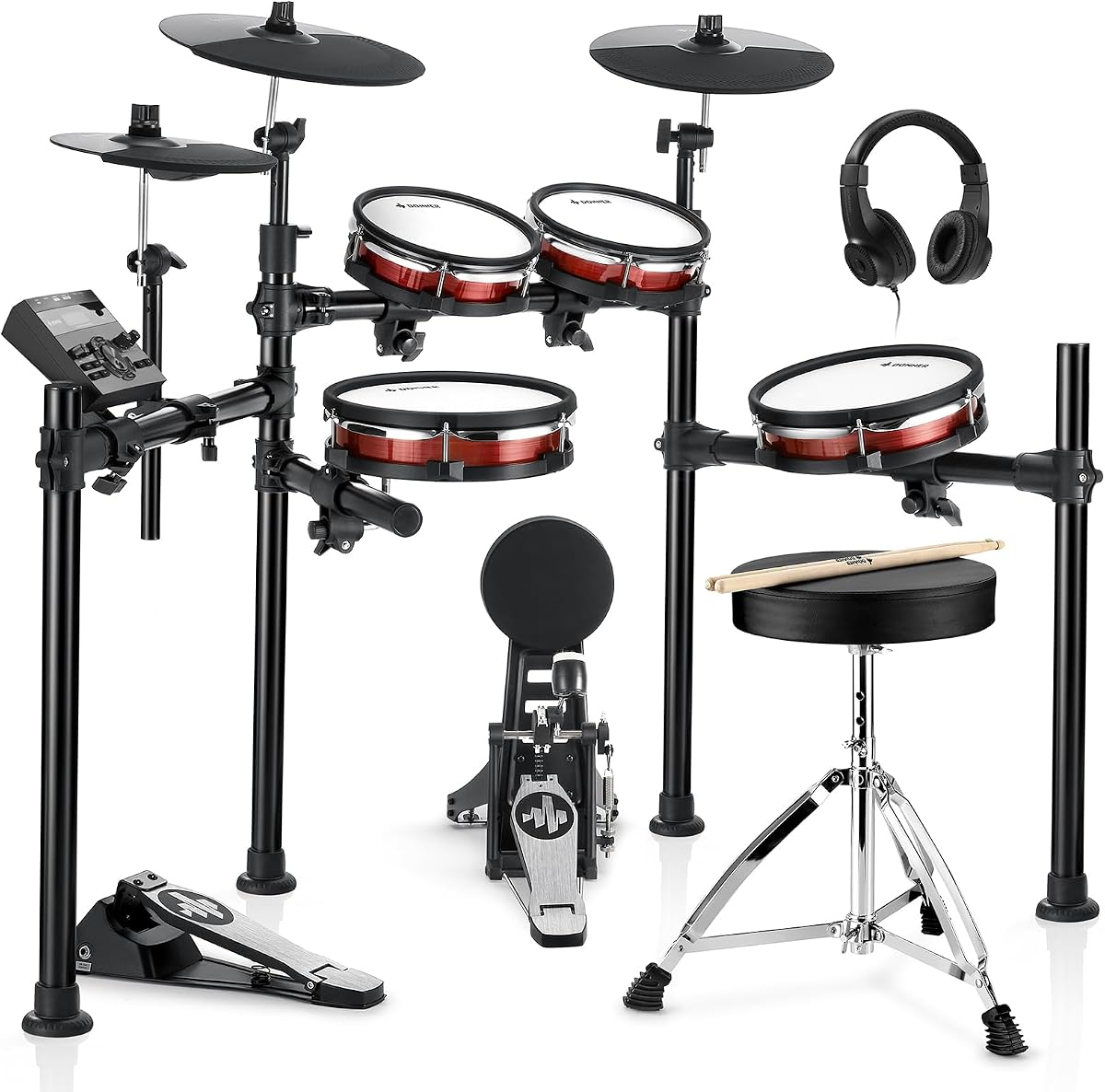
The Donner DED-200 MAX is a strong value-oriented choice because it combines large mesh heads, 450 sounds, 31 complete kits, and 50 play-along songs without concentrating on one narrow feature. Its 4.5 rating makes it an appealing option for metal beginners who need useful learning features alongside a believable acoustic-style response.
We may earn a commission when you buy through this link, at no additional cost to you.
The upgraded layout uses a 10-inch snare, two 10-inch toms, a 10-inch hi-hat, and 12-inch crash and ride cymbals. The two-ply mesh heads are designed for dynamic tracking and durability, while larger playing surfaces provide more precise hit detection than many small starter pads. A sequencer, metronome, auxiliary input, recording function, and smartphone compatibility make the module more than a simple tone generator.
The DED-200 MAX is especially attractive because the package includes a foldable iron stand, four-post aluminum rack, hi-hat control, bass drum pedal, headphones, throne, audio cable, and sticks. That reduces the chance that a new player will need to assemble a long list of essential additions immediately. Its main limitation is that it has no built-in speaker, and even with headphones, users will eventually want an amplifier or monitor for fuller sound and band practice.
Choose the DED-200 MAX when you want a substantial, mesh-equipped kit for learning metal rhythms and playing along with recorded music. It is less suited to advanced recording work than the Alesis or AKLOT because its editing and expansion options are less clearly developed. For beginners prioritizing broad content and a complete setup, however, it delivers an unusually useful combination.
The 10-inch snare, 10-inch toms, and 12-inch cymbals offer more usable surface area than compact training kits. That extra room can help new drummers develop consistent stroke placement and transition more naturally from full-size acoustic drum dimensions.
Metronome, recorder, sequencer, and 50 practice tracks provide structured ways to develop timing. The included headphones, throne, sticks, bass pedal, and rack make the set easier to set up and use immediately.
We may earn a commission when you buy through this link, at no additional cost to you.
The Roland TD-07DMK is a compact four-piece kit aimed at drummers who value response, reliable triggering, and a manageable footprint. Its 4.4 rating is supported by a module with 25 preset kits, 25 user kits, 143 instruments, and editing tools that extend well beyond a simple practice set.
We may earn a commission when you buy through this link, at no additional cost to you.
The included drum surface centers on an eight-inch PDX-8 snare with independent head and rim zones and three 6.5-inch PDX-6A tom pads. Roland's ultra-quiet double-ply mesh heads prioritize low physical noise and an acoustic-like surface. The TD-07 module includes V-Edit, EQ, ambience, and 30 multi-effects, allowing players to alter tone, add space, and shape a more personal sound.
Bluetooth support is useful for playing along with music, while USB allows connection to computer recording software. The principal drawback is that the snare, toms, and cymbals do not form a complete acoustic-style setup on their own, and the kick pedal, throne, and sticks are sold separately. There is also no built-in speaker, so headphones or an amplifier are needed for sound.
For apartment practice or a dedicated home studio, this Roland is a refined and quiet choice. Metal drummers can add a kick tower, pedal, throne, and sticks as their technique develops. It is less suitable for someone who wants a full eight-piece kit immediately, but for compact practice, editing, and recording, the TD-07DMK remains highly functional.
The module brings extensive sound-shaping tools into a compact format. With V-Edit, EQ, ambience, multi-effects, and both factory and user kits, players can develop distinct tones for metal practice and recording without taking up a large acoustic-style footprint.
Double-ply mesh surfaces reduce physical impact noise compared with many conventional kits. Independent snare zones also support separate head and rim assignments, useful for layering ghost notes, cracks, and other articulation changes.
We may earn a commission when you buy through this link, at no additional cost to you.
The AODSK beginner set is built for players who want a complete, approachable electronic setup for learning basic rhythms and metal patterns. Its 4.4 rating reflects a useful balance of sounds, accessories, portability, and practice features, though its smaller silicone pads place it below mesh-equipped premium kits in physical realism.
We may earn a commission when you buy through this link, at no additional cost to you.
The kit contains four 6.5-inch drum pads and three 10-inch cymbals. Its UAED-400 module provides 150 sounds, 15 complete kits, and 10 demonstration tracks, with a metronome and LED display for straightforward navigation. USB MIDI output and an auxiliary input allow connection to software or accompaniment sources, while headphone output supports quieter practice sessions.
Its most appealing feature is completeness for a new player. A folding metal frame, module, throne, sticks, headphones, necessary cables, and two pedals are included, allowing a beginner to begin with a coordinated setup rather than assembling each accessory separately. The portable frame also works well in bedrooms and small rooms. The trade-off is pad size: 6.5-inch silicone heads offer less surface area and less acoustic-style rebound than mesh systems, which can affect advanced doubles, fills, and cymbal techniques.
This AODSK is best for a first serious attempt at electronic drumming, especially for a student learning steady subdivision, basic backbeats, and simple groove patterns. A player already developing metal technique should consider a larger mesh-head kit for more realistic movement. Even so, as an affordable gateway with USB MIDI and all core accessories, this model serves its intended beginner audience well.
The bundled frame, pedals, throne, sticks, headphones, cables, and module remove much of the initial shopping burden. That makes the set practical for a student who needs a ready-to-use system and may not understand which additional hardware is required.
Fifteen kits and 150 voices cover common practice needs without overwhelming new players. USB MIDI and AUX connections also create a route into software-based recording and external accompaniment when the drummer is ready to progress.
We may earn a commission when you buy through this link, at no additional cost to you.
The Donner DED-70 is a child-focused learning kit with features designed to help younger drummers establish rhythm and technique. Its 4.5 rating indicates a well-received package, and the combination of quiet mesh pads, an adjustable frame, 40 virtual lessons, and broad accessory inclusion makes it particularly relevant to younger metal and rock students.
We may earn a commission when you buy through this link, at no additional cost to you.
The kit uses four 6.5-inch dual-layer mesh heads and three 9-inch silicone cymbals. The module offers 150 sounds, 15 customizable kits, and 10 demo tracks across styles ranging from rock to pop. Headphone output supports low-noise practice, while USB MIDI and compatibility with smartphones and tablets create routes for play-along material and recording. The stated age range of six to 14 is reflected in a height-adjustable, collapsible frame.
The DED-70 supports either its power adapter or a USB power bank, although the bank is not included. Forty virtual Melodics lessons and Donner Play app compatibility add structured instruction, but the product details state that users must contact customer service to receive course access. An external amplifier is also required for normal sound output. These are meaningful limitations for anyone expecting immediate, completely self-guided setup.
This is a strong first kit for a child learning snare patterns, basic fills, and consistent tempo. Its mesh surfaces are quieter and more realistic than many similarly sized beginner systems, while the portable power option is useful for rehearsal away from a wall outlet. Older students or advanced players will eventually want larger pads, deeper editing, and a more expansive sound library.
Height-adjustable pads and cymbals help young drummers maintain a more comfortable playing position. The lightweight collapsible design also makes the kit easier to reorganize as the available practice space changes.
Dual-layer mesh heads reduce impact noise, while included headphones create a private practice environment. The Melodics course library and app support add interactive guidance, although course delivery requires contacting customer service.
We may earn a commission when you buy through this link, at no additional cost to you.
The AODSK UAED-403TS combines larger 8-inch drum pads with a portable folding frame, giving beginners and mobile players a more substantial playing surface than the smallest practice kits. Its 4.5 rating and 200 included sounds make it a flexible middle ground for learning styles from rock to metal.
We may earn a commission when you buy through this link, at no additional cost to you.
The configuration includes four high-density rebound sponge drum heads and three 10-inch cymbals. The module contains 200 sounds, 20 kits, and 20 demonstration songs, supported by a metronome, LED display, headphone output, AUX input, and USB MIDI. These functions cover the needs of a learner working on timing, playing along with recordings, and experimenting with computer-based drum software.
The complete package includes the frame, module, throne, sticks, headphones, and required cables, so a new player receives a functional setup without immediately hunting for basic accessories. Its folding metal construction supports storage and transport better than a fixed eight-piece kit. The drawback is that the sponge-style heads do not provide the layered rebound and visual realism associated with mesh pads, and the module's editing tools appear more modest than those of professional-oriented kits.
Choose the UAED-403TS for a drummer who needs a portable and complete set with room to grow through a substantial library. It suits bedroom practice, lessons, and occasional rehearsal, particularly for players who may move the kit between locations. If natural feel, high-speed rebound, and independent cymbal articulation are the main priorities, moving up to a mesh or acoustic-style configuration is advisable.
The 8-inch heads retain a larger strike area while the folding frame remains easier to store and transport. That balance makes the set practical for homes, classrooms, and rehearsal spaces where space or movement matters.
Two hundred voices and 20 complete kits provide ample choices for a beginner comparing rock, metal, and other styles. Demo songs, a metronome, and USB MIDI make it easier to practice with structure or connect the kit to a computer.
We may earn a commission when you buy through this link, at no additional cost to you.
The AKLOT acoustic-style kit is the most specialized option in this roundup, pairing independent wooden kick and snare hardware with extensive triggering and sound customization. Its 4.8 rating is the highest listed here, and the design is especially relevant to drummers pursuing fast doubles, technical footwork, and realistic metal articulation.
We may earn a commission when you buy through this link, at no additional cost to you.
Its centerpiece is a 16-inch independent wooden bass drum designed for a double pedal, with a tension-adjustable mesh head and adjustable sensitivity. The separate 12-inch wooden snare has dual-zone detection, a triple-ply mesh head, and six-point tension adjustment. The hi-hat is a two-piece 12-inch system, while the cymbal set includes a dual-zone crash and 14-inch triple-zone ride with bow, edge, and bell detection. That level of articulation is far beyond what most beginner systems offer.
The BEATCORE module contains 460 sampled voices, 20 preset kits, and 20 user kits, with adjustable reverb, EQ, shell and cymbal controls, and muting rings for reduced-noise practice. Wireless audio and USB MIDI support practice-along use, virtual instruments, and DAW recording. The trade-off is complexity and size. A preassembled main frame simplifies the initial build, but the independent components still require more deliberate assembly and setup than a compact kit or a unified seven-piece package.
This is the most compelling premium recommendation for a committed metal drummer who wants dedicated double-pedal hardware, high-resolution cymbal zones, and deep sound shaping. It is not the logical first purchase for an uncertain beginner, and players with very limited space may find the 16-inch kick and full acoustic-style arrangement imposing. For the right user, however, it offers the most specialized hardware in the group.
The independent 16-inch kick uses a tension-adjustable mesh head, responsive tracking, and a dedicated double-pedal arrangement. Those details directly address the footwork demands that separate a serious metal kit from a general beginner practice set.
A dual-zone snare, two-piece hi-hat, choked crash, and triple-zone ride provide more distinct playing responses. Those zones can be assigned to separate sounds or used to add realism and variation to fills, accents, and slower passages.
With 460 voices, 20 factory kits, 20 user slots, detailed editing, EQ, ambience, and USB MIDI, the module supports both practice and home production. Muting-ring options also help control physical noise without abandoning the acoustic-style layout.
We may earn a commission when you buy through this link, at no additional cost to you.
The AODSK AED-403 is a compact learning-oriented kit for teenagers and beginners who want mesh surfaces, a folding frame, and a reasonably broad sound library. Its 4.4 rating reflects a generally solid first kit, although the small drum pads and simple configuration make it more appropriate for foundational work than advanced metal technique.
We may earn a commission when you buy through this link, at no additional cost to you.
The playing surfaces comprise three 7-inch mesh drum pads, a 7-inch snare with a rim-hit function, and three 10-inch cymbals. The module offers 195 sounds, 15 kits, a metronome, an LED display, and a drum coach intended to make practice more engaging. Headphone output supports quiet sessions, and the USB MIDI interface and AUX input create options for computer-based work and external accompaniment.
The included metal frame folds for storage, while the module, throne, sticks, headphones, and necessary cables provide a ready-to-use package. It should fit comfortably in a bedroom or shared practice environment. As with other compact kits, the main limitation is available striking area: seven-inch pads demand closer hand placement than full-size acoustic heads, and the limited number of drums can constrain the natural range of fills and setups.
This AED-403 is a sensible choice for a young beginner learning consistent strokes, basic grooves, and the value of regular practice. Its mesh heads, drum coach, and quiet operation give it advantages over a bare-bones toy-style set. Once the player develops wider hand movement, advanced doubles, or a more demanding metal setup, upgrading to larger pads and an independent kick tower becomes appropriate.
Quiet mesh surfaces provide a more familiar playing texture, and the snare rim function introduces basic multi-zone triggering. The built-in coach and metronome provide immediate structure for students who are still learning how to organize practice time.
The folding frame reduces the space required for storage, while the bundled throne, sticks, headphones, and cables make the kit approachable for a first setup. USB MIDI and AUX connections add flexibility once the player wants to work with software.
We may earn a commission when you buy through this link, at no additional cost to you.
The Donner DED-200 LITE pairs a full seven-piece configuration with 450 sounds and 31 complete kits, giving beginners more library depth than most similarly approachable kits. Its 4.6 rating is especially notable because the set includes mesh drum heads, both foot controls, headphones, a throne, sticks, and all required cables.
We may earn a commission when you buy through this link, at no additional cost to you.
The drums include an 8-inch mesh snare with adjustable position and three 8-inch mesh toms, accompanied by three 10-inch cymbals. The module adds 50 play-along tracks, a metronome, auxiliary input, drum coach, USB MIDI, and a headphone jack. Forty virtual Melodics lessons and Donner Play app support can extend the learning experience, although the instructions state that customers should contact support for access.
The folded frame is designed for home use, and the 45-by-44-by-19.7-inch expanded size is more substantial than a compact tabletop arrangement. The set also includes a kick pedal and hi-hat pedal, allowing immediate playing without sourcing them separately. A power amplifier is needed for sound output, and the module's editing depth is not specified in the supplied information, making it less oriented toward detailed sound design than the Alesis or AKLOT.
This is a strong choice for an adult beginner or returning drummer who wants realistic mesh surfaces and a broad selection of practice material. It also suits a player who wants a larger kit without moving directly to a specialized premium configuration. For advanced metal work, the lack of stated independent kick architecture and limited editing details suggest a future upgrade may be appropriate.
With 450 voices, 31 kits, 50 play-along tracks, and coaching tools, the module offers a broad starting point. New drummers can move between genres and practice structures without investing in extra sound content immediately.
The included kick pedal, hi-hat pedal, throne, sticks, headphones, rack, and module provide a cohesive first setup. Mesh heads improve the basic playing texture and reduce the toy-like feel associated with smaller silicone pad kits.
We may earn a commission when you buy through this link, at no additional cost to you.
The Pearl ERS1000 eRoadshow is an all-in-one educational kit designed for quick setup, quiet practice, and immediate access to structured lessons. Its 4.6 rating and included hardware make it a dependable first electronic drum set for students who want to begin learning metal and rock rhythms without a complicated shopping list.
We may earn a commission when you buy through this link, at no additional cost to you.
The set contains four mesh drum pads, three rubber cymbal pads, two pedal controllers, a support rack, a sturdy throne, sticks, and headphones. Its 150 onboard sounds and 15 kits cover several styles, while a metronome, performance recorder, and 10 play-along tracks help develop timing. The practice material explicitly reaches into metal, making it relevant to a drummer preparing for fast subdivisions, backbeats, and accented patterns.
The dual-zone snare supports separate head and rim response, and the tom mesh surfaces plus rubber cymbals provide a more tactile experience than basic rubber-pad kits. Fast setup is another practical strength: the product information states that assembly requires only a few simple steps and no extra tools, with an online video available for guidance. The limitation is that 150 sounds and 15 kits offer less variety than the largest modules, and the supplied specifications do not describe extensive deep editing.
This Pearl is best for a first-time player who values brand name, quick assembly, a complete package, and guided educational content. It is also suitable for metal beginners learning with accompaniment tracks in a quiet home environment. Players wanting a larger full-size kit, detailed sound sculpting, or a dedicated double-pedal system will find more specialized options elsewhere in this guide.
A preassembled support system, bundled controls, and simple assembly process reduce the barrier to getting started. This is particularly useful for a student who wants to focus on playing rather than deciphering hardware compatibility and rack adjustment.
Ten onboard tracks include metal styles, while the metronome and recorder help isolate timing and review progress. Free access to 50 lessons and a larger play-along library through the Melodics app extends the educational value beyond the hardware.
We may earn a commission when you buy through this link, at no additional cost to you.
Metal drummers should prioritize triggering, pad geometry, cymbal articulation, footwork, sound quality, and room limitations rather than choosing a kit solely by its number of sounds or accessories.
Prioritize a set with large snare and tom surfaces, especially if you already play an acoustic kit. Look for adjustable snare positioning and tension options if you want to refine the response. Avoid judging a small beginner kit as inferior, but recognize that it may require more frequent adjustment as technique develops.
For beginners, a stable rack and included kick and hi-hat pedals may be more useful than advanced acoustic-style hardware. For committed players, prioritize independent bass-drum support, a responsive hi-hat, and a frame that remains stable under rapid footwork. Always verify whether pedals, throne, sticks, and audio output are included.
If you want realistic articulation, seek independent ride, crash, and hi-hat zones rather than a limited multi-cymbal switcher. Beginners can still use simpler pads effectively, but should verify that essential cymbal crashes and distinct hi-hat positions are represented in the layout.
Choose a broad library when exploring styles, but prioritize deep editing and recording integration when producing tracks. Multi-velocity samples and downloadable expansion packs provide longer-term flexibility, while fixed beginner libraries are usually sufficient for learning basic grooves and fills.
For home recording, confirm that the module supports USB MIDI and check the included connection cable. For live or rehearsal use, wired audio is often more predictable. Remember that many electronic kits need headphones or an external amplifier because they do not contain a built-in speaker.
Look for beginner-friendly navigation, a readable display, and a metronome that is easy to adjust. Recording is particularly valuable because it lets a player identify rushed doubles, uneven snare placement, and inconsistent crash timing without requiring another person to listen.
Measure the intended practice area before purchasing and account for pedal clearance and throne placement. In apartments, prioritize mesh heads, headphone capability, and optional muting features. In a dedicated rehearsal room, a larger kit with independent kick and cymbal hardware may provide a better long-term foundation.
Compare the package with the likely upgrade path rather than judging only by what is included. A smaller kit with everything supplied may suit a student better than a premium configuration requiring several additions. Always verify compatibility among the module, rack, pedals, headphones, and any powered or wireless components.
Begin by assembling the kit on a level surface, checking that rack joints are fully tightened and that the pads do not wobble. Set the snare and toms at comfortable heights, position the kick pedal where the leg can remain relaxed, and adjust the hi-hat so the foot rests lightly without forcing it closed. Connect the module to headphones or an amplifier, select a basic rock or metal kit, and increase the master volume gradually before adding EQ or effects.
Build the kit sound in layers. Use a restrained kick layer for the fundamental pulse, add a snare backbeat with moderate dynamics, and introduce cymbals only as needed to avoid masking important rhythmic details. Save edited settings as a user kit so they can be recalled consistently. When practicing, begin at a controlled tempo, isolate footwork with the metronome, and record short passages to evaluate double-kick timing, snare consistency, and unwanted stick noise.
Protect the electronics and playing surfaces by avoiding excessive force, moisture, and cable strain. Clean pads with a suitable soft, dry cloth, tighten rack hardware before each session, and route the cable snake without sharp bends. Store the kit in a dry area, remove batteries from portable products during long storage periods, and update associated software when instructed by the manufacturer. For any setup, follow the included assembly and safety instructions.
Yes, electronic kits are well suited to metal practice because they provide repeatable backing tracks, recording tools, metronomes, and the ability to control volume through headphones. The important part is practicing accurately rather than simply playing loudly. A drummer should focus on consistent timing, clean double-bass technique, and dynamic control while gradually increasing speed.
Many metal styles rely heavily on fast kick patterns, but the required pedal depends on the music and the player's technique. A single pedal is enough for foundational exercises, while a tower or independent double-pedal system provides better spacing and control for alternating kicks. Players moving into technical metal should evaluate dedicated double-bass hardware rather than relying on a small auxiliary pedal.
Mesh heads usually provide a more acoustic-like rebound, quieter impact, and a more natural response for developing technique. Rubber pads are simpler, often less expensive, and can be sufficient for very early learning. Because of their larger playing surfaces, mesh kits are generally more comfortable for long sessions and for transferring between acoustic and electronic drums.
You can record many electronic kits through a DAW, particularly if the module supports USB MIDI. The kit can trigger software drum sounds and record the performance, while headphone and auxiliary connections support monitoring and backing tracks. Check the module's connection requirements and included cables before attempting a recording setup.
Most need headphones or an external amplifier or monitor because their modules do not contain a built-in speaker. The Donner DED-70, DED-200 LITE, and DED-200 MAX explicitly note this requirement. Even models with headphone outputs generally benefit from a fuller monitor for band rehearsal, though quiet home practice can be conducted entirely through headphones.
Trigger reliability, stable rack construction, responsive foot controls, and consistent snare and cymbal zones are especially important. Latency, false triggers, and inconsistent rebound can make fast passages feel harder than necessary. A dedicated double-pedal system, independent hi-hat, and clear multi-zone cymbals are valuable for advanced technical playing.
Smaller kits can be suitable for children because they are easier to reach and often include educational tools, adjustable hardware, and a folding frame. A metal-focused child may still benefit from larger pads as technique develops. The Donner DED-70 is specifically positioned for ages six to 14 and includes age-appropriate adjustment and lesson support.
A broad factory library is useful for exploring styles, but editing controls determine how easily the kit can evolve. EQ, reverb, effects, multi-zone assignments, and user-kit storage are especially useful for shaping a focused metal sound and preparing recordings. Beginners can start with a simpler library, while serious players should prioritize how deeply the sounds can be modified.
For a child or new adult player, prioritize a complete package, stable rack, quiet pads, clear learning tools, and an included bass pedal. As technique advances, move toward larger mesh surfaces, a dedicated kick tower, independent hi-hat control, and multi-zone cymbals. Serious metal drummers should also examine latency, module editing, USB MIDI, and whether the kit can support a DAW workflow.
Before purchasing, verify the current listing, package contents, dimensions, and any accessory requirements, especially headphones, a throne, sticks, pedals, and an amplifier. Product configurations can change, and prices and availability vary over time. Reading the final specifications carefully will help ensure the chosen electronic drum kit matches both the player's technique and the intended practice space.