
evelor A19 LED Light Bulbs
4.7Editor score
Nine-watt LED efficiency
800-lumen daylight output
E26 medium screw base
Fifteen-thousand-hour lifespan
Explore 10 energy efficient products, including LED bulbs, space heaters, and a dehumidifier, with ratings, features, and practical buying advice for every
Energy-efficient products can lower household electricity use while preserving the comfort, brightness, and convenience people expect from modern equipment. The right choice depends on the room, fixture, heating pattern, family routines, and whether the product must operate continuously, in changing weather, or across a large area.
We compared ten products across lighting, portable and wall-mounted heating, whole-home moisture control, and electrical power optimization. The assessment considers stated power consumption, light output, color rendering, control features, safety protections, coverage, installation requirements, and the suitability of each design for common household or workplace environments.
Each pick reveals what a particular product does best while also identifying compromises such as non-dimmable lighting, limited compatibility, or the need for careful placement. Ratings and specifications reflect the supplied product information, while prices and promotions can change, so readers should confirm current costs and product details before purchasing.
4.7Editor score

4.7Editor score

4.5Editor score
This side-by-side comparison highlights the most important efficiency, output, control, installation, and safety characteristics of all ten selected products.


This 24-pack replaces 60-watt incandescent bulbs with 8.5-watt LED alternatives that deliver 800 lumens of 5000K daylight light. Its 4.7 rating reflects a broadly favorable balance of brightness, efficiency, and practical home installation, while the large pack makes it especially convenient for conducting a complete household lighting upgrade.
We may earn a commission when you buy through this link, at no additional cost to you.
The most compelling feature is the combination of useful brightness and reduced consumption. A frosted A19 design spreads light across a 230-degree beam, and CRI 80-plus supports relatively natural color rendering. Instant-on operation, stable output, and the absence of mercury, lead, infrared radiation, or reported flicker make the bulbs appropriate for bedrooms, offices, kitchens, and general living areas.
The primary limitation is that these bulbs are not dimmable, so they should not be installed in a fixture controlled by a dimmer switch unless the switch and fixture arrangement explicitly supports non-dimmable bulbs. They also require an E26 medium screw base, making compatibility checks important. Even so, the low wattage, long expected service life, and convenience of replacing 24 bulbs at once make those restrictions manageable for many homes.
This is the strongest all-around pick for shoppers replacing many standard lamps at once. Choose it when you want bright daylight illumination, straightforward installation, and a sizable efficiency improvement over incandescent bulbs without adding dimming complexity. Households with mixed fixture types should verify bulb shape and base before ordering.
Using 8.5 watts to deliver the stated 800-lumen output substantially reduces the power required from traditional 60-watt bulbs. The 24-bulb count also limits the number of separate shopping trips and makes this pack practical for widespread replacement.
The frosted lens and 230-degree spread soften glare while providing broad room coverage. CRI 80-plus and flicker-free output make the 5000K spectrum suitable for task, work, and general ambient lighting.
We may earn a commission when you buy through this link, at no additional cost to you.
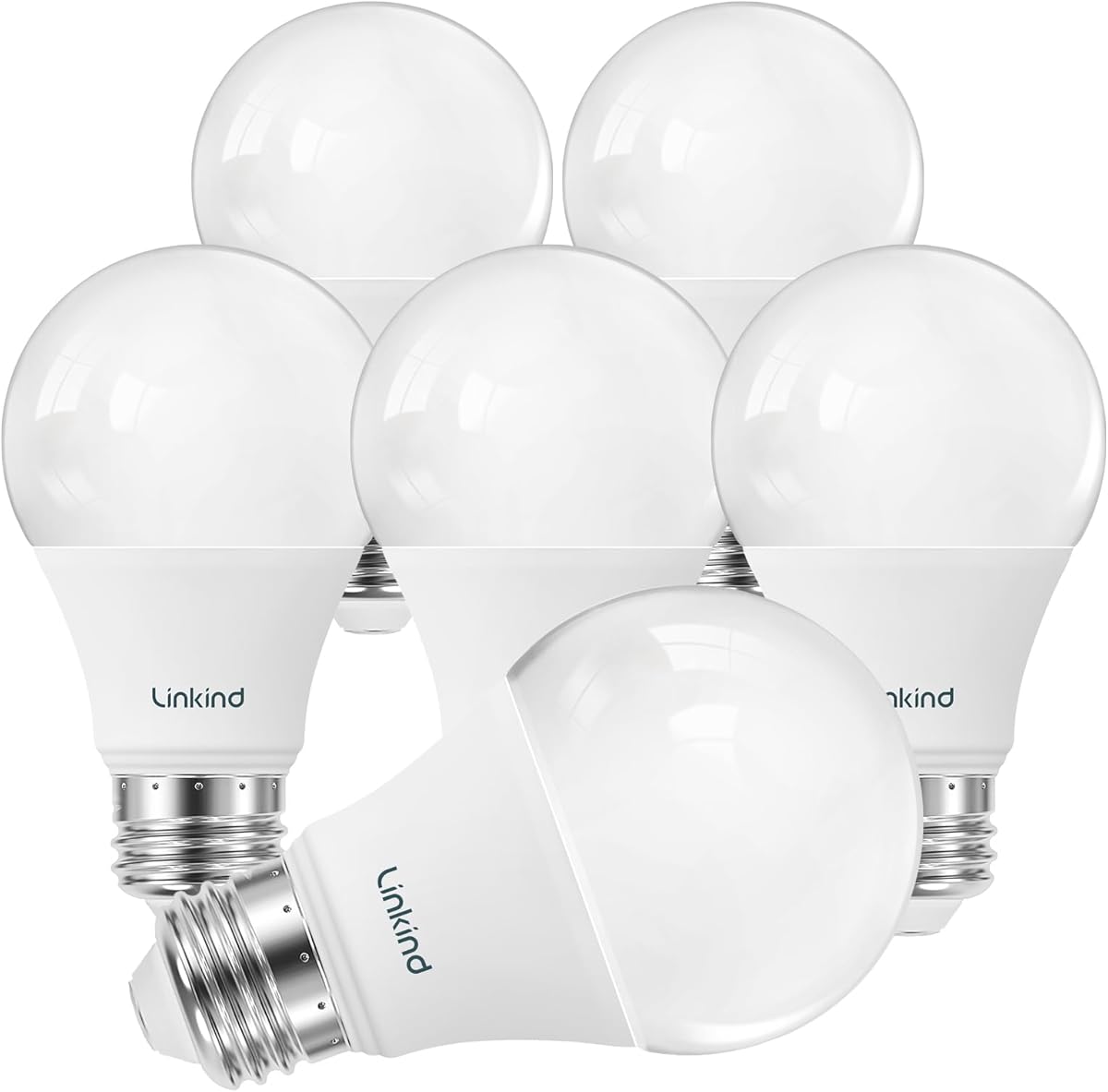
Linkind's six-pack provides 840 lumens per bulb from an 8.5-watt LED source, giving it one of the strongest output-to-power combinations in this guide. The 4.7 rating and broad room applications make it a strong contender for households replacing standard 60-watt-equivalent A19 lamps in several rooms.
We may earn a commission when you buy through this link, at no additional cost to you.
Its 5000K daylight color is designed for crisp visibility in living rooms, dining spaces, kitchens, and offices. The bulbs turn on immediately, use standard E26 medium screw bases, and provide stable non-flickering light without ultraviolet or infrared radiation. A claimed lifespan of up to 15,000 hours also reduces replacement frequency compared with incandescent and halogen lamps.
Buyers must accept that the bulbs are not dimmable and should not be used with a dimmer switch. The six-bulb quantity is also less convenient for replacing a very large number of fixtures at once than the 24-pack alternatives. Nevertheless, the high lumen output, simple installation, and stated energy savings make these bulbs attractive for targeted room upgrades.
This pick suits consumers who want a balance of brightness and low power without paying for a larger multipack. It works especially well for a home office, kitchen, hallway set, or several matching lamps. Confirm that every intended fixture accepts A19 LED bulbs and that none requires dimming.
The 840-lumen output is useful where visibility matters, such as worktops, desks, and entry areas. Operating at 8.5 watts helps limit the energy required for each hour of use.
The E26 medium base supports straightforward installation in common household fixtures. A rated life of up to 15,000 hours reduces maintenance, although actual longevity depends on usage and operating conditions.
We may earn a commission when you buy through this link, at no additional cost to you.
The QQT heater is a compact indoor heating solution rated at up to 1200 watts, with low and high settings for adjusting output. Its 4.4 rating and under-30-decibel noise specification make it particularly relevant to desks, bedside tables, and offices where quiet personal warmth is more important than whole-room coverage.
We may earn a commission when you buy through this link, at no additional cost to you.
PTC ceramic heating technology is combined with an insulating shell, enhanced safety plug, overheat protection, and automatic shutdown when the unit tips. The heater smooths airflow to reduce turbulence, and its indicator light clearly shows when it is operating. A concealed handle and compact footprint make it easy to move between rooms.
There is no listed thermostat, so users must select the appropriate heat setting manually rather than defining a target temperature. The transportation anti-vibration cover must also be removed before operation because leaving it in place can interfere with the overheating protection. These are meaningful considerations, but neither undermines the heater's usefulness for short, localized warming.
This model is best for someone seeking supplemental heat in a small personal zone without the noise of a conventional fan heater. It is less suitable as the sole heating source for a large room. Keep the unit stable, remove the shipping cover, leave clearance around the air outlet, and follow all included operating instructions.
Noise below 30 decibels makes this heater suitable for bedrooms, quiet offices, and work sessions. The two-speed design lets users choose a lower output when full power is unnecessary.
Tip-over, overheat, and insulated-shell protections help manage common placement risks. Removing the anti-vibration shipping cover is an essential first step because it can inadvertently activate the protection system.
We may earn a commission when you buy through this link, at no additional cost to you.
The AEOCKY RHEA-001 is a compressor dehumidifier built for homes up to 5,500 square feet, with a stated maximum extraction rate of 80 pints per day in severe humidity. Its 4.5 rating reflects strong performance and efficiency positioning, while ENERGY STAR Most Efficient 2025 certification provides a more meaningful selection criterion than broad efficiency language alone.
We may earn a commission when you buy through this link, at no additional cost to you.
The product listing highlights a high-efficiency rotary compressor, copper heat-exchanger tubing, hydrophilic aluminum foil, and precise humidity compensation. The claimed 56-pint capacity in a warm, damp basement and 80-pint performance at high humidity demonstrate the importance of choosing by operating conditions rather than tank volume alone. A low 44-decibel minimum fan setting and stated quietness even at higher settings support use around living spaces.
This is a large and sophisticated appliance rather than a lightweight option for occasional dampness. It weighs 31 pounds and measures 14.45 by 8.66 by 24.09 inches, so placement and drainage logistics matter. Its power-off memory works especially well with a compatible smart socket for automatic resumption, and the three-year coverage is longer than many competing warranties. Buyers should also verify local drainage arrangements and current certification details.
This premium pick is most appropriate for households with recurring moisture problems, basements, large living areas, or year-round humidity concerns. Its efficiency credentials, capacity, sensors, and low-temperature support distinguish it from smaller portable dehumidifiers. For a compact apartment with only occasional condensation, a smaller unit would generally be more proportionate.
The combination of ENERGY STAR Most Efficient 2025 status, a high-efficiency compressor, and 80-pint maximum extraction targets users who need moisture removal without relying on inefficient cycling. Capacity figures vary with temperature and humidity.
Dynamic sensing and proprietary compensation algorithms support more stable indoor humidity. Power-off memory also makes the unit practical for smart-socket setups and locations where power interruptions are common.
We may earn a commission when you buy through this link, at no additional cost to you.
DREO's Atom One combines up to 1500 watts of heating with an adjustable digital thermostat, making it a strong option for users who want more control than a simple two-speed heater. Its 4.6 rating reflects a favorable combination of rapid heating, broad airflow, quiet operation, and safety features.
We may earn a commission when you buy through this link, at no additional cost to you.
The thermostat spans 41 to 95 degrees Fahrenheit in one-degree increments, while ECO mode adjusts heat output to reach the selected temperature. A 70-degree oscillation pattern distributes warmth across a wider area than a stationary directional heater. The brushless DC motor and nine aerodynamic blades are designed to smooth airflow and reduce turbulence, with noise stated as low as 37.5 decibels.
Shield360° protection includes tip-over and overheat protection, an enhanced safety plug, and UL94 V-0 flame-retardant materials. Although 1500 watts can provide fast warmth, it also represents a higher maximum electrical load than lower-powered personal heaters. The product is designed for indoor supplemental heating, not outdoor use or whole-house replacement.
This heater is best for bedrooms, offices, garages with suitable indoor power, and basements where a thermostat and broad oscillation add value. Position it near the intended zone rather than against furniture or curtains, and allow the required airflow clearance. It is an excellent choice for comfort-focused heating with automatic energy management.
Selecting a target temperature gives the heater a clear operating objective, while ECO mode adjusts output automatically. This approach can avoid the unnecessary continuous high setting associated with basic manual controls.
Seventy-degree oscillation expands the heated zone, and the nine-blade motor is designed for smoother airflow. A stated minimum noise of 37.5 decibels makes the model practical for sleeping and desk work.
We may earn a commission when you buy through this link, at no additional cost to you.
This plug-in energy-saving box is designed to stabilize voltage, balance current, and improve the power factor of connected appliances. It has a 3.5 rating, lower than the other products in this guide, so shoppers should evaluate it as a supplementary electrical accessory rather than assume guaranteed savings.
We may earn a commission when you buy through this link, at no additional cost to you.
The product's stated purpose is to reduce losses associated with unstable voltage, unbalanced current, and harmful harmonics. It fits into a standard wall outlet without blocking adjacent receptacles and does not require complex setup. A green indicator confirms operation, making it convenient for homes, offices, cafes, restaurants, and small commercial environments.
Efficiency outcomes depend on the connected equipment, electrical conditions, and how often the appliance operates. A power factor correction device cannot create energy where none is used, and its actual effect may be limited with modern equipment that already includes efficient power supplies. Its lower rating and lack of quantified performance data warrant careful consideration and independent verification of claims.
The product may be useful for users who want a simple, dedicated device compatible with household appliances, especially in shared or older electrical environments. It is not a substitute for replacing inefficient appliances, improving insulation, or selecting correctly sized efficient equipment. Use only with compatible loads and follow the manufacturer's instructions.
The device is simply connected to a standard wall outlet, and a green light indicates that it is running. Its compact form avoids the installation work associated with larger electrical equipment.
The strongest applications involve loads where voltage instability or power factor correction offers meaningful benefit. Actual savings are not universal and may be limited by modern appliance electronics, load size, and local electrical conditions.
We may earn a commission when you buy through this link, at no additional cost to you.
ASOMST's A19 LED delivers up to 1,100 lumens using 11 watts, making it the brightest and highest-wattage lighting option listed. Its 4.6 rating makes it a strong choice for task lighting, commercial ambient lighting, and fixtures that need more punch than a standard 60-watt-equivalent bulb.
We may earn a commission when you buy through this link, at no additional cost to you.
CRI 85-plus is a meaningful advantage for spaces where color definition matters, such as craft areas, workbenches, kitchens, and retail environments. The 5000K daylight-white output provides a crisp atmosphere, while a 220-degree beam spreads illumination across a broad area. The product also states stable, flicker-free light without ultraviolet or infrared radiation.
The bulb is non-dimmable and must not be assumed to work with a dimmer switch. Although 11 watts remains far below the 100-watt incandescent output it replaces, it uses slightly more power than several 60-watt-equivalent alternatives in the guide. The claimed lifespan of up to 25,000 hours helps offset the operating difference by reducing replacement frequency.
Choose this model when brightness and color quality are the leading priorities. It is particularly suitable for pendant lights, chandeliers, vanity fixtures, wall lanterns, floor lamps, and table lamps that accept E26 A19 bulbs. For dimmable fixtures or maximum whole-house efficiency, one of the lower-wattage 60-watt-equivalent options may be more suitable.
The 1,100-lumen output provides ample illumination for work areas and larger fixtures. Using 11 watts retains a major efficiency advantage over traditional 100-watt incandescent bulbs.
CRI 85-plus helps reveal more natural-looking colors than lower-CRI alternatives. This makes the bulb attractive for kitchens, creative workspaces, and areas where visual accuracy matters.
We may earn a commission when you buy through this link, at no additional cost to you.
The evelor six-pack provides a straightforward way to replace 60-watt-equivalent incandescent lamps with 9-watt LED bulbs. It produces 800 lumens at 5000K and carries a 4.7 rating, making it a convincing budget pick for users who want proven brightness and efficiency without moving to a higher-output design.
We may earn a commission when you buy through this link, at no additional cost to you.
The stated energy saving reaches 90 percent compared with traditional 60-watt incandescent bulbs, which represents one of the strongest reduction claims in the guide. CRI 80-plus supports natural-looking color, and the no-flicker design provides stable output for hallways, stairways, living rooms, kitchens, and work areas. The standard E26 medium base makes installation straightforward in compatible fixtures.
These bulbs are not dimmable, which is the main limitation for anyone seeking adjustable lighting. The product listing also mentions indoor and outdoor applications, but shoppers should still verify that the specific fixture, damp-location rating, and local conditions are appropriate. A claimed lifespan above 15,000 hours reduces replacement frequency and maintenance.
This pick is ideal for targeted upgrades on a constrained budget, such as replacing six high-use bulbs in a hallway, bedroom, or office. It offers a better balance of multipack convenience, brightness, and operating efficiency than many budget alternatives. Confirm the bulb shape, base, dimmer compatibility, and fixture rating before ordering.
Replacing a 60-watt incandescent with a nine-watt LED can significantly reduce lighting electricity use. The 800-lumen output maintains practical brightness for common household spaces.
The six-bulb quantity works well for several high-use locations, while 15,000-plus-hour life helps limit replacements. Non-dimmable operation should be confirmed before fitting these bulbs to controlled fixtures.
We may earn a commission when you buy through this link, at no additional cost to you.
Dalattin's 24-bulb pack delivers 800 lumens of 5000K daylight light from each nine-watt bulb. Its 4.7 rating indicates a strong reception, and the combination of a large multipack, standard E26 base, and claimed 85-percent energy reduction makes it especially practical for comprehensive household lighting replacements.
We may earn a commission when you buy through this link, at no additional cost to you.
The bulbs are marketed for living rooms, offices, cafes, and other residential or hospitality spaces. CRI 80-plus helps colors appear vivid and accurate, while non-flicker, non-dazzling output is intended to provide a more comfortable visual environment. The absence of lead and mercury supports their positioning as a modern alternative to traditional incandescent lamps.
They are non-dimmable, making them less flexible than dimmable LED alternatives. Their calculated operating-life range depends on three hours of daily use, so individual household habits will determine the actual replacement interval. Like all multipacks, this one is most valuable when many compatible fixtures need the same bulb type; unused bulbs should be stored in a dry place with protection from physical damage.
This is a practical choice for households ready to replace many fixtures at once, especially those that value simple installation, consistent light, and lower operating demand. It is less compelling for a single-lamp project because of the pack size. Verify every fixture accepts A19 E26 non-dimmable bulbs before making the switch.
Twenty-four matching bulbs make it easy to standardize compatible fixtures throughout a home or small commercial setting. A consistent 5000K output also creates a uniform visual atmosphere.
Using nine watts instead of a 60-watt incandescent reduces lighting demand while maintaining 800 lumens. The stated long service life further reduces the frequency of bulb changes.
We may earn a commission when you buy through this link, at no additional cost to you.
The JNDRO wall-mounted heater combines thermostat-based control, remote operation, and an ECO mode that adjusts heating power according to ambient temperature. Its 4.4 rating makes it a compelling option for households seeking hands-free convenience and a heater that does not occupy floor space.
We may earn a commission when you buy through this link, at no additional cost to you.
Users can set temperatures from 41 to 95 degrees Fahrenheit and control the timer, fan speed, and oscillation through the included remote. A clear LED display shows current settings, while a 24-hour timer helps avoid unnecessary operation. The heater supports 60-, 90-, and 120-degree oscillation angles, allowing the user to select a narrower or wider distribution pattern.
Unlike portable models, this product requires secure wall mounting, making installation a central consideration. The remote requires two AAA batteries, which are not included. A child lock helps prevent accidental operation, and the product listing states that it includes a 30-day return and 12-month replacement policy. Buyers should confirm wall condition, placement, and local safety requirements before installation.
This model is best for a garage, home office, laundry room, workshop, or other indoor area where wall space is available and remote temperature changes are convenient. It may be less convenient for renters or anyone wanting to move the heater between rooms. Professional installation is advisable whenever the instructions call for it or the mounting surface is uncertain.
ECO mode changes heating power according to the ambient temperature, while the thermostat provides a clear target. The timer offers another way to avoid operating the heater when no one needs warmth.
Remote adjustment of temperature, fan speed, timer, and oscillation reduces the need to approach the wall-mounted unit. A visible LED screen communicates the selected settings, and a child lock adds household control.
We may earn a commission when you buy through this link, at no additional cost to you.
The most energy-efficient product is the one that meets your operating need without adding unnecessary capacity, incompatible controls, or installation complexity. Compare power, performance, controls, safety, and the environment where the device will be used.
Energy efficiency depends on both the amount of power a device draws and how long it remains active. A nine-watt LED used for several hours each day can produce meaningful savings over a 60-watt incandescent, while a 1200-watt space heater consumes considerably more electricity per hour than a smaller personal heater. Consider both rated wattage and realistic runtime rather than relying on efficiency claims alone.
Match power to the room, not merely the largest available setting. A compact desk heater may be sufficient for personal warmth, whereas a large or poorly insulated room may require supplemental heat that one portable unit cannot provide efficiently.
LED shoppers should compare lumens, correlated color temperature, and CRI rather than relying on wattage alone. More lumens indicate greater total brightness, while CRI describes how accurately a light renders colors. A 5000K daylight spectrum suits task-heavy and crisp environments, but warmer alternatives may be preferable for bedrooms or relaxed living spaces when mood is the priority.
Match the bulb's beam and brightness to the fixture. An overly bright bulb in a small decorative shade can create glare, while an underpowered bulb may leave a work area poorly illuminated.
Thermostats, ECO modes, timers, remotes, and automatic oscillation can make equipment more efficient because they reduce unnecessary output. A thermostat is particularly useful for heaters, allowing the appliance to stop or reduce heating after the selected temperature is reached. Remote controls add convenience, although their benefit is greatest when they also connect to timers or adaptive modes.
For lighting, confirm whether a dimmable product is required rather than choosing one solely for brightness. Some fixtures and bulbs do not work together, so compatibility should always be checked.
Coverage claims are meaningful only when they align with the intended area. A six-bulb pack may be perfect for several lamps, while a 5,500-square-foot dehumidifier is excessive for a small apartment. Portable heaters focus warmth around one person, and oscillation or wall mounting can extend reach. Dehumidifiers require enough space for airflow, drainage, and access to the water tank.
Also consider room insulation, ceiling height, furniture placement, and humidity levels. A correctly sized appliance generally operates more efficiently because it does not have to work at maximum output to overcome an undersized design.
Look for protections directly relevant to the product. Space heaters should include tip-over and overheat shutdown, along with a safe housing and appropriate placement guidance. Electrical power devices should offer overheat, overload, and overvoltage protection. LED bulbs need appropriate base and wattage compatibility, while wall-mounted equipment should be secured according to its instructions.
A safety feature is useful only when it is properly understood and maintained. Keep heaters away from combustibles, remove shipping covers, follow clearance requirements, and never bypass built-in protection systems.
The easiest efficiency upgrade is one that fits the intended setup without modifications. A19 LED bulbs require compatible E26 sockets, and non-dimmable bulbs should not be paired with unsupported dimmers. Wall-mounted heaters require suitable walls and secure installation, while plug-in power devices need a standard outlet without blocking neighboring receptacles.
Check dimensions, voltage, base type, fixture rating, outlet format, and drainage requirements before ordering. Reading the included instructions can prevent returns, unsafe installation, or inefficient operation caused by incorrect placement.
For heaters and dehumidifiers, noise can determine whether a product is practical in a bedroom, office, or living room. Lower-decibel models are generally better for sleeping and focused work, while airflow design can reduce turbulence even when the fan must operate. Lighting comfort depends on flicker, glare, color rendering, and appropriate brightness for the room.
Comfort is part of energy efficiency because a product people dislike or avoid may be used differently than intended. Select a comfortable output that meets the space's needs without making the room excessively bright, noisy, or warm.
Recognized certifications can help distinguish efficiency claims, although shoppers should still understand what each certification represents. ENERGY STAR Most Efficient identifies a specialized group within a broader efficiency program, while ETL or UL listing indicates evaluation against applicable safety standards. A manufacturer warranty and responsive service can also reduce the long-term cost of ownership through repairs or replacements.
Certification labels, coverage terms, and product details can change, so verify the current listing and documents. Consumers should preserve receipts and follow the manufacturer's maintenance and warranty instructions.
Before installation, read the product instructions, confirm compatibility, and inspect the equipment for shipping damage. For LED bulbs, match the A19 shape and E26 base to the fixture, check whether dimming is required, and install the bulb with the power off. Remove any packaging or protective materials, especially transport covers on portable heaters.
Operate heating and dehumidifying equipment within their intended indoor conditions, preserve the specified clearance around vents and outlets, and avoid extension cords unless the manufacturer expressly permits them. Use thermostats, ECO modes, timers, and oscillation settings to match the equipment to the occupied space. Stable placement is essential for portable heaters with tip-over protection.
For ongoing care, clean accessible filters and vents according to the manual, empty dehumidifier collection containers before they become full, and inspect cords and plugs regularly. Keep LED fixtures operating within their rated limits, replace damaged bulbs promptly, and avoid covering powered devices. Periodic care helps maintain efficiency, protects safety systems, and supports a longer service life.
Yes, LED bulbs generally use substantially less electricity to produce comparable brightness. Several products in this guide use 8.5 to 11 watts for 800 to 1,100 lumens, whereas the listed incandescent equivalents consume 60 to 100 watts. Actual household savings also depend on usage hours, electricity rates, and how many bulbs are replaced.
Lumens measure visible light output, while watts measure electrical power consumption. A lower-watt bulb is not automatically the best choice if it produces too little light for the space. Compare both figures and consider CRI, color temperature, beam spread, and fixture compatibility to identify a suitable energy-efficient replacement.
These bulbs are not designed for dimmer switches, and using them on one may cause flicker, buzzing, reduced output, or early failure. Replace the dimmer with a standard on-and-off switch or choose a bulb specifically labeled as dimmable and confirm that the fixture supports dimming.
They can be more efficient for warming a small occupied area because they deliver heat where it is needed. However, a portable heater is not a universal replacement for a properly sized central system, and its electricity consumption still depends on wattage and runtime. Use it to supplement a primary heating source and avoid leaving it unattended.
Capacity should be matched to the size of the space and severity of the moisture problem, while efficiency certification and compressor controls help govern energy use. Tank volume alone is not the same as dehumidification capacity. Buyers should also consider drainage, low-temperature performance, noise, and the space required for airflow.
Mounting alone does not guarantee lower consumption. Efficiency depends on the heater's controls, thermostat, operating time, and whether it heats only an occupied zone. A wall-mounted model can still improve convenience and space use, particularly when remote controls, oscillation, and ECO mode help avoid unnecessary operation.
No. Their effect depends on the connected appliance, the electrical load, and the condition of the installation. Modern electronics may already have efficient power supplies, so a plug-in correction device may have little measurable effect. Efficiency claims should be considered alongside equipment replacement and other conservation measures.
Check that the output matches expectations, controls respond correctly, and safety indicators or displays show normal operation. For bulbs, look for steady light without unusual flicker; for heaters, confirm stable placement and proper oscillation; and for dehumidifiers, monitor collection and humidity readings. Stop using any device that shows damage, overheating, or abnormal electrical behavior.
The evelor six-pack stands out as a budget-friendly lighting choice, the 24-pack A19 LEDs offer the best overall convenience for broad household replacement, and the AEOCKY dehumidifier takes the premium position for its certification, capacity, and advanced humidity controls. Each serves a distinct need, so installation and output requirements matter more than a single universal winner.
Prioritize the operating features that reduce consumption in your specific environment: low wattage for frequently used lighting, thermostats and timers for heating, and appropriately sized capacity for moisture control. Verify base, fixture, outlet, wall, and dimmer compatibility before buying, and follow all supplied safety and maintenance instructions.
Current prices, promotions, certifications, and product configurations can change over time, so shoppers should review the live listing before ordering. Comparing the present product details with the requirements of the room will help identify the most efficient and practical option in November 2026.