
MOCREO WiFi Freezer Alarm
4.5Editor score
No separate hub required
Push and email alerts
Up to two years history
A freezer thermometer with app turns a basic temperature display into a remote warning system, helping you catch unsafe temperature changes before frozen food is affected. The best models combine dependable sensing, phone alerts, flexible placement, clear history, and simple setup for kitchens, garages, RVs, and other monitored spaces.
We compared all ten products by examining their stated temperature ranges, accuracy, app notifications, alarm options, wireless coverage, data storage, power source, humidity tracking, and installation features. The list covers gateway-based systems, direct WiFi models, Bluetooth sensors, and LoRa-based monitoring for locations beyond ordinary router reach.
Each pick highlights a different reason to consider it, from balanced everyday monitoring to long-range coverage, multi-sensor setups, and budget-friendly alert systems. Product availability and pricing can change, so check the current listing and confirm gateway, app, network, and power requirements before making a final decision.
4.5Editor score

4.4Editor score

4.6Editor score
As an Amazon Associate we earn from qualifying purchases.
This side-by-side comparison evaluates each thermometer's connection method, alert coverage, monitoring capabilities, and practical installation features, making it easier to identify the right system for your freezer and home setup.


The GoveeLife WiFi Refrigerator Thermometer Sensor with Alarm is a well-rounded connected monitoring system for anyone who wants temperature readings and timely warnings from multiple cold-storage locations. It carries a 4.4 rating, and its appeal lies in the combination of a two-sensor package, an included gateway, app notifications, email alerts, and a built-in audible alarm. That combination gives the system more ways to communicate a problem than a basic display or a single notification channel.
We may earn a commission when you buy through this link, at no additional cost to you.
The sensing specifications are particularly useful for freezers because the stated operating range extends from minus 40°F to 158°F, with accuracy of plus or minus 0.9°F and a two-second response time. The slim 2.7mm NTC probe can be positioned away from the warmest or coldest surfaces, while the included holder keeps the cable organized. The magnetic and hanging options make it practical for refrigerators, freezers, and other household spaces without requiring complicated installation.
The main drawback is the requirement for a gateway and a compatible 2.4GHz WiFi network. While a single gateway can coordinate as many as 10 sensors within 230 feet, that means planning placement so the hub has a clear path to the sensors. The audible buzzer can also be muted in the app, but silencing it manually otherwise requires pressing a side button. Buyers who want completely hands-free sound control may prefer a system whose hub beep can be dismissed remotely.
This is a strong recommendation for households monitoring a kitchen freezer, garage refrigerator, basement cold room, or several temperature-sensitive areas at once. It offers enough accuracy, range, and alert flexibility for everyday use while remaining straightforward to install. The included hardware and centralized control make it easier to expand than a one-sensor setup, particularly for families who want protection while away from home.
App push notifications and email alerts support remote awareness, while the 80dB device buzzer provides an immediate local warning. This is useful when a freezer is in a garage, basement, or other space where an ordinary audible appliance alarm would be difficult to hear.
The two-second refresh rate provides a responsive view of temperature changes, while magnetic mounting, hanging hardware, and the probe holder help keep the installation neat. Position the probe centrally rather than against a wall or directly beside the cooling outlet for a more representative reading.
We may earn a commission when you buy through this link, at no additional cost to you.
The GoveeLife WiFi Refrigerator Thermometer 2-Pack with Gateway & LCD Display combines remote app monitoring with a temperature screen that can be checked without opening a phone. Its 4.4 rating reflects a broadly capable system, and the two-pack is useful for tracking a refrigerator and freezer independently. It shares the same general strengths as the first GoveeLife option but adds a visible local display and explicit two-year data retention.
We may earn a commission when you buy through this link, at no additional cost to you.
The app supports customizable temperature ranges and notifications when readings move outside the selected limits. A delayed-alarm function can wait between one and ten minutes, reducing the chance that a brief door opening triggers a false notification. The stated sensor accuracy is plus or minus 0.9°F over a minus 40°F to 158°F range, with updates every two seconds. An included holder secures the probe, and the slim cable should make routing through a door seal easier than with a bulky sensor.
It is important to understand the distinction between the sensor and the network hub. Although the product listing describes audible alerts, the sensor itself does not sound an alarm; the included gateway handles the WiFi connection and app remote alarms. The gateway can pair with up to 10 sensors and uses 2.4GHz WiFi only. Buyers also need to distinguish this bundle from a standalone sensor package, because a gateway sold separately may be necessary for remote use.
This kit is an attractive option for someone who wants both glanceable readings and detailed phone-based history. It is especially helpful for comparing a refrigerator against a freezer or monitoring two different cabinets. For households that do not need a local audible siren from the sensor itself, the LCD and app combination provides an effective way to check conditions without depending solely on remote alerts.
The LCD makes quick checks more convenient, while the app's online graphs preserve two years of data for review or export. Together, they help users identify short-term fluctuations and longer compressor or defrost patterns.
A user-adjustable delay helps distinguish ordinary access from a sustained temperature excursion. This makes the system better suited to busy kitchens where doors are opened frequently during meals or unpacking.
We may earn a commission when you buy through this link, at no additional cost to you.
The MOCREO WiFi Thermometer Freezer Alarm is a capable two-sensor system for users who want app, email, and audible notifications without a recurring subscription. Its 4.4 rating and broad compatibility make it a flexible middle ground. The hub can connect as many as 30 supported BLE sensors, allowing a single setup to cover multiple refrigerators, freezers, hot tubs, RVs, nurseries, greenhouses, or other monitored areas.
We may earn a commission when you buy through this link, at no additional cost to you.
Remote muting is a particularly useful feature. When the hub emits its 90dB beep, the user can dismiss it from the app rather than walking over to the hub. The hub also offers offline, low-battery, and anti-false-alarm settings. Sensors measure from minus 40°F to 158°F with plus or minus 0.9°F stated accuracy, and their ultra-thin 0.9mm cables are designed to pass through a door seal without holding it open.
The tradeoff is that this is a hub-based arrangement, so the buyer must place the hub within wireless reach of the sensors and connect it to a 2.4GHz network. The compatible sensor list is broad, but it is not universal; buyers with existing equipment should confirm the exact model numbers before purchasing. The system is also more elaborate than necessary if only one freezer needs checking, and a direct WiFi model may be easier to deploy in that scenario.
For buyers who want several monitored locations and a wide range of notification controls, this kit is an excellent value-oriented choice. The included magnetic backing, metal mounting plate, cable clips, and organizers help make installation tidy. It is also a good fit for users who value remote silencing and no-subscription history, particularly when one hub needs to serve a freezer, refrigerator, and other temperature-sensitive environment.
The ability to pair up to 30 supported sensors means the initial two-sensor setup can expand into a broader monitoring network. This is useful for households, workshops, or small commercial spaces that need several independent temperature points.
App push, email, and a loud hub beep provide three notification paths. The remote mute function also prevents the need to physically silence an alarm at the hub, while two years of exportable history help with record keeping.
We may earn a commission when you buy through this link, at no additional cost to you.
The MOCREO WiFi Remote Thermometer Freezer Alarm is built for locations that exceed the practical reach of an ordinary WiFi sensor. It holds a 4.6 rating and includes two smart wireless sensors, a digital hub, and support for open-air communication up to 1,640 feet, or roughly one-third of a mile. The hub can accommodate as many as 100 sensors, making this one of the most scalable options in the guide.
We may earn a commission when you buy through this link, at no additional cost to you.
Its monitoring range is minus 4°F to 131°F, with stated accuracy of plus or minus 0.9°F. That makes it less suited to deep-freezer conditions than several products rated to minus 40°F, but it remains suitable for refrigerators, outdoor cold storage, greenhouses, RVs, pet shelters, nurseries, restaurants, and other spaces where long-range communication is more important. The LS1 sensor has IP66 splash resistance for humid environments.
The digital hub acts as a local dashboard with real-time readings, historical graphs, alarm information, a clock, weather, and calendar updates. It connects through Ethernet or 2.4GHz WiFi, while app notifications, email alerts, and a 95dB hub beep provide multiple ways to respond. Remote muting is available. Buyers must avoid fully enclosed metal containers because such surroundings can interfere with the wireless signal, even when the open-air specification is substantial.
This system is best for large properties, mobile or remote installations, and users who want centralized monitoring across widely separated areas. It is overkill for a compact kitchen but compelling when a garage, greenhouse, RV, and basement all need coverage. Its two-year CSV export, low-battery warnings, power-outage settings, and compatibility with numerous MOCREO sensor families add value for users building a broader monitoring network.
A stated one-third-mile open-air range allows sensors to operate far from the hub, making the system suitable for large lots and multi-building environments. Real-world performance still depends on walls, doors, appliances, and other obstructions.
The hub display combines live readings with alarms, trends, time, weather, and calendar information. Ethernet support is convenient when running a stable network connection is easier than relying on WiFi throughout the property.
We may earn a commission when you buy through this link, at no additional cost to you.
The WiFi Freezer Thermometer with App Alarm offers a simple way to monitor temperature and humidity using two fully wireless sensors. Its 3.8 rating is the lowest in this group, so buyers should weigh that carefully against the appealing no-cable design, broad stated range, and app-based history. It is aimed at users who prioritize clean installation and flexible sensor placement over laboratory-grade precision.
We may earn a commission when you buy through this link, at no additional cost to you.
The app sends notifications when temperatures move outside user-defined ranges, and one year of historical information can be viewed as graphs or exported to CSV. The monitoring range is minus 4°F to 140°F with stated accuracy of plus or minus 1.8°F, while humidity is measured from 0% to 99% relative humidity. A single setup can support up to nine sensors, with a stated wireless range of 492 feet.
The principal limitation is the minimum measurement point. The product cannot detect temperatures below minus 20°C, which is minus 4°F, so it should not be used in a deep-freezer environment that regularly operates colder. Its accuracy specification is also less precise than the plus or minus 0.9°F used by several MOCREO and GoveeLife options. The included freeze-resistant AAA batteries are important for continued operation inside a refrigerator, and the listing recommends replacing them with the same type later.
This is a reasonable choice for standard refrigerators, cold storage rooms, basements, and garage units where the operating range is adequate. The wireless sensors eliminate the problem of routing a cable through a door seal, and their small form should make placement simple. It is less suitable for deep freezers, precision-sensitive applications, or users who require the tightest temperature tolerance in this comparison.
Fully wireless sensors avoid a probe cable that could interfere with a door gasket or create an untidy installation. Each unit can be repositioned as storage needs change, which is useful in adaptable garage or basement setups.
Humidity tracking adds context that a temperature-only device cannot provide. The app's graphs make it possible to examine whether a cabinet is experiencing both cold and condensation concerns over time.
We may earn a commission when you buy through this link, at no additional cost to you.
The YoLink Freezer Temperature Sensor Kit is a premium connected monitoring package containing one hub and three sensors. Its 4.6 rating reflects a strong combination of accuracy, long-range communication, flexible alerts, and extended battery life. Unlike conventional WiFi monitors, the system uses a LoRa-based protocol, so sensors can communicate with the hub without relying on the capacity or reach of the home WiFi network.
We may earn a commission when you buy through this link, at no additional cost to you.
The stated open-air range is up to 2,034 feet, and the sensors can be placed in refrigerators, freezers, greenhouses, barns, chicken coops, plant nurseries, or other remote areas. The accuracy specification is plus or minus 0.36°F from 32°F to 129°F and plus or minus 0.72°F from minus 20°F to 32°F. The overall measurement range is minus 4°F to 122°F, making it less appropriate for a deep freezer that operates below minus 4°F.
Users can create custom temperature thresholds and choose among text, email, and push notifications. Apple devices support Critical Alerts, while Android offers comparable options. SMS access has a defined allowance of 15 free messages per month for a hub-and-sensor combination. IFTTT applets can be triggered by alarm thresholds, and Alexa can provide a voice temperature query, although Alexa routines are not supported. Two AA batteries power each sensor for up to five years depending on use and conditions.
The three-sensor configuration makes this an excellent choice for households that want coverage of a refrigerator, freezer, and another remote area without adding sensors separately. It is particularly compelling for a property where ordinary WiFi would be difficult to reach. The minimum-temperature limitation should be checked carefully, and buyers who require unlimited or high-volume SMS should account for the included allowance.
The LoRa connection gives the system more freedom in garages, outbuildings, and remote storage areas. It also avoids adding more traffic to a home network, which can be advantageous when several distant sensors must remain online.
The included three sensors allow immediate coverage of multiple cold-storage points. Combined with detailed accuracy ratings and long battery life, this is well suited to users who view temperature monitoring as an ongoing household system.
We may earn a commission when you buy through this link, at no additional cost to you.
The GoveeLife Bluetooth Refrigerator Thermometer with LCD Display is a flexible single-sensor option that can operate as a local Bluetooth device or connect to a compatible GoveeLife gateway. Its 4.4 rating and four-inch-wide temperature range make it useful for standard refrigerators, freezers, aquariums, and hot tubs. The LCD provides an immediate local reading, while the app adds history and configurable alerts.
We may earn a commission when you buy through this link, at no additional cost to you.
The sensor measures from minus 40°F to 158°F with plus or minus 0.9°F accuracy and a two-second refresh. Its slim probe, magnetic mounting, lanyard, and holder allow tidy placement. A delay of one to ten minutes can suppress notifications caused by brief door openings, and low-battery reminders are included. When paired with a supported gateway, the product supports remote app monitoring and two years of graph viewing and data export.
The important limitation is that the gateway is not included. Without one, the sensor has a stated Bluetooth range of 197 feet, and the app must remain active in the background to provide proximity alerts. For true remote notifications from away from home, buyers need a compatible H5151, H5042, or H5043 gateway. This makes the single sensor a sensible starting point, but it is not the simplest standalone choice for unattended locations.
This product is best for users who may later add a gateway, need a local LCD, or want to monitor a nearby aquarium, hot tub, refrigerator, or freezer. Its accuracy and deep-temperature range are compelling, but the distinction between local Bluetooth proximity alerts and gateway-based remote monitoring must be understood before purchase. It works especially well as an adaptable component within a broader GoveeLife setup.
The sensor can provide nearby app notifications through Bluetooth without a hub. Buyers who later need more range or away-from-home alerts can add a compatible gateway, making this a flexible entry point for staged setups.
A minus 40°F lower limit distinguishes this sensor from options that stop at minus 4°F. That makes it a better fit for conventional chest freezers and deep-freezer cabinets where low readings are expected.
We may earn a commission when you buy through this link, at no additional cost to you.
The AcuRite Digital Wireless Fridge and Freezer Thermometer offers a focused alternative for buyers who want reliable local monitoring without an app, gateway, or connected account. Its 4.5 rating reflects a straightforward design that includes separate refrigerator and freezer sensors, a digital console, customizable alarms, and maximum/minimum temperature tracking. It is especially useful for homes and restaurants that need an at-a-glance warning without smart-home integration.
We may earn a commission when you buy through this link, at no additional cost to you.
The console has a readable LCD and can be mounted magnetically to a refrigerator, hung on a wall using its keyhole, or placed on a countertop with the foldout stand. Silicone sensor straps can be secured with suction cups or wrapped around a wire shelf. These placement options make it straightforward to position each probe where it can best represent the temperature of its compartment.
The central trade-off is that there is no companion app. Users cannot expect remote phone notifications, cloud records, emailed warnings, or web-based graphs. Wireless distance is also naturally limited compared with gateway and LoRa systems. It is therefore most appropriate when the display can sit near the monitored appliances or when the primary goal is a dependable local alarm rather than remote supervision.
For a user whose freezer is in the kitchen and visible from the living area, this is a compelling, uncomplicated choice. It covers two compartments with a single console and provides enough historical context through maximum and minimum readings to reveal unusual temperature excursions. Buyers who require phone access while away should instead choose one of the connected models, but those who value simplicity will find this system easier to operate.
Customizable temperature alarms help notify you when a door is left open or an appliance begins failing. The console's local operation means there is no network, account, app, or hub to configure.
Separate refrigerator and freezer sensors feed a single display, making it easy to compare conditions at a glance. Maximum and minimum tracking preserves the most recent extremes without requiring a full historical graph.
We may earn a commission when you buy through this link, at no additional cost to you.
The MOCREO WiFi Freezer Alarm Refrigerator Thermometer is a practical single-sensor solution for buyers who want direct app monitoring without adding a gateway. It holds a 4.5 rating and supports push notifications, email alerts, and an on-device screen that flashes red during an alarm. The device connects directly to a 2.4GHz home WiFi network, simplifying the components that must be installed.
We may earn a commission when you buy through this link, at no additional cost to you.
Its stated range extends from minus 40°F to 257°F with plus or minus 0.9°F accuracy. A long, ultra-thin 4.9-foot probe can pass through a refrigerator or freezer gasket and can also be used in reptile enclosures or wine coolers. App adjustment lets the user compare the reading with another thermometer and fine-tune the displayed value for greater confidence in alarm settings.
The biggest limitation is that the NS1 requires a 2.4GHz network within reach. A garage, basement, cabin, or detached workshop may need its own router or extender. It also runs on continuous USB-C power, so a wall outlet must be within reach of the probe cable. A USB power adapter is not included, and the system is tied to a cable rather than a freely positioned wireless cell.
This is an excellent match for someone who wants continuous power, direct app control, and no separate hub. It is particularly suitable for deep freezers, medicine refrigerators, and food storage where a stable power supply is desirable. The lack of a hub simplifies the setup, but users must confirm that their network reaches the appliance and that they are comfortable routing and powering a permanent cable.
The sensor connects straight to a 2.4GHz network, avoiding the cost, setup, and failure point of a separate gateway. This keeps the installation focused on one device, its probe, and app configuration.
The wide minus 40°F to 257°F range and plus or minus 0.9°F accuracy suit cold-storage monitoring. Continuous USB-C power removes the need to recharge a battery or watch for a sudden loss of monitoring.
We may earn a commission when you buy through this link, at no additional cost to you.
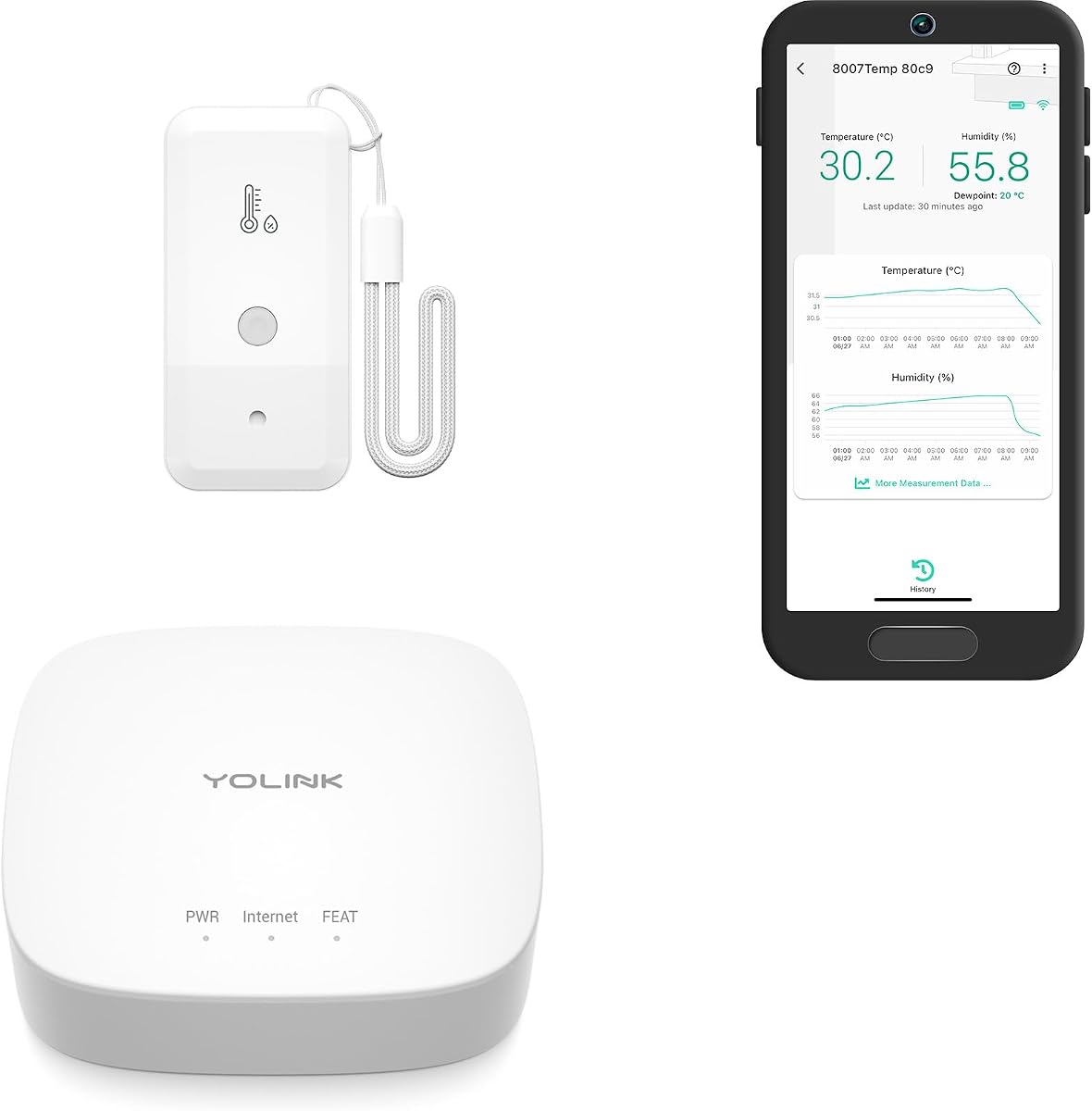
The YoLink Freezer Thermometer Hygrometer Kit is a compact connected monitoring package for users who want temperature and humidity information in one sensor. It has the highest listed rating in this guide at 4.7 and includes one hub and one sensor. The long-range LoRa connection distinguishes it from conventional WiFi products and allows monitoring in areas where router coverage is limited.
We may earn a commission when you buy through this link, at no additional cost to you.
Custom temperature and humidity thresholds can trigger text, email, or push notifications. The app provides regular condition updates, and the stated open-air range is up to 2,034 feet. The hub-and-sensor combination includes 15 free SMS messages per month, while Critical Alerts can help Apple users receive important notices even when the phone is silenced. The sensor uses two AA batteries and may operate for up to five years depending on usage and environmental conditions.
This kit is less extensive than the three-sensor YoLink package because only one sensor is included. The product information also does not state a specific temperature measurement range, so buyers who need verified deep-freezer capability should confirm the current specifications before purchase. Alexa can answer temperature queries, but humidity voice queries and Alexa routine triggering are not supported, even though IFTTT temperature alert applets are available.
For a single distant cabinet, pet area, greenhouse, nursery, or other humidity-sensitive location, this is a strong and refined solution. Its combination of long-range communication, dual-parameter monitoring, critical notifications, and long battery life makes it particularly useful where maintaining a reliable connection matters. Users needing several monitored points should consider the larger YoLink kit instead.
Humidity readings can reveal condensation, damp storage conditions, or poorly balanced environments that a temperature-only sensor would miss. Separate thresholds allow the app to notify you about whichever condition is more important.
The LoRa-based connection keeps sensors independent of home WiFi congestion and allows them to operate far from the hub. This is useful for detached structures, basements, and outdoor locations where reliable network coverage is uncertain.
We may earn a commission when you buy through this link, at no additional cost to you.
The right connected freezer thermometer depends on where the appliance is located, how much remote coverage you need, and whether convenience or precision is the priority. Consider connection architecture, alert methods, accuracy, placement, power, and data retention together rather than focusing on a single headline specification.
A direct WiFi model connects to a 2.4GHz network without a separate hub, making it the simplest option for a nearby freezer. The MOCREO Direct WiFi Alarm illustrates this approach: it provides app and email alerts while removing another powered device from the setup. Hub-based systems add a central coordinator, but that hub can serve multiple sensors, extend communication options, and provide a local display or audible alarm. Direct WiFi is convenient for one location, while a gateway is often more logical for several appliances, multiple rooms, or a need for centralized status information.
In both cases, check whether the appliance has dependable 2.4GHz coverage. A basement or detached garage may have a strong router upstairs but still lack a usable signal at the freezer. Direct models may require a nearby router or network extender, while hub systems require careful placement of both the hub and sensors.
Bluetooth is useful when the phone will remain near the sensor, but it should not be confused with full remote monitoring. The GoveeLife Bluetooth Sensor can send proximity alerts through its app, yet unattended away-from-home notifications require a compatible gateway and an active background app. LoRa-based systems take a different approach by using a long-range, low-power protocol between the sensors and hub. YoLink products can therefore work far beyond ordinary WiFi reach and do not add traffic to the home network.
Choose Bluetooth when local convenience and future gateway expansion are the goals. Choose LoRa when a freezer, greenhouse, garage, or outbuilding is remote from the router and dependable long-distance communication is more important than a hub-free arrangement.
The measurement range must match the coldest temperature your appliance can reach. Several GoveeLife sensors and the MOCREO Direct WiFi Alarm extend to minus 40°F, making them more appropriate for deep freezers. The MOCREO Long-Range System, Wireless WiFi Sensor Pair, and YoLink kits list a lower limit of minus 4°F. That may be suitable for a refrigerator or shallow cold-storage cabinet, but it is not equivalent to continuous deep-freezer capability.
Accuracy specifications also vary. Plus or minus 0.9°F is common among the leading options, while the Wireless WiFi Sensor Pair lists plus or minus 1.8°F and the YoLink kits provide more detailed ratings across different temperature bands. Consider whether the cabinet requires strict control, ordinary food-safety awareness, or general environmental tracking.
A useful system should notify you through more than one channel. App push notifications are immediate, email provides a record, and a hub or device beep can warn people nearby. Some products also issue critical alerts that can bypass silent or Do Not Disturb modes. Consider how you want to be reached: a traveling user may prefer a critical phone notification, while someone at home may value a loud local alarm.
Frequent brief temperature changes are normal around refrigerator doors and compressor or defrost cycles. A configurable delay between one and ten minutes can prevent these moments from generating unnecessary alerts. Remote mute is another useful feature, allowing you to silence a hub from the app rather than walking to it. Compare these controls before choosing a system that may be too sensitive for your routine.
Wireless sensor pairs offer clean placement because they do not require a cable through the door seal. Wired-probe models can reach a broader temperature range and may be more suitable for deep freezers, but the cable must be routed without obstructing the gasket. The MOCREO kits use ultra-thin flat cables for this reason, while the GoveeLife units include holders and organizers to keep the probe tidy.
For non-app systems, consider the AcuRite display's magnetic backing, wall keyhole, foldout stand, suction cups, and silicone straps. For any sensor, place the probe away from walls, vents, door seals, heating elements, and containers that block airflow. A central location generally provides a more representative cabinet reading than a corner.
Continuous USB-C power is convenient for a stationary freezer because it removes battery maintenance and the risk of a monitor going silent after a battery dies. The MOCREO Direct WiFi Alarm takes this approach, although a suitable USB adapter is not included. The 4.9-foot cable also means an outlet must be within reach.
Battery-powered sensors are easier to place and continue operating during a power outage, but they require periodic replacement. The MOCREO hubs offer low-battery warnings and up to two years of stated operation for compatible sensors. The Wireless WiFi Sensor Pair uses freeze-resistant AAA batteries, and the YoLink sensors use AA batteries with a stated lifespan of up to five years. Think about access, battery type, and alert reliability together rather than focusing only on stated maximum duration.
Historical graphs help reveal compressor cycling, defrost patterns, repeated door openings, and gradual changes that may not be obvious from a current reading. The GoveeLife LCD WiFi Kit and both MOCREO hub systems support two years of viewing and export. The MOCREO Long-Range System and Direct WiFi Alarm also provide CSV export, while the Wireless WiFi Sensor Pair offers one year. Local display models may provide only maximum and minimum values.
Decide whether you need a simple alarm, a recent trend, or a long record that can be exported for analysis. If the system may support a business, laboratory, or compliance workflow, verify how data is retained and exported before installation.
Humidity monitoring is useful for condensation control, storage conditions, and environments where moisture can damage goods. The Wireless WiFi Sensor Pair and YoLink Hygrometer Kit provide both temperature and humidity readings, while the MOCREO Long-Range System and YoLink kits also add IP66 splash resistance for humid locations. More sensors make sense when several cabinets or areas need continuous coverage.
Check whether the app supports the alerts you need and whether integrations fit your smart home. YoLink supports IFTTT and limited Alexa temperature queries, while MOCREO's direct model emphasizes critical phone alerts and offline warnings. Avoid buying more sensors than you will actually place well; thoughtful positioning and suitable thresholds often deliver more value than a large but poorly arranged network.
Begin by deciding what should trigger an alert. Use the manufacturer's guidance and the nature of the stored items to set sensible upper and lower limits, then add a short delay if the cabinet is opened regularly. A delay of several minutes can filter out temporary changes caused by retrieving food while still catching a genuine door-left-open or appliance-failure event. Position the sensor before treating the first reading as final.
Place the probe or wireless sensor near the middle of the freezer, away from walls, vents, the door seal, and items that obstruct airflow. For wired models, route the cable through the gasket without forcing the door open, secure it with the supplied holder, and keep the probe from touching frozen packages. For wireless sensors, attach them securely and choose a location that preserves radio communication. With a hub, position it centrally and away from thick metal obstructions.
After installation, connect the sensor or hub to the app, grant notification and critical-alert permissions, and test the system by opening the door or briefly moving the sensor beyond a threshold. Confirm that the reading resembles a known thermometer, check for low-battery or offline warnings, and review the graph after a full compressor cycle. Clean the exposed sensor with a soft, dry cloth, avoid spraying liquid near it, and check the battery or power connection on the schedule recommended by the manufacturer.
Yes, provided the system has a working connection to its hub or 2.4GHz WiFi network. App push notifications and email are common options, while some systems also offer critical alerts that can appear even when a phone is silenced. Direct WiFi products need a sufficiently strong network at the freezer, and hub systems need the hub online. Test the notification path before relying on it for an unattended appliance.
Choose a model that measures below the lowest temperature expected inside the freezer. Several products in this guide reach minus 40°F, while others stop at minus 4°F and may not detect colder conditions. Also consider accuracy, not just the range endpoints. The probe should be placed near the middle of the compartment so that it reflects the overall temperature rather than a localized cold spot or warm wall.
It depends on the model. Direct WiFi products connect to the router without a gateway, while Bluetooth sensors may require a compatible gateway for full remote alerts. Gateway-based packages include a hub and can centralize multiple sensors. A hub also offers advantages such as longer communication options, a local display, or an audible alarm, so compare those benefits before choosing the simplest architecture.
Battery-powered sensors can continue monitoring during an outage and may send an offline or rising-temperature alert if the hub or network loses power. A continuously powered device may stop monitoring when its outlet loses power, depending on whether it has a backup battery. Some systems specifically include power-outage and WiFi-disconnection alerts. Check those features and test the behavior before an emergency occurs.
Use the alarm delay feature to allow a short period outside the safe range. Many systems support delays ranging from one to ten minutes, which is enough for normal access while still detecting a sustained problem. Position the sensor away from the door opening when possible, and use a reasonable threshold that reflects the food being stored. Avoid making the range so narrow that normal compressor cycling repeatedly activates it.
Many of the listed WiFi systems require 2.4GHz, even if the home also supports 5GHz. LoRa-based systems avoid ordinary home WiFi and communicate through their hub, while Bluetooth models use a separate proximity connection. Check the listing's network requirements and ensure a 2.4GHz signal reaches the freezer. A router or extender may be necessary for a basement, garage, cabin, or detached building.
Yes, and many of the listed products are designed for refrigerators, hot tubs, fish tanks, RVs, greenhouses, nurseries, barns, pet shelters, and other areas. Check the measurement range, moisture resistance, and wireless reach for the intended location. Systems that support several sensors are especially useful when the goal is whole-home or property-wide temperature awareness rather than a single appliance.
Review the app's battery status regularly and replace cells according to the manufacturer's guidance. Inspect the probe after moving items, cleaning the freezer, or noticing an abrupt reading change. Battery life estimates vary with temperature, transmission frequency, and alert activity. Confirm that the sensor remains in open air and that its holder, adhesive, or magnetic mount has not shifted.
The GoveeLife WiFi Refrigerator Thermometer Sensor with Alarm is the strongest all-around choice for balanced monitoring, offering two sensors, a gateway, app and email alerts, a local buzzer, and a wide temperature range. The MOCREO Direct WiFi Alarm stands out for buyers who want remote monitoring without a separate hub, while the YoLink Three-Sensor Kit is the premium pick for long-range LoFi communication and multi-location coverage.
Prioritize the requirements that affect your particular setup. Choose a gateway for centralized control and multiple sensors, direct WiFi for a simple nearby installation, and LoRa for remote buildings or poor router coverage. Pay equal attention to the lowest temperature your freezer reaches, alert delivery, false-alarm controls, power source, and the placement of the probe. A lower listed rating may still be suitable if the product meets your location and precision needs.
Before ordering, verify the current product details, app compatibility, network requirements, included accessories, and whether any gateway must be purchased separately. Product listings, bundles, and availability can change, so confirm that the package includes the sensors and components needed for your intended installation.