
Amazon Basics 6ft HDMI Cable
4.7Editor score
Supports 4K at 60Hz
18Gbps HDMI bandwidth
ARC and Ethernet support
Six-foot cable length
Discover the best HDMI leads for 4K TV, with expert comparisons of bandwidth, refresh rates, HDR, audio, durability, and device compatibility.
An HDMI lead must do more than connect a television to a streaming box or game console. For a modern 4K TV, bandwidth, refresh-rate support, HDR handling, audio return options, and dependable construction determine whether the connection can deliver the image quality your equipment is designed to produce.
We compared ten HDMI leads using the specifications and features supplied for each product. The list covers certified and ultra-high-speed options, multipacks, braided designs, gaming-oriented cables, and a simpler 4K@60Hz model for straightforward television connections.
Each review explains the strongest reasons to choose that cable, along with its limitations and ideal setup. Ratings and product availability can change, and prices fluctuate, so check the current listing before making a purchase.
4.7Editor score
4.8Editor score

4.6Editor score
The comparison below highlights each cable's stated bandwidth, maximum resolution, refresh-rate capability, and practical role, helping readers distinguish a basic 4K television lead from a cable intended for advanced gaming and home-theater features.


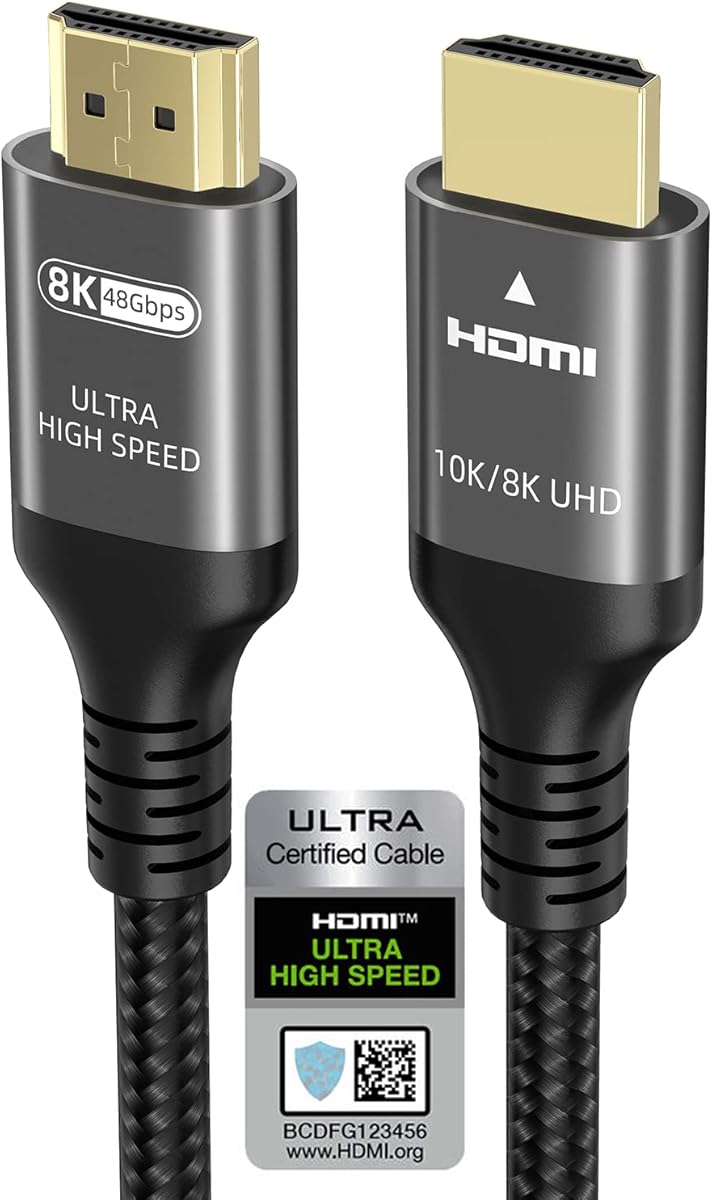

The Highwings 8K 10K 4K HDMI Cable 48Gbps 6.6FT/2M, Certified Ultra High Speed receives a 4.7 rating and stands out for combining high bandwidth with a useful set of gaming and compatibility features. Its stated 48Gbps capacity and support for 8K@60Hz make it a strong match for a modern 4K television that may later be paired with higher-resolution source equipment.
We may earn a commission when you buy through this link, at no additional cost to you.
The cable is designed around HDMI 2.1 technology and supports 4K@120Hz as well as 4K@240Hz according to the supplied information. Variable refresh rate support is particularly attractive for compatible consoles and PCs because it can help a gaming system synchronize its output more closely with the display. Backward compatibility with HDMI 2.0b, 2.0a, 1.4, 1.3, 1.2, and 1.1 means the lead can also serve older televisions, Blu-ray players, and streaming devices.
Construction is designed with frequent use in mind. Highwings uses military-grade tensile nylon and an upgraded anti-bending tail, both intended to reduce stress where the cable meets the connector. The stated laboratory performance testing adds confidence in the design, although certification labels and real-world performance still depend on the exact certification status shown in the listing and the connected equipment.
This is a good general recommendation for a 4K TV used for a mixture of streaming, movies, and gaming. It provides more headroom than a conventional 4K@60Hz cable without adopting the more forward-looking specifications of the Highwings HDMI 2.2 option. It is best suited to setups where the six-foot length reaches without an extension or additional cable-management compromise.
The combination of 4K@120Hz, 4K@240Hz, and 8K@60Hz support allows this cable to cover a television used for both cinematic viewing and demanding game consoles. The feature set is broad without being limited to one device category.
The anti-bending tail and tensile nylon construction target the connector area, which is often the first part of a lead to fail after repeated plugging, repositioning, and routine cable handling.
We may earn a commission when you buy through this link, at no additional cost to you.
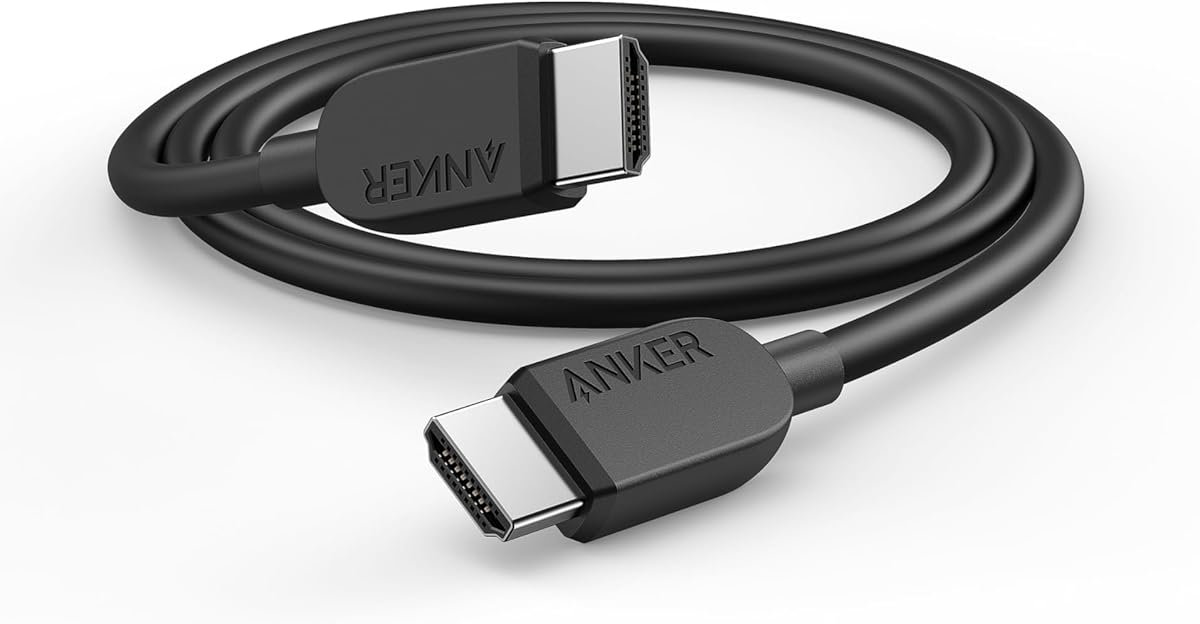
The Anker HDMI 2.1 Cable,4K@240Hz HDMI Cord, 48Gbps Certified Ultra High-Speed has a 4.7 rating and offers a clear combination of performance specifications and practical construction. Its headline capability is support for 8K@60Hz and 4K@120Hz, with the product title also identifying 4K@240Hz support, making it suitable for a high-end 4K television used with compatible gaming hardware.
We may earn a commission when you buy through this link, at no additional cost to you.
The stated bandwidth of 48Gbps gives the cable enough capacity for modern high-resolution video without restricting a 4K television to a basic 60Hz experience. It also supports 4K@60Hz, 4K@120Hz, and 4K@240Hz according to the supplied feature information, giving buyers flexibility when connecting a PC, console, projector, television, or streaming hardware.
Durability is another major part of the proposition. Anker says the cable is designed to withstand up to 1,000 bends, a useful reassurance for a lead that may be moved around behind a media unit or plugged and unplugged regularly. The package includes a six-foot cable, welcome guide, 18-month warranty, and customer support.
The main limitation is practical rather than technical. Six feet is sufficient for many television stands but may be tight when the screen is wall-mounted, the console is on a separate shelf, or the soundbar and receiver require additional routing. It remains an excellent pick for a straightforward 4K television and gaming setup where both source and display support the advertised modes.
The cable's stated support for 4K@120Hz and 4K@240Hz makes it relevant to high-refresh gaming displays. Actual mode availability depends on the source device, television, graphics settings, and the game itself.
Compatibility with tablets, laptops, projectors, desktop screens, and other HDMI-enabled devices makes this a flexible option for homes where the television is not the only display in use.
We may earn a commission when you buy through this link, at no additional cost to you.
The Silkland Certified HDMI 2.1 Cable Ultra High Speed 48Gbps Braided HDR 6.6FT earns a 4.7 rating and is one of the most feature-rich cables in this guide. Its HDMI 2.1 certification, 48Gbps bandwidth, and support for high-resolution and high-refresh modes make it particularly appropriate for a 4K TV used in a modern entertainment system.
We may earn a commission when you buy through this link, at no additional cost to you.
Gaming specifications include 4K@120Hz for compatible PS5 and Xbox hardware, along with 4K@144Hz for PCs. The product data also lists 10K@60Hz, 8K@60Hz, 5K@120Hz and 90Hz, 2K@240Hz and 165Hz, with 12-bit color support across the principal high-resolution modes. These are ambitious specifications, but buyers should match them to hardware capable of producing the desired signal.
The E-Braid construction combines a double-layer fishnet winding with nylon braiding, while copper cores and ferrite magnetic beads are intended to support stable transmission. Dynamic HDR, HDCP 2.2 and 2.3, and enhanced ARC or eARC support add value for streaming and home cinema. Compatibility extends backward from HDMI 2.1 to HDMI 1.1.
Silkland also states that a QR-code scanner app can be used to verify the cable's HDMI 2.1 certification, which is a useful distinction in a category where terminology can be confusing. The cable is best for buyers who want extensive specifications, strong gaming support, and a durable, feature-rich link between source components and a 4K television.
Support for 4K@120Hz and 4K@144Hz can reduce motion judder and improve responsiveness when the television, source, graphics settings, and selected game all support those modes.
Copper conductors, ferrite beads, and double-layer fishnet winding are intended to support reliable transmission while the nylon exterior helps guard against everyday abrasion and bending.
We may earn a commission when you buy through this link, at no additional cost to you.
The Ubluker 10K 8K 4K HDMI Cable 6.6FT Certified Passed, Ultra High Speed HDMI® has a 4.7 rating and emphasizes official certification alongside unusually broad device compatibility. It is a strong candidate for buyers who want a capable 4K television cable without limiting their thinking to one console, streaming platform, or home-theater device.
We may earn a commission when you buy through this link, at no additional cost to you.
Its listed 48Gbps bandwidth supports resolution modes including 10K@60Hz, 8K@60Hz, 5K@144Hz, 4K@240Hz, 4K@120Hz, 4K@144Hz, and lower modes such as 2K@360Hz and 1080p@360Hz. Features include VRR, ALLM, QMS, QFT, Dynamic HDR, HDR10+, CEC, and HDCP 2.2 and 2.3. The inclusion of all of these functions makes it relevant to a mixed ecosystem of modern displays and source components.
Audio support is also extensive, with eARC, ARC, DTS Master Audio, DTS:X, Dolby TrueHD, Dolby Vision, and Dolby Atmos listed among supported formats. For a television connected to a soundbar or receiver, that breadth is useful, provided the downstream equipment can decode the selected format and the chosen HDMI mode allows the audio path to operate.
The official HDMI certification label is a notable advantage because it gives buyers a clearer basis for evaluating the product's claims. Its compatibility list covers gaming PCs, FreeSync, G-SYNC, recent GeForce RTX families, soundbars, several PlayStation and Xbox models, Apple TV+, OLED televisions, MacBook computers, projectors, monitors, and major streaming platforms. The six-foot length is the main practical constraint for larger or wall-mounted installations.
An official certification label indicates that the cable has been evaluated against HDMI Forum requirements, which is more informative than an unqualified Ultra High Speed description.
The extensive device list reduces the risk of buying a narrowly specialized cable. It is especially useful for households that alternate between consoles, PCs, streaming devices, and traditional television sources.
We may earn a commission when you buy through this link, at no additional cost to you.
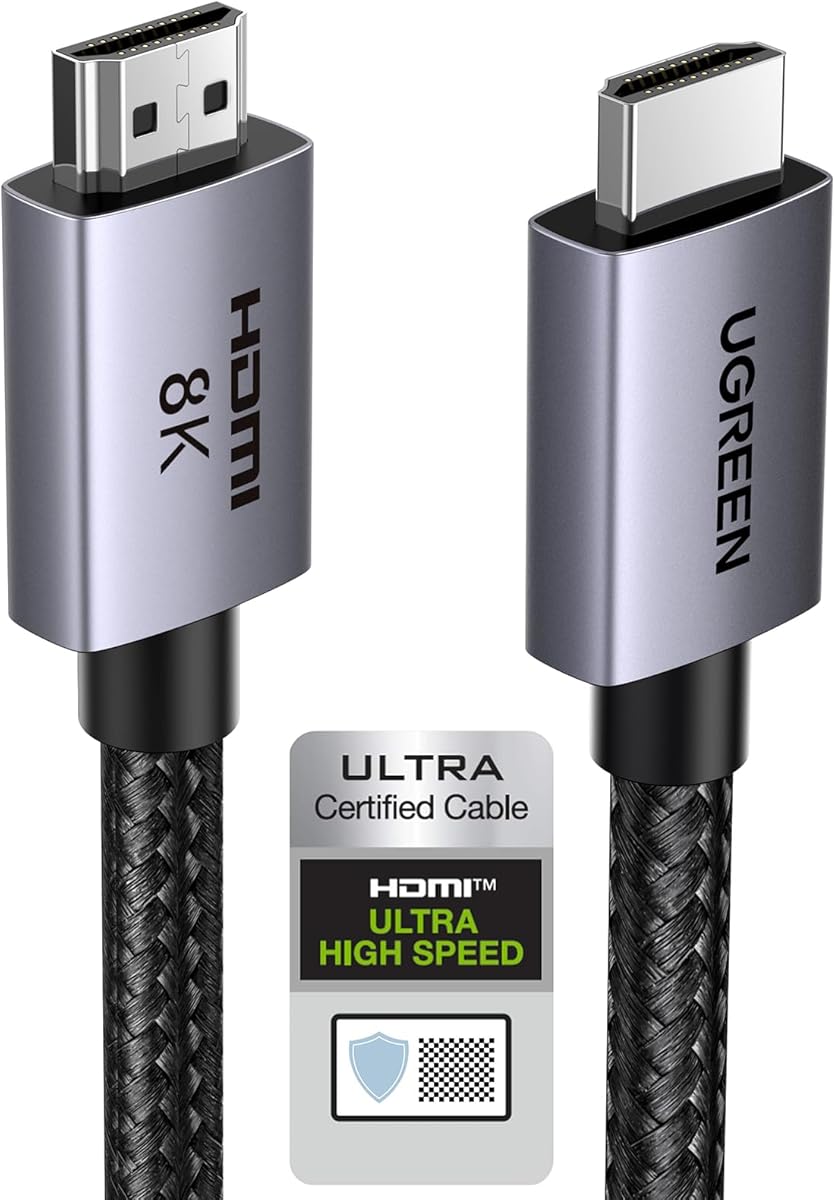
The UGREEN 8K HDMI 2.1 Cable 48Gbps 6.6FT, Certified Ultra High Speed HDMI Cord has a 4.8 rating, making it one of the strongest overall choices in the group. It combines certified HDMI 2.1 performance, 48Gbps bandwidth, broad device support, and a durable construction in a format well suited to a 4K television.
We may earn a commission when you buy through this link, at no additional cost to you.
The cable supports 10K@60Hz and 4K@240Hz according to the supplied information, while 4K@60Hz remains the most common television use. Its 48Gbps capacity is more than sufficient for current high-refresh 4K modes, and the inclusion of VRR, QFT, quick media switching, and auto low latency mode gives it useful capabilities for compatible gaming systems and media sources.
Dynamic HDR and 12-bit color accuracy are valuable additions for a modern television. The eARC capability can send full-resolution audio, including formats such as Dolby Atmos and DTS:X, from a compatible television to a soundbar or AV receiver. HDCP 2.2 and 2.3, Ethernet, and 3D support round out a well-rounded feature set.
Physical construction is a major strength. UGREEN uses an aluminum alloy housing, nickel-plated connectors, and a durable nylon braided jacket. These materials are intended to reduce connector damage and cable rupture without compromising flexibility. Compatibility is broad, covering popular streaming devices, consoles, computers, projectors, televisions, receivers, and other HDMI-enabled products. This is the most versatile recommendation for a 4K TV setup that includes gaming, streaming, and external audio.
The 48Gbps capacity handles demanding 4K modes while remaining appropriate for ordinary television viewing. It gives a setup room to grow without asking the buyer to focus on a narrow use case.
Aluminum alloy shells, nickel-plated contacts, and a nylon braid improve the cable's resistance to frequent bending and everyday wear while maintaining a practical form for home installation.
We may earn a commission when you buy through this link, at no additional cost to you.
The Amazon Basics HDMI Cable, 6ft, 4K@60Hz, High-Speed 4K HDMI 2.0 Cord with Ethernet, 18Gbps, 2160p, 48 bit, Compatible with TV/PS5/Xbox/Roku/Blu-ray, Black holds a 4.7 rating and serves a clear purpose: reliable 4K@60Hz connectivity without paying for capabilities that many television setups do not need.
We may earn a commission when you buy through this link, at no additional cost to you.
Its 18Gbps bandwidth supports 2160p video at 60Hz with 48-bit-per-pixel color. It also includes support for Ethernet, 3D, and Audio Return Channel. These features are useful in a living room, where a television may serve as the central display for a Blu-ray player, Fire TV, Apple TV, game console, computer, A/V receiver, or other HDMI source.
The cable is an HDMI male-to-male lead measuring six feet in black. Its backwards compatibility makes it suitable for a wide range of HDMI-enabled devices. The Ethernet capability can also simplify sharing an internet connection among compatible devices, reducing the need for a separate network cable in certain arrangements.
There is an important limitation. The product explicitly supports up to 4K@60Hz and cannot properly operate if the source device outputs a higher standard. A PS5 or Xbox can still be connected, but advanced 4K@120Hz modes are outside this cable's capability. For ordinary 4K television viewing, however, it is a sensible, uncomplicated recommendation with a strong 4.7 rating.
Most streaming, broadcast television, and many gaming experiences operate at 4K@60Hz, which this cable directly supports. It avoids carrying additional specifications that will not be used in a basic setup.
ARC support can return television audio to a compatible soundbar or receiver, while the Ethernet channel offers another way to distribute connectivity to supported HDMI devices.
We may earn a commission when you buy through this link, at no additional cost to you.
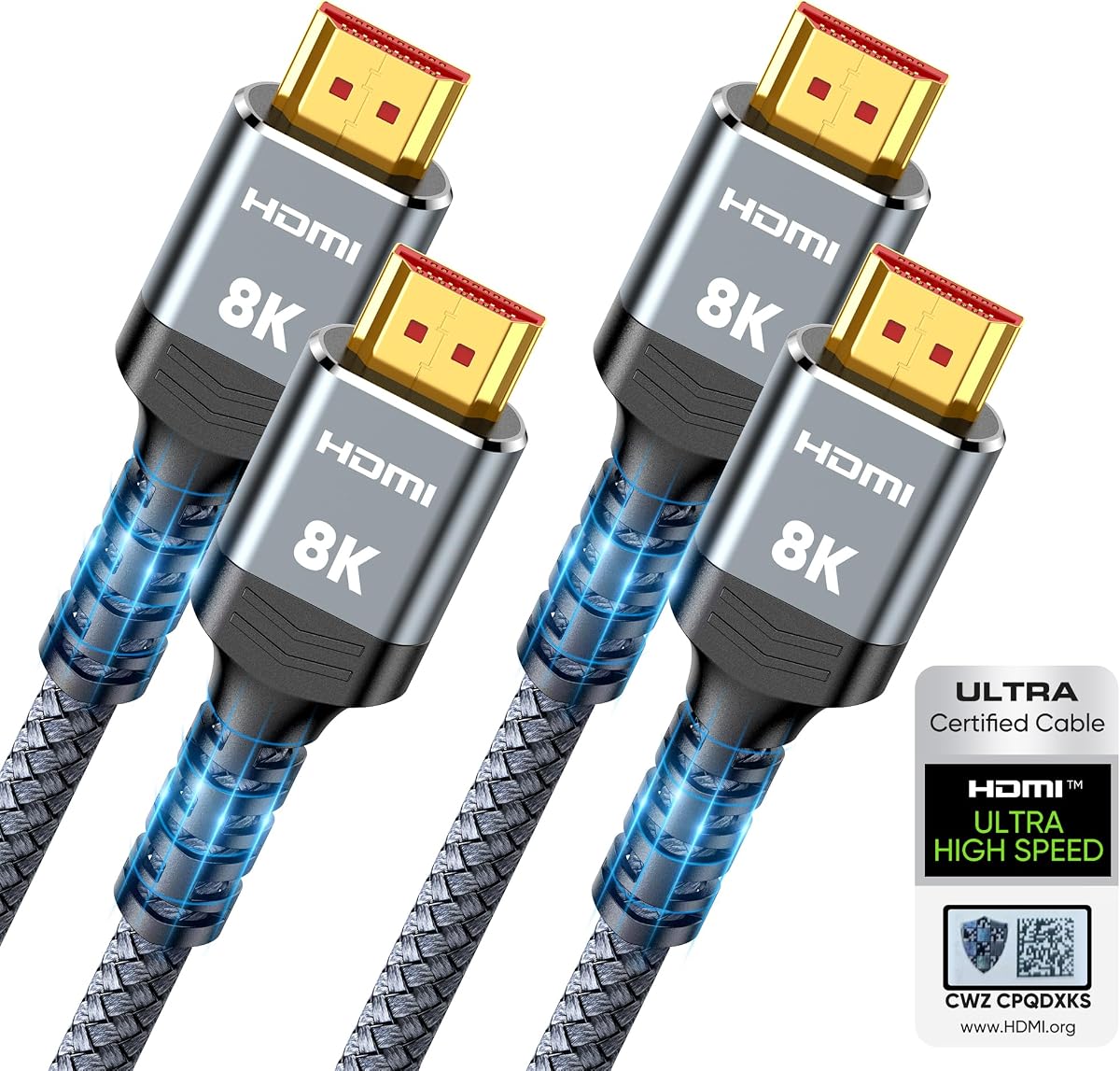
The Highwings 8K HDMI 2.1 Cable 2-Pack 6.6FT, Certified 48Gbps Ultra High Speed has a 4.7 rating and offers a convenient bundle for anyone who needs more than one connection. Two certified 6.6-foot cables provide flexibility for a television, gaming console, streaming device, projector, or second display.
We may earn a commission when you buy through this link, at no additional cost to you.
The included leads support 10K, 8K@60Hz, 4K@240Hz, and 4K@120Hz according to the supplied information. Their 48Gbps bandwidth provides ample capacity for a 4K television while also allowing compatible equipment to operate at higher refresh rates. Variable refresh rate support is included for compatible games, consoles, PCs, and displays.
Construction uses an aluminum alloy shell, an upgraded anti-bending tail, and military-grade tensile nylon. The package description says each cable has undergone laboratory performance testing. These details are especially relevant to a two-pack because both leads may receive regular handling in different parts of a home entertainment setup.
The chief benefit is convenience. One cable can connect the television to a gaming console while the second links a media device, soundbar, projector, or another compatible screen. The trade-off is that both leads have the same 6.6-foot length, which may not suit every arrangement. It is an attractive choice when a second identical cable is useful and a single purchase is preferable.
A two-pack reduces the need to make a second purchase for a separate source component or display. It can also provide a convenient replacement if the original cable is moved between rooms.
Both cables are described as certified ultra-high-speed HDMI 2.1 leads with 48Gbps capacity, so the bundle does not sacrifice high-end specifications to gain the convenience of two included cables.
We may earn a commission when you buy through this link, at no additional cost to you.
The Acer HDMI 2.1 Cable 6.6FT (8K@60Hz,4K@120Hz) 48Gbps High-Speed Braided Cord has a 4.7 rating and combines a 4K-focused feature set with durable physical construction. It is well suited to televisions, monitors, and projectors used across gaming, streaming, and home entertainment.
We may earn a commission when you buy through this link, at no additional cost to you.
Stated support covers 8K@60Hz and 4K@240Hz, 120Hz, and 144Hz, with backward compatibility for 4K@60Hz, 2K, and 1080p. The 48Gbps bandwidth allows compatible systems to use high-refresh 4K output, while VRR is included to help reduce screen tearing. As with every cable in this guide, the television and source device must support the selected resolution and refresh rate.
Audio functionality includes eARC and ARC, alongside Dolby Vision and Dolby Atmos support on compatible devices. That makes the lead useful for a television connected to a soundbar, where a full-resolution audio return path can reduce the need for a separate audio cable when both ends support the selected feature.
The cable uses a high-purity copper core, aluminum alloy shells, and a braided jacket to resist electromagnetic interference, bending, and daily wear. Plug-and-play compatibility extends to PS5, PS4, Xbox, Roku, Fire TV, Apple TV, PCs, laptops, Mac mini systems, monitors, projectors, and 8K or 4K televisions. The result is a flexible cable for a broad range of home, office, and entertainment configurations.
Support for 4K@120Hz, 4K@144Hz, 4K@240Hz, and VRR makes the cable relevant to fast television and monitor use. It offers room beyond standard 4K@60Hz playback.
The braided outer jacket works with the copper core and aluminum housing to create a lead designed for repeated handling while maintaining a relatively flexible profile.
We may earn a commission when you buy through this link, at no additional cost to you.
The Highwings 16K 4K 480Hz hdmi 2.2 Cable, 8K240Hz 96Gbps Ultra High Speed eARC has a 4.6 rating and represents the most forward-looking option in this guide. Its advertised 96Gbps bandwidth and potential 16K support are intended to provide more headroom than current 4K televisions and conventional HDMI 2.1 cables require.
We may earn a commission when you buy through this link, at no additional cost to you.
The listed performance targets include 12K@120Hz, 8K@240Hz, and 4K@480Hz. For today's most common television use, the cable still functions as a 4K connection, but its main attraction is capacity for unusually high-resolution and high-refresh combinations. Buyers should understand that a cable cannot create a resolution, refresh rate, or special feature that the source and television do not support.
Gaming features include VRR and ALLM, while Dynamic HDR and Dolby Vision are listed for compatible content and devices. The cable also supports enhanced eARC for high-quality, uncompressed audio from a television to a soundbar or AV receiver, plus an Ethernet channel for compatible connected devices.
Construction includes a double-braided nylon jacket, corrosion-resistant 24K gold-plated connectors, and advanced aluminum foil shielding intended to reject EMI and RFI. It is a premium recommendation for enthusiasts who want maximum stated bandwidth, extensive future-facing support, and a robust physical design. For a basic 4K television setup, however, the specification may be considerably more than required.
The stated 96Gbps capacity and HDMI 2.2 positioning are intended to accommodate emerging high-resolution and high-refresh formats. This makes the cable attractive to buyers focused on long-term equipment upgrades.
Aluminum foil shielding, corrosion-resistant gold-plated contacts, and a double-braided jacket form a layered approach to signal integrity and connector durability in a frequently handled cable.
We may earn a commission when you buy through this link, at no additional cost to you.
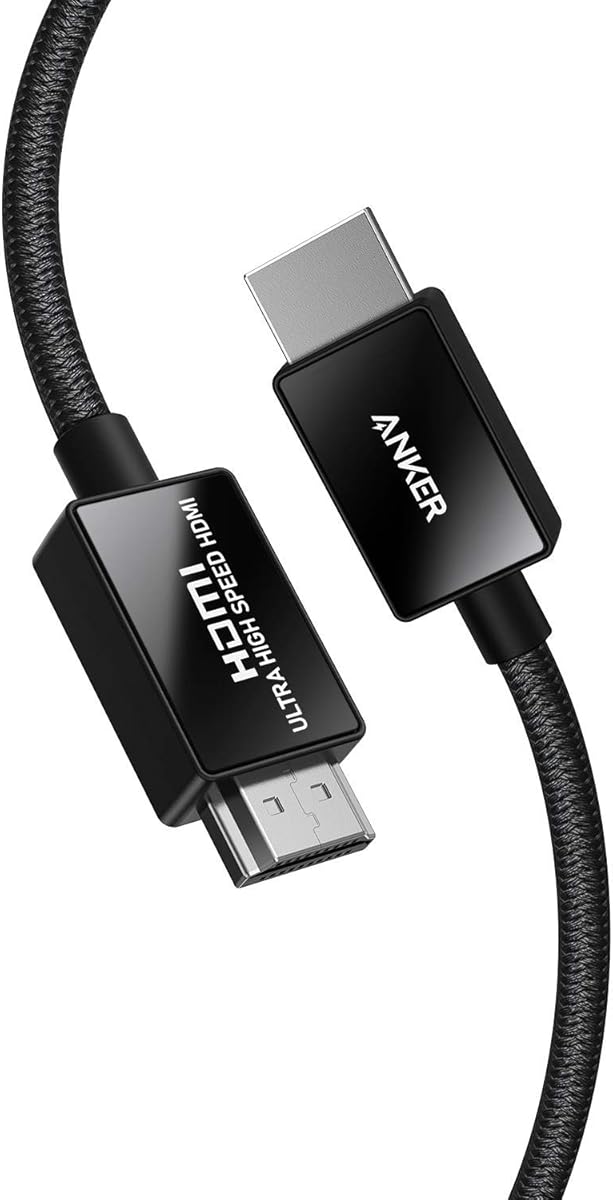
The Anker HDMI 2.1 Cable, 48Gbps Ultra High Speed Cord with 8K@60Hz, 6.6ft has a 4.8 rating and offers a refined mix of certified performance, gaming support, and premium construction. Its 48Gbps bandwidth and 8K@60Hz support make it a strong 4K television option, particularly for consoles and displays capable of 4K@120Hz.
We may earn a commission when you buy through this link, at no additional cost to you.
Anker describes the cable as one of the first officially certified Ultra High Speed HDMI cables. The certification testing is stated to include electromagnetic-interference shielding, which helps distinguish it from cables that use high-speed terminology without the same formal certification. Compatibility includes PS5, Xbox Series X/S, 8K televisions, Apple TV, and Roku Ultra.
The connectors use carbon steel bodies and gold-plated pins, while the cable has a double-braided nylon finish. Anker says the connectors can withstand 10,000 plug-and-unplug cycles, a useful detail for a lead connecting a frequently accessed game console or media device. The package includes a welcome guide, 18-month warranty, and customer service.
Although the product title highlights 8K@60Hz and 4K@120Hz rather than 4K@240Hz, it still provides ample capacity for high-end 4K television use. It is a polished recommendation for a living room where dependable certification, durable materials, and 120Hz gaming matter. The six-foot length should be measured against the planned television stand or wall-mounted arrangement before ordering.
Official Ultra High Speed certification provides a more concrete basis for judging performance than a generic high-speed label, particularly when connecting current and future 4K television equipment.
Carbon steel connector bodies, gold-plated pins, and a double-braided finish are intended to withstand repeated handling. The stated 10,000-cycle plug-and-unplug claim reinforces that positioning.
We may earn a commission when you buy through this link, at no additional cost to you.
The right cable depends on the modes your television and source devices actually support, the distance between them, the audio equipment in the chain, and how often the connection will be handled. Reviewing these factors first prevents unnecessary spending or an upgrade that cannot deliver its advertised benefits.
A cable advertised for 4K does not necessarily support every 4K mode. The common baseline is 4K@60Hz, while gaming televisions and high-end PCs may use 4K@120Hz, 144Hz, or higher. Check the input specifications for the exact television model and the output limits of the console, streaming box, game PC, or Blu-ray player. The cable must support the intended combination of pixel resolution and refresh rate, not merely carry the phrase 4K.
For most television viewing, an 18Gbps HDMI 2.0 cable with 4K@60Hz is enough. For gaming or advanced home theater, look for a 48Gbps HDMI 2.1 lead with support for 4K@120Hz and the required gaming features.
Bandwidth describes the maximum data capacity of the connection. A 48Gbps cable provides substantially more headroom than an 18Gbps model, allowing compatible hardware to use high-resolution, high-refresh combinations. This is particularly relevant when the same television may later be connected to a new game console, graphics card, projector, or 8K source. Extra bandwidth cannot make an unsupported television display 8K, but it can prevent the cable from becoming the limiting component in an otherwise capable system.
Choose a basic high-speed cable for a fixed 4K@60Hz setup, or favor 48Gbps or greater when your devices advertise 4K@120Hz, 8K, high refresh rates, or advanced gaming features.
HDMI terminology can be confusing because some product descriptions emphasize a nominal version, while official certification provides a more verifiable standard. The Ubluker and UGREEN cables in this guide are described as certified, and both Anker options also reference formal certification. Certified Ultra High Speed cables are tested against requirements relating to signal performance, interference, and supported features, which can provide additional confidence.
Look for an identifiable certification claim and verify the product listing or packaging. Certification is especially useful for advanced modes where signal integrity matters more than in a basic 4K@60Hz connection.
HDR, VRR, ALLM, QFT, QMS, and HDCP can add meaningful features, but each requires compatible hardware and sometimes compatible software. Dynamic HDR and formats such as Dolby Vision depend on the source content, television, picture settings, and viewing mode. VRR depends on compatible games, consoles, PCs, and displays. ALLM can help reduce input lag in supported gaming setups. A capable cable can carry these features, but it cannot activate them independently.
List the features you expect to use and verify that they are named in the cable's specifications. This approach prevents paying for headline bandwidth that your current equipment cannot exploit.
ARC and eARC can simplify a television-and-soundbar arrangement by returning audio over the same HDMI connection. Standard ARC carries common surround formats, while compatible eARC can support higher-quality, including uncompressed audio. The television, soundbar, and cable must all support the selected return path, and the chosen HDMI mode must permit the audio functionality. Advanced gaming modes can also affect whether audio return remains available.
Use eARC when you want the highest level of compatible audio return and own matching hardware. Use ARC for a simpler supported setup, and confirm that a soundbar or receiver can receive the television's audio through the intended connection.
Most televisions, consoles, and soundbars work well with a cable around six feet long, but installation layout matters more than a universal number. Measure from the television's HDMI port to the source device while allowing slack for routing and service loops. Wall-mounted screens, larger cabinets, component depth, and separate shelves can require a longer cable. A very long lead is not automatically better because additional length can complicate routing and handling.
Choose the shortest length that reaches comfortably, or select a longer option when the furniture arrangement requires it. Avoid forcing a cable into a tight bend behind a television, and use appropriate routing or management to protect the connectors.
A good HDMI lead should tolerate repeated plugging, unplugging, bending near the connector, and routine movement behind a media cabinet. Braided nylon jackets, reinforced anti-bending tails, aluminum alloy shells, and corrosion-resistant contacts are all positive construction indicators. Bend-cycle claims can be useful comparisons, but they are not directly interchangeable unless test conditions are known. The best guide is to choose a design that matches how often the cable will be handled.
For a permanent installation, a flexible braided cable with reinforced connector ends is a sound choice. For a game console that is moved often, pay particular attention to strain relief and connector housing quality rather than choosing only on maximum bandwidth.
A multipack can be convenient when a household needs separate leads for a television, projector, gaming monitor, or second room. The Highwings two-pack includes two 6.6-foot certified cables, allowing more than one high-bandwidth connection without another purchase. However, multipacks can be unnecessary for a single-device living room, and each included cable has the same fixed length. Count the connections you realistically need before choosing a bundle.
Buy a multipack if you have multiple 4K devices or want a matching spare. A single cable is more economical and focused for one television connected to one source device.
Start by identifying the correct HDMI port on the television and source device, then check the source output and television input settings. Connect the cable firmly without twisting the connector or applying force to the cable itself. If the picture is absent, test the source on another input, briefly disconnect and reconnect the cable, and confirm that the television is selecting the intended HDMI input. Advanced refresh rates may also need to be enabled separately in the display and source menus.
Route the cable along the back of the television stand or through a cable-management system rather than leaving it stretched across a walking area. Avoid sharp bends immediately beside the connector, where repeated flexing can damage internal conductors. If the lead is longer than needed, create a gentle service loop and secure it with soft ties. Do not wrap the cable tightly around itself or place heavy objects on top of it.
For gaming, set the console or PC to the highest resolution and refresh-rate combination jointly supported by both the source and television. For HDR, verify that the content, source, television picture mode, and cable all support the intended format. Periodically inspect the connectors for dust, bent pins, or damaged shielding, and disconnect the cable by its housing rather than pulling on the cable. Replace it if performance becomes unstable or the connector no longer seats firmly.
It depends on the refresh rate and features you want to use. A good HDMI 2.0 cable is sufficient for 4K@60Hz, but an HDMI 2.1 cable with 48Gbps bandwidth is appropriate for 4K@120Hz, advanced gaming features, and greater future compatibility. The television and source device must support those modes for the cable to make a visible difference.
A six-foot cable is common and often sufficient for a television on a stand with a nearby source device. Measure the actual route, allowing enough slack for bending and servicing, especially with a wall-mounted television or soundbar. Longer leads can be useful for larger furniture arrangements, but they should be routed carefully without tight connector bends.
A higher-specification cable can help when the connected devices support modes that a basic cable cannot carry, such as 4K@120Hz, high-bitrate HDR, or advanced audio return. If your setup only uses 4K@60Hz, a capable basic cable should provide the same picture quality as a premium lead. The television, source, processing, and viewing mode usually have a greater effect on image quality.
Yes. An HDMI cable can carry digital video and multichannel audio. ARC and eARC can also return television audio to a compatible soundbar or receiver over HDMI, which may reduce the number of cables required. Support for the newest formats and bandwidth depends on the television, soundbar, source, cable, and selected video mode all working together.
Check that the television is on the correct HDMI input, reconnect the cable at both ends, and try another source or input to isolate the problem. Confirm that the source's output does not exceed what the cable and television support. If the setup uses 4K@120Hz, VRR, or another advanced mode, temporarily select a lower mode such as 4K@60Hz while troubleshooting.
Braided construction can improve resistance to everyday wear and make the cable easier to organize, but it does not independently determine gaming performance. Resolution, refresh rate, VRR, ALLM, and latency are more important. A braided cable with the required bandwidth and gaming features is a good choice, provided both the console or PC and display support the desired mode.
The Ethernet channel within HDMI can allow compatible connected devices to share an internet connection, reducing the need for a separate network cable in some arrangements. Its usefulness depends on the source and television supporting the feature. It does not replace Ethernet for every home-network need, but it can simplify certain HDMI device installations.
They can provide extra bandwidth headroom, but a 4K television cannot display 8K or 16K resolution. If your current source and television are limited to 4K@60Hz, the higher specification will not improve the picture. It may be worthwhile for future upgrades, premium installations, or compatibility with very high-refresh 4K equipment.
The UGREEN 8K HDMI 2.1 Cable is the most balanced overall recommendation because it combines 48Gbps bandwidth, HDMI 2.1 certification, high-refresh 4K support, Dynamic HDR, eARC, and durable construction. The Amazon Basics 6ft cable is the straightforward choice for 4K@60Hz, while the Highwings 16K HDMI 2.2 cable is the premium option for buyers seeking maximum advertised bandwidth and future-facing specifications.
Prioritize what your source equipment and television can actually output. For ordinary 4K viewing, a reliable 18Gbps cable may be sufficient; for 4K@120Hz gaming, advanced HDR, VRR, and eARC, choose a capable 48Gbps HDMI 2.1 lead. Length, connector reinforcement, and ease of routing are just as important as headline specifications in a real installation.
Ratings, certification details, product listings, and prices can change over time. Before purchasing, confirm the television model, source output, required refresh rate, audio system, and distance, then review the current product page for the most accurate specifications and availability.