
CallToU Home Care Wireless Pager
4.6Editor score
One receiver and call button
500-plus-foot open-area range
55 selectable ringtones
Waterproof and dustproof design
Compare 10 hospital pager systems across range, alerts, expandability, waterproofing, and ease of use to help you choose one for care teams.
Hospital pager systems give patients, residents, and staff a direct way to request assistance without relying on wall wiring or complicated clinical communication platforms. A useful system should identify the caller clearly, remain audible in a busy care environment, reach across the intended building, and continue working when normal facility operations are disrupted.
We compared the 10 options in this guide using their published specifications, including wireless range, call-button quantity, display and voice features, waterproofing, alert controls, receiver placement, scalability, and intended clinical or caregiving environments. The list covers compact home-care systems as well as larger installations designed for wards, nursing homes, clinics, assisted living facilities, and other multi-room settings.
Each review explains the strongest reasons to consider a particular model, along with practical trade-offs involving coverage, installation, receiver count, and day-to-day operation. The top selections reflect the balance of features and convenience visible in the supplied product information, while current prices and availability should always be checked before purchase.
4.6Editor score

4.4Editor score

4.4Editor score
The comparison below highlights the major differences among these hospital pager systems, including included components, alert identification, maximum stated range, and expansion capacity. Specifications are based on the supplied product information, and actual wireless coverage can vary with walls, floors, metal, building layout, and receiver placement.





This system earns the Editor's Choice position because it combines a 10-button starting kit with a portable caregiver pager, seven-language voice announcements, eight selectable tones, and room for as many as 255 wireless call buttons. Its stated open-area range reaches 1000 feet, making it a balanced option for nursing homes, clinics, assisted living facilities, and other care environments where a fixed desk receiver alone may not provide enough mobility.
We may earn a commission when you buy through this link, at no additional cost to you.
The portable QM003 caregiver pager is the most important distinguishing feature. Instead of requiring staff members to remain at a monitoring station, authorized personnel can carry alerts with them as they move through a facility. The receiver can identify the numbered button that was activated, while one-off and repeat modes let a team control whether a call sounds once or continues until the event is cleared.
There are practical trade-offs. A portable receiver still needs a reliable location with sufficient signal, and walls, floors, and metal can reduce the advertised 1000-foot range. The system also does not include backup power for the receiver, so facilities that must remain operational during outages should consider a separate power strategy. Even so, the combination of mobility, expansion, multilingual announcements, and straightforward controls makes this a highly versatile option.
This is a strong recommendation for buyers who want more than a basic home caregiver alert and less complexity than a large commercial installation. It suits facilities where staff need to receive alerts away from a nurse station and where the organization expects to add call points over time. For a small home-care arrangement, the portable pager may be more than necessary, but for shared clinical or residential care it provides unusually useful flexibility.
The included portable pager allows a caregiver to carry incoming call information while moving between rooms. That mobility is especially valuable in larger homes and facilities where staff cannot remain beside a central display.
Support for up to 255 wireless buttons makes this system more than a fixed 10-room kit. New rooms, restrooms, service areas, and common spaces can be added as a care environment expands or changes.
We may earn a commission when you buy through this link, at no additional cost to you.
This model is the most feature-rich option in the group, pairing 15 call buttons with a display, seven prompt tones, ten volume levels, external-audio support, and a stated signal distance of up to 1312 feet in an open outdoor area. It also supports 200 buttons identified with numbers from 001 through ZZZ and 26 English letters, allowing facilities to create more descriptive call locations than a simple two-digit display permits.
We may earn a commission when you buy through this link, at no additional cost to you.
The system's flexibility is its defining advantage. Different prompt tones can distinguish categories of calls, repeat counts can be configured, and the multi-number display can show several active requests at once. Each button is supplied with a lanyard, while waterproof wrist watches are mentioned as another alert form. These features allow care teams to choose a wearable option for patients who may be away from a wall-mounted button.
Range claims need careful interpretation. The supplied information lists 164 to 328 feet indoors between the display and buttons, compared with 1312 feet outdoors. Watches have a still shorter stated range of 60 to 98 feet indoors. Walls, doors, and other objects can affect all of these distances, and the product information says a signal booster may be needed for insufficient coverage. External audio is useful for broadcasting, but it adds another item to install and manage.
The system is best suited to buyers who need broader labeling, more included call points, or support for multiple alert formats. It is particularly relevant for larger clinics, rehabilitation centers, hotels with medical services, or multi-wing care facilities. Those wanting a simple home pager may find the feature set excessive, but organizations prioritizing flexibility and centralized call management get the most from this premium configuration.
The ability to combine numbers and letters helps operators identify rooms, zones, or service areas more clearly. This is valuable when a simple numeric display would not communicate enough detail.
Ten volume levels, configurable repeat counts, and external-audio support give staff several ways to manage alerts. The display also helps reduce the need for staff to leave a station just to identify a caller.
We may earn a commission when you buy through this link, at no additional cost to you.
The CallToU Numbered Call System provides a straightforward route to assisted calling with a pre-paired wireless button, a plug-in receiver, a 500-foot stated range, and a display that identifies the caller by number. Its 4.5 rating reflects a useful balance of approachable setup, strong alert customization, and a receiver volume that can reach 110 dB, making it appropriate for people who may have difficulty hearing a conventional call bell.
We may earn a commission when you buy through this link, at no additional cost to you.
The system offers 55 ringtones and five volume settings, while the large display makes it easier to see which paired button is requesting help. The call button is IP65 waterproof, so it can be placed in a bathroom or other damp location without concern about ordinary splashes. Additional receivers and buttons can be paired, allowing a home, clinic, or small residential care setting to expand beyond the initial one-button arrangement.
This is not the most comprehensive kit in the list. It begins with one receiver and one button rather than a multi-room package, and the receiver's dependence on an outlet means it must be placed where caregivers can hear and see it. The stated 500-foot reception distance is also less than several larger systems, so buyers should account for walls and multiple floors before assuming full nominal coverage.
The product is a good fit for a single patient room, an at-home caregiver arrangement, a small clinic, or a budget-conscious facility that wants a dependable visual and audible alert. It is particularly helpful for users with poor hearing because staff can identify the numbered caller even when they do not immediately hear the ringtone. Buyers needing several simultaneous call points should plan to purchase expansion components from the outset.
Each button is paired to a unique number, allowing staff to see who is calling. The large screen is useful in home care and clinic settings where audible alerts may be missed during a busy task.
The IP65 call button is appropriate for bathrooms, kitchens, and other areas where ordinary moisture is likely. Mounting it near the point of need makes assistance available without a complicated wiring installation.
We may earn a commission when you buy through this link, at no additional cost to you.
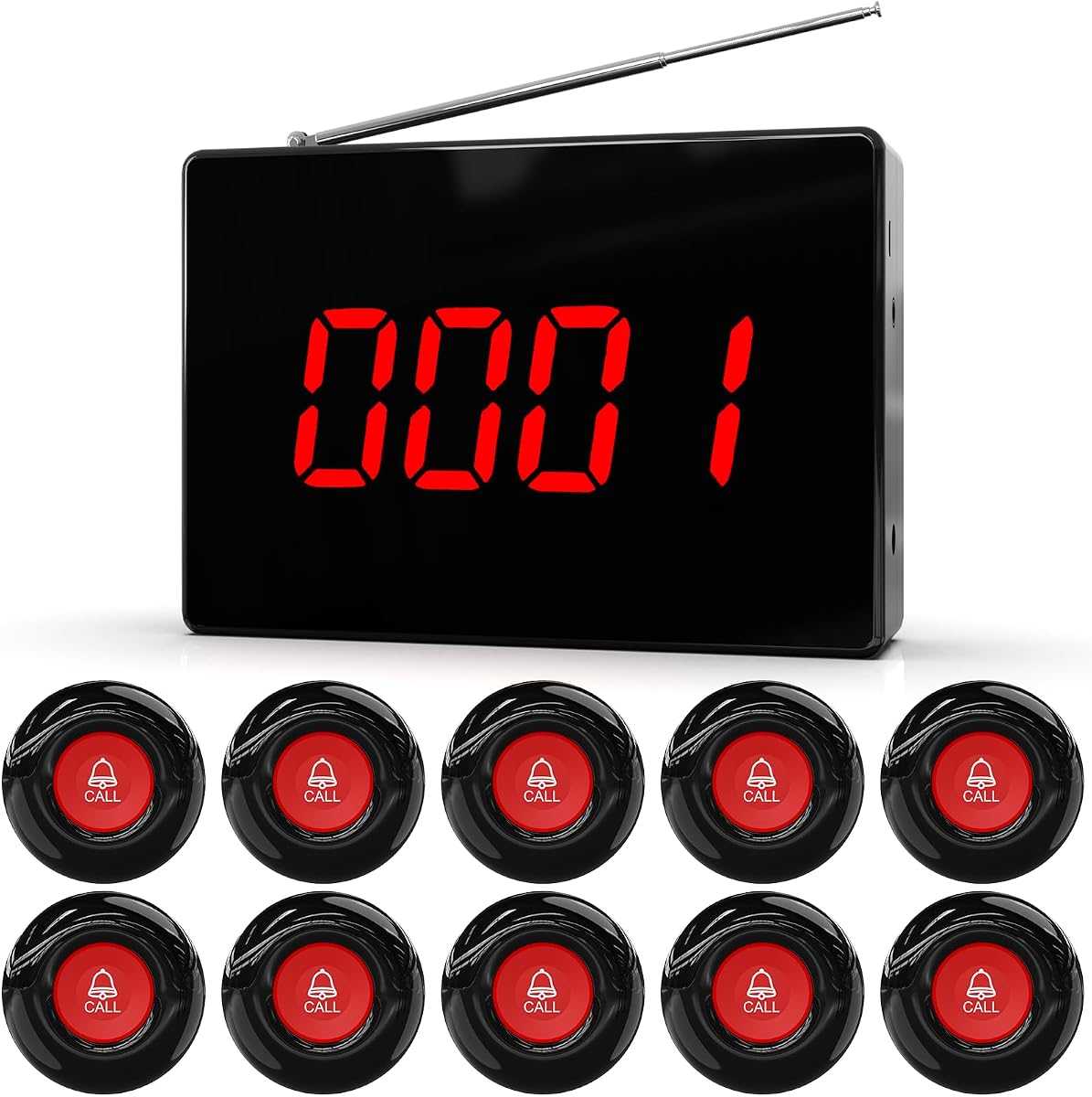
This 10-button system combines a central display receiver with waterproof call buttons, voice announcement of the call number, repeat alerts, and a stated open-area range of 1000 feet. Its 4.6 rating and broad intended uses make it a practical starting point for nursing homes, clinics, restaurants, and home-care environments that need to identify requests from several locations.
We may earn a commission when you buy through this link, at no additional cost to you.
Voice announcement is a standout feature because it allows staff to learn which call button has been pressed without having to look directly at the display. The alert can also repeat multiple times, reducing the chance that a request will disappear after a single missed beep. Buttons may be mounted with stickers or worn around the neck, giving the system flexibility for both fixed rooms and mobile users.
The advertised scalability is substantial, with expansion stated for as many as 1000 call buttons. That figure represents capacity rather than an included package, and additional buttons are separate purchases. Buyers should therefore distinguish between the 10 buttons in the box and the system's larger possible ecosystem. Indoor performance also depends on walls, floors, and the placement of the receiver.
This is a good choice for a nursing station, small ward, clinic, assisted living wing, or a larger home where several people need a direct way to summon help. The combination of numbered voice alerts and repeating notifications is especially useful for busy caregivers. It may exceed the needs of a single-patient setup, but for a multi-room environment it offers a more immediately useful starting package than one-button alternatives.
Spoken call numbers can help staff identify a request while looking elsewhere. This supports faster response and reduces the need to approach the display for every activation.
Configurable repeating notifications are useful when staff are occupied or away from the station. A patient does not have to press the button again simply because the first alert was not noticed.
We may earn a commission when you buy through this link, at no additional cost to you.
This package stands out for including six waterproof panic buttons and three plug-in receivers, giving a facility more ways to position staff coverage than a standard one-receiver kit. The LED number display identifies the calling button, and 38 ringtones plus five volume levels create a broad selection of alert profiles. The product data specifically notes that each panic button can be programmed to its own sound.
We may earn a commission when you buy through this link, at no additional cost to you.
Multiple receivers are especially useful when caregivers divide their time between a bedroom, kitchen, office, and yard. A caregiver can move the receiver to the location where assistance is most likely needed, while the 500-foot receiving range covers many homes and smaller clinical spaces. The buttons attach to walls or other surfaces without pulling wiring through the building.
Each receiver must be plugged into an outlet, and all three need to remain within a usable signal area. The stated 500-foot range should be treated as a best case rather than a guaranteed distance through every wall or floor. Buyers should also consider how the chosen ringtones perform in noisy environments and whether a silent mode could lead to calls being overlooked during a particular shift.
The system is a good fit for a family coordinating care across several rooms, a small clinic wanting coverage at more than one station, or a nursing home experimenting with distributed receiver placement. It provides more flexibility than a one-receiver product and a simpler initial package than systems supporting hundreds of programmed buttons. Its main appeal is the balance between three receivers, six waterproof buttons, and individualized sound alerts.
Distributed receivers reduce dependence on a single nursing station. Care teams can position units in separate work areas or living spaces without adding a more complex centralized system.
Programming separate buttons to different sounds can help staff recognize the general source of a request. The numbered LED display adds a second identification method for more precise response.
We may earn a commission when you buy through this link, at no additional cost to you.
The CallToU Home Care Pager is a focused two-component system containing one receiver and one wireless call button. It carries a 4.6 rating and offers 500-plus feet of stated open-area range, 55 ringtones, and five volume levels. That makes it a practical entry point for one-patient home care, a private residence, or a compact care setting where simplicity matters more than multi-room expansion.
We may earn a commission when you buy through this link, at no additional cost to you.
The receiver can be moved between a bedroom, kitchen, or living area, allowing the caregiver to hear alerts without remaining in one fixed place. The call button can be worn around the neck with a strap, secured with a bracket, or attached with double-sided stickers. Both the button and receiver are described as waterproof and dustproof, adding useful resilience in washrooms and exposed areas.
The main limitation is scale. With only one included button, the package does not provide immediate coverage for a clinic with multiple rooms or a nursing home with numerous beds. A second receiver or call button may be needed for broader use, and the receiver must always be connected to an electrical outlet. Indoor range will also decline when obstacles separate the button and receiver.
This system is best for a caregiver monitoring one person at home, particularly when the patient can wear the button or needs an accessible call point near a bathroom. It is also a sensible first system for a small private-care arrangement. Buyers should choose it for straightforward, low-complexity calling and select a multi-button package when several rooms or patients need simultaneous access to assistance.
Because the receiver is designed to be moved, a caregiver can keep it nearby in different parts of the home. This makes it easier to hear alerts while cooking, resting, or completing other caregiving tasks.
Wearable, bracketed, and adhesive mounting options let the button fit the user's mobility and environment. The waterproof and dustproof construction is useful for bathrooms and changing weather conditions.
We may earn a commission when you buy through this link, at no additional cost to you.
The CallToU Voice Announcement System is built around clear, hands-free call identification. It includes six waterproof call buttons and three receivers, while the receiver announces numbers one through six and maintains a longer digital display time. With 44 ringtones, five volume levels, and a stated range of 500 feet, it offers a balanced package for homes, hospitals, and nursing homes.
We may earn a commission when you buy through this link, at no additional cost to you.
The pre-paired setup is designed to be ready quickly: buyers need to plug in a receiver and mount the buttons in the desired locations. The extended display duration helps staff read the calling number even when they are not standing directly in front of the unit. The included receivers can be distributed around a home or care environment, reducing dependence on a single audible location.
The product information recommends considering additional receivers or call buttons to extend reception, but the initial package is still concentrated around six numbered locations. Walls, floors, and other obstructions may reduce the nominal open-area distance. The five volume levels span silent operation through 110 dB, which is useful for nighttime needs, although a zero setting obviously depends on visual awareness of the display.
This is a strong choice for a family caring for several people or a small residential facility seeking a middle ground between a one-button pager and a large nurse-call installation. Voice announcements make it especially useful for caregivers who need to know the source of a call without walking to the receiver. It is less suitable for a large hospital with hundreds of independently identified rooms unless additional components and careful coverage planning are part of the purchase.
Voice announcements make the source of a call accessible across the room. This is valuable when a visual-only display would require the caregiver to stop other work and approach the receiver.
A longer display time reduces the chance that a caregiver will miss the calling number. This complements the voice announcement and gives staff two ways to identify the request.
We may earn a commission when you buy through this link, at no additional cost to you.
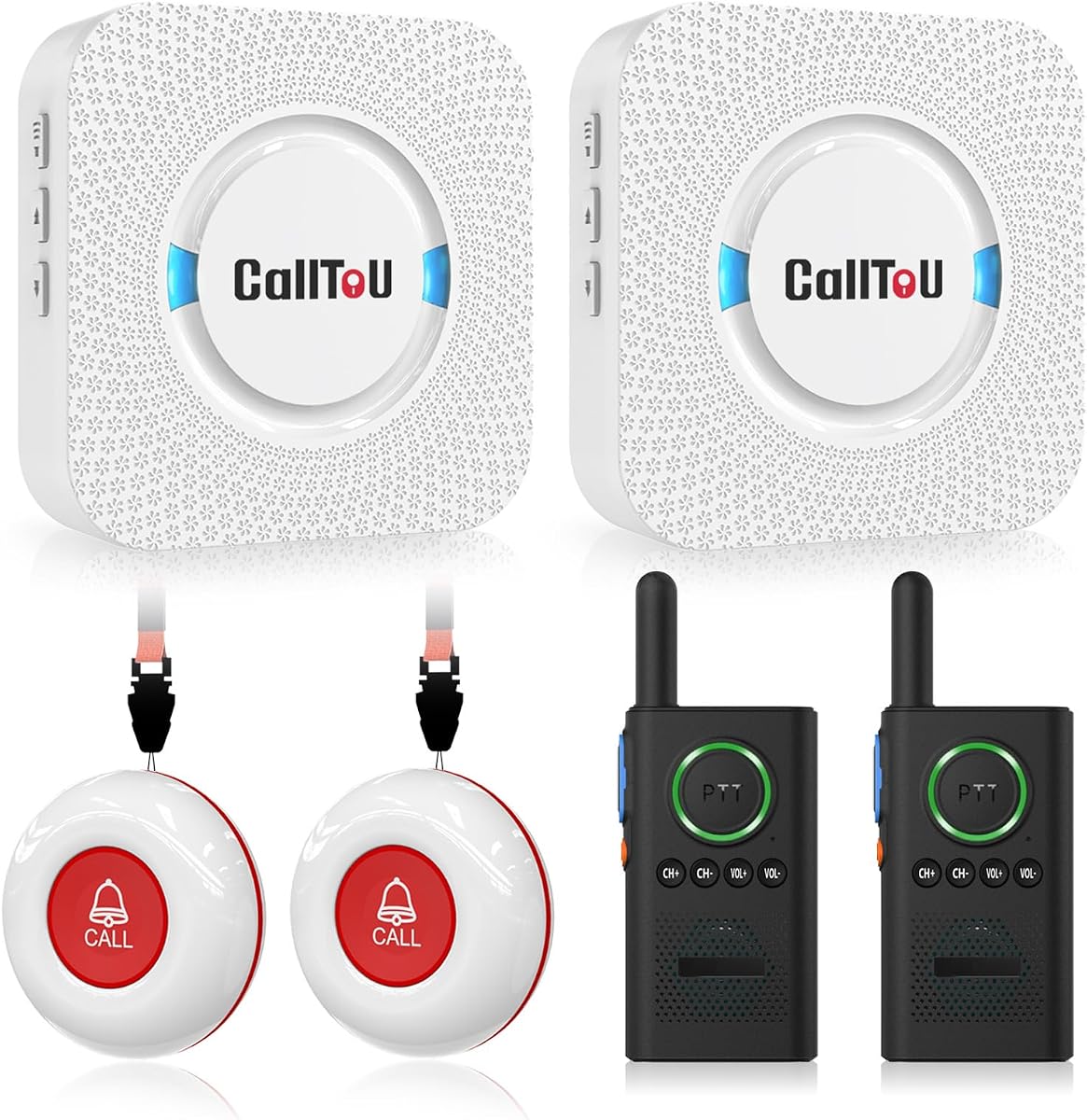
This caregiver paging package is distinctive because it includes two receivers, two call buttons, and two walkie-talkies. The pager system provides 500 feet of stated open-area range, while the radios enable two-way conversation without requiring someone to hold a button. It is designed for elderly, senior, patient, and disabled-user care where verbal follow-up may be as important as receiving the initial alert.
We may earn a commission when you buy through this link, at no additional cost to you.
The receivers can be moved throughout a home, and each call button can be worn with a neck strap or secured with a bracket or adhesive. The 55 ringtones and five volume levels, spanning zero to 110 dB, give caregivers a way to match alerts to different conditions. Waterproof and dustproof construction adds protection in bathrooms and outdoors.
An important distinction is that the wireless intercom and pager are separate systems and cannot be paired with one another. The product data recommends keeping the working pager range below 300 feet indoors because obstacles reduce signal strength. That makes careful placement essential, especially in homes with multiple floors or substantial masonry. Plug-in receivers also need reliable outlet access.
This package is best for caregivers who want alert-and-response communication in a larger home or compact residential care setting. The walkie-talkies are useful for discussing a situation after an alert, while the paired pager receivers provide call identification and monitoring. It is less suitable for a formal hospital ward where numerous independently numbered rooms and centralized management are required.
Two-way communication can help a caregiver ask basic questions or understand a situation without traveling to the caller. This makes the package more interactive than an alert-only system.
Because the pager and intercom cannot be paired, buyers should map their intended communication tasks before placing equipment. This avoids assuming that radio messages and pager alerts share one network.
We may earn a commission when you buy through this link, at no additional cost to you.
The Programmable Clinic Call System is designed for buyers who prioritize capacity and centralized call handling. It can be programmed for up to 999 call buttons or bells, reaches a stated 1000 feet in an open area, and offers 15 adjustable volume levels. Its 4.6 rating reflects a feature set aimed at clinics, hospitals, nursing homes, rehabilitation spaces, and other busy environments.
We may earn a commission when you buy through this link, at no additional cost to you.
The display shows the room number associated with an active call, and the alert continues until staff clear it. This behavior can reduce the risk of a request disappearing when a caregiver is briefly occupied. Settings are automatically saved and are not erased after a restart, which is useful for systems that need to retain programmed button assignments during normal operation.
Call buttons are pre-paired with the receiver, use a durable ABS shell, and can be mounted on a wall or worn on a lanyard. Coverage can be affected by walls and other objects, and the manufacturer recommends avoiding metal and brick walls to optimize performance. The product information does not specify how many buttons ship in the box, so prospective buyers should confirm the package contents before planning an installation.
The system is a good fit for administrators who want a large programmable ceiling without a listed 200-button or 255-button limitation. It may suit a multi-department clinic or a care operator adding call points over time. Before buying, confirm the number of included buttons, perform a coverage test in priority rooms, and ensure receivers can be placed where staff reliably see the display.
Support for up to 999 call buttons gives administrators room to expand across rooms, departments, or service areas. The implementation should still be planned around actual wireless coverage rather than capacity alone.
Automatically saved settings remain after a restart. This reduces the likelihood that staff will need to rebuild button assignments and room labels after an ordinary system interruption.
We may earn a commission when you buy through this link, at no additional cost to you.
This six-button, three-receiver system provides a flexible middle ground for home care, clinics, hospitals, and nursing environments. It includes waterproof panic buttons, LED number displays, 38 ringtones, and five volume levels from silent to 110 dB. Its 4.5 rating reflects a practical combination of distributed receivers, individual call identification, and uncomplicated installation.
We may earn a commission when you buy through this link, at no additional cost to you.
Every panic button can be assigned a distinct sound, while the receiver's LED number display shows the room or button requesting assistance. Using both audio and visual identification gives staff more than one way to recognize a call. Three receivers can be positioned in different parts of a home or facility, helping caregivers remain within range without carrying every receiver to one location.
Each receiver must be plugged into an outlet, and the stated 500-foot reception range can be reduced by walls, floors, and other objects. The buttons can be mounted on virtually any suitable surface, but placement should prioritize easy physical access for the patient. Buyers should also consider whether a louder ringer could disturb residents at night and whether the visual display remains visible from the intended monitoring position.
This system is appropriate for a family coordinating care in several rooms, a small medical clinic, or a care home that wants multiple monitoring points without starting with a large kit. It is less suited to a facility requiring hundreds of individually labeled locations or a formal hospital-grade communication architecture. Its strongest appeal is the useful balance of six waterproof buttons, three receivers, and programmable alert sounds.
The LED number and configurable ringtones provide complementary ways to identify a caller. Staff can rely on sight during quiet periods and sound during active tasks.
Three receivers can be placed in separate rooms or zones, making the system more adaptable than a single-receiver arrangement. Placement still depends on power access and reliable wireless signal.
We may earn a commission when you buy through this link, at no additional cost to you.
The right hospital pager system depends on the number of users, building layout, response workflow, and need for wearable, visual, or spoken alerts. Comparing coverage, power requirements, expansion, and environmental resistance is more useful than focusing on a single headline specification.
Start with the distance between the call buttons and receiver rather than focusing only on the largest advertised range. Open-area figures are best-case conditions, while walls, concrete, metal, glass, and multiple floors can substantially reduce real coverage. A home may be adequately served by a system with a more modest stated distance, but a hospital, nursing home, or clinic with separate wings needs a careful site survey. Receiver placement can make a major difference, and adding a second receiver may be more dependable than assuming one unit will cover every corridor.
Choose a package that covers the number of beds, treatment rooms, bathrooms, or patient spaces that need access to help. A ten-button kit is more immediately useful for a small ward than a one-button home-care set, while very large facilities may need extensive expansion. Also consider mounting style. Wall buttons work well in fixed rooms, whereas lanyard or wrist-worn alerts are more appropriate for mobile patients, visitors, or people who may not be able to reach a fixed point.
A numeric display helps staff identify the source of a call, while voice announcements can provide the same information hands-free. Larger displays are easier to read from a distance, and longer display times reduce the chance that a number will disappear before it is noticed. For facilities serving people with hearing limitations, pairing audible alerts with visual indicators is especially valuable. It is also worth checking whether a system can show multiple active calls, repeat unresolved alerts, or display descriptive room numbers rather than only a generic button number.
Ringtones and volume levels determine how noticeable an alert will be in a noisy care environment. More tone choices allow different rooms or urgency levels to sound different, although staff must learn the assignments for that feature to help. Some systems support voice alerts, repeated announcements, and external speakers, while others provide visual or vibrating alternatives. Test the intended sound in the actual environment during both busy and quiet periods, and consider mute behavior carefully so an alert is not unintentionally disabled.
Most receivers require a plug-in power connection, so an outlet must be available at every monitoring location. Some systems mention battery backup for a central unit, but buyers should confirm exactly which component receives backup power and how long it is expected to last. For facilities with formal continuity requirements, a pager system should be treated as one part of a broader emergency communication plan rather than the sole method for contacting emergency services or clinical staff.
Bathrooms, kitchens, therapy spaces, and outdoor areas expose call buttons to moisture. Waterproof or water-resistant construction gives users more freedom to place help buttons where they are genuinely accessible. The stated rating still matters: a system described as waterproof may have different resistance levels for the button and receiver. Also verify whether a lanyard, adhesive, or wall bracket is included, since the best call point is one that can be placed safely and remain within easy reach.
Expansion figures reveal a system's long-term ceiling, but they do not indicate the number of components included. Large capacities are useful for facilities adding rooms over time, yet a complex installation also requires consistent button numbering, receiver placement, and staff procedures. Simple systems are easier for occasional caregivers to maintain, while larger systems benefit from a clear room map and written escalation plan. Buyers should compare the included package separately from the theoretical maximum.
A fixed display receiver serves a nurse station effectively, while a portable receiver allows staff to remain mobile. Multiple receivers can cover separate wings or living areas, and two-way radios may help caregivers discuss a request after receiving an alert. Check whether all components use the same compatible system, because some bundles include separate pager and intercom networks. Choose mobility when response staff are frequently away from a desk, but keep a clear view of where receivers are located.
Begin by mapping the locations that need access to help and assigning each call button a clear number or room label. Install the receiver in a location with a reliable outlet, a clear view of the display, and a sound level staff can hear. Pair or program the components according to the manual, test every button, and confirm that the receiver identifies each location correctly before relying on the system for daily care.
Place waterproof buttons near bedsides, bathrooms, treatment areas, and other points where help may be needed. If a button is wearable, check that the cord or strap does not create a fall hazard and that the user can press it comfortably. After installation, test coverage from each location rather than only near the receiver. Heavy walls, floors, and metal can change the result, so move a receiver or add coverage when a room is unreliable.
Create a routine for acknowledging, responding to, and clearing calls. Train staff to recognize custom tones, locate the displayed number, and follow the facility's escalation procedure. Test the system after a power interruption, receiver move, button replacement, or room reassignment. Clean call buttons and receivers according to the manufacturer's guidance, keep battery compartments dry, and replace weak batteries before they begin reducing transmission reliability.
A home caregiver pager usually includes one call button and one portable receiver for a single-patient arrangement. A hospital pager system typically supports more rooms, multiple call points, larger displays, and broader expansion. The appropriate choice depends more on the number of patients and the response workflow than on whether the setting is technically a home or a medical facility.
The required range should be based on the actual distance between every call button and receiver, plus a margin for walls and floors. Open-area range ratings are best-case figures, so a building with masonry, metal, or multiple stories may need multiple receivers. A site test in the priority rooms is the most reliable way to confirm performance.
Many products in this guide include waterproof call buttons designed for bathrooms and other damp areas. Buyers should check the stated water-resistance rating and whether only the button, rather than the receiver, is protected. Proper placement and regular cleaning also help maintain reliable operation.
That depends on the model. Some systems include a portable caregiver pager, while others rely on plug-in receivers placed at fixed stations. A portable unit is convenient for staff moving between rooms, but it still requires an outlet and must remain within effective signal range of the call buttons.
Voice announcements identify the calling button without requiring staff to look directly at the display. This can shorten the time needed to locate a caller and is helpful in busy or noisy settings. Voice identification works best when the system is configured so that staff understand the numbering plan.
Most listed systems can be paired with additional buttons or receivers, although the maximum capacity varies considerably. Expansion often requires compatible components and careful receiver placement. Confirm what is included in the box and whether the advertised maximum refers to buttons, bells, or a combined programmable total.
No. A wireless pager is primarily intended for routine assistance requests, such as helping a patient, resident, or staff member. Facilities should retain any required emergency, code, nurse-call, or clinical communication systems needed for urgent and regulated events. A pager can complement those systems by handling everyday requests.
Test every call button from its normal mounted position and confirm that the receiver shows or announces the correct location. Check audible range, visual visibility, repeat behavior, and battery condition. After moving receivers, changing room assignments, or experiencing a power interruption, repeat the test to ensure the system remains dependable.
The Wireless Nurse Call System with Portable Pager stands out for organizations that need mobile staff coverage, multilingual voice alerts, and room to expand to 255 buttons. The 1200+ft Caregiver Pager System is the feature-heavy choice for larger or more complex sites, while the CallToU Home Care Pager offers a focused, economical way to monitor one patient with a receiver that can move around the home.
The right system should be judged by the environment rather than by the biggest range or capacity claim. Count current call points, consider wearable and waterproof needs, identify where staff will hear alerts, and test signal quality in important rooms. Receiver quantity, backup behavior, custom identification, and the simplicity of daily operation often have a greater effect on whether a system is genuinely useful.
Before purchasing, verify the current package contents, compatible accessories, power requirements, and installation instructions. Product configurations and availability can change, and current prices should be checked on the linked listing. Choosing a system that matches the care setting, team workflow, and building layout will deliver a more dependable result than simply choosing the model with the largest headline specification.