
Klein Tools 93RLS Green Self-Leveling Rotary Laser Level Kit, 1150-Foot
4.3Editor score
Class 3R green laser
Up to 1,150 feet range
24-hour battery runtime
Impact sensing protection
A laser level for grading gives contractors, landscapers, and survey crews a dependable way to establish level references, transfer elevations, and check grades across an entire work area. The best results depend on beam visibility, self-leveling performance, working range, environmental protection, and whether the included receiver and supports are adequate for the job.
We compared ten rotary laser kits using the specifications supplied for each model, focusing on stated accuracy, receiver-assisted range, self-leveling range, laser color, ingress protection, power options, and included accessories. The list covers red and green-beam systems for indoor layouts, outdoor grading, excavation, foundations, concrete alignment, drainage, and general construction.
Each review explains where a model fits best and where its specifications suggest compromises. The three highlighted selections cover a practical budget-oriented kit, a strong all-around option, and a premium feature set. Product configurations and current prices can change, so confirm the listed specifications and seller details before purchasing.
4.3Editor score

4.7Editor score

4.0Editor score
As an Amazon Associate we earn from qualifying purchases.
This side-by-side comparison organizes the ten laser level kits by their most important stated characteristics, including receiver-assisted range, accuracy, self-leveling behavior, outdoor protection, and supplied field equipment.

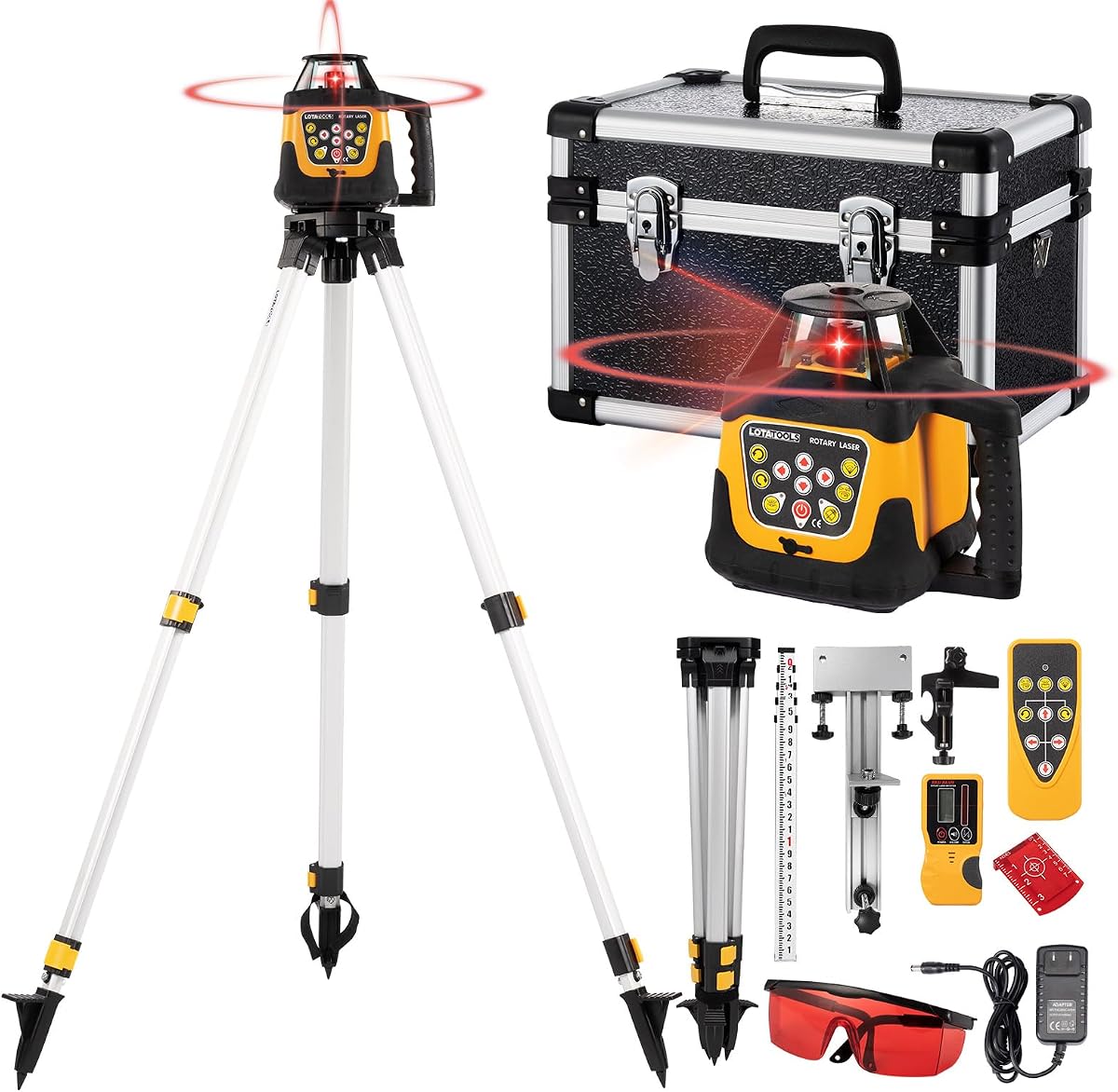


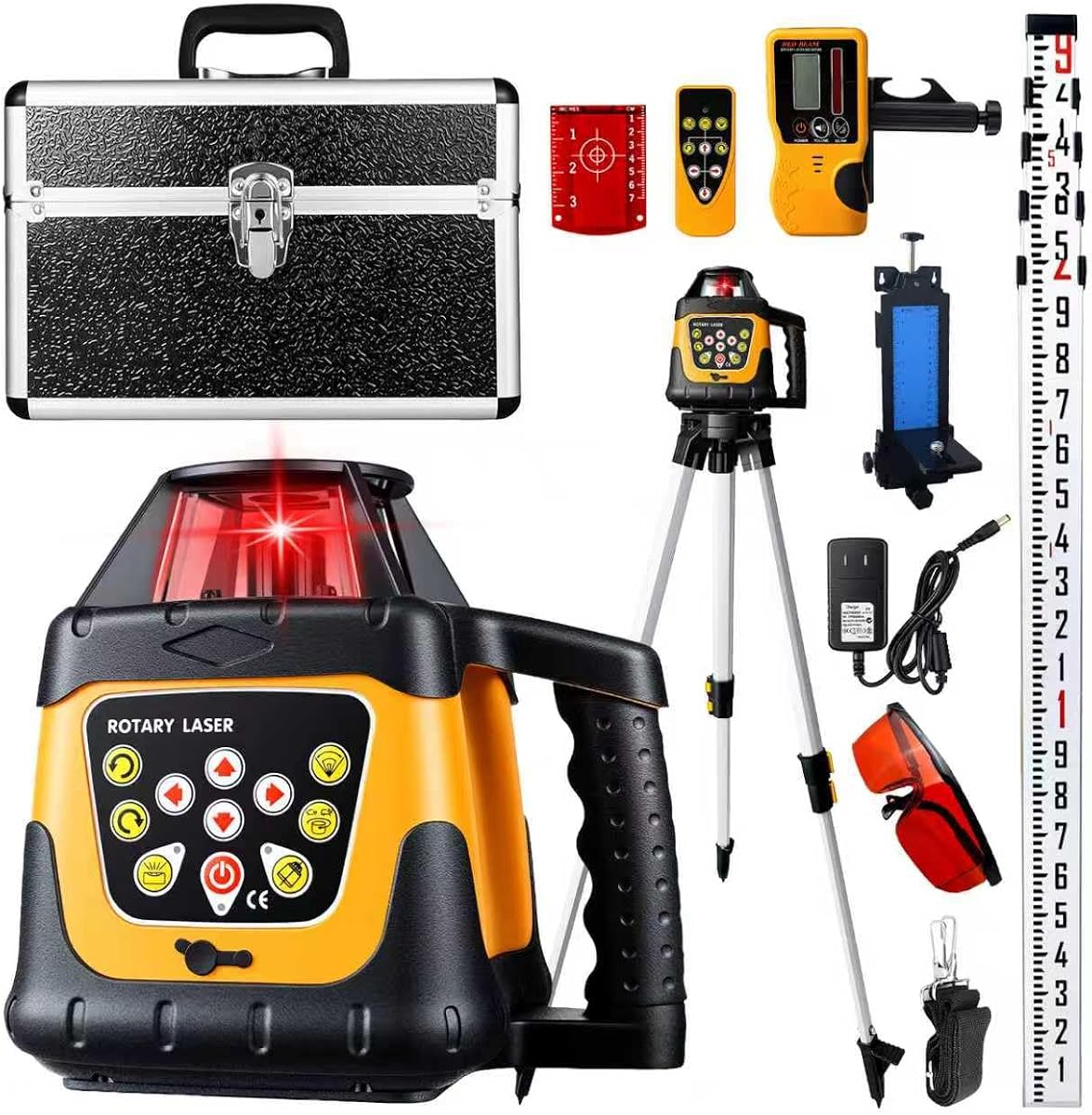
The VEVOR Rotary Laser Level Kit combines a stated range of 1,650 feet with accuracy of 0.06 inch per 100 feet, making it a compelling specification-led option for contractors building a capable grading kit. Its 4.0 rating places it among the strongest-rated products in this list, and the included receiver, tripod, grade rod, remote control, glasses, and case create a notably complete package.
We may earn a commission when you buy through this link, at no additional cost to you.
The self-leveling system covers ±5°, while manual mode is available when the instrument is used on a slope or when controlled leveling is needed. Rotation speeds of 0, 60, 120, 300, and 600 rpm, together with scan angles from 0° through 180°, give the operator several ways to adapt the beam to a crowded jobsite or isolated elevation check. The receiver extends the usable distance to 1,650 feet for large remodels, foundations, and broad exterior layouts.
Four 1.2V NiMH cells provide a stated 8–12 hours of operation per charge, and the charger is included. The 5/8-inch mounting thread is compatible with common rotary-laser tripods and accessories, while the remote can operate the unit from as far as 65 feet away. The principal trade-off is the IP54 enclosure, which protects against water and dirt but does not offer the more severe dust-and-water sealing of the IP66 competitors.
This kit is a practical choice for contractors who want broad functionality without assembling every support separately. It is especially useful for general leveling, alignment, grading references, and outdoor work where the receiver will do most of the detection. Buyers should favor it when the accessory bundle, scanning control, and stated accuracy matter more than maximum ingress protection. It is our budget-oriented pick for a versatile grading laser package.
A red beam is inherently less conspicuous than green in bright conditions, so using the receiver is the practical way to locate the rotating signal over distance. The complete accessory list also reduces the need to purchase a separate receiver, grade rod, tripod, or transport case immediately. For users who need the tool outdoors every day and work in sustained rain or heavy dust, one of the IP66-rated models may be the safer long-term match.
Five selectable rotation speeds and multiple scan angles make this model more adaptable than a basic fixed-speed rotary laser. These controls can help an operator reduce visual clutter, focus on a narrow work area, or create a broad reference for a large site without changing instruments.
The included receiver, grade rod, tripod, remote, protective glasses, charger, and hard case cover the basic field workflow. That makes the kit particularly convenient for crews starting a new tool inventory or replacing several separately purchased accessories at once.
We may earn a commission when you buy through this link, at no additional cost to you.
The DOVOH H3-360G-KIT is designed around a green Class II laser rated at 520nm and less than 1mW. Its 4.3 rating, receiver-assisted 400-foot range, and stated three-times output power make it a compelling choice for crews that prioritize visible green-beam performance over very long-distance coverage.
We may earn a commission when you buy through this link, at no additional cost to you.
The receiver is the important component for outdoor work. DOVOH specifically notes that the visible beam can be difficult to see directly in sunlight, while the detector provides more reliable signal detection. A target plate and green glasses are also included to help operators locate the beam. The kit does not include a grade rod, so users needing one should plan to obtain it separately or look for a compatible DOVOH bundle.
Two 2,600mAh batteries allow the crew to rotate between power sources and reduce downtime associated with charging. The double shockproof construction wraps the core assembly in two layers of cushioning rubber, which may be useful on active construction sites. DOVOH also provides a five-year accuracy warranty for qualifying normal-use issues and a two-year warranty for quality concerns, adding useful support beyond the basic hardware.
This is a sensible choice for outdoor landscaping, smaller foundations, drainage layouts, and general construction areas where green visibility and dual-battery operation matter. The main limitation is the 400-foot receiver range, which is substantially shorter than the 1,650- to 2,300-foot figures associated with several other selections. It is best suited to work areas that can be covered with fewer setups, or to users who prefer a brighter beam and simpler kit.
Its double shockproof assembly and extended warranty coverage make it appealing for users who expect regular transport and jobsite handling. The absence of a grade rod and tripod should be checked against the rest of the equipment on hand. Even with those caveats, the H3 is a refined alternative for crews that want green-beam visibility without purchasing a large-range rotary package.
Green light is generally easier for the human eye to perceive than red, making this kit useful around bright exterior spaces. The receiver remains essential for dependable detection at longer distances and in direct sunlight, even when the beam itself appears strong.
The two-layer cushioning construction is designed to absorb shocks around the internal assembly. Combined with the stated accuracy and quality warranties, it may be appealing for buyers who want long-term support in addition to physical protection.
We may earn a commission when you buy through this link, at no additional cost to you.
This 2,000-Foot Rotary Grading Kit offers a broad combination of range, environmental protection, and included equipment. Its stated accuracy is ±1/8 inch at 100 feet, automatic self-leveling extends across ±5°, and the included receiver supports working distances of up to 2,000 feet in diameter, giving it enough reach for large foundations, outdoor layouts, and broad grading operations.
We may earn a commission when you buy through this link, at no additional cost to you.
The kit is unusually complete. It includes the rotary laser, a receiver and clamp, remote control, target plate, laser glasses, a five-section grade rod, a 5.5-foot aluminum tripod, a wall mount, and a protective aluminum carrying case. The wall mount adds value for elevation transfer or interior work, while the receiver and rod make the package suitable for crews beginning from scratch.
Its IP66 enclosure is a significant advantage for outdoor users because it is designed to withstand dust, water, and impacts. The 635nm Class II red laser is specified at less than 5mW and is intended for indoor and outdoor professional leveling. The receiver remains the important element for outdoor beam detection, especially across the stated long working range.
The main limitation is that the ±1/8-inch accuracy figure is less precise than the ±1/16-inch and ±1/10-inch claims of some competitors. That difference can matter when transferring delicate elevations or checking demanding grade work. For broad construction tasks within its stated tolerance, however, the combination of range, IP66 protection, and accessories is difficult to dismiss.
This model is best for contractors who want an immediately deployable grading set and who need to work across sizable outdoor areas. It is less obvious than the 1/16-inch model for precision-sensitive elevation transfer, yet it may offer a more balanced package for a general construction crew. Confirm that the included rod, tripod, receiver, and mounting hardware meet your normal site workflow before buying.
The stated 2,000-foot diameter can reduce the need to reposition the laser repeatedly on large properties. It is especially relevant for foundation layouts, grading, concrete alignment, and other tasks where one reference point must serve a broad work area.
The receiver, rod, tripod, remote, wall mount, target plate, and case eliminate several separate accessory decisions. Users can deploy the kit for field elevation work or use the wall mount for interior elevation transfer.
We may earn a commission when you buy through this link, at no additional cost to you.
The 1/16-Inch Rotary Laser Kit combines the highest listed customer rating in this group, 4.7, with a strong set of grading specifications. It is rated at ±1/16 inch per 100 feet, reaches up to 2,296 feet with its receiver, self-levels automatically, and carries an IP66 housing for protection against dust and rain.
We may earn a commission when you buy through this link, at no additional cost to you.
Its ability to operate as either a 360-degree rotary laser or a single-beam transit gives it unusual flexibility. Rotary mode supports broad horizontal layout, while transit mode can be used for elevation transfer during excavation, foundation work, drainage, and interior layout. This dual role makes it more useful to contractors who move between exterior grading and indoor construction than a single-purpose line laser.
The specified operating range of 14°F to 122°F supports use through cold mornings and hot afternoons, while the IP66 enclosure is suited to rain and dusty conditions. The kit includes the laser, receiver, tripod, a nine-foot grade rod, and an aluminum case. That is a streamlined field bundle covering the primary components needed to begin elevation work.
One operational detail deserves attention: the unit displays flashing dots while auto-leveling, and a continuous rotating line appears only after leveling stabilizes. Operators should allow the unit to complete that stage before making a reading. Also, the long working-distance figure depends on the receiver; it should not be interpreted as a naked-eye beam range.
This is our all-around pick because it balances precision, range, protection, and operating flexibility without requiring a separate assessment of several lesser-known attributes. It should appeal to general contractors, survey crews, landscapers, and foundation specialists. Choose it when the stated 1/16-inch tolerance, 2,296-foot range, and dual rotary-transit capability align closely with the intended work.
The ±1/16-inch tolerance and 2,296-foot receiver range provide a strong combination for high-accuracy work without constant relocation. This makes the model suitable for transferring elevations across large properties and maintaining a consistent reference during grading.
Rotating mode creates a full horizontal reference, while transit mode provides a focused beam for elevation transfer. The ability to change roles expands the kit's usefulness across excavation, drainage, foundations, concrete, and interior layout.
We may earn a commission when you buy through this link, at no additional cost to you.
The Topcon RL-H5A is a professional self-leveling construction laser paired with an LS-80 receiver. Its 4.5 rating, ±10 arc-second self-leveling specification, and 800-meter working diameter position it as a strong choice for crews requiring precise elevation work over large construction areas.
We may earn a commission when you buy through this link, at no additional cost to you.
Electronic self-leveling is designed to take over quickly after the unit is turned on. If the laser is disturbed on the job, it relevels automatically, reducing the need for repeated manual adjustment. That behavior is particularly valuable around active excavation equipment, uneven ground, and high-traffic layout areas where maintaining a level reference is essential.
The stated 800-meter diameter gives the instrument excellent reach for large sites, while the included LS-80 receiver supports detection where the visible beam is difficult to locate. The IP66 rating is designed to withstand dust, showers, and even torrential rain, making the enclosure well matched to demanding exterior construction environments.
The supplied component list is more focused than that of many competitors: the laser, LS-80 receiver, sensor holder, and carry case. A tripod, grade rod, batteries, and charger are not identified in the provided information, so buyers may need to confirm what is included in the exact package. The absence of a broad accessory bundle should not be confused with a lack of core laser performance.
This model is best suited to professional grading, excavating, and general construction projects where precision and a large reference diameter are priorities. It is also a logical choice for buyers already comfortable with Topcon-style construction instruments. Confirm accessory availability and current package contents before purchase, but the core RL-H5A platform offers a compelling balance of accuracy, automatic leveling, and weather resistance.
The ±10 arc-second self-leveling specification is particularly notable for elevation-sensitive construction. It provides a tighter stated leveling reference than models whose accuracy is expressed only as a fraction of an inch over a specific distance.
Automatic releveling helps the laser recover when it is bumped or otherwise disturbed. The result is less operator intervention and a more consistent reference in active work zones.
We may earn a commission when you buy through this link, at no additional cost to you.
The Green 2,300-Foot Rotary Kit is built around a green Class II laser rated at 520nm and no more than 5mW. It pairs a 2,300-foot receiver-assisted working diameter with ±1/10-inch accuracy at 100 feet, giving it one of the strongest combinations of visibility, range, and precision in this comparison.
We may earn a commission when you buy through this link, at no additional cost to you.
Green light is easier for many operators to perceive than red, which can improve usability during outdoor layout and interior work. The included receiver is nevertheless essential for long-distance outdoor detection, where ambient light and beam attenuation make the rotating line difficult to follow directly. A target card and protective glasses are included to assist with beam location.
Automatic self-leveling operates within ±5°, helping the instrument establish a horizontal or vertical reference on uneven ground. Its IP66 housing, impact-resistant shell, and broad accessory package suit crews that use one instrument across multiple types of construction, landscaping, and grading assignments.
The bundle includes the rotary laser, receiver and clamp, remote control, target card, protective glasses, a five-section grade rod, a 5.5-foot aluminum tripod, and a carrying case. This is one of the more complete configurations among the green-beam choices, reducing the need for separate purchases of the basic leveling setup.
The model is well suited to large properties, exterior foundations, drainage, landscaping, and other jobs where both long range and green visibility are valuable. Its stated accuracy is not as fine as the ±1/16-inch option, but it remains suitable for a broad range of professional leveling work. As with any rotating laser, users should observe the product's laser-safety instructions and rely on the receiver during distance work.
At up to 2,300 feet with the receiver, this model offers the largest stated working diameter in the group. That reach can help cover expansive grading, excavation, and site-layout tasks with fewer relocations.
The 520nm green beam is easier to perceive than many red systems, while ±1/10-inch accuracy at 100 feet adds a useful precision margin. It is a balanced choice for general contractors who need both.
We may earn a commission when you buy through this link, at no additional cost to you.
The Johnson Level & Tool 40-6517 is identified as a self-leveling rotary laser system with a red beam and a listed size of 29 by 7 inches. Its 4.1 rating provides a positive user history, while the recognizable manufacturer and relatively compact format make it worth considering for crews familiar with this product category.
We may earn a commission when you buy through this link, at no additional cost to you.
The supplied information confirms the system's rotary design, self-leveling function, red laser color, and Class IIIa classification with maximum output of 5mW. It does not provide a receiver-assisted range, accuracy tolerance, ingress rating, battery runtime, or detailed package inventory. As a result, it is not possible to compare this model line-for-line with the more extensively specified rotary kits in the guide.
That limited information is the central consideration. Buyers can confidently identify it as a self-leveling rotary system, but they should not assume that it matches a 2,000-foot receiver range, a 1/16-inch tolerance, or an IP66 enclosure unless those details appear in the current listing and documentation. The product's compact stated dimensions may be attractive for storage, transport, and confined work areas.
A red rotary laser can remain useful for indoor construction, general alignment, and outdoor applications where a receiver is used. However, red beams are usually less conspicuous than green beams in bright conditions. Its suitability for extensive grading therefore depends heavily on receiver compatibility and field performance that should be confirmed before purchase.
This system is best for a buyer who recognizes the Johnson brand, values a compact self-leveling rotary format, and can verify the missing specifications directly. It may fit a tool belt or case more easily than larger kits, but it is less compelling on the available documentation alone. Consider it when the product listing provides satisfactory answers about range, accuracy, accessories, and environmental protection.
The stated 29 by 7-inch system size suggests a more compact unit than many full field kits. Compactness can simplify storage, vehicle transport, and setup in crowded work areas, although the listed dimensions do not include a tripod or receiver.
Because the supplied details do not state range, accuracy, or protection rating, buyers should confirm those points before selecting the system for precision grading. Receiver availability is also important for effective outdoor use.
We may earn a commission when you buy through this link, at no additional cost to you.
The Klein Tools 93RLS is a premium-looking green-beam kit with a 1,150-foot receiver range, IP66 protection, and an integrated rechargeable battery. Its impact-sensing system, 24-hour stated runtime, and complete support package distinguish it from basic rotary lasers, while its 4.3 rating indicates generally positive user reception.
We may earn a commission when you buy through this link, at no additional cost to you.
The Class 3R green laser is specified at no more than 5mW and provides 360-degree horizontal and vertical coverage. Green output is useful for visual alignment because it is generally more conspicuous to the eye than red. An integrated plumb spot adds a quick vertical reference for ceiling and overhead layout work, expanding the tool beyond basic horizontal grading.
Impact sensing is the standout operational feature. The unit automatically pauses when disturbed, helping protect the validity of a reading rather than allowing a displaced laser to continue giving a misleading reference. Audio and visual indicators also assist with signal detection, while the included detector is necessary for locating the signal across the stated 1,150-foot working range.
The built-in rechargeable battery is rated for up to 24 hours of continuous operation. That runtime may cover a full working day, reducing charging interruptions, although the non-removable design means the entire tool must be connected to power when its battery needs recharging. Buyers should consider whether that arrangement suits their charging schedule and spare-power strategy.
The kit includes the detector, detector mount, a nine-foot grade rod, charging cable, rugged case, and heavy-duty tripod with 5/8-inch mounting threads. It is a strong premium choice for professional crews wanting green visibility, monitoring features, long runtime, and a complete setup. Its range is shorter than the 2,000- to 2,300-foot options, so it is most attractive where one setup can serve the work area without extreme repositioning.
Automatic pausing after a disturbance helps avoid using a reference that has shifted from its original position. This is particularly useful around active equipment, busy walkways, and elevated work platforms where vibration or contact is likely.
The stated 24-hour runtime offers ample capacity for many full workdays. The integrated battery simplifies daily charging, though its non-removable construction means users cannot carry a spare cell in the same way they might with a removable-battery system.
We may earn a commission when you buy through this link, at no additional cost to you.
The VEVOR Rotary Laser Level 2000 ft combines a green 360-degree beam with a 2,000-foot working distance and a 4.4 rating. Its IP66 high-impact composite housing, rechargeable power, and broad scanning controls give it a strong feature set for construction crews that need flexible field operation.
We may earn a commission when you buy through this link, at no additional cost to you.
The self-leveling range is stated at ±3°, and manual alignment is also available. Five rotation speeds—0, 60, 120, 300, and 600 rpm—plus several scan-angle options allow the operator to choose between a stationary reference, a slow sweep, or a fast rotating signal. The remote control operates from up to 65 feet away, making it easier to adjust the unit without walking back to the tripod.
A receiver is included and is required for outdoor and indoor use according to the product information. That instruction matters because the red laser line mentioned in the description may not be visible to the naked eye in the specified conditions, despite the product's green-beam classification. Glasses are included to help locate and interpret the laser signal.
The power system uses four 1.2V NiMH batteries with a stated runtime of 8–12 hours, and the charger is included. A 5/8-inch thread supports common tripod mounting hardware. The carrying case helps protect the unit and organize accessories, while the composite housing is designed to resist dust, water, and impacts.
This model is a strong candidate for broad site grading, alignment, and layout work where a green beam and long receiver range are both useful. The ±3° self-leveling range is more modest than the ±5° figures advertised by several competitors, and buyers should account for that when the tool will be placed on uneven terrain. Otherwise, its scanning flexibility, remote operation, and IP66 protection make it a compelling field option.
Variable speeds and selectable scan angles let the operator adapt visibility to the task. This can be useful for isolating a narrow reference line in a busy area or using a faster sweep to locate the instrument across a site.
The included remote can control the laser from up to 65 feet away. Crews can make setup changes without repeatedly approaching the instrument, which is convenient around machinery, trenches, and other restricted work areas.
We may earn a commission when you buy through this link, at no additional cost to you.
The Industrial 2,000-Foot Grading Kit is explicitly oriented toward site grading, excavation, and structural alignment. It combines a stated 2,000-foot receiver diameter, ±1/8-inch accuracy at 100 feet, automatic ±5° self-leveling, and an IP66 housing with an extensive supporting kit.
We may earn a commission when you buy through this link, at no additional cost to you.
A major strength is the included 16.4-foot, five-section telescopic grade rod. Its dual graduations in tenths and inches provide useful flexibility for reading elevations, and its length exceeds that of the nine-foot rods supplied with several other selections. The 5.5-foot aluminum surveying tripod has quick-clamp extendable legs and is intended to provide stable setup.
The receiver, clamp, remote control, laser glasses, target plate, wall mount, tripod, grade rod, and protective aluminum case make this one of the most complete packages. The receiver and clamp support the stated 2,000-foot diameter, while the remote and wall mount broaden the ways the instrument can be used. Five rotation speeds and selectable scan angles provide control similar to the other VEVOR rotary systems.
An automated disturbance alarm warns the crew if the unit is bumped, helping prevent inaccurate readings after a shift in position. The 635nm Class II red laser is specified at less than 5mW. It is suitable for professional leveling, but outdoor and long-distance detection depend on the receiver because the visible red beam is not practical to follow unaided in bright conditions.
Its 3.8 rating is the lowest among the ten products, so prospective buyers should review customer feedback carefully for recurring concerns. Despite that, the kit is compelling for users who prioritize a complete grading setup, a long rod, and strong range. The ±1/8-inch tolerance is less precise than the leading ±1/16-inch and ±1/10-inch options, making this bundle more appropriate for general field grading than exceptionally fine elevation work.
The 16.4-foot five-section rod is one of the most substantial supports listed in the comparison. Its greater reach can improve elevation reference flexibility and reduce the need to rearrange accessories during measurements.
The automatic alarm provides an immediate warning when the instrument is moved. That feedback helps operators stop, reestablish the reference, and avoid carrying a displaced measurement into subsequent grading decisions.
We may earn a commission when you buy through this link, at no additional cost to you.
Choosing a laser level for grading means matching accuracy, range, visibility, protection, and field accessories to the size and conditions of your work. A model that looks capable on a feature list may still be unsuitable if its receiver cannot cover the site or its enclosure cannot handle the expected environment.
Accuracy is one of the first specifications to examine because grading work depends on consistent elevation transfer and reference lines. The listed options include ±1/16 inch per 100 feet, ±1/10 inch per 100 feet, ±1/8 inch at 100 feet, and the Topcon model's ±10 arc-second self-leveling specification. These figures describe different aspects of performance and should not be treated as perfectly equivalent measurements. Consider the required tolerance, the distance from laser to receiver, and whether the task involves rough site control or more precise elevation transfer.
Choose the tightest stated tolerance that matches the work and budget. For general construction, many contractors prioritize usability and range; for delicate layouts, drainage, or elevation transfer, a more precise specification may be worth prioritizing.
A large receiver-assisted working range lets one instrument setup cover a broad property, reducing the time spent moving the tripod and repeatedly reestablishing a reference. Stated distances among these products range from 400 feet to 2,300 feet, but each represents a working distance with a receiver rather than a naked-eye visible-beam range. Property dimensions, terrain, obstructions, and required setup spacing should guide the comparison.
For compact properties and short layouts, a smaller range may be sufficient. For large grading, excavation, or foundation projects, prioritize a receiver-assisted figure that comfortably covers the largest working area.
Green lasers are generally more conspicuous to the human eye than red lasers, which can make green models easier to use for interior alignment and outdoor work in daylight. Red systems remain capable, particularly when paired with a receiver, but operators may find them less visible at longer distances or in bright conditions. Laser class, output, and wavelength also affect handling and safety requirements.
Choose green for maximum visual detection and red when the kit better matches your equipment, budget, or operating plan. Whichever color you select, use the supplied receiver for dependable outdoor distance work.
Construction tools are exposed to rain, dust, mud, vibration, impacts, and changing temperatures. IP54 is designed to offer protection against water and dirt, while IP66 provides stronger dust-and-water sealing. The topcon RL-H5A and several modern rotary kits carry IP66 protection, making them better aligned with year-round outdoor work than an IP54 alternative. Operating-temperature specifications are also useful in regions with extreme cold or heat.
Match the enclosure to the actual job environment. For frequent rain, dusty terrain, and demanding daily use, favor IP66. Also check the stated temperature range if work continues through cold mornings or hot afternoons.
Self-leveling allows the instrument to establish a horizontal or vertical reference quickly, reducing manual setup. The listed models offer automatic leveling ranges of ±3° or ±5°, while the Topcon model uses electronic self-leveling. Disturbance warnings, automatic pausing, and automatic releveling are valuable additions: they help signal that the laser moved and reduce the chance that an operator uses an invalid reference.
Favor wider self-leveling capability when setting up on uneven ground. In active work zones, impact sensing or a disturbance alarm adds confidence that a bumped tool will not silently continue delivering readings.
A rotary laser is only one part of a field system. The receiver detects the beam, the tripod provides a stable reference, and the grade rod transfers the height to the work area. Some packages include all three, while the DOVOH kit specifically omits a grade rod and the Johnson listing provides limited accessory information. A wall mount, remote control, target plate, and protective glasses can further improve workflow efficiency.
Inventory existing equipment before buying. If you already own a compatible receiver and stable tripod, a simpler laser package may be sufficient; if you are starting from scratch, a complete kit offers better value and fewer compatibility questions.
Power options affect setup and downtime. Several models use removable 1.2V NiMH cells with stated runtimes of 8–12 hours, while the Klein 93RLS uses a built-in rechargeable battery with a stated runtime of up to 24 hours. The DOVOH H3 includes two 2,600mAh batteries, allowing one battery to charge while the other is used. Whether the battery is removable is important for crews that travel far from power or prefer to carry a charged spare.
Choose a system that can cover a typical workday with charging margin. Consider charging logistics, battery availability, and the inconvenience of downtime before deciding which power arrangement best fits the crew.
A rotary laser projects a moving horizontal or vertical reference over a broad area, making it useful for grading, layout, and alignment. A transit mode concentrates a single beam for elevation transfer, which can be preferable during excavation, foundation work, and interior layout. The 1/16-Inch Rotary Laser Kit explicitly supports both rotary and transit operation, offering flexibility for crews that move between field and interior tasks.
Check whether dual-mode operation is important before purchase. If all work involves broad horizontal references, a standard rotary system may be sufficient; if elevation transfer is frequent, transit capability can expand the tool's value.
Begin by selecting a stable setup point with a clear line of sight and a tripod that can be firmly planted on firm ground. Assemble the tripod, attach the rotary laser through its compatible mounting thread, and center the instrument as required by the model. Turn the unit on and allow the self-leveling cycle to finish. If the beam displays flashing dots during this stage, wait for a stable rotating line before taking a reading. For outdoor work, pair the laser with the receiver and use a target plate or glasses when needed to locate the signal.
Set the receiver to the appropriate height and align it with the rotating laser. Move the detector up or down until the displayed signal indicates the beam center, then read the elevation from the receiver or grade rod. Keep the laser and receiver within the manufacturer's stated working range, and avoid relying on the naked-eye beam for long-distance measurements. If the instrument is disturbed, check for an alarm, pause operation, and allow the unit to relevel before resuming.
For care, keep the lens clean and protect it from dust, mud, and dried material that could reduce visibility or damage the optics. Store the unit in its case, remove batteries from models that use removable cells during long storage, and charge the integrated battery according to the manufacturer's guidance. Inspect the housing, tripod, receiver clamp, and cables regularly. Do not open the instrument yourself, and follow the supplied laser-safety instructions, particularly when working around people or reflective surfaces.
The appropriate tolerance depends on the job. General site leveling and rough grading may not demand the tightest figure, while foundations, drainage, and elevation transfer can benefit from a more precise specification. Among these products, the 1/16-Inch Rotary Laser Kit states ±1/16 inch at 100 feet, while the Topcon RL-H5A lists ±10 arc-second self-leveling. Always interpret the measurement over a defined distance and account for setup, receiver operation, and site conditions.
A green laser is generally easier to see with the naked eye, which can make it more convenient for interior alignment and outdoor work in daylight. A red laser can still provide excellent results when used with a compatible receiver over distance. The color is only one consideration; accuracy, range, self-leveling, environmental protection, and included accessories should carry more weight when choosing a grading tool.
A receiver is highly recommended and may be required for practical outdoor or long-distance use. The rotating beam can be difficult to identify in bright conditions or at greater distances, while the receiver detects the signal and helps the operator transfer the elevation accurately. Several kits include one, but the DOVOH H3 bundle does not include a grade rod, and accessory availability should be confirmed for any system that lists limited components.
It generally means the instrument can be used with a compatible receiver across a working area with a stated diameter of about 2,000 feet. It does not mean the visible beam can be seen clearly at that distance by the naked eye. Actual performance can be affected by obstructions, ambient light, the receiver's specifications, site conditions, and whether the manufacturer expresses the figure as a radius or diameter.
IP66 indicates a higher level of dust and water protection than IP54, making it a better fit for exposed outdoor work and repeated contact with rain or dust. It does not make the tool waterproof for immersion, and the lens, battery compartment, charging connection, and other openings must be properly closed. Follow the manufacturer's handling and storage instructions even with a high ingress-protection rating.
Rotary mode sends a rotating beam around the instrument, creating a broad horizontal or vertical reference for layout, grading, and alignment. Transit mode concentrates a single beam for transferring elevations between points. The 1/16-Inch Rotary Laser Kit supports both, which can be useful for crews moving between exterior site work and interior layout. Other systems may offer only the rotating function.
Flashing dots commonly indicate that the instrument is in its auto-leveling stage. The unit must establish an accurate reference before it begins normal rotation. The 1/16-Inch Rotary Laser Kit specifically notes that a continuous beam begins after leveling stabilizes. If the unit does not settle, check whether it is sufficiently level, whether the tripod is stable, and whether the self-leveling range is appropriate for the terrain.
A complete kit is usually more convenient for new users because it can include the laser, receiver, tripod, grade rod, case, and other necessary items. Existing owners may save money by selecting a laser that works with equipment already owned. Before buying, verify receiver compatibility, the 5/8-inch mounting thread, tripod stability, rod length, battery requirements, and whether the exact package includes everything shown in the listing.
The 1/16-Inch Rotary Laser Kit stands out as the strongest all-around selection because it combines the highest listed rating, ±1/16-inch accuracy, a 2,296-foot receiver range, IP66 protection, and both rotary and transit modes. The Klein Tools 93RLS is the premium-oriented option for crews seeking green visibility, impact sensing, and a stated 24-hour runtime, while the VEVOR 1650-Foot Rotary Kit offers an extensive accessory bundle and strong range at the budget end of the highlights.
For most grading tasks, prioritize the tolerance you actually need, the distance the receiver must cover, and the environmental conditions the tool will face. A complete accessory package can be highly convenient, but it should not distract from receiver compatibility, tripod stability, or a suitable grade rod. Green beams and disturbance alarms are valuable additions, while IP66 sealing and dual-mode operation can improve long-term versatility.
Finally, check the current product listing, included components, specifications, and price before ordering. Laser classes, package contents, accuracy claims, and accessory availability can vary or change, and promotional configurations may differ. A careful comparison against the actual field workflow will help ensure that the selected laser level for grading remains useful beyond the first setup.