
Aux Cord for iPhone Two-Pack
4.4Editor score
Two cables included
MFi-certified construction
Twenty-thousand bend tests
Our Lightning Auxiliary Audio Cable guide compares ten MFi-certified and multi-device options for iPhone, iPad, car stereos, speakers, headphones, and home
A Lightning auxiliary audio cable provides a straightforward way to connect an iPhone or iPad to a car stereo, home receiver, speaker, or traditional headphone jack. A worthwhile cable should combine a stable Lightning connection, clear stereo transmission, flexible construction, and compatibility with the devices and ports you actually use.
This guide compares ten Lightning auxiliary audio cables across the factors that affect everyday performance, including MFi certification, DAC support, connector design, cable length, bend resistance, device coverage, and intended applications. The list includes dedicated Lightning cables, two-packs, a longer braided option, and a dual Lightning and USB-C model.
Each review explains the cable's strongest qualities, useful limitations, and most suitable buyer. The top selections represent a balanced overall choice, a value-oriented two-pack, and a premium option, while the full comparison shows how shorter and longer designs, single-device and multi-device approaches, and different construction priorities compare. Prices and availability can change.
4.4Editor score
4.4Editor score

4.6Editor score
The table below compares all ten cables by certification, audio hardware, length, flexibility, and key compatibility considerations, making it easier to identify the option that fits your devices and intended setup.


The Seulliya Lightning AUX Cable is a 3.3-foot, Lightning-to-3.5mm cable built around an Apple MFi-certified chip. Its 4.3 rating reflects a practical combination of stable connectivity, flexible construction, and useful compatibility. It is designed for iPhone and iPad users who want to connect a Lightning device to a car stereo, home system, speaker, computer, or conventional headphone jack without installing software.
We may earn a commission when you buy through this link, at no additional cost to you.
Its standout feature is the built-in digital-to-analog converter, which works with high-purity copper wiring to maintain a clear stereo signal. The soft TPE jacket is also useful for commuters because it is designed to resist kinking, knotting, and the repeated flexing that occurs when a cable is stored in a center console, bag, or pocket. A 3.3-foot length is long enough for many car-console arrangements while remaining manageable elsewhere.
The main limitation is that this is exclusively a Lightning cable. It will not connect a USB-C phone, tablet, or laptop without the appropriate USB-C-to-3.5mm accessory. The supplied information also emphasizes stable audio rather than two-way communication, so buyers should not treat it as a wired headset cable for calls. Those restrictions are reasonable for a dedicated auxiliary audio lead, provided they match the intended setup.
This is a good choice for a Lightning iPhone owner who prioritizes a flexible jacket, a certified connector, and straightforward plug-and-play operation. It is especially suitable for daily car use, travel, and connecting an iPad to a 3.5mm input. Buyers who need USB-C support, more length, or two cables should compare the two-in-one and multi-pack alternatives in this guide.
The 3.3-foot length and soft TPE jacket make this cable practical for connecting an iPhone to a car stereo while keeping the Lightning end within reach. Its MFi certification and plug-and-play design reduce setup friction for everyday listening.
A 15,000-plus bend lifespan is a meaningful durability feature for a cable that is routinely plugged in, removed, and loosely coiled. The flexible jacket is also less likely to develop sharp kinks when stored between trips.
We may earn a commission when you buy through this link, at no additional cost to you.
The Seulliya MFi AUX Cord is a 3.3-foot male-to-male cable intended to bridge Lightning devices and 3.5mm audio equipment. With a 4.1 rating, it sits in the middle of the field and offers a recognizable combination of MFi certification, gold-plated contacts, and flexible construction. It can be used with a car stereo, home stereo, portable speaker, headphones, computer, or other equipment featuring a standard auxiliary input.
We may earn a commission when you buy through this link, at no additional cost to you.
The 24K gold-plated contacts are the feature most likely to appeal to buyers focused on signal quality. Combined with a soft cable jacket, the design aims to maintain reliable stereo transmission while resisting snagging, creasing, and tangling. The 15,000-plus bend rating also makes it more persuasive as a regularly used accessory than a basic disposable-style lead, although it still needs sensible storage.
Compatibility is broad across iPhone generations with Lightning connectors, including many Pro, Mini, and standard models, plus tablets, laptops, computers, media players, headphones, and portable speakers with 3.5mm ports. It does not solve the transition to USB-C, and its 3.3-foot length may be tight for dashboard-mounted devices in vehicles with unusually deep center consoles. The cable is still long enough for many conventional arrangements.
Choose this cable if you want a compact, flexible Lightning-to-AUX lead with certified construction and gold-plated contacts. It is a sensible match for everyday car listening and portable speakers where a full six-foot cable would be inconvenient. Buyers needing USB-C support, a two-pack, or an extended reach should look elsewhere in the comparison.
The gold-plated 3.5mm contacts are designed to support consistent contact and clean stereo transmission. They make this cable a sensible option when the Lightning end will be connected frequently to a car dashboard or portable speaker.
The soft jacket and 15,000-plus bend rating target the twisting and compression that occur during travel. Its 3.3-foot length reduces excess cable while retaining enough reach for many car installations.
We may earn a commission when you buy through this link, at no additional cost to you.
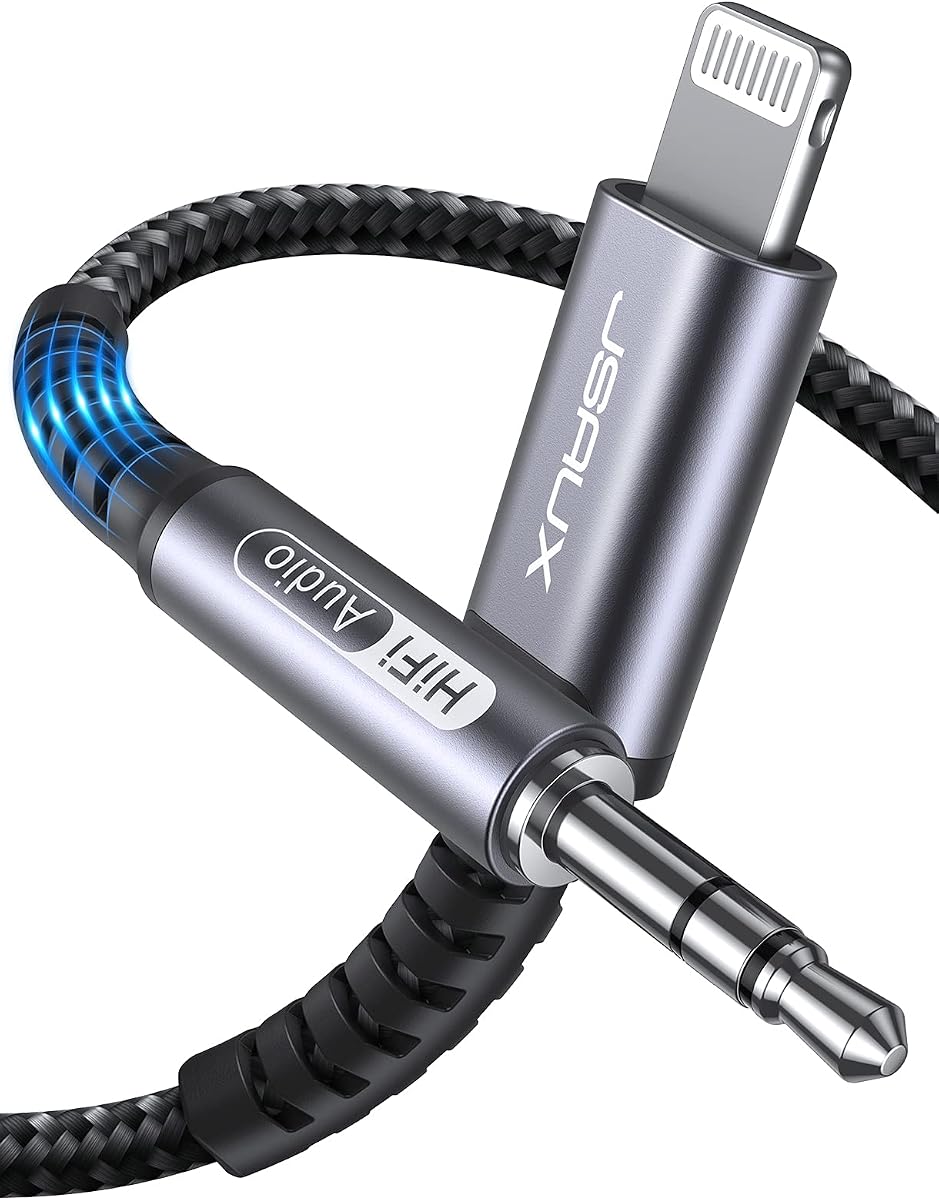
The JSAUX Lightning to 3.5mm Audio Cord is a six-foot, Apple MFi-certified cable with a 4.4 rating. It offers the most balanced combination of reach, audio hardware, and rugged construction in this group. The extended length is particularly useful when the iPhone is not placed immediately beside the receiving device, while the MFi-certified connection targets reliability and avoids common accessory-warning messages.
We may earn a commission when you buy through this link, at no additional cost to you.
A built-in DAC noise-reduction chip supports audio up to 24-bit/96kHz, while the nylon braid, reinforced strain-relief design, and aluminum alloy housing are intended to withstand repeated use. The 15,000-plus bend claim adds confidence for a cable likely to travel between a car, a home stereo, and a portable speaker. Its compatibility list covers many modern and older Apple devices, including iPhone 14 and 13 families, sixth-generation iPod touch, and several iPad lines.
There are two practical limitations. First, this remains a Lightning cable, so USB-C devices need their own appropriate 3.5mm connection. Second, the supplied information explicitly excludes AirPods Max and Beats Solo Pro. A six-foot lead may also be longer than necessary for a compact dashboard setup, where excess cable can need to be carefully routed.
This is the most versatile recommendation for readers who want one cable capable of handling cars, home audio, portable speakers, headphones, and conventional hi-fi equipment. Its certification, DAC, braided construction, and extended reach justify choosing it as an all-purpose Lightning auxiliary cable. It is particularly attractive to users who frequently move between locations or want more placement flexibility than a 3.3-foot model provides.
Six feet gives the user freedom to position an iPhone across a room, inside a vehicle, or farther from a speaker. The extra reach reduces tension at both connectors and is particularly useful with home stereo systems.
The integrated DAC noise-reduction chip supports up to 24-bit/96kHz audio. It is designed to maintain a stable, high-fidelity signal from a Lightning device to a conventional 3.5mm input.
We may earn a commission when you buy through this link, at no additional cost to you.
The Haoano Two-Pack AUX Cord provides two three-foot Lightning-to-3.5mm cables, one black and one white. Its 4.4 rating reflects a useful combination of broad device support, certified construction, and the convenience of keeping a cable in more than one location. The pair is aimed at households, offices, vehicles, and travelers who want a spare without needing to unplug the primary cable.
We may earn a commission when you buy through this link, at no additional cost to you.
Each cable uses an MFi-certified connection, a DAC chip, and 24K gold-plated contacts. The nylon braid is designed to resist winding, knotting, and kinking, with a stated test endurance of at least 15,000 bends. It connects directly to equipment with regular or recessed 3.5mm jacks, including car stereos, headphones, portable speakers, computers, tablets, laptops, and media players.
The product listing includes an important functional warning: the cable does not work in both directions, does not support phone calls or music controls, and is not compatible with AirPods Max. Some newer iPad models use USB-C rather than Lightning, including the listed 10th-generation iPad and 11-inch fourth-generation iPad Pro, so checking the device port is essential. Audio output from the Lightning device to a 3.5mm input is the intended use.
This two-pack is most attractive to buyers who value organization and sharing. One cable can remain in the car while the other is used at home or carried while traveling. It is a strong pick for multiple Lightning iPhone owners, provided nobody needs wired call handling or remote music controls and all intended devices use a Lightning port.
Keeping one cable in the car and another at home or in a work bag avoids the inconvenience of constantly transferring a single lead. The contrasting colors also make the cables easier to identify.
The Lightning-to-3.5mm male connectors provide a simple plug-and-play path to compatible stereos, speakers, and headphones. No driver, external power supply, or separate adapter is required.
We may earn a commission when you buy through this link, at no additional cost to you.
The Two-in-One AUX Cable combines Lightning and USB-C device connectors with a four-foot 3.5mm auxiliary plug. It carries a 4.4 rating and stands apart from the dedicated Lightning options by also serving compatible USB-C phones and tablets. The supplied compatibility information includes current and recent iPhone, Galaxy, and Pixel models, making it a useful shared accessory for households with mixed connector standards.
We may earn a commission when you buy through this link, at no additional cost to you.
Its audio design uses state-of-the-art chips and pure copper wire, with gold-plated 3.5mm contacts intended to reduce signal loss and maintain a consistent connection. The polished metal plug, antioxidant and wear-resistant materials, and soft, tension-resistant jacket support regular use. A stated 20,000-plus elastic life is among the higher bend figures listed for the products in this guide.
The key distinction is that the two-in-one feature concerns device-side connectivity, not two-way communication. A Lightning iPhone uses the Lightning branch, while a compatible USB-C device uses the USB-C branch, but the output remains a conventional 3.5mm stereo signal. The cable does not add phone-call or remote music-control support. Buyers must also confirm that their USB-C device permits analog audio output through the connection.
This is the most versatile model for anyone moving between Lightning and USB-C devices. It can serve a compatible iPhone, Samsung Galaxy, Google Pixel, or iPad with one four-foot cable, provided the destination has a 3.5mm AUX input. It is less suitable for users who require bidirectional headset functions or a completely single-device cable, but it reduces the need to carry separate leads for different connector types.
The dual device-side design is useful for shared vehicles, offices, and travel kits. It reduces the need to carry separate Lightning and USB-C auxiliary leads when the destination uses a standard 3.5mm input.
Pure copper wiring, gold-plated contacts, and a soft anti-tangle jacket support dependable daily use. The stated bend endurance and four-foot length balance flexibility with practical reach.
We may earn a commission when you buy through this link, at no additional cost to you.
The MFi Nylon AUX Cable is a three-foot, or one-meter, Apple MFi-certified Lightning-to-3.5mm lead with a 4.2 rating. It is particularly well described as a car and home audio cable, connecting Apple devices to stereos, speakers, headphones, and compatible hi-fi equipment. The one-meter length offers a useful compromise between portability and access to the auxiliary input.
We may earn a commission when you buy through this link, at no additional cost to you.
Its built-in DAC chip and 100% copper wire core are designed to provide stable, high-fidelity stereo output with lower distortion. The connector housing uses textured aluminum, while the cable itself has a premium nylon braid for flexibility and resistance to everyday wear. The supplied information also states support for iOS versions 10 through 16 and later, which may be helpful for owners of older compatible hardware.
A broad device list includes iPhone 14, 13, 12, 11, XS, XR, X, 8, and 7 families, iPod touch, iPad Mini, iPad Air, and iPad Pro. The cable can output music to devices such as Beats, Bose, Sony, and Audio-Technica headphones when they use a 3.5mm jack. It remains limited to Lightning devices, and some three-foot installations can require careful cable routing if the phone sits far from the stereo.
This is a sound pick for a user who wants one compact, certified cable for multiple Apple devices and several types of 3.5mm equipment. Its support and service details add reassurance for buyers who want a straightforward auxiliary solution. It is less compelling than a six-foot option for room-spanning home audio, but it should suit many dashboard and travel applications.
A copper core, DAC chip, and nickel-plated connector work together to support a stable stereo signal. The arrangement is aimed at clear music output through car and home audio systems.
The extensive compatibility list makes the cable a practical shared accessory across several iPhone and iPad models. It can also feed compatible wired headphones and portable speakers with 3.5mm inputs.
We may earn a commission when you buy through this link, at no additional cost to you.
The Two-Pack 3.3-Foot AUX Cord is a set of black and white Lightning-to-3.5mm cables with a 4.4 rating. It stands out for combining MFi certification, aluminum housing, braided construction, and a stated 20,000-plus bend test figure. The package provides two working locations or users with a spare, making it a convenient choice for homes, offices, and vehicles.
We may earn a commission when you buy through this link, at no additional cost to you.
A certified chip is included to support contact reliability and lossless sound transmission. The nylon-braided jackets and aluminum housings are designed to protect the internal connection from physical stress. At 3.3 feet, each cable is long enough for common auxiliary arrangements without creating as much excess slack as a six-foot model. The design is especially useful for users who previously found very short Lightning adapters inconvenient.
The compatibility list covers many iPhone, iPad, iPod touch, and iPod nano models that use Lightning. The cables can connect to car stereos, headphones, speakers, hi-fi equipment, and other devices with 3.5mm inputs. The listing clearly states that they do not support phone calls or charging, so they should be treated as one-way music leads rather than full headset or charging cables.
This is the strongest value-oriented pick in the guide because the package does not ask the buyer to choose between a primary cable and a backup. It is well suited to families with multiple compatible Apple devices, frequent travelers, and anyone who wants cables for more than one location. A dedicated USB-C cable would be necessary for newer non-Lightning hardware, but the two-pack remains versatile for the device family it supports.
A second cable can be kept in a glove box, office drawer, or travel bag without disconnecting the first. The black and white colors also help distinguish the two units quickly.
The combination of braided nylon, aluminum housings, and a 20,000-plus bend claim provides a reassuring durability profile. It suits a cable expected to be moved repeatedly between home, work, and the car.
We may earn a commission when you buy through this link, at no additional cost to you.
The JSAUX 3.3-Foot AUX Cable is an Apple MFi-certified Lightning-to-3.5mm cable with a 4.5 rating. It combines a compact length with high-resolution DAC support, a braided nylon exterior, and reinforced connector housings. It is designed for car stereos, home systems, portable speakers, computers, headphones, and other products with a standard 3.5mm input.
We may earn a commission when you buy through this link, at no additional cost to you.
Its built-in DAC noise-reduction chip supports up to 24-bit/96kHz audio. A special strain-relief design is tested for more than 15,000 bends, and the aluminum housing and braided jacket are intended to improve durability while reducing tangling. These qualities make the cable particularly suitable for portable use, including carrying it in a pocket for a speaker, a short car journey, or a fitness session.
Compatibility extends across many iPhone 14 through 7 models, sixth-generation iPod touch, and several iPad families. The exclusions matter: the supplied information states that the cable does not support AirPods Max, Beats Solo Pro, the 2018 12.9-inch iPad Pro, the 11-inch iPad Pro, or the 2020 fourth-generation iPad Air. Some of those products use USB-C, so the connection standard must be confirmed before purchase.
This cable is a strong choice for a Lightning iPhone user who values high-resolution audio specifications in a compact package. Its 4.5 rating also makes it one of the most favorably rated products in the roundup. It is ideal for portable speakers and shorter car installations, while buyers needing USB-C support or a much longer reach should choose a more specialized alternative.
The 24-bit/96kHz DAC specification provides a clear technical benefit for listeners who use a Lightning device with a capable stereo, speaker, or portable audio system. Its compact length also reduces the need to coil a long cable.
The braided jacket resists tangling, while the cable's modest size makes it convenient to carry in a pocket or small bag. It is a good match for users who switch between a car, desk, and portable speaker.
We may earn a commission when you buy through this link, at no additional cost to you.
The Syncwire Genuine MFI Cable earns the highest rating in this guide at 4.6. This three-foot Lightning-to-3.5mm cable is built around genuine Apple MFi certification, with the model SW-SC635 listed for verification through the Apple MFi page. That added transparency is a meaningful advantage for buyers who want confidence that the cable is designed to work correctly and securely with compatible Apple devices.
We may earn a commission when you buy through this link, at no additional cost to you.
Its flexible carbon nylon jacket and aluminum metal housing are intended to withstand regular bending while remaining easy to coil. Special strain relief is tested for more than 15,000 bends, giving the cable a durable profile for use with car stereos, speakers, headphones, home systems, and computers. The 3.3-foot length is compact enough for portable use but adequate for many common car arrangements.
The compatibility list covers most Lightning-era iPhone models, including iPhone 14, 13, 12, 11, XS, XR, X, 8, and 7 families, along with iPod touch, iPad Mini, iPad Air, and iPad Pro models. The product does not support AirPods Max, and it is not suitable for devices with a USB-C interface, including the listed 2018 12.9-inch and 11-inch iPad Pro versions. Its function is audio output to a 3.5mm input, not two-way headset communication.
This is the premium pick for buyers who prioritize certification transparency, refined materials, and strong ratings over multi-device versatility. It is a refined, straightforward cable for compatible Apple hardware, particularly useful in a car or as a durable daily lead. Users who need USB-C, a longer length, or a two-pack should choose one of the more specialized options elsewhere in the guide.
The supplied model number can be searched on the Apple MFi page, adding a layer of transparency. This is helpful for buyers who want more than a general claim of compatibility from a Lightning audio accessory.
Carbon nylon, aluminum housing, and reinforced strain relief address the most common failure points of an auxiliary cable. The result is well suited to repeated plugging, unplugging, coiling, and travel.
We may earn a commission when you buy through this link, at no additional cost to you.
The UGREEN MFi AUX Cord is a Lightning-to-3.5mm cable with a 4.5 rating. Its defining feature is a dual-shielded cable construction combined with corrosion-resistant, nickel-plated 3.5mm connectors. The stated goal is to preserve a clear signal by reducing noise, interference, and signal loss, making it appropriate for car stereos, home systems, speakers, headphones, computers, and hi-fi equipment.
We may earn a commission when you buy through this link, at no additional cost to you.
The nylon braid provides wear resistance and protects the inner conductor, while the scratch-resistant aluminum housing gives the ends a durable finish and helps dissipate heat. MFi certification supports secure recognition with compatible Apple devices. Together, these features make the cable a practical choice for users who plan to connect the same Lightning device to several different 3.5mm destinations over time.
Compatibility covers numerous iPhone 14, 13, 12, 11, XS, XR, X, 8, and 7 models, along with iPad, iPod touch, and compatible accessories. The explicit limitation is AirPods Max compatibility, which the supplied information says the cable does not support. It also does not address USB-C devices, so a separate cable is required for those products. The exact listed length is not specified in the available product information.
UGREEN's cable is a strong all-around pick for a Lightning user who values signal shielding, a braided exterior, and a highly rated, certified connection. It works especially well when interference from a car electrical system or nearby electronics is a concern. Its focused one-device-standard design is less versatile than the two-in-one model, but it is a refined and dependable choice for classic AUX setups.
Dual shielding and nickel-plated contacts are designed to preserve a stable audio signal while limiting noise and corrosion. These details make the cable appealing for car stereos and home electronics.
The nylon exterior protects the internal conductor from everyday abrasion, while the aluminum housings add rigidity at the connection points. These features suit a cable that is handled and repositioned frequently.
We may earn a commission when you buy through this link, at no additional cost to you.
The right Lightning auxiliary audio cable depends on device port, destination equipment, cable length, audio hardware, and how often the lead will be moved. These factors help separate a convenient daily accessory from a cable that is merely compatible on paper.
A Lightning auxiliary cable is intended for devices with a Lightning port, not for USB-C or Micro-USB equipment. The Apple MFi certification listed for many options adds confidence that the connector is designed to meet Apple requirements, but certification does not expand the physical port compatibility. Check the charging and audio port on your iPhone, iPad, or iPod before choosing, and do not assume that a connector advertised for the newest iPhone model will work with a USB-C iPad.
The receiving end must have a standard 3.5mm male AUX or headphone connection. Most car stereos, home receivers, portable speakers, wired headphones, computers, and hi-fi amplifiers use this format, but some modern systems have removed it entirely. A Lightning-to-3.5mm lead cannot create a physical connection for a speaker that only accepts USB-C or Bluetooth. Listing compatibility with many devices is helpful, but the output jack remains an essential part of the setup.
A 3.3-foot cable is compact and convenient for portable speakers, short car-console arrangements, and headphones. A four-foot length adds modest placement flexibility, while a six-foot cable is more useful when an iPhone must sit farther from a home stereo, amplifier, or dashboard input. Excess length is not always better because it can tangle or hang loosely in a vehicle, so measure the intended route and choose the shortest length that provides comfortable reach.
MFi certification indicates that the accessory has completed Apple's certification requirements and is intended to provide a secure, recognized connection. That can be particularly important for avoiding accessory warnings on compatible Lightning devices. Among the products reviewed, JSAUX, Syncwire, UGREEN, Seulliya, Haoano, and the two-pack option are described as MFi certified. Certification should complement, rather than replace, a check of the cable's physical connectors and stated exclusions.
A built-in digital-to-analog converter can help a Lightning device send clean analog audio to a 3.5mm input. Several choices in this guide include a DAC chip, and the JSAUX models specify support for audio up to 24-bit/96kHz. Gold-plated contacts, copper conductors, shielding, and nickel-plated connectors are also designed to support signal stability. These specifications are most useful when connecting to a capable stereo or speaker, although actual results also depend on the source device and destination equipment.
A cable used in a car, office, or travel bag bends repeatedly at the connectors and wherever it is coiled. Braided nylon and soft TPE jackets help resist sharp kinks, while reinforced strain relief protects the areas most vulnerable to fatigue. Stated bend test figures range from 15,000-plus to 20,000-plus across this group. These figures are useful comparative indicators, but proper care still matters: avoid tightly wrapping the cable around the connector and do not pull it sideways when unplugging it.
A two-pack can be more useful than a single premium-style cable when several people or locations need access. One lead can remain in the car while another stays near a home stereo or in a travel bag, and contrasting colors help with identification. A single six-foot cable may be preferable for users who want fewer accessories and maximum placement freedom. The two-in-one Lightning and USB-C model serves a different need: reducing the number of cables required across mixed device ecosystems.
Most Lightning-to-3.5mm auxiliary cables in this guide are designed for one-way music output from the Apple device to a stereo, speaker, or headphone input. They do not provide charging, remote music controls, or full bidirectional headset functionality. Some listings explicitly exclude phone calls. If the goal is to make or receive calls, connect a USB-C or Lightning headset directly and use the auxiliary lead only for music. Checking these limitations before buying prevents an otherwise suitable cable from falling short of the intended task.
Start by identifying the 3.5mm input on the destination device. Connect the 3.5mm plug fully into the car stereo, home receiver, speaker, amplifier, or headphone jack, then connect the Lightning end directly to the compatible iPhone, iPad, or iPod. Select the appropriate AUX input on the stereo, adjust the device and source volume gradually, and avoid pushing the connector into a recessed port with excessive force.
Route the cable carefully in a vehicle. Secure excess slack away from pedals, door hinges, and sharp console edges, and remove the cable before moving the phone if possible. For home audio, use gentle bends rather than tight coils around furniture or equipment. When disconnecting, always pull the plug straight out instead of tugging on the cable, as sideways force places unnecessary stress on the Lightning connector and strain-relief section.
Store the cable loosely in a pocket, pouch, or cable organizer after use. Keep both ends free of dirt and inspect the connectors periodically for debris. Do not wrap the cable tightly around its Lightning plug, and avoid pulling the cable while the phone is still connected to a car or home system. These simple practices help preserve the jacket, connector housings, and internal conductors over repeated use.
A standard Lightning-to-3.5mm cable requires a Lightning port on the device. iPhone models that use USB-C need either a USB-C-to-3.5mm cable or a dual Lightning and USB-C auxiliary cable. The two-in-one option in this guide includes both device-side connectors, but the destination equipment must still have a 3.5mm input.
No. The cables in this roundup are designed for one-way analog audio output and do not provide charging while connected. You would need to disconnect the auxiliary cable to charge the device. If simultaneous charging and audio are important, consider a compatible adapter that provides separate Lightning and 3.5mm connections, then check whether the intended app supports that arrangement.
The cables reviewed are primarily intended for music playback from the Lightning device to a 3.5mm output, and several listings explicitly do not support phone calls. They also do not provide inline music controls. Buyers who need communication or remote functions should use a dedicated Lightning or USB-C headset designed for those features.
A Lightning auxiliary cable has a Lightning connector for the phone or tablet, while a USB-C version has a USB-C connector. Some newer Apple devices and many Android phones use USB-C, while older compatible iPhones use Lightning. A two-in-one cable combines both device-side options, but it still needs a 3.5mm jack at the destination end.
MFi certification indicates that the cable has completed Apple's accessory certification requirements and is intended to establish a secure, recognized connection. This can reduce uncertainty compared with an uncertified cable. It does not guarantee compatibility with a device that uses a different physical port, and users should still check the stated model and feature exclusions.
A three- to four-foot cable is usually sufficient when the phone is placed near the stereo or dashboard input. A six-foot cable offers more freedom if the phone sits in a console, pocket, or seat area farther away. The best length is the shortest one that reaches without pulling the connector tight or leaving excessive cable around controls and pedals.
Only if the speaker has an actual 3.5mm audio input. A speaker that supports Bluetooth but lacks the physical jack cannot receive analog audio through this cable. You would need a compatible Bluetooth receiver or transmitter instead. Always distinguish Bluetooth capability from a wired auxiliary input when checking speaker specifications.
Choose a braided or flexible cable, coil it loosely rather than in tight loops, and keep the connector from wrapping around the cable body. Securing the excess length in a vehicle also prevents snagging around console edges. The two-pack options are also convenient for keeping separate cords in separate bags or locations.
The JSAUX six-foot cable is the most balanced overall selection because it combines MFi certification, DAC support, a high 4.4 rating, and useful extended reach. The two-pack 3.3-foot cable stands out as the best value for households or users who want a spare in each location, while the Syncwire Genuine MFI Cable is the premium option with the highest rating, verifiable certification details, and refined construction.
For most buyers, the most important priorities are the correct device port, a genuine 3.5mm input at the destination, MFi certification, and a length suited to the intended setup. Add DAC hardware and a strong bend rating when the cable will be used frequently or paired with a capable stereo. A two-pack helps multiple users, while a dual Lightning and USB-C design makes more sense for mixed device ecosystems.
Current prices, availability, and product details can change, so check the latest listing and compatibility information before purchasing. Confirm your phone or tablet port, the auxiliary jack on the destination device, and whether you need music only or additional call and control functions. With those checks completed, the right Lightning auxiliary audio cable should provide a simple and dependable audio connection for daily use.