
APEXEL 100Ultra
4.0Editor score
10x smartphone magnification
Universal clip-on design
F1.05 aperture specification
Explore the best macro lens for insect photography with 10 expert picks across phone, DSLR, and mirrorless options, compared for magnification and clarity.
Macro lens for insect photography must resolve tiny textures while remaining fast enough to track a moving subject. A useful lens combines dependable magnification, smooth manual focus, adequate light gathering, and a practical working distance. The right choice also depends on whether you use a phone, an interchangeable-lens camera, or an existing camera setup.
This guide compares ten macro and close-up options using only their stated optical specifications, compatibility, magnification, focusing behavior, and available features. It covers clip-on phone lenses, filter kits, dedicated camera lenses, and conversion attachments, allowing readers to compare optical reach, portability, and setup complexity.
Each pick reveals what a particular product is best suited to, from budget mobile magnification to high-end full-frame focus control. Ratings reflect the supplied marketplace feedback, while product listings and availability can change. Readers should verify the current specification, camera fit, and accessory requirements before making a final purchase.
4.0Editor score

4.6Editor score

4.7Editor score
The comparison below organizes all ten options by device type, magnification, focusing method, and the practical features that matter when photographing insects.




The APEXEL 100Ultra is a clip-on smartphone macro lens with a stated 10x magnification rating and a 4.0 user rating. Its strongest appeal is accessibility: photographers can add close-focus capability to a compatible phone without carrying a dedicated camera body, manual-focus lens, or other complex optical system.
We may earn a commission when you buy through this link, at no additional cost to you.
The product combines a 50–110mm telephoto macro focal range with an advertised F1.05 aperture and a multi-lens optical design. Those specifications indicate an emphasis on close-range detail, light gathering, and background separation. The universal clip is designed to fit a broad range of phones, including iPhone and Samsung Galaxy models, and the stated installation process requires no tools.
The main trade-off is that a phone attachment offers less precise focusing and exposure control than an interchangeable-lens macro lens. Close subjects can also become difficult to keep in frame, particularly if the insect moves. The listed features therefore make the APEXEL most attractive to mobile-first photographers who value reach and convenience over a dedicated camera workflow.
Choose the APEXEL 100Ultra when you want dramatic insect detail from a phone or need a compact kit for outdoor observation. It is also a practical entry point for testing whether close-up photography appeals to you. Confirm that the clip aligns properly with your specific phone camera and use steady support when the subject is active.
The stated 10x magnification can reveal wing veins, body segments, and flower textures that occupy only a small part of a normal phone frame. A clip-on optical attachment is especially useful when a conventional phone camera cannot focus at the same close distance.
The universal clip and tool-free attachment reduce the learning curve for beginners. Correct alignment with the active camera remains essential, and a small support can improve consistency when insects are moving.
We may earn a commission when you buy through this link, at no additional cost to you.
The TTARTISAN 40mm f/2.8 Macro is a 1:1 macro prime for Sony E-mount cameras, including many APS-C bodies listed in its compatibility information. Its 4.4 rating reflects a favorable balance of useful magnification, manual focusing, and a relatively compact design for nature and travel photography.
We may earn a commission when you buy through this link, at no additional cost to you.
A 1:1 ratio means the subject can be reproduced at life size on the sensor, which is a major step beyond general-purpose lenses. The stated 6.7-inch minimum focusing distance, f/2.8 maximum aperture, and 11-blade diaphragm can provide a practical combination of close-focus capability, subject isolation, and background blur.
Manual focus requires practice, particularly around the closest focusing distance where depth of field becomes extremely shallow. The product also cannot be used with non-Sony E-mount cameras without an adapter that is not specified as included. These limitations make it less flexible than a dedicated lens, but its compact 371-gram body and all-metal construction remain attractive for dedicated macro work.
Buy this lens if you already use a compatible Sony E-mount camera and want genuine life-size reproduction without selecting the highest-end specialist optic. It suits insects, jewelry, botanical subjects, still life, and portraits. Pair it with a tripod or stable surface, use the focus ring deliberately, and learn how aperture changes affect both exposure and depth of field.
The 1:1 magnification ratio gives tiny insects substantial presence in the frame. It also permits close-focus compositions of flowers, jewelry, and natural details without relying on digital cropping.
At 371 grams, the lens is compact enough to accompany a Sony E-mount camera on nature walks. Its stated all-metal construction should appeal to users who want a durable working lens rather than a lightweight travel-only option.
We may earn a commission when you buy through this link, at no additional cost to you.
The ULANZI CL-003 is a 75mm phone macro lens designed around 10x optical magnification, a 45–90mm focusing range, and tele-focusing operation. Its 4.3 rating indicates a well-regarded option for mobile photographers who want more deliberate focus adjustment than a basic clip-on lens.
We may earn a commission when you buy through this link, at no additional cost to you.
The tele-focusing mechanism separates focusing distance from the position of the phone camera, making it easier to refine the plane of focus on insects or small objects. An upgraded multi-element design is intended to improve light throughput and reduce distortion, while the aluminum alloy body and textured exterior provide a more tactile handling experience.
Compatibility requires attention. The included cold-shoe lens clip and 17mm adapter options support phones and rigs using the appropriate 17mm connection, but not every installation will be identical. The lens also does not provide the exposure, aperture, or stabilization controls of a camera system, and subject framing can still become difficult at high magnification.
The ULANZI CL-003 is a strong fit for mobile creators who want explicit distance control and plan to use a compatible clip or 17mm accessory. It works particularly well for stationary insects, flowers, jewelry, and handicrafts. Confirm the phone case or cage thread, align the optical axis with the camera, and stabilize the phone while adjusting focus.
The 45–90mm focusing range lets the photographer refine the working distance more precisely than a fixed close-focus clip. This control is valuable when an insect is partly concealed or when multiple planes must be aligned.
The supplied cold-shoe clip and 17mm connection make the lens suitable for compatible phone cages and cases. That broader mounting system can offer a more stable foundation than a simple spring-style phone clip.
We may earn a commission when you buy through this link, at no additional cost to you.
The FotoZ Macro Conversion Lens offers an 8-diopter close-up attachment for compatible DSLR and mirrorless lenses, earning a 4.6 rating in the supplied data. It is designed to add substantial magnification to an existing camera setup without requiring a dedicated macro lens.
We may earn a commission when you buy through this link, at no additional cost to you.
Its spring-loaded attachment fits camera lenses with listed filter-thread diameters from 37mm through 72mm, and included adapter rings expand the options for mixed lens kits. A three-element, three-group design with multicoated glass is intended to control distortion, improve transmission, and preserve close-up detail.
As a conversion lens, it reduces the effective light available to the camera sensor, which can require slower shutter speeds, higher ISO, or a supplementary light source. Adding the attachment also increases overall length and may make manual focus more critical. The tool-free design is convenient, but selecting the correct adapter and avoiding thread mismatch remain essential.
Choose the FotoZ when you already own one or more compatible camera lenses and want flexible close-focus capability for insects, jewelry, coins, and flowers. It is particularly useful for testing macro photography on a limited budget while preserving the ability to remove the converter and return to normal photography. Match the filter-thread measurement before ordering and use a tripod when light levels fall.
The 8-diopter specification provides more magnification than a typical close-up filter while allowing you to retain your familiar camera body. It also creates a reusable setup for multiple compatible lenses when paired with the right adapter.
The spring-loaded design attaches directly to compatible filter rings. This makes it practical to alternate between close-up and standard shooting without changing lenses or carrying a second body.
We may earn a commission when you buy through this link, at no additional cost to you.
The Canon RF100mm F2.8 L Macro is a premium RF-mount macro lens rated 4.7, with a maximum magnification of 1.4x. It is designed for photographers who want high-resolution close-ups with enough control over focus, depth of field, and subject presentation to handle demanding insect work.
We may earn a commission when you buy through this link, at no additional cost to you.
Its 100mm medium-telephoto design provides a noticeable working distance from small subjects, reducing the likelihood of disturbing an insect while still filling the frame. The fixed f/2.8 aperture supports consistent exposure and shallow depth of field, while optical and hybrid image stabilization provide up to five stops of stated shake correction.
This is still a specialist lens rather than a casual compact option. The 1.4x maximum magnification produces an extremely thin depth of field, and the stated spherical aberration control ring adds a physical control that many photographers may not use. Those capabilities benefit users who understand macro exposure, manual or assisted focus, and the effects of close-range light.
The Canon RF100mm is the strongest recommendation for a compatible Canon RF photographer seeking exceptional magnification and refined background rendering. Use a sturdy tripod for close-focus work, stabilize the camera before making fine focus adjustments, and consider diffused lighting. It is particularly compelling for insects that stay still long enough to reward precise composition and depth control.
The 1.4x maximum ratio can render a small subject larger than life size on the sensor. That capability is valuable when wing markings, scales, antennae, or surface textures need to occupy meaningful frame area.
The spherical aberration control ring lets photographers adjust the character of foreground and background blur. This offers creative influence over how a detailed insect separates from its natural environment.
We may earn a commission when you buy through this link, at no additional cost to you.
The Canon RF35mm F1.8 Macro STM combines an everyday 35mm focal length with 0.5x close-focus magnification and a 4.7 rating. It is a practical option for Canon RF users who want to photograph insects without carrying a large dedicated macro lens.
We may earn a commission when you buy through this link, at no additional cost to you.
The fixed f/1.8 aperture can gather substantial light and create shallow depth of field, while the 0.56-foot minimum focusing distance supports close compositions. A control ring provides direct setting changes, and optical image stabilization is stated to offer up to five stops of shake correction. The lens is compatible with EOS R-series cameras.
The 0.5x ratio is the central compromise. It can reveal detail in insects and flowers, yet it does not offer the 1:1 or greater reproduction of specialist macro lenses. At close range, depth of field is shallow, and the relatively wide focal length can feel less forgiving when a subject moves across the frame.
Buy this lens if you want one compact prime for both ordinary photography and occasional close-up work. It is especially useful for travel, environmental portraits, and insects that can be approached safely. Check the RF mount and camera body before buying, and use stabilization or a support when working at the closest focusing distances.
The 0.5x ratio makes it possible to frame smaller subjects without switching to a specialist lens. That versatility is useful when insect opportunities arise during a general walk or nature trip.
The f/1.8 maximum aperture offers a bright starting point for close-up exposure and supports deliberate background separation. It can also make it easier to keep the shutter speed practical when additional light is limited.
We may earn a commission when you buy through this link, at no additional cost to you.
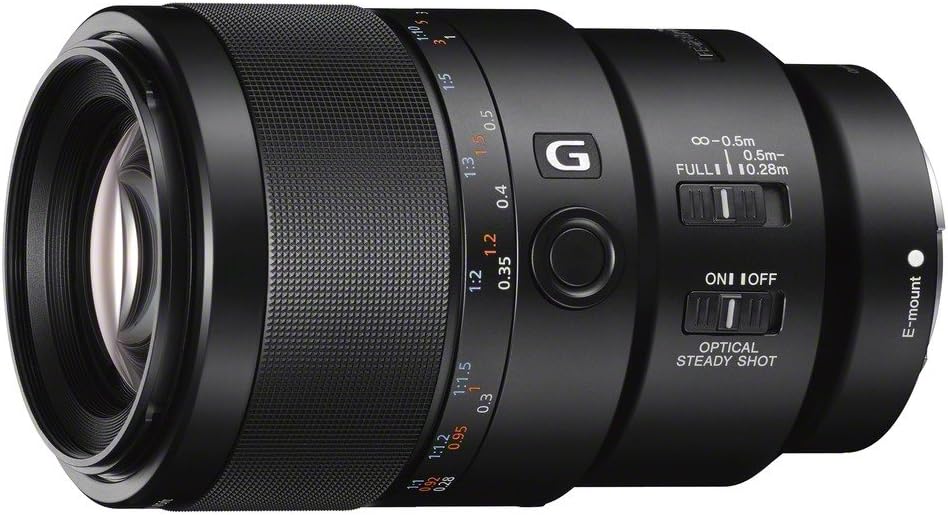
The Sony FE 90mm F2.8 Macro G OSS is a 1:1 full-frame macro lens with a 4.6 rating. Designed for Sony E-mount cameras, it is aimed at photographers who want life-size detail, bright optics, and dependable stabilization in a dedicated macro setup.
We may earn a commission when you buy through this link, at no additional cost to you.
Its 90mm focal length gives a useful balance between magnification and working distance, while the 0.28-meter minimum focusing distance allows close approaches. The fixed f/2.8 aperture, advanced spherical elements, Super ED glass, and multicoating are designed to provide corner-to-corner sharpness while limiting flare and ghosting. A nine-blade circular aperture supports rounded out-of-focus highlights.
The lens is not as light as many smaller macro options, with a stated weight of 602 grams. It also targets full-frame E-mount cameras, making it a less natural choice for photographers using APS-C bodies or unrelated camera systems. Like other high-magnification lenses, it offers a narrow depth of field that demands accurate focus and careful subject placement.
This is an excellent choice for Sony full-frame photographers who regularly photograph insects, flowers, products, or small natural subjects. Stabilization is useful for framing, but a tripod remains valuable for maximum detail. Use the sliding focus ring to switch between manual and autofocus, and take advantage of the bright aperture for cleaner exposure in shaded environments.
The 1.0x maximum reproduction and 90mm focal length let insects fill the frame while maintaining a practical distance. This is useful for subjects that might react to a camera positioned too close.
Advanced spherical elements, Super ED glass, and multicoating support a lens designed for crisp close-ups with controlled flare. Optical Steady Shot adds useful stability for handheld framing at close focus.
We may earn a commission when you buy through this link, at no additional cost to you.
The 67mm Close-up Filter Kit includes +1, +2, +4, and +10 diopter filters, giving it a 4.4 rating among users seeking an inexpensive way to add close-focus capability. It is designed for 67mm camera lenses across brands including Canon, Nikon, Sony, Pentax, Olympus, and Fujifilm.
We may earn a commission when you buy through this link, at no additional cost to you.
Each filter can be used independently or stacked to produce stronger magnification, allowing the photographer to choose a working distance for flowers, coins, insects, and other small subjects. The double-threaded design also supports adding compatible filters such as a polarizer or skylight filter, while the included pouch, lens cap, and microfiber cloth help protect the set.
Close-up filters are inherently less demanding than dedicated macro lenses. As magnification increases, light loss and optical limitations become more significant, and a small camera sensor may struggle with the reduced working distance. The 67mm thread is also non-universal, so the lens barrel or lens cap must be checked before ordering.
Choose this kit if you already own a 67mm-threaded lens and want an inexpensive, reversible close-up option. Start with the lower-power filter for composition, then stack only as needed. A tripod and additional illumination can help compensate for the light reduction, while the simple thread attachment makes the system easy to use.
The four diopter strengths let users begin gently and increase magnification as the subject fills the frame. Stacking provides flexibility, although the strongest combinations generally produce the shortest working distances and lowest light levels.
The filters screw onto a compatible 67mm lens without specialized equipment. The supplied storage pouch and cleaning cloth are useful for keeping a frequently transported accessory organized and protected.
We may earn a commission when you buy through this link, at no additional cost to you.
The Xenvo Pro Lens Kit is a mobile photography bundle for iPhone, Android, tablets, and laptops, combining a 15x macro lens, 0.45x wide-angle lens, LED light, clip, case, lanyard, and cleaning cloth. Its 4.1 rating reflects a versatile package aimed at travelers and casual mobile photographers.
We may earn a commission when you buy through this link, at no additional cost to you.
The Clarus macro attachment is designed for very close subjects, with the instructions recommending a position of approximately one-half inch from the subject. Precision focusing helps users isolate fine details, while the TruGrip clip is intended to secure the lens during active shooting. The separate GlowClip light offers three brightness settings for continuous illumination.
The stated 15x number describes the macro attachment's close-focus capability rather than the same type of optical reproduction available on a dedicated camera lens. The lens is intended for nearby subjects, not distant ones, and its short working distance can make it difficult to photograph insects that move. Phone cameras also limit aperture and exposure control.
This kit is best for mobile users who want a complete, travel-ready system rather than a single optical accessory. It is particularly useful for flowers, jewelry, and insects that tolerate a close approach. The included case makes storage simple, while the LED can provide steadier, more natural fill than a phone flash. Check the clip alignment before each use.
The 15x macro attachment is built for objects positioned immediately in front of the phone. Its strongest applications are stationary insects, plant details, and small collectibles rather than distant wildlife.
The rechargeable LED provides warm, continuous illumination with three brightness levels. Continuous light can be easier to compose with than a brief phone flash, especially when working at a very short distance.
We may earn a commission when you buy through this link, at no additional cost to you.
The AstrHori 25mm f/2.8 Ultra Macro is built for extreme close-ups, with a stated 2:1 to 5:1 magnification range and a 4.2 rating. It is designed for Sony E-mount mirrorless cameras and prioritizes high magnification over the ability to photograph distant scenes.
We may earn a commission when you buy through this link, at no additional cost to you.
Its wide-angle configuration provides greater depth of field than many telephoto macro lenses, which can help keep more of a small subject in focus. Manual focusing gives precise control over the exact plane of sharpness, and the slim body leaves room around the front element for illuminating a subject. On APS-C systems, the stated equivalent focal length is 37.5mm.
The lens does not support infinity focus, so it must be removed for ordinary photography. At magnifications far beyond life size, depth of field remains shallow and tiny movements can quickly push the subject out of focus. The fixed f/2.8 aperture is useful for exposure, yet additional lighting may still be necessary in dark habitats.
Choose the AstrHori for experienced photographers who want magnification beyond conventional 1:1 macro lenses and enjoy deliberate manual focusing. It is especially appropriate for stationary insects, scales, flower structures, and small objects. Use a focusing rail, fine adjustment, and diffused light for best results, and check the camera's E-mount fit before purchasing.
The 2:1 to 5:1 range can expose textures that remain nearly invisible at conventional macro reproduction. This creates a strong tool for scientific-style documentation and highly abstract insect compositions.
The 25mm design produces a wider field of focus than a traditional telephoto macro lens. That can make a complex insect easier to hold sharply, although manual focus remains critical at the highest ratios.
We may earn a commission when you buy through this link, at no additional cost to you.
The right macro lens depends on your camera, preferred level of control, typical insect size, and tolerance for manual focus. The following factors help narrow the field before you invest in an optical system.
Magnification determines how much of a tiny subject fills the sensor. A conventional 1:1 macro can reproduce a subject at life size, while products described as ultra macro may reach 2:1, 5:1, or an equivalent phone magnification. Higher magnification reveals exceptional detail but reduces the field of view, narrows the depth of field, and often shortens the working distance. Choose the lowest magnification that reliably fills your desired composition so focus and lighting remain manageable.
For most insect photographers, 1:1 provides a strong balance of scale and control. Extreme magnification is most useful for stationary specimens, textured wings, and small body features rather than fast-moving subjects.
Working distance is the space between the front of the lens and the subject. Longer distances reduce the chance of disturbing a nervous insect and make framing easier, while shorter distances offer a more immersive view but demand careful movement. Telephoto macro lenses generally provide more space than phone attachments and close-up filters. Insect behavior should influence the choice: active subjects benefit from a wider field and longer lens, whereas motionless insects tolerate closer positioning.
Do not force a short-distance lens onto a moving subject. If flight or rapid crawling is common, prioritize reach, stabilization, and a broader focus area over maximum magnification.
Dedicated camera lenses require the correct mount, while conversion attachments and filter kits depend on the filter-thread diameter of an existing lens. The compatibility list is only the starting point; full-frame and APS-C crop factors also change the effective field of view. Phone attachments add another layer of alignment and case-fit considerations. Verify the mount, thread size, and intended camera body before buying, and check whether an adapter is included.
A lens that is electronically compatible may still behave differently from a native model. Native lenses generally offer more reliable autofocus, aperture control, stabilization, and metadata.
Manual focusing offers fine control and works with nearly any camera, but it requires skill to locate the exact focus plane. Motorized focusing can make initial acquisition faster, although close-up motors may struggle when the subject is very small or moves unpredictably. Phone lenses often have limited or fixed focus behavior. For insects, manual focus combined with magnification assistance can be dependable, particularly when the insect pauses on a predictable surface.
Practice focusing on a stationary subject before an outing. Once the technique is familiar, manual focusing becomes faster and less distracting.
A wide maximum aperture gathers more light and supports faster shutter speeds, but it also makes depth of field extremely shallow at high magnification. Conversion lenses and close-up filters can further reduce available light. A dedicated f/2.8 macro lens offers a useful balance for outdoor insects, while a phone LED can help in shaded locations. Continuous diffused light is often more effective than a direct flash because it reveals surface detail without producing harsh reflections.
Match the light source to the environment and keep it moving slightly. Evenly illuminated subjects show texture more clearly and are easier to judge for focus.
Stabilization reduces visible camera shake and can make framing easier, especially with telephoto macro lenses. It cannot stop subject movement or replace a tripod. At very close focus, a tripod, monopod, stable surface, or camera support can make a major difference in repeatability. Phone systems benefit from a compact support that holds the lens at a consistent distance from the subject.
Stabilize the camera before refining focus. Trying to move the camera and focus simultaneously often produces a missed critical moment.
Field macro work rewards portability. A lightweight, compact lens is easier to carry on a walk, while a heavier all-metal lens may feel more balanced and durable in the hand. Phone clips are exceptionally compact but depend on careful alignment, whereas dedicated lenses mount securely and may include weather-resistant construction. Consider the entire kit, including rings, adapters, lighting, a support, and a protective case.
Choose the lightest complete system you can comfortably carry. Gear left behind because it is cumbersome is less useful than slightly heavier equipment that accompanies you regularly.
Begin by confirming compatibility. For a camera lens, check the mount and any required adapter. For a filter or conversion attachment, measure the filter-thread diameter printed on the lens barrel or lens cap. Phone users should align the attachment with the active camera lens and ensure the clip or case does not block the camera, microphone, or flash.
Find insects during a period when they are likely to pause, such as early morning or a cooler period of the day, and approach slowly. Stabilize the camera before focusing, then move in small increments. For manual-focus lenses, use magnification on the display or camera screen to make fine adjustments. Keep the camera parallel to the subject's body when possible, and stop shooting if the insect changes its behavior.
Clean the front element gently with a lens cloth and avoid touching it with bare fingers. Store phone attachments and conversion lenses in their cases, and keep filters dry and dust-free. After a session, check that insects or debris are not attached to the lens. Protect the optics from impacts, condensation, and prolonged direct sunlight, and follow the manufacturer's instructions for cleaning agents and storage.
A dedicated macro lens generally provides better control over focus, exposure, magnification, and background rendering. Phone attachments are more portable and convenient, and they can reveal impressive insect detail when the subject stays close and still. The best choice depends on the camera equipment you already own and the level of control you need.
A 1:1 macro lens is a common starting point because it reproduces a subject at life size. Phone products may advertise higher numerical magnification, but those figures are not always directly comparable with camera reproduction ratios. Greater magnification is useful for tiny features, although it reduces the field of view and makes focus and lighting more difficult.
Flying insects are challenging for any close-focus setup because their movement is fast and their position changes constantly. A longer-focal-length macro lens, wider aperture, and effective stabilization can improve your chances. A wider environmental composition may also tell a more engaging story than an extreme crop when the insect is in constant motion.
Stabilization is helpful but not essential when the camera is supported on a tripod. It is particularly valuable for handheld framing and telephoto macro work. At extreme magnification, stabilization reduces your movement but cannot freeze a moving insect or replace accurate focus.
Manual focus requires practice, especially at high magnification because depth of field becomes very shallow. A steady camera, magnification assistance, and slow movement make focusing easier. Manual focusing also allows you to work with nearly any camera body and can be reliable when a subject pauses on a flat surface.
Soft, diffused light reveals texture without producing harsh reflections on wings or bodies. A small LED or a diffused flash can help in shaded environments, but the light should be positioned to avoid casting your shadow across the subject. A continuous source is often easier to judge while composing than a brief flash.
General-purpose lenses with close-focusing ability can provide useful insect images, especially when a moderate crop is acceptable. Dedicated macro lenses produce higher reproduction ratios and often narrower depth of field. Phones, 35mm Canon RF lenses, and some normal lenses offer different compromises between magnification, framing, and everyday versatility.
Get as close as the subject safely tolerates without disturbing it. Many insects react to sudden movement, airflow, and obstruction of their path. A telephoto macro lens can create a close image from farther away, while a phone lens may require the phone to be only inches from the subject. Watch the insect's behavior and retreat if it becomes active.
The APEXEL 100Ultra stands out for accessible phone magnification, the FotoZ offers a versatile 8-diopter conversion system for existing camera lenses, and the Canon RF100mm represents the premium option with up to 1.4x magnification and sophisticated stabilization. Each serves a distinct user, but all are built around the challenge of resolving fine detail.
Prioritize camera compatibility, working distance, and focusing method before chasing a larger magnification number. A slightly lower magnification can produce more successful images when the subject is active or the lighting is poor. For dedicated camera users, a true 1:1 macro lens offers the most balanced path to repeatable results, while mobile photographers gain the most from a secure clip and stable support.
Finally, confirm the current manufacturer specifications, included accessories, camera fit, and marketplace listing before ordering. Product configurations and retail listings can change, so current information is the final check before choosing the equipment that will join your field kit.