
3 Bank Marine Battery Charger 5X3, 15A (5A/Bank) – 12V Boat Charger
4.8Editor score
Three independently controlled banks
Five amps per charging bank
Automatic repair and diagnostics
Our Marine Battery Chargers guide compares 10 onboard, waterproof, multi-bank and maintainer options for boats, helping you match charging power to your setup.
Marine battery chargers must handle demanding conditions, including salt air, vibration, temperature swings, moisture, and the unique charging needs of starter, house, deep-cycle, and lithium batteries. A good charger provides enough current, operates safely in confined spaces, and protects each battery with suitable charging modes and diagnostic features.
We compared ten products by number of banks, total and per-bank charging output, supported battery chemistries, waterproofing, temperature compensation, repair functions, installation approach, and onboard suitability. The guide covers dedicated marine chargers, fixed-install onboard units, and more compact maintenance-oriented options for different boat electrical systems.
Each review identifies the charger’s strongest traits, practical limitations, and ideal use case, while the comparison table makes bank count and charging capacity easy to scan. Ratings reflect the supplied customer feedback, and product availability, features, and prices can change, so confirm current specifications before purchasing.
4.8Editor score

4.9Editor score
4.8Editor score
The table below compares all ten chargers by charging architecture, output, battery support, and environmental protection, making it easier to identify the right model for a simple maintenance setup or a multi-battery onboard installation.




The NOCO GENPRO10X2 is a compact onboard charger for boats with two 12-volt battery banks, earning a supplied rating of 4.7. Its standout qualities are a fully sealed IP68 enclosure, independently selected charging modes, temperature sensing, and the ability to charge severely discharged batteries. The supplied 72-inch DC leads and eyelet terminals suit a permanent installation.
We may earn a commission when you buy through this link, at no additional cost to you.
Each of its two banks can be configured for standard 12-volt lead-acid, AGM, lithium, or repair charging. An integrated thermal sensor adjusts the charging process to ambient conditions, while Force Mode can initiate charging on batteries down to zero volts. The simplified mounting system accepts any orientation and includes an anti-vibration backing.
The main limitation is its two-bank architecture. A boat with separate starting, house, and additional auxiliary batteries will need more connections than this unit offers, and ten amps per bank is modest compared with higher-output three-bank models. Even so, the compact housing, sealed design, and ability to remain connected for maintenance make it well suited to a straightforward two-bank system.
Choose the GENPRO10X2 when you need a durable, permanently installed charger for two 12-volt banks and value compact dimensions, flexible chemistry settings, and recovery from deeply discharged batteries. It is our Editor’s Choice because it combines marine-grade physical protection with a versatile and understandable feature set.
Independent controls let the owner select the appropriate chemistry for each battery instead of forcing one common setting across the entire system. That flexibility is valuable when a boat combines a flooded house battery with an AGM starter battery or a lithium auxiliary bank.
The IP68 enclosure, long cable set, secure mounting system, and anti-vibration backing are practical for a marine environment. The supplied Type-B AC cable and three-year warranty further support its use as a fixed onboard charging system.
We may earn a commission when you buy through this link, at no additional cost to you.
The 3 Bank Marine Battery Charger 10X3 provides 30 amps of total charging output across three independently controlled 12-volt banks, and its supplied rating is 4.5. It is designed for permanent onboard use and combines an IP68 sealed enclosure with selectable SLA/AGM, lithium, and calcium modes.
We may earn a commission when you buy through this link, at no additional cost to you.
Each bank can be assigned a suitable mode through its own MODE control, allowing different battery types to charge simultaneously. The display indicates progress through five power levels, while diagnostic functions identify overvoltage, a bad battery, excessive temperature, and reverse connection. An integrated thermal sensor adjusts charging for hot or cold ambient conditions.
Its primary drawback is that lithium compatibility depends on selecting the right mode rather than being automatically identified. The product data also lists four screws but only three mounting screws in the box, which may matter if the installation requires more than one fastener. These are modest concerns compared with the charger’s three-bank flexibility and sealed construction.
This charger fits boats that need to maintain three separate batteries and want independent chemistry settings without moving to a much larger four-bank unit. It is especially appealing for owners who value clear diagnostic indicators, an automatic repair function, and a five-stage visual representation of charging progress.
Independent mode selection is the defining advantage. A starting battery, house battery, and lithium auxiliary battery can each receive an appropriate charging profile without sharing a one-size-fits-all configuration.
The built-in checks for common installation and battery faults can reduce guesswork. A five-grid power display also provides a quick visual indication of charging progress on each supported system.
We may earn a commission when you buy through this link, at no additional cost to you.
The ProMariner ProSport HD is a waterproof 20-amp, three-bank onboard charger with a supplied rating of 4.5. Its most interesting feature is Distributed-On-Demand Technology, which directs available charging current toward the batteries that need it rather than limiting each bank to a rigid allocation.
We may earn a commission when you buy through this link, at no additional cost to you.
Microprocessor and software control support precise charging, while the heavy-duty tri-surface extruded heat-sink design faces upward, downward, and rearward to improve cooling. Its expanded LED display combines a completion-status gauge, a multistage charge-mode bar, a system-check indicator, and individual battery-type and status information.
The charger’s total output is lower than that of several competing three-bank models that provide 30 amps. It also replaces an earlier ProSport model, and buyers should confirm exact battery-type compatibility and current installation requirements before ordering. The distributed-current approach can nevertheless make 20 amps feel more adaptable across a mixed battery bank.
Choose the ProSport HD for a permanently installed three-bank system where cooling, informative status feedback, and flexible allocation of available current matter most. It is a strong match for owners who want a conventional waterproof marine charger with clear operating indicators.
Distributed-On-Demand Technology can move unused current to one battery or a combination of batteries. This is useful when one bank is depleted faster than the others and does not require identical charging demand at all times.
The three-facing heat-sink surfaces are designed to dissipate heat while maintaining rated constant current during the charger’s two charge modes. That construction is especially relevant in enclosed compartments where heat accumulation can shorten component life.
We may earn a commission when you buy through this link, at no additional cost to you.
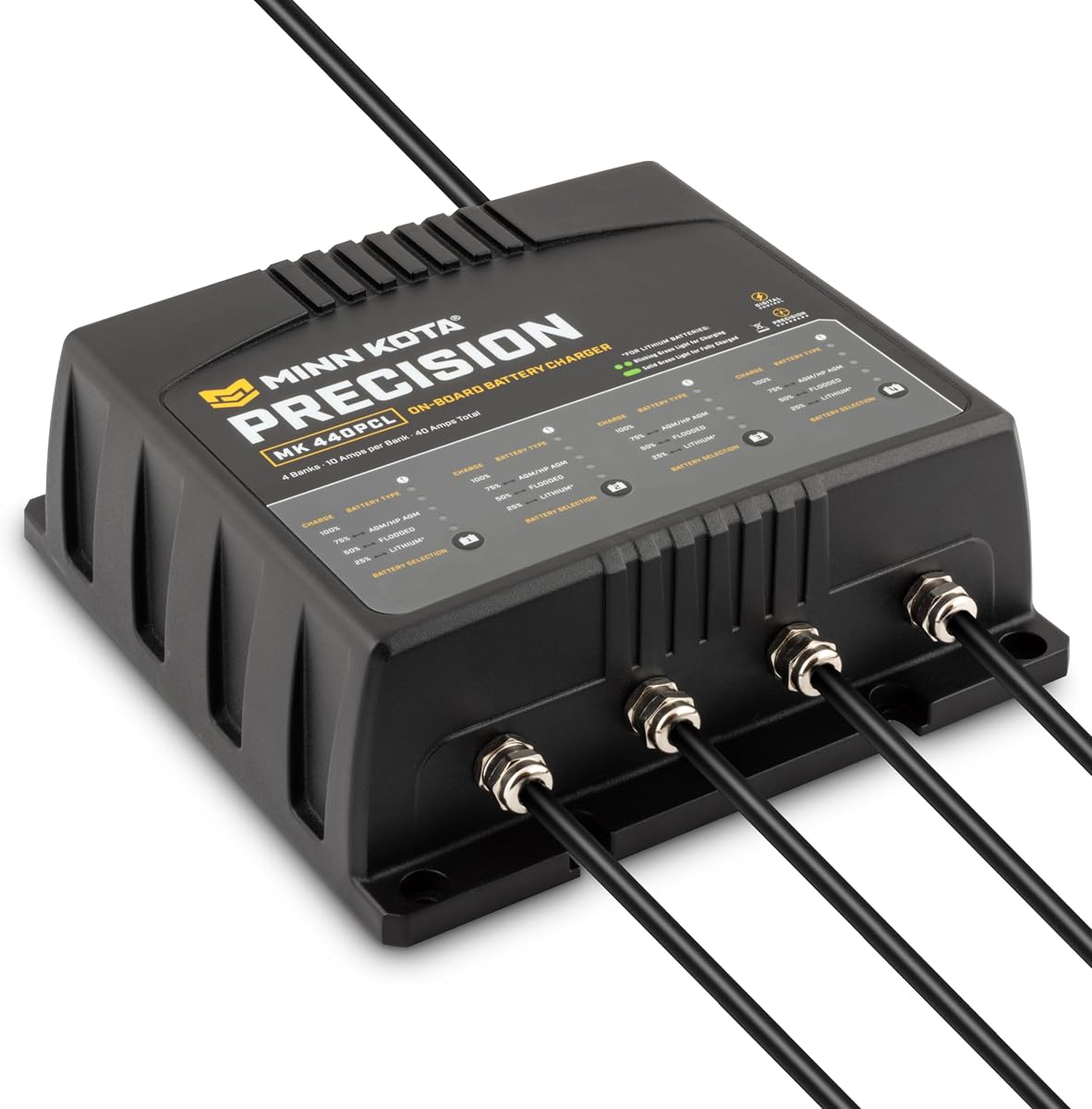
The Minn Kota Precision MK-440PCL is the most expansive installation in this guide, offering four independently selectable charging banks at 10 amps each. Its supplied rating of 4.8 reflects a feature set aimed at complex onboard systems, including AGM, flooded lead-acid, gel, and LiFePO4 compatibility.
We may earn a commission when you buy through this link, at no additional cost to you.
A microprocessor-based design regulates voltage and current through an automatic multi-stage cycle. Temperature compensation adjusts for ambient changes and low-line voltage, while the equalization and maintenance function cleans flooded lead-acid batteries during normal charging. A push button starts a more rigorous equalization cycle for owners who want deeper maintenance.
Four banks demand more wiring, mounting space, and attention to cable routing than a two- or three-bank charger. The automatic cleaning feature is specifically relevant to flooded lead-acid batteries and should not be treated as a general benefit for lithium chemistries. Gel compatibility is also absent from the similarly positioned MK 330D model, making exact model comparison important.
Choose the MK-440PCL for larger boats with several battery groups or a need to charge mixed battery types independently. Its four-bank architecture, 40-amp total capacity, equalization tools, and rugged shock- and vibration-resistant construction make it the premium choice for elaborate onboard electrical systems.
Four independent channels make this charger suitable for boats with starting, house, trolling motor, and auxiliary battery groups. Each bank can be assigned its own battery type, preventing chemistry mismatches within a shared system.
The maintenance cycle automatically works with flooded lead-acid batteries, and a push-button control initiates a more thorough cleaning process. Owners using other chemistries should rely on the appropriate charging mode instead of assuming equalization is appropriate for every battery.
We may earn a commission when you buy through this link, at no additional cost to you.
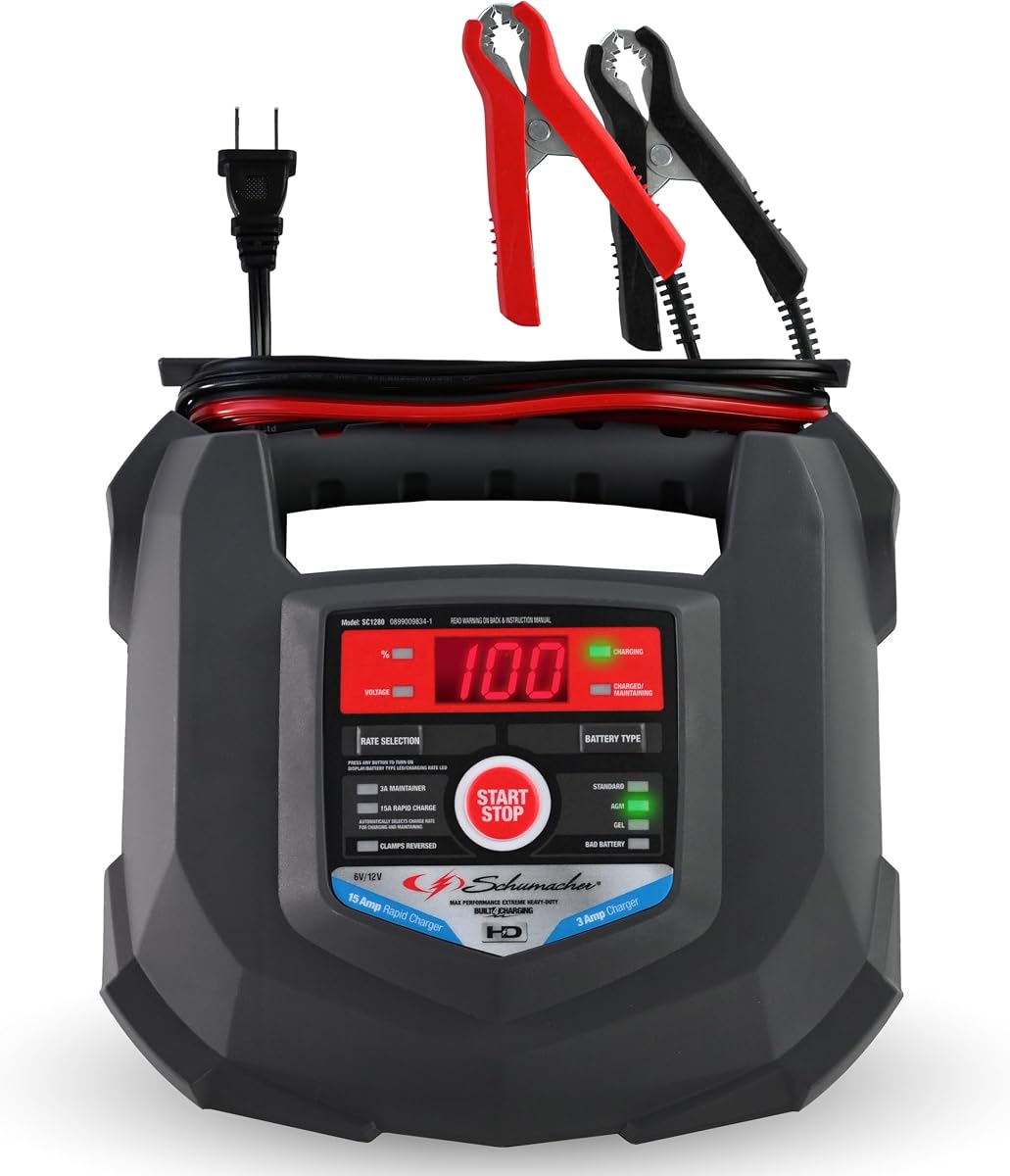
The Schumacher SC1280 is a 15-amp charger and maintainer for 6- and 12-volt batteries, with a supplied rating of 4.6. Although it is not a permanently installed marine charger, it supports boats along with cars, motorcycles, ATVs, trucks, and SUVs, making it a versatile option for seasonal battery care.
We may earn a commission when you buy through this link, at no additional cost to you.
Automatic voltage detection, microprocessor control, and multi-stage charging simplify operation. The desulfation mode is intended to address sulfation, and the unit also tests and maintains batteries. Its support for standard, AGM, gel, and deep-cycle battery types gives it broader compatibility than a specialized lead-acid-only charger.
The absence of multiple banks prevents simultaneous charging of a starter and house battery, and the supplied information does not claim an onboard waterproof rating. It is therefore better suited to a garage, storage area, or occasional dockside maintenance than a harsh exposed marine compartment.
Choose the SC1280 when you want one charger for several vehicles and battery types, especially if your boat has only one battery or you need a portable maintenance solution. It offers a simpler and more flexible way to care for individual batteries than a full multi-bank onboard system.
The SC1280 is particularly useful for owners of a boat and other recreational vehicles stored over winter. Automatic voltage detection and broad battery-type support reduce the need for separate equipment for common 6- and 12-volt applications.
The 15-amp output supports routine charging, while desulfation, testing, and smart trickle charging add recovery and storage functions. That combination makes it more versatile than a basic maintainer intended only for a fully charged battery.
We may earn a commission when you buy through this link, at no additional cost to you.
The 3 Bank Marine Battery Charger 5X3 supplies 15 amps across three 12-volt banks, with a supplied rating of 4.8. Its five-amp output per bank is better suited to maintaining charged batteries and smaller bank requirements than aggressively replenishing deeply depleted high-capacity groups.
We may earn a commission when you buy through this link, at no additional cost to you.
The IP68 enclosure is designed for fully sealed onboard operation. Each bank supports SLA/AGM, lithium, or calcium charging, and users can select the mode independently. A five-grid display shows charging progress, while automatic diagnostics cover overvoltage, bad-battery conditions, over-temperature, and reverse connection.
Its chief trade-off is charging speed. Five amps per bank can take longer than 10- or 15-amp alternatives, especially for large deep-cycle batteries. As with the similarly named 10X3 model, lithium users must select lithium mode correctly rather than relying on automatic chemistry detection.
Choose the 5X3 when the boat has three modest battery banks, the priority is reliable maintenance rather than rapid recovery, and sealed construction at a lower tier is important. It earns our Best Budget designation for delivering a rare combination of three banks, independent controls, diagnostics, and an IP68 enclosure.
The 5X3 divides 15 total amps evenly, providing enough current for routine upkeep while limiting stress on smaller batteries. It is an efficient solution when all three banks are maintained regularly rather than intentionally discharged.
The repair indicator can begin the included repair sequence without manual activation. Diagnostic notices for voltage, temperature, polarity, and battery faults help owners identify why a bank is not charging as expected.
We may earn a commission when you buy through this link, at no additional cost to you.
The NOCO GENIUS2D is a 2-amp, single-bank onboard charger with a supplied rating of 4.6. It is designed primarily to maintain one 12-volt lead-acid battery and can serve marine batteries in a straightforward system where rapid charging and multiple independent banks are not priorities.
We may earn a commission when you buy through this link, at no additional cost to you.
A durable snap-fit bracket and truss-head self-tapping screws simplify installation near the battery. The integrated thermal sensor adjusts the charge for hot or cold conditions, and Force Mode can begin charging a battery down to zero volts. Pulse charging is designed to address sulfation and acid stratification.
The major limitation is output. Two amps is appropriate for maintenance and small-capacity batteries, but it will not restore a deeply depleted bank quickly. The listed chemistry support covers AGM, gel, SLA, VRLA, flooded, maintenance-free, deep-cycle, marine, and RV lead-acid batteries, not lithium.
Choose the GENIUS2D for a small boat, a single house battery, or a simple auxiliary system where space, simple mounting, and dependable float maintenance matter. It is less appropriate for large banks, frequent deep discharge, lithium systems, or owners wanting to charge several batteries independently.
The compact charger and direct-mount bracket are helpful in tight compartments or on smaller boats. Its single-bank design keeps wiring straightforward when the vessel has only one battery that needs ongoing maintenance.
The smart charger monitors the battery and can remain connected indefinitely. Force Mode and pulse charging add recovery paths for neglected batteries, although the low output means recovered batteries will take longer to regain capacity.
We may earn a commission when you buy through this link, at no additional cost to you.
The 3 Bank Battery Charger 12V 30A is a feature-dense onboard unit with three independent 10-amp outputs, a supplied rating of 4.6, and an IP68 waterproof enclosure. Its defining feature is a segmented nine-stage smart-charging process intended to adjust current and voltage as battery status changes.
We may earn a commission when you buy through this link, at no additional cost to you.
Separate SLA/AGM, lithium, and calcium modes support mixed battery banks, while automatic temperature compensation helps protect batteries in hot or cold environments. Diagnostic functions identify overvoltage, a bad battery, excessive temperature, and reverse connection. A repair function operates automatically when its indicator is active.
The charger can work with batteries as low as one volt through a slow recovery process, and a manual forced-charge mode extends the stated recovery range to zero volts. That initial recovery can take one to two hours. As with other selectable-mode designs, selecting lithium mode correctly is essential for lithium banks.
Choose this model for a three-bank boat that needs a strong output, extensive diagnostics, and layered charging logic in a fully sealed unit. It is a good match for mixed battery fleets and owners who value forced recovery and a detailed charging sequence over a simpler interface.
The multi-stage process changes current and voltage rather than applying one constant output throughout the cycle. That approach can improve control across different starting conditions and battery states.
The supplied information describes a slow recovery path for batteries between zero and one volt. A held MODE control initiates forced charging, giving the owner a way to address batteries that regular detection would not recognize.
We may earn a commission when you buy through this link, at no additional cost to you.
The WAVLINK 3 Bank 15A combines three independently operating five-amp channels with a supplied rating of 4.9, the highest in this guide. Its IP68 waterproof and dustproof enclosure, zero-volt recovery mode, automatic cutoff, and broad chemistry support distinguish it from many similarly sized competitors.
We may earn a commission when you buy through this link, at no additional cost to you.
The charger supports SLA, AGM, flooded, maintenance-free, calcium, and LiFePO4 lithium batteries. Multi-stage logic adjusts current and voltage according to battery status, while an included repair function targets sulfation. A 72-hour timer helps limit excessive charging, and the full-auto stop function ends the process when a battery reaches full voltage.
Five amps per channel is modest for large or deeply discharged banks, so it is best viewed as an efficient maintenance charger for suitable battery capacities. Its stated operating range is -20°C to 40°C, which is narrower than some competing units advertise for active charging even though the storage range is wider.
Choose the WAVLINK when three independent banks, mixed battery chemistries, and comprehensive protection are the priority. It earns our Editor’s Choice for combining a sealed marine enclosure, automatic charging behavior, repair functions, and one of the strongest supplied customer ratings in the category.
Each channel operates separately, preventing one bank’s demand from interfering with another. Support for six common battery types also makes the unit adaptable to boats that combine flooded house batteries with AGM or LiFePO4 starting banks.
Reverse-polarity, overheat, overvoltage, overcurrent, and short-circuit safeguards provide multiple layers against improper conditions. Automatic stop at full voltage and a 72-hour timer add further limits on prolonged charging.
We may earn a commission when you buy through this link, at no additional cost to you.
The Minn Kota MK 330D is a three-bank digital onboard charger rated at 10 amps per bank, with a supplied customer rating of 4.7. It delivers 30 amps of total output and uses microprocessor control to regulate voltage and current throughout automatic multi-stage charging.
We may earn a commission when you buy through this link, at no additional cost to you.
Temperature compensation allows the charger to adjust to ambient conditions, while LED indicators communicate charge stage, maintenance status, errors, and full charge. The waterproof housing is also designed to withstand shock and vibration, which are constant concerns in a boat compartment or near an exposed electrical panel.
The key restriction is gel battery compatibility, which the supplied data explicitly marks as unsupported. The product description also does not detail a broad menu of selectable chemistry modes, making the newer Precision MK-440PCL easier to assess when lithium, gel, or independent bank selection is important.
Choose the MK 330D for a conventional three-bank lead-acid installation that values balanced output, temperature compensation, and rugged onboard construction. It remains a practical fit when the boat’s batteries use compatible chemistries and the owner prefers a straightforward digital charger without a large selection of modes.
The microprocessor regulates the voltage and current supplied through the charging cycle. This supports faster, more controlled charging while reducing the need for the owner to manage separate charging steps manually.
Shock- and vibration-resistant construction addresses a key onboard reality. LED status lights make it possible to check charging progress, maintenance operation, and faults without opening the enclosure.
We may earn a commission when you buy through this link, at no additional cost to you.
The right marine battery charger depends on the number and type of batteries aboard, how deeply they are discharged, whether the unit is permanently installed, and how much space and wiring the installation can accommodate.
A bank is a separately connected battery or battery group that the charger can manage independently. A boat with only a single house battery may be served by a compact single-bank unit, while a vessel with starting, house, trolling motor, and auxiliary batteries may need three or four banks. The number of batteries alone does not determine bank count because two batteries may be wired in parallel and treated as one charging group.
Choose the number of channels based on actual wiring needs, not the total battery count. More banks provide greater control, but they also require more connections, more space, and careful assignment of the correct chemistry and charging mode to every channel.
The charger’s amperage determines how quickly it can restore a depleted battery. Small maintenance units around two amps are useful for float charging, while five-amp banks suit routine upkeep of appropriately sized batteries. Ten-amp banks provide a more capable balance for common deep-cycle installations, and higher total output is valuable for large groups that undergo repeated deep discharge.
Do not assume the highest current is always best. Battery condition, capacity, chemistry, and manufacturer recommendations matter. The current available at each bank and the charger’s complete multi-stage profile are more meaningful than the headline total alone.
The list includes models supporting lead-acid, flooded, SLA, AGM, calcium, and LiFePO4 lithium batteries. Some products offer independently selected modes, while others use broader automatic logic. Verify that every chemistry aboard the boat is explicitly supported rather than assuming a lithium battery will be treated like a flooded battery.
The correct mode is essential because lithium and lead-acid batteries require different charging profiles. If your installation includes multiple chemistries, a charger with per-bank selection provides better control than a single-mode unit.
Permanent onboard chargers should be designed to tolerate moisture, salt, dust, vibration, and changing temperatures. An IP68 rating indicates a fully sealed enclosure designed to resist dust ingress and prolonged submersion under the conditions defined by that standard. Shock-resistant and vibration-resistant construction matters as well because marine movement can loosen components or damage circuit boards.
A portable garage charger does not need the same physical protection as a fixed marine unit. Match the product to the installation environment rather than paying for unnecessary features or assuming a general automotive charger belongs beside a battery in a wet compartment.
Battery charging requirements change with ambient temperature. Integrated thermal sensors allow a charger to reduce, alter, or otherwise regulate its output in heat and cold, helping prevent overcharging in warm conditions and undercharging in cold weather. The products in this guide commonly include some form of temperature compensation or thermal monitoring.
For year-round onboard use, temperature compensation is more than a convenience. It helps the charger respond to the actual battery environment, particularly in an uninsulated compartment exposed to direct sun, changing seasons, or overnight temperature swings.
A repair mode may use pulsed charging or extended stages to address sulfation, acid stratification, or other conditions associated with a neglected battery. Force charging can help a charger recognize a battery that is below its normal detection threshold. These features are useful for recovery, but they do not replace proper battery replacement when a battery is physically damaged or has lost capacity permanently.
Check the minimum recognized voltage, the length of any recovery process, and whether a mode is selected automatically or must be activated. Very low-voltage charging should be used carefully because accepting a depleted battery does not guarantee that it will recover to its original capacity.
A fixed marine charger needs secure mounting, strain relief, correctly sized cabling, and access for inspection. Some units include snap-fit brackets, anti-vibration backing, long DC leads, eyelets, battery clips, connectors, fuses, and screws. Others are designed to be hardwired or attached to a battery with a bracket. Compare the supplied hardware with your actual connection plan before ordering.
LED status displays can show charge stage, full-charge completion, maintenance mode, and fault notifications. These indicators are particularly valuable in an enclosed compartment where the charger cannot be checked frequently. A clear display can also help distinguish a normal charging cycle from a wiring or battery fault.
Always follow the charger manufacturer’s installation instructions, battery manufacturer recommendations, and local electrical safety requirements. The supplied listings emphasize use in a well-ventilated area, which is particularly important for lead-acid batteries because charging can release gas. Secure connections, correct polarity, suitable fusing, and protection from chafing are essential in a marine environment.
Before installation, disconnect power as directed, identify each battery bank, confirm voltage and chemistry, and plan cable routing away from sharp edges and moving parts. Periodic inspections should check for loose terminals, corrosion, damaged insulation, excessive heat, or moisture intrusion.
Begin by identifying the voltage, chemistry, capacity, and intended role of every battery. Connect the charger to shore power in a well-ventilated location, install the unit according to its instructions, and observe polarity before attaching the DC leads. For a multi-bank charger, assign one bank to each battery group and select the corresponding chemistry mode for each output.
Let the charger complete its programmed multi-stage cycle without interrupting it unless you suspect a fault. Use the LEDs and diagnostic indicators to monitor charging progress. A repair or forced-charge mode should be used only for a compatible battery that needs recovery, and it may take substantially longer than ordinary charging.
After charging, inspect the terminals and mounting hardware, remove any corrosion with suitable equipment, and check cable insulation. Review the display regularly during long storage periods, keep the charger and connectors protected from standing water and debris, and have the system checked if the charger repeatedly reports reverse connection, overheating, overvoltage, or a bad-battery condition.
Not always. The number of charger banks should match the number of independently wired battery groups, not necessarily the physical number of batteries. Batteries connected in parallel may be managed as one bank, while a starter battery, house battery, and trolling motor battery usually require separate channels. A multi-bank charger is convenient because it can maintain several groups from one AC connection and assign different modes to each bank.
Only if the charger explicitly supports the correct lithium chemistry, such as LiFePO4, and the matching mode is selected. Lead-acid and lithium batteries have different voltage and charging profiles, so using the wrong setting can damage a battery or charger. Check both the battery manufacturer’s recommendations and the charger’s mode labels before connecting a lithium bank.
IP68 is an ingress-protection rating indicating strong resistance to dust and water under the standard’s defined test conditions. It is especially useful for chargers permanently installed near a battery, where spray, rain, or temporary submersion may occur. The rating does not eliminate the need for sound mounting, proper seals, and routine inspection, and it should not be assumed that every electrical connection is protected by the enclosure rating.
The appropriate output depends on battery capacity, chemistry, and how often the bank is deeply discharged. A low-current charger is sufficient for maintaining a healthy battery, while depleted deep-cycle banks benefit from more current. Compare per-bank output with the batteries connected to that bank, and follow any manufacturer-specified charging current limits.
Several products in this guide are designed for continuous onboard operation, and their smart monitoring is intended to prevent overcharging. Even so, the charger should be installed in a well-ventilated area, protected from physical damage, and operated according to its manual. Verify that every battery chemistry and voltage is compatible before leaving the unit connected.
A charger is intended to restore a battery by supplying the current and voltage needed to move it through its charging stages. A maintainer is primarily designed to keep a charged battery topped up during storage. Some products combine both functions, while higher-output marine chargers can also serve as maintainers after completing a full recovery cycle.
First disconnect or isolate the charger as directed and check the polarity, connections, and selected battery mode. Inspect the battery for swelling, leakage, corrosion, or damaged cables, and verify that the reported bank is connected to the battery you think it is. A diagnostic warning does not automatically prove the battery is defective, so testing it with an appropriate battery tester can clarify its condition.
A portable charger can be suitable for occasional boat battery maintenance if its voltage, current, and chemistry support match the battery. It should not be installed permanently in a wet, exposed compartment unless the product is specifically designed and rated for that environment. A sealed onboard marine charger is the better choice for long-term vessel storage or maintenance.
The WAVLINK 3 Bank 15A stands out for its broad chemistry support, independent channels, comprehensive protections, zero-volt recovery, and strong supplied rating. The 3 Bank Marine 5X3 provides a practical lower-tier alternative for three modestly sized banks, while the Minn Kota Precision MK-440PCL is the most capable choice for boats that need four independently managed battery groups.
Before buying, prioritize the number of required banks, supported chemistries, adequate per-bank current, and the physical demands of the installation. Temperature compensation, sealed construction, clear diagnostics, and a secure mounting system are especially important for permanent onboard use. A portable charger can be sensible for a single maintained battery, but it should not substitute for a purpose-built marine unit in a harsh compartment.
Ratings, specifications, product availability, and prices can change over time, so check the current listing and manufacturer instructions before purchasing. Confirm the charger’s cable length, included mounting hardware, battery modes, ventilation guidance, and warranty details against your boat’s electrical plan.