
Vallejo Surface Primer Black 60 ml
4.8Editor score
Airbrush-focused acrylic primer
Fast-drying matte black finish
Designed for strong model adhesion
Works on clean miniature surfaces
Primer for 3D Prints guide comparing ten acrylic primers, airbrush kits, and finishing sprays for adhesion, coverage, layer lines, and smooth results.
A reliable primer gives a 3D print the stable, paintable surface it needs for color to adhere evenly and details to remain sharp. The right product also helps reduce visual inconsistencies, supports common airbrush techniques, and can make layered plastic or resin parts look more uniform before the finishing stages begin.
This guide compares ten primer, airbrush-medium, and finishing-spray options based on the supplied product information. It considers material compatibility, adhesion, finish, drying behavior, ease of application, container format, and suitability for 3D-printed models, miniatures, prototypes, and other hobby projects.
Each pick highlights a different reason to consider it, from a coordinated multi-product airbrush set to single-color primers and clear coatings designed to reduce visible layer lines. Ratings and product details reflect the supplied listings, while current availability and retailer information can change over time.
4.8Editor score

4.8Editor score
4.8Editor score
The table below places every listed option side by side, emphasizing product type, usable color or purpose, application method, and finish. It shows how dedicated airbrush primers differ from multi-piece kits and clear sprays intended primarily for smoothing and protecting printed models.


The Roizefar Airbrush Medium Set is an eight-piece acrylic kit built around a complete airbrushing workflow. It combines two white primer bottles, black and gray primers, airbrush thinner, flow improver, gloss varnish, and matte varnish. Its 4.8 rating and explicit suitability for plastic, resin, metal, and 3D prints make it the most comprehensive option in this guide.
We may earn a commission when you buy through this link, at no additional cost to you.
Its main advantage is coordination. A maker can select a light, dark, or neutral base without assembling several unrelated products. The thinner adjusts paint consistency, while the flow improver is intended to reduce tip drying and support smoother spraying. Adding either gloss or matte varnish creates a defined path from preparation through final protection, which is particularly helpful for miniatures and display models.
The tradeoff is that this is a broad kit rather than a single-purpose primer. Someone who only needs black primer may find the additional containers unnecessary, and acrylic paints are not part of the listed contents. Users will also need suitable airbrush equipment and some familiarity with thinning and flow control. Nevertheless, the variety gives more value and flexibility for a complete hobby workflow.
This is the recommendation for a maker who wants one coordinated set for priming, paint adjustment, and finishing. It is particularly practical for owners of multiple 3D-printed models who want different base colors and both gloss and matte outcomes. For the most streamlined all-in-one option, this set leads the list.
Instead of buying separate mediums, the set places primers, thinner, flow improver, and varnish in one coordinated package. That makes it easier to move from a bare printed part to a finished and protected model without searching for each stage separately.
White, black, and gray bases support different painting approaches: a light base can suit bright colors, a dark base can deepen shadows, and gray offers a flexible middle tone. The two varnish options also allow the final surface to match either a reflective or non-reflective preference.
We may earn a commission when you buy through this link, at no additional cost to you.
Vallejo Surface Primer Black in the 60 ml format is a focused acrylic primer developed for airbrushing and scale-model preparation. It carries a 4.8 rating and forms a quick-drying, homogeneous matte film designed to give subsequent colors a dependable foundation. For makers committed to a black undercoat, it delivers a clear and specialized purpose.
We may earn a commission when you buy through this link, at no additional cost to you.
The product information specifically recommends degreasing the model before application, which is sensible for 3D prints that may retain release-agent residue. It can be used directly or adjusted with Vallejo Airbrush Thinner or Flow Improver, giving users more control over spray behavior. Recommended compressor settings are approximately 15–20 PSI, or 0.5–1 kg, according to the listing.
Its limitation is color flexibility. Unlike a three-color set or multi-piece medium kit, this product supplies only black primer. That can be ideal for dark schemes and dramatic shading, but it may not suit a maker who wants a white undercoat for vivid colors or a neutral gray base. The 60 ml container is also smaller than larger-format options for high-volume projects.
Choose this primer when your painting process already uses an airbrush and your planned color scheme benefits from a black base. It is a focused, approachable pick for miniatures and scale models, especially for hobbyists who want a proven airbrush formulation without assembling a full collection of media.
The formula is specially formulated for airbrushing, and the listing provides suggested compressor settings. It can also be diluted or enhanced with compatible Vallejo mediums when a maker wants more control over viscosity and flow.
The model should be cleaned before priming to remove remaining release agents. This preparation step improves the likelihood of proper adhesion and helps the primer form a more uniform base across the printed surface.
We may earn a commission when you buy through this link, at no additional cost to you.
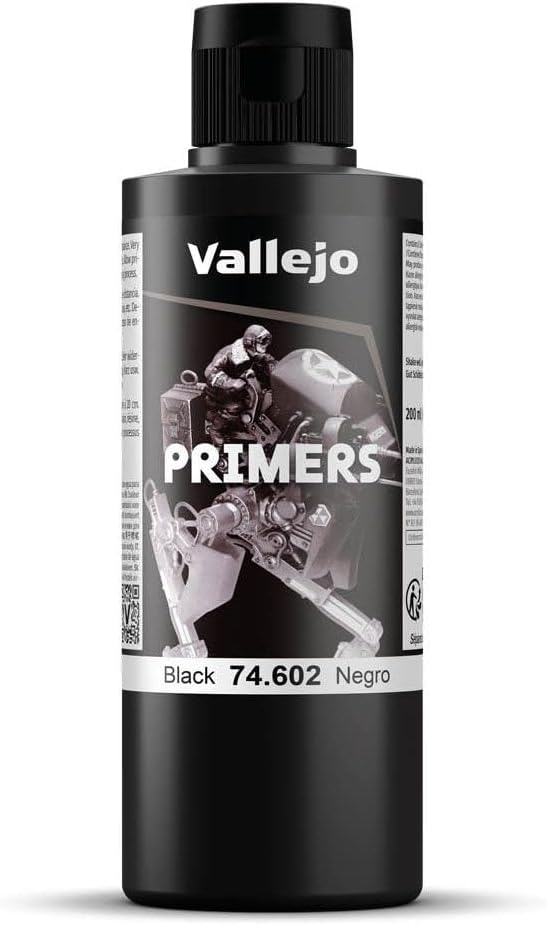
The 200 ml version of Vallejo Surface Primer Black is the large-format choice for serious model and miniature workflows. It shares the airbrush-focused formulation, fast-drying matte finish, and strong adhesion emphasis of the smaller bottle. A 4.8 rating reinforces its position as a well-regarded option for repeated priming sessions.
We may earn a commission when you buy through this link, at no additional cost to you.
The larger container is the defining advantage for workshops, tabletop painters, and makers producing many parts. It reduces the practical inconvenience of repeatedly working through smaller containers, particularly when a batch of printed miniatures must be primed in succession. The hinged-cap and dropper format also aligns with the controlled application expected of airbrush painting.
There is no need to purchase this larger format for one small figurine, and the black color still limits its usefulness for projects that require a light or neutral foundation. Users should also follow the same cleaning advice provided for the smaller version: remove release-agent residue before applying the primer. Thin or flow-adjust the product as needed with compatible Vallejo mediums.
This is the pick for high-volume airbrush painters who regularly prepare 3D-printed figures, scale models, and other miniatures. It provides the same specialized matte black function as the 60 ml version but in a format better suited to sustained work. For established hobbyists, that combination of familiarity and capacity is especially compelling.
The generous bottle makes more sense for batches of models or a regular tabletop-painting practice. It is better suited to dedicated hobbyists than to someone trying one quick test project.
The primer can be used directly or combined with Vallejo Airbrush Thinner and Flow Improver. That flexibility lets painters tune the mixture for their equipment and preferred application pattern.
We may earn a commission when you buy through this link, at no additional cost to you.
The U.S. Art Supply Black, White, Gray Surface Primer set combines three ready-to-spray colors in four-ounce bottles. Its self-leveling, water-based acrylic polyurethane formula is intended to create strong adhesion and a durable hard matte finish. The set holds a 4.2 rating and supports both airbrush and brush application.
We may earn a commission when you buy through this link, at no additional cost to you.
Having all three fundamental base colors is useful for visual planning. White can support brighter, cleaner-looking colors, black creates depth and dramatic contrast, and gray offers a middle tone for versatile shading. The formula is also listed for plastics, metals, resin, fiberglass, ceramic, wood, fabric, leather, canvas, paper, and other mixed-media surfaces.
The supplied bullet points contain an apparent inconsistency for the individual gray and white listings, referring to a black primer even when those products are identified as gray or white. That makes the individual color descriptions less precise than the set listing. The 4.2 rating is also below the leading products, so buyers should carefully confirm the contents and color labeling upon receipt.
This set is a strong fit for hobbyists who want several basic base colors without assembling separate purchases. It is particularly useful for mixed projects involving both printed parts and conventional craft surfaces. Confirming the bottle colors and following the surface-preparation instructions will help buyers get the most dependable result.
Black, white, and gray cover many foundational painting needs. They can be selected according to the intended color scheme rather than forcing every part into the same undercoat strategy.
The self-leveling formula is primarily intended for airbrushing but remains compatible with brush application. This makes the set useful when a model includes areas that are easier to reach by hand.
We may earn a commission when you buy through this link, at no additional cost to you.
The Two-Bottle 3D Printer Model Gloss Spray is a clear finishing product intended to reduce visible layer lines and produce a smooth high-gloss appearance. It includes two 60 ml bottles and uses a quick-drying application. Its 1.0 rating is the lowest in the list and deserves careful attention from potential buyers.
We may earn a commission when you buy through this link, at no additional cost to you.
For a maker at the final stages of a project, the product's role is distinct from a colored primer. A base primer creates adhesion and a uniform surface, while this spray fills micro-gaps and visually softens texture before the highlight is complete. The compact bottles are convenient for carrying between hobby sessions or using on small models and prototypes.
The product description provides fewer material-compatibility details than the dedicated primers and does not provide a comprehensive technical specification list. Its low rating may reflect limited customer feedback or unresolved satisfaction, so it cannot be recommended as strongly as the highly rated options. Users should test it on a small, less visible area and verify compatibility with their specific print before applying it broadly.
This spray is best considered by makers who already have a reliable primer and need a high-gloss final layer to reduce the visibility of printed texture. Because it is a clear finisher rather than an adhesion primer, it should not be treated as a complete substitute for surface preparation. Its portability and two-bottle format are appealing, but the low rating makes cautious testing essential.
This product focuses on visual smoothing and gloss after the model has been prepared. It complements a base primer rather than replacing one, making it most useful as the final step in a layered finishing process.
The two compact bottles are easy to store and carry. They suit focused hobby sessions involving miniatures, prototypes, and other relatively small printed pieces, although thorough testing remains important given the low rating.
We may earn a commission when you buy through this link, at no additional cost to you.
U.S. Art Supply Gray Surface Primer is an eight-ounce, ready-to-spray acrylic polyurethane primer with a 4.2 rating. It is described as self-leveling, strongly adhesive, and capable of producing a durable hard matte finish. Gray is a practical middle tone for projects that need to support both lighter and darker topcoats.
We may earn a commission when you buy through this link, at no additional cost to you.
The primer can be applied mainly by airbrush or with a brush, giving makers flexibility in how they handle complex printed geometry. Its listed surfaces include plastic, metal, resin, fiberglass, ceramic, textile products, wood, leather, canvas, and paper. This broad compatibility makes it useful for projects that combine a 3D-printed component with other crafted elements.
The main concern is a wording error in the supplied listing, which calls the gray product black in the opening bullet. The product name and image identify it as gray, but that inconsistency could cause confusion during purchase. It is advisable to verify the selected listing and color carefully. As a single-color purchase, it also cannot provide the flexibility of the related three-color set.
Choose this primer for a neutral base that can sit comfortably between light and dark paint schemes. It is especially attractive for mixed-material craft projects and for makers who prefer to prime with an airbrush but occasionally brush difficult areas. After confirming the color, it offers a versatile and broadly compatible foundation for painted models.
Gray sits between light and dark, allowing it to work with many color schemes without visually dominating the finish. It can help reduce the need for excessive topcoat layers when the final colors are balanced carefully.
The listed formula is suitable for plastics, metals, resin, fiberglass, ceramic, and numerous craft surfaces. That range is useful when a printed model needs to match the coating approach used on other project components.
We may earn a commission when you buy through this link, at no additional cost to you.
U.S. Art Supply White Surface Primer is an eight-ounce ready-to-spray primer made with a water-based acrylic polyurethane formula. It carries a 4.2 rating and is presented as a strongly adhesive, self-leveling primer that dries to a hard matte finish. White is especially relevant for prints that will receive bright or light-colored topcoats.
We may earn a commission when you buy through this link, at no additional cost to you.
Using a white base can help maintain the clarity of light paint colors, pastel schemes, and vivid hues that might appear dull over a darker foundation. The formula is designed primarily for airbrushing but also supports brush application. Its listed material range includes plastic, resin, metal, fiberglass, ceramic, fabric, wood, leather, paper, and canvas.
The opening bullet in the supplied listing mistakenly describes the white primer as black. Although the product title, image, and remaining color information identify white, the inconsistency should prompt buyers to double-check the listing before purchasing. It is also important to evaluate whether a full opaque white coat is necessary for the project, since achieving complete coverage can take more care than a neutral base.
This primer is a logical choice for light-colored miniatures, prototypes, and models intended for bright schemes. It combines a straightforward ready-to-spray format with broad surface compatibility and a durable matte result. Confirming the color in the listing is the main precaution, and thorough curing before painting is important for a clean finish.
A white base helps light topcoats retain their intended brightness and clarity. It is a useful foundation for pastel, vivid, and high-key designs that might lose impact over a dark primer.
Although optimized for airbrush use, the primer can also be brushed. That flexibility is valuable on models with recessed areas, thin supports, or complicated shapes where spray access is difficult.
We may earn a commission when you buy through this link, at no additional cost to you.
The Single-Bottle 3D Printer Model Gloss Spray has a 5.0 rating, making it the highest-rated product in this guide. It is a quick-drying clear spray designed to give printed models a high-shine appearance, reduce visible layer lines, fill micro-gaps, and create a protective surface that resists fingerprints and dust.
We may earn a commission when you buy through this link, at no additional cost to you.
Compatibility is one of its strongest practical points. The listing names resin, PLA, ABS, PETG, and other common print materials, while also identifying miniatures, prototypes, cosplay props, and functional parts as suitable applications. The described quick-dry behavior allows multiple coats to be applied without extended waiting periods between layers.
Although the product is presented as a layer-line eraser, it does not physically remove every ridge in the way sanding or careful surface preparation can. The visual result depends on the original print quality, coating thickness, spray technique, and compatibility with the particular material. It is also a final clear coating rather than a colored adhesion primer, so users still need a suitable base for painted projects.
This is an attractive choice for someone who wants a polished display finish and wants a clear coat that works across several filament types. The perfect rating is encouraging, although it should not be interpreted as evidence of independent testing by this guide. Apply it in a ventilated area, follow the label directions, and test a small area first.
The clear coating is designed to fill micro-gaps and reduce the visibility of rough texture. This can make layered prints look more uniform without requiring the same level of mechanical finishing as heavy sanding.
The finish is described as resisting smudges and repelling dust, which is useful for display models that are handled often. This protective quality makes the spray more than a purely visual enhancement.
We may earn a commission when you buy through this link, at no additional cost to you.
Micro-Mark Gray Acrylic Primer is a professional-grade acrylic surface primer with a 4.5 rating. Its eight-ounce bottle is designed to provide strong adhesion and coverage for models, miniatures, and craft projects. The neutral gray base is particularly useful for paint schemes that need a stable transition between light and dark colors.
We may earn a commission when you buy through this link, at no additional cost to you.
The listing identifies plastic, resin, and metal as suitable surfaces, which directly covers the most common 3D-printing materials. Its neutral tone is described as improving color accuracy and potentially reducing the number of topcoat layers needed. The large bottle also provides useful capacity for makers who want to complete several projects without constantly replenishing the primer.
Compared with the airbrush-focused Vallejo options, the supplied information gives less detail about spray behavior, drying speed, and thinning. It does not explicitly promise quick drying or identify a compressor setting, so users would be well advised to consult the physical label for application instructions. Those details limit the product's appeal for an airbrush-specific workflow compared with more explicitly documented alternatives.
This primer suits model painters who prefer a neutral acrylic base and want one container to handle multiple printed materials. It is a particularly sensible choice when the final scheme includes both pale and dark colors. Confirm the label directions before applying it, allow adequate drying, and use it as the foundational layer in a proper preparation-and-painting sequence.
Neutral gray can support both light and dark topcoats without imposing the strong visual bias of black or white. This makes it a practical default when the final color scheme has not been fully decided.
The primer is listed for plastic, resin, and metal, covering common choices in desktop printing and modeling. This makes it convenient for prototypes that combine several types of parts.
We may earn a commission when you buy through this link, at no additional cost to you.
Vallejo USN Light Ghost Grey Acrylic Primer is a 200 ml airbrush primer with a 4.8 rating. It produces a fast-drying matte finish and is formulated to form a homogeneous, hard, resistant film. Its light gray color gives model painters a more versatile base than either a strongly light or strongly dark option.
We may earn a commission when you buy through this link, at no additional cost to you.
The recommended compressor range of approximately 15–20 PSI, or 0.5–1 kg, gives airbrush users a useful starting point. The primer may be used directly or adjusted with compatible Vallejo Airbrush Thinner and Flow Improver. Because it is solvent-free and described as not flammable, it can suit a controlled hobby setup when used according to its label.
As with the other Vallejo primers, thorough degreasing is important before application. Remaining release agents can interfere with adhesion, particularly on smooth printed surfaces. The product is a base primer, not a clear protective varnish, so painting and finishing remain separate stages. Although its light gray shade is versatile, buyers who want a true black or bright white foundation may need a different color.
Choose this option for airbrush users who want a light neutral base in a large container. It is well suited to scale models, figurines, and 3D prints that will receive layered colors, especially when a middle tone offers more flexibility than white or black. Clean the parts carefully, apply successive coats as directed, and allow the surface to dry before continuing.
Light ghost gray offers a softer middle tone than black while remaining more dimensional than white. It can support accurate color transitions and flexible approaches to light and dark shading.
The primer can be sprayed directly or combined with compatible thinner and flow improver. Makers can use the suggested compressor range as a starting point, then adjust the mixture to suit their equipment and model complexity.
We may earn a commission when you buy through this link, at no additional cost to you.
The most useful primer is not simply the one with the strongest-sounding finish. Consider the print material, intended color scheme, application method, available equipment, surface condition, and whether you need a base coat or a final clear coating.
The primer should be listed as compatible with the filament or resin used to create the part. Common choices include PLA, PETG, ABS, and resin, but no two surfaces behave identically. Resin prints may have a smooth finish that needs careful cleaning, while fused-filament parts can retain fine ridges and a slightly textured skin. Several options in this guide explicitly list plastic, resin, or metal, whereas the clear finishing sprays emphasize broader filament compatibility.
Match the product to the actual print material and avoid assuming that any paint or clear coat will behave identically on every plastic. Check the manufacturer information, test a hidden section, and allow the test piece to cure fully before judging adhesion or appearance.
A good primer should create a stable foundation that helps subsequent colors adhere and remain visually consistent. Strong adhesion is especially important on printed parts, where release-agent residue, oils, and plasticizers may remain on the surface. Vallejo explicitly recommends degreasing models before priming, and that principle applies regardless of primer brand. Washing, handling, and storage can also introduce contaminants that reduce the quality of the bond.
Clean the part as directed, avoid touching the prepared surface, and use thin, even coats. Adhesion is a combination of product chemistry and preparation; no primer can compensate for an oily or contaminated surface.
Choose a base color according to the final scheme rather than by appearance alone. Black creates strong depth and can make lighter colors appear brighter by comparison. White supports pale and vivid colors but may require careful coverage. Gray occupies the middle ground and is often the easiest base to balance across varied projects. The three-color primer set is especially useful for makers who routinely switch between light, dark, and neutral approaches.
Select a primer color that supports your intended result and expected number of topcoats. Neutral gray is often the safest all-purpose choice when a precise color plan has not been established.
If using an airbrush, look for a formula specifically formulated for that application. Some primers can also be diluted with thinner or flow improver, giving the user control over viscosity, spraying, and tip drying. The Vallejo products include suggested compressor settings and compatibility with related mediums, while the Roizefar set includes both adjustment products. Other listings mention self-leveling behavior and brush compatibility but provide less detail about spray settings.
Choose an adjustable product when your setup or model geometry makes consistent flow difficult. If you prefer brush application, confirm that the primer supports it and select one with a finish and working time that suit hand-applied coats.
A base primer and a finishing spray perform different jobs. Colored surface primers establish adhesion, coverage, and a foundation for paint. Clear sprays are intended to reduce the appearance of texture, add gloss, and protect the finished surface. The two 3D-print gloss sprays are therefore complements to a primer rather than direct substitutes. If the project is painted, a matte primer often gives a controlled surface for color and shading.
Decide whether you need a base, a protective clear coat, or both. Buying only a high-gloss finisher when you still need adhesion can leave the topcoats vulnerable, while using a primer where a final seal is required may not achieve the intended polished appearance.
Fast drying is valuable because it reduces the time between coats and limits the chance of wet paint lifting earlier layers. Several listed products describe quick-drying behavior, while Vallejo says successive coats form a resistant film within a few hours after application. Faster drying does not necessarily mean that a part can be handled aggressively immediately, so the product label and practical curing behavior should guide the next stage.
Apply controlled layers rather than flooding the surface. Good airflow, clean equipment, and appropriate distance help reduce runs, texture, and accidental buildup, especially on glossy clear coats.
Small bottles suit occasional projects and reduce the risk of material drying out before use. Larger containers are more practical for batches of miniatures, repeated airbrush sessions, and workshops. The Roizefar set uses 120 ml containers for each included product, while individual Vallejo and U.S. Art Supply options range from smaller dropper formats to eight-ounce or 200 ml bottles. Clear sprays come in compact single- or two-bottle formats suited to hobby mobility.
Estimate how many prints you regularly coat and how often the product will be opened. Choose a container that matches your workflow rather than simply choosing the largest option available.
Product information should be read carefully, especially when individual color listings contain inconsistent wording. Two U.S. Art Supply listings refer to black within descriptions that identify gray or white products. Customer ratings add another signal: the single-bottle gloss spray holds a 5.0 rating, while the two-bottle version has a 1.0 rating. A high rating does not replace material testing, and a low rating does not automatically make a product unusable.
Check the listing title, image, bullet points, and current customer feedback together. Test the product on a small or concealed area, then proceed only if the result meets your expectations.
Begin by completing the printed part, removing supports where appropriate, and cleaning the surface according to the print material and primer instructions. For resin prints, follow the appropriate washing and curing process; for filament prints, remove grease and handling residue. Let the model dry fully, then inspect it for fingerprints, dust, and remaining support marks before applying any primer.
Shake or stir the primer according to its label and set up an airbrush or brush in a well-ventilated workspace. Test the mixture on a scrap surface, and use thin, even coats rather than attempting to cover the entire part at once. Let each coat dry as directed before adding another. Keep the model moving if the product begins to sag, and avoid placing a heavily coated part directly against another surface while it is wet.
After the primer has dried and cured sufficiently, proceed with the intended paint scheme. Keep the airbrush clean, rinse it according to the medium manufacturer's instructions, and store primers tightly closed in a suitable location. Do not return used product to its original container. For clear sprays, follow the label's ventilation and drying directions, test compatibility first, and allow the coating to settle fully before handling or display.
Priming is highly recommended when the printed part will receive paint or another decorative coating. It can improve adhesion, create a more uniform base, and make the final colors easier to control. The print should first be cleaned of release agents, oils, and support residue. A primer does not permanently fix every layer line, but it can make the surface more consistent before the finishing stages begin.
It depends on the specific formula and the print material. Several products in this guide explicitly mention plastics, resin, or metal, while some clear sprays name PLA, PETG, ABS, and resin. Check the product instructions for supported materials and test a small concealed area first. A successful test should include checking adhesion and appearance after the recommended drying time.
Black provides depth and can increase the apparent brightness of lighter colors. White offers a clean base for pastel and vivid schemes, while gray is a versatile middle tone that works between light and dark colors. The best choice depends on your final palette and painting method. Gray is a practical default when several color schemes or model types are being prepared.
Primer can make layer lines less noticeable by creating a uniform base, but it is not a substitute for sanding, scraping, or other mechanical surface preparation. The clear gloss sprays in this guide are specifically marketed as layer-line reducers and fillers of micro-gaps. For the smoothest result, still remove obvious defects before coating and apply the product in controlled, thin passes.
No. Some products are formulated primarily for airbrush use, but the U.S. Art Supply primers are also described as compatible with brush application. The Roizefar set is centered on an airbrush workflow and includes thinner and flow improver. Your equipment should match the application method, and you should follow any thinning and spray-setting instructions on the label.
It depends on your goal and the product's instructions. A clear gloss spray is primarily a finishing and protective coating rather than a colored adhesion primer. Painting directly over it may work for some materials and paint types, but a compatible base primer usually provides a more controlled foundation. If the spray is intended as the final clear coat, apply it after the paint has cured.
Follow the drying guidance printed on the primer and allow additional time when the part is large, thick, or painted in several heavy coats. Some listed products are described as quick drying, but touch-dry does not always mean fully cured. Avoid handling or recoating too early, because early movement can affect adhesion, texture, and the clarity of subsequent color layers.
Flush the airbrush with the cleaner recommended by the primer or medium manufacturer, working through the fluid path and tip as directed. Never mix products unless the manufacturer explicitly confirms compatibility. Wipe away excess moisture and residue, let the airbrush dry, and store it in a clean, protected location. A disciplined cleaning routine reduces nozzle obstruction and inconsistent spraying.
The Roizefar Airbrush Medium Set stands out for the most complete workflow, combining three primer colors, paint-adjustment products, and two varnish options. The 60 ml Vallejo black primer is a focused choice for airbrush users, while its 200 ml counterpart better serves repeated batch work. Together, these three options provide strong starting points for different budgets and production levels.
Prioritize compatibility with the print material, adhesion after proper cleaning, and the base color that supports your intended scheme. Airbrush users should also consider thinning and flow control, while makers pursuing a polished appearance can use a clear gloss spray after painting or surface preparation. Read the supplied instructions and test a small area before treating an entire model.
Ratings and retailer listings can change, and individual products may arrive with updated packaging or revised descriptions. Review the current listing, manufacturer guidance, and customer feedback before purchasing. The most reliable result comes from pairing a well-chosen primer with careful preparation, controlled application, and enough drying time between each stage.